4
Chapter 1 Overview of forest products markets and policies
Wood export bans were a common topic of discussion, and those countries are considering implementing, or have already implemented, such bans. As of May 2015, the area of certified forest worldwide was about 439 million hectares, which is 10.9% of the global forest area. The growth of certified forest area is slowing, and it may be time for diversification and new approaches to certification, including through opportunities to address regulatory needs for monitoring and to provide accountability benefits.
1.4
INSTITUTIONAL FORESTLAND OWNERSHIP
Worldwide, financial investors hold close to 24 million hectares of timberland, at an estimated value of close to $100 billion. This group of forest owners represents a growing share of the world’s industrial timber supply. Financial investors have changed the way in which the forest industry operates; forest industries in the US no longer control their raw-material sources, and the same is happening in other regions. Financial investors have high targets for returns on forest management; simultaneously they have brought diverse management. The institutional ownership of forestland is still limited in Europe, where state ownership and small-scale private ownership (family forestry) are the dominant ownership types. There are four basic types of financial investment in forestry:
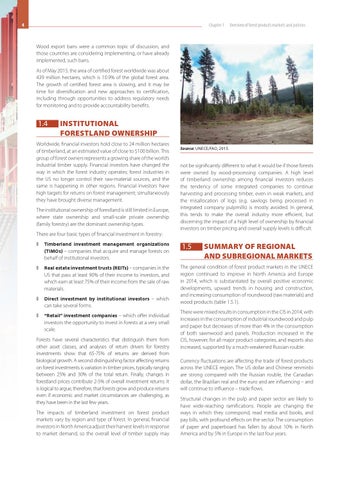
Source: UNECE/FAO, 2015.
not be significantly different to what it would be if those forests were owned by wood-processing companies. A high level of timberland ownership among financial investors reduces the tendency of some integrated companies to continue harvesting and processing timber, even in weak markets, and the misallocation of logs (e.g. sawlogs being processed in integrated company pulpmills) is mostly avoided. In general, this tends to make the overall industry more efficient, but discerning the impact of a high level of ownership by financial investors on timber pricing and overall supply levels is difficult.
❚
Timberland investment management organizations (TIMOs) – companies that acquire and manage forests on behalf of institutional investors.
1.5
❚
Real estate investment trusts (REITs) – companies in the US that pass at least 90% of their income to investors, and which earn at least 75% of their income from the sale of raw materials.
❚
Direct investment by institutional investors – which can take several forms.
The general condition of forest product markets in the UNECE region continued to improve in North America and Europe in 2014, which is substantiated by overall positive economic developments, upward trends in housing and construction, and increasing consumption of roundwood (raw materials) and wood products (table 1.5.1).
❚
“Retail” investment companies – which offer individual investors the opportunity to invest in forests at a very small scale.
Forests have several characteristics that distinguish them from other asset classes, and analyses of return drivers for forestry investments show that 65-75% of returns are derived from biological growth. A second distinguishing factor affecting returns on forest investments is variation in timber prices, typically ranging between 25% and 30% of the total return. Finally, changes in forestland prices contribute 2-5% of overall investment returns. It is logical to argue, therefore, that forests grow and produce returns even if economic and market circumstances are challenging, as they have been in the last few years. The impacts of timberland investment on forest product markets vary by region and type of forest. In general, financial investors in North America adjust their harvest levels in response to market demand, so the overall level of timber supply may
SUMMARY OF REGIONAL AND SUBREGIONAL MARKETS
There were mixed results in consumption in the CIS in 2014, with increases in the consumption of industrial roundwood and pulp and paper but decreases of more than 4% in the consumption of both sawnwood and panels. Production increased in the CIS, however, for all major product categories, and exports also increased, supported by a much-weakened Russian rouble. Currency fluctuations are affecting the trade of forest products across the UNECE region. The US dollar and Chinese renminbi are strong compared with the Russian rouble, the Canadian dollar, the Brazilian real and the euro and are influencing – and will continue to influence – trade flows. Structural changes in the pulp and paper sector are likely to have wide-reaching ramifications. People are changing the ways in which they correspond, read media and books, and pay bills, with profound effects on the sector. The consumption of paper and paperboard has fallen by about 10% in North America and by 5% in Europe in the last four years.