3
UNECE/FAO Forest Products Annual Market Review, 2014-2015
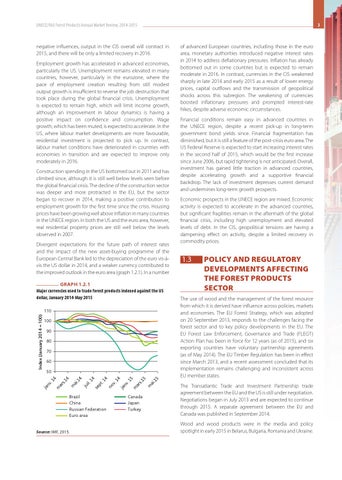
negative influences, output in the CIS overall will contract in 2015, and there will be only a limited recovery in 2016. Employment growth has accelerated in advanced economies, particularly the US. Unemployment remains elevated in many countries, however, particularly in the eurozone, where the pace of employment creation resulting from still modest output growth is insufficient to reverse the job destruction that took place during the global financial crisis. Unemployment is expected to remain high, which will limit income growth, although an improvement in labour dynamics is having a positive impact on confidence and consumption. Wage growth, which has been muted, is expected to accelerate. In the US, where labour market developments are more favourable, residential investment is projected to pick up. In contrast, labour market conditions have deteriorated in countries with economies in transition and are expected to improve only moderately in 2016. Construction spending in the US bottomed out in 2011 and has climbed since, although it is still well below levels seen before the global financial crisis. The decline of the construction sector was deeper and more protracted in the EU, but the sector began to recover in 2014, making a positive contribution to employment growth for the first time since the crisis. Housing prices have been growing well above inflation in many countries in the UNECE region. In both the US and the euro area, however, real residential property prices are still well below the levels observed in 2007. Divergent expectations for the future path of interest rates and the impact of the new asset-buying programme of the European Central Bank led to the depreciation of the euro vis-Ă vis the US dollar in 2014, and a weaker currency contributed to the improved outlook in the euro area (graph 1.2.1). In a number GRAPH 1.2.1 Major currencies used to trade forest products indexed against the US dollar, January 2014-May 2015
Index (January 2014 = 100)
110 100 90 80 70 60 50
Brazil China Russian Federation Euro area Source: IMF, 2015.
Canada Japan Turkey
of advanced European countries, including those in the euro area, monetary authorities introduced negative interest rates in 2014 to address deflationary pressures. Inflation has already bottomed out in some countries but is expected to remain moderate in 2016. In contrast, currencies in the CIS weakened sharply in late 2014 and early 2015 as a result of lower energy prices, capital outflows and the transmission of geopolitical shocks across this subregion. The weakening of currencies boosted inflationary pressures and prompted interest-rate hikes, despite adverse economic circumstances. Financial conditions remain easy in advanced countries in the UNECE region, despite a recent pick-up in long-term government bond yields since. Financial fragmentation has diminished, but it is still a feature of the post-crisis euro area. The US Federal Reserve is expected to start increasing interest rates in the second half of 2015, which would be the first increase since June 2006, but rapid tightening is not anticipated. Overall, investment has gained little traction in advanced countries, despite accelerating growth and a supportive financial backdrop. The lack of investment depresses current demand and undermines long-term growth prospects. Economic prospects in the UNECE region are mixed. Economic activity is expected to accelerate in the advanced countries, but significant fragilities remain in the aftermath of the global financial crisis, including high unemployment and elevated levels of debt. In the CIS, geopolitical tensions are having a dampening effect on activity, despite a limited recovery in commodity prices.
1.3
POLICY AND REGULATORY DEVELOPMENTS AFFECTING THE FOREST PRODUCTS SECTOR
The use of wood and the management of the forest resource from which it is derived have influence across policies, markets and economies. The EU Forest Strategy, which was adopted on 20 September 2013, responds to the challenges facing the forest sector and to key policy developments in the EU. The EU Forest Law Enforcement, Governance and Trade (FLEGT) Action Plan has been in force for 12 years (as of 2015), and six exporting countries have voluntary partnership agreements (as of May 2014). The EU Timber Regulation has been in effect since March 2013, and a recent assessment concluded that its implementation remains challenging and inconsistent across EU member states. The Transatlantic Trade and Investment Partnership trade agreement between the EU and the US is still under negotiation. Negotiations began in July 2013 and are expected to continue through 2015. A separate agreement between the EU and Canada was published in September 2014. Wood and wood products were in the media and policy spotlight in early 2015 in Belarus, Bulgaria, Romania and Ukraine.