the
UNITED NATIONS ECONOMIC COMMISSION FOR AFRICA UNITED NATIONS ECONOMIC COMMISSION FOR EUROPE UNITED NATIONS ECONOMIC COMMISSION FOR LATIN AMERICAAND THE CARIBBEAN UNITED NATIONS ECONOMIC AND SOCIAL COMMISSION FOR ASIAAND THE PACIFIC UNITED NATIONS ECONOMIC AND SOCIAL COMMISSION FOR WESTERN ASIA INTERNATIONAL UNION OF RAILWAYS INTERNATIONAL ROAD TRANSPORT UNION International
Road
Transport
Union
Transport for
The case of inland transport
Sustainable Development
The study «Transport for Sustainable Development: The case of Inland Transport» – with UNECE as the lead author – is the result of cooperation between the five Regional Commissions of the United Nations and key global stakeholders, in particular, the International Road Transport Union and the International Union of Railways. The study examines issues, progress and challenges in global efforts to achieve a transition to sustainable mobility of freight and people using inland modes of transport, i.e. road, railways, inland waterways and intermodal transport. While transport is a precondition for social and economic interactions, unfortunately, it has also negative impacts, such as road crashes, air and noise pollution, and greenhouse gas emissions. With a wealth of good and best practices, the study showcases results in mitigating the negative impacts, and also identifies the main challenges and opportunities to accelerate the transition to sustainability. It promotes an in-depth and real-world understanding of the five defining dimensions of sustainable transport – accessibility, affordability, safety, security and environmental performance. The study brings forth theoretical insights and best practices from all regions of the world and thus maps similarities and differences among countries of different income groups and geographical regions in their efforts towards sustainable transport. A common element is that transport is central in the shift to sustainable societies but a high level of political will is needed to decouple its growth from impacts such as air pollution, traffic accidents or climate change. Statistics show that only UNECE countries have managed to decrease the per capita CO2 emissions from transport in the decade 2001-2011. But, as these countries are responsible for roughly 50 per cent of the total emissions, further progress is needed. Only UNECE Governments have achieved absolute decoupling between the increasing levels of motorization and road fatalities (i.e. the latter decreases while the former increases). In two other regions (UNECLAC and UNESCWA) during the same period, Governments achieved relative decoupling (the latter increases at a slower pace than the former); in the other two regions (UNECA and UNESCAP) decoupling has, however, yet to be achieved. The authors of this study are committed to promoting sustainable mobility and transport which are central to sustainable economic and social development. We plan to regularly update this study, as well as to facilitate broad exchanges of best practices. Any views, suggestions or examples you wish to share can be submitted to: sustainable_inland_transport@unece.org
This book is issued by: the United Nations Economic Commission for Europe (UNECE) Palais des Nations CH - 1211 Geneva 10, Switzerland Telephone: +41(0)22 917 44 44 Fax: +41(0)22 917 05 05 E-mail: info.ece@unece.org Website: http://www.unece.org
Designed and Printed at United Nations, Geneva – 1516710 (E) – September 2015 – 976 – ECE/TRANS/251
UNITED NATIONS
ISBN 978-92-1-117096-2
The case of Inland Inland Transpor ansportt
Transport for Sustainable Development - The case of Inland Transport
Transport for
Sustainable Development
Transport for Sustainable Development
The case of Inland Transport This publication is part of the Transport Trends and Economics Series
UNITED NATIONS New York and Geneva, 2015
Š 2015 United Nations All rights reserved worldwide
Requests to reproduce excerpts or to photocopy should be addressed to the Copyright Clearance Center at copyright.com. All other queries on rights and licenses, including subsidiary rights, should be addressed to: United Nations Publications, 300 East 42nd St, New York, NY 10017, United States of America. Email: publications@un.org; website: un.org/publications United Nations’ publication issued by the United Nations Economic Commission for Europe. The designations employed and the presentation of the material in this publication do not imply the expression of any opinion whatsoever on the part of the Secretariat of the United Nations concerning the legal status of any country, territory, city or area, or of its authorities, or concerning the delimitation of its frontiers or boundaries. Maps and country reports are only for information purposes.
ECE/TRANS/251
ISBN: 978-92-1-117096-2 eISBN: 978-92-1-057518-8 Sales No. E.15.II.E.12
Foreword
I commend the United Nations Economic Commission for Europe for initiating and producing this paper in cooperation with the United Nations Regional Commissions with support from the International Road Transport Union and the International Union of Railways. This publication comes at a critical moment for the international community as leaders adopt the 2030 Agenda, our vision for sustainable development and a life of dignity for all. The growing transport sector is an essential component of economic and social development, linking markets and facilitating trade. Transport is an important source of revenue and major employer. Success in achieving many of the Sustainable Development Goals will require affordable, efficient and environmentally sound transport systems. At the same time, the transport sector consumes significant energy resources, generating air and noise pollution as well as greenhouse gas emissions. We need more political commitment to foster a low-carbon transport future. We also need action to reduce road crashes and other traffic accidents. This study demonstrates that there are solutions. Our challenge is to share lessons and take action. We must generate more innovations to meet demands for mobility and transport while reducing their negative impacts. I recommend this publication to officials in government, industry and academia as well as others interested in how to optimize transport to build a better future for all.
15 September 2015
Ban Ki-moon Secretary-General of the United Nations
III
Transport for Sustainable Development – The case of Inland Transport
IV
Acknowledgements
This publication was prepared under the leadership of the United Nations Economic Commission for Europe (UNECE), in cooperation with the United Nations Economic Commission for Africa (UNECA), the United Nations Economic Commission for Latin America and the Caribbean (UNECLAC), the United Nations Economic and Social Commission for Asia and the Pacific (UNESCAP), the United Nations Economic and Social Commission for Western Asia (UNESCWA) – and contains sector specific contributions prepared by the International Road Transport Union(IRU) and the International Union of Railways (UIC). The study was prepared by a team comprising of UN, IRU and UIC staff and other partners that contributed to the study, provided comments and delivered representative case studies. Among the major contributors and authors are Prof. A. F. Velegrakis (University of the Aegean, Greece) and Nikola Sahovic (University of Coimbra, Portugal). The authors and the team worked under the guidance of and benefited from significant contributions by Eva Molnar, Director of UNECE Sustainable Transport Division, Miodrag Pesut, Chief of Transport Facilitation and Economics Section, and George Georgiadis, Secretary of the Inland Transport Committee. For their invaluable contributions and comments, the team thanks Stephen N. Karingi and Tama R. Lisinge (UNECA), Francesco Dionori, Olivier Kervella, Victoria Ivanova, Nenad Nikolic, Walter Nissler and Christopher Smith (UNECE), Azhar Jaimurzina and Ricardo Sanchez (UNECLAC), Yuwei Li and Thanattaporn Rasamit (UNESCAP), Adel Al-Ghaberi (UNESCWA), Jens Hugel and Umberto de Pretto (IRU) and Andrea Braschi, Nicholas Craven, Jean-Pierre Loubinoux and Vincent Vu (UIC). In addition, the team would like to express gratitude to all colleagues who contributed inputs and provided advice and support during the course of preparation this publication and particularly to the editors Violet Yee and Bentley Jensen and the team assistant, Anastasia Barinova (UNECE).
V
Transport for Sustainable Development – The case of Inland Transport
VI
Table of Contents
Foreword.............................................................................................................................................................................................................. Acknowledgements ..................................................................................................................................................................................... List of Acronyms .............................................................................................................................................................................................. Executive Summary ......................................................................................................................................................................................
1.
2.
Sustainable Development and Transport ........................................................
1
1.1 1.2 1.3
Sustainable Development........................................................................................................................................ Sustainable Transport.................................................................................................................................................. Assessing Sustainable Development ................................................................................................................
1 2 4
General Trends Controlling Transport Growth and Demand .......................
9
2.1 2.2 2.3 2.4.
3.
Economic Development........................................................................................................................................... Social and Demographic Trends .......................................................................................................................... Environmental Trends and Implications for Inland Transport ............................................................ Challenges..........................................................................................................................................................................
9 18 23 30
Accessibility ...........................................................................................................
33
3.1 3.2 3.3 3.4
4.
Transport Accessibility: Individuals and Households .............................................................................. Transport Accessibility: Access to International Markets ...................................................................... Challenges and Best Practices for Transport Accessibility.................................................................... Concluding Remarks....................................................................................................................................................
33 47 52 61
Affordability: Affordable Mobility for Individuals and Societies.................
63
4.1 4.2 4.3
5.
6.
Transport Affordability for Individuals and Households........................................................................ Transport Affordability for Societies................................................................................................................... Challenges and Best Practices ...............................................................................................................................
63 70 76
Transport Safety ...................................................................................................
83
5.1 Road Safety ........................................................................................................................................................................ 5.2 Rail Safety ............................................................................................................................................................................ 5.3 Inland Waterway Safety ...................................................................................................................................................... 5.4 Transport of dangerous goods.............................................................................................................................. 5.5 Cross Sector Safety ........................................................................................................................................................
84 96 104 109 120
Transport Security ................................................................................................ 123 6.1 6.2 6.3 6.4
7.
III V X XV
Minimizing Terrorism Threats and Preventing Attacks ........................................................................... Criminal Activities.......................................................................................................................................................... Elements of Railway Security – The perspective of the International Union of Railways ..... Security in the Transport of Dangerous Goods...........................................................................................
124 127 131 136
Inland Transport and the Environment ............................................................ 139 7.1 7.2 7.3 7.4
Energy Use ......................................................................................................................................................................... Transport Effects on the Environment.............................................................................................................. Environmental Effects on Transport................................................................................................................... Challenges and Best Practices ...............................................................................................................................
139 143 148 152
VII
Transport for Sustainable Development – The case of Inland Transport
8.
Intermodal Transport and Modal Shift............................................................. 161 8.1 8.2
9.
Trends in Freight and Passenger Transport.................................................................................................... Challenges and Best Practices ...............................................................................................................................
United Nations International Transport Agreements and Conventions.............. 177 9.1 United Nations Economic Commission for Europe .......................................................................................... 9.2 United Nations Economic Commission for Asia and the Pacific ...................................................... 9.3 United Nations Economic and Social Commission for Western Asia ............................................
10.
177 186 188
Sustainable Development: The Current Situation and the Way Forward .. 191 10.1 10.2 10.3
11.
161 170
Verdict - The Current Situation .............................................................................................................................. Sustainable Inland Transport in the post-2015 Development Agenda ....................................... Policy Implications ........................................................................................................................................................
191 195 196
Our Commitment to Sustainable Transport .................................................... 201 11.1 11.2 11.3 11.4 11.5 11.6 11.7
United Nations Economic Commission for Africa ..................................................................................... United Nations Economic Commission for Europe.................................................................................. United Nations Economic Commission for Latin America and the Caribbean....................... United Nations Economic and Social Commission for Asia and the Pacific ............................. United Nations Economic and Social Commission for Western Asia ............................................ International Road Transport Union................................................................................................................... International Union of Railways............................................................................................................................
201 202 205 206 207 208 209
References........................................................................................................................ 211 Annexes ............................................................................................................................ 221 ANNEX I ................................................................................................................................................................................................ ANNEX II ...............................................................................................................................................................................................
222 232
VIII
List of Figures
Figure 2.1
Trends in non-fuel exports in the 1998–2011 period (in billions of United States dollars) ..................................................................................................................................................
10
Trends in annual GDP growth in high, low and middle-income countriesSource: DESA, 2013 .........................................................................................................................................................................................
10
Figure 2.3
Average annual GDP growth rate at constant 2005 prices for the period 2005–2013 .......
11
Figure 2.4
(a) Unemployment rates in the world for 2012 (b) Economic growth rates (at constant 2005 prices) in selected UNECE member States (c) Unemployment rates for the month of May (2006–2013) in selected UNECE member States .................................................................................................................................................................
13
Inland freight transport excluding inland waterways transport (blue line) and nominal GDP growth (red line) trends...................................................................................................................................
14
Latin America and the Caribbean: GDP growth and terms of trade, 1970–2012 (percentage).......................................................................................................................................................................
15
Figure 2.7
Global and regional population size projections for the twenty-first century .........................
18
Figure 2.8
Changes in population older than 65 years of age during the period 2003–2013 (Percentage).......................................................................................................................................................................
19
Change in the proportion of elderly (over 65 years old) population in UNECE member States, I1990–2013..........................................................................................................................................................
20
Figure 2.10 Urbanisation trends and projections, 1950–2050 ......................................................................................
21
Figure 2.11 World, Latin America, developed and developing regions: Urban population estimates and projections, 1950–2050.....................................................................................................................................
22
Figure 2.12 (a) CO2 emissions (in million metric tonnes) from transport (2011) (b) Changes in the CO2 emissions, 2001–2011 (see also ANNEX Table A.1) ...............................
25
Figure 2.13 Projected global totals and regional differences for CO2 emissions (in GtC per year) .........
26
Figure 2.14 Development of the energy use per capita for commercial transport in different regions, 2001–2011 (in Tonnes of Oil Equivalent (TOE)) .........................................................................
27
Figure 2.15 Projected global trends in transportation energy consumption in OECD and nonOECD countries, 2010–2040 (in quadrillion Btu).........................................................................................
28
Figure 3.1
Road density by kilometre of road /100 km2(2010 or latest available year)..............................
34
Figure 3.2
Road density and the Human Development Index by different countries and regions ...
35
Figure 3.3
Percentage of paved roads relative to total road length (2010 or latest available data)....
36
Figure 3.4
Kilometres of road per 100 km of area and per 1,000 inhabitants by regional commission (2011).........................................................................................................................................................
37
Figure 3.5
Rail density in the UNECE region (2012 or latest available year) .......................................................
38
Figure 3.6
Regional urban population changes, 2010–2030 ......................................................................................
40
Figure 3.7
Urban agglomeration population growth projections, 2015–2030 ...............................................
41
Figure 3.8
Rural populations in the different regions, living within 2 km of an all-season road (2004 data) ..........................................................................................................................................................................
44
Share of the population with long-term illnesses or health problems in EU-28 member States in 2012 ....................................................................................................................................................................
45
Figure 2.2
Figure 2.5 Figure 2.6
Figure 2.9
Figure 3.9
2
IX
Transport for Sustainable Development – The case of Inland Transport
Figure 3.10 Factors affecting individual transport accessibility and their interactions ................................
46
Figure 3.11 Total international trade (the sum of exports and imports of goods and services) as a share of GDP, 2005–2012 (in 2015 United States dollars) .....................................................................
48
Figure 3.12 Foreign trade of goods and services as a share of GDP (2012) in UNECE member States (where data exists) .........................................................................................................................................................
49
Figure 3.13 Inland freight transport, excluding Inland Waterway Transport........................................................
50
Figure 3.14 Global distribution of the Logistics Performance Index (1-low to 5-high) ................................
51
Figure 4.1
Global distribution of the Gini index (2010 or latest available data) .............................................
64
Figure 4.2
Simulated shares of household expenditures, 2010.................................................................................
64
Figure 4.3
Housing and transport expenditures by income quintile on the basis of United States of America household budget data, 2003 and 2013/2014 ..................................................................
65
Figure 4.4
Development of the price of transport in selected countries, 1996-2013..................................
67
Figure 4.5
Annual Harmonized Index of Consumer Prices for transport in the European Union (Harmonized Index of Consumer Prices (HICP) 2005 = 100) ...............................................................
68
Household spending on transport according to the income class in the European Union, 2010 ........................................................................................................................................................................
68
Average expenditure on transport, as a percentage of expenditure in 31 UNECE member States, 2012....................................................................................................................................................
69
Investment in inland transport infrastructure as a share of GDP (2011 or latest available year) .........................................................................................................................................................................................
71
Private investment in transport infrastructure (movable assets/small projects excluded) in the countries showing an aggregate (2003-2013) investment higher than US$ 0.5 billion (in billions of United States dollars)....................................................................................
72
Figure 4.10 Investment in road, rail and inland waterway transport as a share of the total inland transport investment in 40 UNECE member States, 1995-2011 .......................................
73
Figure 4.11 Number and value of rail transport projects in low and medium income countries with investments from the private sector, 1990-2013.............................................................................
75
Figure 4.12 Number and value of road transport projects in low and middle income countries, 1990-2013 ............................................................................................................................................................................
75
Figure 4.13 Investment in infrastructure by sector in Latin America, 1980-2012* (Percentages of GDP)....................................................................................................................................................
76
Figure 5.1
Fatalities as a share of classes of road users (average for 2008-2012) ............................................
85
Figure 5.2
Road fatality changes in the period 2000-2013 (unless otherwise indicated) .........................
86
Figure 5.3
Road fatalities per 1 million inhabitants in the UNECE region and five UNESCAP member States, 2000 and 2013 .............................................................................................................................
87
Figure 5.4
Progress in UNESCAP subregions between 2007 and 2010 ................................................................
88
Figure 5.5
Fatalities by road user types in the UNESCAP region in 2010 ............................................................
89
Figure 5.6
Change in Motorization levels and road fatalities – (a) all regions 1996 – 2010; ......................................................................................................................................
89
(b) Country comparisons and examples of notable dimensional shifts 1996 - 2010...........
90
Figure 5.7
Trends in road safety policies in the UNECLAC region ...........................................................................
95
Figure 5.8
Railway fatalities per million train-kilometres in 2003–2012 for Australia, Canada, the Republic of Korea, the United States of America and for EU-28 countries (excluding suicides) ................................................................................................................................................................................
96
Figure 4.6 Figure 4.7 Figure 4.8 Figure 4.9
X
Figure 5.9
Railway accidents in Europe with five or more fatalities, 1980-2013..............................................
97
Figure 5.10 Rail fatalities in the EU-28, 2006-2013 ................................................................................................................
97
Figure 5.11 Railway fatalities per category of victim, 2013..............................................................................................
98
Figure 5.12 Main causes of railway accidents in 2013........................................................................................................
99
Figure 5.13 Causes of fatal accidents in EU-28 railways ...................................................................................................
99
Figure 5.14 Active level crossings in the European Union ..............................................................................................
100
Figure 5.15 Accidents on the European inland waterways, 2010-2013 ..................................................................
104
Figure 5.16 Inland waterways accidents in the Netherlands, 2004-2012...............................................................
105
Figure 5.17 Inland waterways towing accidents in the United States of America, 2004-2012 ................
106
Figure 5.18 EU-28 (provisional data) Road transport of dangerous goods by type of dangerous goods, 2010 (percentage in tonne-km) ..........................................................................................................
113
Figure 5.19 Dangerous goods transported by rail EU-27 (2006) (per cent tkm) .............................................
113
Figure 7.1
Energy use per capita, 2011 (in TOE-Tonnes of Oil Equivalent) ..........................................................
140
Figure 7.2
Share of energy use in transport of total energy consumption-global, 1992-2012..............
140
Figure 7.3
Proportion of combustible renewables and waste of total energy use in road transport – global, 1992-2012.................................................................................................................................
141
Figure 7.4a Energy consumption of transport relative to GDP, by mode in the EU-27 plus Norway and Switzerland (index 2000 = 100) ...................................................................................................................
142
Figure 7.4b Energy consumption of transport relative to GDP, by mode – global (index 2000 = 100) .........................................................................................................................................................
142
Figure 7.5
Annual anthropogenic CO2 emissions, 1750 – 2011 (in PgC/year) Fossil fuel and cement CO2 emissions by category, estimated by the Carbon Dioxide Information Analysis Center (CDIAC))................................................................................................................................................................
143
Carbon emissions from fossil fuel combustion according to four RCP scenarios (in PgC/yr)............................................................................................................................................................................
144
Figure 7.7
Regional per capita transport-related CO2 emissions 2001-2011 .....................................................
145
Figure 7.8
European Union emissions of fuel combustion gases (CO, NOx, PM10 and SOx), 1990-2011 ............................................................................................................................................................................
146
Daytime exposure to noise above 55 db in select European Union countries (in 2010 and 2014)..........................................................................................................................................................
147
Figure 7.10 Weather related damages to transport infrastructure.............................................................................
149
Figure 7.11 Change in the 7-day maximum pavement temperature in different European climate zones (in the case of the A1B scenario: comparison between 2040-2070 and 1990-2010) ................................................................................................................................................................
151
Figure 7.6
Figure 7.9
Figure 8.1
Energy use and CO2 emissions across the transport alternatives for the Berlin-Rome route (for passenger (www.ecopassenger.org) and freight (www.ecotransit.org) transport) .............................................................................................................................................................................
161
Modal split of inland freight transport in the UNECE region (in 2011 or latest available) .....................................................................................................................................................................
163
Freight modal share and freight transport weight by distance in the United States of America in 2007 ........................................................................................................................................................
164
Figure 8.4
Transport modal split in South American countries (volume in tons) ..........................................
165
Figure 8.5
Modal share of freight transport volume in China and Thailand .....................................................
165
Figure 8.2 Figure 8.3
XI
Transport for Sustainable Development – The case of Inland Transport
Figure 8.6
Modal split for transport to work/training in selected European cities in 2009 ......................
167
Figure 8.7
Transport modal split in cities of Latin America, China and India (2010).....................................
168
Figure 8.8
Freight modal shift potential...................................................................................................................................
169
Figure 8.9
Development of intermodal road/rail transport in Europe, 2000-2011........................................
170
Figure 9.1
Number of UN Transport Conventions and Agreements adhered to per country. The darker the colour, the higher number of UN Transport Conventions a country has acceded to. ........................................................................................................................................................................
178
Figure 9.2
Number of UNESCAP Transport Conventions and Agreements per country ...........................
187
Figure 9.3
Number of UNESCWA Transport Conventions and Agreements per country..........................
189
Figure 10.1 Sustainable Inland Transport and post-2015 Sustainable Development Goals ......................
195
XII
List of Tables
Table 1.1
Transport for Sustainable Development: Transport themes, 3 pillars of sustainable development and general and specific performance indicators .....................................................
6
Table 2.1
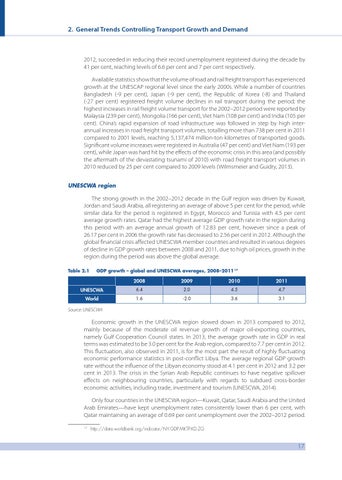
GDP growth – global and UNESCWA averages, 2008–2011 ...............................................................
17
Table 2.2
Largest urban agglomerations by population size in 2015 and in 2030 (DESA, 2014) .......
22
Table 3.1
Fastest growing urban agglomerations, 2015-2030 ................................................................................
42
Table 3.2
Modal split of freight transport volume in selected regions and countries .............................
50
Table 3.3
Comparison of transport in countries of the League of Arab States and countries of the Economic Cooperation Organization ......................................................................................................
52
Table 5.1
Incidents by mode and incident calendar year...........................................................................................
114
Table 5.2
Fatalities and major injuries by mode and incident calendar year ..................................................
114
Table 5.3
Number of potential hazardous materials carriers (United States)..................................................
119
Table 5.4
Hazardous materials fleet/vehicles (United States) ...................................................................................
119
Table 8.1
Modal split in the transport of passengers, selected Latin American cities, per cent, 2010 .......................................................................................................................................................................................
167
Table 11.1
Main activities of UNECE in transport and sustainable development...........................................
204
Table A1a
UN TRANSPORT AGREEMENTS SERVICED BY UNECE................................................................................
222
Table A1b
UN TRANSPORT AGREEMENTS SERVICED BY ESCAP.................................................................................
230
Table A1c
UN TRANSPORT AGREEMENTS SERVICED BY UNESCWA........................................................................
231
Table A2a.
Statistics for 210 countries of the world (The World Bank) ...................................................................
232
Table A2b.
Statistics for 210 countries of the world (The World Bank, UNECE, OECD) .................................
239
Table A2c.
Statistics for 210 countries of the world (The World Bank, UNECE, UNDP) ................................
247
Table A2d
Correlation between population and land area with different transport factors (SPSS correlation) (**, correlation significant at 0.01 level; *, correlation significant at 0.05 level). The data analysed have been for the years 2001 and 2011 (where available). ..........
254
XIII
Transport for Sustainable Development – The case of Inland Transport
List of Acronyms
Acronym
Definition
ADB
Asian Development Bank
ADN
European Agreement concerning the International Carriage of Dangerous Goods by Inland Waterways
ADR
European Agreement concerning the International Carriage of Dangerous Goods by Road
AEGPL
European Liquefied Petroleum Gas Association
AGC
European Agreement on Main International Railway Lines
AGN
European Agreement on Main Inland Waterways of International Importance
AGR
European Agreement on Main International Traffic Arteries
AGTC
European Agreement on Important International Combined Transport Lines and Related Installations
ASEAN
Association of Southeast Asian Nations
ATP
Agreement on the International Carriage of Perishable Foodstuffs and on the Special Equipment to be Used for such Carriage
AU
African Union
AUC
African Union Commission
CDIAC
Carbon Dioxide Information Analysis Center
CDM
Clean Development Mechanism
CECI
European Centre for International Cooperation
CEFACT
United Nations Centre for Trade Facilitation and Electronic Business
CEVNI
European Code for Inland Waterways
CNG
Compressed Natural Gas
COSIPLAN
South American Infrastructure and Planning Council
CTU Code
IMO/ILO/UNECE Code of Practice for Packing of Cargo Transport Units
DESA
(United Nations) Department of Economic and Social Affairs
DGSA
Dangerous Goods Safety Advisors
EATL
Euro-Asian Transport Links
ECA
(United Nations) Economic Commission for Africa
ECE
(United Nations) Economic Commission for Europe
ECLAC
(United Nations) Economic Commission for Latin America and the Caribbean
ECO
Economic Cooperation Organization
ECOSOC
(United Nations) Economic and Social Council
EDIFACT
(United Nations) Electronic Data Interchange for Administration, Commerce and Transport
EEA
European Environment Agency
EIA
(United States of America) Energy Information Administration
XIV
EIGA
European Industrial Gases Association
ERA
(European Union) European Railway Agency
ESCAP
(United Nations) Economic and Social Commission for Asia and the Pacific
ESCWA
(United Nations) Economic and Social Commission for Western Asia
ETS
(European Union) Emissions Trading Scheme
EU
European Union
ForFITS
For Future Inland Transport Systems
GCC
Cooperation Council for the Arab States of the Gulf
GDP
Gross Domestic Product
GHG
Greenhouse Gases
GPL
Liquefied Petroleum Gas
GPST
Global Partnership for Sustainable Tourism
HDI
Human Development Index
HICP
Harmonized Index of Consumer Prices
ICAO
International Civil Aviation Organization
IDEP
(UNECA) African Institute for Economic Development and Planning
IEA
International Energy Agency
IIRSA
Initiative for the Integration of Regional Infrastructure in South America
ILO
International Labour Organization
IMDG (Code)
International Maritime Dangerous Goods (Code)
IMF
International Monetary Fund
IMO
International Maritime Organization
IPCC
Intergovernmental Panel on Climate Change
IRTAD
(International Transport Forum) International Traffic Safety Data and Analysis Group
IRU
International Road Transport Union
ISPS (Code)
International Ship and Port Facility Security (Code)
ITC
UNECE Inland Transport Committee
ITF
International Transport Forum
ITSAM
Integrated Transport System in the Arab Mashreq
IWGLTS
International Working Group on Land Transport Security
IWT
Inland Waterway Transport
LAIA
Latin American Integration Association
LANDSEC
(European Union) Advisory Group on Land Transport Security
LAS
League of Arab States
LDC
Least Developed Country
LLDC
Land-Locked Developing Countries
LPI
(World Banks) Logistics Performance Index
MDG
Millennium Development Goals
MERCOSUR
Southern Common Market
XV
Transport for Sustainable Development – The case of Inland Transport
MFAG
Medical First-Aid Guide for Use in Accidents involving Dangerous Goods
NHTSA
(United States of America, Department of Transportation) National Highway Traffic Safety Administration
OECD
Organization for Economic Cooperation and Development
OTIF
Intergovernmental Organization for International Carriage by Rail
PEP
Transport, Health and Environment Pan-European Programme
PIDA
Programme for Infrastructure Development in Africa
RAI
Rural Access Index
RCP
Representative Concentration Pathways
RICAM
International Network of Mesoamerican Highways
RID
Regulations concerning the International Carriage of Dangerous Goods by Rail
RSSB
Rail Safety and Standards Board
SADC
Southern African Development Community
SAFE
Framework of Standards to Secure and Facilitate Global Trade
SC.1
(UNECE) Working Party on Road Transport
SC.2
(UNECE) Working Party on Rail Transport
SDG
Sustainable Development Goals
SEFA
European Syndicate on Steel Drums
SIECA
Permanent Secretariat of the General Treaty on Central American Economic Integration
SIGNI
Signs and Signals on Inland Waterways
SOLAS
International Convention for the Safety of Life at Sea
SPECA
Special Programme for the Economies of Central Asia
SRES
Special Report on Emission Scenarios
SSATP
Sub-Saharan Africa Transport Policy Programme
TAH
Trans-African Highways
TAPA
Transported Asset Protection Association
PWG-TBC
Project Working Group on Transport and Border Crossing
TEM
Trans-European North-South Motorway
TEN-T
Trans-European Transport Network
TER
Trans European Railways
TFEU
Treaty on the Functioning of the European Union
TIR
Customs Convention on the International Transport of Goods under Cover of TIR Carnets
TOD
Transit-Oriented Development
TOE
Tons of Oil Equivalent
C-TPAT
Customs-Trade Partnership Against Terrorism
TSA
(United States of America) Transportation Security Administration
UIC
International Union of Railways
UIRR
International Union of Combined Road-Rail Transport Companies
XVI
UITP
International Association of Public Transport
UNASUR
Union of South American Nations
UNCED
United Nations Conference on Environment and Development
UNCTAD
United Nations Conference on Trade and Development
UNDA
United Nations Development Account
UNDP
United Nations Development Programme
(UN) DPI
(United Nations) Department of Public Information
UNECA
United Nations Economic Commission for Africa
UNECE
United Nations Economic Commission for Europe
UNECLAC
United Nations Economic Commission for Latin America and the Caribbean
UNEP
United Nations Environment Programme
UNESCAP
United Nations Economic and Social Commission for the Asian and the Pacific
UNESCWA
United Nations Economic and Social Commission for Western Asia
UNLK
United Nations Layout Key (for Trade Documents)
UNTDED
United Nations Trade Data Elements Directory
WCED
World Commission on Environment and Development
WCO
World Customs Organization
WHO
World Health Organization
WP.1
(UNECE) Working Party on Road Traffic Safety
WP.11
(UNECE) Working Party on the Transport of Perishable Foodstuffs
WP.29
(UNECE) World Forum for Harmonization of Vehicle Regulations
WTO
World Trade Organization
XVII
Executive Summary
A well-functioning transport sector is an essential requirement for the economic and social development of all countries as well as for supporting regional and global cooperation and integration. Historically, development of the transport sector has been an indicator of a country’s economic welfare and success. Well-developed, efficient, safe and secure inland transport systems offer important access to markets, employment, education and basic services critical to poverty alleviation; at the same time, transportation is a major driving force behind a growing world demand for energy and it has a significant environmental footprint. Transport sustainability is shaped by socio-economic, demographic and environmental megatrends, i.e. major shifts in economic, social and environmental conditions that can impact people and transform societies. Present economic growth, which has been associated with a ‘reversed’ geographical fragmentation of production, has created particular transport patterns such as increasing transport volumes mostly in the non-OECD regions. At the same time, the significant changes in global population size, age structure, household size and urbanization expected in the twenty-first century may have substantial implications for inland transport, in terms of transport patterns, energy use and GreenHouse Gas (GHG) emissions. These will be further complicated by the mounting effects of climate change and inconsistency on the transport infrastructure and services. As a cross-cutting sector, transport will play an important role in efforts towards achieving post-2015 sustainable development goals. As such, in addition to their value and job creation, inland transport systems need to be considered partly as enablers of sustainable development. Therefore, integrated approaches to policy making should be fostered, including planning for land use, infrastructure development, public transport systems and goods delivery networks, with a view to providing affordable, efficient, safe and secure transport, improving energy efficiency, and at the same time reducing pollution and congestion. In this study, the relationship between transport and social, economic and environmental sustainability worldwide is assessed by providing deeper insight into the current state of the five dimensions of sustainable transport – access (mobility of individuals and for societies), affordability (of transport for individuals and society), safety, security and environmental impact (of transport and on transport). Accessibility - In transport, accessibility refers to the peoples’ ability to reach goods, services, activities and destinations from a given location, using the available transportation system. Many factors affect accessibility, including the transport needs and abilities of individuals, quality of transport options, connectivity of the various links and modes, landuse patterns, and the quality/costs of alternative solutions. Transport accessibility has large impacts in both economic and human development, as improved accessibility to transport can facilitate the achievement of many economic, social and environmental objectives. Rural accessibility is a challenge in all regions; nearly one billion people worldwide still lack adequate access to road networks and continue to live more than two kilometres from an all-weather road. Fast urbanization, increasing congestion and insufficient access to public transportation in many areas call for a redesigning of urban mobility conditions, with an emphasis on facilitating infrastructure for more environmentally friendly modes like walking and cycling, as well as vulnerable groups such as children, persons with reduced mobility and the growing global elderly population.
XIX
Transport for Sustainable Development – The case of Inland Transport
International transport links are the most important facilitator of global trade and a prerequisite for economic development. Participation in global supply chains is essential for attracting foreign investment and enterprises as well as human capital. In many areas it is hampered by underdeveloped international transport links which undermine national and regional competitiveness. Foreign trade is especially important for small, land-locked and sea-locked economies, which are also dependent on hinterland and/or sea connections and border crossings. Emerging land- and sea-locked economies require particular attention, as their geography constrains trade and economic development. Inefficient border crossings reduce the efficiency of global trade, and are a particular challenge in parts of South-eastern Europe, the Caucasus, Central and East Asia, countries of the UNESCWA region and Africa. Affordability - Transport costs money and, thus, transport accessibility is controlled by the costs (and returns) of the passenger and freight transport services as well as by the sustainability of the investments associated with upgrading, planning and construction of new transportation infrastructure. Transport affordability refers to the financial ability of people and societies to access adequate transport services without compromising their ability to purchase other basic goods and services, such as food, housing, education and health. It can be assessed from several perspectives, e.g. the level of private motorization, the costs of owning, driving and parking private vehicles as well as the quality and cost of alternative transport modes such as public transport and cycling. High income inequalities are an issue present in all regions, and low income groups, which spend a high proportion of their income on transport, are especially dependant on the availability of affordable public transport. At the same time, in the present global economic climate, national and local government capacities to offer affordable public transport are diminished by a lack of availability of public funds. All available trends and projections relating to passenger and freight volumes suggest a strong future growth particularly in the non-OECD regions (see Chapter 2). The expected growth in freight and passenger transport will require planning and construction of new transportation infrastructure as well as the establishment of sustainable funding mechanisms for the transport sector. Efficient, safe and environmentally sustainable transport infrastructure is expensive and, despite recent improvements, transport networks in many regions still suffer from the under-investment of the previous decades. At the same time, infrastructure development is generally planned and financed within national budgets and under macro-economic constraints, and in competition with other needs such as education, health, housing or security. The 2008 financial crisis and its aftermath have increased pressures on national budgets and reduced public funding for transport infrastructure development, increasing the importance of private sector funding (as well as hybrid financing through public-private partnerships), and warranting more rigorous project feasibility assessment. Safety -Transport related injuries are a serious social, economic and development issue. Developing countries and economies in transition bear the majority of this burden so transport fatalities and injuries are a development issue that disproportionately affects the poor in low and middle-income countries. Globally, well over a million people are killed annually in road traffic accidents causing, in addition, to human loss and suffering, billions of dollars of associated costs which amounts, in some countries, to 1-3 per cent of GDP. Underreporting and insufficient global harmonization of statistics are obstacles to improving insight into transport safety challenges — the first step in efforts to develop solutions.
XX
Road safety depends also on driver behaviour, infrastructure quality and vehicle safety. Improvements can be achieved only by considering all these contributing factors and through adequate legislation modelled to respond to local circumstances. In order to break the cycle of increased casualties, road infrastructure safety and vehicle safety legislation, standards, traffic rules, management and programmes need to be strengthened, with special attention to vulnerable road users (motorcyclists, cyclists, pedestrians). The main precursors to railway accidents remain level crossing incidents along with high trespassing rates on railway infrastructure which leads to fatalities. Certain parts of Africa and Asia are suffering from a high rate of accidents on internal waterways involving commuters, often resulting from vessel overloading, poor construction and a lack of appropriate safety measures and their enforcement. Safety in transport of dangerous goods is a special focus area and deserves more attention as it presents severe risks for the population in general, property and the environment. Security -The notion of transport security encompasses acts ranging from ordinary infliction of damage and everyday delinquency to highly orchestrated acts of terrorism directed towards transport systems infrastructure, passenger and freight vehicles. Due to their open areas, inland transport systems are relatively unprotected from security threats in comparison with maritime ports and airports. Transport related crime rates are high in many parts of the world, while analytical and statistical data on the phenomena needs to be strengthened in many others. A high volume of cross-border transport related crime in certain regions calls for a strengthening of international cooperation and coordination of responsive actions. Both public and private transport systems stakeholders must, in cooperation with the relevant security services, work to establish national, regional and international frameworks that can ensure security of persons, infrastructure and freight. Economic cost of transport crime must not be overlooked and security systems in place should not interfere with the efficiency of operations and the movement of persons and freight within and across transport modes. In taking actions to guarantee such collective security, the stakeholders involved must safeguard the personal freedoms of individuals. Environmental impact - Transport can affect or be affected by the environment in many ways and at different spatio-temporal scales. Inland transport requires infrastructure, the construction of which could involve extensive land use and, consequently, potential loss of natural habitat. Transport also requires energy. Unfortunately many of the most popular transport modes, despite energy efficiency improvements, depend on increasing amounts of non-renewable energy sources which contribute to the emission of greenhouse gases that severely affect the environment at the global level. Air pollutants from transport (nitrogen oxides, particles, carbon monoxide and hydrocarbons) reduce air quality and can have damaging (local) impacts on human health and ecosystems. Moreover, transport produces noise, which can also have significant implications for human health, particularly in urban agglomerations, and ecosystems. Keeping vehicles environmentally friendly throughout their lifetime and adjusting to a more environmentally acceptable transport modal split are key challenges today across the world. Transport is not only a major contributor to the observed carbon emission growth and, thus, a probable contributor to climate change, but it is also a ‘victim’ of the effects of climate change and extreme weather events which can have a range of diverse impacts on transport infrastructure and services. These impacts will vary significantly by mode, climate change factor, and will depend on the local or regional circumstances and vulnerabilities, including those associated with the natural environment, as well as a broad range of socioeconomic factors.
XXI
Transport for Sustainable Development – The case of Inland Transport
The way forward
Sustainable transport is safe, high-quality, and accessible to all, ecologically sound, economically viable, and a positive contributor to local, national and international sustainable development. Specific goals for sustainable transport may include: improved service quality and quality of access to goods and services, decreased transport related accident and crime rates, improved air quality, noise reduction, protection of natural habitat and open space, historic preservation, reduced local and GHG emissions, increased social equity, economic development, and a satisfying quality of life, as well as local goals consistent with the overall objective. Economic, social and environmental sustainability can only be achieved through an integrated inland transport system. When water, road and rail transport work together, the comparative advantage of each mode can be exploited optimally. Integration of transport systems is a complex task with many dimensions. The optimal modal split of freight and passenger transport depends on countries’ geographic, demographic, economic and historic conditions. Cooperation across transport modes, regions and borders as well as between public and private operators is needed. Creating an efficient integrated transport network requires international collaboration. The United Nations Regional Commissions provide platforms for intergovernmental cooperation and address the sustainability of transport, across its five key areas — accessibility, affordability, safety, security, environmental impact — through a variety of legal instruments, analytical work and technical assistance, as well as through their governance structures. At the beginning of 2015, a total of 1,701 accessions by countries from six continents to the 58 United Nations legal instruments on transport were being serviced by UNECE. Continued and strengthened international cooperation through the United Nations Regional Commissions will be an important step in securing a future transport sector that strongly contributes to attaining sustainable development goals.
XXII
1.
Sustainable Development and Transport Sustainable development has been hindered by a widely held notion that development can be defined primarily as economic growth; this has been the framework used for many years by developed countries to achieve their current levels of wealth, and major developing economies appear set to follow a similar course. The problem with such an approach is that: (a) economic growth does not necessarily guarantee social equity and (b) natural resources are exhaustible, both in terms of quality (e.g. environmental pollution) and supply (e.g. oil/ gas reserves) (Drexhage and Murphy, 2010).
1.1
Sustainable Development The World Commission on Environment and Development (WCED) report ‘Our Common Future’ (1987) provides the ‘classic’ definition of sustainable development1 as ‘…the development which meets the needs of the present without compromising the ability of future generations to meet their own needs’ (WCED, 1987). Acceptance of the report by the United Nations General Assembly gave the term political salience and, in 1992, leaders set out the principles of sustainable development at the UN Conference on Environment and Development (UNCED) in Rio de Janeiro (Brazil), also referred to as the Rio Summit or the Earth Summit. Sustainable development is a fluid concept (see e.g. DESA, 2013). In spite of ongoing discussions on its exact meaning, certain fundamental principles have emerged in the past decades (Drexhage and Murphy, 2010): (i) a commitment that decisions should consider equity and fairness and account for the rights of future generations; (ii) a long-term view should emphasize the precautionary principle, i.e. “where there are threats of serious or irreversible damage, lack of full scientific certainty shall not be used as a reason for postponing cost-effective measures to prevent environmental degradation”2 and (iii) sustainable development involves understanding and acting on the complex interconnections between its three pillars, i.e. the economy, society and the environment. Acting on the complex interconnections between the economy, society and the environment should not be a balancing act; instead, there is an apparent need for convergence between the three pillars of sustainable development, i.e. the economic development, social equity and environmental health/sustainability; moreover, sustainable The framework for sustainable development evolved between the early seventies and the early nineties in many international conferences and initiatives. The 1972 UN Conference on the Human Environment (Stockholm) led to the establishment of the United Nation Environment Programme and numerous national environmental protection agencies. Stockholm’s recommendations were further considered in the 1980 World Conservation Strategy (e.g. Talbot, 1980), a collaboration between the International Union for the Conservation of Nature (IUCN), the World Wildlife Fund (WWF), and UNEP, which aimed at prioritising conservation issues and defining key policy options. In 1983, the United Nations convened the World Commission on Environment and Development, comprised of representatives from developed and developing countries and chaired by then Norwegian Prime Minister Gro Harlem Brundtland, to address growing concerns over the ‘accelerating deterioration of the human environment and natural resources and the consequences of that deterioration for economic and social development’; in 1987, the Commission produced its landmark report ‘Our Common Future’, also known as ‘the Brundtland report’, see www.un-documents.net/our-common-future.pdf.
1
2 Principle 15 of the Rio Declaration on Environment and Development (Annex I), of the United Nations Conference on Environment and Development (Rio de Janeiro, 1992) www.un.org/documents/ga/conf151/aconf15126-1annex1.htm.
1
Transport for Sustainable Development – The case of Inland Transport
development should aim at inter- and intra-generational distributional justice, i.e. should aim at the well-being of both the current and future generations of the global population in its entirety. Presently, all three sustainable development pillars (economic, social and environmental) face great challenges: more than one billion people still live in extreme poverty, income inequality within and among many countries has been rising and unsustainable consumption/production patterns have resulted in increasing environmental degradation and dwindling natural resources.
1.2
Sustainable Transport Transport is essential for the economic and social development of all countries as well as for supporting regional and global cooperation and economies. Historically, the development of a country’s transport sector has been an indicator of its economic welfare and success. The direct value added by the transport sector to global GDP is about 3-5 per cent, and transport typically provides 5-8 per cent of average national total paid employment. Between 1950 and 1990, the number of motorized vehicles in the world grew by roughly nine times, from about 75 million to 675 million. During the same period, the world population doubled, from about 2.55 billion to near 5.25 billion. The United Nations Department of Economic and Social Affairs (DESA) estimates that the global population will increase by more than 2.5 billion during the next 35 years reaching over 9.5 billion inhabitants in 2050. Population growth, coupled with continuing globalization and trade liberalization, is expected to accelerate the demand for transportation of both people and goods. The ever-increasing movement of people and goods has resulted in transport becoming instrumental to many economic and social functions and, thus, one of the controls of sustainable development. Principles of development (increasing well-being and equity) as well as sustainability (preserving natural and man-made capital) should be inherent in sustainable transport policies and manifested in transport trends (Gudmundsson and Höjer, 1996). Adequate, efficient, and effective transport systems are important for access to markets, employment, education and basic services critical to poverty alleviation; at the same time, transportation is expected to be a major driving force behind a growing world demand for energy and it has a significant environmental footprint. Therefore, integrated approaches to policymaking should be promoted, including policies/planning for land use, infrastructure development, public transport systems and goods delivery networks, with a view to providing affordable, efficient and safe transportation, increasing energy efficiency, and reducing pollution and congestion effects.3 In recent extensive consultations with decision makers4, different international organisations and industry associations have highlighted some of the current challenges associated with sustainable transport.
3
See also: http://sustainabledevelopment.un.org/index.php?menu=238
Consultation of Decision-Makers on Implementing Sustainable Transport New York City, USA, September 26th 2013 attended by 67 participants from all regions. Organized by DESA, Ford Foundation, FIA Foundation and UN-Habitat. See also http://sustainabledevelopment.un.org/index.php?menu=1569.
4
2
1. Sustainable Development and Transport
The International Energy Agency (IEA) provided an evaluation of future energy requirements under different development scenarios, based on a mobility model. It found that a lot of action would be required by the transport sector in order to remain within the +2 °C temperature increase scenario, including a so-called ‘avoid, shift and improve’ approach. 5 The United Nation Economic Commission for Europe (UNECE) has suggested that transport is instrumental for poverty eradication. According to UNECE, there are five key dimensions of sustainable transport: (i) access – integrating countries in a broader market to eradicate poverty; (ii) affordability; (iii) safety, (vi) security and (v) environmental aspects. The United Nations Environment Programme (UNEP) has suggested that there are five key areas of intervention, involving: (i) road safety - infrastructure; (ii) public transportation - mass transit; (iii) air quality - link to health issues; (iv) fuel consumption - link to energy and (v) new technologies. The World Bank has focussed on the significance of improving accessibility to transport services in rural areas, which will offer greater potential for economic growth, market access/consolidation, opening up of small businesses and employment and, thus, for poverty alleviation. UN-Habitat stressed the importance of urban mobility and linking cities and urban areas in the twenty-first century, considering a mixed-use environment approach by integrating land-use and non-motorizing infrastructure. The United Nations Economic Commission for Latin America and the Caribbean (UNECLAC) analysed the role of the transport sector in the progress towards the Millennium Development Goals (MDG), highlighting the high impact of the sector’s performance for achieving most MDGs. It underlined the fundamental role of the public transport policies in reducing the increasing externalities of economic growth and in making sure that the saving and benefits from better transport services effectively contribute to reducing social and economic inequality, which remains a major challenge in the UNECLAC region (UNECLAC, 2012). The International Road Transport Union (IRU) has suggested that buses/coaches and taxis should be placed at the centre of the transport policymaking debate, in order to double their use and achieve sustainable mobility for all. The Asian Development Bank (ADB) has predicted that increasing demand for private motorisation in South-East Asia will exacerbate traffic congestion and air pollution, contribute to climate change and reduce road safety in this region. ADB discussed its ‘Sustainable Transport Initiative’, which involves the establishment of a Multilateral Development Bank working group on sustainable transport, initiation of innovative sustainable transport projects and capacity-building for sustainable transport. Finally, UNECE has developed a new initiative to support the efforts of member States to promote sustainable housing and land management, in order to achieve green, inclusive, compact and resilient cities, which are regarded as prerequisite to sustainable transport in the urban environment. 6
5
See also www.unep.org/transport/about.asp
6
See http://sustainabledevelopment.un.org/index.php?page=view&type=1006&menu=1510&nr=2603
3
Transport for Sustainable Development – The case of Inland Transport
1.3
Assessing Sustainable Development Each transportation system is unique, with its complexity derived from the pluralism of its hardware (infrastructure and vehicles) and of the people and organizations involved. The complexity is multiplied by the existence/roles of the different transport modes, the various regulatory and legislative bodies, service providers, builders, financing systems, technologies, land-use patterns, and, most importantly, human behaviour. Therefore, no single measurement of sustainable development allows an evaluation of the current state and progress of sustainability of transport. Transport sustainability is linked to many factors (e.g. DESA, 2013) making it necessary to establish a set of indicators to determine the current situation and trends. It is theoretically optimal to define these indicators based on the capital approach, i.e. of the sustainability of the total capital base of global society (UNECE, 2012). This capital base can be defined as consisting of three types of capital7, frequently referred to as the ‘triple bottom line’ of transport sustainability (Richardson, 2005): •
•
•
Social capital, which refers to “the institutions, relationships and norms that shape the quality and quantity of a society’s social interactions” (World Bank, 2011). Transport connects people and provides access to basic social services; it is therefore a necessary condition for social sustainability. Economic capital refers to (tangible and intangible) financial capital. Transport provides access, connects people and business and is therefore essential for economic sustainability. Environmental capital refers to the natural capital, including stocks of natural resources, land and ecosystems. Transportation affects environmental capital negatively through pollution, Greenhouse Gas (GHG) emissions, energy use, waste generation and loss of natural habitat. Mitigation of these impacts is crucial for transport sustainability.
The economic, social and environmental pillars of sustainability are closely linked and a single policy distinction between these pillars is neither possible nor beneficial. In fact, the close linkage between all aspects of sustainability and efficiency, once understood and acknowledged, encourages the private sector to set sustainability goals in order to meet external demands coming from a growing number of concerned stakeholders. 8 Evaluation of the current state and future challenges involving the sustainability of transport should be made on the basis of trends/projections in transport accessibility, affordability, safety and security, environmental impacts, as well as the presence/promotion of integrated transport (e.g. intermodality). Transport accessibility can be measured against, for example, infrastructure density and quality. At the same time, international transport links play an important role in the economic development of regions. The flow/volume of international freight transport and border-crossing efficiency can provide an assessment of the performance of the transport system with respect to international accessibility. Mobility is an important factor for social and economic inclusion. Access to the most basic goods and services requires mobility; an affordable transport system is thus a prerequisite to social and economic development. Individual affordability can be evaluated by, for example, the share of transport expenditure Typically, five to six types of capital are used: financial capital, produced capital, natural capital, human capital and social capital. In the present report, these types have been aggregated into the three pillars of sustainable development: social, economic and environmental (see also UNECE, 2012).
7
Wilmsmeier G., et al, “Efficiency — key ingredient towards sustainable supply chains”, ELCAC FAL Bulletin No. 331, Number 3 / 2014.
8
4
1. Sustainable Development and Transport
relative to the total household income/consumption and/or the development of transport pricing. Transport systems should be also affordable for societies; therefore, public expenditure in a sustainable form as well as alternative funding options should be also evaluated. Traffic accidents (fatalities or injuries) lead to substantial social and economic losses for families and society. In order to evaluate transport safety, particularly in the road sector, the current situation, trends and controlling factors (e.g. speeding and drink-driving) of traffic accidents should be assessed. Finally, transportation negatively affects the environment through the consumption of non-renewable fuels, local and GHG emissions, noise and ecosystem degradation. At the same time, transport infrastructure and services are impacted by the environmental conditions and their variability. Table 1.1 summarises the relation between the three pillars of sustainable development, the key issues and particular performance indicators. The following chapters that focus on individual dimensions of sustainable transport, as defined above, contain overviews of indicators listed in table 1.1, i.e. the current regional and global situations across those dimensions, the challenges facing transport policymakers and selected best practices contributing to achieving more sustainable inland transport of passengers and freight.
5
Sustainability targets
Indicators
Impact on capital
Table 1.1
Indicator 3: Transport Public investment Indicator 4: Transport Private investment
Affordable for all incomes
Indicator 3: International transport
Indicator 4: Burden of border crossing
Infrastructure density linked to social development performance
Efficient border crossings
Strategic international links especially for landlocked countries
Thorough pre-investment analysis
Long-term investment plans
Indicator 2: Price of transport
Indicator 2: Infrastructure quality
Minimize population share without access to all-season transport road/rail
Indicator 1: Household transport spending
Indicator 1: Infrastructure density
Social capital: Affordable access to basic social services
Economic capital: Affordable access to employment and education opportunities. Long-term economically sustainable investments
Economic capital: Access to markets and employment
Social capital: Access to basic social services
Affordability
Access
Minimize accidents involving dangerous goods
Minimize rail and IWT fatalities and injuries
Minimize road fatalities and injuries
Indicator 3: Active level crossings
Indicator 2: Seat-belt use, impaired driving and speeding
Prevent criminal activities
Prevent terrorist threat/attacks
Indicator 2: Criminal activities
Indicator 1: Terror threats
Economic capital: Secure transport to avoid losses in infrastructure, goods and human capital
Economic capital: Safe transport to avoid costs of traffic accidents
Indicator 1: Road fatalities
Social capital: Secure transport for individuals and increase of human and cultural capital security
Security
Social capital: Safe transport for individuals and increase of human and cultural capital safety
Safety
Minimize waste from transport and improve recycling
Minimize noise from transport
Minimize greenhouse gas and pollutant emissions
Reduce dependency on nonrenewable energy sources
Indicator 4: Noise from transport
Indicator 3: Local pollutants from transport
Indicator 2: Emission of greenhouse gases and local pollutants
Indicator 1: Transport Energy consumption
Natural capital: Transport that is sustainable with respect to energy use, emissions and land use to maintain the natural capital of the world
Environment
Transport for Sustainable Development: Transport themes, 3 pillars of sustainable development and general and specific performance indicators
Transport for Sustainable Development – The case of Inland Transport
6
2.
General Trends Controlling Transport Growth and Demand Transport sustainability is controlled by socio-economic, demographic and environmental megatrends, i.e. major shifts in economic, social and environmental conditions that can impact people at all levels and transform societies. In recent decades, large sections of the global society have benefited from market access and the dissemination of knowledge and technology, but others remain marginalized. Stronger trade and investment links have augmented global interdependence, but also increased the contagion risks from a financial crisis. Disparate population and economic growth dynamics have resulted in greater income inequalities, whereas environmental degradation has worsened due to non-sustainable production and consumption patterns. At the same time, long term climatic changes and extreme weather events (SREX, 2012; IPCC, 2013) can result in large transport infrastructure damages and costs (UNECE, 2013), and undermine efforts to achieve sustainable development. This chapter will provide an overview of global and regional economic development, as well as social, demographic and environmental trends, and describe their implications for the future development of the inland transport sector in accordance with the principles and requirements for achieving sustainable development of society.
2.1
Economic Development
2.1.1
Global Trends
Globalization was accelerated in the nineteenth century, when technological progress in the transportation sector cut the cost of transportation and drove a sustained trade expansion of about 4 per cent annually throughout the century (DESA, 2013). The latest globalization boom has been, however, qualitatively different, as underlying global production patterns have fundamentally changed through the rise of transnational corporations and globalized transport chains. Assembly-oriented export production, mostly concentrated in the industrialising East Asian economies, has introduced a ‘reversed’ geographical fragmentation of production, creating at the same time further requirements for efficient global transport networks. It is interesting to note that, in the past decades, trade has grown at much faster rates than those of the World GDP (United Nations, 2010). There is, however, a structural regional diversity in trade growth. Growth in production of manufactured goods has been mostly limited to Asia, whereas in Africa and, to a lesser extent, in Latin America trade growth has been dominated by increases in commodity exports and/or imports of manufactured and capital goods (Erten and Ocampo, 2012). At the same time, foreign direct investment has been growing faster than world trade, reaching 1.5 trillion United States dollars in 2011 (UNCTAD, 2012). Trade flows have recovered from their 2008–2009 collapse (Figure 2.1), but growth is projected to remain slower than that prevailing before the 2008–2009 crisis, at least for some years (United Nations, 2013).
9
Transport for Sustainable Development – The case of Inland Transport
In recent years, economic growth has been consistently higher in the low- and middleincome economies than in the developed countries (Figures 2.2 and 2.3). Nevertheless, average per capita growth may hide increasing income inequalities (Dervis, 2012) that undermine prospects for sustainable development (Berg and Ostry, 2011), threaten economic stability (Stiglitz, 2012), impact on transportation patterns (e.g. Lau, 2011) and, ultimately, affect the sustainability of the transport sector. Figure 2.1
Trends in non-fuel exports in the 1998–2011 period (in billions of United States dollars)
14'000
Intermediate goods Consumption goods
12'000
Capital goods
10'000 8'000 6'000 4'000
2011
2010
2009
2008
2007
2006
2005
2004
2003
2002
2001
2000
0
1999
2'000
Source: DESA, 2013 Figure 2.2
Trends in annual GDP growth in high, low and middle-income countriesSource: DESA, 2013
8
High-income countries Low-income countries Middle-income countries
Average GDP growth
6 4 2 0 -2 -4
2011
2010
2009
2008
2007
2006
2005
2004
2003
2002
2001
2000
1999
1998
1997
1996
1995
1994
1993
1992
1991
1990
-6
Source: DESA, 2013
10
2. General Trends Controlling Transport Growth and Demand
In addition, the outsourcing/offshoring of jobs requiring mid-level skills that have been facilitated by changes in global production patterns and improved transport sector efficiency can affect considerably labour markets (Abel and Deitz, 2012). At the same time, continued growth in emerging economies can be a growth engine for the world economy, providing also opportunities for other developing countries; nevertheless, the gravity shift to China and India (the major drivers of this process) can also change the character of end markets and pose new challenges for economic development. Globalization may also increase the cyclical interdependence of national economies making them more vulnerable to external shocks. Changes in consumer demand in end-markets are likely to be transmitted in real time to producers, with large implications for economic growth, employment and the transport sector (Cattaneo et al., 2010; Keane, 2012). Figure 2.3
Average annual GDP growth rate at constant 2005 prices for the period 2005–2013
GDP Annual Growth Rate % 2005 -2013
No Data
-2.7 - -0.1
6.1 - 9.0
0.1 - 3.0
3.1 - 6.0
9.1 - 13.2
Source: World Bank
Passenger and freight flow trends as well as transport infrastructure development are controlled by economic growth and its spatial distribution, as well as demographics and environmental policies. It is expected that transport volumes are likely to grow strongly in non-OECD regions, although there are certain challenges that may affect their growth, such as the availability of sustainable funding mechanisms for the development of sustainable capacities. 2.1.2. Regional trends
Western European and Nordic countries, Canada, Mexico and the United States of America have had an annual low/moderate economic growth (1–2 per cent on average) in the years after 2005. In comparison, economic growth has been higher in Eastern Europe, Asia, most African countries and certain Latin American countries (Figure 2.3), forcing a narrowing of the gap between the per capita income of the poorest and the richest countries. For example, the 2005 per capita income in Tajikistan was 92 times lower than that of the United States of America, but by 2011 this difference had been reduced to about 40 times (UNECE, 2012).
11
Transport for Sustainable Development – The case of Inland Transport
This section contains a brief overview of GDP, and the evolution of unemployment and rail and road freight transport volume in the member States of the five United Nations regional commissions. Table A2 in annex II to this report provides a more detailed basis for correlation analysis relevant to sustainable transport. UNECA region (excluding UNESCWA member States)
Africa has benefited from unprecedented growth while a large part of its population remains trapped in economic poverty, facing rampant unemployment and inequality. The continent has averaged 5 per cent annual growth over the last decade, with some countries returning more than 7 per cent. Leading the growth were Equatorial Guinea, Liberia, Angola and Chad, with 10 per cent average annual growth between 2002 and 2012, while the most lagging behind country during that period was Zimbabwe, losing over a fifth of the value of its economy. Underpinning this growth were relatively high commodity prices, increased domestic demand (due especially to increased private investment in infrastructure and energy) and improved economic governance and management (UNECA and AU, 2014). In most UNECA member States, according to International Labour Organization (ILO) estimates, unemployment has been steady during the past decade, regardless of the actual rate. In 2012, thirty-nine African countries had unemployment rates at lower than 10 per cent, while only six were below 5 per cent. South Africa has suffered consistently high unemployment at 25 per cent during much of the past decade, while Algeria showed the most progress, cutting unemployment from 29.8 per cent in 2000 to 9.8 per cent in 2012. The global unemployment rate in the continent was estimated at 6.0 per cent in 2013, and unemployment numbers are set to rise from 202 million in 2013 to 205 million in 2014 (UNECA, 2014). Most of Africa’s railway lines and roads are in bad condition and need huge investments, while the proportion of paved roads on the continent today is five times less than those in developed countries. As a result, transport costs alone are 63 per cent higher in Africa than in developed countries, hampering its competitiveness in the international and local markets (UNDPI, 2014). Algeria is the only country from the UNECA region with available road freight transport statistics9, while data on rail freight transport is available for only a dozen or so countries.10 In most of the countries for which data is available, there is a clear dip in rail freight transport volume between 2008 and 2010, as in the UNECE case, as a result of the economic crisis. UNECE Region
In the UNECE region, growth and development in recent years has been diverse. Although the GDP of all member States was seriously affected by the 2008–2009 financial crisis, the long-lasting economic growth and unemployment repercussions have been concentrated only in some of the member States (Figure 2.4). In 1995, more than one quarter of UNECE member States (for which data are available) had double-digit unemployment rates. This number peaked in 1999, when nearly half of these countries had an unemployment rate above 10 per cent. Following the rapid economic growth at the beginning of the twenty-first century, only seven UNECE member States had double-digit unemployment rates in 2007. The 9 10
http://data.worldbank.org/indicator/IS.ROD.GOOD.MT.K6 http://data.worldbank.org/indicator/IS.RRS.GOOD.MT.K6
12
2. General Trends Controlling Transport Growth and Demand
2008–2009 global financial crises resulted in a return to the 1995 levels, with about onethird of UNECE member States exhibiting unemployment rates of more than 10 per cent. In 2009, only nine UNECE States for which data was available had unemployment rates below 6 per cent, with the unemployment rate in Norway being 3.2 per cent. The former Yugoslav Republic of Macedonia showed the highest unemployment rate (32.2 per cent), followed by Bosnia and Herzegovina (24.1 per cent). In Estonia, Latvia and Lithuania unemployment rates more than doubled in 2008–2009 whereas, over the same period, unemployment in the United States of America increased from 5.8 per cent in 2008 to 9.3 per cent in 2009 (see also UNECE, 2012). In the following years (2009–2012), only 13 of the 43 UNECE member States (for which data have been available) achieved unemployment rates below 6 per cent. The southern European countries showed devastating increases in their unemployment rates: Spain had its unemployment rate soar from 18 to 25 per cent, Greece from 9.5 to 24.3 per cent, Portugal from 10.6 to 15.9 per cent, and Cyprus from 5.4 to 11.9 per cent. Figure 2.4
(a) Unemployment rates in the world for 2012 (b) Economic growth rates (at constant 2005 prices) in selected UNECE member States (c) Unemployment rates for the month of May (2006–2013) in selected UNECE member States
0°0’00’’
45°0’00’’E
a) No Data
0.1 - 4.3
4.4 - 6.9
7.0 - 9.0
9.1 - 14.0
14.1 - 59.6
Years
10
2013
2012
2011
0
2010
5 2009
2014
2013
2012
2011
2010
2009
2008
2007
-10
2006
-5
15
2008
0
20
Germany Greece Norway Russia Spain USA
2007
5
25
2006
10
30
2005
Greece Norway Romania Spain UK USA
Unemployment rates 2005 - 2013
15
2005
GDP per capita growth rate (constant 2005 prices)
Unemployment Total (% of total labor force for
Years
Source: (a) World Bank; (b) and (c) UNECE
13
Transport for Sustainable Development – The case of Inland Transport
In comparison, the unemployment rate in Germany has been steadily decreasing from 7.8 per cent in 2009 to about 5.5 per cent in 2012, making Germany the country with the eighth lowest unemployment rate in the UNECE region (after Norway, Switzerland, Austria, Luxemburg, Kazakhstan, the Netherlands and Azerbaijan). This, as well as Figure 2.4, shows that there is a large diversity in the unemployment rates of the UNECE region. Inland freight transport increased considerably in the UNECE region between 2000 and 2007, with eastern and south-eastern European member States showing increasing demand for freight transport (UNECE, 2012). Following a sharp decline in 2009 due to the 2008–2009 crisis, inland transport freight recovered and continued its increasing trends. The available data on the relationship between economic growth and inland transport indicates a relative ‘decoupling’ since 2000 (Figure 2.5); this may reflect control by other factors such as demographics, income distribution, the global distribution of industrial production and the patterns of transportation — most of which have gone through major changes in recent years (see also Chapter 8.1.1). Figure 2.5
Inland freight transport excluding inland waterways transport (blue line) and nominal GDP growth (red line) trends
220
Level in 2001 = 100
200 180 160 140 120 100 80
2000
2002
2004
2006
2008
2010
2012
Source: World Bank Note: The volume of goods transported by railway and road vehicles in metric tons multiplied by km travelled. 11
UNECLAC region (excluding UNECE and UNESCAP member States)
The 2008–2009 economic crises strongly affected the UNECLAC region, with 20 regional countries experiencing recession in 2009. While the majority bounced back in 2010 and 2011, eight countries were still in recession in 2010, including Haiti, which did not find itself in economic downturn due to the global crisis, but as a result of the devastating 2010 earthquake. Nevertheless, average GDP growth rates for the previous decade were positive for several countries, with Panama (7.43 per cent) and the Dominican Republic (5.46 per cent) leading the way in Central America, Peru (6.23 per cent), Columbia (4.53 per cent) and Argentina (4.35 per cent), after its recovery from national recession in the early 2000s; showing strong growth in South America, while Trinidad and Tobago (4.89 per cent) and Cuba (5.22 per cent) growth stood out in the Caribbean region.12 For goods transported by railway: http://data.worldbank.org/indicator/IS.RRS.GOOD.MT.K6 and for goods transported by road http://data.worldbank.org/indicator/IS.ROD.GOOD.MT.K6
11
12
http://data.worldbank.org/indicator/NY.GDP.MKTP.KD.ZG
14
2. General Trends Controlling Transport Growth and Demand
Following an initial surge, economic growth in Latin America and the Caribbean has been slowing since 2011, and the data available for the first six months of 2014 indicate that the region will not match the growth rate of 2.5 per cent recorded in 2013. A regional growth rate of 2.2 per cent was forecasted for 2014 (UNECLAC, 2014a13). Despite the periods of sustainable growth for a number of countries in the first decade of the 2000s, the overall growth performance of the UNECLAC region in the past thirty years has not been so encouraging. The region performed poorly in the three decades between 1980 and 2012, at least from the perspective of much of the Latin American and Caribbean population. The average annual gain in per capita GDP during these 32 years has been less than 2 per cent for 91.7 per cent of the population, and less than 1 per cent for 32.0 per cent. For a large number of countries, economic growth was insufficient to produce convergence with the per capita GDP of developed countries. Very importantly, income distribution in the region continues to be highly unequal. In Latin America, the richest 10 per cent of the population capture 32 per cent of total income, while the poorest 40 per cent receives only 15 per cent. Inequality levels are lower in the Caribbean. Growth in Latin America and the Caribbean in the past three decades shows the heavy influence of external conditions. Long periods of limited access to external financial resources, crises in large economies in the region and beyond, and negative turns of events in export markets leading to terms-of-trade deterioration, have almost always slowed growth and, in certain instances, have led output to fall outright. Although the region showed significant resilience during the global financial crisis, thanks to its capacity to implement countercyclical policies and rapidly regain access to international financial markets, external variability continued to slow down its growth (UNECLAC, 2013). Figure 2.6
Latin America and the Caribbean: GDP growth and terms of trade14, 1970–2012 (percentage)
10.00% 8.00% 6.00% 4.00% 2.00% 0.00% -2.00% -4.00% -6.00% -8.00%
GDP growth
2012
2010
2008
2006
2004
2002
2000
1998
1996
1994
1992
1990
1988
1986
1984
1982
1980
1978
1976
1974
1972
1970
-10.00% Variation in terms of trade
Source: UNECLAC, 2013
13
Available from www.cepal.org/publicaciones/xml/1/53391/EconomicSurvey2014.pdf (accessed May 2015)
The relative price of exports in terms of imports and is defined as the ratio of export prices to import prices. It can be interpreted as the amount of import goods an economy can purchase per unit of export goods. 14
15
Transport for Sustainable Development – The case of Inland Transport
A number of countries in the region are experiencing high unemployment rates, with Guyana having the highest levels during the past decade, surpassing 20 per cent. Six other South American and Caribbean countries have maintained unemployment levels higher than 10 per cent over the same period. Argentina has bounced back from an unemployment rate high of 18.3 per cent in 2001 to 7.2 per cent in 2012. Panama, Trinidad and Tobago, Venezuela (Bolivarian Republic of ) and Belize have significantly reduced unemployment levels when compared to 2002, while eight regional countries currently have unemployment rates lower than 5 per cent of the total labour force.15 Intraregional trade statistics indicate that in 2010, 34.6 per cent of volume (metric tons) was moved by road transport, 1.3 per cent by rail, while river and lake transport accounted for 1 per cent of the total annual trade volume. In terms of value, road transport accounted for 41.8 per cent, rail 0.7 per cent, and river and lake transport for 0.42 per cent of the total value of traded goods. Maritime transport is by far the most dominant mode, representing more than 60 per cent of the volume and almost 50 per cent of the value of traded goods. Available data indicates that in most countries the volumes of rail and road freight transport have been increasing in the past decade. Since 2002 levels, Brazil, Chile and Mexico have increased rail freight volumes by 43 per cent, 22 per cent and 21 per cent respectively, while Argentina has experienced a slight decline of 4 per cent in 2009 compared to 2008 levels, but has since been increasing rail freight transport volumes. In Colombia, freight transport volumes were increasing until 2009 but have since dropped. UNESCAP region (excluding UNECE member States)
Countries in the Asia and the Pacific region face a challenging task of sustaining growth and productive and decent employment in a complex and uncertain global economic situation. Prolonged recession in the developed world and slowdown in major emerging market economies further hampered export prospects (UNESCAP, 2014a). The economic crisis induced a slowdown in growth in most countries in the UNESCAP region including China and India, where growth rates in 2008 dropped by 5 per cent compared to the precious year, while Iran (Islamic Republic of ), Japan, Thailand and a number of pacific island states experienced recession in 2008–2009. The average growth rate of the developing economies of Asia and the Pacific is forecasted to rise moderately in 2014 to 5.8 per cent from 5.6 per cent in 2013. In line with the diversity of the region, economic growth momentum in 2014 will likely be varied across subregions. In South and South-West Asia, the forecast is for a significant increase in growth, to 4.7 from 3.9 per cent in 2013. Pacific island developing economies are also forecast to record a notable increase in growth, to 4.9 from 4 per cent in 2013, while East and North-East Asia is forecast to post stable growth in 2014 and growth in South-East Asia is projected to record 4.6 per cent (UNESCAP, 2014b). The average regional unemployment rate between 2002 and 2012 was 5 per cent. Much like in the UNECA region, according to ILO estimates16 unemployment has been stable in the past decade in UNESCAP member States, with 18 States recording average annual unemployment below 5 per cent between 2002 and 2012. On the other hand, the Islamic Republic of Iran and the Maldives have consistently been exposed to unemployment rates greater than 10 per cent during the same period. Indonesia and the Philippines had, by
15
http://data.worldbank.org/indicator/SL.UEM.TOTL.ZS
16
http://data.worldbank.org/indicator/SL.UEM.TOTL.ZS
16
2. General Trends Controlling Transport Growth and Demand
2012, succeeded in reducing their record unemployment registered during the decade by 41 per cent, reaching levels of 6.6 per cent and 7 per cent respectively. Available statistics show that the volume of road and rail freight transport has experienced growth at the UNESCAP regional level since the early 2000s. While a number of countries Bangladesh (-9 per cent), Japan (-9 per cent), the Republic of Korea (-8) and Thailand (-27 per cent) registered freight volume declines in rail transport during the period; the highest increases in rail freight volume transport for the 2002–2012 period were reported by Malaysia (239 per cent), Mongolia (166 per cent), Viet Nam (108 per cent) and India (105 per cent). China’s rapid expansion of road infrastructure was followed in step by high interannual increases in road freight transport volumes, totalling more than 738 per cent in 2011 compared to 2001 levels, reaching 5,137,474 million-ton kilometres of transported goods. Significant volume increases were registered in Australia (47 per cent) and Viet Nam (193 per cent), while Japan was hard hit by the effects of the economic crisis in this area (and possibly the aftermath of the devastating tsunami of 2010) with road freight transport volumes in 2010 reduced by 25 per cent compared to 2009 levels (Wilmsmeier and Guidry, 2013). UNESCWA region
The strong growth in the 2002–2012 decade in the Gulf region was driven by Kuwait, Jordan and Saudi Arabia, all registering an average of above 5 per cent for the period, while similar data for the period is registered in Egypt, Morocco and Tunisia with 4.5 per cent average growth rates. Qatar had the highest average GDP growth rate in the region during this period with an average annual growth of 12.83 per cent, however since a peak of 26.17 per cent in 2006 the growth rate has decreased to 2.56 per cent in 2012. Although the global financial crisis affected UNESCWA member countries and resulted in various degrees of decline in GDP growth rates between 2008 and 2011, due to high oil prices, growth in the region during the period was above the global average. Table 2.1
GDP growth – global and UNESCWA averages, 2008–2011 17
2008
2009
2010
2011
UNESCWA
6.4
2.0
4.5
4.7
World
1.6
-2.0
3.6
3.1
Source: UNESCWA
Economic growth in the UNESCWA region slowed down in 2013 compared to 2012, mainly because of the moderate oil revenue growth of major oil-exporting countries, namely Gulf Cooperation Council states. In 2013, the average growth rate in GDP in real terms was estimated to be 3.0 per cent for the Arab region, compared to 7.7 per cent in 2012. This fluctuation, also observed in 2011, is for the most part the result of highly fluctuating economic performance statistics in post-conflict Libya. The average regional GDP growth rate without the influence of the Libyan economy stood at 4.1 per cent in 2012 and 3.2 per cent in 2013. The crisis in the Syrian Arab Republic continues to have negative spillover effects on neighbouring countries, particularly with regards to subdued cross-border economic activities, including trade, investment and tourism (UNESCWA, 2014). Only four countries in the UNESCWA region—Kuwait, Qatar, Saudi Arabia and the United Arab Emirates—have kept unemployment rates consistently lower than 6 per cent, with Qatar maintaining an average of 0.69 per cent unemployment over the 2002–2012 period. 17
http://data.worldbank.org/indicator/NY.GDP.MKTP.KD.ZG
17
Transport for Sustainable Development – The case of Inland Transport
On the other hand, a number of countries have struggled with high unemployment during the same period, seven of which had an average rate of over 10 per cent, with Iraq and Yemen being the hardest hit with average rates of 18.62 per cent and 15.66 per cent during the period. There does not seem to be any correlation in regional unemployment with the global economic crisis of 2008–2009, as the majority of countries demonstrate stable unemployment rates, regardless if they are low, moderate or high. Road transport in Arab countries accounts for more than 80 per cent of the total transportation of passengers and freight. There are very limited statistics describing the volume of road freight transport in the region, and are to an extent available only for Morocco and Tunisia. Railway transport systems are available in a limited number of Arab countries, especially in Egypt, Iraq, Saudi Arabia, the Sudan and the Syrian Arab Republic (UNESCWA, 2009). According to available statistics, the rail freight transport volume has since 2006 decreased in Egypt and Iraq by close to 60 per cent, and by 33 per cent in Jordan. Elsewhere it has remained stagnant during the period, with a notable increase in freight volume reported only in Saudi Arabia (36 per cent). 18
2.2
Social and Demographic Trends
Figure 2.7
Global and regional population size projections for the twenty-first century
Solid lines: Global projections Coloured bands: Regional projections
Source: O’Neill et al., 2010
Significant changes in global population size, age structure, household size and urbanization are expected for the twenty-first century (Cohen, 2003); such changes could have substantial implications for inland transport, in terms of transport patterns, energy use and greenhouse gas emissions (see also Chapters 2.3 and 7). An assessment of the implications of demographic changes on the basis of an energy-economic growth model that accounts for demographic dynamics (O’Neill et al., 2010) has shown for the twenty-first century (a) an increase of the population trend that will probably peter out after 2050 and (b) significant regional differences (Figure 2.7).
18
http://data.worldbank.org/indicator/IS.RRS.GOOD.MT.K6
18
2. General Trends Controlling Transport Growth and Demand
Population ageing, which presently takes place in many regions (Figure 2.8), is likely to increase in the future decades due to reductions in new births and the lengthening of life expectancy, particularly in China, Western Europe, Canada and Latin America. In comparison, certain parts of Africa and central Asia are likely to experience opposing trends. The number of people per household is also projected to decline in many areas due to living arrangement shifts towards nuclear families. Figure 2.8
Changes in population older than 65 years of age during the period 2003–2013 (Percentage)
0°0’00’’
45°0’00’’E
Change (%) in Population Older than 65 years old (2003-2013)
No Data
<0
0-5
5 - 15
15 - 30
>30
Source: World Bank
It appears that several regions have entered critical phases of demographic evolution. In Western European countries, populations have been ageing since the beginning of the twenty-first century, driven by low fertility/birth rates over the previous three decades. The effects of this ageing are likely to increase over time, if fertility remains at low levels and without offsets from immigration or rising life expectancy (Lutz et al., 2003). Figure 2.9 shows the changes in the proportion of the population older than 65 years in UNECE countries during the 1993–2013 period. The proportion of elderly populations have increased in 50 of the 52 UNECE member States (for which data are available), with nineteen member States showing increases greater than 30 per cent, a further four greater than 50 per cent, Bosnia and Herzegovina by more than 100 per cent, while only Kyrgyzstan, Norway and Tajikistan showed an actual proportion decrease compared to 1993 rates. In absolute terms, the over 65 population increased by 31 per cent in the UNECE region between 1993 and 2013 (and is 15 per cent of total).
19
Transport for Sustainable Development – The case of Inland Transport
Figure 2.9
Change in the proportion of elderly (over 65 years old) population in UNECE member States, I1990–2013
Germany Italy Greece Sweden Bulgaria Finland Portugal Latvia Austria Croatia Estonia Belgium Denmark France Spain Switzerland United Kingdom Slovenia Hungary Netherlands Czech Republic Malta Norway Lithuania Bosnia and… Canada
Romania Ukraine Poland Georgia Serbia Luxembourg United States Belarus Montenegro Russian… Slovak Republic Iceland Macedonia, FYR Cyprus Ireland Moldova Albania Israel Armenia Turkey Kazakhstan Azerbaijan Uzbekistan Kyrgyz Republic Turkmenistan Tajikistan 0%
5%
2013
10%
15%
20%
1993
0% 5% 10% 15% 20% 25% 2013
1993
Source: World Bank 19
In other parts of the world (e.g. East Asia, Latin America), population ageing (and, possibly, population decreases) are also projected to occur if the current trends (Figure 2.8) continue. Urbanization has also altered (and will continue to alter) the global demography in an unprecedented manner. These trends are likely to significantly affect inland transport and its sustainability. Growth in the over 65 years of age population is exceeding the total population growth rate on all continents, as much as by a factor of three in Asia-Pacific and Latin America. Such changes in the population age distributions must be carefully considered when designing future transport systems; elderly people are likely to have particular needs, which must be accommodated. Global population may grow by more than 2 billion by 2050, with the growth concentrated in urban areas (Figure 2.10). Urbanization, a direct effect of modernization and industrialization, allows individuals and corporations to take advantage of the opportunities offered by proximity, diversity, and market place competition, altering, at the same time, the socio-economic and environmental character of the growing cities and surrounding areas. Since the beginning of the twenty-first century, the number of people living in urban centres has grown to exceed the number of people living in rural areas and this trend is 19
http://data.worldbank.org/indicator/SP.POP.65UP.TO.ZS
20
2. General Trends Controlling Transport Growth and Demand
expected to perpetuate in the future decades, with the urban populations being projected to constitute more than 65 per cent of the total population by 2050.
10'000 9'000
70%
Global population
8'000 Millions of persons˜
80%
Global rural population
60%
Share of urban population (secondary axis)
7'000 6'000
50%
5'000
40%
4'000
30%
3'000
20%
2'000
10%
1'000 2050
2045
2040
2035
2030
2025
2020
2015
2010
2005
2000
1995
1990
1985
1980
1975
1970
1965
1960
1955
1950
0%
Percentage share of global urban population
Figure 2.10 Urbanisation trends and projections, 1950–2050
Source: DESA, 2013
Considerable regional diversity exists in the patterns, level and pace of urbanization. For example, Latin America and the Caribbean regions are highly urbanized, whereas least developed countries and land-locked developing countries are still predominantly agricultural, although they will also probably experience accelerating urbanization in the coming decades (DESA, 2013). On average, nearly 80 per cent of the population in developed regions resides in urban centres, whereas the average share of urban populations in parts of Asia and Africa is less than 50 per cent (Grübler and Buettner, 2013). Nevertheless, it is Asia and Africa that will host nine out of ten of the most populous urban agglomerations in 2030, six of which will be in China and South Asia. Projections (DESA, 2014) indicate that the list of ten largest urban agglomerations will continue to be dominated by cities of the UNESCAP region in 2030 (table 2.2). These projections also indicate that for the first time in modern history no European or American cities will be amongst the ten most populous in the world.
21
Transport for Sustainable Development – The case of Inland Transport
Table 2.2
Largest urban agglomerations by population size in 2015 and in 2030 (DESA, 2014) 2015
2030
Urban Population Rank Agglomeration (millions)
Rank
Region
Country
1
UNESCAP
Japan
Tokyo
38.00
2
UNESCAP
India
Delhi
3
UNESCAP
China
Shanghai
Urban Population Agglomeration (millions)
Region
Country
1
UNESCAP
Japan
Tokyo
37.19
25.70
2
UNESCAP
India
Delhi
36.06
23.74
3
UNESCAP
China
Shanghai
30.75
4
UNECLAC
Brazil
São Paulo
21.07
4
UNESCAP
India
Mumbai
27.80
5
UNESCAP
India
Mumbai
21.04
5
UNESCAP
China
Beijing
27.71
6
UNECLAC
Mexico
Mexico City
21.00
6
UNESCAP
Bangladesh
Dhaka
27.37
7
UNESCAP
China
Beijing
20.38
7
UNESCAP
Pakistan
Karachi
24.84
8
UNESCAP
Japan
Osaka
20.24
8
UNECA
Egypt
Cairo
24.50
9
UNECA
Egypt
Cairo
18.77
9
UNECA
Nigeria
Lagos
24.24
10
UNECE
USA
New York
18.59
10
UNECLAC
Mexico
Mexico City
23.86
Source: DESA, 2014
As stated above, currently the urban population in Latin America is larger, in percentage terms, than the world average. The urban population, as a proportion of the total, in the region rose dramatically between 1950 and 1995, as a result of the import substitution policy and the absence of reform in the countryside. This trend continued until the end of the twentieth century, by which time Latin America had overtaken the most developed regions in terms of urban population. Today, with about 80 per cent of its population residing in cities (Figure 2.11), Latin America has the most urbanized population of any region in the developing world (UNECLAC, 2014b). Figure 2.11 World, Latin America, developed and developing regions: Urban population estimates and projections, 1950–2050
100
Billions of persons
90 80 70 60 50 40 30 20 10 0
1950
1960
1970
1980
Less developed regions
1990 World
2000
2010
Latin America
2020
2030
2040
2050
More developed regions
Source: UNECLAC, 2014
22
2. General Trends Controlling Transport Growth and Demand
It should also be noted that, since the middle of the last century, there has been a move in developed countries towards suburbanization and counter-urbanization. This trend was accommodated by the development of a more adequate transportation infrastructure. Suburbanization began in earnest in the 1950s in the United States of America, following the construction of the interstate highway system and private vehicles being more affordable for middle class families. In the 1990s, another trend emerged (‘ex-urbanization’), when higher income urban dwellers started to move out of the inner cities and suburbs to high-end housing in the countryside. In addition to these changes, there have been also changes in the education levels, the income levels/inequality as well as changes in the geospatial distribution of the populations due to, for example, population movement towards the coastal areas. All these trends have been influencing transport needs and patterns, and related energy use and greenhouse gas emission patterns (e.g. Dodson and Sipe, 2006).
2.3
Environmental Trends and Implications for Inland Transport The transport sector is instrumental in many economic and social functions. At the same time, transport infrastructure/services have a significant environmental footprint at different spatio-temporal scales. Transport can even affect the global climate through its substantial emissions (see below) as well as be affected by the Climate Variability and Change (see also Chapter 7). Global Climate Variability and Change is controlled by the planet’s heat inflows and outflows and its storage dynamics in the various constituents of the earth’s system. There is now sufficient evidence to suggest a long-term, increasing temperature trend, with the global average air temperature having increased by about 0.8 °C since the 1850s and the upper 75 m of ocean increasing by 0.11 °C per decade over the last 40 years (IPCC, 2013). Atmospheric temperature increases of between 1.0 and 3.7 °C have been projected for 2100, depending on the scenario. Precipitation has also changed, but in a more complex manner, with some regions becoming wetter and others dryer; such trends are predicted to remain steady or even increase in pace in the future (IPCC, 2013). One of the most damaging side-effects of the temperature increases is rising mean sea levels, due to ocean thermal expansion, the melting of the Greenland and Antarctic ice sheets and the glacier and ice caps, the glacio-isostatic adjustment and changes in the terrestrial water storage (Hanna et al., 2013). Since the 1860s, sea levels have risen by about 0.2 m, with satellite information showing a progressive increase rate (to up to 3.1 mm/yr-1) since the 1990s (Church and White, 2011). Changes in the average climate conditions can also lead to fluctuations in the frequency, intensity, spatial coverage, duration, and timing of extreme weather and climate events, which can, in turn, modify the distributions of future climatic conditions. Extreme events (e.g. storms and storm surges, floods, droughts and heat waves), as well as changes in the patterns of particular climatic systems such as the monsoons (SREX, 2012), can have more severe impacts on transport than changes in the mean variables when concentrated in smaller areas over a limited period. One of the clearest trends appears to be the increasing frequency and intensity of heavy downpours. Climate models project the continuation of this trend; for example, the 1 in 20 year (heaviest) downpours of North America have been projected to occur every 4 to 15 years by 2100, depending on the location (Karl et al., 2009). River floods also appear to present significant hazards and evidence suggests increases in the frequency and intensity of heat waves—of extended periods of abnormally hot weather, as well as of severe droughts in some regions (EEA 2012; UNECE, 2013).
23
Transport for Sustainable Development – The case of Inland Transport
The above changes may severely impact transport infrastructure, hubs and services. Coastal flooding will have significant impacts on coastal transport infrastructures, by rendering them unusable for the duration of the flood and significantly damaging terminals, intermodal facilities, freight villages, cargo, storage areas and energy infrastructure (Brown et al., 2014) and, thus, disrupting intermodal supply chains and transport connectivity for longer periods. Ports, which form key-nodes in international transport networks by linking international supply-chains, will be particularly affected, due mostly to the long life nature of their key infrastructure, their exposed coastal and/ or estuarine location, and their dependence on trade, shipping and inland transport that are also vulnerable to climate change (Becker et al., 2013). Precipitation changes may result in changes to the movement of water courses, which in turn, affect roadways, railways, and rail and coach terminals. Direct damages during the event are probable, necessitating emergency responses and affecting the structural integrity and maintenance of roads, rail lines, bridges, tunnels, drainage systems, telecommunication and traffic management systems. Increases in the number of heavy precipitation events and floods will cause more accidents due to vehicle, road and rail track damage and poor visibility as well as delays and traffic disruptions. Inland waterways can suffer navigation suspensions, silting, changes in river morphology and damages of banks and flood protection systems. Extreme winds can damage coastal and estuarine railways, destroy agricultural crops and stress industrial facilities and, thus, indirectly affect the transport industry, damage road and railway infrastructure (through e.g. wind-generated debris) and strain road and rail operations. Heat waves may also have substantial impacts on transport infrastructure and services, by stressing water supplies and food storage and energy systems, damaging roads, deforming rail tracks and damaging track foundations as well as by causing lengthy delays through speed restrictions (UNECE, 2013). One of the major causes of the observed climatic changes is considered to be the increasing atmospheric concentrations of GreenHouse Gases (GHG), e.g. water vapour, carbon dioxide (CO2), methane (CH4) and nitrous oxide (N2O), which absorb heat reflected back from the Earth’s surface and, thus, increase the Earth’s heat storage (IPCC, 2013). Since the industrial revolution, atmospheric concentrations of the GHGs have been steadily increasing—higher now than they have been for some million years. For example, in early May 2013, CO2 concentration surpassed the 400 ppm (parts per million) milestone for the first time since, probably, the mid-Pliocene Warm Period (3.3 to 3.0 million years before the present era) (IPCC, 2013). Climatic changes can be amplified by reinforcing feedbacks—climate change-driven processes that can induce further global warming. For example, previously inert carbon reservoirs (e.g. the tropical peatlands and the vast CH4 stores of the Arctic permafrost) can be mobilized by increasing temperatures and release more CO2 and/or CH4 into the atmosphere. The rapid reduction in the spatial coverage of Arctic Ocean ice, particularly during summer, may also affect climate since sea ice reflects most of the incoming sun radiation back into the atmosphere in contrast to sea water; an ice-free Arctic Ocean will absorb more sun radiation, reinforce global warming and increase ‘tipping’ risks (Lenton et al., 2008; SREX, 2012; IPCC, 2013; Lenton, 2013). The transport sector is one of the major contributors of CO2 emissions as well as a major energy consumer. Therefore, in order to assess transport sector sustainability, it is necessary to assess its trends and projections concerning carbon emissions and energy use.
24
2. General Trends Controlling Transport Growth and Demand
2.3.1
Global and Regional Trends in Carbon Emissions
The expansion of global trade due to changes (including fragmentation) in production patterns has resulted in increases in the global CO emissions, with the transport sector being a significant source of such emissions; the international trading of goods generates emissions that are 50 per cent higher, on average, than those generated by locally-traded goods (United Nations, 2013). It is expected that the expansion of and changes in the consumption patterns in emerging economies will exacerbate the already significant environmental challenges that have been originally imposed by unsustainable consumption patterns in the developed countries (DESA, 2013). 2
Presently, CO2 transport emissions show a significant spatial variations. The highest emissions are found in the United States of America, the Russian Federation, China, Japan and Brazil, with Western Europe, Australia and India also associated with high transport emissions (Figure 2.12(a)). In comparison, Africa and the central Asia are characterized by low transportgenerated emissions. The fastest growing CO2 emissions are found in China, certain African countries, Eastern Europe, India and in the western Latin America (Figure 2.12(b)). In the UNECE region, CO2 transport related emissions increased by 23 per cent in the period 1990–2008, but with large variations; in several member States emissions have more than doubled, whereas in others, emissions have decreased as, for example, in Germany (UNECE, 2012). Figure 2.12 (a) CO2 emissions (in million metric tonnes) from transport (2011) (b) Changes in the CO2 emissions, 2001–2011 (see also ANNEX Table A.1)
Source: World Bank Note: The information relates to emissions from the combustion of fuel for all transport activities, regardless of the mode (except for international marine bunkers and international aviation). It includes domestic aviation and navigation, road, rail and pipeline transport, and corresponds to IPCC Source/Sink Category 1 A 3.
25
Transport for Sustainable Development – The case of Inland Transport
Analysis of the historical data suggests that population growth has been one of the significant drivers of carbon emission growth over the past several decades, with urbanization, ageing, and changes in household size of importance. A recent model on future projections (O’Neill et al., 2010) has suggested that changes in population composition can significantly influence carbon emissions in particular regions, notwithstanding the effects of changes in population size. It has been suggested that ageing, which can influence labour supply and productivity, may reduce long-term emissions by up to 20 per cent, particularly in industrialized countries—whereas urbanization may increase emissions by more than 25 per cent, particularly in developing regions. Nevertheless, there are other studies which suggest that urban living, as it generally becomes more energy and transport-efficient, may actually result in carbon emission decreases (Dodman, 2009; Clark, 2013). O’Neill, et al. (2010) also suggest that if the population was to follow the low path rather than the medium in the Special Report on Emissions Scenarios (SRES) B2 scenario (Figure 2.13), emissions may significantly decrease with global reductions of 1.4 GtC/year in 2050 and 5.1 GtC/year in 2100 being projected. However, if population growth was, rather to follow the high projection, global emissions would increase by 1.7 GtC/year in 2050 and 7.3 GtC/year in 2100. Regionally, the most substantial changes are projected to be in the developing countries, although the contribution from the industrialized countries will also be substantial; a positive change in American population growth will have a pronounced effect on carbon emissions, despite its small contribution to global population growth, due to the relatively high per capita emissions implied in the B2 scenario. For the IPCC SRES A2 scenario, projections at the global level are even larger in absolute terms (Figure 2.12). Figure 2.13 Projected global totals and regional differences for CO2 emissions (in GtC per year)
Source: O’Neill et al., 2010 Note: Solid lines: Global totals; Coloured bands: Regional differences
The coloured bands indicate the contribution of each region to the difference between global scenarios. Solid lines shows emissions in the baseline scenario, and dashed lines show emissions in variants with alternative demographic assumptions. All scenarios include the effects of changes in population composition by household age, size, and urbanisation. Economic and technological assumptions are based on the IPCC A2 (left) and B2 (right) scenarios.
26
2. General Trends Controlling Transport Growth and Demand
2.3.2. Global and Regional Trends in Energy Consumption
The transportation sector is a very substantial consumer of end-use energy, accounting for about 26 per cent of the total world-delivered energy consumption and 55 per cent of the total liquid fuel consumption in 2010 (EIA, 2013). In the period 2001–2011, energy use increased in most countries, with some exceptions. A comparison between the development of energy use and (nominal) GDP (Figure 2.14) shows that energy use has growth slower than nominal GDP growth, with some regions showing an actual decrease of energy consumption (a full ‘decoupling’ between energy consumption and economic growth) during this period. Energy consumption is projected to increase substantially in the following decades (EIA, 2013). The development of energy use will control the sustainability of the transportation sector. Oil prices were projected to be consistently high in the next decades20, in response to dwindling oil resources and a strong increase in demand for transportation fuels, particularly in the emerging non-OECD21 economies (Figure 2.14). In these economies, income growth and demand for personal mobility (private motorization) together with rapid urbanization, is likely to induce a strong growth in transportation energy use, especially if contrary to past projections the price of oil remains low. Figure 2.14 Development of the energy use per capita for commercial transport in different regions, 2001–2011 (in Tonnes of Oil Equivalent (TOE))
Energy use per capita for commercial transport (2001=100)
140 East/ South East Asia
South America
South Asia ECLAC
120
Caucuses/ Central Asia/ Turkey
ESCAP
North Africa
Central America
ECA ECE
Eastern Europe
ESCWA
West/Central Africa
100 Australia/New Zealand
Caribbean Western Europe/ North America
80 100
150
200
250
300
350
400
450
500
550
600
650
GDP (2001=100) Source: World Bank, http://data.worldbank.org/indicator/NY.GDP.MKTP.CD Note: It refers to primary energy use, before transformation to end-use fuels (indigenous production plus imports and stock use, minus exports and fuels supplied to ships and aircraft engaged in international transport) 20 Nevertheless, oil consumption as reflected by oil prices can also be volatile, depending on the economic cycle and geo-political circumstances. For example, the crude oil price (per barrel) in mid-January 2015 was 50 per cent lower than in January 2014. See www.nasdaq.com/markets/crude-oil.aspx?timeframe=1y
OECD member countries (as of 1 September 2012) are Australia, Austria, Belgium, Canada, Chile, Czech Republic, Denmark, Estonia, Finland, France, Germany, Greece, Hungary, Iceland, Ireland, Israel, Italy, Japan, Korea, Luxembourg, Mexico, the Netherlands, New Zealand, Norway, Poland, Portugal, Slovak Republic, Slovenia, Spain, Sweden, Switzerland, Turkey, the United Kingdom and the United States. 21
27
Transport for Sustainable Development – The case of Inland Transport
According to recent projections (EIA, 2013), non-OECD transportation energy use will grow by 2.2 per cent annually in the period 2010–2040. China will lead the projected global growth in the demand for transportation fuels, which is projected to more than triple its consumption from 8 in 2010 to 26 quadrillion Btu22 in 2040, an energy consumption that will be similar to that of the United States of America (EIA, 2013). The projected growth in energy demand in the sector will require an increased uptake of renewable energy based fuels and innovative solutions for their competitive application. A recent study (Gujba et al., 2013) on the life cycle impacts and costs of the passenger transport sector in Nigeria for 2003–2030 has found that in a Business As Usual (BAU) scenario, the life cycle environmental impacts will double, despite a projected 35 per cent increase in fuel/vehicle efficiency; at the same time, fuel costs at the sectorial level will increase threefold, from US$ 3.4 billion/year in 2003 to US$ 9.7 billion/year in 2030. Increasing the use of public transport (buses) could reduce environmental impacts by 15–20 per cent and fuel costs by 25–30 per cent relative to the BAU scenario, whereas high economic growth with increased car ownership/private motorization and decline of public transport would increase environmental impacts and fuel costs by 16 and 26 per cent, respectively. Figure 2.15 Projected global trends in transportation energy consumption in OECD and non-OECD countries, 2010–2040 (in quadrillion Btu)
100 OECD
non-OECD
80
60
40
20
0
2010
2015
2020
2025
2030
2035
2040
Source: EIA, 2013
High oil prices, together with the 2008–2009 financial crisis, had a more profound impact on OECD economies than on non-OECD economies. Energy use for transportation in OECD countries declined by 2 per cent in 2008, followed by a further decrease of 3.1 per cent in 2009, before recovering in 2010 (about 0.8 per cent growth). Slower economic and population growths are likely to drive a slow growth in OECD transportation energy demand in the short to mid-term future. In addition, demand for transportation fuels in OECD countries will be constrained by policies aimed at strong energy efficiency improvements in the transportation sector. Recent studies suggest that in the period 2010–2040, transportation energy use in OECD countries will decline by an average of 0.1 per cent annually. Whereas, at the global level, transportation energy use is projected to increase by 1.1 per cent annually, driven by the high transportation growth projected for non-OECD countries—in these countries, transportation energy use will increase by about 2.3 per cent per year (EIA, 2013). 22 One quadrillion (1 x 10¹⁵) Btu (British thermal units) is equivalent to about 180,136,000 boe (barrels of oil equivalent)
28
2. General Trends Controlling Transport Growth and Demand
In the UNECE region, liquid fuel consumption per capita in the transport sector increased by 12 per cent in the period 1993–2008. Consumption peaked in 2007, when per capita consumption was 0.965 TOE. In 2008, Luxembourg and the United States of America were the highest per capita consumers while Tajikistan the lowest (UNECE, 2012). In the UNECLAC region, the transport sector’s energy demand represented 27 per cent, 31 per cent and 35 per cent, in 1990, 2000 and 2010 respectively, of total supply (simple non-weighted averages) and was the largest single energy consumer in many cases. Its relative weight in the energy matrix is a function, on the one hand, of the configuration of the transport sector’s own energy demand, level of activity, modes of transport used, the size of the vehicle fleet, etc., and, on the other hand, the relative weight of other sectors, especially the electricity-generating and industrial sectors, which are equally large energy consumers in some countries (Kreuzer and Wilmsmeier, eds., 2014). The Latin American countries can be divided into three groups: (a) low-consumption countries, which display varying patterns but in which, with the exception of the Dominican Republic , the transport sector has increased its level of energy consumption significantly; (b) intermediate-consumption countries (consumption levels between 2,000 and 20,000 ktoe in 2010), in which consumption levels also increased, but less sharply (Chile, Colombia, Ecuador, Guatemala, Peru and the Bolivarian Republic of Venezuela); and (c) high-consumption countries in which the sector’s energy use rose steeply (Brazil and Mexico) (Kreuzer and Wilmsmeier, eds, 2014). The absolute and relative intensities of energy use by the transport sector in the Latin American countries are determined by the exogenous factors of levels of economic activity, income levels and population growth and by the sector-specific factors of the distribution of modes of transport and their efficiency in a broad sense—which includes the technologies embedded in the equipment in used, the level of use (load factors), the condition of the railway system and others. Key issues in Latin America and the Caribbean are the rapid expansion of the vehicle fleet, particularly of vehicles used for personal transportation at a time when the roadway network has not kept pace with that expansion has turned mobility into a challenge and a high-priority issue in terms of comfort, transit times and air pollution for the governments of many cities. This is especially so in Latin America. Another evident trend in Latin America is the rising use of diesel fuel by automobiles, chiefly because the price of diesel is usually lower than petrol and because the use of sport utility vehicles is increasing when most of these vehicles are diesel-fuelled. The total petrol and diesel oil consumption in road transport in 2012 in the UNESCWA region reached about 391 million tons of oil equivalents. Although national proportions vary, the transport sector accounts for 30 per cent of total regional fuel consumption. The use of fuel in transport sector is as high as 50 per cent of total consumption in Iraq, while at the lower end it is 19 per cent in Oman and in the United Arab Emirates. The transport sector in the UNESCWA region relies on oil and oil products as its primary source of energy. Hence, oil and oil-based products supplied 98.4 per cent of energy consumed in the transport sector in 2011. 23 Natural gas use in the transport sector represents a small fraction, 1.6 per cent (2011) of the total energy mix. The total GHG emissions associated to the transport sector account for 22 per cent of the total CO2 emitted; 85 per cent of which is attributed to inland transportation.24
23
www.iea.org/statistics/statisticssearch/report/?country=Oman&product=balances&year=2011
Environment 2007 – International Conference on Integrated Sustainable Energy Resources in the Arid Regions, 28 January to 1 February 2007, Abu Dhabi. 24
29
Transport for Sustainable Development – The case of Inland Transport
2.4. Challenges In the near to mid-term future, the transportation sector will face significant challenges. Continuation of the current trends in the economic growth, which has been consistently higher in developing countries than in the developed world, is likely to influence transportation patterns, particularly if such trends couple with increases in the developing countries’ consumption volumes and patterns. Nevertheless, increasing income inequalities might also affect demand/consumption and, thus, the transportation sector. In addition, changes in the global populations’ size, age structure, household size, as well as increasing urbanization could have significant impacts on inland transport, as they are also likely to influence transportation patterns and volumes. For example, road (highway) travel in the European countries is expected to grow slowly due to changes in the population age structure: as the average age increases, the number of licensed drivers and the average amount of highway travel per capita will probably decline in areas with already high motorization levels. At the same time, the fast-paced economic growth and sociodemographic changes in the developing countries are likely to increase uncertainties in the long-term development of the transportation sector, due to a greater flexibility in capital investment and the associated infrastructure/services development. In the next decades, the nexus between transportation, energy and carbon emissions will continue to pose challenges for the transport sector. Transportation energy demand is projected to increase in the next decades due to the increasing private motorization of non-OECD countries and the increasing freight transport in both developing and developed economies (EIA, 2013). At the same time, improvements in energy efficiency are likely to moderate future energy transportation demand in OECD economies. Adaptation of more stringent fuel economy standards (e.g. EC, 2012a) will probably curb growth in transportation energy use in the developed economies, as may specially-targeted financial instruments. For example, many European countries have increased fuel consumption taxes on motor vehicles to encourage fuel conservation. Although such taxes vary widely, diesel fuel is generally treated more favourably and is generally 20–30 per cent more efficient than petrol in equivalent vehicles (see also Chapter 7). Also, individuals/households with different income levels show differential effects in energy use and income; this also further increases social inequality. It seems that income inequality is also an obstacle to the use of new technology (e.g. electric vehicles), and can therefore be an obstacle to sustainable energy use (Andrich et al., 2013). It has been suggested that global oil supplies will only meet demand until global oil production peaks; this could cause a global energy gap to develop, which would have to be bridged by unconventional and renewable energy sources (e.g. Salameh, 2003) and/ or reduced demand. With transportation, there is a scope for continued research and development to further improve car energy efficiency. A recent study (Daly and Ó Gallachóir, 2012) modelled future car stock and policy and measures related to Ireland’s transport energy demand in the period up to 2030. Modelled policies/measures involved deployment targets for electric and compressed natural gas vehicles, European Union (EU) regulations on improved vehicle efficiency and implementation of national bio-fuel obligations as well as encouraging modal shifts and reduced travel demand. The results indicated a possible improvement of 32 per cent in car stock efficiency and a 22 per cent reduction in private car CO2 emissions relative to 2009 levels, and a 7.8 per cent renewable energy share of road and rail transport.
30
2. General Trends Controlling Transport Growth and Demand
It must be noted that decarbonisation targets have already been set in some areas. For example, the EU Roadmap 2050 specifies an 80 per cent GHG emissions reduction target by 2050. Simulation of alternative EU decarbonisation pathways under technological limitations and climate policy delays (Capros et al., 2014) has shown that (a) the EU emissions reduction target is feasible within currently known technological options and at low cost (lower than 1 per cent of GDP in the period 2015–2050) and (b) delay on emission reduction action until 2030 will have significant adverse effects on energy system costs. Decoupling carbon emissions from transport activities is urgent. It could be driven by, for example, alternative transportation options in urban areas. However, a key uncertainty is the effectiveness of future policies on shaping transportation demand – the effectiveness of policies that promote novel energy-efficiency technologies and their timely uptake, the introduction of alternative-fuel vehicles and more efficient land-use planning. Finally, the sustainability of the transportation sector will also depend on its ability to adapt to the projected climatic changes and its resilience to climatic extremes (UNECE, 2013). It must be noted that climate change and energy security are two of the key global policy issues of our time. At the same time, although the transportation sector is a substantial energy consumer, about 55 per cent of the total liquid fuel consumption (EIA, 2013), it is also the sector which has achieved considerable emission reductions. Nonetheless, substantial further progress in warranted in the future. Action will be required at all levels of governance, from international to local, on behalf of the regulator, as well as of businesses and users.
31
References
References Abel, J.R. and R. Deitz (2012). Job polarization and rising inequality in the nation and the New York-northern New Jersey region. Current Issues in Economics and Finance, vol. 18, no. 7, pp. 1-7. Andrich, M.A., J. Imberger and E.R. Oxburgh (2013). Inequality as an obstacle to sustainable electricity and transport energy use. Energy for Sustainable Development, vol. 17, no. 4, pp. 315-325. Arkell, B.P. and G.J.C. Darch (2006). Impact of climate change on London’s transport network. Proceedings of the ICE - Municipal Engineer, vol. 159, no. 4, pp. 231-237. Arvis, J-F, M.A Mustra, L. Ojala, B. Shepherd, D. Saslavsky (2010). Connecting to Compete 2010: Trade Logistics in the Global Economy. World Bank, Washington, D.C. Asariotis, R. (2005). Implementation of the ISPS Code: an Overview of Recent Developments, Journal of International Maritime Law, pp. 266-287. Auto Theft, 2011. Auto Theft Statistics (http://www.auto-theft.info/?page_id=49) Baker, C.J., L. Chapman, A. Quinn and K. Dobney (2010). Climate Change and the Railway Industry: a Review. Proceedings of the Institution of Mechanical Engineers, Part C: Journal of Mechanical Engineering Science, vol. 224, no. 3, pp. 519-528. Becker, A., M. Acciaro, R. Asariotis, E. Cabrera, L. Cretegny, P. Crist, M. Esteban, A. Mather, S. Messner, S. Naruse, A.K.Y. Ng, S. Rahmstorf, M. Savonis, D.W. Song, V. Stenek and A.F. Velegrakis (2013). A Note on Climate Change Adaptation For Seaports: A Challenge for Global Ports, a Challenge for Global Society. Climatic Change, vol. 120, pp. 683-695 (doi: 10.1007/s10584-013-0843-z). Beniston, M. and H.F. Diaz (2004). The 2003 Heat Wave as an Example of Summers in a Greenhouse Climate? Observations and Climate Model Simulations for Basel, Switzerland. Global and Planetary Change, vol. 44, pp. 73-81. Berg, A. and J. Ostry (2011). Inequality and Unsustainable Growth: Two Sides of the Same Coin? International Monetary Fund Staff Discussion Note. SDN/11/08. Washington, D.C. Available from http://www.imf.org/ external/pubs/ft/sdn/2011/sdn1108.pdf Bolech, M. et al. (2013), Electric buses for SolaRoad, TNO-report 2013 R11533 Brogan, J.J., A.E. Aeppli, D.F Beagan, A. Brown, M.J. Fischer, L.R. Grenzeback, E. McKenzie, L. Vimmerstedt, A.D. Vyas, E. Witzke (2013). Freight Transportation Modal Shares: Scenarios for a Low-Carbon Future. Transportation Energy Futures Series. Prepared by Cambridge Systematics, Inc., (Cambridge, MA.), and the National Renewable Energy Laboratory (Golden, CO) for the U.S. Department of Energy, Washington, D.C. DOE/GO-102013-3705. Brown, S., S. Hanson and R.J. Nicholls (2014). Implications of Sea-level Rise and Extreme Events around Europe: A Review of Coastal Energy Infrastructure. Climatic Change, vol. 122, pp. 81-95. Cambridge Systematics (2010). Measuring Transportation Network Performance, NCHRP 664, TRB (www.trb. org), New York. Available from http://onlinepubs.trb.org/onlinepubs/nchrp/nchrp_rpt_664.pdf. Capros, P., L. Paroussos, P. Fragkos, S. Tsani, B. Boitier, F. Wagner, S. Busch, G. Resch, M. Blesl and J. Bollen (2014). European Decarbonisation Pathways under Alternative Technological and Policy Choices: A multi-model Analysis. Energy Strategy Reviews, vol. 2, nos.1-2, pp. 231-245. Available from www.sciencedirect.com/ science/article/pii/S2211467X13001053 Cattaneo, O., G. Gereffi and C. Staritz, eds (2010). Global Value Chains in a post-crisis World: Resilience, Consolidation, and Shifting End Markets. In Global Value Chains in a Postcrisis World: A Development Perspective, Washington, D.C., World Bank.
211
Transport for Sustainable Development – The case of Inland Transport
Chee, W.L. and J.L. Fernandez (2013). Factors that Influence the Choice of Mode of Transport in Penang: A Preliminary Analysis, Procedia - Social and Behavioral Sciences, vol. 91, pp. 120-127. Church, J.A. and N.J. White (2011). Sea-level rise from the late 19th to the early 21st Century. Surveys in Geophysics, vol. 32, pp. 585-602 (doi: 10.1007/s10712-011-9119-1). Clark, T.A. (2013). Metropolitan density, energy efficiency and carbon emissions: Multi-attribute tradeoffs and their policy implications, Energy Policy, vol. 53, pp. 413-428. Codagnone, C., F. Bogliacino and G. Veltri (2013). Testing CO2/Car labelling options and consumer information. Final Report to the European Commission DG Climate Action,. 111 pp. Cohen, J.E., (2003). Human Population: The Next Half Century,. Science, vol. 302, :pp. 1172–1175. Colliard, J. (2012). Rail Transport Security in Inland Transport Security Discussion Forum. OSCE/UNECE. Available from www.osce.org/eea/99852?download=true Daly, H.E., and B.P. Ó Gallachóir (2012). Future energy and emissions policy scenarios in Ireland for private car transport. Energy Policy, vol. 51, pp. 172-183. Denmark, Statistics Denmark (2011). Statistkbanken tabel straf11. Available from www.statistikbanken. dk/383. Derviş K. (2012). Convergence, Interdependence, and Divergence. Finance and Development, vol. 49, no. 3, pp. 10-14. Available from www.imf.org/external/pubs/ft/fandd/2012/09/pdf/dervis.pdf DESA (2013). World Economic and Social Survey 2013: Sustainable Development Challenges. United Nations Department of Economic and Social Affairs, E/2013/50/Rev. 1 ST/ESA/344. ISBN 978-92-1-109167-0. Available from www.un.org/en/development/desa/policy/wess DESA (2014). Urban Agglomerations 2014. United Nations Department of Social and Economic Affairs – Population Division. Dodman, D. (2009). Blaming Cities for Climate Change? An analysis of urban greenhouse gas emissions inventories. Environment and Urbanization, vol. 21, no. 1, pp. 185–201. Dodson, J. and N. Sipe (2006). Shocking the Suburbs: Urban Location, Housing Debt and Oil Vulnerability in the Australian City, Research Paper 8, Urban Research Program, Griffith University. Available from www98. griffith.edu.au/dspace/bitstream/10072/12665/1/41353.pdf. Drevs, F., D.K. Tscheulin, J. Lindenmeier and S.Renner (2014). Crowding-in or crowding out: An empirical analysis on the effect of subsidies on individual willingness-to-pay for public transportation. Transportation Research Part A: Policy and Practice, vol. 59, pp. 250-261. Drexhage, J. and D. Murphy (2010). Sustainable Development: From Brundtland to Rio 2012. Background Paper for the High Level Panel on Global Sustainability at its First Meeting, 19 September 2010. United Nations. New York. 26 pp. Available from www.un.org/wcm/webdav/site/climatechange/shared/gsp/ docs/GSP1-6_Background%20on%20Sustainable%20Devt.pdf Denmark, Statistics Denmark. (2011) DST. Statistkbanken tabel straf11, Available from www.statistikbanken. dk/383. EC (2012a). Directive 2012/27/EU of the European Parliament and of the Council on energy efficiency, amending Directives 2009/125/EC and 2010/30/EU and repealing Directives 2004/8/EC and 2006/32/EC. Official Journal L 315, 14. 11. November 2012, p. 1. Available from http://eur-lex.europa.eu/LexUriServ/ LexUriServ.do?uri=CONSLEG:2012L0027:20130701:EN:PDF _________ (2012b). Impacts of Climate Change on Transport: A focus on road and rail transport infrastructures, F. (Nemry F and H. Demirel, JRC Scientific and Policy Reports. Publications Office of the European Union, Luxembourg, ISBN 978-92-79-27037-6.
212
References
_________ (2012c). Commission Staff Working Document on Transport Security. European Commission, SWD(2012). 143 final. Brussels, 31.5.2012. Available from http://ec.europa.eu/transport/themes/security/ doc/2012-05-31-swd-transport-security.pdf. EEA (2012). Climate change, impacts and vulnerability in Europe 2012. An indicator-based report. European Environmental Agency (EEA), European Environmental Agency. Copenhagen. , Denmark, 300 pp. (ISBN 978-92-9213-346-7) Available from www.eea.europa.eu/publications/climate-impacts-andvulnerability-2012. EIA (2013). International Energy Outlook 2013, Energy Information Administration with Projections to 2040. U.S. Energy Information Administration Office of Energy Analysis U.S. Department of Energy, Washington, D.C. 20585 Available from http://www.eia.gov/forecasts/ieo/pdf/0484(2013).pdf EPEC (2015). Market Update - Review of the European PPP Market in 2014. European Public Private Partnership Expertise Centre. Luxembourg. Available from www.eib.org/epec/epec_market_update_2014_en.pdf ERA (2012). Railway safety performance in the European Union. European Railway Agency. Valenciennes, France. 57 pp. Available from www.era.europa.eu/Document-Register/Pages/Railway-Safety-Performance-inthe-European-Union-2012.aspx. _________ (2014). Railway safety performance in the European Union, European Railway Agency. Valenciennes, France. Available from www.era.europa.eu/Document-Register/Documents/SPR2014.pdf. Erten, B. and J.A. Ocampo, J.A. (2012). Super-cycles of commodity prices since the mid-nineteenth century. DESA Working Paper no. 110,. ST/ESA/2012/ DWP/110. Available from www.un.org/esa/desa/ papers/2012/wp110. Eurostat (2009). Panorama of Transport. Eurostat Statistical Books. Available from http://ec.europa. eu/eurostat/documents/3217494/5711595/KS-DA-09-001-EN.PDF/9c90d489-5009-4acc-9810ae39612897d3?version=1.0 Ferrari, L., M. Berlingerio, F. Calabrese, J. Reades (2013). Improving the accessibility of urban transportation networks for people with disabilities. Transportation Research Part C: Emerging Technologies, vol. 45. pp. 2740 (accessed online 21 December 2013). Ferro, P.S., R. Behrens and P. Wilkinson (2013). Hybrid urban transport systems in developing countries: Portents and prospects. Research in Transportation Economics, vol. 39, no. 1, pp. 121-132. FHWA (2012). United States of America, Federation Highway Administration. Freight Analysis Framework (FAF3 Data and Documentation). U.S. Department of Transportation, Federal Highway Administration, February 27, 2012. Cited 18 April 2012. Available from www.ops.fhwa.dot.gov/freight/freight_analysis/ faf/ Field, C.B., , L.D. Mortsch,, M. Brklacich, D.L. Forbes, P. Kovacs, J.A. Patz, S.W. Running and M.J. Scott, (2007). Chapter 14, North America. In North America: Climate Change 2007: Impacts, Adaptation and Vulnerability. M. Parry , O. Canziani, J. Palutikof, P. van der Linden and C Hanson, eds. Contribution of Working Group II to the Fourth Assessment Report of the Intergovernmental Panel on Climate Change, Cambridge University Press, Cambridge, UK, and New York, pp. 617-652. Available from www.ipcc.ch/pdf/assessment-report/ ar4/wg2/ar4_wg2_full_report.pdf Foth, N., K. Manaugh and A.M. El-Geneidy (2013). Towards equitable transit: Examining transit accessibility and social need in Toronto, Canada, 1996–2006. Journal of Transport Geography, vol. 29, pp. 1-10. Available from http://tram.mcgill.ca/Research/Publications/Toronto_equity.pdf Galbraith, R.M., D.J. Price and L. Shackman, eds. (2005). Scottish Road Network Climate Change Study. Jacobs Scottish Executive, Edinburgh, Scotland. Godard, X. (2013). Comparisons of urban transport sustainability: Lessons from West and North Africa. Research in Transportation Economics, 2013, vol. 40, issue no. 1, pp. 96-103.
213
Transport for Sustainable Development – The case of Inland Transport
Grieco, M. (2013). Transport, the poor and moving towards low-carbon societies. UNECLAC Bulletin FAL, Issue. 318, no. 2. Grubler, A. and T. Buettner (2013). Urbanization past and future. In Energizing Sustainable Cities: Assessing Urban Energy, A. Grubler and D. Fisk, eds. Abingdon, United Kingdom: Earthscan from Routledge. Gudmundsson, H. and M. Höjer (1996). Sustainable development principles and their implications for transport. Ecological Economics, vol. 19, no. 3, pp. 269–282. Gujba, H., Y. Mulugetta and A. Azapagic (2013). Passenger transport in Nigeria: Environmental and economic analysis with policy recommendations. Energy Policy, vol. 55, pp. 353-361. Gwilliam, K. (2013). Cities on the move – Ten years after. Research in Transportation Economics, vol. 40, no. 1, pp. 3-18. Hambly, D., J. Andrey, B. Mills and C. Fletcher (2012). Projected implications of climate change for road safety in Greater Vancouver, Canada. Climatic Change. (doi: 10.1007/s10584-012-0499-0). Hamersma, M., T. Tillema, J. Sussman, and J. Arts (2014). Residential satisfaction close to highways: The impact of accessibility, nuisances and highway adjustment projects. Transportation Research Part A: Policy and Practice, vol. 59, pp. 106-121. Hanna, E., F.J. Navarro, F. Pattyn, C.M. Domingues, X. Fettweis, E.R. Ivins, R.J. Nicholls, C. Ritz, B. Smith, S. Tulaczyk, P.L. Whitehouse and H. Jay Zwally (2013). Ice sheet mass balance and climate change. Nature, vol. 498, pp. 51-59. Haque, M.M., H.C. Chin and A.K. Debnath (2013). Sustainable, safe, smart—three key elements of Singapore’s evolving transport policies. Transport Policy, vol. 27, pp. 20-31. Hooper, E. and L. Chapman (2012). Chapter 5 - The Impacts of Climate Change on National Road and Rail Networks. In Transport and Climate Change, Transport and Sustainability, Vol. 2., T. Ryley and L. Chapman, eds., Emerald Group Publishing Ltd, pp. 105–136. Available from http://dx.doi.org/10.1108/S20449941(2012)0000002008. IDB-AULTU-IRU (2013). Action Plan: For safer and more efficient road transport in the Arab World. Islamic Development Bank, Arab Union of Land Transport, International Road Transport Union. Istanbul, Turkey. Available from www.iru.org/cms-filesystem-action/mix-publications/IDB-Action_plan-EN-web.pdf IPCC (2013). Climate Change 2013: The Physical Science Basis. Contribution of Working Group I to the Fifth Assessment Report of the Intergovernmental Panel on Climate Change. Stocker, T.F., D. Qin, G.-K. Plattner, M. Tignor, S.K. Allen, J. Boschung, A. Nauels, Y. Xia, V. Bex and P.M. Midgley, eds., Cambridge University Press, Cambridge, UK and New York, USA, 1535 pp. Available . ITF (2013). Road Safety Annual Report 2013. International Traffic Safety Data and Analysis Group, IRTAD - ITF/ OECD. _________ (2014). Road Safety Annual Report 2014. International Traffic Safety Data and Analysis Group, IRTAD - ITF/OECD. Available from www.oecd-ilibrary.org/docserver/download/7514011e. pdf?expires= 424799004&id=id&accname=guest&checksum=FE00E1E93D165E244C5622D9F8F54858 Jonkeren O., P. Rietveldand J. van Ommeren (2007). Climate Change and Inland Waterway Transport: Welfare effects of low water levels on the river Rhine. Journal of Transport Economics and Policy, vol. 41, no. 3, pp. 387–411. Karl, T.R., J.M. Melillo and T.C. Peterson, eds. (2009). Global Climate Change Impacts in the United States. Cambridge University Press. New York. Available from http://www.globalchange.gov/browse/reports/ nrc-potential-impacts-climate-change-us-transportation-special-report-290. Keane, J.A. (2012). The Governance of Global Value Chains and the Effects of the Global Financial Crisis Transmitted to Producers in Africa and Asia. Journal of Development Studies, vol. 48, no. 6, pp. 783-797. Available from http://dx.doi.org/10.1080/00220388.2011.649260
214
References
Kennedy, C., E. Miller, A. Shalaby, H. Maclean and J. Coleman (2005). The Four Pillars of Sustainable Urban Transport. Transport Reviews, vol. 25, no. 4., pp. 393-414. Kreuzer, F.M. and G. Wilmsmeier, eds. (2014). Energy efficiency and mobility - A roadmap towards a greener economy in Latin America and the Caribbean. UNECLAC. Santiago. Available from http://repositorio. cepal.org/handle/11362/37148 Chile, 2014. Lantuit, H. and W.H. Pollard (2008). Fifty years of coastal erosion and retrogressive thaw slump activity on Herschel Island, southern Beaufort Sea, Yukon Territory, Canada. Geomorphology, vol. 95, nos. 1-2, pp. 84–102. Lardé, J. and J.R. Sánchez (2014). The economic infrastructure gap and investment in Latin America. UNECLAC Bulletin FAL, Issue 332, no. 4. Lau, J.C.-y (2011). Spatial mismatch and the affordability of public transport for the poor in Singapore’s new towns. Cities, vol. 28, no. 3, pp. 230-237. Lenton T.M. (2013). What early warning systems are there for environmental shocks? Environmental Science and Policy, vol. 27, Supplement 1, pp. S60-S75. Lenton T.M., H. Held, E. Kriegler, J.W. Hall, W. Lucht, S. Rahmstorf, and H.J. Schellnhuber (2008). Tipping elements in the Earth’s climate system. Proceedings of the National Academy of Sciences of the United States of America, vol. 105, no. 6, pp. 1786-1793. Available from www.pnas.org/content/105/6/1786.full Lipman B.J. (2006). A Heavy Load: The Combined Housing and Transportation Burdens of Working Families. Center for Housing Policy. Washington, D.C., Available from http://www.nhc.org/media/documents/pub_ heavy_load_10_06.pdfwww.cnt.org/repository/heavy_load_10_06.pdf. Litman, T.A. (2012). Evaluating Accessibility for Transportation Planning: Measuring People’s Ability to Reach Desired Goods and Activities. Technical Report, Victoria Transport Policy Institute, Australia, 49 pp. Available from www.vtpi.org/access.pdf _________ (2013). Affordable-Accessible Housing in a Dynamic City. Victoria Transport Policy Institute. 52 pp. Available from www.vtpi.org/aff_acc_hou.pdf Lucas K., ed. (2004). Transport and Social Exclusion: A G7 Comparison Study. FIA Foundation for the Automobile and Society. 40 pp. Available from www.fiafoundation.org/../social_exclusion.pdf. ________ (2010). Transport and Social Exclusion: Where Are We Now? Twelfth WCTR, 11-15 July 2010, Lisbon. 23 pp. _________ (2012). Transport and Social Exclusion: Where Are We Now? Transport Policy, vol. 20, pp. 105-113. Lutz, W., B.C. O’Neill and S. Scherbov (2003). Europe’s Population at a Turning Point. Science, no. 299, pp. 19911992. Marsden G. and T. Rye (2010). The Governance of Transport and Climate Change. Journal of Transport Geography, vol. 18, no. 6, pp. 669-678. McCann, B. (2000). Driven to $pend: The Impact of Sprawl oin Household Transportation Expenses. Surface Transportation Policy Project and Center for Neighborhood Technology Report. Available from www.transact. org/PDFs/DriventoSpend.pdf http://transact.org/wp-content/uploads/2014/04/DriventoSpend.pdf Mitric, S. (2013). Urban transport lending by the World Bank: The last decade. Research in Transportation Economics, vol. 40, (no. 1), pp. 19-33. Morris, J.M., P.L. Dumble and M.R. Wigan (1979). Accessibility indicators for transport planning. Transportation Research- Part A: Policy and Practice, vol. 13A, pp. 91-109. Moss, R.H., et al. (2010). The next Generation of Scenarios for Climate Change Research and Assessment. Nature, vol. 463, pp. 747–756.
215
Transport for Sustainable Development – The case of Inland Transport
Mu, R. and M. De Jong, M. (2012). Establishing the Conditions for Effective Transit-oriented Development in China: the case of Dalian. Journal of Transport Geography, vol. 24, pp. 234-249. Musso A., C. Piccioni, M. Tozzi, G. Godard, A. Lapeyre, and K. Papandreou (2013). Road Transport Elasticity: How Fuel Price Changes can Affect Traffic Demand on a Toll Motorway. Procedia - Social and Behavioral Sciences, vol. 87, pp. 85-102. the Netherlands, Ministry of Infrastructure and Environment (2010). Monitoring Nautische Veiligheid 2010. Rijkswaterstaat Water, Verkeer en Leefomgeving, Afdeling Veiligheidsmanagement en Verkeersveiligheid. Rijkswaterstaat Water, Verkeer en Leefomgeving, Delft, 2010. the Netherlands, Ministry of Infrastructure and Environment (2013). Monitoring Nautische Veiligheid 2013. Rijkswaterstaat Water, Verkeer en Leefomgeving, Afdeling Veiligheidsmanagement en Verkeersveiligheid. Rijkswaterstaat Water, Verkeer en Leefomgeving, Delft, 2013. NSTSS, (2013). Australian National Surface Transport Security Strategy. Transport Security Committee -Transport and Infrastructure Senior Officials’ Committee. September, 2013. Available from www.infrastructure.gov. au/transport/security/doc/National_Surface_Transport_Security_Strategy_September_2013.doc. O’Neill B.C., M. Dalton, R. Fuchs, L. Jiang, S. Pachauri and K. Zigova (2010). Global demographic trends and future carbon emissions. Proceedings of the National Academy of Sciences of the United States of America, vol. 107, no. 41, pp. 17521–17526. (doi: 10.1073/pnas.1004581107). O’Toole, R (2008). Does Rail Transit Save Energy or Reduce Greenhouse Gas Emissions? Policy Analysis, no. 615, CATO Institute, Washington, D.C. 23 pp. OECD/ITF (2009). Terrorism and International Transport: Towards Risk-Based Security Policy. OECD/ITF Transport Research Centre, Round Table no. 144. Available from www.internationaltransportforum.org/pub/ pdf/09rt144.pdf. _________ (2013). ITF Transport (doi: 10.1787/9789282103937-en).
Outlook
2013:
Funding
Transport,
OECD
Publishing/ITF.
PAHO (2009). Pan American Health Organization, Informe sobre el estado de la seguridad vial en la región de las Américas, Pan American Health Organization, Washington, D.C. Perherin, C., A. Roche, F. Pons, I. Roux, G. Desire, and C. Boura (2010). Vulnérabilité du territoire national aux risques littoraux. XIèmes Journées Nationales Génie Côtier – Génie Civil Les Sables d’Olonne, 22-25 June 2010. (doi: 10.5150/jngcgc.2010.072-P) Perrotti, D. and J.R. Sánchez (2011). La brecha de infraestructura en América Latina y el Caribe. Natural Resources and Infrastructure Division, Series no. 153, United Nations publication, Santiago, Chile. PIARC (, 2012). Dealing with the effects of climate change on road pavements. World Road Association (PIARC). Technical Committee D.2 Road Pavements, 146 pp. (ISBN: 2-84060-247-4). Available from www.piarc.org/ en/order-library/16862-en Dealing%20with%20the%20effects%20of%20climate%20change%20on%20 road%20pavements.htm Potter, J.R., V.R. Burkett and M.J. Savonis, eds. (2008). Executive summary. In: Impacts of Climate Change and Variability on Transportation Systems and Infrastructure: Gulf Coast Study, Phase I. (Savonis, M.J., V.R. Burkett and J.R. Potter, eds.). Synthesis and Assessment Product, U.S. Department of Transportation, Washington, D.C., pp ES-1 to ES-10. Available from http://downloads.globalchange.gov/sap/sap4-7/sap4-7-final-all.pdf PTEG (2010). Transport and Social Inclusion: Have we made the connections in our cities? Passenger Transport Executive Group. United Kingdom. Available from www.pteg.net/system/files/ ptegTransportandSocialInclusionreportMay10.pdf _____ (2015). Ticket to Thrive: The role of urban public transport in tackling unemployment. Passenger Transport Executive Group. United Kingdom. Available from www.pteg.net/system/files/general-docs/PTEG%20 %E2%80%93%20Ticket%20to%20Thrive%20Final%20Feb%2015.pdf
216
References
Rahmstorf, S. (2012). Climate Change: State of Science. In: Maritime Transport and the Climate Change Challenge, R. Asariotis and H. Benamara, eds., Earthscan, pp. 3-11. REN21 (2013). Renewables Global Status Report 2013. Renewable Energy Policy Network for the 21st Century. Available from www.ren21.net/portals/0/documents/resources/gsr/2013/gsr2013_lowres.pdf. Richardson, B.C. (2005). Sustainable transport: analysis frameworks. Journal of Transport Geography, vol. 13, no. 1, pp. 29–39. Roberts, P., K.C. Shyam and C. Rastogi (2006). Rural Access Index: A Key Development Indicator. Transport Paper TP-10, Transport Sector Board, World Bank, Washington, D.C. Available from http://www.worldbank.org/ en/topic/transport Rode, P., G. Floater, N. Thermopulos, J. Docherty, P. Schwinger, A. Mahendra, W. Fang (2014). Accessibility in Cities: Transport and Urban Form. NCE Cities Paper 03. LSE Cities. London School of Economics and Political Sciences. Available from https://b7a2bff57ce0e87c1ddf-082e7e193ab68c7d8c492b8b6f26a502. ssl.cf3.rackcdn.com/files/2014/11/LSE-Cities-2014-Transport-and-Urban-Form-NCE-Cities-Paper-03.pdf Rona, J. (2011). Climate Change Adaptation and Transport – UK and Rail. Presentation at the second session of the Group of Experts on Climate change impacts and adaptation for international transport networks, UNECE, Geneva, 8 November 2011. Roso, V., J. Woxenius and K. Lumsden (2008). The Dry Port Concept: Connecting Container Seaports with the Hinterland, Journal of Transport. Geography, vol. 17, no. 5, pp. 338-345. (doi: 10.1016/j.jtrangeo.2008.10.008) RSSB (2010). Tomorrow’s railway and climate change adaption, Phase 1 report: T925. Rail Safety and Standards Board, 4 pp. Salameh, M.G. (2003). Can Renewable and Unconventional Energy Sources Bridge the Global Energy Gap in the 21st Century? Applied Energy, vol. 75, nos. 1–2, pp. 33-42. Salaz, G.P. (2013). Seguridad de la cadena logistica terrestre en America Latina, 2013. UNECLAC, Santiago. Sánchez, R. and G. Tomassian, G. (2012). UNASUR: infrastructure for Regional Integration, UNECLAC, Santiago. SDSN (2015). Indicators and a Monitoring Framework for Sustainable Development Goals – Launching a data revolution for the SDGs – Working draft for consultation. January, 2015. Available from http://unsdsn. org/wp-content/uploads/2015/01/150116-Indicators-and-a-Monitoring-Framework-for-SDGs-workingdraft-for-consultation.pdf. Short, J. (2003). Working Together to Combat Freight Crime. Presentation to the ECMT, Copenhagen, 20 November 2003. SREX (2012). Managing the Risks of Extreme Events and Disasters to Advance Climate Change Adaptation. A Special Report of Working Groups I and II of the Intergovernmental Panel on Climate Change (IPCC). Field C.B., V. Barros, T.F. Stocker, D. Qin, D.J. Dokken, K.L. Ebi, M.D. Mastrandrea, K.J. Mach, G.K. Plattner, S.K. Allen, M. Tignor, and P.M. Midgley, eds. Cambridge University Press, Cambridge, UK, and New York, USA, 582 pp. Stiglitz, J.E. (2012). The Price of Inequality: How Today’s Divided Society Endangers Our Future.: W.W. Norton and Company, New York. Streletskiy D.A., N.I. Shiklomanov and F.E. Nelson (2012). Spatial variability of permafrost active-layer thickness under contemporary and projected climate in Northern Alaska. Polar Geography, vol. 35, no. 2, pp. 95-116. Supreme (2007). Summary and Publication of Best Practices in Road Safety in the Member States. Thematic Report: Vehicles, Part F4, Forum of European Road Safety Institutes(FERSI), European Commission. Talbot, L.M. (1980). The World’s Conservation Strategy. Environmental Conservation, vol. 7, no. 4, pp. 259-268. Available from http://www.millennium-project.org/millennium/Global_Challenges/chall-01.html
217
Transport for Sustainable Development – The case of Inland Transport
Tomassian C., G. Pérez and R. Sánchez (2011). Políticas integradas de infraestructura, transporte y logística: experiencias internacionales y propuestas iniciales, UNECLAC, Natural Resources and Infrastructure Division. Series no. 150, United Nations publication. Santiago. Tsamboulas, D.A. (2007). A Tool for Prioritizing Multinational Transport Infrastructure Investments. Transport Policy, vol. 14, no. 1, pp. 11-26. UNCTAD (2012). World Investment Report, 2012. United Nations Conference on Trade and Development. Sales no. E.12.II.D.3. ________ (2013). Review of Maritime Transport, 2013. Chapter 5, 119 and Box 5.1. Available from http://unctad. org/en/PublicationChapters/rmt2013ch5_en.pdf ). UNDPI (2014). African Renewal, April 2014, p. 16. Available from http://wwwwww.un.org/africarenewal/ magazine/april-2014/bumpy-roads-and-rails. UNECA (2014). Annual Report 2014. E/ECA/COE/33/11. 21 March 2014. Abuja, Nigeria. _________ and AU (2014). Dynamic Industrial Policy in Africa Executive Summary – Economic Report on Africa, 2014. Addis Ababa, Ethiopia. March 2014. Available from http://wwwwww.uneca.org/sites/default/files/ uploaded-documents/COM/com2014/Documents/ unera2014_executivesummary_8pages-hirescropmarks.pdf. UNECE (2010). Hinterland Connections of Seaports. United Nations Economic Commission for Europe, ECE/ TRANS/210. 73 pp. Available from www.unece.org/trans/doc/2010/itc/ECE-TRANS-210.pdf _________ (2012). Transport for Sustainable development in the ECE Region. United Nations Economic Commission for Europe, ECE/TRANS/226. 160 pp. _________ (2013). Climate Change Impacts and Adaptation for International Transport Networks. Inland Transport Committee Expert Group Report. United Nations Economic Commission for Europe. UNECE ECE/TRANS/238. 221 pp. Available from http://wwwwww.unece.org/trans/main/itc/itc_inf_76.html UNECLAC (2012). García, Alonso L. and R. Sánchez, R. El papel del transporte con relación a los Objetivos de Desarrollo del Milenio, Natural Resources and Infrastructure Division. Series no. 160, UNECLAC, July 2012. _________ (2013). Comisión Económica para América Latina y el Caribe (CEPAL), Estudio Económico de América Latina y el Caribe 2013: tres décadas de crecimiento económico desigual e inestable. (LC/ G.2574-P), Santiago de Chile, 2014. _________ (2013). Road Safety in Latin America and the Caribbean: Recent Performance and Future Challenges, Bulletin FAL, Bulletin NoIssue. 322, no. ??, 2013. Santiago. _________ (2014a). Comisión Económica para América Latina y el Caribe (CEPAL), Estudio Económico de América Latina y el Caribe, 2014 (LC/G.2619-P), Santiago. _________(2014b). Economic Commission for Latin America and the Caribbean (UNECLAC), Demographic Observatory, 2013 (LC/G.2615-P), Santiago. UNESCAP (2011). Environmentally Sustainable Transport. Expert Group Meeting on preparations for the Ministerial Conference on Transport. Bangkok, 14-15 July 2011. Available from http://wwwwww.unescap. org/ttdw/MCT2011/EGM/EGM1-8E.pdf _________ (2014a). United Nations Economic and Social Commission for Asia and the Pacific 2014 Annual Report. Bangkok. _________ (2014b). Economic and Social Survey of Asia and the Pacific 2014 – Regional Connectivity for Shared Prosperity. Bangkok. UNESCWA (2009). Transport for Sustainable Development in the Arab Region: Measures, progress achieved, challenges and policy framework. New York, USA. October, 2009.
218
References
________ (2014). Survey of Economic and Social Developments in the Arab Region 2013-2014. Beirut, Lebanon. 2014. UN-Habitat (2013). Planning and Design for Sustainable Mobility – Global Report on Human Settlements 2013. United Nations Human Settlements Programme. Nairobi. Available from http://unhabitat.org/planningand-design-for-sustainable-urban-mobility-global-report-on-human-settlements-2013/ United Kingdom, Department for Environment, Food and Rural Affairs (2012). UK Climate Change Risk Assessment: Government Report. London: The Stationery Office. Available from www.defra.gov.uk/ environment/climate/government/ United Kingdom, Social Exclusion Unit (2003) Making the Connections: Final Report on Transport and Social Exclusion. Office of the Deputy Prime Minister. United Nations (2010). World Economic and Social Survey 2010: Retooling Global Development. Sales No. E.10. II.C.1. _________ (2013). World Economic Situation and Prospects 2013. Sales no. E.13.II.C.2. _________ (2013). World Economic and Social Survey 2013: Sustainable Development Challenges, Sales no. E.13. II.C.1 ________ (2013). World Economic and Social Survey 2013: Sustainable Development Challenges. E/2013/50/ Rev. 1 ST/ESA/344. ISBN 978-92-1-109167-0. Available from www.un.org/en/development/desa/policy/ wess _________ Department of Economic and Social Affairs (2014). Urban Agglomerations 2014. Population Division. United States of America, Department of Homeland Security (UNDHS, 2010). Transportation Systems SectorSpecific Plan - An Annex to the National Infrastructure Protection Plan 2010. Available from http://www. dhs.gov/xlibrary/assets/nipp-ssp-transportation-systems-2010.pdf. _________ Department of Transportation (USDOT, 2008). Transportation Vision for 2030: Ensuring Personal Freedom and Economic Vitality for a Nation on the Move. Washington, D.C. Available from www.rita.dot. gov/sites/default/files/rita_archives/rita_publications/transportation_vision_2030/pdf/entire.pdf _________ (USDOT, 2012). Impacts of Climate Change and Variability on Transportation Systems and Infrastructure: The Gulf Coast Study, Phase 2. Center for Climate Change and Environmental Forecasting. Choate, A., W. Jaglom, R. Miller, B. Rodehorst, P. Schultz and C. Snow, eds. Washington, D.C., 470 pp. Available from http://www.fhwa.dot.gov/environment/climate_change/adaptation/ongoing_and_current_ research/gulf_coast_study/phase2_task1/gulf01.cfm Van Dender, K. and M. Clever (2012). Recent Trends in Car Usage in Advanced Economies–Slower Growth Ahead? Summary and Conclusions. Discussion Paper no. 2013-9 to ITF/OECD Round table on Long-run Trends in Car Use, Paris, 29-30 November 2012. Available from http://www.internationaltransportforum. org/pub/new.html . Wang, R. and Q. Yuan (2013). Parking Practices and Policies under Rapid Motorization: The Case of China, Transport Policy, vol. 30, pp. 109-116. Welch, T.F. (2013). Equity in Transport: The Distribution of Transit Access and Connectivity among Affordable Housing Units. Transport Policy, vol. 30, pp. 283-293. WHO (2013). World Health Organization, Global Status Report on Road Safety 2013: supporting a decade of action. WHO Press, 20 Avenue Appia, 1211 Geneva 27, Switzerland. Available from www.who.int/ violence_injury_prevention/road_safety_status/2013/en/
219
Transport for Sustainable Development – The case of Inland Transport
Willway, T., L. Baldachin, S. Reeves, M. Harding, M. McHale and M. Nunn (2008). The effects of climate change on highway pavements and how to minimise them: Technical report. PPR184, TRL Limited. ISBN 978-184608-734-9. United Kingdom. Wilmsmeier, G. and L. Guidry (2013). The Evolution of Modal Split for Goods Transport in South America. UNECLAC Bulletin FAL, Issue 325, no. 9, Santiago. Wilmsmeier, G., et al. (2014). Efficiency — a Key Ingredient Towards Sustainable Supply Chains, UNELCAC Bulletin FAL, Issue 331, no. 3, Santiago. Wilmsmeier, G., J.F. Jacobs and A. Zotz (2014). Energy Consumption and Efficiency: Emerging Challenges from Reefer Trade in South American Container Terminals. UNELCAC Bulletin FAL, Issue 329, no. 1. Santiago. World Bank (2011). What is social capital? Available from http://go.worldbank.org/K4LUMW43B0 ________ (2012). PPI data Update Note 75. Public Private Infrastructure Advisory Facility. Available from http://ppi.worldbank.org/features/September-2012/Transport%20Note%20Final%202011.pdf World Commission on Economic Development (1987). Our Common Future. Report of the World Commission on Environment and Development. Oxford University Press, Oxford. ISBN 019282080X. Wright, L., P. Chinowsky, K. Strzepek, R. Jones, R. Streeter, J.B. Smith, J.M. Mayotte, A. Powell, L. Jantarasami and W. Perkins (2012). Estimated effects of climate change on flood vulnerability of U.S. bridges. Mitigation and Adaptation Strategies for Global Change, vol. 17, pp. 939-955 (doi: 10.1007/s11027-011-9354-2). Wu Qingbai, Cheng Guodong, Ma Wei and Liu Yongzhi (2008). Railway Construction Techniques: Adapting to Climate Warming in Permafrost Regions. State Key Laboratory of Frozen Soil Engineering, Cold and Arid Regions Environmental and Engineering Research Institute, China. Available from www.climatechange. cn/CN/article/showArticleFile.do?attachType=PDF&id=8528 Zeibots, M. and P. Petrocz (2005). The Relationship between Increases in Motorway Capacity and Declines in Urban Rail Passenger Journeys: A Case Study of Sydney’s M4 Motorway and Western Sydney Rail Lines. Paper presented at the twenty-eighth Australasian Transport Research Forum on Transporting the future: Transport in a changing environment. Sydney, 28-30 September. Zhang, Y., X. Wang , R. Fraser, I. Olthof, W. Chen, D. Mclennan, D. Ponomarenko and W. Wu (2013). Modelling and mapping climate change impacts on permafrost at high spatial resolution for a region with complex terrain. The Cryosphere Discussions, vol. 6, 4599–4636.
220
Annexes
222 X
Belgium
X
X
Barbados
Belarus
X
Bahrain
X
X S
X
X
X
X
X
X
3
X
X
X
X
4
X S
5
X
X
6
X
X
X
X
X
7
X
X
X
X
X
X
X
X
8
X
X
X
X
X
X
X
X
X
X
X
X
X
X
X
X
X
X
X
X
X
X
X
X
X
X
X
X
X
X
X
X
X
X
S
X
S
X
X
X
X
Vehicles
X
X
X
X
X
X
X
X
S
X
X
X
Taxation Priv. Road Vehic. , 1956
X
X
X
X
X
X
X
X
X
X
X
X
X
S
Other Legal Instruments Related to Road Transport
X
Taxation Road Goods. Vehic. , 1956 Protocol to CMR, 1978
Protocol to CVR, 1978
S S
X
X
Collision Inl. Nav. , 1960
S
X
X
X
X S
Inland navigation
X
X
X
X
X
X
X
X
X
X
X
X
X
X
X
X
X
S
X
X
X
X
X
X
X
X
X
X
X
X
X
X
X
Protocol to CLN, 1978 Protocol to CVN, 1978
TIR Convention, 1959
X
X
X
X
X
X
X
X
X
X
X
X
X
X
X
X
X
X
X
X
X
Border crossing facilitation
X
X
X
X
X
X
X
X
X
X
X
X
X
X
X
X
X
9 10 11 12 13 14 15 16 17 18 19 20 21 22 23 24 25 26 27 28 29 30 31 32 33 34 35 36 37 38 39 40 41 42 43 44 45 46 47 48 49 50 51 52
1 2
Road traffic and road safety
Infrastructure networks
UN TRANSPORT AGREEMENTS SERVICED BY UNECE
Bangladesh
Bahamas
Austria
Azerbaijan
Australia
Armenia
Argentina
Andorra
Antigua and Barbuda
Algeria
Albania
Afghanistan
COUNTRY
Table A1a
E Rail Network (AGC), 1985 Protocol Inl. Nav. to AGTC, 1997 Road Traffic, 1949
Road Signs & Signals, 1968
Weights and Dimensions, 1950 Road Markings, 1957
Vehicles Regulations, 1958
ANNEX I
Construction Traffic Arteries, 1950 E Road Network (AGR), 1975 E Comb. Tr. Network (AGTC), 1991 E Inl. Water Network (AGN), 1996 Road Traffic, 1968 Protocol on Road Signs & Signals, 1949 Suppl. 1968 Convention Road Traffic, 1971 Suppl.1968 Conv. Road Signs & Signals, 1971 Suppl. 1949 Conv. and Protocol, 1950 Protocol Road Markings, 1973 Issue and Validity of Driving Permits (APC) Techn. Inspect. Vehicles, 1997 Global Vehicles Regulations , 1998 Work of Crews Int. Road Transport (AETR), 1970 Taxation Road Passenger Vehic. , 1956 Contract Road Goods Transport (CMR) ,1956 Add’l Protocol to CMR, (e-CMR) 2008 Contract Pass. & Lugg. Rd. Transp. (CVR) , 1973 Econ. Regulat. Road Transp. , 1954 Registr. Inl. Nav. Vessels, 1965 Measurement Inl. Nav. Vessels, 1966 Liability Vessel Owners (CLN), 1973 Contract Inl. Nav. Pass. & Lugg. (CVN) , 1976 Touring Facilities, 1954 Protocol Touring Facilities, 1954 Temp. Import. Priv. Road Vehicles, 1954 TIR Convention, 1975 Temp. Import.Aircraft & Boats, 1956 Temp. Import. Commerc. Vehicles, 1956 Cross. Front. Pass. Bagg. Rail, 1952 Cross. Front. Goods Rail, 1952 Spare Parts Europ Wagons, 1958 Customs Container Convention, 1956 Customs Container Convention, 1972 Customs Treatment Pallets, 1960 Harmoniz. Frontier Controls Goods, 1982
X
Customs Pool Containers, 1994
-
SMGS Transit by Rail, 2006
X
X
X
X
X
X
X
X
X
X
X
X
X
X
X
X
X
X
53 54 55 56 57
Dangerous goods & special cargoes
Dang. Goods by Road (ADR) , 1957 Protocol to ADR, 1993 Liabil. Dang. Goods (CRTD) , 1989 Dang. Goods by Inland Waterways (ADN), 2000 Perishable Foodstuffs (ATP), 1970
Transport for Sustainable Development – The case of Inland Transport
223 X1/ S1/
S
X
X
X
China
Congo
Costa Rica
Côte d’Ivoire
Cyprus
S1/
X
Cuba
X
S
X
Chile
Croatia
X
Central African Republic
X X X
X X
X
X
X
6
X
X
X
X
X
X
X
7
X
X
X
X
8
X
X
X
X
X
X
S
X
X
S
X
X
X
X
X
X
X
X
X
X
X
X
X
X
X
X
X
X
S
X
X
X
X
X
X
X
X
X
X
X
X
X
X
X
X
X
X
X
X
X
X
X
Legend: X = Ratification, accession, definite signature; S = Signature
X
Protocol to CLN, 1978 Protocol to CVN, 1978
X
X
X
X
X
X
X
X
X
X
X
X
X
X
X
S
X
X
X
X
X
X
X
X
S
X
X
X
X
X
TIR Convention, 1959
X
X
X
X
X
X
X X
X
X
X
X
X
X
X
X
X
X
Border crossing facilitation
X
X
5
Taxation Road Goods. Vehic. , 1956 Protocol to CMR, 1978
Protocol to CVR, 1978 Collision Inl. Nav. , 1960
Inland navigation
X
X
X
4
Road Signs & Signals, 1968
Weights and Dimensions, 1950 Road Markings, 1957
Vehicles Regulations, 1958
Taxation Priv. Road Vehic. , 1956
Other Legal Instruments Related to Road Transport
Canada
X
X
3
E Rail Network (AGC), 1985 Protocol Inl. Nav. to AGTC, 1997 Road Traffic, 1949
Vehicles
Cameroon
Cambodia
Burundi
Burkina Faso
X
X
Bulgaria
X
X
X
X
X
X
X
X
X
X X
X
X
X
X
9 10 11 12 13 14 15 16 17 18 19 20 21 22 23 24 25 26 27 28 29 30 31 32 33 34 35 36 37 38 39 40 41 42 43 44 45 46 47 48 49 50 51 52
2
1
Brazil
Botswana
Benin
Bosnia and Herzegovina
COUNTRY
Road traffic and road safety
Infrastructure networks
Construction Traffic Arteries, 1950 E Road Network (AGR), 1975 E Comb. Tr. Network (AGTC), 1991 E Inl. Water Network (AGN), 1996 Road Traffic, 1968 Protocol on Road Signs & Signals, 1949 Suppl. 1968 Convention Road Traffic, 1971 Suppl.1968 Conv. Road Signs & Signals, 1971 Suppl. 1949 Conv. and Protocol, 1950 Protocol Road Markings, 1973 Issue and Validity of Driving Permits (APC) Techn. Inspect. Vehicles, 1997 Global Vehicles Regulations , 1998 Work of Crews Int. Road Transport (AETR), 1970 Taxation Road Passenger Vehic. , 1956 Contract Road Goods Transport (CMR) ,1956 Add’l Protocol to CMR, (e-CMR) 2008 Contract Pass. & Lugg. Rd. Transp. (CVR) , 1973 Econ. Regulat. Road Transp. , 1954 Registr. Inl. Nav. Vessels, 1965 Measurement Inl. Nav. Vessels, 1966 Liability Vessel Owners (CLN), 1973 Contract Inl. Nav. Pass. & Lugg. (CVN) , 1976 Touring Facilities, 1954 Protocol Touring Facilities, 1954 Temp. Import. Priv. Road Vehicles, 1954 TIR Convention, 1975 Temp. Import.Aircraft & Boats, 1956 Temp. Import. Commerc. Vehicles, 1956 Cross. Front. Pass. Bagg. Rail, 1952 Cross. Front. Goods Rail, 1952 Spare Parts Europ Wagons, 1958 Customs Container Convention, 1956 Customs Container Convention, 1972 Customs Treatment Pallets, 1960 Harmoniz. Frontier Controls Goods, 1982
X
Customs Pool Containers, 1994
-
SMGS Transit by Rail, 2006
X
X
X
X
53 54 55 56 57
X
X
X
X
X
X
X
Dangerous goods & special cargoes
Dang. Goods by Road (ADR) , 1957 Protocol to ADR, 1993 Liabil. Dang. Goods (CRTD) , 1989 Dang. Goods by Inland Waterways (ADN), 2000 Perishable Foodstuffs (ATP), 1970
Annexes
224 E Rail Network (AGC), 1985
S
S
S
Protocol Inl. Nav. to AGTC, 1997
S
S
S
S
X
X
X
X
X
Road Traffic, 1949
7
X
X
X
X
S
X
X
X
6
Holy See
X
X
X X
X
5
X
X
X
4
Haiti
X
Ghana
Greece
Guyana
X
X
X
Georgia
Germany
Guatemala
X
X
X
France
X
X
X
Finland
X
X
Fiji
European Union
X
Egypt
Estonia
X
Ecuador
El Salvador
X
X
X
X
3
Dominican Republic
X
X
X
Denmark
Czech Republic
S
X
S
X
X
X
X
X
X
S
X
X
8
X
X
X
X
X
X
X
X
X
X
X
S
X
S
X
X
X
X
X
X
S
X
X
X
X
X
X
X
X
X
X
X
X
X
X
X
X
X
X
X
X
X
X
X
X
X
X
X
X
X
X
X
X
X
X
X
X
X
X
X
S
S
S
S
X
X
S
S
X
X
X
X
Vehicles
X
X
X
X
X
X
X
X
X
Road Signs & Signals, 1968
Weights and Dimensions, 1950 Road Markings, 1957
Vehicles Regulations, 1958
X
X
X
X
Taxation Priv. Road Vehic. , 1956
X
X
X
X
X
X
X
X
X
X
X
X
X
X
X
X
X
X
X
X
X
X
X
X
S
X
S
X
Other Legal Instruments Related to Road Transport
Taxation Road Goods. Vehic. , 1956 Protocol to CMR, 1978
S
Protocol to CVR, 1978
X
X
S
X
X
Collision Inl. Nav. , 1960
S
X
X
X
X
S S
Inland navigation
Legend: X = Ratification, accession, definite signature; S = Signature
X
X
S
X
S
X
X
X
X
X
X
X
X
X
X
S
S
X
X
X
X
X
X
X
X
X
X
X
X
S
X
S
X
X
X
X
X
X
X
X
X
X
S
X
X
X
X
X
X
X
X
X
X
X
X
X
X
X
Protocol to CLN, 1978 Protocol to CVN, 1978
TIR Convention, 1959
X
X
X
X
X
X
X
X
X
X
X X X
X
X
X
X
X
X
X
Border crossing facilitation
X
S
X
X
X
X
X
X
X
X
X
X
X
X
X
X
X
X
X
X
X
S
9 10 11 12 13 14 15 16 17 18 19 20 21 22 23 24 25 26 27 28 29 30 31 32 33 34 35 36 37 38 39 40 41 42 43 44 45 46 47 48 49 50 51 52
2
1
Democratic Rep. of the Congo
COUNTRY
Road traffic and road safety
Infrastructure networks
Construction Traffic Arteries, 1950 E Road Network (AGR), 1975 E Comb. Tr. Network (AGTC), 1991 E Inl. Water Network (AGN), 1996 Road Traffic, 1968 Protocol on Road Signs & Signals, 1949 Suppl. 1968 Convention Road Traffic, 1971 Suppl.1968 Conv. Road Signs & Signals, 1971 Suppl. 1949 Conv. and Protocol, 1950 Protocol Road Markings, 1973 Issue and Validity of Driving Permits (APC) Techn. Inspect. Vehicles, 1997 Global Vehicles Regulations , 1998 Work of Crews Int. Road Transport (AETR), 1970 Taxation Road Passenger Vehic. , 1956 Contract Road Goods Transport (CMR) ,1956 Add’l Protocol to CMR, (e-CMR) 2008 Contract Pass. & Lugg. Rd. Transp. (CVR) , 1973 Econ. Regulat. Road Transp. , 1954 Registr. Inl. Nav. Vessels, 1965 Measurement Inl. Nav. Vessels, 1966 Liability Vessel Owners (CLN), 1973 Contract Inl. Nav. Pass. & Lugg. (CVN) , 1976 Touring Facilities, 1954 Protocol Touring Facilities, 1954 Temp. Import. Priv. Road Vehicles, 1954 TIR Convention, 1975 Temp. Import.Aircraft & Boats, 1956 Temp. Import. Commerc. Vehicles, 1956 Cross. Front. Pass. Bagg. Rail, 1952 Cross. Front. Goods Rail, 1952 Spare Parts Europ Wagons, 1958 Customs Container Convention, 1956 Customs Container Convention, 1972 Customs Treatment Pallets, 1960 Harmoniz. Frontier Controls Goods, 1982 Customs Pool Containers, 1994
-
SMGS Transit by Rail, 2006
X
X
X
X
X
X
X
X
X
X
X
X
X
X
53 54 55 56 57
S X
X
X
X
X
X
X
X
X
X
X
Dangerous goods & special cargoes
Dang. Goods by Road (ADR) , 1957 Protocol to ADR, 1993 Liabil. Dang. Goods (CRTD) , 1989 Dang. Goods by Inland Waterways (ADN), 2000 Perishable Foodstuffs (ATP), 1970
Transport for Sustainable Development – The case of Inland Transport
225 X
X
Lao People’s Dem. Rep.
Latvia
X
X X X
S X
X
X
X
X
X
X
X
X
X
X
X
X
X
X
X
X
X
8
Kuwait
X
E Rail Network (AGC), 1985 Protocol Inl. Nav. to AGTC, 1997 Road Traffic, 1949
7
Kyrgyzstan
Kenya
Jordan
Kazakhstan
X
X
6
X
X
X
5
Japan
X
X
4
X
Italy
X
X
3
Jamaica
Israel
Iraq
X
Iran, Islamic Republic of
Ireland
S
India
X
X
X
S
S
X
X
X
X
X
X
X
X
S
X
X
X
X
X
X
X
X
X
X
X X
X
S
X
X
X
X
X
X
X
X
X
X
S
S
X
X
X
X
X
X
Vehicles
Road Signs & Signals, 1968
Weights and Dimensions, 1950 Road Markings, 1957
Vehicles Regulations, 1958
X
X
X
X
X
X
X
X
X
Taxation Road Goods. Vehic. , 1956
X
X
X
X
X
X
X
X
X
X
X
X
X
X
X
Protocol to CMR, 1978
X X X
Protocol to CVR, 1978
X
X
X
Collision Inl. Nav. , 1960
X
Inland navigation
Legend: X = Ratification, accession, definite signature; S = Signature
X
Taxation Priv. Road Vehic. , 1956
Other Legal Instruments Related to Road Transport
X
X
X
X
X
X
X
X
S
X
X
X
X
X
X
X
X
X
S
X
X
X
X
X
X
X
X
X
S
X
X
X
X
X
X
X
X
X
X
X
X
X
X
X
X
X
X
X
X
Protocol to CLN, 1978 Protocol to CVN, 1978
TIR Convention, 1959
X
X
X
X
X
X
X
X X X X
X
X
X
X
X
Border crossing facilitation
X
X
X
X
X
X
X
X
X
X
X
X
X
X
X
9 10 11 12 13 14 15 16 17 18 19 20 21 22 23 24 25 26 27 28 29 30 31 32 33 34 35 36 37 38 39 40 41 42 43 44 45 46 47 48 49 50 51 52
2
1
Indonesia
Iceland
Hungary
Honduras
COUNTRY
Road traffic and road safety
Infrastructure networks
Construction Traffic Arteries, 1950 E Road Network (AGR), 1975 E Comb. Tr. Network (AGTC), 1991 E Inl. Water Network (AGN), 1996 Road Traffic, 1968 Protocol on Road Signs & Signals, 1949 Suppl. 1968 Convention Road Traffic, 1971 Suppl.1968 Conv. Road Signs & Signals, 1971 Suppl. 1949 Conv. and Protocol, 1950 Protocol Road Markings, 1973 Issue and Validity of Driving Permits (APC) Techn. Inspect. Vehicles, 1997 Global Vehicles Regulations , 1998 Work of Crews Int. Road Transport (AETR), 1970 Taxation Road Passenger Vehic. , 1956 Contract Road Goods Transport (CMR) ,1956 Add’l Protocol to CMR, (e-CMR) 2008 Contract Pass. & Lugg. Rd. Transp. (CVR) , 1973 Econ. Regulat. Road Transp. , 1954 Registr. Inl. Nav. Vessels, 1965 Measurement Inl. Nav. Vessels, 1966 Liability Vessel Owners (CLN), 1973 Contract Inl. Nav. Pass. & Lugg. (CVN) , 1976 Touring Facilities, 1954 Protocol Touring Facilities, 1954 Temp. Import. Priv. Road Vehicles, 1954 TIR Convention, 1975 Temp. Import.Aircraft & Boats, 1956 Temp. Import. Commerc. Vehicles, 1956 Cross. Front. Pass. Bagg. Rail, 1952 Cross. Front. Goods Rail, 1952 Spare Parts Europ Wagons, 1958 Customs Container Convention, 1956 Customs Container Convention, 1972 Customs Treatment Pallets, 1960 Harmoniz. Frontier Controls Goods, 1982
X
Customs Pool Containers, 1994
-
SMGS Transit by Rail, 2006
X
X
X
X
X
X
X
X
X
X
S
X
X
X
X
X
X
X
53 54 55 56 57
Dangerous goods & special cargoes
Dang. Goods by Road (ADR) , 1957 Protocol to ADR, 1993 Liabil. Dang. Goods (CRTD) , 1989 Dang. Goods by Inland Waterways (ADN), 2000 Perishable Foodstuffs (ATP), 1970
Annexes
226 X
X
X
Nepal
Netherlands X
X
X X X
X
5
X
X
X
6
X
X
7
X
X
X
X
X
X
8
X
X
X
S
X
X
X
S
X
X
X
X
X
X
X
X
X
X
X
X
X
X
S
X
X
X
X
X
X
X
X
X
X
X X
X
X
X
X
X
X
X
X
X
X
X
X
X
X
X
X
X
Taxation Road Goods. Vehic. , 1956
X
X
X
X
X
X
X
X
X
X
X
X
Protocol to CMR, 1978
X
X S
Protocol to CVR, 1978
S
S
X
Collision Inl. Nav. , 1960
X
X
X
X
Inland navigation
X
X
X
4
Road Signs & Signals, 1968
Weights and Dimensions, 1950 Road Markings, 1957
Vehicles Regulations, 1958
Taxation Priv. Road Vehic. , 1956
Other Legal Instruments Related to Road Transport
Morocco
X
X
3
E Rail Network (AGC), 1985 Protocol Inl. Nav. to AGTC, 1997 Road Traffic, 1949
Vehicles
Namibia
Mongolia
S
X
Mexico
Monaco
X
Mauritius
X
Malaysia
Mali
X
X
Malawi
Malta
X
Madagascar
X
X
X
Lithuania
Luxembourg
Liechtenstein
X
Liberia
X
Lesotho
X
S
X
X
X
X
X
X
X
X
X
X
X
X
S
X
X
X
X
X
X
X
X
X
X
X
X
S
X
X
X
X
X
X
X
X
X
X
X
X
X
X
X
X
X
X
X
X
Protocol to CLN, 1978 Protocol to CVN, 1978
TIR Convention, 1959
X
X
X
X
X
X
X
X
X
X
X
X
X
X
X
X
Border crossing facilitation
X
X
X
X
X
X
X
X
X
X
X
X
X
X
X
X
9 10 11 12 13 14 15 16 17 18 19 20 21 22 23 24 25 26 27 28 29 30 31 32 33 34 35 36 37 38 39 40 41 42 43 44 45 46 47 48 49 50 51 52
2
1
Lebanon
COUNTRY
Road traffic and road safety
Infrastructure networks
Construction Traffic Arteries, 1950 E Road Network (AGR), 1975 E Comb. Tr. Network (AGTC), 1991 E Inl. Water Network (AGN), 1996 Road Traffic, 1968 Protocol on Road Signs & Signals, 1949 Suppl. 1968 Convention Road Traffic, 1971 Suppl.1968 Conv. Road Signs & Signals, 1971 Suppl. 1949 Conv. and Protocol, 1950 Protocol Road Markings, 1973 Issue and Validity of Driving Permits (APC) Techn. Inspect. Vehicles, 1997 Global Vehicles Regulations , 1998 Work of Crews Int. Road Transport (AETR), 1970 Taxation Road Passenger Vehic. , 1956 Contract Road Goods Transport (CMR) ,1956 Add’l Protocol to CMR, (e-CMR) 2008 Contract Pass. & Lugg. Rd. Transp. (CVR) , 1973 Econ. Regulat. Road Transp. , 1954 Registr. Inl. Nav. Vessels, 1965 Measurement Inl. Nav. Vessels, 1966 Liability Vessel Owners (CLN), 1973 Contract Inl. Nav. Pass. & Lugg. (CVN) , 1976 Touring Facilities, 1954 Protocol Touring Facilities, 1954 Temp. Import. Priv. Road Vehicles, 1954 TIR Convention, 1975 Temp. Import.Aircraft & Boats, 1956 Temp. Import. Commerc. Vehicles, 1956 Cross. Front. Pass. Bagg. Rail, 1952 Cross. Front. Goods Rail, 1952 Spare Parts Europ Wagons, 1958 Customs Container Convention, 1956 Customs Container Convention, 1972 Customs Treatment Pallets, 1960 Harmoniz. Frontier Controls Goods, 1982 Customs Pool Containers, 1994
-
SMGS Transit by Rail, 2006
X
X
X
X
X
X
X
X
X
X
53 54 55 56 57
S
X
X
X
X
X
X
X
X
Dangerous goods & special cargoes
Dang. Goods by Road (ADR) , 1957 Protocol to ADR, 1993 Liabil. Dang. Goods (CRTD) , 1989 Dang. Goods by Inland Waterways (ADN), 2000 Perishable Foodstuffs (ATP), 1970
Transport for Sustainable Development – The case of Inland Transport
227 Rwanda
Russian Federation X
X
Romania X
X
X
Republic of Montenegro
X
X
X
X
X
X
X
X
S
X
Republic of Moldova
X
X
X
S
5
X
S
X X
4
Qatar
X
X
X
6
E Rail Network (AGC), 1985 Protocol Inl. Nav. to AGTC, 1997
X
X
X
X
X
Road Traffic, 1949
7
X
X
Portugal
X
3
Republic of Korea
X
X
Poland
X
X
X
X
Philippines
X
Paraguay
Peru
X
Panama
Papua New Guinea
X
Pakistan
X
X
Nigeria
X
Niger
Norway
X
X
X
X
S
X
X
X
X
X
X
8
X
X
X
X
X
X
X
S
X
X
X
X
S
X
X
X
X
X
X
X
X
X
X
X
X
X
X
X
X X
X
X
X
X
X
X
X
X
X
X
X
X
X
X
X
X
X
X
X
S
X
X
X
X
X
Vehicles
X
Road Signs & Signals, 1968
Weights and Dimensions, 1950 Road Markings, 1957
Vehicles Regulations, 1958
X
X
X
X
X
X
X
X
X
X
X
X
X
X
X
X
X
X
X
Taxation Road Goods. Vehic. , 1956
X
X
X
X
X
X
X
X
X
X
X
X
Protocol to CMR, 1978
S
X
X
Protocol to CVR, 1978
S
X
X
X
X
X
Collision Inl. Nav. , 1960
X
X
X
X
X
X X
Inland navigation
Legend: X = Ratification, accession, definite signature; S = Signature
Taxation Priv. Road Vehic. , 1956
Other Legal Instruments Related to Road Transport
X
X
X
X
X
X
X
X
S
X
X
X
X
X
X
X
X
X
X
X
S
X
X
X
X
X
X
X
X
X
X
X
S
X
X
X
X
X
X
X
X
X
X
X
X
X
X
X
X
Protocol to CLN, 1978 Protocol to CVN, 1978
TIR Convention, 1959
X
X
X
X
X
X
X
X
X
X
X
X
X
X
X
Border crossing facilitation
X X
X
X
X
X
X
X
X
X
X
X X
X
X
X
X
X
X
9 10 11 12 13 14 15 16 17 18 19 20 21 22 23 24 25 26 27 28 29 30 31 32 33 34 35 36 37 38 39 40 41 42 43 44 45 46 47 48 49 50 51 52
2
1
New Zealand
COUNTRY
Road traffic and road safety
Infrastructure networks
Construction Traffic Arteries, 1950 E Road Network (AGR), 1975 E Comb. Tr. Network (AGTC), 1991 E Inl. Water Network (AGN), 1996 Road Traffic, 1968 Protocol on Road Signs & Signals, 1949 Suppl. 1968 Convention Road Traffic, 1971 Suppl.1968 Conv. Road Signs & Signals, 1971 Suppl. 1949 Conv. and Protocol, 1950 Protocol Road Markings, 1973 Issue and Validity of Driving Permits (APC) Techn. Inspect. Vehicles, 1997 Global Vehicles Regulations , 1998 Work of Crews Int. Road Transport (AETR), 1970 Taxation Road Passenger Vehic. , 1956 Contract Road Goods Transport (CMR) ,1956 Add’l Protocol to CMR, (e-CMR) 2008 Contract Pass. & Lugg. Rd. Transp. (CVR) , 1973 Econ. Regulat. Road Transp. , 1954 Registr. Inl. Nav. Vessels, 1965 Measurement Inl. Nav. Vessels, 1966 Liability Vessel Owners (CLN), 1973 Contract Inl. Nav. Pass. & Lugg. (CVN) , 1976 Touring Facilities, 1954 Protocol Touring Facilities, 1954 Temp. Import. Priv. Road Vehicles, 1954 TIR Convention, 1975 Temp. Import.Aircraft & Boats, 1956 Temp. Import. Commerc. Vehicles, 1956 Cross. Front. Pass. Bagg. Rail, 1952 Cross. Front. Goods Rail, 1952 Spare Parts Europ Wagons, 1958 Customs Container Convention, 1956 Customs Container Convention, 1972 Customs Treatment Pallets, 1960 Harmoniz. Frontier Controls Goods, 1982
X
Customs Pool Containers, 1994
-
SMGS Transit by Rail, 2006
X
X
X
X
X
X
X
X
X
X
X
X
X
X
X
X
X
X
X
X
X
X
X
X
53 54 55 56 57
Dangerous goods & special cargoes
Dang. Goods by Road (ADR) , 1957 Protocol to ADR, 1993 Liabil. Dang. Goods (CRTD) , 1989 Dang. Goods by Inland Waterways (ADN), 2000 Perishable Foodstuffs (ATP), 1970
Annexes
228 Togo
S
Thailand
The FYR of Macedonia
X
Tajikistan
Syrian Arab Republic
Switzerland
X
X
X
X
X
X
X
X X X X
X
X
X
S
X
X
X
X
S
X
X
X
X
S
X
X
X
S
X
X
X
X
Sudan
S
X
X
X
X
X
X
Sweden
X X
X
X
X
X
S
X X
X
8
Sri Lanka
X
X
X
X
X
X
X X
7
Spain
X
X
6
X
Slovenia
X
5
South Africa
X
X
X
Slovakia
Solomon Islands
X
Singapore
X
X
X
Sierra Leone
Seychelles
X
X
X
X
X
X
X
X
X
X
X
X
Serbia X
X
X
4
X
X
X
S
X
X
X
X
X
X
X
X X
X
X
X
X
X
X
X
X
X
S
S
S
S
X
X
X
X
X
X
X
X
X
X
X
X
X
X
X
X
X
X
X
X
X
X
X
X
X
X
X
X
X
X
X
X
X
X
X
X
X
X
X
X
S
X
X X
X
S
S
S
X
X
X
X
X
X
X
Legend: X = Ratification, accession, definite signature; S = Signature
Taxation Road Goods. Vehic. , 1956 Protocol to CMR, 1978
Protocol to CVR, 1978 Collision Inl. Nav. , 1960
S
Inland navigation
X
3
Road Signs & Signals, 1968
Weights and Dimensions, 1950 Road Markings, 1957
Vehicles Regulations, 1958
Taxation Priv. Road Vehic. , 1956
Other Legal Instruments Related to Road Transport
Senegal
San Marino
X
X
X
X
X
X
X
X
X
X
X
X
X
X
X
X
X
X
X
X
X
X
X
X
X
X
X
X
X
X
Protocol to CLN, 1978 Protocol to CVN, 1978
X
X
X
X
TIR Convention, 1959
X
X
X
X
X
X
X
X
X
X
X
X
X
X
X
X
X
X
X
X
X
X
X
X
S
X
S
X
X
X X
X
X
X
X
X
X
X
Border crossing facilitation
X
X
X
X
X
X
X
X
X
X
X
X
X
X
X
X
X
X
X
X
X
S
X
X
X
9 10 11 12 13 14 15 16 17 18 19 20 21 22 23 24 25 26 27 28 29 30 31 32 33 34 35 36 37 38 39 40 41 42 43 44 45 46 47 48 49 50 51 52
2
1
E Rail Network (AGC), 1985 Protocol Inl. Nav. to AGTC, 1997 Road Traffic, 1949
Vehicles
Saudi Arabia
COUNTRY
Road traffic and road safety
Infrastructure networks
Construction Traffic Arteries, 1950 E Road Network (AGR), 1975 E Comb. Tr. Network (AGTC), 1991 E Inl. Water Network (AGN), 1996 Road Traffic, 1968 Protocol on Road Signs & Signals, 1949 Suppl. 1968 Convention Road Traffic, 1971 Suppl.1968 Conv. Road Signs & Signals, 1971 Suppl. 1949 Conv. and Protocol, 1950 Protocol Road Markings, 1973 Issue and Validity of Driving Permits (APC) Techn. Inspect. Vehicles, 1997 Global Vehicles Regulations , 1998 Work of Crews Int. Road Transport (AETR), 1970 Taxation Road Passenger Vehic. , 1956 Contract Road Goods Transport (CMR) ,1956 Add’l Protocol to CMR, (e-CMR) 2008 Contract Pass. & Lugg. Rd. Transp. (CVR) , 1973 Econ. Regulat. Road Transp. , 1954 Registr. Inl. Nav. Vessels, 1965 Measurement Inl. Nav. Vessels, 1966 Liability Vessel Owners (CLN), 1973 Contract Inl. Nav. Pass. & Lugg. (CVN) , 1976 Touring Facilities, 1954 Protocol Touring Facilities, 1954 Temp. Import. Priv. Road Vehicles, 1954 TIR Convention, 1975 Temp. Import.Aircraft & Boats, 1956 Temp. Import. Commerc. Vehicles, 1956 Cross. Front. Pass. Bagg. Rail, 1952 Cross. Front. Goods Rail, 1952 Spare Parts Europ Wagons, 1958 Customs Container Convention, 1956 Customs Container Convention, 1972 Customs Treatment Pallets, 1960 Harmoniz. Frontier Controls Goods, 1982 Customs Pool Containers, 1994
-
SMGS Transit by Rail, 2006
X
X
X
X
X
X
X
X
X
X
X
X
X
X
X
X
X
X
S
X
X
X
X
X
X
53 54 55 56 57
Dangerous goods & special cargoes
Dang. Goods by Road (ADR) , 1957 Protocol to ADR, 1993 Liabil. Dang. Goods (CRTD) , 1989 Dang. Goods by Inland Waterways (ADN), 2000 Perishable Foodstuffs (ATP), 1970
Transport for Sustainable Development – The case of Inland Transport
229 X
X
X
Viet Nam
Zimbabwe
27 37 27 32 S
Venezuela
TOTAL
X
X
Uzbekistan
X
X
Uruguay
X
X
9
5
X
X
7
X
S
X
X
X
X
X
8
X
X
X
X
S
X
S
X
X
X
X
S
X
X
S
X
18 96 71 39 63 35 32
X
6
8 14 18 27
X S
X
X
7 S
X
X
X
X
X
X
X
X
X
X
X
X
X
X
X
X
X
X
8 9
X
1 4
S
13 9 16
Legend: X = Ratification, accession, definite signature; S = Signature
X X
X
X
X
Legend: X = Ratification, accession, definite signature; S = Signature
X
X
48 12 33 51 24 20 20 55 42
X
X
X
X
Taxation Road Goods. Vehic. , 1956 Protocol to CMR, 1978
Protocol to CVR, 1978 Collision Inl. Nav. , 1960
1 0 1
Inland navigation
United States
S
X
X
4
Road Signs & Signals, 1968
Weights and Dimensions, 1950 Road Markings, 1957
Vehicles Regulations, 1958
Taxation Priv. Road Vehic. , 1956
Other Legal Instruments Related to Road Transport
X
X
X
United Kingdom
X
X
3
E Rail Network (AGC), 1985 Protocol Inl. Nav. to AGTC, 1997 Road Traffic, 1949
Vehicles
United Rep. of Tanzania
X
United Arab Emirates
Uganda
Ukraine
X
Turkey
Turkmenistan
X
Tunisia
X X
X
X
Tonga
9 10 11 12 13 14 15 16 17 18 19 20 21 22 23 24 25 26 27 28 29 30 31 32 33 34 35 36 37 38 39 40 41 42 43 44 45 46 47 48 49 50 51 52
2
1
Trinidad and Tobago
COUNTRY
Road traffic and road safety
Infrastructure networks
Construction Traffic Arteries, 1950 E Road Network (AGR), 1975 E Comb. Tr. Network (AGTC), 1991 E Inl. Water Network (AGN), 1996 Road Traffic, 1968 Protocol on Road Signs & Signals, 1949 Suppl. 1968 Convention Road Traffic, 1971 Suppl.1968 Conv. Road Signs & Signals, 1971 Suppl. 1949 Conv. and Protocol, 1950 Protocol Road Markings, 1973 Issue and Validity of Driving Permits (APC) Techn. Inspect. Vehicles, 1997 Global Vehicles Regulations , 1998 Work of Crews Int. Road Transport (AETR), 1970 Taxation Road Passenger Vehic. , 1956 Contract Road Goods Transport (CMR) ,1956 Add’l Protocol to CMR, (e-CMR) 2008 Contract Pass. & Lugg. Rd. Transp. (CVR) , 1973 Econ. Regulat. Road Transp. , 1954 Registr. Inl. Nav. Vessels, 1965 Measurement Inl. Nav. Vessels, 1966 Liability Vessel Owners (CLN), 1973 Protocol to CLN, 1978 Contract Inl. Nav. Pass. & Lugg. (CVN) , 1976
0
Protocol to CVN, 1978
X
X
X
X
X
X
X
S
X
X
X
X
X
X
X
X
X
X
X
X
TIR Convention, 1959
X
X
X
X
X
X
X
X
X
X
X
X
X
X
9 X
X
X
X
X
X
X
X
X
X
X
X
X
44 38 30 57 14
X
X
X
Border crossing facilitation
79 74 80 37 68 26 41 10 12
X
X
X
X
X
Touring Facilities, 1954 Protocol Touring Facilities, 1954 Temp. Import. Priv. Road Vehicles, 1954 TIR Convention, 1975 Temp. Import.Aircraft & Boats, 1956 Temp. Import. Commerc. Vehicles, 1956 Cross. Front. Pass. Bagg. Rail, 1952 Cross. Front. Goods Rail, 1952 Spare Parts Europ Wagons, 1958 Customs Container Convention, 1956 Customs Container Convention, 1972 Customs Treatment Pallets, 1960 Harmoniz. Frontier Controls Goods, 1982
X
X
S
Customs Pool Containers, 1994
0
S
-
SMGS Transit by Rail, 2006
48 33
X
X
X
X
53 54 55 56 57
X
1 17 48
X
X
X
X
X
X
X
Dangerous goods & special cargoes
Dang. Goods by Road (ADR) , 1957 Protocol to ADR, 1993 Liabil. Dang. Goods (CRTD) , 1989 Dang. Goods by Inland Waterways (ADN), 2000 Perishable Foodstuffs (ATP), 1970
Annexes
Transport for Sustainable Development – The case of Inland Transport
Table A1b UN TRANSPORT AGREEMENTS SERVICED BY ESCAP
Intergovernmental Agreement on the Asian Highway Network, 2003
Intergovernmental Agreement on the Trans-Asian Railway Network (with annexes), 2006
Intergovernmental Agreement on Dry Ports, 2013
Infrastructure networks 1
2
3
S
S
COUNTRY Afghanistan
X
Armenia
X
Azerbaijan
X
S
Bangladesh
X
X
S
Bhutan
X
Cambodia
X
X
S
China
X
X
S
Democratic People’s Republic of Korea
X
X
Georgia
X
X
India
X
X
Indonesia
X
S
S
Iran (Islamic Republic of)
X
X
S
Japan
X
Kazakhstan
X
Kyrgyzstan
X
Lao People’s Democratic Republic
X
Malaysia
S
Mongolia
X
Myanmar
X
Nepal
X
X
Pakistan
X
X
Philippines
X
S X
S
X
S S S
Republic of Korea
X
X
X
Russian Federation
X
X
S
Sri Lanka
X
X
S
Tajikistan
X
X
S
Thailand
X
X
X
Turkey
X
S
S
Uzbekistan
X
X
Viet Nam
X
X
X
Legend: X = Ratification, accession, definite signature; S = Signature
230
Annexes
Table A1c
UN TRANSPORT AGREEMENTS SERVICED BY UNESCWA
Agreement on International Roads in the Arab Mashreq, 2001
Agreement on International Railways in the Arab Mashreq, 2003
Infrastructure networks 1
2
Bahrain
X
X
Egypt
X
X
Iraq
X
Jordan
X
X
Kuwait
X
X
Lebanon
X
X
Qatar
X
Saudi Arabia
X
X
State of Palestine
X
X
Sudan
X
X
Syrian Arab Republic
X
X
United Arab Emirates
X
X
Yemen
X
X
COUNTRY
Legend: X = Ratification, accession, definite signature; S = Signature
231
Transport for Sustainable Development – The case of Inland Transport
ANNEX II
1.5
2.3
0.5
Algeria
DZA
16.9
32.3
0.8
American Samoa
ASM
Andorra
AND
Angola
AGO
Antigua and Barbuda
ATG
Argentina
ARG
36.5
46.9
1.6
Armenia
ARM
0.6
1.3
0.7
Aruba
ABW
Australia
AUS
73.7
86.0
Average GDP Annual Growth Rate ( per cent), 2001-2013
ALB
Nominal GDP (Current billion US $), 2012
Albania
Nominal GDP (Current billion US $), 2011
AFG
Nominal GDP (Current billion US $), 2001
Afghanistan
Energy Use per capita for transport, incl. indigenous production plus imports and stock changes (TOE), 2011
Energy Use per capita for transport, incl. indigenous production plus imports and stock changes (TOE), 2001
CO2 Emissions from Transport excl. marine bunkers and international aviation (million metric tonnes), 2011
CO2 Emissions from Transport excl. marine bunkers and international aviation (million metric tonnes), 2001
Table A2a. Statistics for 210 countries of the world (The World Bank)
2.5
17.9
20.5
9.8
0.7
4.1
13.0
12.6
4.1
1.1
54.7
199.1
205.8
3.0
1.3 1.2
6.8
0.5
5.4
0.7
4.4
8.9
104.1
114.1
10.7
0.8
1.1
1.1
1.1
2.0
268.7
446.0
475.5
6.9
0.9
2.1
10.1
10.0
9.1
1.9
2.6
5.5
378.6
1386.9
1532.4
-2.7 2.9
Austria
AUT
20.0
21.6
3.8
3.9
191.7
415.6
394.7
1.5
Azerbaijan
AZE
2.6
5.8
1.4
1.4
5.7
66.0
66.6
13.2
Bahamas. The
BHS
6.5
7.9
8.1
0.7
Bahrain
BHR
1.6
2.9
8.7
7.4
7.9
29.0
Bangladesh
BGD
3.8
8.4
0.2
0.2
47.0
111.9
116.4
6.2
Barbados
BRB
3.1
4.4
4.2
1.1
Belarus
BLR
6.1
11.0
2.5
3.1
12.4
64.3
63.3
6.0
Belgium
BEL
25.1
26.4
5.7
5.3
232.5
512.9
483.3
1.1
Belize
BLZ
0.9
1.5
Benin
BEN
2.5
7.3
7.6
4.0
Bermuda
BMU
3.7
5.6
5.5
-0.5
Bhutan
BTN
0.5
1.8
1.8
8.7
Bolivia
BOL
2.8
5.9
0.3
0.7
8.1
23.9
27.0
4.9
Bosnia and Herzegovina
BIH
2.1
3.4
1.1
1.8
5.7
18.3
17.5
2.5
Botswana
BWA
1.3
2.1
1.0
1.1
5.5
15.3
14.5
4.7
Brazil
BRA
126.7
181.9
1.1
1.4
553.6
2476.7
2252.7
3.5
Brunei Darussalam
BRN
0.8
1.3
6.5
9.4
5.6
16.4
17.0
0.7
1.0
3.3
0.3
0.4
5.3
2.8
232
Nominal GDP (Current billion US $), 2001
Nominal GDP (Current billion US $), 2011
Nominal GDP (Current billion US $), 2012
Average GDP Annual Growth Rate ( per cent), 2001-2013
Burundi
Energy Use per capita for transport, incl. indigenous production plus imports and stock changes (TOE), 2011
Burkina Faso
Energy Use per capita for transport, incl. indigenous production plus imports and stock changes (TOE), 2001
BGR
CO2 Emissions from Transport excl. marine bunkers and international aviation (million metric tonnes), 2011
Bulgaria
CO2 Emissions from Transport excl. marine bunkers and international aviation (million metric tonnes), 2001
Annexes
5.6
7.9
2.4
2.6
13.9
53.5
51.0
2.7
BFA
2.8
10.4
10.4
6.3
BDI
0.9
2.4
2.5
4.0
Cambodia
KHM
1.5
2.0
0.3
0.4
4.0
12.8
14.0
7.6
Cameroon
CMR
1.8
2.8
0.4
0.3
9.6
25.5
25.3
3.5
Canada
CAN
146.7
166.0
8.0
7.3
715.4
1777.8
1821.4
1.7
Cape Verde
CPV
0.6
1.9
1.8
5.6
Cayman Islands
CYM
Central African Republic
CAF
0.9
2.2
2.2
1.4
Chad
TCD
1.7
12.2
12.9
6.1
Channel Islands
CHI
6.2
Chile
CHL
15.9
21.6
1.6
4.1
1.9
72.3
251.2
269.9
4.3
China
CHN
259.3
623.3
0.9
2.0
1324.8
7321.9
8227.1
10.2
Colombia
COL
19.3
23.8
0.6
0.7
98.2
336.6
369.6
4.7
Comoros
COM
0.2
0.6
0.6
2.2
Congo. Dem. Rep.
COD
0.6
1.8
0.4
0.4
4.7
15.7
17.2
6.5
Congo. Rep.
COG
0.5
1.6
0.3
0.4
2.8
14.4
13.7
5.0
Costa Rica
CRI
3.1
4.6
0.7
1.0
16.4
41.0
45.1
4.7
Cote d’Ivoire
CIV
1.3
1.5
0.4
0.6
10.5
24.1
24.7
2.8
Croatia
HRV
4.5
5.8
1.8
2.0
23.1
61.8
59.2
0.5
Cuba
CUB
2.2
1.4
1.1
1.0
31.7
68.2
Curacao
CUW
5.9
Cyprus
CYP
1.8
2.1
2.2
2.1
9.7
24.9
22.8
1.0
Czech Republic
CZE
12.9
16.5
4.1
4.1
64.4
216.0
196.4
2.3
Denmark
DNK
12.0
12.3
3.6
3.2
160.5
333.6
314.9
0.4
Djibouti
DJI
0.6
Dominica
DMA
0.3
0.5
0.5
2.4
Dominican Republic
DOM
5.7
4.9
0.8
0.7
24.9
55.7
59.0
6.4
Ecuador
ECU
9.5
16.0
0.7
0.8
24.5
76.8
84.0
4.3
Egypt. Arab Rep.
EGY
27.3
40.0
0.7
1.0
97.6
236.0
262.8
4.6
El Salvador
SLV
2.5
3.1
0.7
0.7
13.8
23.1
23.9
1.8
4.5
233
Nominal GDP (Current billion US $), 2011
Nominal GDP (Current billion US $), 2012
Average GDP Annual Growth Rate ( per cent), 2001-2013
Energy Use per capita for transport, incl. indigenous production plus imports and stock changes (TOE), 2011
Energy Use per capita for transport, incl. indigenous production plus imports and stock changes (TOE), 2001
GNQ
Nominal GDP (Current billion US $), 2001
Equatorial Guinea
CO2 Emissions from Transport excl. marine bunkers and international aviation (million metric tonnes), 2011
CO2 Emissions from Transport excl. marine bunkers and international aviation (million metric tonnes), 2001
Transport for Sustainable Development – The case of Inland Transport
1.7
16.8
17.7
3.8
Eritrea
ERI
0.3
0.2
0.2
0.1
0.8
2.6
3.1
1.8
Estonia
EST
2.0
2.2
3.6
4.2
6.2
22.5
22.4
2.8
Ethiopia
ETH
1.9
2.9
0.4
0.4
8.1
29.9
41.6
10.0
Faeroe Islands
FRO
1.2
Fiji
FJI
1.7
3.8
3.9
0.9
Finland
FIN
11.9
12.3
6.4
6.4
124.6
262.1
247.5
0.9
France
FRA
133.5
122.1
4.2
3.9
1338.3
2779.7
2612.9
0.8
French Polynesia
PYF
Gabon
GAB
0.3
0.5
1.3
1.3
4.7
18.8
18.4
3.7
Gambia. The
GMB
0.7
0.9
0.9
3.3
Georgia
GEO
1.1
2.3
0.6
0.8
3.2
14.4
15.7
5.8
Germany
DEU
168.0
148.7
4.2
3.8
1880.9
3624.9
3428.1
1.3
Ghana
GHA
2.8
5.5
0.4
0.4
5.3
39.6
40.7
7.7
19.7
19.5
2.6
2.4
129.8
289.6
249.1
-1.6
Greece
GRC
Greenland
GRL
1.1
Grenada
GRD
0.5
0.8
0.8
1.5
Guam
GUM
Guatemala
GTM
18.7
47.7
50.2
3.6
Guinea
GIN
2.8
5.1
5.6
2.7
Guinea-Bissau
GNB
0.4
1.0
0.8
2.3
Guyana
GUY
0.7
2.6
2.9
2.8
Haiti
4.1
5.5
0.6
0.7
1.4
HTI
0.8
1.1
0.2
0.3
3.5
7.3
7.8
2.0
Honduras
HND
2.2
3.1
0.5
0.6
7.6
17.6
18.4
3.8
Hungary
HUN
9.2
11.3
2.5
2.5
52.7
137.4
124.6
0.5
Iceland
ISL
0.6
0.8
11.4
18.0
7.9
14.0
13.6
1.8
India
IND
93.9
169.9
0.4
0.6
494.0
1872.8
1841.7
7.3
Indonesia
IDN
69.2
114.8
0.7
0.9
160.4
846.3
878.0
5.9
Iran. Islamic Rep.
IRN
79.5
117.2
2.0
2.8
115.4
514.1
Iraq
IRQ
28.8
34.2
1.1
1.3
18.9
180.6
210.3
4.6
Ireland
IRL
10.7
10.5
3.7
2.9
105.2
225.8
210.8
1.2
2.8
234
1.6
Average GDP Annual Growth Rate ( per cent), 2001-2013
Nominal GDP (Current billion US $), 2012
Nominal GDP (Current billion US $), 2011
Nominal GDP (Current billion US $), 2001
Energy Use per capita for transport, incl. indigenous production plus imports and stock changes (TOE), 2011
Energy Use per capita for transport, incl. indigenous production plus imports and stock changes (TOE), 2001
CO2 Emissions from Transport excl. marine bunkers and international aviation (million metric tonnes), 2011
CO2 Emissions from Transport excl. marine bunkers and international aviation (million metric tonnes), 2001
Annexes
Isle of Man
IMN
Israel
ISR
9.4
11.1
3.0
3.0
122.9
258.2
Italy
ITA
117.7
108.2
3.0
2.8
1123.7
2195.0
2014.7
-0.4
Jamaica
JAM
1.9
2.1
1.5
1.1
9.1
14.4
14.8
-0.4
Japan
JPN
258.4
219.7
4.0
3.6
4159.9
5896.8
5959.7
0.7
Jordan
JOR
3.7
5.3
1.0
1.1
9.0
28.8
31.0
5.3
Kazakhstan
KAZ
8.1
12.5
2.3
4.7
22.2
188.0
203.5
6.6
Kenya
KEN
2.7
4.7
0.4
0.5
13.0
33.6
40.7
4.8
Kiribati
KIR
0.1
0.2
0.2
1.4
Korea. Dem. Rep.
PRK
1.6
1.3
0.9
0.8
Korea. Rep.
KOR
80.9
85.6
4.0
5.2
504.6
1114.5
1129.6
3.5
Kosovo
KSV
0.7
1.0
1.1
1.4
2.5
6.6
6.4
4.6
Kuwait
KWT
6.1
11.6
10.1
10.4
34.9
160.9
Kyrgyz Republic
KGZ
0.9
2.8
0.4
0.6
1.5
6.2
6.5
4.2
Lao PDR
LAO
1.8
8.3
9.4
8.0
Latvia
LVA
2.5
3.1
1.7
2.1
8.3
28.5
28.4
2.7
Lebanon
LBN
3.7
5.0
1.6
1.4
17.6
40.1
42.9
4.4
Lesotho
LSO
0.7
2.5
2.4
4.7
Liberia
LBR
0.5
1.5
1.7
11.2
Libya
LBY
Liechtenstein
LIE
Lithuania
LTU
3.3
4.2
2.4
2.4
12.2
42.9
42.3
3.1
Luxembourg
LUX
5.1
6.9
7.9
8.0
20.2
58.0
55.2
1.9
Macedonia. FYR
MKD
1.0
1.4
1.2
1.5
3.4
10.4
9.6
3.1
Madagascar
MDG
4.5
9.9
10.0
2.9
Malawi
MWI
1.7
5.6
4.3
3.7
Malaysia
MYS
92.8
289.3
305.0
4.8
Maldives
MDV
0.8
2.2
2.2
5.7
Mali
MLI
2.6
10.7
10.3
4.2
Malta
MLT
3.9
9.2
8.7
2.3
Marshall Islands
MHL
0.1
0.2
0.2
1.5
11.4
33.6
0.4
12.0
43.0
0.5
3.1
2.1
2.0
2.2
2.6
2.1
7.0 4.2
3.4
28.4
3.1
2.5
3.5
235
Nominal GDP (Current billion US $), 2001
Nominal GDP (Current billion US $), 2011
Nominal GDP (Current billion US $), 2012
Average GDP Annual Growth Rate ( per cent), 2001-2013
Energy Use per capita for transport, incl. indigenous production plus imports and stock changes (TOE), 2011
Energy Use per capita for transport, incl. indigenous production plus imports and stock changes (TOE), 2001
CO2 Emissions from Transport excl. marine bunkers and international aviation (million metric tonnes), 2011
CO2 Emissions from Transport excl. marine bunkers and international aviation (million metric tonnes), 2001
Transport for Sustainable Development – The case of Inland Transport
Mauritania
MRT
1.3
4.3
4.2
6.1
Mauritius
MUS
4.5
11.3
10.5
3.8
Mexico
MEX
733.5
1159.9
1178.1
2.4
Micronesia. Fed. Sts.
FSM
0.2
0.3
0.3
0.4
Moldova
MDA
1.5
7.0
7.3
4.3
Monaco
MCO
2.7
6.1
Mongolia
MNG
1.3
1.3
8.8
10.3
9.1
Montenegro
MNE
1.9
1.2
4.5
4.4
3.7
Morocco
MAR
8.5
14.3
0.4
0.5
37.7
99.2
96.0
4.6
Mozambique
MOZ
0.8
1.9
0.4
0.4
4.1
12.6
14.2
7.2
Myanmar
MMR
2.8
2.3
0.3
0.3
Namibia
NAM
1.3
1.8
0.6
0.7
3.5
12.6
13.1
4.3
Nepal
NPL
0.7
1.9
0.4
0.4
6.0
19.1
19.0
4.2
Netherlands
NLD
32.6
33.4
4.7
4.6
400.7
832.0
770.6
0.9
New Caledonia
NCL
New Zealand
NZL
12.0
13.5
4.4
4.1
53.3
162.6
167.3
1.6
Nicaragua
NIC
1.5
1.7
0.5
0.5
5.3
9.6
10.5
3.8
Niger
NER
1.9
6.4
6.8
5.3
Nigeria
NGA
Northern Mariana Islands
MNP
Norway Oman
107.3
0.5
0.9
152.0
1.1
1.6
1.4
0.8
1.0
0.6
1.6
0.9
7.9
26.3
23.6
0.8
0.7
44.1
245.7
262.6
6.5
NOR
12.1
13.6
5.9
5.7
170.9
491.1
499.7
1.3
OMN
2.9
8.8
3.8
8.4
19.9
70.0
Pakistan
PAK
26.7
36.2
0.4
0.5
72.3
213.9
225.1
4.2
Palau
PLW
0.2
0.2
0.2
-0.3
Panama
PAN
11.8
31.3
36.3
8.8
Papua New Guinea
PNG
3.1
12.4
15.7
6.2
Paraguay
PRY
3.0
4.5
0.7
0.7
7.7
26.0
25.5
4.9
Peru
PER
9.0
16.9
0.4
0.7
53.9
181.0
203.8
6.9
Philippines
PHL
26.4
23.3
0.5
0.4
76.3
224.1
250.2
5.2
Poland
POL
27.0
47.4
2.3
2.6
190.4
515.7
489.8
3.9
Portugal
PRT
17.9
17.1
2.4
2.2
120.3
237.7
212.3
-0.3
2.2
3.6
0.9
1.1
5.1
236
Nominal GDP (Current billion US $), 2011
Nominal GDP (Current billion US $), 2012
Average GDP Annual Growth Rate ( per cent), 2001-2013
Energy Use per capita for transport, incl. indigenous production plus imports and stock changes (TOE), 2011
Energy Use per capita for transport, incl. indigenous production plus imports and stock changes (TOE), 2001
PRI
Nominal GDP (Current billion US $), 2001
Puerto Rico
CO2 Emissions from Transport excl. marine bunkers and international aviation (million metric tonnes), 2011
CO2 Emissions from Transport excl. marine bunkers and international aviation (million metric tonnes), 2001
Annexes
69.2
98.8
101.5
-1.0
Qatar
QAT
2.6
14.5
20.4
17.4
17.5
171.5
12.8
Romania
ROU
11.5
14.1
1.7
1.7
40.2
189.8
192.7
3.0
Russian Federationn Federation
RUS
194.0
247.5
4.3
5.1
306.6
1899.1
2014.8
3.8
Rwanda
RWA
1.7
6.4
7.1
7.8
Samoa
WSM
0.2
0.6
0.7
1.3
San Marino
SMR
0.8
Sao Tome and Principe
STP
0.1
0.2
0.3
4.4
Saudi Arabia
SAU
62.1
109.2
5.1
6.7
183.0
669.5
711.0
6.0
Senegal
SEN
1.2
2.1
0.3
0.3
4.9
14.4
14.0
3.7
Serbia
SRB
3.7
5.7
2.0
2.2
11.4
43.3
37.5
2.0
Seychelles
SYC
0.6
1.1
1.1
5.1
Sierra Leone
SLE
1.1
2.9
3.8
8.2
Singapore
SGP
6.0
8.1
5.1
6.5
91.1
245.0
274.7
5.7
Slovak Republic
SVK
5.3
7.1
3.5
3.2
30.3
95.9
91.1
4.0
Slovenia
SVN
3.7
5.6
3.4
3.5
20.5
50.3
45.3
1.2
Solomon Islands
SLB
0.4
0.9
1.0
5.8
118.5
401.8
384.3
3.3
19.1
10.2
-2.6
2.9
Somalia
SOM
South Africa
ZAF
South Sudan
SSD
Spain
ESP
94.0
91.3
3.1
2.7
608.9
1453.2
1323.0
0.6
Sri Lanka
LKA
5.2
7.2
0.4
0.5
15.7
59.2
59.4
6.7
36.1
51.2
2.5
2.8
St. Kitts & Nevis
KNA
0.5
0.7
0.8
2.6
St. Lucia
LCA
0.7
1.3
1.2
1.8
St. Vincent & the Grenadines
VCT
0.4
0.7
0.7
1.7
Sudan
SDN
13.2
64.0
58.8
2.2
Suriname
SUR
0.8
4.4
5.0
4.3
Swaziland
SWZ
1.3
4.0
3.7
1.8
Sweden
SWE
21.2
22.4
5.7
5.2
227.4
536.3
523.8
1.9
Switzerland
CHE
16.1
16.9
3.7
3.2
262.6
657.4
631.2
2.0
3.5
7.6
0.4
0.4
237
Energy Use per capita for transport, incl. indigenous production plus imports and stock changes (TOE), 2001
Energy Use per capita for transport, incl. indigenous production plus imports and stock changes (TOE), 2011
Nominal GDP (Current billion US $), 2001
SYR
8.0
11.9
0.9
0.9
21.1
Tajikistan
TJK
0.1
0.3
0.3
0.3
1.1
Tanzania
TZA
1.7
3.2
0.4
0.4
Thailand
THA
44.9
58.3
1.2
1.8
Timor-Leste
TLS 0.3
1.0
0.4
0.4
73.7
5.1
6.5
7.0
6.9
10.4
23.9
28.2
6.9
115.5
345.7
366.0
3.4
0.4
1.1
1.3
8.1
1.3
3.7
3.8
3.6
0.2
0.4
0.5
0.9
Nominal GDP (Current billion US $), 2011
Average GDP Annual Growth Rate ( per cent), 2001-2013
CO2 Emissions from Transport excl. marine bunkers and international aviation (million metric tonnes), 2011
Syrian Arab Republic
Nominal GDP (Current billion US $), 2012
CO2 Emissions from Transport excl. marine bunkers and international aviation (million metric tonnes), 2001
Transport for Sustainable Development – The case of Inland Transport
Togo
TGO
Tonga
TON
Trinidad and Tobago
TTO
1.6
2.8
9.2
15.7
8.8
23.6
23.3
2.8
Tunisia
TUN
4.1
5.7
0.8
0.9
22.1
46.4
45.7
3.4
Turkey
TUR
33.3
45.7
1.1
1.5
196.0
774.8
789.3
4.4
Turkmenistan
TKM
5.3
7.2
3.3
4.8
3.5
29.2
35.2
11.2
Turks and Caicos Islands
TCA
Tuvalu
TUV
0.0
0.0
0.0
1.7
Uganda
UGA
5.8
16.8
19.9
7.0
Ukraine
UKR
28.2
32.6
2.8
2.8
38.0
163.4
176.3
1.9
United Arab Emirates
ARE
16.1
30.9
11.9
7.4
103.3
348.6
United Kingdom
GBR
121.1
116.8
3.8
3.0
1485.1
2478.9
2471.8
0.9
United States
USA
1709.8
1638.1
7.8
7.0
10625.3 15533.8
16244.6
1.5
Uruguay
URY
2.4
3.2
0.8
1.3
20.9
46.4
49.9
1.8
Uzbekistan
UZB
10.2
7.9
2.0
1.6
11.4
45.3
51.1
8.2
Vanuatu
VUT
0.3
0.8
0.8
4.1
Venezuela. RB
VEN
36.4
43.0
2.3
2.4
122.9
316.5
381.3
4.5
Viet Nam
VNM
11.2
32.9
0.4
0.7
35.3
135.5
155.8
6.2
3.3
Virgin Islands (U.S.)
VIR
West Bank and Gaza
PSE
Yemen. Rep.
YEM
4.8
5.8
0.3
0.3
9.9
31.7
35.6
2.3
Zambia
ZMB
0.8
0.7
0.6
0.6
3.7
19.2
20.7
6.4
Zimbabwe
ZWE
1.7
1.3
0.8
0.7
6.8
8.9
9.8
0.2
3.3
6.3
238
Annexes
4 (‘10)
25.9
34.51 (‘08) 2.4(’10)
39.0 (‘02)
37.3
63 (’02)
86.1
35.30 (’95)
2.6
77.1 (‘10)
9.2
5 (‘10)
65.4
0.3
42.66 (‘09)
2.5
10.4 (‘01)
-2.4
4 (’01)
105.0
0.1
33.0 (‘02)
0.1
3.0
32.2
8.3
9
38.6
1.9
2.7
93.6 (‘09)
-7.4
26
78.8
0.8
12.6
11
41.7
1.8
100.0
16.8
137
99 (‘07) 112.3
0.8
2.4
55.6
-9.8
22
24 (‘10)
3.4
BHS
2.9
57.4 (‘01)
30.6
19 (‘01)
Bahrain
BHR
3.1
83.7
-4.6
546
Bangladesh
BGD
2.6
9.5 (‘03)
14.0
15 (‘09)
Barbados
BRB
100.0 (‘04)
-2.9
372 (‘01)
Belarus
BLR
26.48 (‘11)
2.6
86.5
-3.5
42
Belgium
BEL
32.97 (‘00)
4.0
78.2
4.4
504
Belize
BLZ
17.0 (‘01)
-4.7
13 (’01)
Benin
BEN
9.5 (04)
2.3
17 (‘01)
Bermuda
BMU
Bhutan
BTN
38.73 (‘12)
2.3
34.2
20.9
22
104.0
Bolivia
BOL
56.29 (‘08)
2.5
11.6
13.5
7
81.7
Bosnia and Herzegovina
BIH
36.21 (‘07)
2.7
92.1 (‘10)
27.9
45
102.9
27.82 (‘08)
Albania
ALB
Algeria
DZA
American Samoa
ASM
Andorra
AND
Angola
AGO
Antigua and Barbuda
ATG
Argentina
ARG
44.49
Armenia
ARM
31.30
Aruba
ABW
Australia
AUS
35.20 (’98)
3.8
43.3
Austria
AUT
29.15 (‘00)
3.6
Azerbaijan
AZE
33.71 (‘08)
Bahamas, The
Private Investment in Inland Transport Infrastructure (billion US $), 2000-2012
Road Density (km of road per 100 sq. km of land area), 2011 or latest
16.0
AFG
Investment in Inland Transport Infrastructure ( per cent of GDP), 2011 or latest
Change in Population Older than 65 years old ( per cent), 2003-2013
36.4 (‘10)
Afghanistan
Total trade- sum of merchandise and services exports and imports, ( per cent of GDP), 2012
Paved Roads ( per cent of total), 2011 or latest
2.1
GINI Index (0-perfect equality, 100 - perfect inequality), 2010 or latest
Logistics performance index (1=low to 5=high), 2014
Rail Density (km of lines operated per 1,000 sq. km), 2012 or latest
Table A2b. Statistics for 210 countries of the world (The World Bank, UNECE, OECD)
2.3
0.3
112.2
39.5
32.12
38.62 (‘04)
2.6
81.3 107.4
58.2
5 (‘11)
162.1
0.0
211 (‘09) 221.4 0.8 (‘09) 0.0 47.6
0.5
43.6
0.0
239
Change in Population Older than 65 years old ( per cent), 2003-2013
Road Density (km of road per 100 sq. km of land area), 2011 or latest
61,00 (’94)
2.5
32.6 (‘05)
17.2
4 (‘05)
103.4
Brazil
BRA
54.69 (‘09)
2.9
13.5
27.8
19
26.5
Brunei Darussalam
BRN
82.3
41.9
54
100.0
Bulgaria
BGR
28.19 (‘07)
3.2
98.6
12.8
18
Burkina Faso
BFA
39.79 (‘09)
2.6
20.6
-7.0
6
52.7
Burundi
BDI
33.27 (‘06)
2.6
10.4 (‘04)
-14.3
44 (‘04)
49.1
Cambodia
KHM
36.03 (‘09)
2.7
6.3 (‘04)
29.2
22 (‘09)
165.7
Cameroon
CMR
38.91 (‘07)
2.3
10.1 (‘10)
-3.4
6 (‘08)
61.2
Canada
CAN
32.56 (‘00)
3.9
39.9 (‘04)
18.1
10 (‘10)
Cape Verde
CPV
50.52 (‘02)
69.0 (‘01)
-5.2
33 (’01)
Cayman Islands
CYM
Central African Republic
CAF
56.30 (‘08)
2.4
6.8 (‘10)
-3.3
3 (‘10)
24.8
Chad
TCD
39.78 (‘03)
2.5
0.8 (‘00)
-11.8
3 (‘06)
59.0
Channel Islands
CHI
Chile
CHL
52.06 (‘09)
3.3
23.8
29.7
10
69.2
7.9
China
CHN
42.06 (‘09)
3.5
63.7
20.6
43
52.8
33.7
Colombia
COL
55.91
2.6
25.3
19
36.5
6.0
Comoros
COM
64.30 (‘04)
2.4
76.5 (‘01)
-6.2
39 (’01)
54.5
0.0
Congo, Dem. Rep.
COD
44.43 (‘06)
1.9
1.8 (‘04)
1.6
7 (‘04)
69.4
Congo, Rep.
COG
47.32 (‘05)
2.1
7.1 (‘06)
-4.5
5 (‘06)
118.4
0.7
Costa Rica
CRI
50.73 (‘09)
2.7
26.0
23.4
83
84.8
0.9
Cote d’Ivoire
CIV
41.50 (‘08)
2.8
7.9 (‘07)
8.6
25 (‘07)
89.7
0.2
Croatia
HRV
33.65 (‘08)
3.1
91.1
10.2
52
Cuba
CUB
2.2
49.0 (‘01)
26.9
55 (’01)
Curacao
CUW
97.9
51
7 (‘09)
139.4
61.6
Private Investment in Inland Transport Infrastructure (billion US $), 2000-2012
Paved Roads ( per cent of total), 2011 or latest
BWA
Investment in Inland Transport Infrastructure ( per cent of GDP), 2011 or latest
Logistics performance index (1=low to 5=high), 2014
Botswana
Total trade- sum of merchandise and services exports and imports, ( per cent of GDP), 2012
GINI Index (0-perfect equality, 100 - perfect inequality), 2010 or latest
Rail Density (km of lines operated per 1,000 sq. km), 2012 or latest
Transport for Sustainable Development – The case of Inland Transport
59.2
1.1
0.5
0.2
1.3
93.5
184
13.6
0.0
73 (‘11)
85.4
1.2
22.7
Cyprus
CYP
3.0
65.8
17.1
141
Czech Republic
CZE
3.5
100.0 (‘04)
19.8
166
86.6 198
173.7
1.1
240
DJI
39.96 (‘02)
172
2.1
45.0 (‘01)
23.6
14 (’01)
Dominica
DMA
Dominican Republic
DOM
47.20
2.9
49.4 (‘01)
Ecuador
ECU
49.26
2.7
Egypt, Arab Rep.
EGY
30.77 (‘08)
El Salvador
SLV
48.33 (‘09)
Equatorial Guinea
81.9 (‘10)
Private Investment in Inland Transport Infrastructure (billion US $), 2000-2012
20.1
Investment in Inland Transport Infrastructure ( per cent of GDP), 2011 or latest
100.0
Total trade- sum of merchandise and services exports and imports, ( per cent of GDP), 2012
3.8
Rail Density (km of lines operated per 1,000 sq. km), 2012 or latest
Road Density (km of road per 100 sq. km of land area), 2011 or latest
Djibouti
Change in Population Older than 65 years old ( per cent), 2003-2013
DNK
Paved Roads ( per cent of total), 2011 or latest
Denmark
Logistics performance index (1=low to 5=high), 2014
GINI Index (0-perfect equality, 100 - perfect inequality), 2010 or latest
Annexes
102.4 0.6 (‘10) 0.6
121 (‘10)
93.9
15.0
26 (’01)
62.5
1.8
14.8 (‘07)
20.3
17 (‘07)
64.1
1.5
3.0
92.2 (‘10)
6.3
14 (‘10)
53.1
2.2
3.0
53.1
20.1
35
78.6
-18.6
10 (’01)
121.5 45.9
GNQ
2.4
Eritrea
ERI
2.1
21.8 (‘01)
18.9
3 (’01)
Estonia
EST
36.00 (‘04)
3.3
18.2
10.9
129
Ethiopia
ETH
33.60 (‘11)
2.6
13.7 (‘07)
11.0
4 (‘07)
50.0
Faeroe Islands
FRO 87.3
48
197.4
1.6
Fiji
FJI
42.83 (‘09)
2.5
49.2 (‘01)
42.2
19 (’01)
Finland
FIN
26.88 (‘00)
3.6
65.8
22.6
23
26 (‘11)
81.6
0.7
France
FRA
32.70 (’95)
3.8
100.0
9.5
192
93 (‘09)
61.9
0.9
French Polynesia
PYF
Gabon
GAB
41.45 (‘05)
2.2
12.0 (‘07)
-10.2
3 (‘07)
85.2
Gambia, The
GMB
47.28 (‘03)
2.2
19.3 (‘04)
-7.8
33 (‘04)
77.6
Georgia
GEO
42.10
2.5
94.1 (‘07)
3.7
27
34 (‘10)
90.0
4.5
Germany
DEU
28.31 (‘00)
4.1
100.0 (‘03)
18.4
180
116
92.4
0.6
Ghana
GHA
42.76 (‘06)
2.6
12.6 (‘09)
7.6
46 (‘09)
Greece
GRC
34.27 (‘00)
3.2
92.0 (‘00)
9.4
89
Greenland
GRL
Grenada
GRD
61.0 (‘01)
-7.8
306 (’01)
79.5
Guam
GUM
Guatemala
GTM
55.89 (‘06)
2.8
44.8
8.1
15
62.8
Guinea
GIN
39.35 (‘07)
2.5
9.8 (‘03)
-6.1
18
73.3
54.7 0.2
92.1 23 (‘08)
0.6
0.0
58.6 1.0 (‘07)
34.8
0.2
241
Change in Population Older than 65 years old ( per cent), 2003-2013
Road Density (km of road per 100 sq. km of land area), 2011 or latest
35.52 (‘02)
2.4
27.9 (‘02)
-3.3
12 (’02)
42.3
Guyana
GUY
44.50 (’98)
2.5
7.4 (‘01)
-16.1
4 (’01)
141.0
HTI
59.21 (‘01)
2.3
24.3 (‘01)
10.8
15 (’01)
64.3
Honduras
HND
56.95 (‘09)
2.6
20.4 (‘01)
9.3
12 (’01)
126.3
Hungary
HUN
31.18 (‘07)
3.5
37.9
11.3
216
99 (‘10) 189.0 1.2 (‘10)
3.4
40.7
9.6
13
114.7
0.4 0.2
Haiti
Private Investment in Inland Transport Infrastructure (billion US $), 2000-2012
Paved Roads ( per cent of total), 2011 or latest
GNB
Investment in Inland Transport Infrastructure ( per cent of GDP), 2011 or latest
Logistics performance index (1=low to 5=high), 2014
Guinea-Bissau
Total trade- sum of merchandise and services exports and imports, ( per cent of GDP), 2012
GINI Index (0-perfect equality, 100 - perfect inequality), 2010 or latest
Rail Density (km of lines operated per 1,000 sq. km), 2012 or latest
Transport for Sustainable Development – The case of Inland Transport
0.1
Iceland
ISL
India
IND
33.90
3.1
53.8
15.4
143
57.4
Indonesia
IDN
38.14 (‘11)
3.1
57.0
8.5
26
49.7
3.9
Iran, Islamic Rep.
IRN
38.28 (‘05)
74.3
13.4
13
Iraq
IRQ
30.86 (‘07)
2.3
84.3 (‘01)
-8.3
10 (‘10)
79.7
0.5
Ireland
IRL
34.28 (‘00)
3.9
100.0 (‘10)
8.6
137 (‘10)
27 (‘10) 189.2 0.9 (‘07)
79.6
Isle of Man
IMN
Israel
ISR
39.20 (‘01)
3.3
100.0
7.2
84
41 (‘06)
Italy
ITA
36.03 (‘00)
3.7
100.0 (‘03)
10.3
162 (‘05)
80 (‘11)
Jamaica
JAM
45.51 (‘04)
2.8
73.3 (‘05)
4.1
201
87.8
Japan
JPN
3.9
78.2 (‘03)
33.7
90
33.6 1.1 (‘10)
Jordan
JOR
35.43
2.9
100.0
12.6
8
124.4
1.4
Kazakhstan
KAZ
29.04 (‘09)
2.7
88.7
-9.6
4
76.6
0.3
Kenya
KEN
47.68 (‘05)
2.8
7.0
-2.7
28
78.2
0.4
Kiribati
KIR
17.7
92 (’01)
62.6
Korea, Dem. Rep.
PRK
2.8 (‘06)
39.1
21 (‘06)
Korea, Rep.
KOR
80.4
43.3
106
113.9
Kosovo
KSV
64 (‘10)
19.0
Kuwait
KWT
Kyrgyz Republic
KGZ
Lao PDR Latvia
31.6 (’98)
3.7
26.0 (‘10) 3.0
85.0 (‘04)
-32.2
39
33.38 (‘11)
2.2
91.1 (‘01)
-26.4
17 (‘07)
LAO
36.74 (‘08)
2.4
13.7 (‘09)
2.4
17
LVA
34.81 (‘09)
3.4
20.9 (‘09)
13.9
108
5 (‘07)
2 (‘08)
59.4 0.5 (‘10) 0.9
0 (‘08) 0.1
154.9 64.6
33
134.9
0.0 1.4
242
-9.0
20 (’01)
172.6
2.6
6.2 (‘01)
-0.1
10 (’01)
86.3
2.5
57.2 (‘01)
16.1
5 (’01)
Private Investment in Inland Transport Infrastructure (billion US $), 2000-2012
53.0 (‘05)
Investment in Inland Transport Infrastructure ( per cent of GDP), 2011 or latest
144.6
2.7
Total trade- sum of merchandise and services exports and imports, ( per cent of GDP), 2012
Road Density (km of road per 100 sq. km of land area), 2011 or latest
Rail Density (km of lines operated per 1,000 sq. km), 2012 or latest
Change in Population Older than 65 years old ( per cent), 2003-2013
67 (‘05)
Paved Roads ( per cent of total), 2011 or latest
18.8
Logistics performance index (1=low to 5=high), 2014
GINI Index (0-perfect equality, 100 - perfect inequality), 2010 or latest
Annexes
Lebanon
LBN
0.2
Lesotho
LSO
52.50 (‘03)
2.4
Liberia
LBR
38.16 (‘07)
Libya
LBY
Liechtenstein
LIE
Lithuania
LTU
37.57 (‘08)
3.2
30.1
6.5
Luxembourg
LUX
30.76 (‘00)
3.9
100.0 (‘04)
-0.9
Macedonia, FYR
MKD
43.56
2.5
58.3
14.2
54
36 (‘11) 133.4
Madagascar
MDG
44.11
2.4
16.3
-4.4
6
45.6
Malawi
MWI
43.91
2.8
45.0 (‘03)
5.0
13 (‘03)
93.6
Malaysia
MYS
46.21 (‘09)
3.6
80.9
29.0
47
166.0
5.9
Maldives
MDV
37.37 (‘04)
2.7
100.0 (‘05)
15.2
29 (‘05)
201.2
0.5
Mali
MLI
33.02
2.5
24.6 (‘09)
-13.2
2 (‘09)
49.5
0.1
Malta
MLT
3.1
87.5 (‘08)
32.4
968 (‘08)
Marshall Islands
MHL
Mauritania
MRT
Mauritius
MUS
Mexico
MEX
47.16
Micronesia, Fed. Sts.
FSM
61.10 (‘00)
Moldova
MDA
33.03
Monaco
MCO
Mongolia
MNG
36.52 (‘08)
2.4
3.5 (‘02)
2.9
1 (‘09)
137.8
Montenegro
MNE
28.58
2.9
70.4
4.7
57
104.3
Morocco
MAR
40.88 (07)
70.6
1.8
13
92.2
0.4
Mozambique
MOZ
45.66 (‘08)
2.2
20.8 (‘09)
3.3
4 (‘09)
111.7
0.3
Myanmar
MMR
2.2
45.7
7.8
6
Namibia
NAM
2.7
14.5 (‘10)
7.3
6
0.1
0.9 (‘05) 127
33 (‘11) 172.8
1.5
202 (‘04) 106 (‘09) 289.5
0.9 0.5
0.3 0.1
208.4 0.1 (‘05) 93.6
40.46 (‘08)
2.2
34.6
0.4
1
126.2
2.5
98.0 (‘09)
36.0
102 (‘10)
130.6
3.1
37.8
24.6
19
67.8
17.5 (‘01)
3.7
34 (’01)
74.9
86.2
5.4
38
2.7
100.0 (‘10)
63.90 (‘04)
34 (‘10) 129.8
0.5
17.6
0.1
0.1
3850(‘10)
0.5
84.7
243
Road Density (km of road per 100 sq. km of land area), 2011 or latest
24.6
14 (‘08)
4.0
90.0 (‘00)
23.4
331
56.2
30 (‘06)
66.2
17.6
2.7
13.3
34.55 (‘08)
2.4
48.83
25.79 (‘00)
Netherlands
NLD
New Caledonia
NCL
New Zealand
NZL
36.20 (’97)
3.6
Nicaragua
NIC
40.47 (‘05)
Niger
NER
Nigeria
NGA
Northern Mariana Islands
MNP
Norway
NOR
Oman
OMN
Pakistan
PAK
Palau
PLW
Panama
PAN
Papua New Guinea
PNG
Paraguay
PRY
Peru
30.02 (‘08)
Private Investment in Inland Transport Infrastructure (billion US $), 2000-2012
Change in Population Older than 65 years old ( per cent), 2003-2013
53.9 (‘08)
Investment in Inland Transport Infrastructure ( per cent of GDP), 2011 or latest
Paved Roads ( per cent of total), 2011 or latest
2.6
NPL
Total trade- sum of merchandise and services exports and imports, ( per cent of GDP), 2012
Logistics performance index (1=low to 5=high), 2014
32.82
Nepal
Rail Density (km of lines operated per 1,000 sq. km), 2012 or latest
GINI Index (0-perfect equality, 100 - perfect inequality), 2010 or latest
Transport for Sustainable Development – The case of Inland Transport
48.0 68 (‘05) 187.4
0.6
35
13.8
0.7
17.8
18
98.2
20.6 (‘08)
3.8
2 (‘10)
67.0
2.8
15.0 (‘04)
-0.4
21 (‘04)
72.9
4.0
80.7 (‘10)
6.6
29
3.0
49.3
14.6
19
2.8
72.6
8.3
33
13
66.6
0.1
3.4
0.9
36.3
2.2
64.4 51.92
3.2
41.8
23.6
20
143.8
0.1
2.4
3.5 (‘01)
13.8
4 (’01)
76.7
52.42
2.8
15.6
18.4
8
80.0
PER
48.14
2.8
13.3
23.8
10
50.5
5.7
Philippines
PHL
42.98 (‘09)
3.0
9.9 (‘03)
16.7
67 (‘03)
60.2
2.3
Poland
POL
32.73 (‘11)
3.5
68.0
11.4
132
120
91.7
Portugal
PRT
32.73 (’97)
3.6
86.0 (‘04)
11.8
24
28
79.2 1.1 (‘10)
Puerto Rico
PRI
95.0 (‘04)
17.5
303 (‘10)
2.5
Qatar
QAT
41.10 (‘07)
3.5
90.0 (‘00)
-34.1
79
Romania
ROU
27.42 (‘11)
3.3
56.5 (‘09)
5.6
47
84
86.2
2.9
0.1
Russian Federationn Federation
RUS
40.11 (‘09)
2.7
67.4 (‘99)
-2.4
6
5 (‘08)
51.4
1.4
9.3
Rwanda
RWA
50.82 (‘11)
2.8
19.0 (‘04)
-13.1
53 (‘04)
48.1
Samoa
WSM
14.2 (‘01)
9.3
82 (’01)
108.4
San Marino
SMR
584
244
Change in Population Older than 65 years old ( per cent), 2003-2013
Road Density (km of road per 100 sq. km of land area), 2011 or latest
68.1 (‘01)
-16.2
33 (’01)
73.5
3.1
21.5 (‘05)
-12.3
11 (‘05)
11.9
40.30 (‘11)
2.6
35.5 (‘10)
-6.1
8
63.2
SRB
29.62
3.0
63.5
4.7
50
43 (‘10) 101.7
Seychelles
SYC
65.77 (‘07)
96.5
-0.3
110
129.8
Sierra Leone
SLE
35.35 (‘11)
8.0 (‘02)
10.0
Singapore
SGP
4.0
100.0
28.8
481
Slovak Republic
SVK
26.00 (‘09)
3.3
100.0
12.2
88
Slovenia
SVN
31.15 (‘04)
3.4
100.0
15.0
193
Solomon Islands
SLB
2.6
2.4 (‘01)
15.8
5 (’01)
Somalia
SOM
1.8
11.8 (‘01)
-3.3
3 (’01)
South Africa
ZAF
63.14 (‘09)
3.4
17.3 (‘01)
40.3
30 (’01)
South Sudan
SSD
45.53 (‘09)
Spain
ESP
34.66 (‘00)
3.7
99.0 (‘03)
5.4
132
Sri Lanka
LKA
36.40
2.7
14.9 (‘10)
26.4
174 (‘10)
St. Kitts & Nevis
KNA
St. Lucia
LCA
St. Vincent & the Grenadines
VCT
Sudan
SDN
35.29 (‘09)
Suriname
SUR
Swaziland
Saudi Arabia
SAU
Senegal
SEN
Serbia
Private Investment in Inland Transport Infrastructure (billion US $), 2000-2012
Paved Roads ( per cent of total), 2011 or latest
2.7
STP
Investment in Inland Transport Infrastructure ( per cent of GDP), 2011 or latest
Logistics performance index (1=low to 5=high), 2014
50.82 (‘01)
Sao Tome and Principe
Total trade- sum of merchandise and services exports and imports, ( per cent of GDP), 2012
GINI Index (0-perfect equality, 100 - perfect inequality), 2010 or latest
Rail Density (km of lines operated per 1,000 sq. km), 2012 or latest
Annexes
0.5 1.2
81.7
0.1
373.5 74
188.8
1.1
107 (‘11) 164.7
0.6
130.6
63.2
4.1
10.9 38 (‘11)
63.4
1.3
62.0
0.5
75.0 21.0
123.2
70.0 (‘03)
-2.1
213 (‘03)
87.8
36.3 (‘01)
7.6
1 (’01)
26.2
52.90 (’99)
26.3 (‘03)
11.8
3 (‘03)
104.3
SWZ
51.49
30.0 (‘02)
13.4
21 (‘02)
102.8
Sweden
SWE
25.00 (‘00)
4.0
23.2
12.4
129
Switzerland
CHE
33.68 (‘00)
3.8
100.0
13.7
173
Syrian Arab Republic
SYR
35.78 (‘04)
2.1
64.9 (‘10)
20.6
38 (‘10)
16.0
Tajikistan
TJK
30.83 (‘09)
2.5
-13.9
19 (’01)
98.0
Tanzania
TZA
37.58 (‘07)
2.3
14.9 (‘09)
8.3
9
76.5
0.2
Thailand
THA
39.37
3.4
98.5 (‘00)
33.7
35 (‘06)
158.6
0.9
2.2
34 (‘10)
85.9
0.0
0.8
86.5 1.5 (‘10) 0.1
245
Timor-Leste
TLS
Togo
TGO
Tonga
1.6(’12) 39.29 (‘11)
2.3
26.5
Private Investment in Inland Transport Infrastructure (billion US $), 2000-2012
Investment in Inland Transport Infrastructure ( per cent of GDP), 2011 or latest
Total trade- sum of merchandise and services exports and imports, ( per cent of GDP), 2012
Rail Density (km of lines operated per 1,000 sq. km), 2012 or latest
Road Density (km of road per 100 sq. km of land area), 2011 or latest
Change in Population Older than 65 years old ( per cent), 2003-2013
Paved Roads ( per cent of total), 2011 or latest
Logistics performance index (1=low to 5=high), 2014
GINI Index (0-perfect equality, 100 - perfect inequality), 2010 or latest
Transport for Sustainable Development – The case of Inland Transport
111.6
21.0 (‘07)
-1.6
21 (‘07)
73.4
TON
27.0 (‘01)
-1.3
91 (’01)
47.9
Trinidad and Tobago
TTO
51.1 (‘01)
30.6
162 (’01)
93.8
Tunisia
TUN
36.06
2.6
76.3
10.5
12
109.0
Turkey
TUR
40.03
3.5
89.4 (‘10)
16.0
47
Turkmenistan
TKM
40.80 (’98)
2.3
81.2 (‘01)
-9.8
5 (’01)
Turks and Caicos Islands
TCA
Tuvalu
TUV
Uganda
UGA
Ukraine
UKR
United Arab Emirates
ARE
United Kingdom
GBR
United States
15 (‘10)
57.5
0.6
0.8 1.2
10.7
76.3
68.6 44.30 (‘09) 2.8(’10)
23.0 (‘03)
-5.7
29 (‘03)
63.8
0.4
3.0
97.9
0.2
28
107.5
0.1
3.5
100.0 (‘00)
-59.0
5 (‘04)
36.00 (‘99)
4.0
100.0
10.2
172
129 (‘10) 66.3
USA
40.81 (‘00)
3.9
100.0 (‘09)
13.6
67
27 (‘10)
Uruguay
URY
45.32
2.7
10.0 (‘04)
5.5
44 (‘04)
52.9
0.3
Uzbekistan
UZB
36.72 (‘03)
2.4
87.3 (‘01)
-7.0
18 (’01)
43.2
0.0
Vanuatu
VUT
23.9 (‘01)
21.3
9 (’01)
104.0
Venezuela, RB
VEN
44.77 (‘06)
2.8
33.6 (‘01)
28.7
11 (’01)
46.5
0.0
Viet Nam
VNM
35.57 (‘08)
3.2
47.6 (‘07)
0.5
48 (‘07)
175.4
1.1
25.62
Virgin Islands (U.S.)
VIR
West Bank and Gaza
PSE
35.50 (‘09)
Yemen, Rep.
YEM
37.69 (‘06)
Zambia
ZMB
Zimbabwe
ZWE
0.7
31.5 0.6 (‘03)
66.3 100.0
21.9
78
2.2
8.7 (‘05)
6.3
14 (‘05)
57.5
0.2
57.49
2.5
22.0 (‘01)
-3.7
12 (’01)
88.3
0.0
50.10 (’95)
2.3
19.0 (‘02)
9.1
25 (’02)
75.8
0.1
246
Annexes
8.5 (‘05)
0.374
22
Albania
ALB
4600 (‘10)
46
14.2 10)
0.749
31
Algeria
DZA
1822
1248
10 (‘11)
0.713
59
Fatalities per 100,000 passenger cars, 2011
7033
Fatalities per 100,000 passenger cars, 2001
RAI Index ( per cent of), 2004
AFG
Passenger Cars per 1,000 inhabitants, 2011
HDI Index (0-low human development, 1-very high human development), 2012
Afghanistan
Passenger Cars per 1,000 inhabitants, 2001
Unemployment ( per cent of total labor force), 2012 or latest
Statistics for 210 countries of the world (The World Bank, UNECE, UNDP)
Goods Transported by Rail (million tons - km), 2012 or latest
Table A2c.
44
102 (‘10)
222
98
American Samoa ASM Andorra
AND
Angola
AGO
Antigua and Barbuda
ATG
Argentina
ARG
` 0.846 4709 (‘01)
0.508
42
0.76
287
12111
7.2
0.811
77
346
18.4 (‘11)
0.729
80
Armenia
ARM
Aruba
ABW
Australia
AUS
194906
59649
5.2
0.938
Austria
AUT
16997
21683
4.3
0.895
95
520
531 (‘10)
23
12
Azerbaijan
AZE
12356
8212
5.2
0.734
67
42
90 (‘10)
163
113
461
493
31
16
263
367
48
24
5.7 (‘07)
Bahamas, The
BHS
14.0
0.794
82
Bahrain
BHR
1.1 (‘10)
0.796
99
Bangladesh
BGD
Barbados
BRB
Belarus
BLR
19436
Belgium
BEL
43658
Belize
BLZ
Benin
BEN
Bermuda
BMU
Bhutan
BTN
Bolivia
BOL
Bosnia and Herzegovina
BIH
710
2363
5.0 (‘09)
0.515
37
11.6
0.825
100
48351
6.1 (‘09)
0.793
64
5439
7.5
0.897
100
8.2 (‘08)
0.702
78
36 (‘08)
0.7 (‘02)
0.436
32
2.1
0.538
47
1060 (‘08)
3.4 (‘09)
0.675
48
1325
28.1
0.735
81
Botswana
BWA
674
17.6 (‘06)
0.634
79
Brazil
BRA
267700
6.7 (‘11)
0.73
53
Brunei Darussalam
BRN
0.855
81
Bulgaria
BGR
0.782
98
17943
2850
12.3
247
25
0.355
19
Cambodia
KHM
92 (‘05)
0.2
0.543
81
Cameroon
CMR
1057
3.8 (‘10)
0.495
20
Canada
CAN
352535
7.2
0.911
Cape Verde
CPV
Cayman Islands
CYM
Central African Republic
CAF
0.352
Chad
TCD
0.34
5
Channel Islands
CHI
Chile
CHL
China
CHN
136393
0.586
458
497 (‘09)
19
13
267
355
55
28
552
35
15
82
4.0 (‘08)
4032
6.4
0.819
76
5137474
2518310
4.0 (‘07)
0.699
97
65688 (‘09)
12 (‘09)
10.6
Colombia
COL
Comoros
COM
Congo, Dem. Rep.
COD
170
Congo, Rep.
COG
257
Costa Rica
Fatalities per 100,000 passenger cars, 2011
0.343
Fatalities per 100,000 passenger cars, 2001
3.3 (‘07)
Passenger Cars per 1,000 inhabitants, 2011
1
Passenger Cars per 1,000 inhabitants, 2001
RAI Index ( per cent of), 2004
BDI
HDI Index (0-low human development, 1-very high human development), 2012
BFA
Burundi
Unemployment ( per cent of total labor force), 2012 or latest
Burkina Faso
Goods Transported by Rail (million tons - km), 2012 or latest
Transport for Sustainable Development – The case of Inland Transport
CRI
0.719
78
0.429
73
0.304
26
0.534
48
7.8
0.773
82
Cote d’Ivoire
CIV
0.432
56
Croatia
HRV
8926
2332
15.8
0.805
84
Cuba
CUB
2461
1351 (‘08)
3.2 (‘11)
0.78
81
Curacao
CUW 11.8
0.848
89
399
Cyprus
675 (‘07)
CYP
923
Czech Republic
CZE
54830
11423
7.0
0.873
97
345
437
38
17
Denmark
DNK
12025
2030 (‘04)
7.5
0.901
99
350
384 (‘09)
23
14
97 (‘05)
59.5 (‘02)
0.445
81
0.745
88
0.702
62
Djibouti
DJI
Dominica
DMA
Dominican Republic
DOM
Ecuador
ECU
Egypt, Arab Rep.
EGY
El Salvador
SLV
14.7 (‘11) 1193 (‘07) 1592
4.1
0.724
73
12.7
0.662
77
6.1
0.68
64
248
ERI
0.351
29
10.1
0.846
86
17.0 (‘06)
0.396
32
Estonia
EST
7365
Ethiopia
ETH
2456 (‘01)
Faeroe Islands
4807
Fatalities per 100,000 passenger cars, 2011
Eritrea
Fatalities per 100,000 passenger cars, 2001
53
Passenger Cars per 1,000 inhabitants, 2011
RAI Index ( per cent of), 2004
0.554
Passenger Cars per 1,000 inhabitants, 2001
HDI Index (0-low human development, 1-very high human development), 2012
GNQ
Goods Transported by Rail (million tons - km), 2012 or latest Equatorial Guinea
Unemployment ( per cent of total labor force), 2012 or latest
Annexes
298
428
49
18
FRO
3.2 (‘05)
Fiji
FJI
8.7 (‘09)
0.702
76
Finland
FIN
23770
9275
7.6
0.892
82
417
553
20
10
France
FRA
293000
31616
9.9
0.893
99
469
483
28
13
French Polynesia
PYF
11.7 (‘07)
Gabon
GAB
Gambia, The
GMB
Georgia
GEO
628
6055 (‘10)
Germany
DEU
468900
105894
Ghana
GHA
Greece
GRC
Greenland
GRL
Grenada
GRD
2417
538
0.683
45
0.439
77
15.0
0.745
82
56
11
225
1069
5.4
0.92
89
539
525
16
9
181 (‘08)
4.2 (‘10)
0.558
61
24.2
0.86
90
0.77
98
0.581
55
0.355
22
8.4 (‘06)
Guam
GUM
12.2
Guatemala
GTM
2.9
Guinea
GIN
Guinea-Bissau
GNB
0.364
52
Guyana
GUY
0.636
46
Haiti
HTI
Honduras
HND
Hungary
HUN
Iceland
1179
ISL
0.456
28
4.4 (‘11)
0.632
40
10.9
0.831
98
244
298
50
21
6.0
0.906
81
561
646
15
6
363
426
29
India
IND
625723
3.6
0.554
61
Indonesia
IDN
7166
6.6 (‘11)
0.629
94
22604
10.5 (‘08)
0.742
66
249
15.3 (‘08)
0.59
58
91
14.7
0.916
93
Iran, Islamic Rep.
IRN
Iraq
IRQ
Ireland
IRL
Isle of Man
IMN
9941
11 (‘10)
2.4 (‘06)
249
HDI Index (0-low human development, 1-very high human development), 2012
RAI Index ( per cent of), 2004
Passenger Cars per 1,000 inhabitants, 2001
Passenger Cars per 1,000 inhabitants, 2011
Fatalities per 100,000 passenger cars, 2001
Fatalities per 100,000 passenger cars, 2011
1099
6.9
0.9
88
231
275 (‘10)
36
16
11249
10.7
0.881
98
583
611
21
10
71
193 (‘10)
210
69
39
58 (‘08)
370
373 (‘08)
251
297
88
29
327
566
62
17
636
664
25
10
152
152
35
55
497
594
8
7
Goods Transported by Rail (million tons - km), 2012 or latest Israel
ISR
Italy
ITA
118565
Jamaica
JAM
Japan
JPN 254078 (‘10)
Jordan
JOR
Kazakhstan
KAZ
Kenya
KEN
Kiribati
KIR
121074
Unemployment ( per cent of total labor force), 2012 or latest
Transport for Sustainable Development – The case of Inland Transport
13.7
0.73
93
20255
4.3
0.912
99
344
12.2
0.7
79
235846
5.3
0.754
77
0.519
44
1399 (‘06)
0.629
Korea, Dem. Rep. PRK
44
Korea, Rep.
KOR
Kosovo
KSV
12545 (‘04)
Kuwait
KWT
Kyrgyz Republic
KGZ
Lao PDR
LAO
320
Latvia
LVA
12131
9996
3.2
0.909
89
3.6 (‘11)
0.79
82
8.2 (‘08)
0.622
76
30.9 1302,8
923 16930
1.4 (‘05)
0.543
64
14.9
0.814
90
Lebanon
LBN
6.2 (‘09)
0.745
87
Lesotho
LSO
25.3 (‘08)
0.461
67
Liberia
LBR
3.7 (‘10)
0.388
66
Libya
LBY
0.769
78
Liechtenstein
LIE
300 (‘10)
Lithuania
LTU
21512
14172
13.2
0.818
Luxembourg
LUX
8837
189
5.1
0.875
Macedonia, FYR
MKD
5381
497 (‘10)
31.0
0.74
78
Madagascar
MDG
12 (‘02)
2.6 (‘05)
0.483
25
0.883 97
Malawi
MWI
33 (‘08)
7.8 (‘04)
0.418
38
Malaysia
MYS
3071
3.0
0.769
82
Maldives
MDV
14.4 (‘06)
0.688
8.8 (‘04)
0.344
14
6.4
0.847
100
31.2 (‘08)
0.467
31
Mali
MLI
Malta
MLT
Marshall Islands
MHL
Mauritania
MRT
Mauritius
MUS
Mexico
MEX
189 (‘02) 250 7536 226900
69185
8.7
0.737
70
4.9
0.775
61
250
66 36
945
5.6
11418
4.8 (‘11)
0.675
19.6
0.791
9.0
0.591
36
Mongolia
MNG
1834 (‘10)
Montenegro
MNE
102,465
Morocco
MAR
800 (‘09)
5976 1193
0.327
27
885 (‘06)
0.498
23
Mozambique
MOZ
Myanmar
MMR
4
Namibia
NAM
591 (‘02)
Nepal
NPL
Netherlands
NLD
New Caledonia
NCL
New Zealand
NZL
Nicaragua
NIC
Niger
NER
Nigeria
NGA
N. Mariana Islands
MNP
Norway
NOR
Oman
OMN
75747
4331 (‘04)
18110
16.7
0.608
57
2.7 (‘08)
0.463
17
5.3
0.921
100
6.9
0.919
83
8.0 (10)
0.599
28
77 (‘07)
0.304
37
0.471
47
83
Fatalities per 100,000 passenger cars, 2011
0.66
3538,1
Fatalities per 100,000 passenger cars, 2001
MCO
82
Passenger Cars per 1,000 inhabitants, 2011
MDA
Monaco
0.645
Passenger Cars per 1,000 inhabitants, 2001
Moldova
RAI Index ( per cent of), 2004
FSM
HDI Index (0-low human development, 1-very high human development), 2012
Micronesia, Fed. Sts.
Unemployment ( per cent of total labor force), 2012 or latest
Goods Transported by Rail (million tons - km), 2012 or latest
Annexes
71
126
164
97
418
471
15
8
415
480
15
7
6.5 (‘05) 16965
2092 (‘05)
3.2
0.955 0.731
81
177954
1757
5.0 (‘08)
0.515
61
Pakistan
PAK
Palau
PLW
4.2 (‘05)
0.791
4.0
0.78
77
0.466
68
4.9
0.669
54
Panama
PAN
Papua New Guinea
PNG
Paraguay
PRY
Peru
PER
900
3.6
0.741
43
Philippines
PHL
1 (‘04)
7.0
0.654
80
Poland
POL
218888
32904
10.1
0.821
95
275
470
53
23
Portugal
PRT
37472
2064
15.6
0.816
88
538
444
30
19
Puerto Rico
PRI
144
203
76
47
Qatar
QAT
Romania
ROU
11785 (‘10)
14.5 26347
11200
98
0.5
0.834
81
7.0
0.786
89
251
Goods Transported by Rail (million tons - km), 2012 or latest
Unemployment ( per cent of total labor force), 2012 or latest
HDI Index (0-low human development, 1-very high human development), 2012
RAI Index ( per cent of), 2004
Passenger Cars per 1,000 inhabitants, 2001
Passenger Cars per 1,000 inhabitants, 2011
Fatalities per 100,000 passenger cars, 2001
Fatalities per 100,000 passenger cars, 2011
Transport for Sustainable Development – The case of Inland Transport
2222388
5.5
0.788
81
178(‘05)
255
133(‘05)
64
Russian Federationn Federation
RUS
Rwanda
RWA
Samoa
WSM
5.7 (‘11)
San Marino
SMR
2.6 (‘07)
Sao Tome and Principe
STP
Saudi Arabia
SAU
Senegal
SEN
247936
446
0.434
52
0.702
71
16.7 (‘06)
0.525
83
1852
5.6
0.782
75
384 (‘07)
10.0 (‘06)
0.47
29 74
Serbia
SRB
23.9
0.769
Seychelles
SYC
2955
5.5 (‘05)
0.806
Sierra Leone
SLE
3.4 (‘04)
0.359
Singapore
SGP
2.8
0.895
Slovak Republic
SVK
29045
7262
13.9
0.84
Slovenia
SVN
15931
3227
8.8
0.892
Solomon Islands
SLB
Somalia
SOM
South Africa
ZAF
South Sudan
SSD
Spain
ESP
Sri Lanka
LKA
St. Kitts & Nevis
KNA
St. Lucia
LCA
St. Vincent & the Grenadines
VCT
Sudan
SDN
0.53
95
264806
113342
25.0
0.629
21
7507
25.0
0.885
95
135 (‘08)
4.0
770
0.715
92
0.745
89
20.6 (‘10)
0.725
89
18.8 (‘08)
0.733
97
14.8 (‘08)
0.414
5
9.5 (‘04)
0.684
79
SUR
Sweden
SWE
33400
11500 (‘08)
8.0
0.916
Switzerland
CHE
17510
8110
4.2
0.913
Syrian Arab Republic
SYR
2206
8.4 (‘10)
0.648
49
555
11.5 (‘09)
0.622
74
728 (‘06)
3.5 (‘11)
0.476
38
TJK
43
240
324
47
19
444
520
31
13
446
483
30
9
452
466
15
7
498
529
15
8
77
SWZ
TZA
57 (‘05)
40
Swaziland
Tajikistan
231
65
Suriname
Tanzania
199(‘05)
862
7 (‘08)
0.536 86
252
TGO
Tanzania
TZA
Thailand
THA
Timor-Leste
TLS
7 (‘08)
728 (‘06) 2455
RAI Index ( per cent of), 2004
HDI Index (0-low human development, 1-very high human development), 2012
0.7
0.69
33
3.9 (‘10)
0.576
90
0.459
22
0.476
38
3.5 (‘11) 0.7
0.69
33
3.9 (‘10)
0.576
90
0.459
22
Togo
TGO
Tonga
TON
1.1 (‘06)
0.71
86
Trinidad and Tobago
TTO
4.6 (‘08)
0.76
91
Tunisia
TUN
16611 (‘02)
2024
18.3 (‘11)
0.712
39
203072
10691
9.2
0.722
69
0.698
66
Turkey
TUR
Turkmenistan
TKM
Turks and Caicos
TCA
5.4 (‘07)
Tuvalu
TUV
6.5 (‘05)
Uganda
UGA
Ukraine
UKR
United Arab Emirates
ARE
United Kingdom
GBR
United States
USA
Uruguay
URY
Uzbekistan
UZB
11992
38596
152990
Vanuatu
VUT
Venezuela, RB
VEN
Viet Nam
VNM 36179 (‘10)
70
103(‘10)
97
54(‘10)
118(‘05)
151
131(‘05)
70
218 (‘04)
4.2 (‘09)
0.456
27
237722
7.5
0.74
56
4.2 (‘09)
0.818
76
19230 (‘10)
7.9
0.875
96
436
454
14
7
2524585
8.1
0.937
86
778
403
19
26
0.792
84
0.654
57
6.5 24500 (‘10)
Fatalities per 100,000 passenger cars, 2011
Togo
2455
Fatalities per 100,000 passenger cars, 2001
TLS
Passenger Cars per 1,000 inhabitants, 2011
THA
Passenger Cars per 1,000 inhabitants, 2001
Thailand Timor-Leste
Unemployment ( per cent of total labor force), 2012 or latest
Goods Transported by Rail (million tons - km), 2012 or latest
Annexes
22482 4.6 (‘09)
0.626
77
81 (‘07)
8.1
0.748
78
3959
1.8
0.617
84
23.0
0.67
Virgin Islands (U.S.)
VIR
West Bank and Gaza
PSE
Yemen, Rep.
YEM
17.8 (‘10)
0.458
21
Zambia
ZMB
15.9 (‘05)
0.448
64
Zimbabwe
ZWE
4.2 (‘04)
0.397
65
1580 (‘08)
253
Transport for Sustainable Development – The case of Inland Transport
Table A2d
Correlation between population and land area with different transport factors (SPSS correlation) (**, correlation significant at 0.01 level; *, correlation significant at 0.05 level). The data analysed have been for the years 2001 and 2011 (where available).
Factor 1
Factor 2
Correlation (Pearson’s r)
Correlation (Significance level)
Population (individuals) 2011
Land Area (km2) 2011
.457**
Significant at the 0.01 level
CO2 emissions from transport, excluding marine bunkers and international aviation (million metric tonnes) 2001
.297**
Significant at the 0.01 level
CO2 Emissions from transport, excluding marine bunkers and international aviation (million metric tonnes) 2011
.462**
Significant at the 0.01 level
Energy use per capita for transport (TOE-Tonnes of Oil Equivalent) 2001
-0.08638
Not significant
Energy use per capita for transport (TOE-Tonnes of Oil Equivalent) 2011
-0.07126
Not significant
Nominal GDP (current billion US $) 2001
.274**
Significant at the 0.01 level
Nominal GDP (current billion US $) 2011
.498**
Significant at the 0.01 level
Paved Roads ( per cent of total) 2011 or latest
0.033203
Not significant
Road Density (road km per 100 km2of land area) 2011 or latest
-.032
Not significant
Rail Density (line km/1,000 km2) 2012 or latest (UNECE)
-0.07497
Not significant
Total trade (merchandise and services, exports and imports) ( per cent of GDP) 2011
-0.09227
Not significant
Goods transported on roads (million tons-km) 2011
.990**
Significant at the 0.01 level
Goods transported by rail (million tons-km) 2011
.635**
Significant at the 0.01 level
Unemployment ( per cent of labor force) 2011
-0.14766
Not significant
Human Development Index–HDI (0 (low) to 1 (high) scale) 2012 (UNDP)
-0.02119
Not significant
RAI Index ( per cent) 2004
0.042645
Not significant
Passenger cars per 1,000 inhabitants 2001 (UNECE)
.412**
Significant at the 0.01 level
Passenger cars per 1,000 inhabitants 2011 (UNECE)
-0.03049
Not significant
Fatalities per 100,000 passenger cars 2001 (UNECE)
-0.15214
Not significant
Fatalities per 100,000 passenger cars 2011 (UNECE)
-0.06246
Not significant
CO2 Emissions from transport, excl. marine Land Area (km2) 2011 bunkers and international aviation (million metric tones) 2001
.491**
Significant at the 0.01 level
CO2 Emissions from transport, excl. marine bunkers and international aviation (million metric tonnes) 2011
.579**
Significant at the 0.01 level
Energy Use per capita for transport TOE-Tonnes of Oil Equivalent) 2001
.094
Not significant
Energy Use per capita for transport (TOE-Tonnes of Oil Equivalent) 2011
.097
Not significant
Nominal GDP (Current billion US $), 2001
.391**
Significant at the 0.01 level
254
Annexes
Factor 1
Factor 2
Correlation (Pearson’s r)
Correlation (Significance level)
Nominal GDP (current billion US $) 2011
.549**
Significant at the 0.01 level
Paved Roads ( per cent of total) 2011 or latest
-.030
Not significant
Road Density (road km per 100 km2of land area) 2011 or latest
-.088
Not significant
Rail Density (line km per 1,000 km2) 2012 or latest (UNECE)
-.292
Not significant
Total trade (merchandise and services, exports and imports) ( per cent of GDP) 2011
-.148*
Significant at the 0.05 level
Goods transported on roads (million tons-km) 2011
.437**
Significant at the 0.01 level
Goods Transported by Rail (million tons-km) 2011
.777**
Significant at the 0.01 level
Unemployment ( per cent of labor force) 2011
-.106
Not significant
Human Development Index–HDI (0 (low) to 1 (high) scale) 2012 (UNDP)
.091
Not significant
RAI Index ( per cent) 2004
-.025
Not significant
Passenger cars per 1,000 inhabitants 2001 (UNECE)
.291
Not significant
Passenger cars per 1,000 inhabitants 2011 (UNECE)
-.159
Not significant
Fatalities per 100,000 passenger cars 2001 (UNECE)
-.071
Not significant
Fatalities per 100,000 passenger cars 2011 (UNECE)
-.023
Not significant
255