PROGRESS OF THE WORLD’S WOMEN 2015-2016
TRANSFORMING ECONOMIES, REALIZING RIGHTS
View the Report at: http://progress.unwomen.org The views expressed in this publication are those of the authors and do not necessarily represent the views of UN Women, the United Nations or any of its affiliated organizations. The boundaries and names shown and the designations used on the maps in this report do not imply official endorsement or acceptance by the United Nations. For a list of any errors or omissions found subsequent to printing please visit our website. ISBN: 978-1-63214-015-9 Design: Blossom - Milan Printing: AGS Custom Graphics, an RR Donnelly Company Š UN Women 2015 Manufactured in the United States All rights reserved
PROGRESS OF THE WORLD’S WOMEN 2015-2016
TRANSFORMING ECONOMIES, REALIZING RIGHTS
FOREWORD BY BAN KI-MOON SECRETARY-GENERAL OF THE UNITED NATIONS
A quality education, a decent job, access to healthcare and a life free from violence and discrimination are necessary foundations for women and girls to be equal partners with men and boys in every aspect of life.
Progress of the World’s Women: Transforming economies, realizing rights is a timely reminder of the importance of women’s economic and social rights to building strong and resilient economies and societies, today and for future generations. It shows where governments and the international community have fallen short on realizing the full inclusion of women and girls and it illustrates how and where immediate action can redress this critical imbalance.
It is fitting that Progress of the World’s Women 2015 is published when the world is poised to embark on a transformative post-2015 sustainable development agenda. The report’s findings and recommendations underline the need to respect and promote the specific rights and needs of women and girls, and to integrate gender equality in all dimensions of sustainable development. I commend Progress of the World’s Women to a wide readership. The report’s authoritative analysis, sharp insights and compelling stories make it essential reading for those committed to a more just and equal world.
Ban Ki-moon
FOREWORD BY PHUMZILE MLAMBO-NGCUKA UNDER-SECRETARY-GENERAL AND EXECUTIVE DIRECTOR, UN WOMEN
In 2014, an unprecedented number of countries provided reports on the extent to which they had been able to implement the Beijing Platform for Action, adopted 20 years ago in 1995 as a global blueprint for the achievement of gender equality. These 167 reports, and the associated regional and global reviews, gave us the clearest reading to date of the status of gender equality across the world.
removal of formal legal barriers to their employment is important, but we also need measures that free up women’s time, such as affordable childcare options and investments in basic infrastructure. We need to enable shifts both great and small in social norms, so that men can take on care work and engage in other areas that foster and demonstrate altered attitudes of responsibility.
Progress of the World’s Women: Transforming economies, realizing rights, provides a timely, action-oriented counterpoint to the Beijing+20 findings. With a view to changing both economic and social institutions, it distils and confronts the most glaring gaps between the laws and policies that guarantee equal rights for women and girls, and the reality on the ground. The drive to achieve substantive equality – making rights real for women – is at the heart of this Progress report, and it provides the evidence and recommendations for public action to achieve it.
As Secretary-General Ban Ki-moon has said, ours is the first generation with the potential to end poverty. Equally important, and intrinsically linked to that goal, it is in this generation’s reach to transform gender relations, to empower women and girls, and humanity as a whole.
Our analysis shows that economic and social policies can contribute to fairer and more gender-equal societies, as well as stronger and more prosperous economies, if they are designed and implemented with women’s rights at their centre. For example, to increase women’s access to decent work, the
We know what needs to be done to achieve equality and a 50:50 Planet by 2030. Together with the findings of the Beijing +20 review, let this report be a call to urgent and sustained action, frontloaded for the next five years, to start real, visible change, especially in the lives of the most marginalized. My hope is that everyone will be inspired to be part of a re-energized and growing movement for gender equality. With determined people from all walks of life, and with more determined leaders, gender equality can be a defining achievement of the first quarter of the 21st century.
Phumzile Mlambo-Ngcuka
3
ACKNOWLEDGEMENTS
Report team Research director: Shahra Razavi Report manager: Laura Turquet Report coordinator: Mika Mansukhani Chapter authors (alphabetical order): James Heintz, Shahra Razavi, Papa Seck, Silke Staab, Laura Turquet Substantive editor: Sally Baden Statistics: Papa Seck, Ginette Azcona, Norberto Rodrigues, Amie Gaye Research assistance: Sophie Browne, Lauren Billi Programme support: Talita Mattos Interns: Chandler Hill, Jonathan Rodriguez, Malcolm Clayton Production and outreach Production coordination: Mika Mansukhani, with Carlotta Aiello Editor: Christina Johnson Communications: UN Women Communications and Advocacy Section led by Nanette Braun Media outreach: Oisika Chakrabarti and Sharon Grobeisen, with Bartley Robb Communications Social Media: Beatrice Frey Outreach coordination: Natasha Lamoreux Website: UN Women Information Systems and Telecommunications Section Design and layout: blossoming.it Printing: AGS Expert Advisory Group Michael Cichon, Diane Elson, Jayati Ghosh, Maria
do Carmo Godinho, Shireen Hassim, Hibaaq Osman, Stephanie Seguino, Zenebework Tadesse Marcos, Joann Vanek UN Women Senior Management Phumzile Mlambo-Ngcuka, Under-SecretaryGeneral and Executive Director Lakshmi Puri, Assistant Secretary-General and Deputy Executive Director, Intergovernmental Support and Strategic Partnerships Yannick Glemarec, Assistant Secretary-General and Deputy Executive Director, Policy and Programme Moez Doraid, Director, Coordination Division Kristin Hetle, Director, Strategic Partnerships Division Khetsiwe Dlamini, Chief of Staff Bego単a Lasagabaster, OIC, Policy Division Daniel Seymour, OIC, Programme Division Christine Brautigam, Director, Intergovernmental Support Division John Hendra, Former Assistant Secretary-General and Deputy Executive Director for Policy and Programme Saraswathi Menon, Former Director, Policy Division G端lden T端rk旦z-Cosslett, Former Director, Programme Division Acknowledgements We thank everyone who has been involved in this volume of the Report, in particular the following contributions:
UN Women headquarters staff Written comments and contributions from: Janette Amer, Rania Antonopolous, Samina Anwar, Tesmerelna Atsbeha, Christine Brautigam, Laura Capobianco, Somali Cerise, Nazneen Damji, Dina Deligiorgis, Sara Duerto Valero, Ingrid Fitzgerald, Sarah Gammage, Riet Groenen, Sylvia Hordosch, Zohra Khan, Begoña Lasagabaster, Sonia Palmieri, Alison Rowe, Nahla Valji.
With additional support from: Maria Concepcion Del Rosario, Christine Harrop, Guro Iren Wiik, Nadezhda Kreshchuk, Lorna Messina-Husain, Julien Pellaux, Vivek Rai, Aryamani Rodríguez, Carmen Schuber, Yemarshet Sissay. UN Women staff in regional and national offices Written comments and contributions from: Sameera Al-Tuwaijri, Melissa Alvarado, Christine Arab, Luiza Carvalho, Roberta Clark, Francisco CosMontiel, Sally Elmahdy, Ingibjörg Gísladóttir, Preeya Ieli, Welder Mtisi, Chrisine Musisi, Mohammad Naciri, Josephine Odera, Hulda Ouma, Alisi Qaiqaica, Jurgita Sereikaite, Victoria Elizabeth Villagómez Morales. Additional reviewers The following individuals reviewed chapters or elements of the report: Ginette Azcona, Debbie Budlender, Marzia Fontana, Duncan Green, Naila Kabeer, Marjorie Mbilinyi, Maxine Molyneux. United Nations System and beyond We also acknowledge and thank colleagues from across the United Nations system and beyond for their comments and contributions to this report: Noureddine Abderrahim (ICF International), Nayda Almodóvar (World Bank), Christina Behrendt (ILO), Florence Bonnet (ILO), Oztomea Bule (National Statistical Office of Vanuatu), Sarah Cook (UNRISD), Ernesto Espíndola (ECLAC), Álvaro Fuentes (ECLAC), Caren Grown (World Bank), Gerald Haberkorn (SPC), Tazeen Hasan (World Bank), Sarah Iqbal (World Bank), Samil Johnson (National Statistical Office of Vanuatu), Oyuntsetseg Mashir (National Statistical Office of Mongolia), Maha Muna (UNFPA), Lucinda O’Hanlon (OHCHR), Samuel
Otoo (World Bank), Mario Piacentini (OECD), Uma Rani (ILO), Nieves Rico (ECLAC), Guillermo Rojas (ICF International), Lucía Scuro, (ECLAC), Magdalena Sepulveda (UNRISD), Roger Smithy (National Statistical Office of Vanuatu), Theo Sparreboom (ILO), Alejandra Valdés (ECLAC), Epeli Waqavonovono (National Statistical Office of Fiji). Background paper authors Merna Aboul-Ezz, Ayşenur Acar, Randy Albelda, Tomás Albuquerque, Pascale Allotey, Camila Arza, Martha Alter Chen, Isabella Bakker, Cem Başlevent, Merike Blofield, Elissa Braunstein, Merle Brown, Debbie Budlender, Daniela Casale, Rebecca Cichon, Virginie Comblon, Mary Daly, Xiao-yuan Dong, Diane Elson, Nancy Folbre, Sandra Fredman, Sarah Gammage, Beth Goldblatt, Janet Gornick, Shireen Hassim, Mala Htun, Markus Jäntti, Margaret Jolly, Abbi Kedir, Amira Khalil, Miloon Kothari, Carla Kraft, Helen Lee, Katherine Lepani, Shi Li, Juliana Martínez Franzoni, Wadan Narsey, Anna Naupa, Andrew Petrovich, Lynda Pickbourn, Ania Plomien, Dorrit Posel, Monika Potoczna, Govindan Raveendran, Anne Sophie Robillard, Sally Roever, Michelle Rooney, François Roubaud, Mona Said, Aili Mari Tripp, Sharuna Verghis, Laurel Weldon, Sui Yang.
Other research inputs: Rosario Aguirre, Caitlin Boyce, Sarah Dix, Eduardo Fajnzylber, Sanjay Kumar, Katharina Greszczuk, Francie Lund, Marjorie Mbilinyi. Making Progress/Stories of Change Authors: Annie Kelly, Flora Charner, Jenny Kleeman, Clar Nichonghaile, Alexandra Topping; with special thanks to the interviewees: Kalpona Akter, Cristina Buarque, Mohamed Chafiki, Kay Kaugla, Ai-jen Poo, Rabéa Naciri, Violet Shivutse, Hania Sholkamy. Financial support UN Women would like to thank the Department of Foreign Affairs and Trade (DFAT) of the Australian Government and the William and Flora Hewlett Foundation for their financial support for the preparation of the Report. All of UN Women’s supporters have played their part insofar as funding for this volume of Progress was drawn in part from the core budget to which they contribute.
5
CONTENTS EXECUTIVE SUMMARY
/1
MAKING PROGRESS/STORIES OF CHANGE MAKING WOMEN’S RIGHTS REAL: Transforming women’s lives in north-eastern Brazil
SUBSTANTIVE EQUALITY FOR WOMEN: THE CHALLENGE FOR PUBLIC POLICY
10 18
22
IN BRIEF
24
INTRODUCTION
26
EQUALITY BEFORE THE LAW: PROGRESS, SETBACKS AND LIMITATIONS
28
SUBSTANTIVE EQUALITY IN HUMAN RIGHTS FRAMEWORKS
35
SUBSTANTIVE EQUALITY FOR WOMEN: A FRAMEWORK FOR ACTION
42
CONCLUSIONS
56
Progress in legal reform Persistent inequalities in practice
Who has obligations to uphold women’s economic and social rights? Demanding accountability for women’s rights
Redressing women’s socio-economic disadvantage Addressing stereotyping, stigma and violence Strengthening women’s agency, voice and participation Transforming structures and institutions for women’s substantive equality
MAKING PROGRESS/STORIES OF CHANGE OUT OF THE ASHES: Creating change from tragedy in Bangladesh’s garment industry FIGURES Figure 1.1 Number of countries with or without select women’s rights provisions, 2014 Figure 1.2 Gender equality in property ownership and inheritance law by region, 1990 and 2010 Figure 1.3 Percentage of countries with legal provisions and policies, 1975-2005 Figure 1.4 A framework for understanding substantive equality Figure 1.5 Ratio of the share of women to men of prime working age (20-59 years) in the poorest 20 per cent of households Figure 1.6 Ratio of net secondary attendance rates of girls in the richest wealth quintile to girls in the poorest quintile, 2000-2005 and 2007-2013 Figure 1.7 Ratio of skilled assistance rates of women in the richest wealth quintile to women in the poorest quintile 2000-2005 and 2007-2013 BOXES Box 1.1 Women’s collective action paves the way to legal reform in Morocco Box 1.2 Substantive equality as defined in the human rights system Box 1.3 State obligations under the International Covenant for Economic, Social and Cultural Rights (ICESCR): Accountability for what? Box 1.4 Gender and poverty: What do we know? Box 1.5 Gender stereotypes and punishment for nonconformity: The case of ‘corrective’ rape in South Africa Box 1.6 Challenging male dominance in agrarian movements: The case of Via Campesina
28 33
37 40 44 49 52 55
58
29 31 32 43 46 47 48 30 36 38 45 51 54
/2
TRANSFORMING WORK FOR WOMEN’S RIGHTS MAKING PROGRESS/STORIES OF CHANGE ON THE BOOKS: Collective action brings victory to domestic workers in New York
62 64
IN BRIEF
68
INTRODUCTION
70
UNEVEN PROGRESS IN WOMEN’S LABOUR FORCE PARTICIPATION
74
Women’s labour force participation: regional trends Education: the great equalizer?
TOWARDS SUBSTANTIVE EQUALITY IN PAID AND UNPAID WORK Unpaid care and domestic work: the foundation for all economic activity Addressing pervasive occupational segregation Closing gender pay gaps
PRIORITY ARENAS TO PROMOTE SUBSTANTIVE EQUALITY AT WORK
75 80
81
83 89 96
101
Women in informal employment Increasing returns to women’s small-scale farming Boosting women’s public sector employment
102 109 114
WOMEN’S ORGANIZING FOR SUBSTANTIVE EQUALITY AT WORK
117
CONCLUSIONS
120
Women workers and the trade union movement Women and informal worker organizing
FIGURES Figure 2.1 Labour force participation rate by sex and region, 1990-2013 Figure 2.2 Gender gaps in labour force participation rates by age group, 1990 and 2013 Figure 2.3 An eye on the gap: the global gender gap in labour force participation Figure 2.4 Average maternal employment rates by number of children in European Union countries, by family policy regime, 2013 Figure 2.5 Typical childcare arrangement for employed women with children under age 6 Figure 2.6 Financing of maternity leave by region, 2013 Figure 2.7 Share of women in total employment in select occupational groups, 2013 Figure 2.8 Change in women’s share of occupations, 2000–2010 Figure 2.9 Unadjusted gender pay gap (GPG), 2000 and 2010 Figure 2.10 Informal employment, as a share of total employment, by type and sex, 2004–2010 Figure 2.11 Segmentation of informal employment by average earnings and sex Figure 2.12 Proportion of women and men in ‘unprotected’ employment over the past decade (as a percentage of total non-agricultural employment), around 2000 and 2010 BOXES Box 2.1 The right to work and rights at work in human rights frameworks Box 2.2 The role of the state in generating decent work in Brazil Box 2.3 Labour force participation, employment and unemployment rates Box 2.4 Accumulating socio-economic disadvantage: Gender gaps in lifetime income Box 2.5 Unpaid work: A note on terminology Box 2.6 Safer marketplaces in Port Moresby, Papua New Guinea Box 2.7 Unions fight for equal pay for work of equal value Box 2.8 Involving informal workers in local and municipal planning in India Box 2.9 Impacts of land dispossession on women in Indonesia Box 2.10 Outsourcing of public sector jobs at the University of Cape Town Box 2.11 Women informal workers organizing for change
118 118
76 77 78 85 86 88 90 91 96 103 104 105 70 73 75 81 83 94 99 107 110 115 119
7
/3
MAKING SOCIAL POLICY WORK FOR WOMEN
122
MAKING PROGRESS/STORIES OF CHANGE SHAPING A REVOLUTION: Transforming social protection for women in Egypt
124
IN BRIEF
128
INTRODUCTION
130
TOWARDS GENDER EQUALITY IN SOCIAL TRANSFER SYSTEMS
134
INVESTMENT IN SOCIAL SERVICES: A LINCHPIN OF GENDER EQUALITY
156
CONCLUSIONS
184
Social transfers and women’s income security Social transfers for families with children Social transfers for working-age adults Social transfers for older people
Social services and the realization of women’s rights Health services Care services Water and sanitation
MAKING PROGRESS/STORIES OF CHANGE A SEAT AT THE TABLE: Caregivers in Kenya come together to demand a voice
134 137 143 147
156 158 170 178
186
FIGURES Figure 3.1 Chapter structure and terminology Figure 3.2 Women’s personal income as a percentage of men’s before transfers (market income) and after transfers (disposable income), 2000-2010 Figure 3.3 Poverty rates among single mothers before and after transfers, percentage of single mothers, selected countries, 2000-2010 Figure 3.4 Proportion of people above statutory pensionable age receiving an old-age pension by sex, selected countries, 2006-2012 Figure 3.5 Proportion of working-age population contributing to a pension scheme by sex, selected countries, 2007-2012 Figure 3.6 Women’s pension attrition and the gender pension gap Figure 3.7 Percentage of women who reported difficulties in accessing health care, by wealth quintile, 2010-2013 Figure 3.8 Trends in the maternal mortality ratio: Rwanda and sub-Saharan Africa regional average, 1990-2013 Figure 3.9 Proportion of women who say they do not make the final decision on their own health care, 2010-2013 Figure 3.10 Percentage of women who reported difficulties in accessing health care because of the distance to health facility, by location, 2010-2014 Figure 3.11 Net enrolment rates in pre-school and childcare, in Latin America and the Caribbean, 2012 Figure 3.12 Pre-school attendance rates by income quintile in Latin American countries, 2006-2012 Figure 3.13 Percentage distribution of the water collection burden, in sub-Saharan African households without piped water on the premises, 2006-2009
180
TABLES Table 3.1 Cash transfer schemes for families with children in selected developing countries Table 3.2 Selected employment guarantee schemes in Africa, Asia and Latin America Table 3.3 Care arrangements for older people in China, Mexico, Nigeria and Peru
139 144 176
BOXES Box 3.1 Economic and social rights: Interlinked and indivisible Box 3.2 Changing demographic, family and household structures: New challenges for social protection Box 3.3 Transforming conditional cash transfer schemes to empower women in Brazil and Egypt Box 3.4 Ethiopia’s PSNP: Gender-responsive design meets implementation challenges Box 3.5 Redressing women’s socio-economic disadvantage in Chile’s 2008 pension reform Box 3.6 Advocating for social pensions: Civil society strategies in the Philippines Box 3.7 Underinvestment in social services and the gender dimensions of Ebola Box 3.8 The right to health Box 3.9 Rwanda’s rapid decline in maternal mortality Box 3.10 Addressing violence against women through the health system: The case of Kiribati Box 3.11 Care and the rights of people with disabilities Box 3.12 Towards a national care system in Uruguay: The role of women’s agency Box 3.13 Women claiming the right to water at South Africa’s Constitutional Court
130 134 142 146 152 154 157 159 164 169 171 177 182
133 136 137 148 149 151 160 164 166 167 172 173
/4
TOWARDS AN ENABLING MACROECONOMIC ENVIRONMENT 190 IN BRIEF
192
INTRODUCTION
194
WHAT’S WRONG WITH MACROECONOMIC POLICY?
196
Gender issues in macroeconomic policy and its goals Macroeconomic policy, employment and gender equality Macroeconomic policy, social policy and gender equality
197 202 204
A RIGHTS-BASED MACROECONOMIC POLICY AGENDA
208
GLOBAL ECONOMIC GOVERNANCE AND GENDER EQUALITY
223
CONCLUSIONS
229
Maximizing resources for substantive equality Making monetary policy work for human rights Guarding against retrogression of economic and social rights Preventing the accumulation of socio-economic disadvantage Democratizing macroeconomics by strengthening women’s agency, voice and participation Global economic integration and policy space A rights-based framework for global economic governance
MAKING PROGRESS/STORIES OF CHANGE COUNTING WOMEN IN: Putting gender equality at the heart of governance in Morocco FIGURES Figure 4.1 Female to male secondary school enrolment ratio and per capita GDP, 2011 Figure 4.2 Time spent per day on unpaid care and domestic work, by sex and total value as a percentage of GDP Figure 4.3 Economic value of unpaid care and domestic work and select areas of economic activity as a percentage of GDP, 2013 Figure 4.4 Government general revenues (as a percentage of GDP) and GDP per capita, 2013 Figure 4.5 Types of revenue, their regressivity and their impact on social relations Figure 4.6 A rights-based approach to macroeconomic policy Figure 4.7 Open Budget Index, 2012 Figure 4.8 Sex composition of board of directors for select intergovernmental and private financial and regulatory institutions, 2014 BOXES Box 4.1 Gender biases in budget and tax policy – the Women’s Budget Group Box 4.2 Crisis, austerity and retrogression in women’s economic and social rights Box 4.3 Key principles for a human rights-based macroeconomic policy Box 4.4 Creation of a sovereign wealth fund in Papua New Guinea Box 4.5 Social protection and gender equality in Costa Rica Box 4.6 Campaigning for gender equality in budget policy in the United Republic of Tanzania Box 4.7 Constraints on macroeconomic policy in post-conflict settings Box 4.8 Maastricht Principles, extraterritorial obligations and global economic governance
211 215 216 217 220 224 226
230
198 200 201 206 207 209 222 227 195 204 210 212 217 221 224 227
MOVING FORWARD: AN AGENDA FOR PUBLIC ACTION
234
ANNEXES
242
MONITORING WOMEN’S ECONOMIC AND SOCIAL RIGHTS: THE ROLE OF GENDER STATISTICS
243
ANNEX 1: PROFILE OF WOMEN AND MEN IN THE POOREST HOUSEHOLDS ANNEX 2: REALIZING THE RIGHT TO EDUCATION ANNEX 3: RIGHTS AT WORK: LAWS, POLICIES AND WORKING CONDITIONS ANNEX 4: RIGHT TO WORK: OPPORTUNITIES, CONSTRAINTS AND EQUALITY ANNEX 5: THE RIGHT TO SOCIAL SECURITY ANNEX 6: CONVENTION ON THE ELIMINATION OF ALL FORMS OF DISCRIMINATION AGAINST WOMEN ANNEX 7: UN WOMEN REGIONAL GROUPINGS
250 258 268 278 288 298 303
ENDNOTES AND REFERENCES BACKGROUND PAPERS
304
ENDNOTES
306
REFERENCES
315
9
EXECUTIVE SUMMARY
Twenty years after the landmark Fourth World Conference on Women in Beijing, and at a time when the global community is defining the Sustainable Development Goals (SDGs) for the post-2015 era, the global consensus on the need to achieve gender equality seems stronger than ever before.1 Empowering women and girls is among the goals aspired to by all, from grassroots organizations, trade unions and corporations, to Member States and intergovernmental bodies. But how far has this consensus been translated into tangible progress on the ground, and what more is needed to bridge the gaps between rhetoric and reality? Drawing on promising experiences from around the world, this Report proposes a comprehensive agenda for key policy actors— including gender equality advocates, national governments and international agencies—to make human rights a lived reality for all women and girls. Governments in every region have made legally binding commitments to respect, protect and fulfil women’s human rights, recognizing their intrinsic value as well as the synergies between women’s rights and wider prosperity. Women’s access to decent employment is not only likely to improve their agency and the distributional dynamics within the household but can also lift whole households out of poverty. Improvements in women’s health and education are key contributors to women’s own wellbeing and life chances and are also linked to better
outcomes for their children. In the long term, societies and economies can only thrive if they make full use of women’s skills and capacities. There have been significant achievements since Beijing: more girls are enrolling in school; and more women are working, getting elected and assuming leadership positions. Where once it was regarded as a private matter, preventing and redressing violence against women and girls is at last on the public policy agenda. Women have gained greater legal rights to access employment, own and inherit property and get married and divorced on the same terms as men. These areas of progress show that gender inequalities can be reduced through public action. However, while hugely important, these changes have not yet resulted in equal outcomes for women and men. Globally three quarters of working age men (15 years old and over) are in the labour force compared to half of working age women. Among those who are employed, women constitute nearly two thirds of ‘contributing family workers’, who work in family businesses without any direct pay.2 Everywhere, women continue to be denied equal pay for work of equal value and are less likely than men to receive a pension, which translates into large income inequalities throughout their lives. Globally, on average, women’s earnings are 24 per cent less than men’s, and even in countries such as Germany—where policies are increasingly supportive of female employment—women on
average earn just half as much income as men over their lifetimes.3 Yet in all regions women work more than men: on average they do almost two and a half times as much unpaid care and domestic work as men, and if paid and unpaid work are combined, women in almost all countries work longer hours than men each day.4 This Report focuses on the economic and social dimensions of gender equality, including the right of all women to a good job, with fair pay and safe working conditions, to an adequate pension in older age, to health care and to safe water without discrimination based on factors such as socio-economic status, geographic location and race or ethnicity. In doing so, it aims to unravel some of the current challenges and contradictions facing the world today: at a time when women and girls have almost equal opportunities when it comes to education, why are only half of women of working age in the labour force globally, and why do women still earn much less than men? In an era of unprecedented global wealth, why are large numbers of women not able to exercise their right to even basic levels of health care, water and sanitation? As the Report shows, these inequalities are not inevitable. Economic and social policies can contribute to the creation of stronger economies, and to more sustainable and gender-equal societies, if they are designed and implemented with women’s rights at their centre. Across the world, gender equality advocates in civil society, ministries, parliaments, the media and universities have demonstrated how to make women’s rights real. And they have won significant victories: examples include the domestic worker alliance in New York that refused to accept poor conditions, and so mobilized nannies and carers in parks, streets and churches to push through the most progressive bill of rights for domestic workers worldwide; the feminist researchers and policy makers in Egypt who joined forces to design an empowering cash transfer programme that puts money in the hands of women; the feminist bureaucrat in Brazil who collaborated with women’s
organizations to provide sugarcane workers with a powerful understanding of their own rights as well as vocational training in non-traditional occupations for a sustainable route out of poverty; the organizations of unpaid caregivers in Kenya who, after years of advocacy, finally have their place at the policy table when it comes to health and welfare decision-making at the local and national level; and the male policy maker in the Ministry of Finance in Morocco, who insisted that his country’s policies would only be legitimate if all budget decisions were assessed for their impact on women and girls and has opened up space for women’s organizations to influence change. These visionary advocates for change have refused to accept the status quo, have rejected the idea that poverty and gender inequality are a fact of life and have recognized that progress for women and girls is progress for all.
A CHALLENGING GLOBAL CONTEXT FOR WOMEN’S RIGHTS The world has changed significantly since the Beijing conference in 1995. The rise of extremism, escalating violent conflict, recurrent and deepening economic crises, volatile food and energy prices, food insecurity, natural disasters and the effects of climate change have intensified vulnerability and increased inequalities. Financial globalization, trade liberalization, the ongoing privatization of public services and the ever-expanding role of corporate interests in the development process have shifted power relations in ways that undermine the enjoyment of human rights and the building of sustainable livelihoods. The world is both wealthier and more unequal today than at any point since World War II. The richest 1 per cent of the world’s population now owns about 40 per cent of the world’s assets, while the bottom half owns no more than 1 per cent.5 The gap between rich and poor women remains huge both between and within countries. A woman in Sierra Leone is 100 times more likely to die in childbirth than a woman in Canada.6 In the least developed countries, a woman living in a rural area is 38 per cent less likely to give birth with a
11
skilled health professional than her counterpart in the city.7 In Latin America, for example, indigenous women are more than twice as likely to be illiterate than non-indigenous women.8 Since 2000, these glaring disparities have narrowed in some countries, but in others they have actually widened.9 Overall, the gaps between rich and poor women remain significant. Gender discrimination compounds other forms of disadvantage—on the basis of socioeconomic status, geographic location, race, caste and ethnicity, sexuality or disability—to limit women’s and girls’ opportunities and life chances. Seven years after the global financial crisis, the world continues to struggle with low growth and high unemployment. Policy makers in rich and poor countries alike face huge challenges in creating enough decent jobs for all those who need them. And austerity policies in both developed and developing countries are shifting the burden of coping and caring back to families and onto the shoulders of women and girls.10 Changes in the global economy have not been beneficial for the majority of men either. At the global level, the narrowing of gender gaps in labour force participation from 28 to 26 percentage points has occurred primarily because men’s participation rates have declined faster than those of women. Similarly, the gender pay gap has narrowed over the past decade in most countries with available data, but this is not always a sign of progress: for example in some countries where gender pay gaps have narrowed this has been in the context of falling real wages for both women and men, and the gaps have narrowed only because men’s wages have fallen more dramatically than women’s. This can hardly be considered ‘progress’: instead of women catching up with men, there is a levelling down for all. In response to these challenges, a variety of actors— bilateral and multilateral agencies, governments, civil society organizations and the private sector— have embraced the need for women’s economic empowerment. Some see in women a largely untapped market of consumers, while others speak about the opportunity of ‘unleashing the economic power and potential of women’11 as a means to
solve the persistent problems caused by the global financial crisis and stalled growth. But while gender equality clearly contributes to broader economic and social goals, not all pathways to economic development advance gender equality.12 Indeed, some patterns of economic growth are premised on maintaining gender inequalities in conditions of work and earnings and enforcing unequal patterns of unpaid work that consign women to domestic drudgery. Without a monitoring framework solidly anchored in human rights, it is difficult to know whether claims of empowering women stand up to scrutiny. This Report therefore underlines the centrality of women’s human rights as both the ‘end’ and an effective ‘means’ of development.
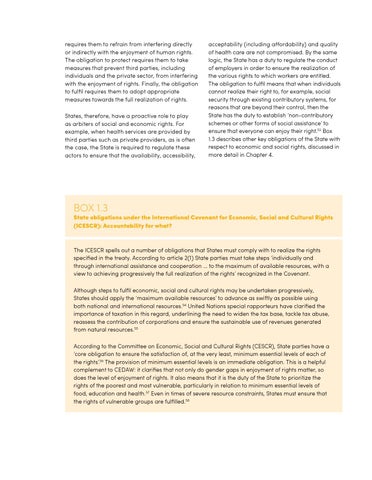
SUBSTANTIVE EQUALITY: MAKING RIGHTS REAL FOR WOMEN Laws that establish that women and men have equal rights provide an important basis for demanding and achieving equality in practice. They can be a central reference point for political and cultural struggles, driving changes in social norms and popular attitudes as well as policy shifts. But making women’s rights real requires more than just legal reform. The translation of equality before the law into equal outcomes is not automatic. Even where gender-equal laws have been put into place, entrenched inequalities, discriminatory social norms, harmful customary practices, as well as dominant patterns of economic development can undermine their implementation and positive impact. International human rights treaties—such as the Convention on the Elimination of All Forms of Discrimination against Women (CEDAW) and the International Covenant on Economic, Social and Cultural Rights (ICESCR)— are legally binding commitments that require States to respect, protect and fulfil women’s rights. As such, they encapsulate a substantive understanding of gender equality that can serve as both a vision and an agenda for action for those seeking to advance women’s rights in today’s challenging context. While formal equality refers to the adoption of laws and policies that treat women and men equally, substantive equality is concerned with the results and outcomes of these,
‘ensuring that they do not maintain, but rather alleviate, the inherent disadvantage that particular groups experience’.13 This Report uses international human rights standards to assess laws and policies for their actual effect on women and girls on the ground. From this perspective, the achievement of substantive equality requires action in three interrelated areas: redressing women’s socioeconomic disadvantage; addressing stereotyping, stigma and violence; and strengthening women’s agency, voice and participation (see Figure 1.4). Coordinated public action across all three of these dimensions has the potential to trigger lasting transformations in structures and institutions that constrain women’s enjoyment of their rights. More of the same will not do for women and girls. While numerical parity in access to education, employment or social protection is an important goal, it does not mean concrete enjoyment of rights or substantive equality. Rather than simply absorbing more girls into fragile and underfunded educational systems, schools must provide a safe learning environment for girls and boys, should aim to provide quality education and should contribute to the promotion of equality through progressive curricula and well trained teachers. Rather than incorporating more women into increasingly precarious and unrewarding forms of employment, labour markets must be transformed in ways that work for both women and men and benefit society at large. Rather than simply adding paid work or poverty reduction to women’s already long ‘to-do’ lists, responsibilities for income-earning, caregiving and domestic work need to be redistributed more equally, both between women and men and between households and society more broadly. Substantive equality requires fundamental transformation of economic and social institutions, including the beliefs, norms and attitudes that shape them, at every level of society, from households to labour markets and from communities to local, national and global governance institutions. Progress towards substantive equality should be measured against how inclusive it is of the rights of poor and marginalized women and girls. It is
therefore important to look beyond the ‘averages’, to make sure that all women are able to enjoy their rights. Rights are also indivisible: how can women claim the rights to quality health care, to decent working conditions or to own land on which to grow food without having the rights to information about laws, policies and government budget allocations and the right to organize to claim their rights? The right to organize and scrutinize public budgets often drives efforts to ensure public services meet women’s needs better; and having access to a range of high quality services can in turn support women’s right to work, creating powerful synergies.
TRANSFORMING ECONOMIES, REALIZING RIGHTS: AN AGENDA FOR ACTION To support substantive equality, economic and social policies need to work in tandem. Typically, the role of economic policies is seen primarily in terms of promoting economic growth, while social policies are supposed to address its ‘casualties’ by redressing poverty and disadvantage and reducing inequality. But macroeconomic policies can pursue a broader set of goals, including gender equality and social justice. Conversely, well-designed social policies can enhance macroeconomic growth and post-crisis recovery through redistributive measures that increase employment, productivity and aggregate demand. The specific policy package to achieve substantive equality will differ from context to context. Ultimately, the aim is to create a virtuous cycle through the generation of decent work, gender-responsive social protection and social services, alongside enabling macroeconomic policies that prioritize investment in human beings and the fulfilment of social objectives. Action is needed in the following three priority areas to transform economies and realize women’s social and economic rights.
1. Decent work for women
Paid work that is compatible with women’s and men’s shared responsibility for unpaid care and domestic work as well as leisure and learning, where earnings are sufficient to maintain an
13
adequate standard of living and women are treated with respect and dignity, is crucial to advancing gender equality. Yet, this type of work remains scarce and economic policies in all regions are failing to generate enough decent jobs for those who need them. The vast majority of women still work in insecure, informal employment. In South Asia, sub-Saharan Africa and East and South-East Asia (excluding China), more than 75 per cent of all jobs are informal. In rural areas, many women derive their livelihoods through small-scale farming, almost always informal and frequently without any direct pay. Alongside economic policies that can create decent employment, extending labour rights and social protection to those in informal employment, such as domestic workers and homebased workers, is essential to increase the viability and security of their livelihoods. Inspiring initiatives, some led by women, point to ways forward. For example, working with local government and urban planners, street vendors in India and Papua New Guinea have negotiated improved and safer spaces to sell their goods. In Colombia, waste pickers have demanded recognition for the invaluable service they provide and won the right to bid for lucrative municipal contracts. In rural areas, including in Ethiopia, Ghana and Rwanda, enabling women to register land titles in their own names or jointly with husbands, reforming agricultural extension services, supporting women’s organizing in cooperatives and subsidizing their access to inputs and resources has been vital to enhance the productivity and sustainability of women’s agricultural selfemployment. Despite women’s increasing levels of education, gender stereotypes in households and labour markets continue to structure the kinds of work that women and men do, the conditions under which they work and their rewards from work. Occupational segregation by gender means that women are still overwhelmingly clustered in low-paid, poor-quality jobs. The most pernicious impact of segregation is pervasive gender pay gaps, which mean that women are systematically paid less than men for work of equal value. Some
83 per cent of the world’s 53 million domestic workers are women, and their number is increasing steadily in developed and developing countries alike. Working behind closed doors, almost 30 per cent of these women are deprived of any labour rights and more than half of them are not entitled to earn the minimum wage.14 Many also suffer from systematic abuse and violence. For these and millions of other low-income workers, minimum wages are a crucial step towards their enjoyment of the right to an adequate standard of living. Action to end harassment and violence against women in the workplace is also essential to restoring their dignity. Women’s continued heavy responsibilities for unpaid care and domestic work limit the types of work they can undertake, which further reinforces their socio-economic disadvantage. Measures to reduce the drudgery of unpaid work through investment in time-saving infrastructure such as safe water sources within easy reach, can free up women’s time for paid work. Parental leave and childcare services can help women and men with care responsibilities and enable women to enter and remain in the labour market when their children are young if they choose to. Among developing regions, Latin America has seen the most progress in family-friendly policies over the past decade and has also seen the most significant increase in women’s labour force participation.15
2. Gender-responsive social policies
Social transfers—including family allowances, unemployment benefits and pensions—protect women and men in the face of contingencies such as unemployment or old age. They also help families shoulder some of the costs involved in raising children or caring for other dependents— challenges that have become more pressing in the face of population ageing and changing family structures. A growing number of women in both developed and developing countries raise children on their own, and social transfers can make a huge difference for these families. In Brazil and Poland, for example, they reduce poverty rates among single mothers by 21 and 34 per cent, respectively. Social services that directly address women’s rights, including housing, health, education, training and
childcare, are just as important and often have an even greater impact than social transfers in reducing poverty and gender inequality. A comprehensive approach to social policy that combines universal access to social services with social protection through contributory and noncontributory transfer systems is the best way to realize economic and social rights for all without discrimination. Currently, only 27 per cent of the world’s population enjoys full access to social protection, whereas 73 per cent are covered partially or not at all.16 Women are often overrepresented among those who lack access to social protection. The definition of national social protection floors, including basic income security for children, working-age adults, older people and people with disabilities as well as the extension of basic social services to all, therefore holds significant promise for women. The introduction of universal social pensions in countries such as the Plurinational State of Bolivia, Lesotho and Mauritius, for example, has helped close gender gaps and provide women with basic income security in old age. In order to contribute to substantive equality, social policies have to be designed with women’s rights at the centre. Particular care is needed to ensure that policies redress women’s socio-economic disadvantage without either reinforcing gender stereotypes or stigmatizing women for needing support. Policy makers should progressively move towards universal, rather than targeted, transfers and services and eliminate co-payments that compromise affordability of health and education, particularly for poorer women and girls. Where possible, conditions tied to the receipt of transfers should be removed, particularly those that reinforce women’s traditional roles and add to their overall work burdens. Instead, women’s empowerment should be an explicit goal of social protection. Investing in more and better services—including health services, education and training, credit and childcare services—to address women’s needs headon and to bolster their income security in the long term is crucial here. With women’s rights placed at the heart of policy design, sustainable and equitable routes out of poverty are possible.
Investing in social protection and social services may seem daunting in the current economic climate. But it is possible. It has been estimated, for example, that the introduction of universal social pensions would cost around 1 per cent of gross domestic product (GDP) per year in most countries in subSaharan Africa. In many low-income countries these benefits will have to be implemented gradually. But as well as realizing women’s rights, the long-term benefits of social investments—such as maintaining a skilled workforce, healthy and well-nourished children capable of learning and creativity and societies where no one is left behind—will more than outweigh their immediate costs.17
3. Rights-based macroeconomic policies
Because macroeconomic policy is treated as ‘gender-neutral’ it has, to date, failed to support the achievement of substantive equality for women. From a human rights perspective, macroeconomic policy needs to pursue a broad set of objectives that include the reduction of poverty and gender inequality. Integrating these social objectives would mean: expanding the targets of monetary policy to include creating decent work; mobilizing resources to enable investments in social services and transfers; and creating channels for meaningful participation by civil society organizations, including women’s movements, in macroeconomic decisionmaking. Conventional monetary policy typically has one target—inflation reduction—and a narrow set of policy tools for achieving it. Although managing inflation is an important goal of monetary policy, the benefits of maintaining very low rates of inflation are not clear cut, particularly when trade-offs exist—with employment generation, for example. There are policy choices to be made: in the wake of the 2008 crisis, many central banks changed their approach to monetary policy by stimulating real economic activity rather than focusing exclusively on inflation. In the arena of fiscal policy, countries can raise resources for gender-sensitive social protection and social services by enforcing existing tax obligations, reprioritizing expenditure and
15
expanding the overall tax base, as well as through international borrowing and development assistance. Several developing countries, including Ecuador, Lesotho and Thailand, have taken advantage of debt restructuring in order to free up resources for social protection.18 Other countries such as Cambodia, Costa Rica and Sri Lanka have reduced defence and security expenditures to support increased social spending. Some countries, such as the Plurinational State of Bolivia and Botswana, have used revenues generated from natural resource extraction to finance their social protection systems, including health-care programmes, income support for vulnerable populations and old-age pensions. Deficit spending is another option. Such spending is usually justified for ‘hard’ infrastructure projects that are classified as ‘investments’. While spending on education, health or water and sanitation is often seen as ‘consumption’, it can actually raise productivity, encourage private investment and stimulate higher rates of growth that can generate the taxes needed to pay back the debt. There are therefore strong grounds for using deficit spending to finance social protection and basic social services, since critical investments in human capacities can ultimately create stronger economies and fairer societies. Tax systems can also be used to redistribute income and redress women’s socio-economic disadvantage by ensuring that women and marginalized groups are not disproportionately burdened. For example, value-added and sales taxes on basic consumption items should be exempted or zerorated, since such spending absorbs a large share of poorer people’s and specifically women’s income. Meanwhile, tax exemptions and allowances that primarily benefit wealthier groups can be minimized or removed to ensure these groups contribute their fair share. Gender-responsive budgeting is increasingly being used to assess and guide revenue collection and spending decisions. In the United Republic of Tanzania, for example, primary school fees were abolished and farm input subsidies were reintroduced in response to genderresponsive budget initiatives led by women’s rights organizations.
Global policy coordination is essential to create a macroeconomic environment that is conducive to the realization of women’s rights. The growing integration of the world’s economies means that actions taken by one government affect the realization of rights elsewhere. Moreover, the proliferation of agreements to liberalize trade and financial flows between countries limits the policy space of individual governments. The lack of global coordination also affects the ability of governments to mobilize resources. Multinational corporations, for example, use a variety of accounting techniques to lower their tax obligations, thereby diminishing their overall contribution to the economies where they operate. Estimates of tax revenue lost to developing countries due to trade mispricing alone amount to an estimated US$98 to $106 billion per year, nearly $20 billion more than the annual capital costs needed to achieve universal water and sanitation coverage by 2015.19 The current system of global governance exacerbates, rather than mitigates, the gender bias in macroeconomic policy. In most existing institutions, including the International Monetary Fund, the World Bank, the G20 and the World Trade Organization, power relations are such that governments of the poorest countries do not have an equal say in the decisions that affect them the most, let alone women in those countries. Global cooperation for the realization of economic and social rights can only be achieved if these institutions are democratized and powerful global players, from national governments to transnational corporations, accept that the obligation to respect, protect and fulfil human rights extends beyond borders.
SHARING RESPONSIBILITY AND ACTING COLLECTIVELY FOR WOMEN’S RIGHTS Human rights treaties have been used as the basis for new national legislation—for example, to address violence against women. But the power of human rights goes beyond the legislative domain. They provide the ethical basis and inspiration for collective action to change policies as well as social norms, attitudes and practices. Human
rights principles are also an important basis for the design of policies, for monitoring their implementation and outcomes and for holding all duty-bearers—States as well as global institutions and corporations—to account for the realization of substantive equality. Human rights emphasize the dignity and freedom of the individual, but their realization depends heavily on solidarity and collective action. Putting in place policies for substantive equality requires collective financing, ideally through progressive taxation. The narrow targeting of social protection to the poorest households may seem to make it more affordable than building universal systems that benefit everyone. But universal systems can actually expand financing options by increasing the willingness of middle and higher income groups to pay taxes for well-functioning education, health or pension systems that they would also use.20 Collective action is crucial as well. Women who experience multiple and intersecting forms of discrimination need to first understand and claim their rights—something that often happens when women get together to discuss their grievances and act collectively to seek solutions. Women workers, including those in informal employment, have
set up their own organizations to represent their interests in the workplace. Women’s organizing and the strength of their autonomous movements are the strongest predictors of gender equality laws and policies across a range of areas from family law to violence against women and from non-discrimination in employment to childcare services.21 Women’s collective action has also been crucial for ensuring the translation of legal rights into the effective delivery of services on the ground, as well as for demanding accountability and redress for major delivery failures. The potential to advance towards substantive equality is greatest when the claims of organized groups of women find openings and receptivity among actors in positions of power, and when there are mechanisms in place—such as public consultation and petitioning processes, or parliamentary committees—through which women can legitimately articulate their claims and policy demands. The success of autonomous women’s movements in mobilizing for women’s rights critically depends on the alliances women are able to build with other social justice movements, and with sympathetic insiders in political parties, parliaments, government bureaucracies, research institutions and international organizations.
17
MAKING PROGRESS/STORIES OF CHANGE
MAKING RIGHTS REAL Transforming women’s lives in north-eastern Brazil
When Maria Jose Pereira was growing up in the rural town of Escada, her father’s tools were off limits. “Everyone in my house worked in construction. My father and brothers were all stonemasons,” Maria says. “I wanted to work with them, but they said I couldn’t because I was a woman.” Thanks to a groundbreaking government initiative, Maria has now proven her family wrong. Not only is she a licensed stonemason, she is also a plumber and electrician.
Chapéu de Palha Mulher, which is derived from ‘straw hat’ in Portuguese, is a social inclusion programme that provides professional training for women living in poor rural communities in the north-eastern state of Pernambuco. Launched in 2007, the programme was created by the state’s Secretariat for Women’s Policies in order to provide alternatives for female sugarcane farmers during the offharvest months.
Cristina Buarque, former State Secretary for Women’s Policies, Pernambuco, watches women from the Chapeu de Palha Mulher programme fish for shrimp in the River Goiana Photo: UN Women/Lianne Milton
19
“Most of these women did not choose to work in the plantations, they usually went with their husbands or fathers,” Cristina Buarque, who led the Secretariat until late 2014, says. “This patriarchal ‘machista’ culture infantilized them. We wanted them to know they had other options.” According to Cristina, women working in the fields were not provided with the same training or compensation as their male counterparts. They were often victims of discrimination, verbal and physical assault and domestic violence. For Maria, who worked in the fields for five years, the job was draining. “It was very difficult. I would spend twelve hours under the hot sun picking sugarcane with my hands full of blisters,” she recalls. “After that, I would come home and have to clean and cook for my husband and kids.”
Chapéu de Palha Mulher provides women with a mandatory three month course in public policy, and a small monthly stipend and childcare to support their participation. The course, taught by feminist trainers, teaches women
about rights and citizenship, covering topics such as the history of slavery; the struggle of women, black and indigenous people for equality; gender stereotypes; and the government’s human rights commitments under the Constitution. Once the participants complete this stage, they choose a professional training course, often opting to develop skills for traditionally male-oriented jobs. “The course is a key component to Chapéu de Palha Mulher,” Cristina explains. “We needed these women to understand how their local government works and what their rights as individuals are in order to train better professionals and better citizens.” Cristina was instrumental in designing the Chapéu de Palha Mulher programme. She was handpicked in 2007 by the late former governor Eduardo Campos to lead the Secretariat for Women’s Policies.
“The patriarchal `machista’ culture infantilized the women. We wanted them to know they had other options”
“I wasn’t a politician, I came from an academic research background,” Cristina says. “When I was approached to do this work, I knew this was an opportunity to bring the work I was a passionate about to a larger scale.” When she joined the state government, Cristina was
Maracatu de baque is an Afro-Indigenous dance typically performed by all men, but women in Pernambuco formed the first and only all-female group to perform the dance Photo: UN Women/Lianne Milton
the only woman serving among 24 other secretaries. Through Chapéu de Palha Mulher, she integrated the work of different departments and more than 40 women’s organizations, helping to strengthen the relationship between the government and civil society. “We wanted the women to learn how to take better care of their bodies, so we called upon the health secretariat. We wanted them to learn how to read and write, so we called on the education secretariat,” Cristina says. “However, the people working on the ground were in the local women’s organizations. We knew their participation was crucial.” In addition to learning new skills, the programme brought women together. Many, like Angela, who chose to identify herself by first name only, found a sense of community within the classroom. “My husband would beat me constantly,” Angela says, who escaped her abusive marriage. “I never had anyone to turn to. Now I know I can count on these women.” Nearly 100,000 women have participated in the programme since 2007, which has expanded to 89 municipalities in Pernambuco to include rural women working in fruit plantations and artisanal fishing. There are also plans to open a school in the town of Pesqueira, where courses will be offered year-round. Cristina resigned from the Secretariat last August shortly after a fatal plane crash killed presidential candidate Eduardo Campos, the former governor who first appointed her to office. “I’m proud of the work I did in the secretariat, but it was time for me to move on,” Cristina says. She is hopeful that the work will be continued under the new governor, Paulo Câmara and the new Secretaria da Mulher, Silvia Cordeiro. Silvia comes to the Secretariat having led one of the local women’s organizations that has been so instrumental to the programme’s success. Back in the sleepy town of Escada, Maria examines the water valve she recently installed in her shower. Her home has become the canvas on which she practices the skills she learned in Chapéu de Palha Mulher. “We were having problems with the electricity, so I fixed it,” Maria says. “I also worked on the plumbing. My next project will be laying down ceramic tile in the kitchen and bathroom.”
Photo: UN Women/Lianne Milton
“The people working on the ground were in the local women’s organizations. We knew their participation was crucial” She has also begun remodeling a neighbour’s home with one of her Chapéu de Palha Mulher classmates. “I love looking at the repairs in my house and other jobs and knowing that I am the one who did them,” Maria says, as she opens the faucet in the kitchen and lets the water run. “I am the one who fixed this, I did this with my own two hands.”
Story: Flora Charner. For more information on Chapeu de Palha Mulher see Cornwall 2015, 2012 and A Quiet Revolution (https://vimeo.com/44520506).
21
/1
SUBSTANTIVE EQUALITY FOR WOMEN: The challenge for public policy
23
IN BRIEF
/1
/2 /3 /4
Laws that establish women and men’s equal rights provide an important basis for demanding and achieving gender equality in practice. But equality before the law is not enough to ensure women’s enjoyment of their rights: power inequalities, structural constraints and discriminatory social norms and practices also need to be addressed. International human rights standards provide an understanding of gender equality—substantive equality for women—that goes beyond formal equality to emphasize women’s enjoyment of their rights in practice. Equality should be understood in relation not only to opportunities but also to outcomes. Unequal outcomes may result from indirect as well as direct discrimination, and ‘different treatment’ might be required to achieve equality in practice. Progress towards substantive equality for women requires public action on three interrelated fronts: redressing socioeconomic disadvantage; addressing stereotyping, stigma and violence; and strengthening agency, voice and participation. Transformation in women’s lives happens when actions along these three dimensions reinforce each other.
/5 /6 /7
The international human rights system clarifies the obligations of States to respect, protect and fulfil human rights. States, therefore, have a proactive role as arbiters of social and economic rights. In an increasingly integrated global economy, where state functions are often ‘outsourced’, the realization of women’s economic and social rights requires a wider framework of accountability, which encompasses the private sector, States’ actions outside their own borders and international organizations. Women’s collective action strengthens accountability for women’s human rights, by legitimizing these rights as issues of public concern and building the capacity of women who experience multiple forms of discrimination, to claim their rights.
25
INTRODUCTION This Report reflects on the ‘progress of the world’s women’ at a critical moment, 20 years after the Fourth World Conference on Women in Beijing set out an ambitious agenda to advance gender equality. As the global community is defining the Sustainable Development Goals (SDGs) for the post-2015 era, it takes stock and draws lessons from policy experiences around the world to chart a forward-looking agenda for action. Has the vision of gender equality set out in the Beijing Declaration and Platform for Action become a reality for women everywhere? This Report draws on experiences, evidence and analysis from diverse national and regional contexts to answer this question. It reviews women’s gains in obtaining equality before the law, access to education and other social services; in increasing their visibility as political actors; in participation in paid work and its benefits; and in increased public recognition of the scale and severity of the violence they experience. But it also asks why progress in ensuring women’s practical enjoyment of a range of economic and social rights has been so slow and uneven across countries and between social groups. At a time when the world has witnessed such impressive gains in material wealth, why are millions of women denied their right to even basic levels of health care, water and sanitation? Why does living in a rural area continue to increase a woman’s risk of dying in pregnancy or childbirth? Why are women still more likely than men to have no income security in their old age? And why are the inequalities among women widening, leaving millions of poor women behind? In seeking to understand why progress in women’s enjoyment of their rights has been
slow and uneven, this Report shares experiences from women’s rights advocates and movements around the world. Their struggles underline how persistent and pervasive discriminatory social norms, stereotypes, stigma and violence remain, holding back women and girls everywhere from realizing their full potential.
Multiple and rising inequalities
The realization of women’s rights cannot be separated from broader questions of economic and social justice. Militarism and violent conflicts, the global financial and economic crises, volatile food and energy prices, food insecurity and climate change have intensified inequalities and vulnerability, with specific impacts on women and girls. Dominant patterns of development have led to increasingly precarious livelihoods. As of 2011, 1 billion people live in extreme poverty1 and many more survive without access to basic services and social protection, exposed to recurring economic shocks, ecological crises, health epidemics and armed conflict. Alongside poverty and vulnerability, levels of inequality are rising both across and within countries.2 The world is said to be more unequal today than at any point since World War II. The richest 1 per cent of the population now owns about 40 per cent of the available assets while the bottom half owns 1 per cent or less.3 These inequalities—among the triggers of the 2008 economic crisis—have been further reinforced by the subsequent recession and austerity measures. Public spending cuts have shifted the burden of coping and caring into the household and onto the shoulders of women and girls.4 Rising levels of inequality compromise the advancement of women’s rights by reinforcing inequalities among women, making it harder for them to join forces across class, racial and other divides.
No empowerment without rights
justice but also a safe place to live, medical care and a job so she can maintain an adequate standard of living for herself and any dependents she may have.9 Her rights to housing, health care and work are distinct but indivisible. Economic and social rights are closely interlinked with all other rights, especially the civil and political rights that enable women’s organizing and claimsmaking. Conversely, an enabling economic environment is an important foundation for States’ capacity to respect and fulfil other rights.
Synergies between women’s economic empowerment and wider prosperity clearly need to be nurtured. Increasing women’s ownership and control over agricultural assets and productive resources is likely to have a positive impact on food security and livelihood sustainability for the whole household.6 Women’s participation in the workforce can enhance the competitiveness of export industries.7 A fundamental question, however, is whether the presumed ‘win-win’ scenarios actually expand women’s own practical enjoyment of their rights or simply harness women’s time, knowledge and resourcefulness to serve development ends, with no benefit to women themselves.
Not only are women’s rights seamlessly connected, so are the actions that help advance them. In practice, economic and social policies have to work in tandem to be effective and to enable the realization of rights. Yet, there is a tendency in policy debates to artificially separate the two. The role of economic policies, especially macroeconomic policies, is seen primarily in terms of promoting economic growth, while social policies are supposed to address its ‘casualties’ by redressing poverty and inequality.
A wide variety of actors—bilateral and multilateral donor agencies, governments, civil society organizations and, more recently, the private sector—have embraced the goal of women’s economic empowerment. Some see in women a largely untapped market of consumers, while others speak about the opportunity of ‘unleashing the economic power and potential of women’5 as a means to solve the lingering problems caused by the global financial crisis and stalled growth.
Without a monitoring framework solidly anchored in human rights, it is difficult to know whether claims of empowering women stand up to scrutiny. Human rights standards—set out in a range of international treaties to which the great majority of governments have voluntarily signed up— provide a framework of binding principles to which countries must be accountable, irrespective of their economic, social and political characteristics. It is a framework that is centred on the rights and freedoms to which all are entitled by virtue of being human. This Report therefore underlines the centrality of women’s human rights as both the ‘end’ and an effective ‘means’ of development.8
Indivisible rights, synergistic policies
This Report also underlines the indivisibility of rights. The focus is on women’s socio-economic disadvantage, but economic, social, civil and political rights are deeply intertwined. When a woman leaves an abusive relationship, she wants
In fact, macroeconomic policies can support a broader set of goals, including gender equality and the realization of human rights. Macroeconomic management is essential to ensure the availability of resources to support the realization of rights and to provide economic opportunities. Conversely, social services, whether provided through government, private providers or unpaid care and domestic work, have economic effects. Investments in child development, education and health improve productivity and contribute to sustainable growth. Social transfers, such as pensions, family allowances and unemployment benefits, have positive multiplier effects on the economy, especially—but not only—during recessions.
Chapter overview and report structure
This Report aims to bridge the gap between global discussions of human rights, on the one hand, and the deliberation of policies to support gender equality and women’s empowerment, on the other. Bridging this divide is essential if public policies are to rise to the challenge of making rights real for all women.
27
This chapter elaborates the Report’s central and guiding concept: substantive equality for women. The first section discusses progress towards equality before the law in various domains, highlighting advances as well as setbacks, underscoring that having legal rights on the statute is no guarantee that women can actually exercise or enjoy those rights in practice. The second section draws on human rights principles and norms to elaborate on the understanding of substantive equality. It shows the need to address both direct and indirect forms of discrimination as well as structural inequalities that constrain women’s enjoyment of rights. Finally, the third section proposes a three-part framework for advancing substantive equality,
which requires progress in: redressing women’s socio-economic disadvantage; addressing stereotyping, stigma and violence against women; and strengthening women’s agency, voice and participation. The framework guides the Report’s identification and assessment in subsequent chapters of the range of economic and social policies that are likely to enhance women’s enjoyment of rights in relation to work and care (Chapter 2), social protection and social services (Chapter 3) and the macro-economy (Chapter 4). Tackling all three dimensions can lay the foundation for lasting transformation of social structures and institutions—families, markets, States—that currently hamper women’s enjoyment of rights.10
EQUALITY BEFORE THE LAW: PROGRESS, SETBACKS AND LIMITATIONS Equality before the law is crucial for gender equality. Laws that establish that women and men have equal rights provide the basis for demanding and achieving equality in practice. They are a touchstone for political and cultural struggles, set standards and incentives for changes in social norms and attitudes and influence shifts in policy. It would be hard to find a country in the world that has successfully tackled entrenched gender or racial discrimination without any constitutional or legal reform.11 It is therefore not surprising that women’s movements have so often mobilized to demand changes in the law.
movements. Within less than a century, women have gained the right to vote and to stand for office in virtually every country of the world.12 Progress is also evident in other areas of the law: as of 2014, 143 countries guarantee equality between women and men in their constitutions; 132 have equalized the minimum age of marriage (without parental consent) at 18 years or older, protecting girls from early marriage; at least 119 have passed legislation on domestic violence; and 125 have passed laws to make workplaces and public spaces safer for women by prohibiting sexual harassment (see Figure 1.1).
PROGRESS IN LEGAL REFORM
Reforming discriminatory family laws
Progress in achieving women’s civil and political rights has been a key achievement of women’s
Progress towards equality before the law has been less consistent on family laws, also called personal status laws. Often derived from customary or
Figure 1.1 Number of countries with or without select women’s rights provisions, 2014 The majority of countries now have laws in place on some key aspects of women’s rights
Have passed laws on domestic violencea Have passed laws to prohibit sexual harassmenta Have equalized the minimum age of marriageb Guarantee equality between women and men in their constitutionsc
119
42
125
34 34
36
132
63
Yes No
52
143
No information
Number of countries
Source: a. OECD 2015. b. UN Women’s analysis of statutory legal age of marriage data from UN Statistics Division 2014b. c. UN Women 2015. Note: The number of countries that have passed laws on domestic violence and those prohibiting sexual harassment excludes countries where legislation is either planned, drafted or being reviewed. Domestic violence is gender-specific violence commonly directed against women, occurring in the family and interpersonal relationships, which can be in the form of physical, emotional or psychological, sexual, or financial or economic abuse. For the definition of sexual harassment, refer to Annex 3.
religious laws, family laws are of particular significance for women because they regulate gender and age hierarchies embedded within the ‘private sphere’ of the home, by shaping the rights and obligations of spouses in marriage and divorce, the relationship between parents and children, marital property, child custody or guardianship and inheritance. These laws shape power relations between women and men, parents and children and brothers and sisters. They also have a direct impact on women’s ability to access and control resources.13 Reform to such laws, and changes in the practices that surround them, are necessary for women to be able to claim fundamental rights to personhood. Data on equality between women and men in family laws covering 71 countries and spanning a 30-year time span (1975–2005) show that progress on this front has been mixed. While 18 countries started the period with family laws that were fully in line with gender equality, a further 15 had achieved this goal by 2005.14 Therefore, by 2005, women in 33 out of 71 countries had acquired equal rights within the family, enabling
them to make decisions about their children and to engage in employment without requiring the permission of a spouse, for example. The remaining 38 countries covered by the study had not fully transitioned towards genderequal family laws by 2005. Some of these countries - including Morocco, the Republic of Korea and Turkey— began the period with extensive discriminatory provisions, but have since advanced significantly towards more gender-equal family laws. However, as of 2005, eight countries—Algeria, Bangladesh, Egypt, the Islamic Republic of Iran, Jordan, Malaysia, Pakistan and Saudi Arabia— had maintained highly discriminatory laws that, for example, endorse men’s authority over women in marriage, give men greater rights over property and limit women’s ability to file for divorce.15 These countries span different regions but all apply a conservative interpretation of Islamic family law. By contrast, in Morocco, women’s rights advocates were able to spearhead extensive reforms in family law that appealed to both Islamic and human rights precepts (see Box 1.1).
29
BOX 1.1
Women’s collective action paves the way to legal reform in Morocco
In 2004, Morocco overhauled its Islamic family law, the Moudawana, as a result of longstanding mobilization by the women’s rights movement.16 Women’s rights activists first started to rally in the early 1990s, launching a grassroots campaign for Moudawana reform that collected over 1 million signatures. Minor reforms of the family law took place in 1993, but major changes were resisted. Shifts in political leadership in the late 1990s—including the victory of a socialist opposition party and the ascendance to the throne of King Mohamed VI—enhanced support for political liberalization and gender equality, enabling women’s demands to be heard. At the same time, growing public support for women’s rights triggered a backlash from conservative Islamist groups. Women’s rights advocates responded to this challenge by establishing alliances with other change-oriented forces, engaging in public awareness campaigns and framing their claims in ways that appealed to Islamic precepts as well as to universal human rights principles. The reformed 2004 law remains faithful to Islamic values and traditions while giving women significantly more rights. In particular, it introduces women’s right to autonomous decision-making by abolishing the notion of male guardianship and the wife’s duty of obedience; establishes equal rights and responsibilities in the family; and equalizes and expands women’s and men’s rights to initiate divorce. The 2004 reform of the Moudawana paved the way for further changes in the law. Most significantly, the 2011 Constitution guarantees equality between women and men, prohibits all forms of discrimination against women and requires the State to promote women’s rights in their entirety. While these momentous changes have been welcome, considerable work remains to be done in aligning all domestic laws with international human rights treaties to which Morocco is a State party and ensuring that all groups of women benefit from the equal protection of the law (see story: Counting women in).
Political agency is key to family law reform
What explains why some countries have made significant progress in legal reform but not others? Analysis of data across these 71 countries suggests that women’s political agency, especially the influence of autonomous feminist movements, is an important catalyst for family law reform.17 In both authoritarian and democratic settings, women’s rights advocates have seized political opportunities for equality-enhancing legal reforms by establishing alliances with other actors, including government officials, lawyers, politicians and development practitioners. Civic pressure alone is not enough, however; there must also be receptivity on the part of the state for change to happen.
What factors determine the disposition of the state toward family law reform? Analysis reveals that there is a powerful association between the character of the state-religion relationship and the degree of gender equality in family law. In countries where the state plays an active role in upholding religious practices, doctrines and institutions, family law tends to discriminate against women. In contexts where political and ecclesiastical institutions are more separated, family law tends to be more egalitarian. This is not to suggest that religions are inherently patriarchal; they are only historically so (as are most secular traditions). The key finding is that religious doctrine is less likely to evolve and
lumped together in post-colonial States. The existence of plural legal systems based on cultural or religious identity can pose particular challenges to women seeking justice.19
adapt to changing social practices where it is upheld by the state. In such contexts patriarchal interpretations of religion get frozen, and it becomes hard to reform family law. Challenges to the religious interpretations endorsed by the law come to be seen as challenges to the entire institutional configuration, binding state power and religious authority.18
Even where progress towards equality in family laws has been achieved, sustaining this progress can be challenging, especially in countries where conservative forces and extremist groups that resist gender equality are gaining ground. These groups, in developed and developing countries alike, misuse religion, tradition and culture to reshape laws, state institutions and social norms to curtail women’s and girls’ human rights and entrench stereotypical gender roles, both within the ‘private sphere’ as well as in public life.20 To resist this rollback and make it clear that culture and religion cannot be a justification for the violation of rights, alliances between women’s
Historical legacies also influence the scope for legal equality. Countries that experienced communist rule often have gender-equal family laws due to communist governments promoting changes in women’s roles in order to encourage full employment and to marginalize religion and traditional cultures. The legacy of British colonialism, by contrast, has been to stymie reform by creating multiple family laws on the basis of cultural identities of the communities
Figure 1.2
100
100
100
100 100
100 100
78 69 66
67
76
83
87
85 85
59
60
70
80
77
Equal property rights in marriage
33 33
40
17 17
20 0 0
0 1990 2010 CEECA
1990 2010 Developed
1990 2010 EAP
1990 2010 LAC
Equal inheritance (sons and daughters)
0 0
Percentage of countries
85
92
92
100 100 100
100 100 100
100 100 100
100
100 100 100
Gender equality in property ownership and inheritance law by region, 1990 and 2010 There has been progress in some regions, but in others discriminatory laws remain in place
1990 2010 MENA
1990 2010 SA
1990 2010 SSA
Equal inheritance (surviving spouse)
Source: UN Women calculations using data from World Bank 2015c. Note: The indicator ‘equal property right in marriage’ measures whether there are gender-based differences in rights to own, manage or dispose of property for married women and men. However, the measure does not capture differences in how property rights are handled in the case of divorce. For instance, in a number of MENA countries women can own property within marriage, but their right to this property is not automatic upon divorce (see UNICEF 2011a). Equal inheritance (between sons and daughters) refers to whether there are gender-based differences in the rules of intestate succession (that is, in the absence of a will) for property from parents to children. And equal inheritance of surviving spouse means both spouses have equal rank and rights when it comes to inheriting assets in the absence of a will. Regions are as follows: CEECA (Central and Eastern Europe and Central Asia); Developed (Developed Regions); EAP (East Asia and the Pacific); LAC (Latin America and the Caribbean); MENA (Middle East and North Africa); SA (South Asia); SSA (sub-Saharan Africa). See UN Women regional groupings for the list of countries and territories included in each region in Annex 7.
31
rights advocates and other like-minded forces, whether in government or in national and global civil society, are key. Another area of the law where customary and religious provisions are often influential is property ownership and inheritance. As Figure 1.2 shows, there has been significant progress between 1990 and 2010 in reducing legal discrimination against women regarding their ability to inherit and own assets in their own name – although here too progress has been uneven across regions. Central and Eastern Europe and Central Asia and Developed Regions have all but removed legal restrictions on women’s property rights. There has also been tremendous progress in Latin America and the Caribbean. Countries in sub-Saharan Africa,
which began the period with the largest number of legal restrictions compared to other regions, have made significant strides in removing gender based differences in the right to own property. In contrast, progress in reducing gender disparities in legislation has been less impressive in the Middle East and North Africa and in South Asia.21
Reforming women’s legal status at work, parental leave and childcare
What about legal rights that shape women’s access to paid work and equal conditions at work, maternity and parental leave and childcare policies? Based on analysis of more than a dozen laws and policies spanning 70 countries over three decades (1975–2005), a more recent study charts the uneven progress in these areas as well.22
Figure 1.3 Percentage of countries with legal provisions and policies, 1975-2005 An increasing number of countries have introduced laws and policies to equalize women’s status at work and provide maternity leave and childcare services Workplace discrimination 100
Family leave policies 97
Percentage of countries
91
80
40
81 66
64
63
71
74
43
41
20 0
96
83
81
60
Child care
20
1975
1985
1995
Anti-sex discrimination at worka
2005
6
7
1975
1985
Paid maternity leave
1995
2005
1975
1985
1995
2005
National day care policyb
Parental leave Source: Htun and Weldon 2014. Note: Based on a study of legal provisions and policies in 70 countries. Definitions, methodology and sample size differ from data used in Annex 3 (see statistical notes in the Annex). a Measures whether there are laws in place that prohibit discrimination in the workplace, for instance, in hiring, pay, termination of employment, access to training, and equal participation in workplace governance/unions. bMeasures whether a national or federal day care policy exists.
The number of countries with policies that formally entrench sex discrimination in the workplace—for example, by prohibiting women from working in certain types of jobs, doing night work or overtime— declined during this period.23 In 1975, it was most typical not to take action to outlaw discrimination. By 2005, the opposite was true, with most countries outlawing workplace discrimination (see Figure 1.3). For example, in 1975 only about one third of countries had legislated for equal pay; by 2005 the proportion had gone up to 86 per cent.24 Similarly, as Figure 1.3 shows, the number of countries that provide paid maternity leave to working women has increased and there has been a dramatic expansion in parental leave. Moreover, by 2005, more than 81 per cent of countries out of the 70 studied had a national day-care policy in place and 43 per cent had committed to public day-care provision.25 As with family laws, women’s movements have played a pivotal role in pushing for women’s legal rights to work and at work. Women’s organizing on their own behalf has played a critical part in triggering changes with respect to women’s legal right to work—by prohibiting discrimination, for example, or promoting equality in hiring and promotion. Overall income levels were a significant factor for the adoption of maternity and parental leave provisions: without an adequate revenue base, countries are unlikely to adopt publicly-funded paid maternity leave.26 Women’s movements have also been influential in the development of childcare policy and have found useful allies on this issue among political parties with a redistributive agenda.
PERSISTENT INEQUALITIES IN PRACTICE Gaps remain, but in many countries legal barriers preventing women from pursuing the same kind of opportunities and careers as men appear to be diminishing. Nevertheless, widespread gender segregation continues to confine women to the lowest paid segments of the labour market. At home and in their communities, women and girls
continue to assume the lion’s share of unpaid care and domestic work. Gender inequalities with regard to earned income, wealth, time use and social security, documented in detail in Chapters 2 and 3, clearly indicate that something is terribly wrong: why are ‘equal opportunities’ not translating into equal outcomes? It is highly unlikely that women as a group would deliberately and consistently choose less remunerative livelihoods.27 And even if women and men did ‘freely choose’ different livelihood options, why should the economic activities that women typically choose systematically attract a lower valuation in the market than those chosen by men?28
Discriminatory social norms
Even in countries where gender-equal laws have been put in place, power inequalities between women and men as well as gender stereotypes and discriminatory social norms are deeply embedded. In some contexts patriarchal structures and practices constrain women’s ability to seek paid work, or even health care, and to participate in social and political life. Gender stereotypes reinforce norms of gender inequality such as the continued devaluation of ‘women’s work’ or the belief that women and men should be confined to narrow and segregated social roles.29 In the labour market, stereotypes about suitable occupations for women and men serve to maintain the existing gender division of labour. Young women and men who move into occupations that are associated with the opposite sex risk disparagement or ridicule. Women who work in male-dominated sectors may find their performance devalued and their competence questioned. This, in turn, can affect their prospects for receiving promotion or pay awards.30 Men have little incentive to move into female-dominated occupations, given that those jobs often pay less than equivalent jobs that are male-dominated.31 Such stereotypes inevitably influence women and men’s choices, even where legislation provides for ‘equal opportunities’.
33
More broadly, social norms generally assume that women will take primary responsibility for domestic chores and the care of young children and other family members. This limits their participation in the labour market compared to men or confines them to lower quality and lower paid jobs and livelihoods that can be ‘reconciled’ with unpaid work, but often at great cost to women themselves. The power of social norms is such that women sometimes do not claim their legal rights due to pressure on them to conform to societal expectations. For example, even where women can legally inherit land on an equal basis with men, a woman may forego this right in order to maintain good relations with her brothers, whose support she may rely upon in case of marital dispute, widowhood or economic need. This practice is prevalent in many parts of South Asia, especially when women are married far away from their birth villages.32 In 2005, India took a major leap forward by amending the Hindu Succession Act (1956) to grant daughters and sons equal inheritance shares to agricultural land at the national level. In practice, a number of factors have hampered implementation of these provisions on the ground. These include: resistance from brothers against their sisters inheriting parental land; the belief that the dowry constitutes the daughter’s share of her natal family’s property; complicated administrative systems; and women’s own fragmentary understanding of their legal rights.33 Even though most women reported wanting to inherit land, they were reluctant to upset their natal families, especially brothers. To address the gap in the implementation of this important law requires efforts at multiple levels: legal literacy campaigns are needed to raise women’s awareness of their entitlements and erode discriminatory social norms; and legal procedures need to be simplified and
government functionaries trained to increase their responsiveness to women’s land rights. Job creation and social protection measures would also help reduce women’s dependence on family networks for their economic security.
Structural constraints
Where women have secured access to land, this does not always translate into remunerative livelihoods due to various structural constraints that they face. Even subsistence farming requires some capital to buy seeds and tools, but more remunerative cash-crop farming requires more generous outlays. Research from sub-Saharan Africa suggests that the sums of money required to make farming viable are beyond the reach of many women farmers. In addition, women face barriers to their engagement with markets (see Chapter 2).34 Gaining equal outcomes from equal rights legislation is particularly hard for poor working class, ethnic minority or indigenous women. Lack of awareness of their rights and social barriers may prevent such women from coming forward to pursue cases through the formal justice system.35 For example, poor Dalit women in the Indian state of Uttar Pradesh are more likely to experience abuse by service providers, or to come under pressure to pay bribes, compared to wealthier or higher caste women. In such cases, they rarely lodge complaints due to fear of victimization and further abuse.36 Similarly, migrant domestic workers face frequent violations of their rights at work. However, national labour laws often exclude them from coverage and residency laws stipulate that they have to be sponsored by their employers. Financial costs, language barriers and discriminatory attitudes among the judiciary further hamper their recourse to justice.37 In political life, women’s equal rights to vote and to stand for political office are now recognized
in the vast majority of countries. However, ‘equal opportunities’ do not become real just because formal barriers are removed.38 Women continue to be excluded from political office by discriminatory attitudes and ‘old boys’ networks’ in political parties, by lack of funds to run election campaigns and by family responsibilities that clash with the inflexible working hours of political institutions. In recognition of these structural constraints, quotas to increase women’s representation have been
adopted across a number of developing and developed countries alike.39 The understanding that special measures are necessary to overcome the disadvantages that women face can be usefully extended to other domains. Indeed, the need for such measures, to achieve equality in practice has long been recognized in the international human rights system.
SUBSTANTIVE EQUALITY IN HUMAN RIGHTS FRAMEWORKS The international human rights system in general, and the Convention on the Elimination of All Forms of Discrimination against Women (CEDAW) in particular, recognizes the limitations of formal equality in delivering equality in practice. Within the human rights system and its associated treaties, there is strong support for going beyond formal equality and the provision of ‘same treatment’. The concept of substantive equality has been advanced in key human rights treaties to capture this broader understanding: that inequality can be structural and discrimination indirect; that equality has to be understood in relation to outcomes as well as opportunities; and that ‘different treatment’ might be required to achieve equality in practice (see Box 1.2). While formal equality refers to the adoption of laws and policies that treat women and men equally,
substantive equality is concerned with the results and outcomes of these: ‘ensuring that they do not maintain, but rather alleviate, the inherent disadvantage that particular groups experience’.40 The concept of substantive equality arose out of the recognition that—because of the legacy of historical inequalities, structural disadvantages, biological differences and biases in how laws and policies are implemented in practice—formal equality is not enough to ensure that women are able to enjoy the same rights as men. To achieve substantive equality, therefore, requires both direct and indirect discrimination to be addressed. It also requires specific measures to be adopted that redress women’s disadvantages and, in the longer term, the transformation of the institutions and structures that reinforce and reproduce unequal power relations between women and men.
35
BOX 1.2
Substantive equality as defined in the human rights system
Article 1 of CEDAW takes a first step towards advancing the notion of substantive equality in its comprehensive definition of ‘discrimination against women’:
(it) shall mean any distinction, exclusion or restriction made on the basis of sex which has the effect or purpose of impairing or nullifying the recognition, enjoyment or exercise by women, irrespective of their marital status, on a basis of equality of men and women, of human rights and fundamental freedoms in the political, economic, social, cultural, civil or any other field.41 This foundational definition prohibits discriminatory treatment (direct discrimination) as well as discriminatory outcomes (indirect discrimination); it also precludes discrimination that is intended (purposive) as well as unintended (discrimination in effect).42 The need to address equality of outcomes is clearly stated in article 3 of the Convention, which obliges States parties to take all appropriate measures
to ensure the full development and advancement of women, for the purpose of guaranteeing them the exercise and enjoyment of human rights and fundamental freedoms on a basis of equality with men. This emphasis on equality of outcomes is further elaborated in the CEDAW Committee’s landmark General Recommendation No. 25 on temporary special measures, which underlines the insufficiency of a ‘purely legal or programmatic approach’ for ‘achieving de facto equality with men, which the Committee interprets as substantive equality’.43 Similarly, the Committee that monitors implementation of the International Covenant on Economic, Social and Cultural Rights (ICESCR), states that ‘(s)ubstantive equality is concerned, in addition, with the effects of laws, policies and practices and with ensuring that they do not maintain, but rather alleviate, the inherent disadvantage that particular groups experience’.44
Addressing indirect discrimination
The CEDAW Committee’s General Recommendation No. 25 on temporary special measures explicitly prohibits indirect discrimination ‘which may occur when laws, policies and programmes are based on seemingly genderneutral criteria which in their actual effect have a detrimental impact on women’.
Gender-neutral laws, policies and programmes unintentionally may perpetuate
the consequences of past discrimination. They may be inadvertently modelled on male lifestyles and thus fail to take into account aspects of women’s life experiences which may differ from those of men. These differences may exist because of stereotypical expectations, attitudes and behaviour directed towards women which are based on the biological differences between women and men. They may also exist because of the generally existing subordination of women by men.45
In other words, ‘discrimination includes any treatment that has the effect of nullifying the enjoyment of human rights by women in all spheres, though such discriminatory effect was not intended’.46 Thus, even where unequal outcomes cannot be attributed to particular, conscious acts, this does not mean that discrimination is not happening. This contrasts with a narrow understanding of discrimination as the intended acts of individuals, which suggests that if there is no intent then there cannot be discrimination.
and promoting the structural, social and cultural changes necessary for the realization of women’s substantive equality. The CEDAW Committee has clarified that such measures should ‘not be deemed necessary forever, even though the meaning of ‘temporary’ may, in fact, result in the application of such measures for a long period of time’. The Committee goes on to explain that such measures may be discontinued ‘when their desired results have been achieved and sustained for a period of time’.50
An example is the austerity measures adopted since 2010 in many countries across the world to reduce budgetary deficits. These do not specifically intend to hurt any particular group, but evidence suggests that they are strongly biased against low-income households, and especially against women within them.47 In the January 2015 Universal Periodic Review (UPR) by the Human Rights Council, for example, Spain came under criticism from its peers for the harsh impact of its austerity measures, especially on women, migrants, people with disabilities and children.48 The concept of indirect discrimination serves to emphasize how seemingly ‘neutral’ policies or practices can act to put some groups at a disadvantage due to structural and historical inequalities.
To enable the equal enjoyment of rights, States must take positive steps to eliminate all forms of discrimination against women, including structural and indirect discrimination. In doing so they can build on the foundations of formal equality, but also need to go further to ensure that the effects of laws, policies and practices redress the disadvantage that women experience.
The need for temporary special measures
CEDAW also makes it clear that non-identical treatment aimed at redressing women’s disadvantages may be necessary to facilitate the achievement of substantive equality for women.49 The idea that ‘same treatment’ is not sufficient to achieve substantive equality and nondiscrimination is also recognized by other human rights treaties, such as the Convention on the Elimination of Racial Discrimination (CERD), which recommends ‘special measures’ to be put in place (article 1). Article 4(1) of CEDAW promotes the use of ‘temporary special measures’, which are aimed at ‘accelerating de facto equality between women and men’ by remedying the effects of past or present discrimination against women
WHO HAS OBLIGATIONS TO UPHOLD WOMEN’S ECONOMIC AND SOCIAL RIGHTS? In addition to CEDAW, which is a vital reference point for understanding the meaning of gender equality, the International Covenant on Economic, Social and Cultural Rights (ICESCR) and the work of the committee that supervises its work, are also essential to understanding and addressing women’s economic and social rights.51 The ICESCR covers the realization of economic and social rights in great depth. Specifically, it addresses the rights to work and to just and favourable conditions of work (articles 6 and 7), the realization of which is extensively explored in Chapter 2 of this Report. The Covenant also includes the right to social security and an adequate standard of living (articles 9 and 11), which are tackled in Chapter 3. In several of its articles the Covenant makes specific references to women’s rights, including to equal pay (article 7) and paid maternity leave (article 10). The international human rights system has helped clarify the duties of States to respect, protect and fulfil rights.52 The obligation to respect
37
requires them to refrain from interfering directly or indirectly with the enjoyment of human rights. The obligation to protect requires them to take measures that prevent third parties, including individuals and the private sector, from interfering with the enjoyment of rights. Finally, the obligation to fulfil requires them to adopt appropriate measures towards the full realization of rights. States, therefore, have a proactive role to play as arbiters of social and economic rights. For example, when health services are provided by third parties such as private providers, as is often the case, the State is required to regulate these actors to ensure that the availability, accessibility,
acceptability (including affordability) and quality of health care are not compromised. By the same logic, the State has a duty to regulate the conduct of employers in order to ensure the realization of the various rights to which workers are entitled. The obligation to fulfil means that when individuals cannot realize their right to, for example, social security through existing contributory systems, for reasons that are beyond their control, then the State has the duty to establish ‘non-contributory schemes or other forms of social assistance’ to ensure that everyone can enjoy their right.53 Box 1.3 describes other key obligations of the State with respect to economic and social rights, discussed in more detail in Chapter 4.
BOX 1.3
State obligations under the International Covenant for Economic, Social and Cultural Rights (ICESCR): Accountability for what?
The ICESCR spells out a number of obligations that States must comply with to realize the rights specified in the treaty. According to article 2(1) State parties must take steps ‘individually and through international assistance and cooperation … to the maximum of available resources, with a view to achieving progressively the full realization of the rights’ recognized in the Covenant. Although steps to fulfil economic, social and cultural rights may be undertaken progressively, States should apply the ‘maximum available resources’ to advance as swiftly as possible using both national and international resources.54 United Nations special rapporteurs have clarified the importance of taxation in this regard, underlining the need to widen the tax base, tackle tax abuse, reassess the contribution of corporations and ensure the sustainable use of revenues generated from natural resources.55 According to the Committee on Economic, Social and Cultural Rights (CESCR), State parties have a ‘core obligation to ensure the satisfaction of, at the very least, minimum essential levels of each of the rights’.56 The provision of minimum essential levels is an immediate obligation. This is a helpful complement to CEDAW: it clarifies that not only do gender gaps in enjoyment of rights matter, so does the level of enjoyment of rights. It also means that it is the duty of the State to prioritize the rights of the poorest and most vulnerable, particularly in relation to minimum essential levels of food, education and health.57 Even in times of severe resource constraints, States must ensure that the rights of vulnerable groups are fulfilled.58
States must also guard against deliberate retrogression (backsliding)—for example, cuts to expenditures on public services that are critical for the realization of economic and social rights or cuts to taxes that are necessary to fund such services.59 Even in the context of economic crisis, governments are required to apply these principles.60 Another immediate obligation is ensuring non-discrimination in the enjoyment of economic, social and cultural rights.61 This means any steps that a State takes to progressively realize such rights must be non-discriminatory in both policy and effect. Finally, the right of individuals to participate is an ‘integral component’ of any policy or practice that seeks to meet the State’s obligation to ensure the equal rights of women and men to the enjoyment of all human rights.62
Enlarged web of accountability
Under international human rights law, States are primary duty-bearers with respect to the protection and fulfilment of the rights of those within their jurisdiction. At the national level, human rights are the concern of all ministries—not only health, education, housing and employment but also finance, planning, trade and central banks—as well as local, municipal and regional governments. However, in today’s increasingly integrated global economy, where States are also undergoing political decentralization and ‘outsourcing’ public service provision and other functions, state accountability for human rights lies within ‘a larger web of accountability’.63 The latter encompasses not only the range of state agencies operating at different levels but also the private sector, other governments and international organizations. Non-state actors are answerable to the wider public for how their actions affect the realization of human rights, including social and economic rights. This particularly applies to the private sector, which has an important role to play in economic development and employment generation. The turn to ‘corporate social responsibility’ (CSR), and later to corporate accountability, is part of
a response not only to market failure but also to ‘the perceived or real inability of governments, particularly in developing countries, to be effective agents of regulation and development, and providers of essential goods and services’.64 The corporate accountability agenda has evolved considerably over the past two decades to encompass more companies and industries and a broader set of issues, including labour rights, and also to involve trade unions and other civil society organizations alongside companies.65 The percentage of companies involved is still very small, however, and CSR initiatives are more prevalent in sectors where there is concern about ‘reputational risk’ among developed country consumers (e.g., toys, electronics or horticultural products). There is a risk that well-intentioned monitoring initiatives create ‘enclaves of good practices’ that have few linkages to the rest of the economy.66 Ongoing efforts to improve corporate accountability must not divert attention from the need for better regulation and enforcement in all sectors, not just those that produce for export.67 Assessments of the long-term effects of voluntary private sector initiatives on working conditions point to some positive impacts in terms of worker health and safety, payment of minimum wages
39
and reduction of unreasonable overtime but much weaker impacts on gender equality, wage discrimination and freedom of association.68 Furthermore, benefits tend to be limited to regular and permanent workers and fail to reach casualized workforces, especially the large numbers of female temporary and contract workers who work at several degrees of separation from parent firms.69 But voluntary self-regulation is most vulnerable to criticism for its record on enforcement.70 Existing CSR initiatives are unable to ensure the compliance of companies with established human rights standards. In particular, they lack the capacity to impose meaningful sanctions or stipulate appropriate remedial action.71 These failures were starkly shown by the 2013 Rana Plaza factory collapse in Bangladesh, in which more than 1,000 workers were killed. After years of voluntary initiatives to clean up garment global value chains, this disaster has finally spurred stronger action including the binding Bangladesh Accord on Fire and Building Safety, which makes companies legally responsible for making factories safe (see story: Out of the ashes). Meanwhile, at the global level, the 2011 endorsement by the Human Rights Council of the Guiding Principles on Business and Human Rights,72 which affirms that business enterprises have at the very least a duty to respect all human rights in their operations under a ‘do no harm’ standard, is a promising development that may strengthen the accountability of business for human rights. The actions or omissions of transnational corporations, international and regional financial institutions, multilateral development banks, credit rating agencies and private foundations can limit the policy space for States to meet their human rights obligations. In addition, global inequalities mean that actions and omissions by the more powerful States will have adverse repercussions on the capacities of smaller and less powerful States to meet their human rights obligations. In 2013, high-income countries accounted for only 18 per cent of the world’s population but
generated close to 70 per cent of global income.73 The failure of rich countries to regulate volatile financial flows, which triggered the 2008 financial crisis, not only plunged their own economies into recession but also had knock-on effects on the rest of the world. The fiscal deficits that resulted from the crisis have led both developed and developing countries to cut back on public social expenditure, which is threatening to increase poverty and gender inequality.74 There is a need therefore for a set of principles on extra-territorial obligations that provides standards to make governments, international financial institutions, intergovernmental organizations and transnational corporations accountable for actions that affect the realization of rights across the world. This issue is discussed in more detail in Chapter 4. In recognition of the transformations that are taking place within, below and above the State, a multidimensional understanding of human rights accountability is beginning to emerge.75 While this creates more complex lines of accountability, States remain primary duty-bearers and must create conditions in which people under their effective jurisdiction can enjoy their rights, including their economic and social rights.
DEMANDING ACCOUNTABILITY FOR WOMEN’S RIGHTS The notion of substantive equality is premised on an enabling State, one that has positive duties to protect and fulfil rights. But how can these principles be made real so that they define state action on the ground? Some would argue that there is a paradox here: States, which are seen as the main duty-bearers and guarantors of rights, may have neither the capacity nor the political will to protect and promote rights. Worse, they often violate the rights of more disadvantaged social groups. The process of translation—of rights into policies and of policies into real changes in women’s lives—has been extremely uneven around the world.76 How can human rights be used to create the kind of States that respect, protect and fulfil human rights, and women’s rights in particular?
International human rights mechanisms can be very useful in reminding States of their duties vis-à-vis women. In its July 2013 concluding observations on the United Kingdom, for example, the CEDAW Committee raised concerns about the way in which austerity measures adopted by the Government have led to ‘serious cuts in funding for organizations that provide social services to women’, as well as budgetary cuts in the public sector that ‘disproportionately affect women, owing to their concentration in this sector’.77 The fulfilment of human rights is sometimes seen as being contingent on a democratic framework, its minimal conditions being the universal right to participate in elections both as voters and as representatives, regular and free elections, free association and free media.78 In practice, however, the relationship between rights activism and democracy works in more complex ways.79 First, human rights activism on a global level has been so successful that even States that are not formally democratic are signatories to at least some human rights treaties. This creates the possibility for advocates to campaign for measures to support the realization of women’s rights even in non-democratic or weakly democratic political systems. In the process by which States compile their national reports for the CEDAW Committee, for example, women’s rights advocates have the opportunity to prepare their own shadow reports, to comment on the official government report and to campaign for greater policy attention. Activists have used this process and their governments’ commitments under CEDAW to leverage positive change for women’s rights: from family law reform in Fiji in 2003 and Morocco in 2004 (see Box 1.1) to the lengthy campaign for legislation against sexual harassment in India, which was finally successful in 2012.80 This is not to deny that civil society faces huge challenges where freedom of expression and association and the right to information are weak and where mechanisms for holding governments accountable for the violation or inadequate realization of rights are feeble or absent. Civil
and political rights are critical if conditions for accountability are to exist and flourish.81 But even where national political systems are not formally democratic, localized forms of organizing can take place around, for example, labour rights, social rights or women’s civil and political rights. Rights advocacy does not have to wait for a fullyfledged democratic regime to emerge. In fact, the process of claiming rights can itself contribute to building state accountability for women’s rights.82 Second, even in formally democratic settings, the idea of human rights may not be enthusiastically embraced by all. The struggle for human rights has often had to contend with two critical sets of challenges: one is that States may have little or no accountability, especially to poor and disadvantaged social groups; and the other is that inequalities—of gender, race, class, ethnicity and sexual identity—may have become so normalized that they are not perceived as unjust even by those who are most subordinated or who suffer most from discrimination.83
The importance of women’s collective action
The presence of women’s organizations can make a significant difference on both these fronts by legitimizing women’s rights concerns within public policy-making; putting onto the public agenda concerns that were hitherto hidden or deemed ‘private’, such as violation of women’s sexual and reproductive rights; and fostering the capacity of those who experience multiple forms of discrimination to engage in forms of advocacy that resonate with their experience.84 This is evident in grassroots work by non-governmental and women’s organizations in urban slums, rural villages and marginalized migrant communities that seeks to create the time and space for women to meet and discuss their situation and constraints and channel their recommendations on how they would like to change things for the better. Indeed, the relevance of human rights does not lie exclusively in how they are used to inspire new legislation, whether nationally or internationally.85
41
Those whose human rights have been violated can also use them to assert their moral claims. Activists can employ them as a tool to monitor policies or do advocacy work in order to advance the effective reach of acknowledged human rights. Public debate, political campaigns and collective organizing around human rights are also important means to question discriminatory social norms, unequal power relations and unequal distribution of resources and to encourage poor and marginalized women to see themselves as rights holders. Work with marginalized communities must begin with the realities of women’s lives and create the space for critical reflection and sharing of experiences. In doing so activists may not always use the language of human rights as their starting point, preferring to employ notions of fairness and dignity that resonate better with grassroots women.86
Going back to the issue of legal rights with which this chapter began, the reason for putting women’s economic and social rights into law is not only to make them justiciable in court; it can also create the political and societal momentum to ensure that women’s rights can be enjoyed in practice. When economic and social rights are recognized in constitutions and enshrined in laws, it helps build political legitimacy behind them. It can also create a horizon of societal expectations and spur public action. It can help women engage with those who administer the laws and programmes that shape their lives, be they land registration officers, health service providers or public school teachers and administrators.87
SUBSTANTIVE EQUALITY FOR WOMEN: A FRAMEWORK FOR ACTION As the previous sections have shown, a key challenge around the world is transforming formal rights into reality to enable women’s practical enjoyment of their human rights. This is how substantive equality can be achieved. Public action is fundamental to support this process. Based on the work of Sandra Fredman and elaborated by Fredman and Goldblatt (2014), this section proposes a framework, derived from human rights treaties as well as the work of the treaty bodies, to support governments and other key actors to make this change happen.88 The framework identifies three interconnected dimensions along which actions need to be taken in order to transform existing structures and institutions so that all women are able to enjoy their rights:
Redressing women’s socio-economic disadvantage Addressing stereotyping, stigma and violence Strengthening women’s agency, voice and participation.89 This Report puts the spotlight on the first dimension—redressing socio-economic disadvantage—and the achievement of women’s economic and social rights. But as Figure 1.4 shows and the following chapters make clear, women cannot enjoy these rights without action to address stereotyping, stigma and violence and strengthen women’s agency, voice and participation.
Figure 1.4
A FRAMEWORK FOR UNDERSTANDING SUBSTANTIVE EQUALITY REDRESSING SOCIO-ECONOMIC DISADVANTAGE
ADDRESSING STEREOTYPING, STIGMA AND VIOLENCE
STRENGTHENING AGENCY, VOICE AND PARTICIPATION
Introduce universal social transfers that do not stigmatize poor women
Support women’s organizations to influence economic policymaking
Source: Fredman and Goldblatt 2014
Implement minimum wages for all workers
TRANSFORMING INSTITUTIONS AND STRUCTURES
SUBST A NTIVE EQ UALITY 43
Stereotyping, stigma and violence are pernicious means by which gender hierarchies, whether in the labour market or in day-to-day life, are held in place and reinforced. Tackling these is necessary to break down barriers that prevent women from exercising their rights to work and social security, for example. The strengthening of women’s agency and collective voice is an important goal in its own right and has also been a driver of changes in laws, policies and practices that enable the realization of economic and social rights. The lasting transformation of social structures and institutions is possible when changes along these three dimensions—of resources, respect and agency—intersect and work in concert. The remainder of this chapter reviews overall progress towards substantive equality along these different dimensions to set the scene for the more detailed analysis of public policies in subsequent chapters. It addresses three questions: Are economic and social policies redressing women’s socio-economic disadvantage? Are public policies addressing deeply entrenched gender stereotypes, stigma and violence? And does the process of public policy formulation create spaces for different groups of women to act collectively and have their voices heard by policy makers?
REDRESSING WOMEN’S SOCIO-ECONOMIC DISADVANTAGE Women’s socio-economic disadvantage is reflected in pervasive gender inequalities in earned income, property ownership, access to services and time use. The absence of sex disaggregated data makes it difficult to establish if women are, across the board, more likely to live in poverty than men (see Box 1.4). But, globally three quarters of working age men are in the labour force compared to half of working age women. And among those who are employed, women constitute nearly two thirds of contributing family workers, who are employed in family businesses and farms, but receive no direct pay.90 Globally, women earn on average 24 per cent less than men (see Annex 4) and are less likely than men to receive a pension (see Annex 5). This translates into
large lifetime inequalities in income between women and men (see Box 2.4). Yet in all regions women work more than men: on average they do at least two and a half times more unpaid care and domestic work than men, and if paid and unpaid work are combined, women work longer hours than men in nearly all countries (see Annex 3). The root causes of these inequalities lie in unequal power structures that are sustained by laws, social norms and practices, market forces and public policies within both the ‘private sphere’ of home and family and the public arena. Both economic and social policies have a role to play in tackling the causes of these inequalities. Policies need to pay particular attention to ensuring the enjoyment of rights by women and girls from disadvantaged and poorer households who face multiple forms of discrimination. How far have public policies supported the progressive realization of women’s economic and social rights over the past decade? Overall women have made important social gains in many countries in terms of access to education and, to a lesser extent, health services and employment. But it has been difficult to sustain these gains and to translate them into an adequate standard of living. Economic policies have either undermined women’s social gains or failed to support them through improved labour market opportunities. Gender gaps are narrowing in some domains, but entrenched and growing wealth inequalities mean that poorer women are being left behind. To sustain and amplify women’s hard-won gains requires a different set of economic and social policies, as the following chapters will elaborate.
Gaps between rich and poor women and girls
Disaggregated data collected to monitor progress towards the achievement of the Millennium Development Goals (MDGs) since 2000 show that there has been progress for women overall in access to education and health in all regions.91 Nevertheless, country level data show that this progress has been very uneven among different social groups. Particularly alarming is that in many countries a gap remains, or is widening,
BOX 1.4
Gender and poverty: What do we know?
Poverty remains a serious global challenge. There has been progress in reducing extreme poverty since 1990, but 1 billion people—or around 15 per cent of the world’s population—were still living in extreme poverty in 2011. It is unknown how many of those living in poverty are women and girls.92 In part this is because the headcount measure of extreme poverty ($1.25 a day) is estimated using aggregate household level income or consumption data, which makes it difficult to estimate individual rates and hence gender differences in the incidence and severity of poverty. In the absence of data on individual poverty rates, a proxy measure of women’s risk of poverty has been developed where the percentage of working age women living in poor households (defined as the bottom 20 per cent of households) is compared to the percentage of working age men in such households.93 Using this measure, as Figure 1.5 shows, women are more likely to live in poverty in 41 out of 75 countries with data. Many factors contribute to women’s heightened vulnerability to poverty, including unequal access to paid work, lower earnings, lack of social protection and limited access to assets, including land and property (see Chapters 2 and 3). An analysis of the characteristics of poor households indicates that countries where women are at greater risk of poverty also tend to have an over-representation of ‘female-only’ households (i.e., those with no male adults) among the bottom 20 per cent. This suggests a greater risk of poverty among separated women, widows and single mothers, including heads of household without a male partner.94 Even where women and men are both just as likely to live in a poor household, women are more likely to be deprived in other key areas of well-being, such as education, and less likely to have an independent source of income through paid work (see Annex 1), which can result in the uneven distribution of power and resources within the household. Latin America and the Caribbean is the only region where analysis of the poorest households by gender composition has been done over time. It shows not only that women outnumber men among those living in households below the poverty line but also that the proportion of women compared to men in poor households has increased over time: from 108.7 women for every 100 men in 1997 to 117.2 women for every 100 men in 2012. This upward trend has taken place in the context of declining poverty rates for the region as a whole: 44.8 per cent of people lived below the poverty line in 1997 compared to 32.7 per cent in 2012. New social policies directed to the poorest segments of the population have contributed to reductions in poverty in the region, but their impact varies depending on the reach of programmes and the size of transfers.95 Furthermore, the poorest women still face major barriers in accessing decent work. Greater efforts are therefore needed for the realization of women’s rights to and at work if they are to benefit equally from economic growth and poverty reduction.
45
Figure 1.5 Ratio of the share of women to men of prime working age (20-59 years) in the poorest 20 per cent of households Women are more likely than men to live in the poorest households in 41 out of 75 countries
Women more likely than men to live in poor households
Women no more likely than men to live in poor households
Women less likely than men to live in poor households
130 120
Ratio
110 100 90 80
Burundi Rwanda Malawi Gabon Democratic Republic of the Congo Chad Burkina Faso Namibia Cameroon Kenya Nigeria Zimbabwe Sudan United Republic of Tanzania Swaziland Benin Niger Ethiopia Togo Maldives India Madagascar Mozambique Lebanon Uganda Tunisia Guinea Mali The State of Palestine Central African Republic Vanuatu Cambodia Timor Leste Iraq Tajikistan Equatorial Guinea Albania Nepal Senegal Mauritania Azerbaijan Sierra Leone Bangladesh Comoros Yemen Morocco Indonesia Liberia Bhutan Egypt Jordan Cote d’Ivoire Afghanistan Turkey Ghana Zambia Pakistan Myanmar Somalia Uzbekistan Viet Nam Armenia Thailand São Tomé and Príncipe Republic of Moldova Bosnia and Herzegovina Kyrgyzstan Ukraine Philippines Mongolia Kazakhstan Lesotho Belarus Montenegro Serbia
70
Source: UN Women calculations using latest available data from Demographic and Health Surveys (DHS) and the Multiple Indicator Cluster Survey (MICS). Note: This indicator is weighted by the ratio of female to male aged 20-59 in all households to take into account the fact that women may be overrepresented in the entire population. See Annex 1 for details. Values above 103 indicate that women are over-represented in the poorest quintile. Values below 97 indicate that men are over-represented in the poorest quintile. Values between 97 and 103 indicate parity. ‘Poor households’ refers to the bottom 20 per cent of households, using the wealth asset index as a proxy measure in DHS and MICS.
between the access to health services of the poorest groups of women compared to women from the better-off social groups. The picture is more positive with respect to wealthbased inequalities in girls’ attendance in secondary school. The investments in education made since the adoption of the MDGs have contributed to reducing gender gaps in enrolment at both primary and lower secondary levels in developing countries, although drop-out rates remain high in some contexts, especially among girls.96 There has also been significant progress in reducing gender gaps in gross enrolment at the upper secondary level.
These investments have narrowed the gaps in educational attendance between rich and poor, but have not succeeded in closing them. Based on data from 23 countries, Figure 1.6 shows that net attendance in secondary school was, in most cases, significantly lower for girls in the poorest quintile than in the richest quintile in the early 2000s.97 In almost all of these countries, wealth-based inequalities in attendance have narrowed over the past decade, but they remain very significant in some. In Mozambique, for example, girls from the highest wealth quintile were still 27 times more likely than girls from the poorest wealth quintile to be attending secondary school in 2011, down from 47 times in 2003.
Figure 1.6 Ratio of net secondary attendance rates of girls in the richest wealth quintile to girls in the poorest quintile, 2000-2005 and 2007-2013 Inequality in secondary school attendance between the richest and poorest girls has declined in most countries, but large disparities remain
Decreasing inequality
No change
50
Increasing inequality
40
Ratio
30 20 10
2000-2005
0 Egypt
Guinea
Namibia
Kenya
Ghana
Malawi
Colombia
Nepal
Dominican Republic
Bolivia, Plurinational State of
Lesotho
Cameroon
Zambia
Benin
Rwanda
Uganda
Haiti
Mali
Cambodia
Senegal
Burkina Faso
Madagascar
Mozambique
2007-2013
Source: UN Women calculations using data from DHS.98
Disparities across regions also remain wide. Between 2000 and 2012, the gender parity index (GPI) in net secondary enrolment increased from 0.92 to 0.96 overall, but GPI values ranged from a high of 1.07 in Latin America and the Caribbean (denoting an advantage for girls) to a low of 0.87 in sub-Saharan Africa.99 The heavy focus on increasing enrolments in recent years, in the drive towards achieving the MDGs, has also arguably come at the cost of attention to the quality of education. The United Nations Educational, Scientific and Cultural Organization (UNESCO) reports that at least 250 million of the world’s 650 million primary school age children
are not learning the basics in reading and mathematics.100 Several country studies show that gender, rural location and poverty play a key role in determining learning outcomes.101
Slow progress in health
Progress has been slower in women’s health outcomes. There are serious challenges in obtaining data on maternal mortality, but globally there were an estimated 289,000 maternal deaths in 2013, down 45 per cent from the level in 1990.102 This is a very significant decline but far short of the MDG target to reduce the maternal mortality ratio by three quarters
47
Figure 1.7 Ratio of skilled assistance rates of women in the richest wealth quintile to women in the poorest quintile, 2000-2005 and 2007-2013 Inequality in access to skilled assistance in childbirth between the richest and poorest women has decreased in some countries, but disparities remain
Decreasing inequality
No change
Increasing inequality
25 15 10
Nigeria
Guinea
Cameroon
Burkina Faso
Dominican Republic
Lesotho
Armenia
Madagascar
Colombia
Namibia
United Republic of Tanzania
Ghana
Malawi
Benin
Uganda
Bolivia, Plurinational State of
Zambia
Philippines
Senegal
Rwanda
Cambodia
2007-2013
Mozambique
0 Peru
2000-2005
Haiti
5 Nepal
Ratio
20
Source: UN Women calculations using data from DHS.103 Note: Skilled assistance refers to assistance by a doctor, nurse or midwife during delivery for all births during the last 5 years.
by 2015. High levels of maternal mortality persist particularly in sub-Saharan Africa and South Asia, which together accounted for 86 per cent of total maternal deaths in 2013.104 Such deaths are largely preventable. They are linked to the low status of women, as well as inadequate health services in developing countries, including low rates of skilled attendance at delivery, women’s lack of access to emergency obstetric care, unsafe abortions, and the lack of health care for underlying conditions such as malaria and HIV and AIDS, which lead to complications in pregnancy. Patterns and trends in the percentage of births that were assisted by a skilled health professional in 25
countries since the early 2000s suggest significant and ongoing disparities in women’s access to health services, as shown in Figure 1.7.105 In all 25 countries, women from the poorest quintile had less access to a skilled professional during childbirth than those from the richest quintile throughout the 2000s. The gap has narrowed in 14 countries, showing that poorer women were catching up, but in 11 countries the gap either did not change or is larger than it was in the early 2000s, indicating that the poorest women were being left behind. In Nigeria, for example, at 82 per cent, skilled birth assistance for the richest quintile did not change much between 2003 and 2013, but the situation for the poorest quintile has actually worsened with a decline from 11 to 5 per cent.
Crisis and austerity are jeopardizing women’s economic and social rights
The 2008 global economic crisis and the austerity policies that followed in many countries since 2010 have further curtailed progress towards the realization of women’s economic and social rights.106 Overall, employment expansion in the 2000s has been sluggish, and the rise in female labour force participation has slowed down after significant growth in previous decades. Gains in women’s rights at work are limited: in sub-Saharan Africa and South Asia, particularly, the majority of working women remain concentrated in low-paid, lowquality forms of employment that do not provide even basic rights at work (see Chapter 2). Particularly in developed countries, there has been retrogression in social and economic rights. Industries where men were strongly represented— such as construction and finance—were most severely affected by the crisis. As a result, the gender gap in unemployment narrowed in the immediate aftermath of the crisis through a process of levelling down: more men lost jobs than women. However, where economic recovery is taking place— for example in the United States of America (United States)—men’s employment is recovering faster than women’s.107 The effects of crisis and austerity policies were less acute in developing countries, but they did put a brake on employment creation and on public investment in infrastructure and services. In Asia, women have been much more affected than men by job losses due to their concentration in the export-oriented manufacturing sector, which has been particularly hard hit.108 Moreover, the persistence of high and volatile global food prices following the 2008 price hikes has affected the rights of millions of people to food and to an adequate standard of living. Faced with higher food prices, households are shifting to cheaper and lower-quality food items and eating less diverse diets, which often means additional time and effort expended by women in buying and preparing food.109
With the onset of austerity measures since 2010, there have also been significant cutbacks in government spending on welfare services and benefits. Spending on child benefits, for example, which had peaked in Europe in 2009, fell back to below 2008 levels.110 In developing countries, cuts have affected subsidies for food, fuel, electricity and transport and threatened the expansion of emerging social protection programmes.111 These effects of economic crisis and austerity continue to be felt and may continue to jeopardize the realization of women’s economic and social rights in the coming years.112
ADDRESSING STEREOTYPING, STIGMA AND VIOLENCE Stereotyping, stigma and violence often compound material disadvantage and prevent women from accessing services and opportunities that could improve their position. Being subjected to violence, for example, is not only a violation of one’s dignity and physical and mental well-being but can also lead to homelessness and poverty.113 Preventing maternal mortality is not simply about scaling up technical interventions or making health care affordable but is also about addressing stigma and discrimination on the part of service providers that can influence women’s decisions to seek reproductive health-care services.114 Gender stereotyping translates into gender segregation first in the education system and subsequently in the labour market. Girls are still less likely than boys to choose scientific and technological fields of study and, when they do, are less likely to take up high-paying jobs in those fields. These ‘choices’ are informed by stereotypes about suitable occupations for girls rather than based on ability.115 Similarly, in the labour market, women are over-represented in clerical and support grades, rather than in managerial roles, as well as in ‘caring’ professions, which tend to be low paid (see Chapter 2).116
49
Gender stereotypes also shape how women and men allocate their time between paid and unpaid care and domestic work as well as between work and leisure. Stereotypes that define caregiving as quintessentially female (and maternal) seem to be much harder to dislodge than those around breadwinning, previously seen as a male domain.117 Increasing numbers of women are adopting what are widely seen as masculine lifestyles and patterns of work by engaging more intensively in the labour market. However, men are not, to the same extent, taking on greater responsibility for unpaid care and domestic work, widely seen as ‘feminine’. Gender gaps in unpaid work are narrowing in developed countries, but they remain starker than those in market-based work virtually everywhere.118 Described as ‘a process of dehumanizing, degrading, discrediting and devaluing people in certain population groups’,119 stigma is a weapon employed by the powerful to define what is ‘normal’ or ‘acceptable’, as a means to uphold their position in relation to a subordinate group. Stigma and even violence are often used to enforce stereotypes and social norms about ‘appropriate’ female and male behaviour.120 Stigma is frequently invoked where gender intersects with other characteristics including disability and sexuality as well as poverty, race, caste, ethnicity and immigrant status. For example, immigrant, ethnic minority women working in domestic service are often stigmatized as being backward, dirty or carrying diseases, thereby justifying their subordinate position vis-à-vis their employers.121 Stigmatization has far-reaching consequences for the realization of economic and social rights: it renders the needs of certain groups and individuals invisible, pushes them to the margins of society and excludes them from access to resources and services, as Chapter 3 shows.122
Addressing violence against women
Men’s use of violence against women is widespread across all countries and socioeconomic groups. Globally, one in three women reports having experienced physical and/or sexual violence at some point in their lives, usually
perpetrated by an intimate partner.123 Changes in the prevalence of violence against women over time are hard to assess given a paucity of reliable and comparable data, but there is no doubt that it continues to be a very widespread problem. Over many decades, women’s rights activists and researchers have documented how gender inequality and men’s power over women create a conducive context for the perpetration of violence against women. As girls and women have entered schools, workplaces, public transport and marketplaces in greater numbers, they are frequently subject to unwelcome scrutiny, harassment and even assault. Violence is also used as a way to punish nonconformity with dominant gender stereotypes, for example in relation to sexual orientation (see Box 1.5). Violence against women also tends to increase during periods of upheaval and displacement associated with armed conflict and natural disasters, as well as in times of crisis and instability, when people are dealing with uncertainty. For example, domestic violence may increase when men are unemployed even if—sometimes especially if—women are bringing in income.124 In response to the massive mobilizations of women’s movements from the 1970s onwards, a range of countries has adopted legislation that criminalizes violence against women, as shown in Figure 1.1. However, the implementation of these legal provisions is rarely supported by adequate investments in services, in capacity building of service providers and in the public campaigns needed to effectively prevent violence against women. Addressing these deficits requires a significant investment in making homes and public spaces safe for women and girls and ensuring access to justice. It also requires a commitment from policy makers to prevent violence before it happens by changing community attitudes that accept it.125 Police services in some countries are starting to respond more effectively to violence against women, especially intimate partner violence. In
BOX 1.5
Gender stereotypes and punishment for nonconformity: The case of ‘corrective’ rape in South Africa
Women and girls with nonconforming sexual identities, including lesbian, gay, bisexual and transgender (LGBT) women, frequently face emotional, verbal, sexual and physical abuse, and even murder, as well as denial of employment, education, health and other basic rights. ‘Corrective’ rape, a practice used to punish nonconforming women and girls, ostensibly to ‘cure’ their sexual preferences, is a particularly appalling example of such abuse. South Africa has been a pioneer in the constitutional recognition of LGBT rights, but these rights continue to be widely violated. Women and girls who transgress social and cultural norms on sexuality, or who do not conform to dominant prescriptions on how women ‘should act’ and what they ‘should look like’ are frequently targeted. Lesbians who are poor, black and live in townships are at particular risk. LGBT support groups claim that 10 new cases of ‘corrective’ rape occur every week in Cape Town alone. Many cases go undocumented due to the perception among victims that the criminal justice system is unresponsive. More than 31 lesbians were murdered in South Africa between 1998 and 2009, but only one of these cases resulted in a conviction. NGO and LGBT activists have criticized the Government for failing to uphold its constitutional obligations to prevent and prohibit these crimes. In response to their demands and a petition with 170,000 signatures from 163 countries, the Department of Justice and Constitutional Development established a National Task Team in 2011 to devise a strategy for combating the problem. The Task Team developed the National Intervention Strategy (2014–2017), which takes a multi-sectoral approach by introducing prevention programmes, enhancing criminal justice system responses and strengthening institutional capacity to address and prevent such forms of violence. Civil society and non-governmental organizations, and activist groups are currently monitoring the implementation of these measures. Meanwhile, concerns remain regarding the need for greater public education to address underlying discriminatory attitudes.126
the state of Victoria in Australia, for example, in what is widely seen as a ‘best practice’, high-level leadership in government and the police agency itself have been key to positive changes in the way services deal with the issue. Other critical factors have been: training on violence against women for police at all levels; the adoption of performance measures related to increased numbers of charges and prosecutions and reduced rates of repeat offending; and a shift from ‘criminal justice’ models
to a broader approach of providing referrals and support to victims. Central to the success of these changes has been the expertise and advice provided by women’s organizations working on violence against women.127 Women’s activism has also played a fundamental role in the recognition, in international norms and agreements, of violence against women as a human rights violation and form of
51
discrimination. CEDAW did not originally specify it as such, leading to waves of global activism and advocacy from feminists to address this gap. Finally, in 1992, the CEDAW Committee adopted General Recommendation No. 19 on violence against women. This unequivocally states that it is a form of gender-based discrimination that ‘seriously inhibits women’s ability to enjoy rights and freedoms on a basis of equality with men’.128 This and other subsequent gains were consolidated during the Beijing Conference in 1995, which recognized violence against women as a critical area in its official declaration, underlining that it is an impediment to the full enjoyment by women of their human rights. In recent years, United Nations intergovernmental and expert bodies have continued to advance the global agenda on violence against women, including at the Commission on the Status of Women (CSW) at its fifty-seventh session in March 2013.129
STRENGTHENING WOMEN’S AGENCY, VOICE AND PARTICIPATION Redressing the socio-economic disadvantage that women experience and contesting the stereotypes, stigma and violence that directly and indirectly violate their rights require strengthening women’s agency, voice and participation, both at the individual and collective level. Agency refers to ‘the ability to define one’s goals and act upon them’.130 It is often associated with decision-making within households about the day-to-day allocation of resources and responsibilities. These decisions have implications for the capacity of women to exercise their rights in both the public and private spheres. Increasing women’s agency in intra-household decision-making is an important goal in itself and also has positive impacts on women’s own well-being as well as that of other household members, especially children. Women’s agency is affected by a variety of factors, including their earning capacity; social norms and laws governing marriage, divorce,
inheritance and child custody; and their social and collective engagements beyond their immediate family and kinship networks.131 Voice is defined in terms of ‘acts or arguments that influence public decisions – usually in public decision-making arenas like legislatures’.132 Voice and influence in decision-making, like agency, have intrinsic value as enabling individual and group enjoyment of democratic freedoms and rights. In addition, they serve to ensure that group-specific interests are represented and advanced in public policy and other decision-making arenas. For example, women’s voice is important in decisions over public spending priorities to ensure adequate provision of services, infrastructure and social security to guarantee their physical integrity and reproductive rights. The provision of better services for women enhances their power and agency within their intimate relations by reducing their dependence on other household members and giving them a stronger ‘fall-back’ position in case of conflicts or relationship breakdown. Participation can be understood as ‘organized efforts to increase control over resources and regulative institutions in given social situations on the part of groups and movements hitherto excluded from such control’.133 Meaningful participation of women is about more than just numerical presence in decision-making forums, whether at the local or national level. Women in decision-making positions must be able to articulate and act on issues that concern different groups of women, especially those who are disadvantaged. Women’s rights advocates and autonomous feminist organizations have a critical role to play here in bringing women’s concerns into the policy-making process and holding decisionmakers and service providers to account.134
Women’s voice and participation in politics and policy-making Recent years have seen a ‘rising tide’ of women’s political representation, with more women than ever before in elected national assemblies. The global average has been climbing and in 2014
stood at close to 22 per cent—far from equality but nevertheless an improvement compared to 14 per cent in 2000.135 The adoption of affirmative action measures—such as quotas on party electoral lists or reserved seats—has been critical in facilitating women’s entry into national assemblies. Innovations in electoral systems and affirmative action measures have come about both as a result of pressure from women’s movements and through the influence of global declarations and resolutions. In local governance, too, women are making inroads in some countries.136 In executive positions in government, however, women continue to be very much in a minority and confined mainly to gender-stereotyped portfolios.137 Moving towards numerical parity in political office remains an essential component of deepening democracy and creating a more just society. Women’s involvement in politics can also have a positive ‘role-modelling’ effect by encouraging other women to seek public office. But does women’s presence in formal politics help bring women’s interests into policy-making? Here the evidence is mixed. There is some evidence, mainly from Scandinavian countries, to support the contention that having a ‘critical mass’ of women in decision-making forums can trigger a shift in priorities to favour women’s concerns.138 Women parliamentarians in a number of developing countries too have taken steps to raise the profile of gender issues in legislative debates: some have formed women’s caucuses to work across party lines and to coordinate their work in legislative committees, while others have formed standing committees on women’s rights and equal opportunities.139 Moving below national legislatures to local governance bodies, there is some evidence to show that when women have a greater voice and participation in public administration, public resources are more likely to be allocated to human development priorities, including child health, nutrition and access to employment.140 Recent research on community forestry institutions governing access to and use of forest products in Gujarat (India) and Nepal also suggests that having a critical mass of women
increases the likelihood of women attending meetings and voicing their concerns.141 Easing women’s access to political office does not, on its own, ensure that a women’s rights agenda is brought into policy-making. Women politicians, like their male counterparts, may address the issues of concern to their parties and constituents, and women’s rights may not be on the agenda of those representing traditional social groups or conservative parties. Moreover, their links with women’s rights organizations may be weak or non-existent. The deficiencies in government, in particular the control of dominant groups on local level bodies, are not magically fixed by having more women incorporated in them.142 As more women have entered political office, many have discovered deeply entrenched patterns and practices in public decision-making and policy implementation that ‘stop progressive public policy in its tracks’.143 Translating women’s political presence into progressive policy change also requires that the state and political parties are responsive to these issues and the political culture is compatible with human rights and equality claims. The capacity of the state to effectively implement policies and regulate market actors also plays a decisive role in determining whether women’s rights can be advanced in practice.144 The number of women in formal politics may not be the best indicator of the quality of women’s political participation or its effectiveness in orienting policy-making towards gender concerns. The number, size and influence of active women’s organizations may be far better indicators of women’s political participation.145 Most importantly, the strength of autonomous women’s movements and how they engage with women in political office and the bureaucracy has been shown to be a key ingredient in progress towards gender-responsive public policies (see section Equality before the law).146 This requires time and resources that women and women’s organizations often do not have. Hence, actions that equalize the distribution of resources, in terms of time and money, between women and men—as captured in the first dimension of the
53
framework shown in Figure 1.4—also contribute to strengthening women’s agency, voice and participation.
Women’s organizing and women’s movements
Significant advances in women’s formal rights have been achieved particularly where women’s movements have been present, organized and broad-based. However, to build inclusive and effective movements, women have to confront tenacious hurdles stemming from gender-biased governance structures as well as the many cleavages that divide them—whether based on ethnicity, race, class or sexual orientation.147 For example, in Latin America legislative progress to strengthen the rights of domestic workers, who are often from disadvantaged ethnic and racial groups, has frequently stalled as a result of foot-dragging in national parliaments. This resistance has, at times, come from female legislators who are able to participate in politics only because their domestic workers put in long hours to sustain their households. In some contexts, including the Plurinational State of Bolivia, Brazil and Chile, however, domestic worker organizations have been able to overcome such resistance and gain legal reforms by combining sustained autonomous movement pressure and
strategic alliance building with progressive parties as well as labour and indigenous organizations.148 In addition to organizing through their own movements and organizations, women have played a key role in mobilizing for women’s economic and social rights within broader labour and social justice movements. Such movements can generate deep and lasting transformations. However, women’s rights and gender equality have not usually been high on the agendas of ‘mainstream’ social movements even when women are active members.149 Around the world, women have too often worked alongside men towards shared goals—independence, democracy, labour rights and redistribution—only to experience their needs and interests as women being sidelined and postponed.150 But there are also more sanguine experiences that illustrate how progress can be achieved by and for women within broader movements and organizations (see Chapter 2 on recent changes in trade unions). For example, women’s specific concerns have come to the fore within Via Campesina, a transnational agrarian movement that campaigns for rural people’s access to land, territory, food, water and seeds within a human rights framework (see Box 1.6).
BOX 1.6
Challenging male dominance in agrarian movements: The case of Via Campesina
Formed in 1993, Via Campesina is made up of over 160 grassroots organizations representing peasants, smallholders, agricultural workers, migrants, youth, indigenous groups and landless people in more than 70 countries.151 At its International Conference held in Txacala (Mexico) in 1996, as a result of women’s collective organizing within the movement, gender issues were identified as central to Via Campesina’s internal functioning. After the conference, Via Campesina women started to meet in autonomous spaces to define a common agenda. In the words of one observer: ‘as women spoke from their own experiences of working within peasant and farm organizations, a real sense of camaraderie, sharing of insights, and respect for one another permeated the discussion of potential models and plans for work within Via Campesina’.152
Achievements have been significant. Today women are a central force in this movement. Women’s participation and representation has increased, they have taken up positions of leadership and significant strides have been made to achieve parity in women’s representation in decision-making bodies. In its Latin American section, for example, parity was established in 1997. Training schools have been set up to show the links between gender and class inequalities, which have helped women to challenge male-dominated structures and sexist behaviour within their respective organizations. Women’s specific concerns have also gained greater visibility on the movement’s agenda. When Via Campesina developed its political position on food sovereignty in the late 1990s, for example, women argued that because women are primarily responsible for the well-being of their families, food sovereignty must include a drastic reduction in the use of healthendangering agrochemicals. Furthermore, they argued that because of women’s unequal access to productive resources, food sovereignty could only be achieved by increasing their participation in agricultural policy-making. Most recently, in 2008, Via Campesina launched a high-profile campaign to end violence against women, which it sees as a structural issue supported by both capitalism and patriarchy, including such violence within the movement itself.
This positive example of women advancing their own agenda within a broad-based social movement highlights the kinds of strategies and alliances that women’s movements need to adopt in order to advance the social and economic rights of women and girls. Yet, one of the greatest obstacles that confront gender equality agendas is the difficulty of working within gender-biased political and governance institutions—all the way from political parties to justice systems and state bureaucracies—that remain resistant to women’s equality claims and require deep institutional reform.
TRANSFORMING STRUCTURES AND INSTITUTIONS FOR WOMEN’S SUBSTANTIVE EQUALITY Change in women’s lives happens when increases in their resources, respect and agency reinforce each other in a synergistic way: when resources and life chances enable an adequate standard of living for all women, as well as the time and resources for greater agency and voice; when
women can live their lives with dignity and respect; and when they are able to voice their interests and participate on equal terms with men in all decisions that affect their lives. This is the long-term goal and vision towards which public action has to move. Long-term change is enabled by both small and big initiatives that transform structures and institutions, to disrupt discriminatory norms and gender stereotypes, redistribute resources and create spaces and mechanisms for women to articulate their grievances and act collectively to claim their rights. The groundbreaking government initiative in Brazil, Chapéu de Palha Mulher (see story: Making rights real), captures the key elements necessary for such transformations. This anti-poverty initiative goes much further than conventional conditional cash transfer programmes (CCTs) directed at poor women by setting out to change the structures that keep gender hierarchies in place and constrain women’s enjoyment of their rights. It provides: a three month course on citizenship and public
55
policy that brings women together to raise their awareness of their rights and provide a space for critical reflection and discussion; training in male-dominated occupations that can challenge gender-based segmentations in the labour market and provide work that is better paid; and childcare services that enable them to take part in the training sessions.153 The challenge is to take the transformative approach of programmes such as Chapéu de Palha Mulher to scale—providing resources, services and spaces that respond to women’s immediate needs while disrupting the structures that reinforce their subordination and constrain the practical enjoyment of their rights. As subsequent chapters will show, more of the same is not enough for women and girls. Substantive equality requires the
fundamental transformation of economic and social institutions at every level of society, from households to labour markets and from communities to local, national and global governance institutions. Rather than simply adding paid work or poverty reduction to women’s already long `to-do’ lists, responsibilities for income-earning, caregiving and domestic work need to be redistributed more equally. Male-biased employment structures must be transformed in ways that work for both women and men and benefit society at large (see Chapter 2); social protection and social services must not only aim to equalize access, but also need to be redesigned with women’s rights at their heart (see Chapter 3); and existing macroeconomic policies should be significantly reoriented to support rather than constrain the realization of rights (see Chapter 4).
CONCLUSIONS Laws that establish equal rights for women and men provide a solid foundation, and indeed a pre-condition, for demanding and achieving gender equality. However, the achievement of gender equality in practice, especially for poorer women and those who are marginalized, requires the dismantling of structural barriers as well as of discriminatory social norms and stereotypes. International human rights standards and principles set out clear obligations for going beyond formal equality and the provision of ‘same treatment’ by recognizing that different treatment might be required to achieve equality of outcomes. Under their commitments to human rights treaties, including CEDAW and the ICESCR, States have obligations to take positive steps to eliminate all
forms of discrimination against women, including structural and indirect discrimination that may occur when laws, policies and programmes based on seemingly gender-neutral criteria have a detrimental impact on women. Women’s collective action has been critical to bringing gender equality into the human rights system and remains vital to the realization of their substantive equality. In the process of claiming rights, women’s collective action can contribute to building state accountability to women. The framework outlined in this chapter can support governments to meet their obligations to respect, protect and fulfil human rights and it can also galvanize women’s rights advocates to hold governments and other duty-bearers to account for their commitments.
Drawing on the understanding of substantive equality in human rights texts, this framework has three interconnected dimensions along which actions need to be taken to achieve progress towards substantive equality for women: redressing women’s socio-economic disadvantage; addressing stereotyping, stigma and violence;
and strengthening women’s agency, voice and participation. Public action across these three dimensions makes meaningful change in existing institutional rules and incentive structures possible, enabling the fulfilment of rights and triggering lasting transformation in the lives of women and girls.
57
MAKING PROGRESS/STORIES OF CHANGE
OUT OF THE ASHES Creating change from tragedy in Bangladesh’s garment industry
On the morning of 24 April 2013, thousands of factory workers went to work in the eight-storey Rana Plaza commercial building just outside of Dhaka. A few hours later the building collapsed, killing 1,137 people and injuring a further 2,500 workers. Most of those who died that morning were women. Women make up 80 per cent of the 4.2 million strong workforce in the garment export industry and for many, these jobs are the first opportunity for economic independence and a job outside the home. Yet the Rana Plaza tragedy underlined what a double-edged sword this employment has proved to be. The industry has created tragically unsafe, exploitative and dangerous workplaces where women workers face poor pay, inequality, harassment and violence. Today, while they are four out of five workers on the production lines of Bangladesh’s 5,000 textile factories, only 1 in 20 supervisors is a woman.
Kalpona Akter, Executive Director of the Bangladesh Centre for Worker Solidarity (BCWS) in her office Photo: Saiful huq Omi/UN Women
59
ENDNOTES EXECUTIVE SUMMARY 1.
UN Economic and Social Council 2015.
2.
UN Women calculations using data from ILO 2015c.
3.
Cichon 2014.
4.
UN DESA 2010.
5.
UNDP 2013b.
6.
WHO et al. 2014.
7.
UNICEF 2015.
8.
ILO 2012a.
9.
UN 2014a.
10. UN Women 2014b. 11.
Lagarde 2014.
12.
Kabeer and Natali 2013.
13.
UN CESCR 2005.
14.
ILO 2013b.
15.
The causality of these two developments may run either way. Indeed, family-friendly policies are often put in place in response to growing female labour force participation, but their existence may then make it possible for more women to join the labour force.
16.
ILO 2014h.
17.
ILO 2011c.
18.
ILO 2014f.
19.
Hollingshead 2010; Hutton 2012.
20. Mkandawire 2005; Korpi and Palme 1998. 21.
Htun and Weldon 2011, 2014, 2012.
CHAPTER 1
15.
Going beyond the 71 countries included in the Htun and Weldon data set, some 24 States continue to uphold reservations to article 16 of CEDAW on equality in marriage and family life, citing conflict with cultural norms or religious laws (Annex 6).
16.
Harrak 2009; Pittman and Naciri 2010; UN Human Rights Council 2012c.
17.
Htun and Weldon 2011.
18.
Htun and Weldon 2015. See also Htun and Weldon Forthcoming.
19.
UN Women 2011.
20. UN General Assembly 2012a. 21.
Hallward-Driemeier et al. 2013.
22. Htun and Weldon 2014. 23. In 1975, for example, 32 countries (out of 70) had laws against women doing night work and 28 had restrictions on women working in specific occupations; by 2005 this had declined to 21 and 23 countries, respectively. 24. See Chapter 2 for an elaboration of equal pay legislation and the distinction between a narrowly defined ‘equal pay for equal work’ provision as opposed to the more expansive ‘equal pay for work of equal value’, which is more effective in addressing gender-based pay gaps in the context of labour market segregation. 25. Htun and Weldon 2014. 26. Nevertheless, a number of low-income countries have been able to provide paid maternity leave for 12 weeks for the small proportion of women who work in the formal sector. 27. Seguino 2013b.
1.
World Bank 2015b.
28. Ibid.
2.
UN DESA 2013a.
29. Connell and Pearse 2014.
3.
UNDP 2013b.
30. Heilman et al. 2004.
4.
Fukuda-Parr et al. 2013; UN Women 2014b.
31.
5.
Lagarde 2014.
6.
FAO 2011.
7.
Seguino 2000.
8.
This approach follows the lines of Sen 1999.
9.
Khan and Petrasek 2014.
10. Fredman 2011; Fredman and Goldblatt 2014. 11.
Khan and Petrasek 2014.
12.
There are, however, a few exceptions. While women and men have the right to vote in Saudi Arabia, women are yet to vote in an election. Both women and men have limited voting rights in Brunei Darussalam. In the United Arab Emirates (UAE) there is limited suffrage as the Parliament is indirectly elected. In some countries women are unable to be head of State because of discriminatory rules of hereditary accession (IPU 2015).
13.
Htun and Weldon 2011.
14.
Ibid. Data for the Dominican Republic are available in the case of family law and included, which increases the sample size to 71 (rather than the 70 countries mentioned in the title of the paper).
Occupational segregation and its associated gender-based pay gaps are discussed in more detail in Chapter 2.
32. Agarwal 1994. 33. Landesa 2013; Rao 2014. The Landesa study focuses on Andhra Pradesh, Bihar and Madhya Pradesh. A study focusing on Karnataka and Maharashtra, where the Act was amended a decade earlier, suggests that daughters have been increasingly able to inherit land as a result of legal reforms, even though the legal amendment did not fully eliminate gender inequality (Deininger et al. 2010). 34. Whitehead 2009. 35. UN Women 2011. 36. Dasgupta 2011. 37. Nasri and Tannous 2014. 38. Dahlerup 2005. 39. Seguino 2013b; Phillips 2004. 40. UN CESCR 2005, para. 7. 41.
Schöpp-Schilling 2003.
42. Otto 2014.
43. UN CEDAW 2004, para. 8. 44. UN CESCR 2005, para. 7. 45. UN CEDAW 2004, note 1. 46. Dairiam 2014. 47. WBG 2012; UN Women 2014b; UN CEDAW 2013, paras. 20–21. 48. UN Human Rights Council 2015. 49. Otto 2014. 50. UN CEDAW 2004. 51.
This section draws on Elson 2014.
52. Eide 1983, Eide 1984, Eide 1987. This approach was first presented in Eide et al. 1984: 154. These principles have since been used by the United Nations Committee on Economic, Social and Cultural Rights in its general comments on specific rights, including those to education, health, water, work and social security. 53. UN CESCR 2008. 54. UN CESCR 1995, para. 9; UN CESCR 1999a, para. 9. 55. UN Human Rights Council 2014. 56. UN CESCR 1990. 57. See UN CESCR 1999b; UN CESCR 1999c; and UN CESCR 2000, respectively. 58. UN CESCR 1991, para. 12; UN CESCR 1999b, para. 28; UN CESCR 2000, para. 18. 59. If such retrogressive measures are deliberate, then the State has to show that they have been ‘introduced after consideration of all alternatives and are fully justifiable by reference to the totality of rights provided for in the Covenant and in the context of the full use of the maximum of available resources’. UN CESCR 1990, para. 9; UN CESCR 1999c, para. 45; UN CESCR 2000, para. 32; UN CESCR 2003, para. 19. 60. Pillay 2012. 61.
UN General Assembly 1966, article 2(2); UN CESCR 1990, para. 1; UN CESCR 1999c, para. 43; UN CESCR 2000, para. 30; UN CESCR 2003, para. 17.
62. UN CESCR 2005, para. 37. See further UN CESCR 2000, para. 54; UN CESCR 2003, paras. 16(a) and 48. 63. OHCHR and CESR 2013. 64. Utting and Zammit 2006; Razavi et al. 2012. 65. Utting 2005; Razavi et al. 2012. 66. ILO 2011b. See also Newitt 2013; OHCHR and CESR 2013. 67. Newitt 2013. 68. Ibid. 69. Barrientos and Smith 2006; Barrientos 2008; Zammit 2008; Bain 2010; Newitt 2013. 70. OHCHR and CESR 2013. 71. Ibid. 72. UN Human Rights Council 2011a. 73. UN Women calculations using data from World Bank 2015d. Country income group classification is based on the World Bank
classification of low-income economies as those with a gross national income (GNI) per capita of $1,045 or less in 2013; middle-income economies as those with a GNI per capita of more than $1,045 but less than $12,746; and high-income economies as those with a GNI per capita of $12,746 or more. See World Bank 2015a. 74. Ortiz and Cummins 2013; UN Women 2014b. 75. OHCHR and CESR 2013. 76. Kabeer 2013. 77. UN CEDAW 2013, para. 20. 78. de Mesquita et al. 2005. 79. Hassim 2014. 80. Byrnes and Freeman 2011; Lawyers Collective 2014. 81.
OHCHR and CESR 2013.
82. Lee 2007; Paidar 2001. 83. Kabeer 2013. 84. Ibid. 85. Sen 2004. 86. Kabeer 2013. 87. Khan and Petrasek 2014. 88. In the background paper prepared for this report, Sandra Fredman and Beth Goldblatt carried out extensive review of existing human rights treaties and current interpretations of international treaty obligations (see Annex 1 on scope and methodology of the review). The framework they developed also draws on also draws on Fredman 2002; Fredman 2011; Fredman and Goldblatt 2014. 89. The three core dimensions of this framework resonate with the framework proposed by Nancy Fraser on ‘redistribution, recognition, representation’. See Dahl et al. 2004. 90. UN Women calculations using data from ILO 2015c. 91.
UN Women 2012b; UN 2014b.
99. UIS 2015. The gender parity index is the ratio of the number of female students enrolled at primary, secondary or tertiary levels of education to the number of male students in each level. 100. UNESCO 2014a. 101. Ibid. 102. In the absence of comprehensive records of deaths and of causes of death, measuring maternal death accurately is difficult. While estimates are often used to fill the data gaps, these can vary widely depending on the data sources and modelling methodology used (see the commentary on gender statistics in the Annex). 103. Armenia, Cambodia, Colombia, Malawi (2000, 2010); Haiti, Peru (2000, 2012); Namibia (2000, 2013); Benin, Nepal, Uganda (2001, 2011); Zambia (2001, 2007); Dominican Republic (2002–2013); Bolivia (Plurinational State of), Ghana, Madagascar (2003, 2008); Burkina Faso (2003, 2010); Mozambique (2003, 2011); Nigeria, Philippines (2003, 2013); Cameroon (2004, 2011); Lesotho (2004, 2009); United Republic of Tanzania (2004, 2010); Guinea (2005, 2012); Rwanda, Senegal (2005, 2010). 104. UN 2014a. 105. There are only 25 countries with data disaggregated by both gender and wealth quintile that allow a comparison between the early 2000s (2000–2005) and the most recent year available (2007–2013).
132. Goetz and Musembi 2008. 133. Stiefel and Wolfe 1994. 134. UNIFEM (now part of UN Women) 2008. 135. UN 2014a. 136. There are no comprehensive global figures available for women’s representation in local government. 137. Goetz 2009. 138. The ‘critical mass’ argument, based on evidence from Scandinavian countries, suggests that when women make up about 30 per cent or more of decision makers, this is likely to produce significant shifts in policy in favour of women’s rights (Dahlerup 1986). 139. UNRISD 2005. 140. Chattopadhyay and Duflo 2004. 141. Agarwal 2010; this study shows that the range is wider than the magic one third having to be women and can lie anywhere between 25 and 33 per cent. 142. Everett 2008. 143. Goetz 2009.
107. UN Women 2014b.
146. Nijeholt et al. 1998; Htun and Weldon 2012.
108. Ibid.; Emmett 2009; ILO and Asian Development Bank 2011.
147. Goetz 2009.
109. Quisumbing et al. 2008; Hossain et al. 2013; UN Women 2014d.
149. Bhattacharjya et al. 2013.
110. UN Women 2014b and sources cited therein.
93. This methodology was first developed by ECLAC as the Poverty Femininity Index. See ECLAC 2004.
114. UN General Assembly 2006, para. 17c.
112. Elson 2014. 113. OHCHR and UN Habitat 2009. 115. OECD 2012a.
94. Research shows that female-headed households are not always the poorest: for example, households where an adult male has migrated and remits funds may be relatively better off. See Chant 1997 and Kabeer 1997.
116. Budig and Misra 2008; Razavi and Staab 2010; see also Chapter 2.
95. ECLAC 2013.
98. Cambodia, Colombia, Malawi (2000, 2010); Egypt (2000, 2008); Haiti (2000, 2012); Namibia (2000, 2013); Benin, Nepal, Uganda (2001, 2011); Mali (2001, 2012); Zambia (2001, 2007); Dominican Republic (2002–2013); Bolivia (Plurinational State of), Ghana, Kenya, Madagascar (2003, 2008); Burkina Faso (2003, 2010); Mozambique (2003, 2011); Cameroon (2004, 2011); Lesotho (2004, 2009); Guinea (2005, 2012); Rwanda, Senegal (2005, 2010).
131. Feminist analyses of agency emphasize the role of social structures in framing women’s possibilities for agency and the social (that is, collective) activities through which agency is exercised. This brings agency closer to notions of voice and participation (Madhok et al. 2013).
144. UNRISD 2005.
111. Ortiz and Cummins 2013; ILO 2014h.
97. There are only 23 countries with data disaggregated by both gender and wealth quintile that allow a comparison between the early 2000s (2000–2005) and the most recent year available (2007–2013).
130. Kabeer 1999.
106. Fukuda-Parr et al. 2013; Ortiz and Cummins 2013; UN Women 2014b.
92. The much cited ‘factoid’ that 70 per cent of the world’s poor are women is now widely regarded as improbable. See Marcoux 1998.
96. UN 2014b.
129. UN Economic and Social Council 2013b.
145. Ibid.
148. Blofield 2012. 150. Molyneux 1985. 151. Desmarais 2003; La Via Campesina 2014 152. Desmarais 2003. 153. Cornwall 2015.
CHAPTER 2 1.
ILO 2009.
2.
Kabeer 2012.
3.
UN General Assembly 1948, Article 23.
118. Esping-Andersen 2009.
4.
UN CESCR 2006.
119. UN Human Rights Council 2012b.
5.
UN CESCR 2006; UN General Assembly 1979, article 11. UN CEDAW 1989 also deals exclusively with equal pay.
6.
UN General Assembly 1966, article 7.
7.
Ibid., article 6; UN General Assembly 1979, article 11.
124. Calderón et al. 2011; Date-Bah 2003.
8.
UN General Assembly 1966, article 7.
125. UN Economic and Social Council 2012a.
9.
Ibid., article 8.
126. Martin et al. 2009; Amnesty International 2013; Di Silvio 2011; HRW 2008, HRW 2014; IRIN 2011; Mieses 2009; The Advocates for Human Rights 2011; The Government of South Africa 2014; UN Human Rights Council 2007; Vetten et al. 2008.
10.
Ibid., articles 9 and 10.
11.
UN Women 2011.
12.
Out of 140 countries with available data. World Bank 2015c.
13.
Out of 161 with available data. OECD 2015, see Annex 3.
14.
Out of 139 and 138 countries with available data respectively. World Bank 2015c.
117. Esping-Andersen 2009 refers to this as the ‘incomplete revolution’ of our time.
120. Phelan et al. 2008. 121. Rollins 1987; Staab and Maher 2006. 122. UN Human Rights Council 2012b. 123. WHO 2013; Devries et al. 2013.
127. Marcus 2009. 128. UN CEDAW 1992.
307
15. 16.
Htun and Weldon 2014; Hallward-Driemeier et al. 2013. Out of 140 countries with available data. This refers to countries that place restrictions on the jobs that women who are neither pregnant nor nursing can do (World Bank 2015c).
46. Staying in education can also constitute a rational but costly response to a lack of opportunities for quality employment (McGuinness 2006).
75. Colombo et al. 2011. 76. Johnson and Lo Sasso 2006. 77.
UN DESA 2013d.
47. This brief section cannot do justice to the full range of important policy issues related to gender equality and education. For further information on education and development, see the multiyear UNESCO Education for All: Global Monitoring Reports.
78. For example, the provision of childcare services to enable women to participate in employment guarantee schemes is discussed in Chapter 3.
20. ILO 2015c.
48. Malhotra et al. 2003.
21.
49. UNESCO 2012b; UN Women calculations using data from Barro and Lee 2014. Values on mean years of education may differ from those presented in Annex 2 due to differences in regional coverage.
81.
17.
Razavi and Staab 2010.
18.
UN DESA 2010.
19.
ILO 2013d. ILO 2014c.
22. Due to differences in the data, coverage and estimation methods, these figures, as presented in Annex 4, may differ slightly from those reported in ILO 2014c. 23. ILO 2014c. 24. Dolan and Sorby 2003. 25. Atkinson et al. 2011; UNDP 2013b. 26. UNRISD 2010a. 27. ILO 2014g; World Bank 2012. 28. Lustig et al. 2012. 29. Elborgh-Woytek et al. 2013. 30. Berg 2010. 31.
This compares to an increase from 34 per cent to 40 per cent for employed men (Gammage et al. 2014a).
32. Berg 2009. 33. The SIMPLES law is a simplified tax regime for mini and small enterprises. See Nes 2012. 34. IPEA 2009, as cited in Berg 2010. Bolsa Familia is a Brazilian conditional cash transfer programme introduced in 2003 as part of the Government’s Fome Zero (Zero Hunger) Programme. 35. The employment-to-population ratio (also called employment rate), expressed as the number of people working for pay or profit as a percentage of the working age population, is also often used as another labour market indicator. The LFPR, the unemployment rate and the employment-to-population ratio are important indicators of the extent to which opportunities are available or barriers exist for people to participate in the labour market. For further definitions and discussions of the merits of these indicators. See ILO 2010c. 36. ICLS 2013. For a summary of debates, see Card 2011. 37. For additional changes to statistics of work, employment and labour underutilization, see ILO 2013g.
79. UN Women 2014d. 80. See Chapter 6 of UN Women 2014d for a review of policy interventions to provide clean cook stoves.
50. ESF 2006; Elborgh-Woytek et al. 2013. 51.
Posel and Casale 2014a, b.
52. Ibid; Kolev and Sirven 2010.
For example, in Ghana, time spent on paid work increases when electricity supplies are provided to households and rural women’s time burden is reduced by the provision of reliable water supplies near their homes. Similarly, the expansion of electricity networks in rural South Africa was associated with an increase of women’s employment by 9.5 percentage points in five years while having no effect on men. See Costa et al. 2009; Dinkelman 2011.
53. Transition is defined as either entering into a stable job (i.e., with a contract of at least 12 months) or into (self-assessed) satisfactory temporary work or self-employment. ILO 2013d; Guarcello et al. 2005; Matsumoto and Elder 2010.
82. ILO 2000a, art. 4 and 6. The accompanying recommendation 191 (ILO 2000b), which is intended to provide additional (non-binding) guidance to countries, recommends a minimum of 18 weeks paid maternity leave.
54. Ñopo et al. 2011.
84. 28 per cent is the ‘effective coverage rate’ of paid maternity leave globally (ILO 2014h).
55. Posel and Casale 2014a, b. 56. Due to the absence of adequate panel data, the distributions of total lifetime income per cohort cannot be determined. The determination of average total lifetime income gaps thus has to resort to the construction of an indicator for ‘standard individuals’ rather than statistical averages based on distributions of lifetime incomes. Similar standardizing methodologies are used in situations where individual biographies are too complex or data do not allow for the establishment of statistical distributions and potential effects of transfer systems yet have to be demonstrated. See complete details in Cichon 2014.
83. Out of 185 countries surveyed (ILO 2014d).
85. ILO 2014h. 86. Ray et al. 2010. 87.
OECD 2011. There is a range of views on the optimal amount of maternity leave, but several commentators suggest six months is about the right level. See Gornick et al. 2009.
59. UNRISD 2010b. See Chapter 4 for further discussion.
88. ILO 2014d. There are currently no ILO standards on paternity or parental leave. The 2009 International Labour Conference Resolution on gender equality at the heart of decent work called for governments to develop, together with the social partners, adequate policies allowing for a better balance of work and family responsibilities for both women and men in order to allow a more equal sharing of these responsibilities. Such policies should include, among other things, paternity and/or parental leave with incentives to encourage men to take up such leave. See ILO 2009, paras. 6 and 42.
60. Elson 1999.
89. Haas and Rostgaard 2011.
61.
90. ILO 2014d. All 16 countries in Central Asia and all developed countries except Switzerland offer parental leave.
57.
See Annex 4.
58. Boll 2011. EUR 201,000, based on 5 April 2011 conversion rate.
In addition, voluntary work and unpaid apprenticeships are other forms of unpaid work.
62. European Commission et al. 2009. 63. ICLS 2013. 64. UN DESA 2010.
91.
In the region, seven countries have no paternity leave, nine grant between one and five days and three grant more than five days (Blofield and Martìnez Franzoni 2014).
38. UN Women calculations using data from ILO 2015c.
65. Budlender 2008. 66. Office National des Statistiques (Algeria) 2013.
92. Haas and Rostgaard 2011.
39. Kapsos et al. 2014; Kannan and Raveendran 2012; Raveendran 2014.
67. Unpaid care and domestic work is defined in the survey as ‘household maintenance’ and’ care of persons’ (see Pakistan Bureau of Statistics 2008). Note that the data for different countries are not strictly comparable since the definitions used in each survey vary.
93. Rudman and Mescher 2013.
40. Thévenon 2011; Plomien and Potoczna 2014. 41.
UN DESA 2013b.
42. Assuming a normal working life of 45 years from age 20 to age 65. This estimate uses the method of Bloom, Canning et al. 2009, adjusted for the decline in median fertility rates globally from 5.2 per cent to 2.4 per cent. 43. Elson 1999; Kabeer 2012. 44. Kabeer 2008; Kandiyoti 1988. 45. ILO 2015c.
68. Meena 2010. 69. UN Women 2014b. 70. Eurostat 2014. 71.
Esping-Andersen 1999; Thévenon 2011, 2013.
72. Thévenon 2013. 73. Dong et al. 2014. 74. Gammage and Kraft 2014.
94. Haas and Rostgaard 2011. 95. One study focused on Sweden, which has been at the forefront of policy innovation in this area, shows that father’s greater uptake of parental leave has not led them to take more time off to care for a sick child (Ekberg et al. 2005). A study on the United States, however, found that fathers who took two weeks off work after the birth of their child were more likely to be doing their share of childcare nine months later (Nepomnyaschy and Waldfogel 2007). The effect of parental and paternity leave on social norms surrounding unpaid care and domestic work is an issue meriting further research.
96. ILO 2000a, article 6, says that cash benefits should be paid ‘at a level which ensures that the woman can maintain herself and her child in proper conditions of health and with a suitable standard of living’. Where cash benefits are based on previous earnings, they should be not less than two thirds of these. 97. ILO 2014d. Maternity payments fully replace previous earnings in one third of OECD countries. The United States is the only OECD country where the statutory right to 12 weeks of leave is unpaid (Hegewisch and Gornick 2011). 98. Haas and Rosgaard 2011. 99. Hegewisch and Gornick 2011.
138. Gender pay gaps refer to the difference between the average wages of women and men as a percentage of men’s wages. 139. Wage data, particularly in developing countries, should always be interpreted with caution. There are important methodological challenges related to the measurement of wages and the extent to which women’s and men’s wages differ. In addition, wage and income data are notoriously difficult and expensive to collect, as well as unreliable, particularly in developing countries where self-employment is the norm. See Blau and Kahn 2000; Petersen and Morgan 1995; Zveglich and van der Meulen 2004.
166. ACTU 2012. 167. European Commission 2013; Greszczuk 2015. 168. Male low pay rates calculated by UN Women using low pay and employment data from ILO 2015b. 169. Rubery and Grimshaw 2009. 170. Belser and Rani 2011. These estimates are based on simulations on the effects of extending the minimum wage to all workers in India, including those in informal employment, and assume perfect compliance. 171. ILO 2013i. 172. ILO 2014g.
104. Anker 1997; Anker et al. 2003; ILO 2013d.
140. Data for Colombia covers only main cities or metropolitan areas. In the case of the Philippines, the gender pay gap favours women, but women’s pay advantage has declined. In Uruguay, women’s real wages did not change while men’s real wages declined, resulting in a decline of the gender pay gap.
105. Globally, women are 40 per cent of those who are employed. ILO 2015c.
141. Campbell and Pearlman 2013; Antonczyk, DeLeire et al. 2010; Bernhardt et al. 1995.
106. UN Women calculations using data from US Bureau of Labour Statistics 2014.
142. Cortez 2001; Galiani and Sanguinetti 2003; Kijima 2006.
107. See Anker et al. 2003 for research on occupational segregation in the 1990s.
143. Christofides et al. 2013.
108. See Anker 1997; Bettio and Verashchagina 2009; Estevez-Abe 2006 for reviews.
144. OECD 2012b.
178. Dinkelman and Ranchhod 2012. Minimum wage increases are regularly determined by the South African Employment Conditions Commission based on a percentage increase over and above the Consumer Prices Index (CPI).
145. Christofides et al. 2013
179. ILO 2013i.
146. Ñopo et al. 2011.
180. Razavi and Staab 2010. See p. 409 for definitions of what paid care work includes.
100. ILO 2014d. 101. Melkas and Anker 1998. 102. World Bank 2011. 103. Ibid.; Ñopo et al. 2011.
109. Blau et al. 2013. 111. UNESCO 2012b, Fig 5.5.1; World Bank 2011, Table 3.1.
147. Gender wage gap calculated by UN Women as the difference between women’s and men’s wages as a percentage of men’s wages using data in Table 3.A and 3.B in Ñopo et al. 2011.
112. Miller et al. 2004; Tripney et al. 2013.
148. King-Dejardin and Bigotta 2009.
113. FRA 2014.
149. Gender wage gap calculated by UN Women as the difference between women’s and men’s wages as a percentage of men’s wages using data in Table 3.A and 3.B in Ñopo et al. 2011.
110. Ibid.
114. Hegewisch and O’Farrell 2014. 115. Agarwala 2013; Smith et al. 2004. 116. McLaughlin et al. 2012. 117. Agarwala 2013; Smith et al. 2004; Roever and Chen 2014. 118. ILO 2015c.
150. Atal et al. 2009, García-Aracil and Winter 2006. 151. Ñopo et al. 2011.
119. Anker 2001, Charles 2003.
152. Arulampalam et al. 2007; Blau and Kahn 2000; Kabeer 2012; Waldfogel 1998.
120. UN Women calculations using data from ILO 2015c; ILO and WIEGO 2013.
153. Out of 53 for which data were available. World Bank 2011.
121. Charles 2003; Charles and Grusky 2005.
154. Hegewisch and Hartmann 2014.
122. World Bank 2015c.
155. Harkness and Waldfogel 2003; Waldfogel 1998, as cited in Budig 2014.
123. UIS 2013. 124. ILO 2012a.
156. Budig 2014.
127. Todd 2012; Ñopo et al. 2007.
157. Gender wage gap calculated by UN Women as the difference between women’s and men’s wages as a percentage of men’s wages using data in Table 3.A and 3.B in Ñopo et al. 2011.
128. AWARD 2015.
158. Christofides et al. 2013.
129. Peeters 2007.
159. Antonczyk, Fitzenberger et al. 2010; Azam and Rospabé 2007; Card et al. 2003; Korpi et al. 2013; Blau and Khan 2003.
125. Staritz and Reis 2013. 126. UN Women 2014a.
130. Ibid. The Government’s action plan Gender Equality 2014 reiterates this 20 per cent target. See The Government of Norway 2012.
160. Austen et al. 2013.
131. Bettio and Verashchagina 2009.
161. UNISON 2013, 2014.
132. The Economist 2014a, b.
162. Gamwell 2013, UK Supreme Court 2012.
133. OECD 2015.
163. Davies 2014. GBP 1.1 billion, based on 11 April 2014 conversion rate.
134. Antecol and Cobb-Clark 2003. 135. UN Women 2012a. 136. ILO 2014b. 137. ITUC 2014.
173. ILO 2013i. 174. Ibid. 175. Ibid. 176. ILO 2013b. 177. UN Women calculations using data from Table 3.5 in Statistics South Africa 2013.
181. Budig and Misra 2010 182. Budig and England 2001; England and Folbre 2002; Razavi and Staab 2010. 183. Mulholland 2005. 184. Charles 2003; Estevez-Abe 2006 185. Folbre 2006. 186. Informal employment comprises all informal jobs that are carried out in formal sector enterprises, informal enterprises or households. The term ‘informal’ denotes jobs that are not covered in law or practice by labour laws or social security. Informal employment generally includes lack of protection in the event of nonpayment of wages, compulsory overtime or extra shifts, lay-offs without notice or compensation, unsafe working conditions and the absence of social benefits such as pensions, pay for sick leave and health insurance. Within informal employment, a distinction is generally made between ‘wage employment’ on the one hand and self-employment on the other. ‘Wage workers’, irrespective of whether they are formal or informal, usually hold an explicit or implicit employment contract that stipulates a basic hourly, daily, weekly or monthly remuneration in cash or in kind, irrespective of the revenue of the enterprise. The remuneration of self-employed workers, on the other hand, is directly tied to the earnings of their enterprise. See ILO and WIEGO 2013; ILO 1993. 187. UNIFEM (now part of UN Women) 2005.
164. Austen et al. 2013
188. UN Women calculations using data from ILO 2015c.
165. AUS $2 billion, based on 1 February 2012 conversion rate.
190. Townsend et al. 2013.
189. Kabeer, Assad et al. 2013.
309
191. Fontana and Paciello 2010. Other forms of non-agricultural employment—for example, in trade activities or small enterprise—constitute only a small fraction of total employment in rural areas 192. Data are not available for China – see ILO and WIEGO 2013. 193. de Schutter 2013. 194. UNIFEM (now part of UN Women) 2005. 195. Roever and Chen 2014.
207. ILO 2013a, c. 208. ILO 2013b. 209. Ibid. 210. Most of these workers come from Bangladesh, Ethiopia, Indonesia, Nepal, the Philippines and Sri Lanka. Al-Nashif 2012.
whether the land is under formal or informal tenure (including customary tenure and commons). 239. White and White 2012; Levien 2015. 240. Daley 2014. 241. Doss et al. 2011.
211. ILO 2013f. See, for example, ILO and CLMC 2014.
242. Walker 2003, as cited in Razavi 2009.
212. ILO 2011a.
244. Ali et al. 2011.
243. Lavers 2014.
197. Own-account work is a form of selfemployment in which workers work on their own account and do not employ anyone else. Not all non-standard employment in developed countries is informal and not all informal employment is non-standard. See ILO and WIEGO 2013.
213. Ratification is a formal commitment by a government to implement the Convention’s provisions and report periodically to the ILO on progress. The 17 countries that have so far ratified are: Argentina, Bolivia (Plurinational State of), Colombia, Costa Rica, Ecuador, Finland, Germany, Guyana, Ireland, Italy, Mauritius, Nicaragua, Paraguay, the Philippines, South Africa, Switzerland and Uruguay.
198. OECD 2014a.
214. ILO 2013h.
251. World Bank and IFPRI 2010.
199. Office for National Statistics (United Kingdom) 2014b; Pearson and Elson 2015.
215. Ibid.
252. Manfre et al. 2013.
200. UN Women calculations using wage data from Pearson and Elson 2015, p.16; median annual earnings from Office for National Statistics (United Kingdom) 2014a.
216. ILO 2010a.
253. Baden 2013a.
217. Ghosh 2015; India Sanitation Portal 2013.
254. Harriss-White 2000; Kabeer 2012; Levien 2015.
218. Sankaran et al. Undated.
255. Baden 2013b; Taylor and Pereznieto 2014.
219. Roever and Chen 2014.
256. Davies 2013; Baden 2013b.
220. WIEGO 2014a.
257. Baden 2014.
221. Ibid.
258. Ghosh 2013.
222. WIEGO 2015b.
259. Knowles 2012.
223. WIEGO 2015d.
260. Bureau of Applied Research in Anthropology 2013.
196. UNIFEM (now part of UN Women) 2005.
201. The concept of the ‘informal sector’ is not new, but definitions of informal employment have been developed more recently. See endnote 186 for definitions (ILO 2013e). 202. Comblon et al. 2014; Dong et al. 2014; Gammage and Kraft 2014; Gammage et al. 2014a, b; Raveendran 2014; Narsey 2014 a, b. Similar trends are reported by ILO data, which show a declining share of women and men in what is termed ‘vulnerable employment’ although absolute numbers in this category are still rising. And within this category, the number of unpaid contributing workers, about two thirds of whom are women, has increased in sub-Saharan Africa and South Asia (ILO 2015c). 203. Comblon et al. 2014; Dong et al. 2014; Gammage and Kraft 2014; Gammage et al. 2014a, b; Raveendran 2014. 204. Said, Petrovich and Khalil 2014. 205. Brazil (2001, 2009): workers who do not have a signed a Carteira de Trabalho and do not receive medical benefits and pension contributions; Cameroon (2005, 2010) and Mali (2004, 2010): all contributing family workers, all independent workers in the informal sector and all employees without written contracts and who do not benefit from social protection; China (2002, 2010): own-account workers, unpaid contributing family workers, wage workers without labour contracts and casual workers; Ecuador (2000, 2010): workers who do not have a contract, an affiliation to social services or receive social insurance from their employer; Egypt (1998, 2012): workers who do not have a social security card and do not receive medical benefits and pension contributions; Ethiopia (2006, 2012): employees with no contract and/or work where social, legal or regulatory protection is lacking; India (1999–2000, 2011–2012): all casual workers, contributing family workers, those who are self-employed in the informal sector, as well as regular wage/salaried workers without any social security benefits provided by employers; Mexico (2000, 2010): those workers without a contract, and not receiving medical benefits or pension contributions. 206. ILO 2013b.
224. This section is adapted from a box prepared by Francie Lund (WIEGO) for this report. 225. In a number of countries, OHS is becoming integrated into primary health care (PHC). The focus on reproductive health services in PHC that developed over the last 50 years has made women- and family-friendly health services accessible to poorer women. Unless resources are ring-fenced for OHS services within PHC, however, the specifically worker-orientation of OHS could get lost. See Lund 2012. 226. Salvador in Brazil, Accra in Ghana, Pune and Ahmedabad in India, Lima in Peru and a variety of places in the United Republic of Tanzania. See WIEGO 2014b. 227. Roever and Chen 2014. 228. Ibid. 229. Ghosh 2013. 230. Guérin et al. 2009, cited in ibid. 231. Inclusive Cities Undated. 232. Ghosh 2013. 233. Globally 35 per cent of women are employed in agriculture, rising to more than 60 per cent in sub-Saharan Africa and South Asia, mostly in agricultural self-employment (see Figure 2.9). 234. UNRISD 2005; Abalu and Hassan 1998. 235. Levien 2015; Doss et al. 2014. 236. UN Women 2014d. 237. See, for example, FAO 2014 and The Comprehensive Africa Agriculture Development Programme, commitment to which was renewed at the African Union Heads of State Summit in June 2014 (CAADP 2014). 238. The terms ‘land grab’ and ‘land dispossession’ are often used synonymously to refer to instances in which governments make people leave their land involuntarily, including instances in which people are dispossessed of landed resources they own or use, irrespective of
245. Daley et al. 2010 246. Ali et al. 2011. 247. Ibid. 248. Whitehead and Tsikata 2003. 249. Razavi 2009. 250. Croppenstedt et al. 2013; Vargas Hill and Vigneri 2011.
261. Baden 2013b; King 2013. 262. Tiba 2011. 263. Chirwa et al. 2011, Fisher and Kandiwa 2014. 264. The pilot countries are Afghanistan, Burkina Faso, Democratic Republic of the Congo, El Salvador, Ethiopia, Ghana, Guatemala, Honduras, Kenya, Liberia, Malawi, Mali, Mozambique, Nicaragua, Rwanda, Sierra Leone, South Sudan, Uganda, United Republic of Tanzania and Zambia. 265. WFP 2014. 266. UN Women 2014d. 267. De Schutter 2014. 268. Heintz 2013b. 269. Meinzen-Dick et al. 2011. 270. Rubery 2013. 271. In 2010, in OECD countries, women were on average 57 per cent of general government employees (which includes teachers and nurses that work at the subnational level) and just over 50 per cent of central government employees (OECD 2014c). 272. ILO 2015a. 273. UNDP 2014a. 274. See, for example, Palriwala and Neetha 2010. 275. OECD 2014c. 276. UNDP 2014a. 277. Ibid. 278. Ibid. 279. UN Security Council 2010. 280. ILO 2012d. 281. Casale 2011. 282. Brown and Budlender 2014. 283. Wills et al. 2009. 284. Ibid.
285. This estimation is based on a threshold of 41.1 health workers per 10,000 populations that are necessary to provide quality services to all in need. ILO 2014a.
15.
Korpi and Palme 1998; Mkandawire 2005.
63. Baird et al. 2011; Freeland 2013.
16.
This part of the chapter only discusses transfers in cash. Social transfers can also be provided in kind through, for example, the distribution of goods such as food or the provision of services such as health care, which are discussed in the second part of the chapter.
64. Budlender and Woolard 2006.
69. ILO 2014e.
286. UNESCO 2014b. 287. See Chapter 4 for further discussion on macroeconomics, public expenditure and public sector employment.
17.
Sepulveda et al. 2012.
288. Budig and Misra 2010.
18.
Barrientos and Niño-Zarazúa 2010a; Hanlon et al. 2010.
19.
Benería and Floro 2006; Cook and Kabeer 2010.
289. UNESCO 2014a. 290. Ghosh 2012. 291. Htun and Weldon 2014. 292. Rubery and Grimshaw 2009. 293. Baden and Pionetti 2011; Agarwal 2014. 294. Kabeer 2003. 295. Vogt 2014. 296. Kainer 2006. 297. Cobble 2012.
20. Kabeer 2007. 21.
OECD 2011.
22. OECD 2014b. 23. Gornick and Jäntti 2014. 24. ECLAC 2006. 25. Children’s Institute 2011. 26. ISSA 2010.
298. Exceptions include Sharan Burrow, General Secretary of the International Trade Union Confederation (ITUC); Frances O’Grady, General Secretary of the Trade Unions Congress (TUC) in the United Kingdom; and Rosa Pavenelli, General Secretary of PSI.
27.
299. ILO and ICFTU 2002.
32. Although, it is difficult to unequivocally allocate household income to individual household members, some income streams, such as earnings and certain pensions, can reasonably be individually assigned.
300. Bouaffre and Sechi 2014. 301. Cobble 2012. 302. Ibid.
UN DESA 2013d.
28. Ibid. 29. Cook and Dong 2011. 30. Gornick and Jäntti 2014. 31. Ibid.
65. Baird et al. 2011. 66. Rocha and Soares 2009. 67. Cornwall 2014. 68. Sholkamy 2011. 70. ILO 2014h. 71.
Antonopoulos 2007.
72. Budlender 2009. 73. The Government of South Africa 2012. 74. Dasgupta and Sudarshan 2011. 75. Chopra 2009. 76. Sudarshan 2011; Pankaj and Tankha 2010; Narayanan 2008. 77. Nandi and Tavares 2014. 78. Golbert 2006. 79. The Government of South Africa 2009. 80. Budlender 2014c. 81. Razavi 2011. 82. Dasgupta and Sudarshan 2011. 83. Ibid. 84. Razavi et al. 2012. 85. Tcherneva and Wray 2007.
35. Daly 2014.
86. Use of temporary work opportunities at below market wages is not, however, a sustainable approach to delivering care services. Part II section 3 of this chapter discusses the provision of care services in more detail.
36. Ibid.
87. Hoddinott et al. 2013.
37.
88. Jones, Tafere et al. 2010; Holmes et al. 2011.
303. See, for example, Women in Informal Employment: Globalizing and Organizing (WIEGO), a global network that supports organizations of informal workers with a focus on the working poor, especially women (WIEGO 2015c).
33. UN Women 2014b.
304. Kabeer, Milward et al. 2013.
38. Dwyer and Bruce 1988.
89. Lavers 2014.
39. Fiszbein et al. 2009.
90. Berhane et al. 2013.
307. SEWA 2009.
40. Barrientos and Niño-Zarazúa 2010a; DFID UK 2011.
91. Ibid.
308. Chen 2015.
41.
309. ILO 2013c.
42. Bhatnagar et al. 2003.
93. Ibid.
310. Cornwall et al. 2013.
43. Molyneux 2008.
311. Seshu 2013.
44. Molyneux 2007.
305. Pollack 2013. 306. Tripp 2014.
34. DFID UK et al. 2009; UNICEF 2012.
WBG 2012.
DFID UK 2011; Jones et al. 2008.
45. Ibid.
CHAPTER 3 1.
Midgley 2009.
2.
UN General Assembly 2010.
3.
UN CESCR 2003.
4.
ILO and WHO 2009; ILO 2011c; ILO 2012c.
5.
Mackintosh and Tibandebage 2006; Nanda 2002.
6.
Cornia et al. 1987; UNICEF 1989; Ortiz and Cummins 2013; UN Women 2014b.
7.
Jolly et al. 2014.
8.
Houtzager 2005.
9.
UN General Assembly 2013a.
10.
Utting et al. 2012.
11.
ILO 2011c.
12. Ibid. 13.
See Chapters 1 and 2 for further discussion of progress towards gender equality in education.
14.
UNRISD 2010a; ILO 2010b; ILO 2011c; UN DESA 2013a; UNDP 2014b.
46. Baird et al. 2013. 47. Kabeer, Assaad et al. 2013; Soares et al. 2007. 48. Eyal and Woolard 2011. 49. Escobar Latapí and González de la Rocha 2009. 50. Gbedemah et al. 2010; OPM 2013. 51.
UNRISD 2010a.
52. Sepúlveda et al. 2012: 39; see also Budlender 2014a. 53. Adato 2000: vii. 54. Goldblatt 2005; Molyneux and Thomson 2011. 55. Sepúlveda et al. 2012: 46. 56. Goldblatt 2003, 2005; Lee-Gong 2010. 57. Adato and Roopnaraine 2004, cited in Bradshaw and Quiros 2008. 58. Molyneux 2014. 59. Molyneux 2007; Chant 2008b. 60. Sepúlveda et al 2012. 61.
Jones et al. 2011; Molyneux and Thomson 2011; Cookson 2014.
62. Budlender 2014a.
92. Jones, Tafere et al. 2010. 94. Unless indicated otherwise, ‘older people’ in this chapter refers to women and men above the age of 60. 95. UN DESA 2013d. 96. ILO 2014h. 97. Holzmann et al. 2009. 98. Arza 2014. 99. OECD 2011. 100. Falkingham and Vlachantoni 2012. 101. Arza 2014. 102. Ibid. According to ILO 2014h, 77 out of 178 countries have only contributory schemes, while another 77 combine contributory with non-contributory (means-tested or universal) schemes. 103. Some of the schemes to which men contribute predominantly, however, include some protection for their wives—if they outlive them—in the form of widows’ pensions. 104. Arza 2014. 105. Ibid. 106. Ibid. 107. Arenas de Mesa and Montecinos 1999; Fultz and Steinhilber 2003; Fultz 2006; Dion 2008; Müller 2010. 108. Arenas de Mesa 2010; Staab 2014.
311
109. Arenas de Mesa and Montecinos 1999.
158. Ravindran 2012; Quick et al. 2014.
110. Arza 2014.
159. WHO 2010b.
111. Fajnzylber 2013.
160. The paucity of sex-disaggregated data on the outcomes of these reforms makes it is difficult to arrive at definitive conclusions about their impact on women and girls (Allotey and Verghis 2014).
112. Ewig and Kay 2011. 113. Arza 2014. 114. Rofman et al. 2008. 115. Although this has been changing in highincome countries, differences remain in many countries. 116. Arza 2014. 117. Vlachantoni 2008. 118. Arza 2014. 119. Ibid. Measured as a rate of previous earnings, with between 3 and 15 years of career interruption. 120. Balcerzak-Paradowska et al. 2003; Staab 2012. 121. Fultz 2011. 122. Tobias and Omondi 2014; HelpAge International 2014b. 123. HelpAge International 2014a. 124. HelpAge International 2014c. 125. Arza 2014. 126. ILO 2010b. 127. Fraser 1987. 128. Education is discussed separately in Chapters 1 and 2. 129. ‘In kind services’ are valued at production costs. 130. Verbist et al. 2012. 131. van Houweling et al. 2012, cited in Fontana and Elson 2014. 132. Devoto et al. 2012, cited in Fontana and Elson 2014. 133. See Annex 5. 134. Ibid. 135. ILO 2014h. 136. See, for example DHS 2011, 2013 and 2014a, b. 137. WHO 2015b. 138. Snyder et al. 2014. 139. Kentikelenis et al. 2014. 140. WHO 2015a.
185. Mutuelles represent a small fraction of total health spending, which remains dependent on international aid (53 per cent in 2012) and outof-pocket payments (21 per cent in 2012). WHO 2014b. 186. Farmer et al. 2013. 187. WHO et al. 2014.
161. WHO 2010a.
188. Ibid.
162. Claeson et al. 2000.
189. Farmer et al. 2013; Chambers and Booth 2012.
163. Ravindran 2012. Globally, an estimated 21.6 million unsafe abortions took place in 2008, mostly in developing countries, resulting in 47,000 deaths or about 13 per cent of all maternal deaths in that year (WHO 2011).
190. McIntyre et al. 2013; Oxfam International 2013.
164. The discussion of US health-care reform is based on a background paper by Albelda and Salas Coronado (2013) commissioned for this report.
194. WHO 2010a.
165. Planned Parenthood 2014.
191. Ravindran 2012. 192. Sen and Olstin 2007. 193. ICF International 2015. 195. Zhu et al. 2014. 196. Khan 2014. 197. Bowser and Hill 2010.
166. Medicare provides health insurance coverage for persons over age 65 and those with some disabilities. Medicaid pays for health-care services for low- and moderateincome children and very low-income adults. It is jointly financed by the state and federal governments and administered by the states (and in some cases local governments). In 2010, women were 62 per cent of those using both Medicare and Medicaid.
198. Garcia-Moreno 2002; WHO 2010a.
167. Liptak 2014.
206. UN General Assembly 2013b.
168. Only 31 states cover the costs of family planning services for low-income women through Medicaid, with 17 including ‘medically necessary’ abortion. Since the mid-1970s, however, states have been precluded from using federal Medicaid money on abortions except in cases of rape, incest or when the woman’s life is in danger.
207. Daly 2001; Gornick and Meyers 2008; Razavi 2007; Williams 2010.
169. The Civil Servant Medical Benefit Scheme (CSMBS) and the Compulsory Social Security Scheme (SSS) for private sector employees combine to cover 22 per cent of the population (Sakunphanit and Suwanrada 2011). 170. Sakunphanit and Suwanrada 2011. 171. Ravindran 2012.
199. Ashford and Feldman-Jacobs 2010. 200. Das and Dasgupta 2013. 201. Muna 2014; UNFPA and SPC 2010. 202. Ewig 2006. 203. UNFPA 2014b. 204. UN General Assembly 1990, articles 7, 18. 205. Knijn and Kremer 1997.
208. Bedford 2010. 209. Morris 2001; Williams 2004, 2010. 210. Parker and Clarke 2002. 211. Kröger 2009. 212. Fine and Glendinning 2005. 213. Kittay 2011: 49. 214. UNRISD 2010b. 215. There are few data available on care services for the frail elderly or people with disabilities, 216. OECD 2014b. 217. OECD 2011. 218. Daly 2014.
144. George 2003.
172. The initial co-payment of 30 Baht (US$ 0.70) was abolished in 2006, but reintroduced in 2012. A series of groups are exempt from these payments, including the poor, the elderly and children below 12 years of age (Allotey and Verghis 2014).
145. Sen and Östlin 2007; WHO 2010a.
173. Averill and Marriott 2013.
221. Lopreite and Macdonald 2013; Blofield and Martìnez Franzoni 2014; Staab and Gerhard 2011.
146. UN DESA 2013c.
174. Gruber et al. 2012; Hanvoravongchai 2013.
222. Daly 2014; Blofield and Martìnez Franzoni 2014.
147. WHO 2010b.
175. Towse et al. 2004.
148. Due to women’s many responsibilities, limited access to means of transport and social norms in some cultures that discourage their presence in public spaces.
176. Allotey and Verghis 2014.
223. Day-care services for mothers in formal employment are provided through the social security system.
141. Hogan 2014. 142. IRC 2014. 143. UNIFEM (now part of UN Women) 2008.
149. Pandey et al. 2013; Målqvist et al. 2013. 150. Bowser and Hill 2010. 151. ILO 2014h; WHO 2010b. 152. UNRISD 2010a. 153. ILO 2014h. 154. WHO 2009. 155. WHO 2010a. 156. Xu et al. 2009. 157. Johnson et al. 2012.
177. Soors et al. 2010. 178. Ravindran 2012. 179. Averill and Marriott 2013. 180. Gajate-Garrido and Owusua 2013. 181. Ghana Statistical Service 2011. 182. 200 Rwandan francs ($0.36) at the primary care level and 10 per cent of the cost at the level of district hospitals (Lu et al. 2012).
219. Fleckenstein and Lee 2014; Morgan 2013. 220. See Annex 2 for 2012 pre-primary enrolment data.
224. Araujo et al. 2013. 225. Staab and Gerhard 2011. 226. Staab 2014, based on household survey data. 227. Abe 2010. 228. ILO 2014h. 229. OECD 2011. 230. HelpAge Korea 2014.
183. Farmer et al. 2013.
231. ILO 2014h.
184. National Institute of Statistics of Rwanda and ORC Macro 2006; National Institute of Statistics of Rwanda et al. 2012.
232. Mayston et al. 2014. 233. Prince et al. 2012. 234. Aguirre 2012.
235. Aguirre and Ferrari 2014.
4.
Lim 2000.
42. Takhtamanova and Sierminska 2009.
236. EUROsociAL 2012.
5.
Lee and Cho 2005.
43. Seguino and Heintz 2012.
237. UN General Assembly 2010. Note that this section deals with access to drinking water and not with water for productive use, such as farming, which also has important gender implications.
6.
For a list of reports and resources, see the WBG 2014a.
44. Stiglitz 2000.
7.
WBG 2014b.
8.
WBG 2013.
9.
Darity 2005.
10.
Heintz and Balakrishnan 2012.
11.
UNHCR 2010.
12.
For an overview of this literature, see Kabeer and Natali 2013.
13.
Ibid.; Dollar and Gatti 1999; Esteve-Volart 2000; Klasen and Lamanna 2009.
14.
Per capita income is measured as GDP per capita, measured in constant US dollars and adjusted for purchasing power parity. The natural logarithm of per capita GDP is used.
238. UN 2014a. 239. Ibid. 240. WHO and UNICEF 2012. 241. UN Women 2014d. 242. Ibid. 243. WHO and UNICEF 2012. 244. WHO and UNICEF 2014. 245. UN Human Rights Council 2012a. 246. Ray 2007. 247. UN General Assembly 2012b, paras. 70 and 74. 248. WHO 2014d. 249. Ibid. 250. O’Hanlon 2014. 251. WHO 2014a. 252. O’Hanlon 2014. 253. Amnesty International 2010. 254. UN Human Rights Council 2012b. 255. Johns 2012. 256. UN Human Rights Council 2012b. 257. UN Women 2012b.
15.
Klasen and Lamanna 2009.
16.
Tzannatos 1999.
17.
Agénor et al. 2010.
18.
Seguino 2000.
19.
England 2005.
20. Duflo 2012; Kabeer and Natali 2013. 21.
World Bank 2006.
22. Braunstein 2012. 23. Seguino 2000. 24. Peng 2012.
45. The real exchange rate—which reflects the price of tradable goods and services relative to non-tradable goods and services—is considered to exert an important influence on growth and economic performance. For an analysis of its impact, see Barbosa-Filho 2008; Cottani et al. 1990; Dollar 1992; Frenkel and Rapetti 2010; Frenkel and Taylor 2006; Gala and Lucinda 2006; Galindo and Ros 2008; Ghura and Grennes 1993. 46. Elson et al. 2013. 47. UN Women 2014b. 48. Ortiz and Cummins 2013. 49. Budlender 2014b. 50. Di John 2008. 51.
Keen and Mansour 2009.
52. Di John 2008. Estimates suggest that in low-income countries only 30 cents of every dollar lost to trade tax reductions is recovered through other revenue sources (Baunsgaard and Keen 2005). 53. Di John 2008. 54. In some cases, this can be explained by nontax sources of revenues, such as those derived from natural resources or ODA. 55. UNDP 2005.
25. Razavi 2012.
56. IMF 2013b.
26. On the undervaluation of care work, see England 2005.
57. Roy et al. 2007.
260. UNDP 2006.
58. Seguino 2013a.
261. Wutich and Ragsdale 2008.
27.
59. Delamonica and Mehrotra 2009.
258. Ray 2007. 259. WHO and UNICEF 2012.
262. Cleaver 1998; Antonopoulos and Hirway 2010. 263. Fontana and Elson 2014. 264. UNDP 2006.
Although the collection of water and fuel should in theory be included in SNA calculations of GDP, it rarely is in practice.
28. Suh and Folbre 2014.
266. Collignon and and Vézina 2000, cited in UNDP 2006.
29. The estimates of the value of care work in Figure 4.2 are based on a single hourly rate for unpaid work. For the methodological details, see Budlender 2008.
267. WHO and UNDP 2007.
30. UN DESA 2010.
268. UN General Assembly 2011.
31.
265. WSSCC 2014.
269. Ray 2014. 270. O’Hanlon 2014. 271. UNDP 2013a. 272. Bennett et al. 2008; UNDP 2006. 273. Albuquerque and Roaf 2012. 274. Langford and Russell 2008. 275. Wesson 2011. 276. Albuquerque and Roaf 2012. 277. Ibid. 278. UNDP 2006. 279. UN Human Rights Council 2011b. 280. UN Women 2014d. 281. Ibid. 282. Paul 2014. 283. Plan International 2013.
CHAPTER 4 1.
Sachs 2009.
2.
Duflo 2012; Kabeer and Natali 2013.
3.
Lee and Cho 2005.
Agénor et al. 2010. See Chapter 2 for examples where benefits of infrastructure investment in terms of increased women’s labour force participation have been calculated.
32. Folbre 2013. 33. Ibid. 34. Elson et al. 2013. 35. Folbre 2013. 36. Heintz 2006; Kapsos 2005; Khan 2006. 37. Kannan and Raveendran 2009. 38. Akyüz 2006. 39. Hammouya 1999.
60. Palmer 1991. 61.
Delamonica and Mehrotra 2009.
62. This is the case in Morocco. See Budlender 2014c. Also, see Grown and Valodia 2010. 63. Budlender 2014c. 64. For more discussion of these issues, see Fukuda-Parr et al. 2013. 65. Balakrishnan and Elson 2008. See Chapter 1 for detailed presentation of these two conventions. 66. See Maastricht University and International Commission of Jurists 2011. 67. Heintz 2013a. 68. Di John 2009. 69. OECD et al. 2010. 70. Ibid. 71.
IMF 2005. See also Di John 2009.
72. ILO 2012b. 73. Jolly et al. 2014.
40. A number of countries that were badly affected by the 2008 global crisis changed their approach to monetary policy as part of their response to the downturn. The recession reduced inflationary pressures and interest rates remained low as monetary policy focused on supplying adequate liquidity to the financial markets.
74. ILO 2012b.
41.
80. Roy et al. 2007.
Specifically, episodes of inflation reduction characterized by restrictive monetary stances are more likely to be associated with slower growth of women’s employment relative to men’s, when compared to long-term trends in women’s and men’s employment (Braunstein and Heintz 2008).
75. Ibid. 76. ILO 2014f. 77. ILO 2012b. 78. Claessens et al. 2010. 79. Elson 2014. 81.
ILO 2012b.
82. Heintz and Balakrishnan 2012. 83. Elson 2014. 84. Elson 2006.
313
85. Elson 1998.
130. Heintz 2009, 2013a.
86. UN Women maintains a website with resources on gender-responsive budgeting. See http://gender-financing.unwomen.org.
93. Lavigne et al. 2014.
131. One way of doing this is through mispricing goods and services that are transferred between different branches of the same company operating in different countries. By setting up a branch in a tax haven and then manipulating the price of imports purchased from and exports shipped to other divisions and affiliates of the same company operating in different countries, corporations can show their profits as accruing to the branch in a tax haven rather than in a country with higher taxes.
94. For a discussion of these issues in the context of sub-Saharan Africa, see Heintz 2013a.
132. Hollingshead 2010; Hutton 2012. 133. Bakker 2014.
95. See, for example, the findings of the U.S. Financial Crisis Inquiry Commission (Angelides and Thomas 2011).
134. Sinclair 2014.
87. UN Women Forthcoming; Elson 1998. 88. Pollin and Zhu 2006. 89. Elson 2014. 90. Cunha et al. 2011. 91.
Bernanke 2012.
92. Dobbs et al. 2013; Bell et al. 2012.
96. Braunstein 2014; Chant 2008a; UNRISD 2010a. 97. Chang and Grabel 2014. 98. Cordero and Montecino 2010. 99. IMF 2013a; Lim et al. 2011. 100. Alderman 2011; Heckman 1999, 2013; Naudeau et al. 2011. 101. Engle et al. 2007; Irwin et al. 2007. 102. Bornstein et al. 2008. 103. Heckman 2013. 104. Chong-Bum and Seung-Hoon 2006. 105. Bloom, Canning and Sevilla 2003. 106. Jones, Harper et al. 2010, Levine et al. 2008. 107. Field and Ambrus 2008. 108. Conde-Agudelo et al. 2005. 109. White and Holmes 2006. 110. Hardgrove et al. 2014.
135. Ibid.
113. UNESCO 2012a. 114. Hardgrove et al. 2014. 115. Central Bank News 2015.
118. The Open Budget Index (OBI) ranks countries (between 0 and 100) based on the responses to 95 survey questions on the degree of budget transparency and the degree to which budget information is publicly available. The survey also asks questions about public participation and oversight, although these questions are not used to calculate the index.
121. IBP 2011. 122. Mbilinyi 2015; Rusimbi and Mbilinyi 2005; TGNP Mtandao 1999.
10. This is an example of the difference between gender statistics and sex-disaggregated data: while sex-disaggregated data are needed to show the differences between women and men, gender statistics is a broader concept that enables the analysis of gender issues. UN Economic and Social Council 2014; see also UN regional reviews ECA 2014, ECE 2014, ECLAC 2014, ESCAP 2014 and ESCWA 2014.
138. See Künnemann 2004.
13.
UN 2013.
139. Elson et al. 2013.
14. Maetz 2013.
140. Coomans and Kamminga 2004.
15.
The number of maternal deaths in 2013 was estimated to be 289,000. However, based on the range of uncertainty published by the inter-agency monitoring group (WHO, UNPOP, UNICEF, World Bank), the value could be anywhere between 170,000 (40 per cent less) to 500,000 (75 per cent more) deaths. UN Women calculations using data from WHO et al. 2014.
16.
WHO 2014d.
17.
See IHSN 2015 for more details.
18.
UN 2010.
19.
Ibid.
137. Coomans 2011; Coomans and Kamminga 2004; Sepulveda 2006.
141. Bakker 2014. 142. Ibid. 143. Ibid. 144. Cox 1992. 145. Heintz 2013a. 146. See Maastricht University, and International Commission of Jurists 2011. 147. These obligations are only legally binding on States that have ratified the legal instruments on which the Maastricht Principles are based. 148. See De Schutter et al. 2012.
20. Paris21 2011. 21.
MOVING FORWARD: AN AGENDA FOR PUBLIC ACTION 1.
UN General Assembly 2014, para. 4.
MONITORING WOMEN’S SOCIAL AND ECONOMIC RIGHTS: THE ROLE OF GENDER STATISTICS 1.
UN Statistics Division 2014a.
2.
UN 1995.
3.
UN Economic and Social Council 2013a. At the regional level, various initiatives on gender statistics also exist, including coordination mechanisms such as those under the auspices of regional statistical commissions.
4.
Ibid.; UN Economic and Social Council 2009.
5.
UN Economic and Social Council 2012b.
6.
Following the resolution of the 15th International Conference of Labour Statisticians (ICLS) in 1993, various efforts have been made to develop guidelines and other tools to assist countries in the production of data on informal employment. These include the Guidelines on Informal Employment adopted by the 17th ICLS in 2003 (ILO 2003) as well as a manual on the measurement of informality (ILO 2013e).
123. Stiglitz 2000. 124. Dowell-Jones 2012. 125. Stiglitz 2000. 126. Ocampo and Vos 2008. 127. IILS 2011. 128. Ocampo 2010. 129. Fukuda-Parr et al. 2013.
Even though the intent is usually to interview the most knowledgeable person, surveyors have to content with the realities on the ground and the person who is available at the time of the survey—who may be a woman—is usually selected for the interview.
UN Economic and Social Council 2012b.
119. IBP 2012. 120. See WBG 2014a.
9.
12.
116. European Central Bank 2015. 117. IBP 2012.
See Deaton and Grosh 2000 for details on the merits and challenges of collecting income and consumption data using household surveys.
11.
136. Ibid.; Bakker 2014.
111. UNICEF 2011b. 112. Adams 2007; Boyden 2013; OECD 2013.
8.
7.
Hirway and Jose 2011.
PARIS21 was founded in November 1999 by the United Nations, the European Commission, the Organisation for Economic Co-operation and Development, the International Monetary Fund and the World Bank, in response to the United Nations Economic and Social Council resolution on the goals of the United Nations Conference on Development. It set up a global framework of national, regional and international statisticians, analysts, policy makers, development professionals and other users of statistics. It is a forum and network to promote, influence and facilitate statistical capacity development and the better use of statistics. See http://www.paris21.org/ for more information.
22. The Busan Action Plan for Statistics, which was endorsed at the 4th High Level Forum on Aid Effectiveness, includes several provisions related to gender equality, including the requirement that gender statistics are fully mainstreamed into the national statistical system and including an indicator on the number of countries incorporating specific plans for gender statistics in their NSDS in order to track progress. 23. OPM 2009. 24. See, for example, UN 2010; UN Statistics Division 2013; UNFPA 2014a; UN DESA 2014; UN DESA 2005. 25. UN Statistics Division 2015. 26. See http://data2x.org/.
REFERENCES Abalu, G. and R. Hassan. 1998. “Agricultural Productivity and Natural Resource Use in Southern Africa.” Food Policy 23, no. 6: 477–90. Abe, A.K. 2010. “The Changing Shape of the Care Diamond: The Case of Child and Elderly Care in Japan.” Gender and Development Programme Paper No. 9. UNRISD, Geneva. ACTU (Australian Council of Trade Unions). 2012. “Equal Pay Justice for Social and Community Sector Workers Signals Historic Day.” Media release. ACTU, Melbourne. Adams, A.V. 2007. “The Role of Youth Skills Development in the Transition to Work: A Global Review.” World Bank, Washington, DC. Adato, M. 2000. “The Impact of Progresa on Community Social Relationships.” International Food Policy Research Institute, Washington, DC. Adato, M. and T. Roopnaraine. 2004. “A Social Analysis of the Red de Protección Social (RPS) in Nicaragua.” International Food Policy Research Institute, Washington, DC. The Advocates for Human Rights. 2011. “Violence against LGBT Women.” Stop Violence against Women Project. November. http:// www.stopvaw.org/violence_against_lgbt_women. Agarwal, B. 1994. A Field of One’s Own: Gender and Land Rights in South Asia. Cambridge: Cambridge University Press. . 2010. Gender and Green Governance. Oxford: Oxford University Press. . 2014. “Food Sovereignty, Food Security and Democratic Choice: Critical Contradictions, Difficult Conciliations.” Journal of Peasant Studies 41, no. 6: 1247–68. Agarwala, R. 2013. Informal Labor, Formal Politics, and Dignified Discontent in India. Cambridge: Cambridge University Press. Agénor, P.-R., O. Canuto and L. Pereira da Silva. 2010. “On Gender and Growth: The Role of Intergenerational Health Externalities and Women’s Occupational Constraints.” Policy Research Working Paper 5492. Poverty Reduction and Economic Management Network, World Bank, Washington, DC. Aguirre, R. 2012. “Reflexiones sobre el Proceso de Construcción de la Política de Cuidados en Uruguay.” ‘Towards a National Care System with a Gender Perspective’, Montevideo, Uruguay, 5 December. Aguirre, R. and F. Ferrari. 2014. “La Construcción del Sistema de Cuidados en el Uruguay: En Busca de Consensos para una Protección Social Más Igualitaria.” Serie Políticas Sociales No. 192. Economic Commission for Latin America and the Caribbean, Santiago. Akyüz, Y. 2006. “From Liberalization to Investment and Jobs: Lost in Translation.” Policy Integration and Statistics Department Working Paper 74. International Labour Organization, Geneva. Albelda, R. and D. Salas Coronado. 2013. “Health-Care Access in the United States: The Patchwork ‘Universalism’ of the Affordable Care Act.” Background paper for Progress of the World’s Women 2015–2016. UN Women, New York. Albuquerque, C.D. with V. Roaf. 2012. On the Right Track: Good Practices in Realising the Rights to Water and Sanitation. Geneva: Office of the High Commissioner for Human Rights.
Alderman, H., ed. 2011. No Small Matter: The Impact of Poverty, Shocks, and Human Capital Investments in Early Childhood Development. Washington, DC: World Bank. Ali, D.A., K. Deininger and M. Goldstein. 2011. “Environmental and Gender Impacts of Land Tenure Regularization in Africa: Pilot Evidence from Rwanda.” Policy Research Working Paper No. 5765. World Bank, Washington, DC. Allotey, P. and S. Verghis. 2014. “Gender, Social Protection and Universal Health Coverage.” Background paper for Progress of the World’s Women 2015–2016. UN Women, New York. Al-Nashif, N. 2012. “Time for Arabs to Live up to Their Call for Social Justice by Protecting Vulnerable Workers.” ILO Newsroom. Accessed January 2015. http://www.ilo.org/global/about-the-ilo/ newsroom/comment-analysis/WCMS_187443/lang--en/index. htm. Amnesty International. 2010. “Insecurity and Indignity: Women’s Experiences in the Slums of Nairobi, Kenya.” Amnesty International, London. . 2013. “Making Love a Crime: Criminalization of Same-Sex Conduct in Sub-Saharan Africa.” Amnesty International, London. Angelides, P. and B. Thomas. 2011. “The Financial Crisis Inquiry Report: Final Report of the National Commission on the Causes of the Financial and Economic Crisis in the United States.” U.S. Government Printing Office, Washington, DC. Anker, R. 1997. “Theories of Occupational Segregation by Sex: An Overview.” International Labour Review 136, no. 3: 315–39. . 2001. “Theories of Occupational Segregation by Sex: An Overview.” In Women, Gender and Work: What Is Equality and How Do We Get There?, edited by M. F. Loutfi, 129–55. Geneva: ILO. Anker, R., H. Melkas and A. Korten. 2003. “Gender-Based Occupational Segregation in the 1990s.” Working Paper No. 16. International Labour Organization, Geneva. Antecol, H. and D. Cobb-Clark. 2003. “Does Sexual Harassment Training Change Attitudes? A View from the Federal Level.” Social Science Quarterly 84, no. 4: 826–42. Antonczyk, D., T. DeLeire and B. Fitzenberger. 2010. “Polarization and Rising Wage Inequality: Comparing the US and Germany.” IZA Discussion Paper No. 4842. Institute for the Study of Labour, Bonn. Antonczyk, D., B. Fitzenberger and K. Sommerfeld. 2010. “Rising Wage Inequality, the Decline of Collective Bargaining, and the Gender Wage Gap.” Labour Economics 17, no. 5: 835–47. Antonopoulos, R. 2007. “The Right to a Job, the Right Types of Projects: Employment Guarantee Policies from a Gender Perspective.” Working Paper No. 516. The Levy Economics Institute of Bard College, Annandale-on-Hudson, NY. Antonopoulos, R. and I. Hirway, eds. 2010. Unpaid Work and the Economy: Gender, Time-Use and Poverty in Developing Countries. New York: Palgrave Macmillan. Araujo, M.C., F. López-Boo and J.M. Puyana. 2013. “Overview of Early Childhood Development Services in Latin America and the Caribbean.” Inter-American Development Bank, Washington, DC.
315
Arenas de Mesa, A. 2010. Historia de la Reforma Previsional Chilena: Una Experiencia Exitosa de Política Pública en Democracia. Santiago: International Labour Organization.
Bakker, I. 2014. “Gender and Global Economic Governance: Ideas, Institutions and Power Potentials.” Background paper for Progress of the World’s Women 2015–2016. UN Women, New York.
Arenas de Mesa, A. and V. Montecinos. 1999. “The Privatization of Social Security and Women’s Welfare: Gender Effects of the Chilean Reform.” Latin American Research Review 34, no. 3: 7–37.
Balakrishnan, R. and D. Elson. 2008. “Auditing Economic Policy in the Light of Obligations on Economic and Social Rights.” Essex Human Rights Review 5, no. 1: 1–19.
Arulampalam, W., A.L. Booth and M.L. Bryan. 2007. “Is There a Glass Ceiling over Europe? Exploring the Gender Pay Gap across the Wage Distribution.” Industrial and Labor Relations Review 60, no. 2: 163–86.
Balcerzak-Paradowska, B., A. Chłoń-Domińczak, I.E. Kotowska, A. Olejniczuk-Merta, I. Topińska and I. Wóycicka. 2003. “The Gender Dimensions of Social Security Reform in Poland.” In The Gender Dimensions of Social Security Reform in Central and Eastern Europe: Case Studies of the Czech Republic, Hungary and Poland, edited by E. Fultz, M. Ruck and S. Steinhilber, 187–314. Budapest: International Labour Office.
Arza, C. 2014. “The Gender Dimensions of Pension Systems: Policies and Constraints for the Protection of Women in Old Age.” Background paper for Progress of the World’s Women 2015–2016. UN Women, New York. Ashford, L. and C. Feldman-Jacobs. 2010. “The Crucial Role of Health Services in Responding to Gender-Based Violence.” Population Reference Bureau and United States Agency for International Development, Washington, DC. Atal, J.P., H. Ñopo and N. Winder. 2009. “New Century, Old Disparities: Gender and Ethnic Wage Gaps in Latin America.” IDB Working Paper No. 109. Inter-American Development Bank, Washington, DC. Atkinson, A.B., T. Piketty and E. Saez. 2011. “Top Incomes in the Long Run of History.” Journal of Economic Literature 49, no. 1: 3–71. Austen, S., T. Jefferson and A. Preston. 2013. “Contrasting Economic Analyses of Equal Remuneration: The Social and Community Services (SACS) Case.” Journal of Industrial Relations 55, no. 1: 60–79. Averill, C. and A. Marriott. 2013. “Universal Health Coverage: Why Health Insurance Schemes Are Leaving the Poor Behind.” Oxfam International, Oxford. AWARD (African Women in Agricultural Research and Development). 2015. “About us.” Accessed January 2015. www.awardfellowships. org. Azam, J.-P. and S. Rospabé. 2007. “Trade Unions Vs. Statistical Discrimination: Theory and Application to Post-Apartheid South Africa.” Journal of Development Economics 84, no. 1: 417–44. Baden, S. 2013a. “Women’s Collective Action in African Agricultural Markets: The Limits of Current Development Practice for Rural Women’s Empowerment.” Gender and Development 21, issue 2: 295–311. . 2013b. Women’s Collective Action: Unlocking the Potential of Agricultural Markets. An Oxfam International Research Report. Oxford: Oxfam International. . 2014. “Women’s Economic Empowerment and Collective Action in Agriculture: New Evidence and Measurement Challenges “Policy Brief No. 68. Future Agricultures Consortium, Brighton, UK. Baden, S. and C. Pionetti. 2011. Women’s Collective Action in Agricultural Markets: Synthesis of Preliminary Findings from Ethiopia, Mali, and Tanzania. Oxford: Oxfam GB. Bain, C. 2010. “Structuring the Flexible and Feminized Labor Market: GlobalGAP Standards for Agricultural Labor in Chile.” Signs 35, no. 2: 343–70. Baird, S., C. McIntosh and B. Özler. 2011. “Cash or Condition? Evidence from a Cash Transfer Experiment.” Quarterly Journal of Economics 126, no. 4: 1709–53. Baird, S.J., E. Chirwa, J. De Hoop and B. Özler. 2013. “Girl Power: Cash Transfers and Adolescent Welfare – Evidence from a Cluster-Randomized Experiment in Malawi.” NBER Working Paper No. 19479. National Bureau of Economic Research, Cambridge, MA.
Barbosa‐Filho, N.H. 2008. “Inflation Targeting in Brazil: 1999–2006.” International Review of Applied Economics 22, no. 2: 187–200. Barrientos, A. and M. Niño-Zarazúa. 2010a. “Effects of Non-Contributory Social Transfers in Developing Countries: A Compendium.” In Extending Social Security to All: A Guide through Challenges and Options. Geneva: International Labour Office. . 2010b. “Social Assistance in Developing Countries Database: Version 5.0.” Brooks World Poverty Institute, University of Manchester and Chronic Poverty Research Centre, Manchester, UK. Barrientos, S. 2008. “Contract Labour: The ‘Achilles Heel’ of Corporate Codes in Commercial Value Chains.” Development and Change 39, no. 6: 977–90. Barrientos, S. and S. Smith. 2006. “The ETI Code of Labor Practice: Do Workers Really Benefit? Report on the ETI Impact Assessment 2006. Part 1: Main Findings”. Institute of Development Studies, Brighton, UK. Barro, R.J. and J.W. Lee. 2014. “A New Data Set of Educational Attainment in the World, 1950–2010.” Journal of Development Economics 104: 184–98. . 2015. “A New Data Set of Educational Attainment in the World.” Accessed March 2015. http://www.barrolee.com/. Başlevent, C. and A. Acar. 2014. “Turkey: Gender and Labour Market Analysis.” Background paper for Progress of the World’s Women 2015–2016. UN Women, New York. Baunsgaard, T. and M. Keen. 2005. “Tax Revenue and (or?) Trade Liberalization.” IMF Working Paper 05/112. International Monetary Fund, Washington, DC. Bedford, K. 2010. “Harmonizing Global Care Policy? Care and the Commission on the Status of Women.” Gender and Development Programme Paper No. 7. United Nations Research Institute for Social Development, Geneva. Bell, V., M. Joyce, Z. Liu and C. Young. 2012. “The Distributional Effects of Asset Purchases.” Bank of England Quarterly Bulletin Q3. Belser, P. and U. Rani. 2011. “Extending the Coverage of Minimum Wages in India: Simulations from Household Data.” Economic and Political Weekly 46, no. 22. Benería, L. and M.S. Floro. 2006. “Labour Market Informalization, Gender and Social Protection: Reflections on Poor Urban Households in Bolivia and Ecuador.” In Gender and Social Policy in a Global Context: Uncovering the Gendered Structure of ‘the Social’, edited by S. Razavi and S. Hassim, 196–216. Basingstoke, UK: Palgrave. Bennett, V., S. Davila-Poblete and M.N. Rico. 2008. “Water and Gender: The Unexpected Connection that Really Matters.” Journal of International Affairs 61, no. 2: 107–26.
Berg, J. 2009. “Brazil: The Minimum Wage as a Response to the Crisis.” ILO Notes on the Crisis. International Labour Organization, Geneva. . 2010. “Laws or Luck? Understanding Rising Formality in Brazil in the 2000s.” MPRA (Munich Personal RePEc Archive) Paper No. 43608 / Decent Work in Brazil Series, Working Paper No. 5. International Labour Organization, Brasilia. Berhane, G., J. Hoddinott, N. Kumar, A. Taffesse, M. Diressie, Y. Yohannes, R. Sabates-Wheeler, M. Handino, J. Lind, M. Tefera and F. Sima. 2013. “Evaluation of Ethiopia’s Food Security Program: Documenting Progress in the Implementation of the Productive Safety Nets Programme and the Household Asset Building Programme.” Ethiopia Strategy Support Program II (ESSP II). International Food Policy Research Institute, Institute of Development Studies, University of Sussex, Dadimos, Washington, DC. Bernanke, B.S. 2012. “Monetary Policy since the Onset of the Crisis.” Federal Reserve Bank of Kansas City Economic Symposium, Jackson Hole, Wyoming, 31 August 2012.
Bornstein, M.H., C.S. Tamis-LeMonda, C.-S. Hahn and O.M. Haynes. 2008. “Maternal Responsiveness to Young Children at Three Ages: Longitudinal Analysis of a Multidimensional, Modular, and Specific Parenting Construct.” Developmental Psychology 44, no. 3: 867–74. Bouaffre, A. and C. Sechi. 2014. “European Trade Union Confederation March 8th Survey 2014 (7th Edition).” European Trade Union Institute, Brussels. Bowser, D. and K. Hill. 2010. “Exploring Evidence for Disrespect and Abuse in Facility-Based Childbirth: Report of a Landscape Analysis.” USAID-TRAction Project. Harvard School of Public Health, Boston, MA. Boyden, J. 2013. “‘We’re Not Going to Suffer Like This in the Mud’: Educational Aspirations, Social Mobility and Independent Child Migration among Populations Living in Poverty.” Compare: A Journal of Comparative and International Education 43, no. 5: 580–600.
Bernhardt, A., M. Morris and M.S. Handcock. 1995. “Women’s Gains or Men’s Losses? A Closer Look at the Shrinking Gender Gap in Earnings.” American Journal of Sociology 101, no. 2: 302–28.
Bradshaw, S. and A. Quiros. 2008. “Women Beneficiaries or Women Bearing the Cost? A Gendered Analysis of the Red de Protección Social in Nicaragua.” Development and Change 39, no. 5: 823–44.
Bettio, F. and A. Verashchagina. 2009. “Gender Segregation in the Labour Market: Root Causes, Implications and Policy Responses in the EU.” European Commission’s Expert Group on Gender and Employment, Luxemburg.
Braunstein, E. 2012. “Neoliberal Development Macroeconomics: A Consideration of Its Gendered Employment Effects.” UNRISD Research Paper 2012–1. United Nations Research Institute for Social Development, Geneva.
Bhatnagar, D., A. Dewan, M. Moreno and P. Kanungo. 2003. “Female Secondary School Assistance Project, Bangladesh.” The World Bank, Washington, DC. Bhattacharjya, M., J. Birchall, P. Caro, D. Kelleher and V. Sahasranaman. 2013. “Why Gender Matters in Activism: Feminism and Social Justice Movements.” Gender and Development 21, no. 2: 277–93. BIS (Bank for International Settlements). 2015. Accessed March 2015. https://www.bis.org/. Blau, F.D. and L.M. Kahn. 2000. “Gender Differences in Pay.” Journal of Economic Perspectives 14, no. 4: 75–99. . 2003. “Understanding International Differences in the Gender Pay Gap.” Journal of Labor Economics 21, no. 1: 106–44. Blau, F.D., P. Brummund and A.Y.-H. Liu. 2013. “Trends in Occupational Segregation by Gender 1970–2009: Adjusting for the Impact of Changes in the Occupational Coding System.” Demography 50, no. 2: 471–92. Blofield, M. 2012. “Care Work and Class: Domestic Workers’ Struggle for Equal Rights in Latin America.” Toronto: University of Toronto Press, 2012. Blofield, M., and J. Martinez Franzoni. 2014. “Work-Family Relations and Inequality in Latin America: The Case of Parental Leave and Care Services.” Background paper for Progress of the World’s Women 2015-2016. UN Women, New York. Bloom, D.E., D. Canning and J. Sevilla. 2003. “The Demographic Dividend: A New Perspective on the Economic Consequences of Population Change.” RAND, Santa Monica, CA. Bloom, D.E., D. Canning, G. Fink and J.E. Finlay. 2009. “Fertility, Female Labor Force Participation, and the Demographic Dividend.” Journal of Economic Growth 14, no. 2: 79–101. Boll, C. 2011. “Mind the Gap: German Motherhood Risks in Figures and Game Theory Issues.” International Economics and Economic Policy 8, no. 4: 363–82.
. 2014. “Economic Growth and Social Reproduction: Gender Inequality as Cause and Consequence.” Background paper for Progress of the World’s Women 2015–2016. UN Women, New York. Braunstein, E. and J. Heintz. 2008. “Gender Bias and Central Bank Policy: Employment and Inflation Reduction.” International Review of Applied Economics 22, no. 2: 173–86. Brown, M. and D. Budlender. 2013. “Spring-Cleaning at Supercare.” Background paper for Progress of the World’s Women 2015–2016. UN Women, New York. Budig, M. 2014. “The Fatherhood Bonus and the Motherhood Penalty: Parenthood and the Gender Gap in Pay.” Third Way and Next, Washington, DC. Budig, M.J. and P. England. 2001. “The Wage Penalty for Motherhood.” American Sociological Review 66, no. 2. Budig, M.J. and J. Misra. 2008. “How Care Work Employment Shapes Earnings in a Cross-National Perspective.” UNRISD Flagship Report on Poverty. United Nations Research Institute for Social Development, Geneva. . 2010. “How Care-Work Employment Shapes Earnings in Cross-National Perspective.” International Labour Review 149, no. 4: 441–60. Budlender, D. 2008. “The Statistical Evidence on Care and NonCare Work across Six Countries.” Gender and Development Programme Paper No. 4. United Nations Research Institute for Social Development, Geneva. . 2009. “Towards Minimum Wages and Employment Conditions for the Expanded Public Works Programme Phase II.” Shisaka Development Management Services, Johannesburg. . 2014a. “Conditional Cash Transfers: Learning from the Literature.” UN Women, Barbados. . 2014b. “Gender Equality and Funding Social Policy: Does the Source of Revenue Matter?” Background paper for Progress of the World’s Women 2015–2016. UN Women, New York.
317
. 2014c. Personal Communication with Author. 17 April 2014. Budlender, D. and I. Woolard. 2006. “The Impact of the South African Child Support and Old Age Grants on Children’s Schooling and Work.” International Labour Organization, Geneva. Bureau of Applied Research in Anthropology and Innovations for Poverty Action. 2013. “Final Impact Evaluation of the Saving for Change Program in Mali 2009–2012.” University of Arizona, Tucson, AZ. Byrnes, A. and M. Freeman. 2011. “The Impact of the CEDAW Convention: Paths to Equality.” Background paper for World Development Report 2012: Gender Equality and Development. World Bank, Washington, DC. CAADP (Comprehensive Africa Agriculture Development Programme). 2014. “About CAADP.” New Partnership for Africa’s Development. Accessed January 2015. http://www.caadp.net/. Calderón, V., M. Gáfaro and A.M. Ibáñez. 2011. “Forced Migration, Female Labour Force Participation, and Intra-Household Bargaining: Does Conflict Empower Women?” MICROCON Research Working Paper No. 56. MICROCON, Brighton, UK. Campbell, C. and J. Pearlman. 2013. “Period Effects, Cohort Effects, and the Narrowing Gender Wage Gap.” Social Science Research 42, no. 6: 1693–711. Card, D. 2011. “Origins of the Unemployment Rate: The Lasting Legacy of Measurement Without Theory.” The American Economic Review 101, no. 3: 552–57. Card, D., T. Lemieux and W.C. Riddell. 2003. “Unions and the Wage Structure.” In International Handbook of Trade Unions, 47, edited by J.T. Addison and C. Schnabel, 246–92. Cheltenham, UK: Edward Elgar Publishing. Casale, G., ed. 2011. The Employment Relationship: A Comparative Overview. Oxford and Geneva: Hart Publishing and International Labour Office. Central Bank News. 2015. “Central Bank Governors.” Accessed 2 February 2015. http://www.centralbanknews.info/p/central-bank-governors.html. Central Statistical Office (Zambia). 2013. “2012 Zambia Labour Force Survey Report.” CSO, Lusaka. Chambers, V. and D. Booth. 2012. “Delivering Maternal Health: Why Is Rwanda Doing Better than Malawi, Niger and Uganda?” Overseas Development Institute, London. Chang, H.-J. and I. Grabel. 2014. Reclaiming Development: An Alternative Economic Policy Manual. London: Zed Books. Chant, S. 1997. “Women-Headed Households: Poorest of the Poor? Perspectives from Mexico, Costa Rica and the Philippines.” IDS Bulletin 28, no. 3, 26–48. . 2008a. “The Curious Question of Feminizing Poverty in Costa Rica: The Importance of Gender Subjectivities.” Gender Institute New Working Paper Series 22. London School of Economics, London. . 2008b. “The ‘Feminisation of Poverty’ and the ‘Feminisation’ of Anti-Poverty Programmes: Room for Revision?”. Journal of Development Studies 44, no. 2: 165–97. Charles, M. 2003. “Deciphering Sex Segregation Vertical and Horizontal Inequalities in Ten National Labor Markets.” Acta Sociologica 46, no. 4: 267–87. Charles, M. and D. Grusky. 2005. Occupational Ghettos: The Worldwide Segregation of Women and Men. Stanford, CA: Stanford University Press.
Chattopadhyay, R. and E. Duflo. 2004. “Women as Policy Makers: Evidence from a Randomized Policy Experiment in India.” Econometrica 72, no. 5: 1409–43. Chen, M. 2015. Personal Communication with Authors. January 2015. Children’s Institute. 2011. “Statistics on Children in South Africa.” University of Cape Town. Accessed December 2014. http://www.childrencount. ci.org.za/. Chirwa, E.W., M. Matita and A. Dorward. 2011. “Factors Influencing Access to Agricultural Input Subsidy Coupons in Malawi.” Working Paper No. 27. Future Agricultures Consortium, Brighton, UK. Chong-Bum, A. and J. Seung-Hoon. 2006. “Demographic Changes and Economic Growth in Korea.” Asia-Pacific Economic Association Annual Conference, University of Washington, Seattle, WA, 29–30 July. Chopra, D. 2009. “National Rural Employment Guarantee Act, India: Towards an Understanding of Policy Spaces.” University of Cambridge, Cambridge. Christofides, L.N., A. Polycarpou and K. Vrachimis. 2013. “Gender Wage Gaps, ‘Sticky Floors’ and ‘Glass Ceilings’ in Europe.” Department of Economics Working Paper No. 1301. University of Guelph, Ontario. Cichon, R. 2014. “A Long Way to Go Towards Equality: An Actuarial Estimation of Gender-Specific Lifetime Income Gaps in Selected European Countries.” Background paper for Progress of the World’s Women 2015–2016. UN Women, New York. Claeson, M., T. Mawji and C. Walker. 2000. “Investing in the Best Buys: A Review of the Health, Nutrition, and Population Portfolio, FY 1993–99.” HNP Discussion Paper Series 99. International Bank for Reconstruction and Development and World Bank, Washington, DC. Claessens, S., M. Keen and C. Pazarbasioglu. 2010. “Financial Sector Taxation: The IMF’s Report to the G-20 and Background Material.” International Monetary Fund, Washington, DC. Clean Clothes Campaign. Undated. “Improving Working Conditions in the Global Garment Industry.” Accessed March 2015. http://www. cleanclothes.org/ranaplaza. Cleaver, F. 1998. “Choice, Complexity, and Change: Gendered Livelihoods and the Management of Water.” Agriculture and Human Values 15, no. 4: 293–99. Cobble, D.S. 2012. “Gender Equality and Labor Movements: Towards a Global Perspective.” Rutgers University, New Brunswick, NJ. Collignon, B. and M. Vézina. 2000. “Independent Water and Sanitation Providers in African Cities: Full Report of a Ten-Country Study.” Water and Sanitation Program and World Bank, Washington, DC. Colombo, F., A. Llena-Nozal, J. Mercier and F. Tjadens. 2011. Help Wanted? Providing and Paying for Long-Term Care. OECD Health Policy Studies. Paris: Organisation for Economic Co-operation and Development. Comblon, V., A.-S. Robilliard and F. Roubaud. 2015. “Gender Analysis of Labor Market Outcomes in the African Region: Evidence from Cameroon and Mali over the Last Decade.” Background paper for Progress of the World’s Women 2015–2016. UN Women, New York. Conde-Agudelo, A., J.M. Belizán and C. Lammers. 2005. “Maternal-Perinatal Morbidity and Mortality Associated with Adolescent Pregnancy in Latin America: Crosssectional Study.” American Journal of Obstetrics and Gynecology 192, no. 2: 342–49. Connell, R. and R. Pearse. 2014. “Gender Norms and Stereotypes: A Survey of Concepts, Research and Issues About Change.” Background paper for UN Women Expert Group Meeting: ‘Envisioning Women’s Rights in the Post-2015 Context’, New York, 3–5 November.
Cook, S. and X.-Y. Dong. 2011. “Harsh Choices: Chinese Women’s Paid Work and Unpaid Care Responsibilities under Economic Reform.” Development and Change 42, no. 4: 947–65.
Dahl, H.M., P. Stoltz and R. Willig. 2004. “Recognition, Redistribution and Representation in Capitalist Global Society: An Interview with Nancy Fraser.” Acta Sociologica 47, no. 4: 374–82.
Cook, S. and N. Kabeer, eds. 2010. Social Protection as Development Policy: Asian Perspectives. New Delhi: Routledge.
Dahlerup, D. 1986. The New Women’s Movement. Feminism and Political Power in the USA and Europe. London: Sage Publications.
Cookson, T.P. 2014. “Gendered Relations of Ruling: An Institutional Ethnography of Peru’s CCT Program Juntos.” International Political Science Association World Congress, Montreal, 19–24 July. Coomans, F. 2011. “The Extraterritorial Scope of the International Covenant on Economic, Social and Cultural Rights in the Work of the United Nations Committee on Economic, Social and Cultural Rights.” Human Rights Law Review 11, no. 1: 1–35.
. 2005. “Increasing Women’s Political Representation: New Trends in Gender Quotas.“ In Women in Parliament: Beyond Numbers, edited by J. Ballington and A. Karam, 141–53. Stockholm: International IDEA. Dairiam, S. 2014. Equity or Equality for Women? New Brunswick, NJ: Rutgers Center for Global Leadership.
Coomans, F. and M.T. Kamminga. 2004. Extraterritorial Application of Human Rights Treaties. Antwerp-Oxford: Intersentia.
Daley, E. 2014. “Women’s Land and Property Rights: A Necessary Foundation for Economic Empowerment.” Paper presented at ‘Women’s Economic Empowerment: Approaches, Strategies and Alliances for Success?’, Oxford, 19 September.
Cordero, J.A. and J.A. Montecino. 2010. “Capital Controls and Monetary Policy in Developing Countries.” Research Report. Center for Economic and Policy Research, Washington, DC.
Daley, E., R. Dore-Weeks and C. Umuhoza. 2010. “Ahead of the Game: Land Tenure Reform in Rwanda and the Process of Securing Women’s Land Rights.” Journal of Eastern African Studies 4, no. 1: 131–52.
Cornia, G.A., R. Jolly and F. Stewart. 1987. Adjustment with a Human Face: Protecting the Vulnerable and Promoting Growth. Vol. 1. Oxford: Clarendon Press.
Daly, M. 2001. “Care Policies in Western Europe.” In Care Work: The Quest for Security, edited by M. Daly, 33–55. Geneva: International Labour Organization.
Cornwall, A. 2012. “Case Study: Empowering Skills Training in Brazil.” Pathways of Women’s Empowerment Research Programme Consortium, Brighton, UK. . 2014. “Strategies and Pathways to Make States More Accountable for Women’s Rights.” Background paper for UN Women Expert Group Meeting, ‘Envisioning Women’s Rights in the Post2015 Context’, New York, 3–5 November. . 2015. “A Quiet Revolution: Pernambuco’s Chapeu de Palha Mulher Programme, Women’s Empowerment and the Power of Feminist Pedagogy.” IDS Working Paper. Institute of Development Studies, Brighton, UK (forthcoming). Cornwall, A., C. Oliveira and T. Gonçalves. 2013. “‘If You Don’t See a Light in the Darkness, You Must Light a Fire’: Brazilian Domestic Workers’ Struggle for Rights.” In Organizing Women Workers in the Informal Economy: Beyond the Weapons of the Weak, edited by N. Kabeer, R. Sudarshan and K. Milward, 149–80. London and New York: Zed Books. Cortez, W.W. 2001. “What Is Behind Increasing Wage Inequality in Mexico?” World Development 29, no. 11: 1905–22. Costa, J., D. Hailu, E. Silva and R. Tsukada. 2009. “The Implication of Water and Electricity Supply in Ghana for the Time Allocation of Women.” IPC-IG Working Paper 59. International Policy Centre for Inclusive Growth, Brasilia. Cottani, J.A., D.F. Cavallo and M.S. Khan. 1990. “Real Exchange Rate Behavior and Economic Performance in LDCs.” Economic Development and Cultural Change 39, no. 1: 61–76. Cox, R. 1992. “Global Perestroika.” Socialist Register 28: 26–43. Croppenstedt, A., M. Goldstein and N. Rosas. 2013. “Gender and Agriculture: Inefficiencies, Segregation, and Low Productivity Traps.” Policy Research Working Paper No. 6370. World Bank, Washington, DC. Cunha, A.M., D.M. Prates and F. Ferrari-Filho. 2011. “Brazil Responses to the International Financial Crisis: A Successful Example of Keynesian Policies?” Panoeconomicus 58, no. 5 special issue: 693–714. da Silva, J.G., M.E. Del Grossi and C.G. de França, eds. 2011. “The Fome Zero (Zero Hunger) Program: The Brazilian Experience.” Ministry of Agrarian Development, Brasilia.
. 2014. “Child-Related Financial Transfers and Early Childhood Education and Care: A Review of Key Developments, Impacts and Influences in Child-Related Support to Families.” Background paper for Progress of the World’s Women 2015–2016. UN Women, New York. Darity, W. 2005. “Stratification Economics: The Role of Intergroup Inequality.” Journal of Economics and Finance 29, no. 2: 144–53. Das, A. and J. Dasgupta. 2013. “Claiming Entitlements: The Story of Women Leaders’ Struggle for the Right to Health in Uttar Pradesh, India.” Centre for Health and Social Justice with COPASAH (Community of Practitioners on Accountability and Social Action in Health), New Delhi. Dasgupta, J. 2011. “Ten Years of Negotiating Rights around Maternal Health in Uttar Pradesh, India.” BMC International Health and Human Rights 11, no. 3: 1–11. Dasgupta, S. and R.M. Sudarshan. 2011. “Issues in Labour Market Inequality and Women’s Participation in India’s National Rural Employment Guarantee Programme.” International Labour Organization, Geneva. Data2x. 2014. “Data2x: Partnering for a Gender Data Revolution.” Accessed January 2015. http://data2x.org/. Date-Bah, E., ed. 2003. Jobs after War: A Critical Challenge in the Peace and Reconstruction Puzzle. Geneva: International Labour Organization. Davies, C. 2014. Equal Pay: The Women Who Won Case against Birmingham City Council. The Guardian. Accessed 25 February 2015. http:// www.theguardian.com/money/2014/apr/11/equal-pay-womenbirmingham-city-council. Davies, I. 2013. “Women’s Collective Action in the Shea Sector in Mali: Transformational Change for Women and Their Communities – Improving Gender Relations through Women’s Collective Action.” Women’s Collective Action Series. Oxfam International, Oxford. de Mesquita, B.B., G.W. Downs and A. Smith. 2005. “Thinking Inside the Box: A Closer Look at Democracy and Human Rights.” International Studies Quarterly 49, no. 3: 439–58. De Schutter, O. 2013. “The Agrarian Transition and the ‘Feminization’ of Agriculture.” Conference paper for Food Sovereignty: A Critical dialogue. Yale University, New Haven.
319
. 2014. “The Power of Procurement: Public Purchasing in the Service of Realizing the Right to Food.” Briefing Note No. 8. April 2014. De Schutter, O., A. Eide, A. Khalfan, M. Orellana, M. Salomon and I. Seiderman. 2012. “Commentary to the Maastricht Principles on Extraterritorial Obligations of States in the Area of Economic, Social and Cultural Rights.” Human Rights Quarterly 34, no. 4: 1084–169. Deaton, A. and M. Grosh (eds.). 2000. “Consumption.”In Designing Household Survey Questionnaires for Developing Countries: Lessons from 15 years of the Living Standards Measurement Study, edited by M. Grosh and P. Glewwe. Vol 1. May. Washington, DC: World Bank. Deininger, K., A. Goyal and H. Nagarajan. 2010. “Inheritance Law Reform and Women’s Access to Capital: Evidence from India’s Hindu Succession Act.” Policy Research Working Paper No. 5338. World Bank, Washington, DC. Delamonica, E. and S. Mehrotra. 2009. “How Can Financing of Social Services Be Pro-Poor?” In Financing Social Policy: Mobilizing Resources for Social Development, edited by K. Hujo and S. McClanahan, 89–114. Geneva: United Nations Research Institute for Social Development and Palgrave Macmillan. Desmarais, A.A. 2003. “The Via Campesina Peasant Women on the Frontiers of Food Sovereignty.” Canadian Woman Studies 23, no. 1: 140–45. Devoto, F., E. Duflo, P. Dupas, W. Pariente and V. Pons. 2012. “Happiness on Tap: Piped Water Adoption in Urban Morocco.” American Economic Journal: Economic Policy 4, no. 4: 68–99. Devries, K., J.Y. Mak, C. García-Moreno, M. Petzold, J. Child, G. Falder, S. Lim, L. Bacchus, R. Engell and L. Rosenfeld. 2013. “The Global Prevalence of Intimate Partner Violence against Women.” Science 340, no. 6140: 1527–28. DFID UK (Department for International Development United Kingdom), HelpAge International, Hope and Homes for Children, IDS (Institute of Development Studies), ILO (International Labour Organization), ODI (Overseas Development Institute), Save the Children UK, UNICEF (United Nations Children’s Fund), UNDP (United Nations Development Programme) and World Bank. 2009. “Joint Statement on Advancing Child-Sensitive Social Protection.” DFID UK (Department for International Development United Kingdom). 2011. “DFID Cash Transfers.” Policy Division Evidence Paper. DFID, London. DHS (Demographic and Health Surveys). 2011. “Republic of Kenya: Service Provision Assessment 2010.”
. 2009. “Taxation, Governance and Resource Mobilisation in Sub‐ Saharan Africa: A Survey of Key Issues.” Working Paper 49/2009. Elcano Royal Institute, Madrid. Di Silvio, L. 2011. “Correcting Corrective Rape: Carmichele and Developing South Africa’s Affirmative Obligations to Prevent Violence against Women.” Georgetown Law Journal 99: 1469–515. Dinkelman, T. 2011. “The Effects of Rural Electrification on Employment: New Evidence from South Africa.” The American Economic Review 101, no. 7: 3078–108. Dinkelman, T. and V. Ranchhod. 2012. “Evidence on the Impact of Minimum Wage Laws in an Informal Sector: Domestic Workers in South Africa.” Journal of Development Economics 99, no. 1: 27–45. Dion, M. 2008. “Pension Reform and Gender Inequality.” In Lessons from Pension Reform in the Americas, edited by S. Kay and T. Sinha, 134–62. New York: Oxford University Press. Dobbs, R., S. Lund, T. Koller and A. Shwayder. 2013. “QE and Ultra-Low Interest Rates: Distributional Effects and Risks.” Discussion Paper. McKinsey Global Institute, San Francisco, CA. Dolan, C. and K. Sorby. 2003. “Gender and Employment in High-Value Agriculture Industries.” Agriculture and Rural Development Working Paper No. 7. World Bank, Washington, DC. Dollar, D. 1992. “Outward-Oriented Developing Economies Really Do Grow More Rapidly: Evidence from 95 LDCs, 1976–1985.” Economic Development and Cultural Change 40, no. 3: 523–44. Dollar, D. and R. Gatti. 1999. “Gender Inequality, Income and Growth: Are Good Times Good for Women?” Policy Research Report on Gender and Development. Working Paper Series 1. World Bank, Washington, DC. Dong, X.-Y., S. Li and S. Yang. 2014. “Gender Analysis of Labor Market Outcomes in China in the First Decade of the 21st Century”. Background paper for Progress of the World’s Women 2015–2016. UN Women, New York. Doss, C., G. Summerfield and D. Tsikata. 2014. “Land, Gender and Food Security.” Feminist Economics 20, no. 1: 1–23. Doss, C., C.D. Deere, A.D. Oduro, H. Swaminathan, S.J. Y., R. Lahoti, W. Baah-Boateng, L. Boakye-Yiadom, J. Contreras, J. Twyman, Z. Catanzarite, C. Grown and M. Hillesland. 2011. “The Gender Asset and Gender Wealth Gaps: Evidence from Ecuador, Ghana and Karnataka, India.” Indian Institute of Management, Bangalore. Douidich, M. 2011. “Inégalités des Salaires Hommes-Femmes, 1991–2007: Tendances, Origines et Femmes Cibles.” Les Cahiers du Plan, no. 36, July/August: 9–20.
. 2013. “Republic of Senegal: Continuous Service Provision Assessment Survey (SCSPA) 2012–2013 Year 1 Report.
Dowell-Jones, M. 2012. “International Finance and Human Rights: Scope for a Mutually Beneficial Relationship.” Global Policy 3, no. 4: 467–70.
. 2014a. “Haiti: Evaluation de la Prestation des Services de Soins de Sante (EPSSS): 2013.”
Duflo, E. 2012. “Women Empowerment and Economic Development.” Journal of Economic Literature 50, no. 4: 1051–79.
. 2014b. “Malawi: Service Provision Assessment 2013–14.” Ministry of Health Malawi and ICF International. . Multiyear. “Demographic and Health Surveys Database.” Accessed January 2015. http://dhsprogram.com/Data/. Di John, J. 2008. “Fiscal Reforms, Developmental State Capacity and Poverty Reduction.” Background paper for UNRISD Flagship Report on Poverty. United Nations Research Institute for Social Development, Geneva.
Dwyer, D.H. and J. Bruce. 1988. A Home Divided: Women and Income in the Third World. Stanford, CA: Stanford University Press. ECA (Economic Commission for Africa). 2014. “Twenty-Year Review of the Implementation of the Beijing Declaration and Platform for Action (BPfA) +20: Africa Regional Review Summary Report 1995–2004, Addis Ababa,. 17–19 November 2014.” Addis Ababa: United Nations. ECE (Economic Commission for Europe). 2014. “Report of the Beijing +20 Regional Review Meeting 6–7 November 2014.” Geneva: United Nations.
. 2015. “UNECE Statistical Database.” Accessed March 2015. http:// w3.unece.org/pxweb/?lang=1. ECLAC (Economic Commission for Latin America and the Caribbean). 2004. “Poverty and Inequality from a Gender Perspective.” in Social Panorama of Latin America 2003–2003, 133–70. Santiago: United Nations. . 2006. “Social Panorama of Latin America and the Caribbean.” Santiago: United Nations. . 2013. Annual Report 2012 – A Look at Grants, Support and Burden for Women. Gender Equality Observatory of Latin America and the Caribbean Santiago: United Nations. . 2014a. “CEPALSTAT Database.” Accessed January 2015. http:// estadisticas.cepal.org/cepalstat/WEB_CEPALSTAT/Portada. asp?idioma=i. . 2014b. “Programas de Transferencias Condicionadas: Base de Datos de Programas de Protección Social no Contributiva en América Latina y el Caribe.” Santiago: United Nations. Accessed January 2015. http://dds.cepal.org/bdptc/. . 2014c. “Regional Review and Appriasal of Implementation of the Beijing Declaration and Platform for Action and the Outcome of the Twenty-Third Special Session of the General Assembly (2000) in Latin American and Caribbean countries.” Santiago: United Nations. The Economist. 2014a. “Women’s Quotas on Company Boards: Harder than It Looks – Germany’s New Policy May Do Little to Boost Gender Equality in the Workplace.” 12 December. http://www. economist.com/news/business-and-finance/21636284-germanys-new-proposals-risk-damaging-gender-equality-workplace-regulation-too-far. . 2014b. “The Spread of Gender Quotas for Company Boards.” 25 March. http://www.economist.com/blogs/economist-explains/2014/03/economist-explains-14. Eide, A. 1983. “The Right to Adequate Food as a Human Right.” Office of the High Commissioner for Human Rights, Geneva.
. 2014. “Redressing Socio-Economic Disadvantage: Women’s Economic and Social Rights and Economic Policy.” Background paper for Progress of the World’s Women 2015–2016. UN Women, New York. Elson, D., R. Balakrishnan and J. Heintz. 2013. “Public Finance, Maximum Available Resources and Human Rights.” In Human Rights and Public Finance: Budgets and the Promotion of Economic and Social Rights, edited by A. Nolan, R. O’Connell and C. Harvey, 13–40. Oxford: Hart Publishing. Emmett, B. 2009. “Paying the Price for the Economic Crisis.” Oxfam International Discussion Paper. Oxfam International, New York. England, P. 2005. “Emerging Theories of Care Work.” Annual Review of Sociology 31: 381–99. England, P and N. Folbre. 2002. “Care, Inequality, and Policy.” In Child Care and Inequality: Re-Thinking Carework for Children and Youth, edited by F. Cancian, D. Kurz, A. London, R. Reviere and M. Tuominen, 133–44. New York: Routledge. Engle, P.L., M.M. Black, J.R. Behrman, M. Cabral de Mello, P.J. Gertler, L. Kapiriri, R. Martorell and M.E. Young. 2007. “Strategies to Avoid the Loss of Developmental Potential in More Than 200 Million Children in the Developing World.” The Lancet 369, no. 9557: 229–42. ESCAP (Economic and Social Commission for Asia and the Pacific). 2014. Report of the Asian and Pacific Conference on Gender Equality and Women’s Empowerment: Beijing +20 Review, Bangkok, 17–20 November 2014. Bangkok: United Nations. Escobar Latapi, A. and M. Gonzalez de la Rocha. 2009. “Girls, Mothers and Poverty Reduction in Mexico: Evaluating Progresa-Oportunidades.” In The Gendered Impacts of Liberalization: Towards ‘Embedded Liberalism’?, edited by S. Razavi, 267–89. New York: Routledge. ESCWA (Economic and Social Commission for Western Asia) 2014. “Regional Review Report on the Implementation of Beijing Platform for Action in the Arab Region.” Beirut: United Nations.
. 1984. “Study on the Right to Adequate Food as a Human Right: Progress Report.” United Nations, New York.
ESF (European Structural Fund). 2006. “Gender Equality Aspects in the Labour Market: The ‘Labour Market Studies’ Project of the European Structural Fund National Programme ‘Labour Market Studies of the Ministry of Welfare’.” ESF, Riga.
. 1987. “The Right to Adequate Food as a Human Right: Final Report by Special Rapporteur, Asbjørn Eide.” United Nations, New York.
Esping-Andersen, G. 1999. Social Foundations of Postindustrial Economies. Oxford and New York: Oxford University Press.
Eide, A., W.B. Eide, S. Goonatilake, J. Gussow and Omawale, eds. 1984. Food as a Human Right. Tokyo: United Nations University. Ekberg, J., R. Eriksson and G. Friebel. 2005. “Parental Leave: A Policy Evaluation of the Swedish Daddy-Month Reform.” IZA Discussion Paper No. 1617. Institute for the Study of Labour, Bonn. Elborgh-Woytek, K., M. Newiak, K. Kochhar, S. Fabrizio, K. Kpodar, P. Wingender, B. Clements and G. Schwartz. 2013. Women, Work, and the Economy: Macroeconomic Gains from Gender Equity. Washington, DC: International Monetary Fund. Elson, D. 1998. “Integrating Gender Issues into National Budgetary Policies and Procedures: Some Policy Options.” Journal of International Development 10, no. 7: 929–41. . 1999. “Labor Markets as Gendered Institutions: Equality, Efficiency and Empowerment Issues.” World Development 27, no. 3: 611–27. . 2006. “Budgeting for Women’s Rights: Monitoring Government Budgets for Compliance with CEDAW.” United Nations Development Fund for Women, New York.
. 2009. Incomplete Revolution: Adapting Welfare States to Women’s New Roles Cambridge: Polity Press. Esteve-Volart, B. 2000. “Sex Discrimination and Growth.” Working Paper No. 84. International Monetary Fund, Washington, DC. Estevez-Abe, M. 2006. “Gendering the Varieties of Capitalism. A Study of Occupational Segregation by Sex in Advanced Industrial Societies.” World Politics 59, no. 1: 142–75. European Central Bank. 2015. “The Governing Council.” Accessed 11 February 2015. https://www.ecb.europa.eu/ecb/orga/decisions/ govc/html/index.en.html. European Commission. 2013. Tackling the Gender Pay Gap in the European Union. Luxembourg: European Union. European Commission, IMF (International Monetary Fund), OECD (Organisation for Economic Co-operation and Development), United Nations and World Bank. 2009. “System of National Accounts 2008.” United Nations, New York.
321
EUROsociAL. 2012. “Avances y Desafíos del Sistema de Cuidados en Uruguay.” EUROsociAL, Madrid. Eurostat. 2015. “Statistical Database.” European Commission. Accessed January 2015. http://ec.europa.eu/eurostat. Everett, J. 2008. “Women in Local Government in India.” In Governing Women: Women’s Political Effectiveness in Contexts of Democratization and Governance Reform, edited by A.-M. Goetz, 196–215. Oxford: Routledge. Ewig, C. 2006. “Global Processes, Local Consequences: Gender Equity and Health Sector Reform in Peru.” Social Politics 13, no. 3: 427–55. Ewig, C. and S.J. Kay. 2011. “Postretrenchment Politics: Policy Feedback in Chile’s Health and Pension Reforms.” Latin American Politics and Society 53, no. 4: 67–99. Eyal, K. and I. Woolard. 2011. “Female Labour Force Participation and South Africa’s Child Support Grant.” CSAE 25th Anniversary Conference 2011: Economic Development in Africa, Oxford, 20–22 March. Fajnzylber, E. 2013. “Gender Policy and Pensions in Chile.” In Nonfinancial Defined-Contribution Pension Schemes in a Changing Pension World, Vol. 2: Gender, Politics, and Financial Stability, edited by R. Holzmann, E. Palmer and D. Robalino, 113–39. Washington: The World Bank. FAO (Food and Agriculture Organization of the United Nations). 2011. The State of Food and Agriculture 2010–11: Women in Agriculture – Closing the Gender Gap for Development. Rome: FAO. . 2014. “2014: International Year of Family Farming.” Accessed January 2015. http://www.fao.org/family-farming-2014/en/. Farmer, P.E., C.T. Nutt, C. Sekabaraga, T. Nuthulaganti, J.L. Weigel, D.B. Farmer, A. Habinshuti, S.D. Mugeni, J.-C. Karasi and P.C. Drobac. 2013. “Reduced Premature Mortality in Rwanda: Lessons from Success.” BMJ 346: f65. Field, E. and A. Ambrus. 2008. “Early Marriage, Age of Menarche and Female Schooling Attainment in Bangladesh.” Journal of Political Economy 116, no. 5: 881–930. Fine, M. and C. Glendinning. 2005. “Dependence, Independence or Inter-Dependence? Revisiting the Concepts of ‘Care’ and ‘Dependency’.” Ageing and Society 25, no. 04: 601–21. Fisher, M. and V. Kandiwa. 2014. “Can Agricultural Input Subsidies Reduce the Gender Gap in Modern Maize Adoption? Evidence from Malawi.” Food Policy 45: 101–11. Fiszbein, A., N.R. Schady, F.H. Ferreira, M. Grosh, N. Kelleher, P. Olinto and E. Skoufias. 2009. Conditional Cash Transfers: Reducing Present and Future Poverty. Washington, DC: International Bank for Reconstruction and Development and World Bank. Fleckenstein, T. and S.C. Lee. 2014. “The Politics of Postindustrial Social Policy: Family Policy Reforms in Britain, Germany, South Korea, and Sweden.” Comparative Political Studies 47, no. 4: 601. Folbre, N. 2006. “Demanding Quality: Worker/Consumer Coalitions and ‘High Road’ Strategies in the Care Sector.” Politics and Society 34, no. 1: 11–31. . 2013. “The Production of People by Means of People.” Background paper for Progress of the World’s Women 2015–2016. UN Women, New York. Fontana, M. and D. Elson. 2014. “Public Policies on Water Provision and Early Childhood Education and Care (ECEC): Do They Reduce and Redistribute Unpaid Work?” Gender and Development 22, no. 3: 459–74.
Fontana, M. and C. Paciello. 2010. “Gender Dimensions of Rural and Agricultural Employment: Differentiated Pathways out of Poverty – A Global Perspective.” In Gender Dimensions of Rural and Agricultural Employment: Differentiated Pathways out of Poverty – Status, Trends and Gaps. Rome: Food and Agriculture Organization of the United Nations, International Fund for Agricultural Development and International Labour Office. FRA (European Union Agency for Fundamental Rights). 2014. “Violence against Women: An EU-Wide Survey.” FRA, Luxembourg. Fraser, N. 1987. “Women, Welfare and the Politics of Need Interpretation.” Hypatia 2, no. 1: 103–21. Fredman, S. 2002. “The Future of Equality in Britain.” EOC Working Paper No. 5. Equal Opportunities Commission, Manchester, UK. . 2011. Discrimination Law. 2 ed. Clarendon Law Series. Oxford: Oxford University Press. Fredman, S. and B. Goldblatt. 2014. “Gender Equality and Human Rights.” Background paper for Progress of the World’s Women 2015–2016. UN Women, New York. Freeland, N. 2013. “Mis-labelled Cash Transfers (MCTS).” Pathways’ Perspectives on Social Policy in International Development, Issue No. 12. Development Pathways, Banbury, UK. Frenkel, R. and M. Rapetti. 2010. “A Concise History of Exchange Rate Regimes in Latin America.” Economics Department Working Paper No. 2010–01. University of Massachusetts, Amherst, MA. Frenkel, R. and L. Taylor. 2006. “Real Exchange Rate, Monetary Policy and Employment.” Working Paper No. 19. United Nations Department of Economic and Social Affairs, New York. Fukuda-Parr, S., J. Heintz and S. Seguino. 2013. “Critical Perspectives on Financial and Economic Crises: Heterodox Macroeconomics Meets Feminist Economics.” Feminist Economics 19, no. 3: 4–31. Fultz, E. 2006. “The Gender Dimensions of Social Security Reform in Central and Eastern Europe, Volume 2: Case Studies of Romania and Slovenia.” International Labour Office, Budapest. . 2011. “Pension Crediting for Caregivers: Policies in Finland, France, Germany, Sweden, the United Kingdom, Canada, and Japan.” Institute for Women’s Policy Research, Washington, DC. Fultz, E., and J. Francis. 2013. “Cash Transfer Programmes, Poverty Reduction and Empowerment of Women: A Comparative Analysis – Experiences from Brazil, Chile, India, Mexico and South Africa.” GED Working Paper 4/2013. International Labour Organization, Geneva. Fultz, E. and S. Steinhilber. 2003. “The Gender Dimensions of Social Security Reform in the Czech Republic, Hungary and Poland.” In The Gender Dimensions of Social Security Reform in Central and Eastern Europe: Case Studies of the Czech Republic, Hungary and Poland, edited by E. Fultz, M. Ruck and S. Steinhilber, 13–42. Budapest: International Labour Office. Gajate-Garrido, G. and R. Owusua. 2013. “The National Health Insurance Scheme in Ghana: Implementation Challenges and Proposed Solutions.” International Food Policy Research Institute, Washington, DC. Gala, P. and C.R. Lucinda. 2006. “Exchange Rate Misalignment and Growth: Old and New Econometric Evidence.” Revista Economia 7, no. 4: 165–87. Galiani, S. and P. Sanguinetti. 2003. “The Impact of Trade Liberalization on Wage Inequality: Evidence from Argentina.” Journal of Development Economics 72, no. 2: 497–513.
Galindo, L.M. and J. Ros. 2008. “Alternatives to Inflation Targeting in Mexico.” International Review of Applied Economics 22, no. 2: 201–14.
. 2005. “Gender and Social Assistance in the First Decade of Democracy: A Case Study of South Africa’s Child Support Grant.” Politikon 32, no. 2: 239–57.
Gammage, S. and C. Kraft. 2014. “Mexico: Gender and Labour Market Analysis in the Decade of the Millennium.” Background paper for Progress of the World’s Women 2015–2016. UN Women, New York.
Gornick, J.C. and M. Jäntti. 2014. “Gender and Poverty: A Cross-National Study of 37 High- and Middle-Income Countries.” Background paper for Progress of the World’s Women 2015–2016. UN Women, New York.
Gammage, S., C. Kraft and T. Albuquerque. 2014a. “Brazil: Gender and Labour Market Analysis in the Decade of the Millennium.” Background paper for Progress of the World’s Women 2015–2016. UN Women, New York.
Gornick, J.C. and M.K. Meyers. 2008. “Creating Gender Egalitarian Societies: An Agenda for Reform.” Politics and Society 36, no. 3: 313–49.
. 2014b. “Ecuador: Gender and Labour Market Analysis in the Decade of the Millennium.” Background paper for Progress of the World’s Women 2015–2016. UN Women, New York. Gamwell, S. 2013. “Council Workers Win Equal Pay Appeal.” EurWORK: European Observatory of Working Life. Accessed 10 November 2014. http://eurofound.europa.eu/observatories/eurwork/ articles/other-working-conditions/council-workers-win-equalpay-appeal. García-Aracil, A. and C. Winter. 2006. “Gender and Ethnicity Differentials in School Attainment and Labor Market Earnings in Ecuador.” World Development 34, no. 2: 289–307. Garcia-Moreno, C. 2002. “Dilemmas and Opportunities for an Appropriate Health-Service Response to Violence against Women.” Lancet 359, no. 9316: 1509–14. Gbedemah, C., N. Jones and P. Pereznieto. 2010. “Gendered Risks, Poverty and Vulnerability in Ghana: Is the Leap Cash Transfer Programme Making a Difference?” Project Briefing No. 52. Overseas Development Institute, London. George, A. 2003. “Accountability in Health Services: Transforming Relationships and Contexts.” HCPDS Working Paper Series 13, no. 1. Harvard Center for Population and Development Studies, Cambridge, MA.
Gornick, J.C., M.K. Meyers, E.O. Wright and B. Bergmann, eds. 2009. Gender Equality: Transforming Family Divisions of Labor. Real Utopias Project Series, Vol. 6. New York: Verso Books. The Government of Ghana. 2013. “The Livelihood Empowerment Against Poverty (LEAP) Programme: Reducing Poverty and Promoting Growth in Ghana.“ Briefing Paper. Ministry of Gender, Children and Social Protection, Accra. The Government of India. 2014. “The Mahatma Ghandi National Rural Employment Guarantee Act 2005.” Department of Rural Development, Ministry of Rural Development. The Government of Norway. 2012. “Equality 2014: The Norwegian Government’s Gender Equality Action Plan.” Norwegian Ministry of Children, Equality and Social Inclusion, Oslo. The Government of South Africa. 2009. “Expanded Public Works Programme (EPWP) Five-Year Report 2004/5 – 2008/9: Reaching the One Million Target.” Department of Public Works, Pretoria. . 2012. “Expanded Public Works Programme (EPWP) Quarterly Report.” Department of Public Works, Pretoria. . 2014. “National Intervention Strategy for Lesbian, Gay, Bisexual, Transgender and Intersex (LGBTI) Sector.” Department of Justice and Constitutional Development, Pretoria.
Ghana Statistical Service. 2011. “Ghana Multiple Indicator Cluster Survey with an Enhanced Malaria Module and Biomarker, 2011: Final Report.” Ghana Statistical Service, Accra.
Greszczuk, K. 2015. Personal Communication with Author. 23 January 2015.
Ghosh, J. 2012. “Left Regimes in Latin America: Economic Aspects of Attempts to Create ‘21st Century Socialism’.” The Marxist 28, no. 2: 29–49.
Grown, C. and I. Valodia. 2010. Taxation and Gender Equity: A Comparative Analysis of Direct and Indirect Taxes in Developing and Developed Countries. Routledge International Studies in Money and Banking, Vol. 58. London: Routledge.
. 2013. “Microfinance and the Challenge of Financial Inclusion for Development.” Cambridge Journal of Economics 37, no. 6: 1203–19. . 2015. Personal Communication with Authors. January 2015. Ghura, D. and T.J. Grennes. 1993. “The Real Exchange Rate and Macroeconomic Performance in Sub-Saharan Africa.” Journal of Development Economics 42, no. 1: 155–74. Goetz, A.M., ed. 2009. Governing Women: Women’s Political Effectiveness in Contexts of Democratization and Governance Reform. New York: Routledge. Goetz, A.-M. and C.N. Musembi. 2008. “Voice and Women’s Empowerment: Mapping a Research Agenda.” Pathways Brief No. 2. Brighton, UK: Institute of Development Studies. Golbert, L. 2006. “Gestión y Financiamiento de las Políticas que Afectan a las Familias.” Reunión de Expertos: Aprendizajes del Programa de Jefes y Jefas de Argentina, Buenos Aires. Goldblatt, B. 2003. “Teen Pregnancy and Abuse of the Child Support Grant: Addressing the Myths and Stereotypes.” Agenda: Empowering Women for Gender Equity 17, no. 56: 79–83.
Gruber, J., N. Hendren and R. Townsend. 2012. “Demand and Reimbursement Effects of Healthcare Reform: Health Care Utilization and Infant Mortality in Thailand.” NBER Working Paper No. 17739. National Bureau of Economic Research, Cambridge, MA. Guarcello, L., M. Manacorda, F. Rosati, J. Fares, S. Lyon and C. Valdivia. 2005. “School to Work Transitions in Sub-Saharan Africa: An Overview.” Understanding Children’s Work (UCW) Project Working Paper Series, November. UCW Project, Rome. Guérin, I., M. Roesch, V. Kumar, Subramaniam and M. Sangare. 2009. “Microfinance and the Dynamics of Rural Vulnerability: Lessons from South India.” Rural Microfinance and Employment (RUME) project Working Paper No. 5. University of Provence, Marseille. Haas, L. and T. Rostgaard. 2011. “Fathers’ Rights to Paid Parental Leave in the Nordic Countries: Consequences for the Gendered Division of Leave.” Community, Work and Family 14, no. 2: 177–95. Hallward-Driemeier, M., T. Hasan and A.B. Rusu. 2013. “Women’s Legal Rights over 50 Years: Progress, Stagnation or Regression?” Policy Research Working Paper No. 6616. World Bank, Washington, DC.
323
Hammouya, M. 1999. “Statistics on Public Sector Employment: Methodology, Structures and Trends.” Bureau of Statistics Working Papers. International Labour Organization, Geneva.
. 2013b. “World Development Report 2013: Meeting the Global Employment Challenge?” Development and Change 44, no. 3: 797–811.
Hanlon, J., A. Barrientos and D. Hulme. 2010. Just Give Money to the Poor: The Development Revolution from the Global South. Sterling, VA: Kumarian Press.
Heintz, J. and R. Balakrishnan. 2012. “Debt, Power, and Crisis: Social Stratification and the Inequitable Governance of Financial Markets.” American Quarterly 64, no. 3: 387–409
Hanvoravongchai, P. 2013. “Health Financing Reform in Thailand: Toward Universal Coverage under Fiscal Constraints.” UNICO (Universal Health Coverage) Studies Series No. 20. Washington, DC: World Bank.
HelpAge International. 2014a. “Advocating for Social Pensions: Lessons Learnt from the Philippines.” HelpAge International, Chiang Mai.
Hardgrove, A., K. Pells, J. Boyden and P. Dornan. 2014. “Youth Vulnerabilities in Life Course Transitions.” Occasional Paper. New York: Human Development Report Office, United Nations Development Programme. Harkness, S. and J. Waldfogel. 2003. “The Family Gap in Pay: Evidence from Seven Industrialized Countries.” Research in Labor Economics 22: 369–413. Harrak, F. 2009. “The History and Significance of the New Moroccan Family Code.” Working Paper No. 09–002. Institute for the Study of Islamic Thought in Africa, Northwestern University, Evanston, IL. Harriss-White, B. 2000. “Taking Gender: Social Institutions as Regulators of Markets.” In Agricultural Markets Beyond Liberalization, edited by A. van Tilburg, H.A.J. Moll and A. Kuyvenhoven, 235–52. New York: Springer. Hassim, S. 2014. “Precarious Democracy: Rebuilding States, Rights and the Public Sphere in Rebellious Times.” Background paper for Progress of the World’s Women 2015–2016. UN Women, New York. Heckman, J. 1999. “Policies to Foster Human Capital.” NBER Working Paper 7288. National Bureau of Economic Research, Cambridge, MA. . 2013. “The Economics of Inequality and Human Development.” First National Congress Meeting on Building a Legal Framework for Public Policies for Early Childhood, Brasilia, 16 April. Hegewisch, A. and J.C. Gornick. 2011. “The Impact of Work-Family Policies on Women’s Employment: A Review of Research from OECD Countries.” Community, Work and Family 14, no. 2: 119–38. Hegewisch, A. and H. Hartmann. 2014. Occupational Segregation and the Gender Wage Gap: A Job Half Done. Washington, DC: Institute for Women’s Policy Research. Hegewisch, A. and B. O’Farrell. 2014. “Women in Construction and the Economic Recovery: Results from 2013 IWPR Tradeswomen Survey.” IWPR Research-in-Brief No. C416, August. Institute for Women’s Policy Research, Washington, DC. Heilman, M.E., A.S. Wallen, D. Fuchs and M.M. Tamkins. 2004. “Penalties for Success: Reactions to Women Who Succeed at Male Gender-Typed Tasks.” Journal of Applied Psychology 89, no. 3: 416–27. Heintz, J. 2006. “Globalization, Economic Policy and Employment: Poverty and Gender Implications.” Employment Strategy Paper 2006/3. International Labour Organization, Geneva. . 2009. “A Rapid Impact Assessment of the Global Economic Crisis on Liberia.” International Labour Organization, Geneva. . 2013a. “How Macroeconomic Policy Can Support Economic Development in Sub-Saharan African Countries.” In The Industrial Policy Revolution II: Africa in the Twenty-First Century, edited by J. Stiglitz, J.L. Yifu and E. Patel, 201–15. Basingstoke, UK: Palgrave Macmillan.
. 2014b. “Global Review of Advocacy on Social Protection: Reviewing Our Theory of Change.” HelpAge International, London. . 2014c. “Pension Watch: Social Protection in Older Age.” Accessed January 2015. http://www.pension-watch.net/about-social-pensions/about-social-pensions/social-pensions-database/. HelpAge Korea. 2014. “Home Care for Older People: The Experience of ASEAN Countries.” HelpAge International, Seoul. Hirway, I. and S. Jose. 2011. “Understanding Women’s Work Using TimeUse Statistics: The Case of India.” Feminist Economics 17, no. 4: 67–92. Hoddinott, J., J. Lind, G. Berhane, F. Flintan, S. Gidey, M. Handino, N. Kumar, B. Nishan, K. Roelen, A.S. Taffesse, M. Tefera and Y. Yohannes. 2013. “PSNP-HABP Impact Evaluation, 2012.” International Food Policy Research Institute, Washington, DC. Hogan, C. 2014. “Ebola Striking Women More Frequently Than Men.” The Washington Post, 14 August. http://www.washingtonpost. com/national/health-science/2014/08/14/3e08d0c8-2312-11e48593-da634b334390_story.html. Hollingshead, A. 2010. “The Implied Tax Revenue Loss from Trade Mispricing.” Global Financial Integrity, Washington, DC. Holmes, R., N. Jones, F. Mannan, R. Vargas, Y. Tafere and T. Woldehanna. 2011. “Addressing Gendered Risks and Vulnerabilities through Social Protection: Examples of Good Practice from Bangladesh, Ethiopia, and Peru.” Gender & Development 19, no. 2: 255–70. Holzmann, R., D.A. Robalino and N. Takayama, eds. 2009. Closing the Coverage Gap: The Role of Social Pensions and Other Retirement Income Transfers. Washington, DC: World Bank. Home Based Care Alliance. Undated. “Home Based Care Alliance: Grassroots Women & AIDS.” Accessed March 2015. http://homebasedcarealliance.org/. Hossain, N., R. King and A. Kelbert. 2013. “Squeezed: Life in a Time of Food Price Volatility, Year 1 Results.” Oxfam and Institute of Development Studies, Oxford. Houtzager, P. 2005. “From Polycentrism to the Polity.” In Changing Paths: International Development and the New Politics of Inclusion, edited by P. Houtzager and M. Moore, 1–31. Ann Arbor, MI: University of Michigan Press. HRW (Human Rights Watch). 2008. “Stop the Violence: Live Updates from South Africa.” http://www.asylumlaw.org/docs/sexualminorities/SoutAfrica021109.pdf. . 2014. World Report 2014: Events of 2013. New York: HRW. Htun, M. and L. Weldon. 2011. “Sex Equality in Family Law: Historical Legacies, Feminist Activism, and Religious Power in 70 Countries.” Background paper for World Development Report. World Bank, Washington, DC. . 2012. “The Civic Origins of Progressive Policy Change: Combating Violence against Women in Global Perspective, 1975–2005.” American Political Science Review 106, no. 3: 548–69.
. 2014. “Progressive Policy Change on Women’s Economic and Social Rights.” Background paper for Progress of the World’s Women 2015–2016. UN Women, New York. . 2015. “State Action to Promote Gender Justice.” Unpublished manuscript to be published in Many Hands of the State, edited by K. Morgan and A. Orloff. . Forthcoming. “Religious Power, the State, Women’s Rights, and Family Law.” Politics and Gender. Hutton, G. 2012. “Global Costs and Benefits of Drinking-Water Supply and Sanitation Interventions to Reach the MDG Target and Universal Coverage.” World Health Organization, Geneva.
. 2011b. “Labour Administration and Labour Inspection.” Report to the International Labour Conference. ILC.100/V. ILO, Geneva. . 2011c. “Social Protection Floor for a Fair and Inclusive Globalization: Report of the Social Protection Floor Advisory Group.” ILO, Geneva. . 2012a. “Indigenous Women Workers: With Case Studies from Bangladesh, Nepal and the Americas.” Working Paper 1/2012. ILO, Geneva. . 2012b. “Fiscal Space and the Extension of Social Protection: Lesson Learnt from Developing Countries.” ESS Paper No. 33. ILO, Geneva.
IAS Plus. Undated. “International Accounting Standards Board (IASB).” Accessed March 2015. http://www.iasplus.com/en/resources/ifrsf/iasb-ifrs-ic/iasb.
. 2012c. Social Protection Floors Recommendation, No. 202: Recommendation Concerning National Floors of Social Protection. Adopted 14 June.
IBP (International Budget Partnership). 2011. “Tanzania Gender Networking Programme (TGNP).” Accessed July 2014. http:// internationalbudget.org/groups/tanzania-gender-networking-programme-tgnp/.
. 2012d. World of Work Report 2012: Better Jobs for a Better Economy. Geneva: ILO.
. 2012. “Open Budget Survey 2012.” IBP, Washington, DC. . 2014. “Open Budget Index.” Accessed January 2015. IBP, Washington, DC. http://survey.internationalbudget.org/#rankings. ICF International. 2015. “The DHS Program Statcompiler.” Accessed March 2015. http://www.statcompiler.com/. ICLS (International Conference of Labour Statisticians). 2013 Resolution Concerning Statistics of Work, Employment and Labour Underutilization. Adopted by the Nineteenth International Conference of Labour Statisticians, Geneva, 2–11 October 2013. IHSN (International Household Survey Network). 2015. “Gender Data Navigator (Beta Version).” Accessed January 2015. http://www. ihsn.org/home/gender-data-navigator. IIF (Institute of International Finance). 2014. “IIF Welcomes New Board Members.” 27 October. https://www.iif.com/press/iifwelcomes-new-board-members. ILO (International Labour Organization). 1952. Social Security (Minimum Standards) Convention. No. 102. . 1993. “Fifteenth International Conference of Labour Statisticians, Report of the Conference. ICLS/15/D.6 (Rev. 1).” ILO, Geneva. . 2000a. Maternity Protection Convention. No. 183. . 2000b. Maternity Protection Recommendation. No. 191. . 2003. “Report of the Seventeenth International Conference of Labour Statisticians 24 November–3 December 2003. Geneva.” . 2009. Resolution Concerning Gender Equality at the Heart of Decent Work. Adopted 17 June. ICLS/17/2003/4. International Labour Office, Geneva.
. 2013a. Child Domestic Work: Global Estimates 2012. Geneva: ILO. . 2013b. Domestic Workers across the World: Global and Regional Statistics and the Extent of Legal Protection. Geneva: ILO. . 2013c. Ending Child Labour in Domestic Work and Protecting Young Workers from Abusive Working Conditions. Geneva: ILO. . 2013d. Global Employment Trends for Youth 2013: A Generation at Risk. Geneva: ILO. . 2013e. Measuring Informality: A Statistical Manual on the Informal Sector and Informal Employment. Geneva: ILO. . 2013f. “Migrant Domestic Workers in Action: Leaflet.” ILO, Geneva. . 2013g. “Report II: Statistics of Work, Employment and Labour Underutilization.” 19th International Conference of Labour Statisticians, Geneva, 2–11 October. . 2013h. The Informal Economy and Decent Work: A Policy Resource Guide Supporting Transitions to Formality. Geneva: ILO. . 2013i. World of Work Report 2013: Repairing the Economic and Social Fabric. Geneva: ILO. . 2014a. “Addressing the Global Health Crisis: Universal Health Protection Policies.” Social Protection Policy Paper No. 13. ILO, Geneva. . 2014b. “Agenda of the International Labour Conference.” International Labour Conference, 13–27 March, Geneva. GB.320/ INS/2. . 2014c. Global Employment Trends 2014: Risk of a Jobless Recovery? Geneva: ILO. . 2014d. Maternity and Paternity at Work: Law and Practice across the World. Geneva: ILO.
. 2010a. “Decent Work for Domestic Workers.” Report IV(1). ILO, Geneva.
. 2014e. “Social Protection Database.” http://www.social-protection.org/gimi/gess/ShowTheme.action?th.themeId=10.
. 2010b. Extending Social Security to All: A Guide through Challenges and Options. Geneva: ILO.
. 2014f. “Social Protection Global Policy Trends 2010–2015: From Fiscal Consolidation to Expanding Social Protection – Key to Crisis Recovery, Inclusive Development and Social Justice.” Social Protection Policy Paper No. 12. ILO, Geneva.
. 2010c. Women in Labour Markets: Measuring Progress and Identifying Challenges. Geneva: ILO. . 2011a. Domestic Workers Convention. No. 189.
. 2014g. World of Work Report 2014: Developing with Jobs. Geneva: ILO.
325
. 2014h. World Social Protection Report 2014–15: Building Economic Recovery, Inclusive Development and Social Justice. Geneva: ILO. . 2015a. “ILOSTAT Database.” Accessed January 2015. http://www. ilo.org/ilostat/.
IPU (Inter-Parliamentary Union). 2015. “PARLINE Database on National Parliaments.” Accessed January 2015. http://www.ipu.org/ parline/parlinesearch.asp.
. 2015b. “ILOSTAT Database: Special Collections for Global Wage Report.” Accessed March 2015. http://www.ilo.org/ilostat/.
IRC (International Rescue Committee). 2014. “9 Unexpected Consequences of the Ebola Crisis on Women and Girls – and 3 Creative Solutions.” IRC News. http://www.rescue.org/blog/9-unexpected-consequences-ebola-crisis-women-and-girls.
. 2015c. “Key Indicators of the Labour Market (KILM) Database.” Accessed January 2015. http://www.ilo.org/empelm/what/ WCMS_114240/lang--en/index.htm.
IRIN. 2011. “South Africa: Activism Makes Inroads on ‘Corrective Rape’.” 15 March. http://www.irinnews.org/report/92198/south-africa-activism-makes-inroads-on-corrective-rape.
ILO (International Labour Organization) and Asian Development Bank. 2011. Women and Labour Markets in Asia: Rebalancing for Gender Equality. Bangkok: ILO and Asian Development Bank. ILO (International Labour Organization), and CLMC (Caritas Lebanon Migrant Center). 2014. Access to Justice for Migrant Domestic Workers in Lebanon. Geneva: ILO. ILO (International Labour Organization) and ICFTU (International Confederation of Free Trade Unions). 2002. “The Role of Trade Unions in Promoting Gender Equality: Report of the ILO-ICFTU Survey.” Geneva: ILO. ILO (International Labour Organization) and WHO (World Health Organization). 2009. “The Social Protection Floor: A Joint Crisis Initiative of the UN Chief Executives Board for Co-Ordination on the Social Protection Floor.” ILO and WHO, Geneva. ILO (International Labour Organization) and WIEGO (Women in Informal Employment: Globalizing and Organizing). 2013. “Women and Men in the Informal Economy: A Statistical Picture.” ILO, Geneva. http://laborsta.ilo.org/informal_economy_E.html. IMF (International Monetary Fund). 2005. “Dealing with the Revenue Consequences of Trade Reform.” Background paper for Review of Fund Work on Trade. IMF, Washington, DC. . 2013a. “Key Aspects of Macroprudential Policies “. IMF, Washington, DC. . 2013b. “Taxing Times.” Fiscal Monitor, October. . 2015. “World Economic Outlook Database.” Accessed January 2015. http://www.imf.org/external/pubs/ft/weo/2014/01/weodata/index.aspx. Inclusive Cities. Undated. “Empowerment to Reach Markets: Didi Bahini Sewa Samaj - Homenet, Nepal “. http://www.inclusivecities.org/wp-content/uploads/2012/07/HomeNet_Nepal_Success_Story_Reach-Markets.pdf. India Sanitation Portal. 2013. “Only 269 Toilets for Women in Delhi: High Court Seeks Report.” Accessed January 2015. http://indiasanitationportal.org/17417. INEGI (Instituto Nacional de Estadística y Geografía). 2014. “Cuenta Satélite del Trabajo no Remunerad o de los Hogares de México, 2013.” Boletín de Prensa No. 567/14. INEGI, Aguascalientes, Mexico. Instituto Nacional de Estadísticas (Chile). 2014. “Nueva Encuesta Suplementaria de Ingresos 2013: Principales Resultados.” INE, Santiago. IOSCO (International Organization for Security Commissions. Undated. “The Global Standard Setter for Securities Markets Regulation.” Accessed March 2015. http://www.iosco.org/. IPEA (Instituto de Pesquisa Econômica Aplicada). 2009. “PNAD 2008: Primeiras Análises.” Comunicado da Presidência, No. 30. 24 September.
Irwin, L.G., A. Siddiqi and C. Hertzman. 2007. “Early Child Development: A Powerful Equalizer.” Final Report to the WHO Commission on Social Determinants of Health. World Health Organization, Geneva. ISSA (International Social Security Association). 2010. “Social Security in an Ageing World: Adapting to Demographic Challenges.” Social Policy Highlight 12. March. ITUC (International Trade Union Confederation). 2014. “Stop Gender Based Violence at Work! Support an ILO Convention!” ITUC, Brussels. Johns, H. 2012. “Stigmatization of Dalits in Access to Water and Sanitation in India.” National Campaign on Dalit Human Rights, New Delhi. Johnson, A., A. Goss, J. Beckerman and A. Castro. 2012. “Hidden Costs: The Direct and Indirect Impact of User Fees on Access to Malaria Treatment and Primary Care in Mali.” Social Science and Medicine 75, no. 10: 1786–92. Johnson, R.W. and Anthony T. Lo Sasso. 2006. “The Impact of Elder Care on Women’s Labor Supply.” INQUIRY 43, no. 3: 195–210. Jolly, M., H. Lee, K. Lepani, A. Naupa and M. Rooney. 2014. “Falling through the Net? Gender and Social Protection in the Pacific.” Background paper for Progress of the World’s Women 2015–2016. UN Women, New York. Jones, N., R. Vargas and E. Villar. 2008. “Cash Transfers to Tackle Childhood Poverty and Vulnerability: An Analysis of Peru’s Juntos Programme.” Environment and Urbanization 20, no. 1: 255–73. Jones, N., C. Harper and C. Watson. 2010. “Stemming Girls’ Chronic Poverty: Catalysing Development Change by Building Just Social Institutions.” Chronic Poverty Research Centre, Manchester, UK. Jones, N., Y. Tafere and T. Woldehanna. 2010. “Gendered Risks, Poverty and Vulnerability in Ethiopia: To What Extent Is the Productive Safety Net Programme (PSNP) Making a Difference?” Overseas Development Institute, London. Jones, N., F. Samuels, L. Gisby and E. Presler-Marshall. 2011. “Rethinking Cash Transfers to Promote Maternal Health: Good Practice from Developing Countries.” Background Note. Overseas Development Institute, London. Kabeer, N. 1997. “Editorial. Tactics and Trade-offs: Revisiting the Links Between Gender and Poverty.” IDS Bulletin 28, no. 3, 1–25. Kabeer, N. 1999. “The Conditions and Consequences of Choice: Reflections on the Measurement of Women’s Empowerment “ UNRISD Discussion Paper No. 108. United Nations Research Institute for Social Development, Geneva. . 2003. “Making Rights Work for the Poor: Nijera Kori and the Construction of ‘Collective Capabilities’ in Rural Bangladesh.” IDS Working Paper 200. Institute of Development Studies, Brighton, UK.
. 2007. “Marriage, Motherhood and Masculinity in the Global Economy: Reconfigurations of Personal and Economic Life.” IDS Working Paper 290. Institute of Development Studies, Brighton, UK. . 2008. “Paid Work, Women’s Empowerment and Gender Justice: Critical Pathways of Social Change.” RPC Pathways of Women’s Empowerment Working Paper No. 3. Institute of Development Studies, Brighton, UK. . 2012. “Women’s Economic Empowerment and Inclusive Growth: Labour Markets and Enterprise Development.” Discussion Paper No. 29/12. International Development Research Centre, London. . 2013. “Rights, Capabilities and Collective Action: The ‘Missing Ingredient’ in the MDGS.” Background paper for Expert Group Meeting: ‘Structural and Policy Constraints in Achieving the MDGs for Women and Girls’. UN Women, Mexico City. Kabeer, N. and L. Natali. 2013. “Gender Equality and Economic Growth: Is There a Win-Win?” IDS Working Paper 417. Institute of Development Studies, Brighton, UK. Kabeer, N., K. Milward and R. Sudarshan. 2013. “Introduction.” In Organizing Women Workers in the Informal Economy: Beyond the Weapons of the Weak, edited by N. Kabeer, K. Milward and R. Sudarshan, 1–48. London and New York: Zed Books. Kabeer, N., R. Assaad, A. Darkwah, S. Mahmud, H. Sholkamy, S. Tasneem, D. Tsikata and M. Sulaiman. 2013. Paid Work, Women’s Empowerment and Inclusive Growth: Transforming the Structure of Constraint. New York: UN Women. Kainer, J. 2006. “Gendering Union Renewal: Women’s Contributions to Labour Movement Revitalization.” Paper prepared for the Union Module of the Gender and Work Database. http://www. genderwork.ca/gwd/?page_id=27. Kandiyoti, D. 1988. “Bargaining with Patriarchy.” Gender and Society 2, no. 3: 274–90. Kannan, K.P. and G. Raveendran. 2009. “Growth Sans Employment: A Quarter Century of Jobless Growth in India’s Organised Manufacturing.” Economic and Political Weekly 44, no. 10: 80–91 Kannan, K. and G. Raveendran. 2012. “Counting and Profiling the Missing Labour Force.” Economic and Political Weekly 46, no. 37: 43–59. Kapsos, S. 2005. “The Employment Intensity of Growth: Trends and Macroeconomic Determinants.” Employment Strategy Paper 2005/12. International Labour Organization, Geneva. Kapsos, S., A. Silberman, and E. Bourmpoula. 2014. “Why Is Female Labour Force Participation Declining So Sharply in India?” ILO Research Paper No. 10. ILO, Geneva. Kedir, A. 2014. “Livelihood and Labour Market Insecurity.” Background paper for Progress of the World’s Women 2015–2016. UN Women, New York. Keen, M. and M. Mansour. 2009. “Revenue Mobilization in Sub-Saharan Africa: Challenges from Globalization.” IMF Working Paper WP/09/157. International Monetary Fund, Washington, DC. Kelkar, G. 2009. “Gender and Productive Assets: Implications of National Rural Employment Guarantee for Women’s Agency and Productivity.” FAO–IFAD–ILO Workshop on Gaps, Trends and Current Research in Gender Dimensions of Agricultural and Rural Poverty: Differentiated Pathways Out of Poverty, 31 March–2 April, Rome. Kentikelenis, A., L. King, M. McKee and D. Stuckler. 2014. “The International Monetary Fund and the Ebola Outbreak.” The Lancet Global Health 3, no. 2: 69–70.
Khan, A. 2014. “Paid Work as a Pathway of Empowerment: Pakistan’s Lady Health Worker Programme.” In Feminisms, Empowerment and Development: Changing Women’s Lives, edited by A. Cornwall and J. Edwards, 104–22. London and New York: Zed Books. Khan, A.R. 2006. “Employment Policies for Poverty Reduction.” In Fighting Poverty: The Development-Employment Link, edited by R. Islam. Boulder, CO: Lynne Rienner Publishers. Khan, I. and D. Petrasek. 2014. “Beyond the Courts – Protecting Economic and Social Rights.” Open Democracy. Kijima, Y. 2006. “Why Did Wage Inequality Increase? Evidence from Urban India 1983–99.” Journal of Development Economics 81, no. 1: 97–117. King, S. 2013. “Women’s Collective Action in the Honey Sector in Ethiopia: Case Study.” Women’s Collective Action Series. Oxfam International, Oxford. King-Dejardin, A. and M. Bigotta. 2009. “Paid Work and Gender: Rural-Urban and Regional Dimensions.” FAO-IFAD-ILO Workshop on Gaps, Trends and Current Research in Gender Dimensions of Agricultural and Rural Employment: Differentiated Pathways Out of Poverty, 31 March–2 April, Rome. Kittay, E.F. 2011. “The Ethics of Care, Dependence, and Disability.” Ratio Juris 24, no. 1: 49–58. Klasen, S. and F. Lamanna. 2009. “The Impact of Gender Inequality in Education and Employment on Economic Growth: New Evidence for a Panel of Countries.” Feminist Economics 15, no. 3: 91–132. Knijn, T. and M. Kremer. 1997. “Gender and the Caring Dimension of Welfare States: Toward Inclusive Citizenship.” Social Politics 4, no. 3: 328–61. Knowles, J.C. 2012. “Increasing the Productivity and Earnings of Rural Women: What Works? (Draft).” Report to the Women’s Economic Empowerment Project of the United Nations Foundation, Washington, DC. Kolev, A. and N. Sirven. 2010. “Gender Disparities in Africa’s Labor Markets: A Cross-Country Comparison Using Standardized Survey Data.” In Gender Disparities in Africa’s Labour Market, edited by J.S. Arbache, A. Kolev and E. Filipiak, 23–53. Washington, DC: Agence Française de Développement and World Bank. Korpi, W. and J. Palme. 1998. “The Paradox of Redistribution and Strategies of Equality: Welfare State Institutions, Inequality, and Poverty in the Western Countries.” American Sociological Review 63, no. 5: 661–87. Korpi, W., T. Ferrarini and S. Englund. 2013. “Women’s Opportunities under Different Family Policy Constellations: Gender, Class, and Inequality Tradeoffs in Western Countries Re-Examined.” Social Politics 20, no. 1: 1–40. Kothari, M. 2014. “Women’s Right to Adequate Housing.” Background paper for Progress of the World’s Women 2015–2016. UN Women, New York. Kröger, T. 2009. “Care Research and Disability Studies: Nothing in Common?” Critical Social Policy 29, no. 3: 398–420. Künnemann, R. 2004. “Extraterritorial Application of the International Covenant on Economic, Social and Cultural Rights.” In Extraterritorial Application of Human Rights Treaties, edited by F. Coomans and M.T. Kamminga, 201–31. Antwerp-Oxford: Intersentia. La Via Campesina. 2014. “Annual Report 2013.” International Peasant Movement, Harare.
327
Lagarde, C. 2014. “The Economic Power of Women’s Empowerment.” Keynote Speech by the Managing Director, International Monetary Fund, Tokyo, 12 September. Landesa. 2013. “The Formal and Informal Barriers in the Implementation of the Hindu Succession (Amendment) Act 2005.” UN Women, New York. Langford, M. and A. Russell. 2008. “Global Precedent or ‘Reasonable No More?’: The Mazibuko Case.” Journal of Water Law 19: 73–78. Lavers, T. 2014. “Conflicting Priorities in the Promotion of Gender Equality in Ethiopia: Uneven Implementation of Land Registration and the Impact on Women’s Land Rights.” Working Paper 2014–2. Gender and Development Programme Area, United Nations Research Institute for Social Development, Geneva. Lavigne, R., S. Sarker and G. Vasishtha. 2014. “Spillover Effects of Quantitative Easing on Emerging-Market Economies.” Bank of Canada Review, Autumn: 23–33. Lawyers Collective. 2014. “Sexual Harrassment of Women at Workplace Bill 2012 passed by Lok Sabha.” http://www.lawyerscollective.org/blog/sexual-harassment-women-workplace-bill-2012passed-lok-sabha.html. Lee, C.K. 2007. Against the Law: Labor Protests in China’s Rustbelt and Sunbelt. Berkeley, CA: University of California Press. Lee, K.W. and K. Cho. 2005. “Female Labour Force Participation During Economic Crises in Argentina and the Republic of Korea.” International Labour Review 144, no. 4: 423–50. Lee-Gong, E. 2010. “Contestations over Rights: From Establishment to Implementation of the National Basic Livelihood Security System in South Korea.” The International Journal of Human Rights 14, no. 6: 880–95. Levien, M. 2015. “Gender and Land Grabs in Comparative Perspective.” Background paper for World Survey on the Role of Women in Development 2014: Gender Equality and Sustainable Development. UN Women, New York. Levine, R., C. Lloyd, M. Greene and C. Grown. 2008. “Girls Count: A Global Investment and Action Agenda.” Center for Global Development, Washington, DC. Levine, S., S. van der Berg and D. Yu. 2009. “Measuring the Impact of Social Cash Transfers on Poverty and Inequality in Namibia” Stellenbosch Economic Working Papers 25/09. Bureau for Economic Research, Stellenbosch University, South Africa. Lim, C., F. Columba, A. Costa, P. Kongsamut, A. Otani, M. Saiyid, T. Wezel and X. Wu. 2011. “Macroprudential Policy: What Instruments and How to Use Them? Lessons from Country Experiences.” Working Paper 11/238. International Monetary Fund, Washington, DC. Lim, J. 2000. “The Effects of the East Asian Crisis on the Employment of Women and Men: The Philippine Case.” World Development 28, no. 7: 1285–306. Liptak, A. 2014. “Supreme Court Rejects Contraceptives Mandate for Some Corporations: Justices Rule in Favor of Hobby Lobby.” The New York Times. 30 June. Lopreite, D. and L. Macdonald. 2013. “Gender and Latin American Welfare Regimes: Early Childhood Education and Care Policies in Argentina and Mexico.” Social Politics 21, no. 1: 1–23. Lu C., B. Chin, J.L. Lewandowski, P. Basinga, L.R. Hirschhorn, K. Hill, M. Murray and A. Binagwaho. 2012. “Towards Universal Health Coverage: An Evaluation of Rwanda Mutuelles in Its First Eight Years.” PLoS ONE 7, no. 6: e39282.
Lund, F. 2012. “Work-Related Social Protection for Informal Workers.” International Social Security Review 65, no. 4: 9–30. Lustig, N., L.F. Lopez-Calva and E. Ortiz-Juarez. 2012. “Declining Inequality in Latin America in the 2000s: The Cases of Argentina, Brazil, and Mexico.” Policy Research Working Paper No. 6248. World Bank, Washington, DC. Maastricht University and International Commission of Jurists. 2011. Maastricht Principles on Extraterritorial Obligations of States in the Area of Economic, Social and Cultural Rights. http://www. maastrichtuniversity.nl/web/Institutes/MaastrichtCentreForHumanRights/MaastrichtETOPrinciples.htm. Mackintosh, M. and P. Tibandebage. 2006. “Gender and Health Sector Reform: Analytical Perspectives on African Experience.” In Gender and Social Policy in a Global Context: Uncovering the Gendered Structure of ‘the Social’, edited by S. Razavi and S. Hassim, 237–57. New York: Palgrave Macmillan. Madhok, S., A. Phillips and K. Wilson. 2013. Gender, Agency and Coercion. Basingstoke: Palgrave Macmillan. Maetz M. 2013. “The Causes of Hunger: Insufficient Support to Agricultural Development.” Hunger Explained?, Paris. Malhotra, A., R. Pande and C. Grown. 2003. “Impact of Investments in Female Education on Gender Equality.” International Center for Research on Women, Washington, DC. Målqvist, M., O. Lincetto, N.H. Du, C. Burgess and D.T.P. Hoa. 2013. “Maternal Health Care Utilization in Viet Nam: Increasing Ethnic Inequity.” Bulletin of the World Health Organization 91: 254–61. Manfre, C., D. Rubin, A. Allen, G. Summerfield, K. Colverson and M. Akeredolu. 2013. “Reducing the Gender Gap in Agricultural Extension and Advisory Services: How to Find the Best Fit for Men and Women Farmers.” MEAS Brief No. 2. Modernizing Extension and Advisory Services and United States Agency for International Development, Urbana, IL. Marcoux, A. 1997. The Feminisation of Poverty: Facts, Hypotheses and the Art of Advocacy. Rome: Population Programme Service, Women and Population Division, Food and Agriculture Organization. Marcus, G. 2009. “Better Policing, Better Outcomes: Changing Police Culture to Prevent Domestic Violence and Homicide.” Issues Paper 18. Australian Domestic & Family Violence Clearinghouse, University of New South Wales, Sydney. Martin, A., A. Kelly, L. Turquet and S. Ross. 2009. “Hate Crimes: The Rise of ‘Corrective’ Rape in South Africa.” ActionAid, London. Matsumoto, M. and S. Elder. 2010. “Characterizing the School-toWork Transitions of Young Men and Women: Evidence from the ILO School-to-Work Transition Surveys.” Employment Working Paper No. 51. International Labour Organization, Geneva. Mayston, R., M. Guerra, Y. Huang, A.L. Sosa, R. Uwakwe, I. Acosta, P. Ezeah, S. Gallardo, V.M. de Oca and H. Wang. 2014. “Exploring the Economic and Social Effects of Care Dependence in Later Life: Protocol for the 10/66 Research Group INDEP Study.” SpringerPlus 3: 379. Mbilinyi, M. 2015. “Transformative Feminism in Tanzania: Animation and Grassroots Women’s Struggles for Land and Livelihoods.” In The Oxford Handbook of Transnational Feminist Movements, edited by R. Baksh and W. Harcourt, 507–528. Oxford: Oxford University Press. McGuinness, S. 2006. “Overeducation in the Labour Market.” Journal of Economic Surveys 20, no. 3: 387–418.
McIntyre, D., M.K. Ranson, B.K. Aulakh and A. Honda. 2013. “Promoting Universal Financial Protection: Evidence from Seven Low-and Middle-Income Countries on Factors Facilitating or Hindering Progress.” Health Research Policy and Systems 11: 36. Meena, R. 2010. “Nurses and Home-Based Caregivers in the United Republic of Tanzania: A Dis-Continuum of Care.” International Labour Review 149, no. 4: 529–42. Meinzen-Dick, R., A. Quisumbing, J. Behrman, P. Biermayr-Jenzano, V. Wilde, M. Noordeloos, C. Ragasa and N. Beintema. 2011. Engendering Agricultural Research, Development, and Extension. Washington, DC: International Food Policy Research Institute. Melkas, H. and R. Anker. 1998. Gender Equality and Occupational Segregation in Nordic Labour Markets. Geneva: International Labour Organization. Midgley, J. 2009. “The Definition of Social Policy.” In The Handbook of Social Policy, edited by J. Midgley and M. Livermore. Thousand Oaks, CA: Sage Publications. Mieses, A. 2009. “Gender Inequality and Corrective Rape of Women Who Have Sex with Women.” GMHC Treatment Issues, December.
Nanda, P. 2002. “Gender Dimensions of User Fees: Implications for Women’s Utilization of Health Care.” Reproductive Health Matters 10, no. 20: 127–34. Nandi, S. and R.R. Tavares. 2014. “Making the NREGA More Gender Responsive: Reflections from the Field.” Policy in Focus 27: Protagonist Women. International Policy Centre for Inclusive Growth, United Nations Development Programme, Brasilia. Narayanan, S. 2008. “Commentary: Employment Guarantee, Women’s Work and Childcare.” Economic and Political Weekly, 1 March: 10–13. Narsey, W. 2014a. “Fiji: Gender and Labour Market Analysis.” Background paper for Progress of the World’s Women 2015–2016. UN Women, New York. . 2014b. “Vanuatu: Gender and Labour Market Analysis.” Background paper for Progress of the World’s Women 2015–2016. UN Women, New York. Nasri, A. and W. Tannous. 2014. Access to Justice for Migrant Domestic Workers in Lebanon. Geneva: ILO. National Domestic Workers Alliance. Undated. Accessed March 2015. http://www.domesticworkers.org/.
Miller, L., F. Neathey, E. Pollard and D. Hill. 2004. “Occupational Segregation, Gender Gaps and Skill Gaps.” EOC Working Paper No. 15. Equal Opportunities Commission, Manchester, UK.
National Institute of Statistics of Rwanda and ORC Macro. 2006. “Rwanda Demographic and Health Survey 2005.” NISR and ORC Macro, Calverton, MD.
Mkandawire, T. 2005. “Targeting and Universalism in Poverty Reduction.” Social Policy and Development Programme Paper No. 23. United Nations Research Institute for Social Development, Geneva.
National Institute of Statistics of Rwanda, Rwandan Ministry of Health and ICF International. 2012. “Rwanda Demographic and Health Survey 2010.” NISR, Rwandan Ministry of Health and ICF International, Calverton, MD.
Molyneux, M. 1985. “Mobilization without Emancipation? Women’s Interests, the State, and Revolution in Nicaragua.” Feminist Studies 11, no. 2: 227–54. . 2007. “Change and Continuity in Social Protection in Latin America: Mothers at the Service of the State?” Gender and Development Programme Paper No. 1. United Nations Research Institute for Social Development, Geneva. . 2008. “Conditional Cash Transfers: A ‘Pathway to Women’s Empowerment’?” Pathways to Women’s Empowerment Working Paper No. 5. Institute of Development Studies, Brighton, UK. . 2014. “Transformations of Welfare: Cash Transfers, Social Accountability and Citizenship.” Urban Inequality and Poverty Collaborative Founding Workshop, University of California, Berkley, CA, 5–6 June. Molyneux, M. and M. Thomson. 2011. “Cash Transfers, Gender Equity and Women’s Empowerment in Peru, Ecuador and Bolivia.” Gender & Development 19, no. 2: 195–212. Morgan, K.J. 2013. “Path Shifting of the Welfare State: Electoral Competition and the Expansion of Work-Family Policies in Western Europe.” World Politics 65, no. 01: 73–115.
National Statistical Office (Malawi). 2014. Malawi Labour Force Survey 2013. Zomba. Naudeau, S., S. Martinez, P. Premand and D. Filmer. 2011. “Cognitive Development among Young Children in Low-Income Countries.” In No Small Matter: The Impact of Poverty, Shocks and Human Capital Investment in Early Childhood Education, edited by H. Alderman. Washington, DC: World Bank. Nepomnyaschy, L. and J. Waldfogel. 2007. “Paternity Leave and Fathers’ Involvement with Their Young Children: Evidence from the American ECLS-B.” Community, Work and Family 10, no. 4: 427–53. Nes, C.F. 2012. “Brazilian Tax - Simples Nacional.” The Brazil Business. Accessed 3 February 2015. http://thebrazilbusiness.com/article/ brazilian-tax-simples-nacional. Newitt, K. 2013. “Private Sector Voluntary Initiatives on Labor Standards.” Background paper for World Development Report 2013. World Bank, Washington, DC.
Morris, J. 2001. “Impairment and Disability: Constructing an Ethics of Care that Promotes Human Rights.” Hypatia 16, no. 4: 1–16.
Nijeholt, G.A., S. Wieringa, G.L. à Nijeholt and V. Vargas, eds. 1998. Women’s Movements and Public Policy in Europe, Latin America, and the Caribbean: The Triangle of Empowerment (Gender, Culture and Global Politics). London: Routledge.
Mulholland, H. 2005. “NHS Staff Win £300m Equal Pay Award.” The Guardian. 14 February. Accessed 25 February 2015. http://www.theguardian.com/money/2005/feb/14/pay.nhsstaff.
Ñopo, H., N. Daza and J. Ramos. 2011. “Gender Earnings Gaps in the World.” IZA Discussion Paper No. 5736. Institute for the Study of Labour, Bonn.
Müller, K. 2010. “Pension Reforms in Central and Eastern Europe: A Comparison of Reform Path and Gender Equality.” In Welfare States and Gender Inequality in Central and Eastern Europe: Continuity and Post-Socialist Transformation in the EU Member States, edited by C. Klenner and S. Leiber. Brussels: European Trade Union Institute.
Ñopo, H., M. Robles and J. Saavedra. 2007. “Occupational Training to Reduce Gender Segregation: The Impacts of Projoven.” Working Paper No. 623. Inter-American Development Bank, Washington, DC.
Muna, Maha, Undated. “Addressing violence against women through the health system: The case of Kiribati,” UNFPA Pacific Sub-regional Office. 2014.
O’Hanlon, L. 2014. “Women and the Right to Water and Sanitation.” Background paper for Progress of the World’s Women 2015–2016. UN Women, New York.
329
Ocampo, J.A. 2010. “Rethinking Global Economic and Social Governance.” Journal of Globalization and Development 1, no. 1: 1–29. Ocampo, J.A. and R. Vos. 2008. “Policy Space and the Changing Paradigm in Conducting Macroeconomic Policies in Developing Countries.” BIS Paper No. 36. Bank for International Settlements, Basel, Switzerland. OECD (Organisation for Economic Co-operation and Development). 2011. Doing Better for Families. OECD, Paris. . 2012a. Closing the Gender Gap: Act Now. Paris: OECD. . 2012b. “Reducing Income Inequality While Boosting Economic Growth: Can It Be Done?” In Economic Policy Reforms 2012: Going for Growth, 181–202. Paris: OECD. . 2013. “Education at a Glance.” OECD Indicators. OECD, Paris. . 2014a. “OECD Employment Database.” Accessed January 2015. http://data.oecd.org/jobs.htm#profile-Employment. . 2014b. “OECD Family Database.” Accessed January 2015. www. oecd.org/social/family/database.htm. . 2014c. Women, Government and Policy Making in OECD Countries: Fostering Diversity for Inclusive Growth. Paris: OECD. . 2015. “Gender, Institutions and Development Database (GID-DB).” Accessed January 2015. http://www.oecd.org/dev/poverty/genderinstitutionsanddevelopmentdatabase.htm. OECD (Organisation for Economic Co-operation and Development), AfDB (African Development Bank Group) and ECA (Economic Commission for Africa). 2010. “Policy Options.” In African Economic Outlook 2010, 104–22. Paris: OECD. Office for National Statistics (United Kingdom). 2014a. “Annual Survey of Hours and Earnings, 2014 Provisional Results.” Accessed January 2015. http://www.ons.gov.uk/ons/rel/ashe/annual-survey-of-hours-and-earnings/2014-provisional-results/index.html. . 2014b. “Self-Employed Workers in the UK, 2014.” Accessed January 2015. http://www.ons.gov.uk/ons/rel/lmac/self-employed-workersin-the-uk/2014/index.html. Office National des Statistiques (Algeria). 2013. “Time Use Survey 2012.” ONS, Algiers. . 2014. “Revenus Salariaux et Caractéristiques Individuelles: Enquête sur les Dépenses de Consommation et le Niveau de Vie des Ménages.” ONS, Algiers, November. OHCHR (United Nations Office of the High Commissioner for Human Rights) and CESR (Center for Economic and Social Rights). 2013. “Who Will Be Accountable? Human Rights and the Post-2015 Development Agenda.” United Nations, New York and Geneva. OHCHR (United Nations Office of the High Commissioner for Human Rights) and UN Habitat (United Nations Human Settlements Programme). 2009. “The Right to Adequate Housing.” Fact Sheet No. 21/ Rev. 1. Geneva. Ortiz, I. and M. Cummins. 2013. “Austerity Measures in Developing Countries: Public Expenditure Trends and the Risks to Children and Women.” Feminist Economics 19, no. 3: 55–81. Otto, D. 2014. “Women’s Rights.” In International Human Rights Law, edited by D. Moeckli, S. Shah, S. Sivakumaran and D. Harris. Oxford and New York: Oxford University Press. Oxfam International. 2013. “Universal Health Coverage: Why Health Insurance Schemes Are Leaving the Poor Behind.” Oxfam Briefing Paper 176. Oxfam, Oxford.
OPM (Oxford Policy Management). 2009. Evaluation of the Implementation of the Paris Declaration: Thematic Study – Support to Statistical Capacity Building, Synthesis Report. London: Department for International Development. . 2013. “Qualitative Research and Analyses of the Economic Impacts of Cash Transfer Programmes in Sub-Saharan Africa: Ghana Country Case Study Report.” Food and Agriculture Organization of the United Nations, Rome. Paidar, P. 2001. “Gender of Democracy: The Encounter between Feminism and Reformism in Contemporary Iran.” Democracy, Governance and Human Rights Programme Paper. United Nations Research Institute for Social Development, Geneva. Pakistan Bureau of Statistics. 2008. “Time Use Survey 2007.” PBS, Islamabad. Palmer, I. 1991. “Gender and Population in the Adjustment of African Economies: Planning for Change.” Women, Work and Development 19. International Labour Organization, Geneva. Palriwala, R. and N. Neetha. 2010. “Care Arrangements and Bargains: Anganwadi and Paid Domestic Workers in India.” International Labor Review 149, no. 4: 511–27. Pandey, J.P., M.R. Dhakal, S. Karki, P. Poudel and M.S. Pradhan. 2013. “Maternal and Child Health in Nepal: The Effects of Caste, Ethnicity, and Regional Identity – Further Analysis of the 2011 Nepal Demographic and Health Survey.” Nepal Ministry of Health and Population, New ERA and ICF International, Kathmandu. Pankaj, A. and R. Tankha. 2010. “Empowerment Effects of the NREGS on Women Workers: A Study in Four States.” Economic and Political Weekly XLV, no. 30: 45–55. Paris21 (Partnership in Statistics for Development in the 21st Century). 2011. “Statistics for Transparency, Accountability and Results: A Busan Action Plan for Statistics.” Paris. Parker, G. and H. Clarke. 2002. “Making the Ends Meet: Do Carers and Disabled People Have a Common Agenda?” Policy & Politics 30, no. 3: 347–59. Patel, L. 2011. “South Africa: Child Support Grants.” In Sharing Innovative Experiences, Vol. 18: Successful Social Protection Floor Experiences, 361–84. New York: United Nations Development Programme. Pathways of Women’s Empowerment. 2015. “Homepage.” Accessed March 2015. http://www.pathwaysofempowerment.org/. Paul, S. 2014. “Indian Girls Break Taboos on Menstrual Hygiene.” IPS-Inter Press Service, 28 May. http://www.ipsnews. net/2014/05/indian-girls-break-taboos-menstrual-hygiene/. Pearson, R. and D. Elson. 2015. “Transcending the Impact of the Financial Crisis in the United Kingdom: Towards Plan F – A Feminist Economic Strategy.” Feminist Review 109: 8–30. Peeters, J. 2007. “Including Men in Early Childhood Education: Insights from the European Experience.” New Zealand Research in Early Childhood Education 10: 15–24. Peng, I. 2012. “The Boss, the Worker, His Wife, and No Babies: South Korean Political and Social Economy of Care in a Context of Institutional Rigidities.” In Global Variations in the Political and Social Economy of Care: Worlds Apart, edited by S. Razavi and S. Staab, 80–82. New York: Routledge. Petersen, T. and L.A. Morgan. 1995. “Separate and Unequal: Occupation-Establishment Sex Segregation and the Gender Wage Gap.” American Journal of Sociology 101, no. 2: 329–65.
Phelan, J.C., B.G. Link and J.F. Dovidio. 2008. “Stigma and Prejudice: One Animal or Two?” Social Science and Medicine 67, no. 3: 358–67.
Rao, N. 2014. “Land Reform and Social Policy with a Focus on Women’s Rights.” New Directions in Social Policy: Alternatives from and for the Global South, Geneva 7–8 April.
Phillips, A. 2004. “Defending Equality of Outcome.” Journal of Political Philosophy 12, no. 1: 1–19.
Raveendran, G. 2014. “India: Gender and Labour Market Analysis.” Background paper for Progress of the World’s Women 2015–2016. UN Women, New York.
Pickbourn, L. 2013. “Gender Equality and Social Protection in Poverty Reduction Strategy papers, 2000–2013.” Background paper for Progress of the World’s Women 2015–2016. UN Women, New York. Pillay, A. 2012. Personal Communication to all States Parties to the International Covenant on Economic, Social and Cultural Rights. United Nations Office of the High Commissioner for Human Rights. Geneva. CESCR/48th/SP/MAB/SW. Pittman, A. and R. Naciri. 2010. “Winning Women’s Rights in Morocco: Cultural Adaptations and Islamic Family Law.” In Citizen Action and National Policy Reform: Making Change Happen, edited by J. Gaventa and R. McGee. London: Zed Books. Plan International. 2013. “How CLTS has contributed to changing gender roles in sanitation.” Accessed January 2015. http:// www.communityledtotalsanitation.org/resource/changinggender-roles-clts Planned Parenthood. 2014. “Happy 2-Year Anniversary, Birth Control Benefit! Too Bad Politicians Keep Trying to Break Us Up.” Accessed January 2015. http://www.plannedparenthoodaction.org/elections-politics/blog/happy-2-year-anniversary-birth-control-benefit-too-bad-politicians-keep-tryingbreak-us/. Plomien, A. and M. Potoczna. 2014. “Gender Analysis of Labour Market Outcomes in Poland, Romania and Russia in the 2000s.” Background paper for Progress of the World’s Women 2015–2016. UN Women, New York. Pollack, J. 2013. “Gender, Ethnicity and the Illegal ‘Other’: Women from Burma Organizing Women across Borders.” In Organizing Women Workers in the Informal Economy: Beyond the Weapons of the Weak, edited by N. Kabeer, R. Sudarshan and K. Milward, 252–75. London and New York: Zed Books. Pollin, R. and A. Zhu. 2006. “Inflation and Economic Growth: A Cross-Country Nonlinear Analysis.” Journal of Post Keynesian Economics 28, no. 4: 593–614. Posel, D. and D. Casale. 2014a. “Gender, Education and Labour Market Outcomes.” Background paper for Progress of the World’s Women 2015–2016. UN Women, New York. . 2014b. “Gender, Education and Labour Market Outcomes: Case Study Report- South Africa .” Background paper for Progress of the World’s Women 2015–2016. UN Women, New York. Prince, M., H. Brodaty, R. Uwakwe, D. Acosta, C.P. Ferri, M. Guerra, Y. Huang, K.S. Jacob, J.J. Llibre Rodriguez, A. Salas, A.L. Sosa, J.D. Williams, A.T. Jotheeswaran and Z. Liu. 2012. “Strain and Its Correlates among Carers of People with Dementia in Low-Income and Middle-Income Countries: A 10/66 Dementia Research Group Population-Based Survey.” International Journal of Geriatric Psychiatry 27, no. 7: 670–82. Quick, J., J. Jay and A. Langer. 2014. “Improving Women’s Health through Universal Health Coverage.” PLoS Medicine 11, no. 1: e1001580. Quisumbing, A.R., R.S. Meinzen-Dick, L. Bassett, M. Usnick, L. Pandolfelli, C. Morden and H. Alderman. 2008. “Helping Women Respond to the Global Food Price Crisis.” IFPRI Policy Brief 7. International Food Policy Research Institute, Washington, DC.
Ravindran, T.S. 2012. “Universal Access: Making Health Systems Work for Women.” BMC Public Health 12, Suppl 1: S4. Ray, I. 2007. “Women, Water, and Development.” Annual Review of Environment and Resources 32, no. 1: 421–49. . 2014. “Socially Transformative Investments for Sustainable Development with Gender Equality: A Post‐2015 Agenda.” Background Paper for the World Survey on the Role of Women in Development. UN Women, New York. Ray, R., J.C. Gornick and J. Schmitt. 2010. “Who Cares? Assessing Generosity and Gender Equality in Parental Leave Policy Designs in 21 Countries.” Journal of European Social Policy 20, no. 3: 196–216. Razavi, S. 2007. “The Return to Social Policy and the Persistent Neglect of Unpaid Care.” Development and Change 38, no. 3: 377–400. . 2009. “Engendering the Political Economy of Agrarian Change.” Journal of Peasant Studies 36, no. 1: 197–226. . 2011. “Engendering Social Security and Protection: Challenges for Making Social Security and Protection Gender Equitable.” Dialogue on Globalization. Friedrich-Ebert-Stiftung, Berlin. . 2012. “World Development Report 2012: Gender Equality and Development— a Commentary.” Development and Change 43, no. 1: 423–37. Razavi, S. and S. Staab. 2010. “Underpaid and Overworked: A Cross-National Perspective on Care Workers.” International Labour Review 149, no. 4: 407–22. Razavi, S., C. Arza, E. Braunstein, S. Cook and K. Goulding. 2012. “Gendered Impacts of Globalization: Employment and Social Protection.” Research Paper No. 2012–3. United Nations Research Institute for Social Development, Geneva. Roca, E.E. 2011. “Argentina: Extension of the Universal Family Allowance – The Universal Child Allowance.” In Sharing Innovative Experiences, Vol. 18: Successful Social Protection Floor Experiences, 23–42. New York: United Nations Development Programme. Rocha, R. and R.R. Soares. 2009. “Evaluating the Impact of Community-Based Health Interventions: Evidence from Brazil’s Family Health Program.” Health Economics 19, no. S1: 126–58. Roever, S. and M. Chen. 2014. “Making Women’s Self-Employment More Viable.” Background paper for Progress of the World’s Women 2015–2016. UN Women, New York. Rofman, R., L. Lucchetti and G. Ourens. 2008. “Pension Systems in Latin America: Concepts and Measurements of Coverage.” Social Protection Discussion Paper No. 0616. World Bank, Washington, DC. Rollins, J. 1987. Between Women: Domestics and Their Employers. Philadelphia, PA: Temple University Press. Roy, R., A. Heuty and E. Letouze. 2007. “Fiscal Space for What? Analytical Issues from a Human Development Perspective.” G-20 Workshop on Fiscal Policy, Istanbul, 30 June–2 July. Rubery, J. 2013. “Public Sector Adjustment and the Threat to Gender Equality.” In Public Sector Shock: The Impact of Policy Retrenchment in Europe, edited by D. Vaughan-Whitehead, 43–83. Cheltenham, UK and Geneva: Edward Elgar Publishing and International Labour Organization.
331
Rubery, J. and D. Grimshaw. 2009. “Gender and the Minimum Wage.” In Regulating for Decent Work: New Directions in Labour Market Regulation, edited by S. Lee and D. McCann, 226–54. Basingstoke, UK and Geneva: Palgrave Macmillan and International Labour Office.
Sen, G. and P. Östlin. 2007. “Unequal, Unfair, Ineffective and Inefficient: Gender Inequity in Health – Why It Exists and How We Can Change It.” Final Report to the WHO Commission on Social Determinants of Health: Women and Gender Equity Knowledge Network.
Rudman, L.A. and K. Mescher. 2013. “Penalizing Men Who Request a Family Leave: Is Flexibility Stigma a Femininity Stigma?” Journal of Social Issues 69, no. 2: 322–40.
Sepulveda, M.C. 2006. “Obligations of ‘International Assistance and Cooperation’ in an Optional Protocol to the International Covenant on Economic, Social and Cultural Rights.”
Rusimbi, M. and M. Mbilinyi. 2005. “Political and Legal Struggles over Resources and Democracy: Experiences with Gender Budgeting in Tanzania.” In Law and Globalization from Below: Towards a Cosmopolitan Legality, edited by B. de Sousa Santos and C.A. Rodríguez-Garavito, 283–309. Cambridge: Cambridge University Press.
Sepulveda, M.C., C. Nyst and H. Hautala. 2012. “The Human Rights Approach to Social Protection.” Ministry of Foreign Affairs of Finland, Helsinki.Netherlands Quarterly of Human Rights 24, no. 2: 271–304.
Sachs, J.D. 2009. “Rethinking Macroeconomics.” Capitalism and Society 4, no. 3. Said, M., A. Petrovich and M. Aboul-Ezz 2014. “Iran: Gender and Labour Market Analysis.” Background paper for Progress of the World’s Women 2015–2016. UN Women, New York. Said, M., A. Petrovich and A. Khalil. 2014. “Egypt: Gender and Labour Market Analysis.” Background paper for Progress of the World’s Women 2015–2016. UN Women, New York. Sakunphanit, T. and W. Suwanrada. 2011. “Thailand: The Universal Coverage Scheme.“ In Sharing Innovative Experiences, Vol. 18: Successful Social Protection Floor Experiences, 385–400. New York: United Nations Development Programme. Sankaran, K., S. Sinha and R. Madhav. Undated. “Street Vendors in India.” Background paper for WIEGO Law Pilot Project on the Informal Economy. WIEGO, Cambridge, MA. Schöpp-Schilling, H.B. 2003. “Reflections on a General Recommendation on Article 4(1) of the Convention on the Elimination of All Forms of Discrimination against Women.” In Temporary Special Measures: Accelerating De Facto Equality of Women under Article 4(1) UN Convention on the Elimination of All Forms of Discrimination against Women, edited by I. Boerefijn, 15–34. Antwerp: Intersentia. Schuberth, H., and B. Young. 2011. “The Role of Gender in Governance of the Financial Sector.” In Questioning Financial Governance from a Feminist Perspective, edited by B. Young, I. Bakker and D. Elson, 132–54. London and New York: Routledge. Seguino, S. 2000. “Gender Inequality and Economic Growth: A Cross-Country Analysis.” World Development 28, no. 7: 1211–30. . 2013a. “From Micro-Level Gender Relations to the Macro-Economy and Back Again: Theory and Policy.” In Handbook of Research on Gender and Economic Life, edited by D. Figart and T. Warnecke, 325–44. Cheltenham, UK: Edward Elgar. . 2013b. “Toward Gender Justice: Confronting Stratification and Unequal Power.” GÉNEROS-Multidisciplinary Journal of Gender Studies 2, no. 1: 1–36. Seguino, S. and J. Heintz. 2012. “Monetary Tightening and the Dynamics of U.S. Race and Gender Stratification.” American Journal of Economics and Sociology 71, no. 3: 603–38. Sen, A. 1999. Development as Freedom. Oxford: Oxford University Press. . 2004. “Elements of a Theory of Human Rights.” Philosophy and Public Affairs 32, no. 4: 315–56.
Seshu, M. 2013. “Sex, Work and Citizenship: The VAMP Sex Workers’ Collective in Maharashtra.” In Organizing Women Workers in the Informal Economy: Beyond the Weapons of the Weak, edited by N. Kabeer, R. Sudarshan and K. Milward, 232–51. London and New York: Zed Books. SEWA (Self Employed Women’s Association). 2009. “About Us.” Accessed December 2014. http://www.sewa.org/About_Us.asp. Sholkamy, H. 2011. “How Can Social Protection Provide Social Justice for Women?” Pathways Policy Paper, October. Pathways of Women’s Empowerment Research Programme Consortium, Brighton, UK. . 2014. “Steady Money, State Support and Respect Can Equal Women’s Empowerment in Egypt.” In Feminisms, Empowerment and Development: Changing Women’s Lives, edited by A. Cornwall and J. Edwards, 123–40. London: Zed Books. Sinclair, S. 2014. “Trade Agreements, the New Constitutionalism and Public Services.” In New Constitutionalism and World Order, edited by S. Gill and A.C. Cutler, 179–96. Cambridge: Cambridge University Press. Smith, S., D. Auret, S. Barrientos, C. Dolan, K. Kleinbooi, C. Njobvu, M. Opondo and A. Tallontire. 2004. “Ethical Trade in African Horticulture: Gender, Rights and Participation.” IDS Working Paper No. 223. Institute of Development Studies, Brighton, UK. Snyder, R.E., M.A. Marlow and L.W. Riley. 2014. “Ebola in Urban Slums: The Elephant in the Room.” The Lancet Global Health 2, no. 12: 685. Soares, S., R.G. Osório, F.V. Soares, M. Medeiros and E. Zepeda. 2007. “Conditional Cash Transfers in Brazil, Chile and Mexico: Impacts upon Inequality.” International Poverty Centre Working Paper No. 35. International Poverty Centre and United Nations Development Programme, Brasilia. Soors, W., N. Devadasan, V. Durairaj and B. Criel. 2010. “Community Health Insurance and Universal Coverage: Multiple Paths, Many Rivers to Cross.” Background paper No. 48 for World Health Report. World Health Organization, Geneva. Staab, S. 2012. “Maternalism, Male-Breadwinner Bias, and Market Reform: Historical Legacies and Current Reforms in Chilean Social Policy.” Social Politics 19, no. 3: 299–332. . 2014. “(En)Gendering Change and Continuity in Chilean Social Policy: Actors, Ideas and Institutions.” Unpublished PhD, University of Manchester, UK. Staab, S. and R. Gerhard. 2011. “Putting Two and Two Together? Early Childhood Education, Mothers’ Employment and Care Service Expansion in Chile and Mexico.” Development and Change 42, no. 4: 1079–107. Staab, S. and K.H. Maher. 2006. “The Dual Discourse About Peruvian Domestic Workers in Santiago De Chile: Class, Race, and a Nationalist Project.” Latin American Politics and Society 48, no. 1: 87–116.
Staritz, C. and J.G. Reis, eds. 2013. Global Value Chains, Economic Upgrading, and Gender: Case Studies of the Horticulture, Tourism, and Call Center Industries. Washington, DC: World Bank. Statistics South Africa. 2013. “Quarterly Labour Force Survey: Statistical Release P0211.” Quarter 4. Government of South Africa, Pretoria. Stiefel, M. and M. Wolfe. 1994. A Voice for the Excluded: Popular Participation in Development: Utopia or Necessity? London and Geneva: Zed Books and United Nations Research Institute for International Development. Stiglitz, J.E. 2000. “Capital Market Liberalization, Economic Growth, and Instability.” World Development 28, no. 6: 1075–86. Sudarshan, R.M. 2011. “India’s National Rural Employment Guarantee Act: Women’s Participation and Impacts in Himachal Pradesh, Kerala and Rajasthan.” CSP Research Report No. 06. Centre for Social Protection and Institute for Development Studies, Brighton, UK. Suh, J. and N. Folbre. 2014. “Valuing Unpaid Child Care in the U.S.: A Prototype Satellite Account Using the American Time Use Survey.” Background paper for Progress of the World’s Women 2015–2016. UN Women, New York. Tabbush, C. 2009. “Gender, Citizenship and New Approaches to Poverty Relief: Conditional Cash Transfer Programmes in Argentina.” In The Gendered Impact of Liberalization: Towards ‘Embedded Liberalism’?, edited by S. Razavi, 290–326. New York, Routledge. Takhtamanova, Y. and E. Sierminska. 2009. “Gender, Monetary Policy, and Employment: The Case of Nine OECD Countries.” Feminist Economics 15, no. 3: 323–35. Tcherneva, P.R. and L.R. Wray. 2007. “Public Employment and Women: The Impact of Argentina’s Jefes Program on Female Heads of Poor Households.” Working Paper 519. The Levy Economics Institute, Annandale-on-Hudson, NY. TGNP Mtandao (Tanzania Gender Networking Programme). 1999. “Budgeting with a Gender Focus.” TGNP, Dar es Salaam. Thévenon, O. 2011. “Family Policies in OECD Countries: A Comparative Analysis.” Population and Development Review 37, no. 1: 57–87. . 2013. “Drivers of Female Labour Force Participation in the OECD.” OECD Social, Employment and Migration Working Paper No. 145. Organisation for Economic Co-operation and Development, Paris. Tiba, Z. 2011. “Targeting the Most Vulnerable: Implementing Social Safety Nets.” In Safeguarding Food Security in Volatile Global Markets, edited by A. Prakash, 491–508. Rome: Food and Agriculture Organization of the United Nations.
Tripney, J., M. Newman, C. Brown, K. Hovish, J.G. Hombrados, K.T. Steinka-Fry and E. Wilkey. 2013. Post-Basic Technical and Vocational Education and Training (TVET) Interventions to Improve Employability and Employment of TVET Graduates in Low- and Middle-Income Countries: A Systematic Review. Oslo: Campbell Collaboration Library of Systematic Reviews. Tripp, A.M. 2014. “Women’s Rights Mobilization across Difference.” Background paper for Progress of the World’s Women 2015–2016. UN Women, New York. Tzannatos, Z. 1999. “Women and Labor Market Changes in the Global Economy: Growth Helps, Inequalities Hurt and Public Policy Matters.” World Development 27, no. 3: 551–69. UIS (UNESCO Institute for Statistics). 2013. “Adult and Youth Literacy: National, Regional and Global Trends, 1985–2015.” Information paper, June. United Nations Educational, Scientific and Cultural Organization, Montreal. . 2015. “UIS Database.” Accessed January 2015. http://data.uis. unesco.org. UK Supreme Court. 2012. Judgement: Birmingham City Council (Appellant) v Abdulla and Others (Respondents). [2012] UKSC 47. On appeal from: [2011] EWCA Civ 1412. UN (United Nations). 1995. Beijing Declaration and Platform of Action, adopted at the Fourth World Conference on Women, 27 October 1995. A/CONF.177/20 and A/CONF.177/20/Add.1. . 2010. Developing Gender Statistics: A Practical Tool. Geneva: United Nations Economic Commission for Europe and World Bank Institute. . 2012. The Millennium Development Goals Report. New York: United Nations. . 2013. Statistics and Indicators for the Post-2015 Development Agenda. New York: UN System Task Team on the post-2015 UN Development Agenda. . 2014a. The Millennium Development Goals Report. New York: United Nations. . 2014b. “The Millennium Development Goals Report: Gender Chart.” United Nations. . 2015. “United Nations Treaty Collection.” Accessed March 2015. https://treaties.un.org/. UN CEDAW (United Nations Committee on the Elimination of Discrimination against Women). 1989. General Recommendation No. 13 on Equal Remuneration for Work of Equal Value (1989). A/44/38. . 1992. General Recommendation 19 on Violence against Women. A/47/38.
Tobias, J. and F. Omondi. 2014. “Unblocking Results: A Case Study of Helpage International in Tanzania.” Overseas Development Institute, London.
. 2004. General Recommendation No. 25 on Temporary Special Measures: Art. 4, Para. 1 of the Convention on the Elimination of All Forms of Discrimination against Women. HRI/GEN/1/Rev.7.
Todd, P. 2012. “Effectiveness of Interventions Aimed at Improving Women’s Employability and Quality of Work: A Critical Review.” Policy Research Working Paper No. 6189. World Bank, Washington, DC.
. 2013. Concluding Observations on the Seventh Periodic Report of the United Kingdom of Great Britain and Northern Ireland. CEDAW/C/GBR/CO/7.
Townsend, R.F., I. Ceccacci, S. Cooke, M. Constantine and G. Moses. 2013. “Implementing Agriculture for Development: World Bank Group Agriculture Action Plan (2013–2015).” Working Paper No. 77911. World Bank, Washington, DC. Towse, A., A. Mills and V. Tangcharoensathien. 2004. “Learning from Thailand’s Health Reforms.” BMJ 328: 3.
UN CESCR (United Nations Committee on Economic, Social and Cultural Rights). 1990. General Comment No. 3 on the Nature of States Parties’ Obligations: Art. 2, Para. 1, of the Covenant (1990). In the Report on the fifth session of the Committee on Economic, Social and Cultural Rights. E/1991/23-E/C.12/1990/8. . 1995. General Comment No. 5: Persons with Disabilities (1995). In the Report on the Tenth and Eleventh Sessions of the Committee on Economic, Social and Cultural Rights. E/1995/22-E/C.12/1994/20.
333
. 1999a. General Comment No. 11: Plans of Action for Primary Education: Art. 14 of the International Covenant on Economic, Social and Cultural Rights (1999). E/C.12/1999/4. . 1999b. General Comment No. 12 on the Right to Adequate Food: Art. 11 of the International Covenant on Economic, Social and Cultural Rights (1999). E/C.12/1999/5. . 1999c. General Comment No. 13 on the Right to Education: Art. 13 of the International Covenant on Economic, Social and Cultural Rights (1999). E/C.12/1999/10. . 2000. General Comment No. 14 on the Right to the Highest Attainable Standard of Health: Art. 12 of the International Covenant on Economic, Social and Cultural Rights (2000). E/C.12/2000/4. . 2003. General Comment No. 15 the Right to Water: Arts. 11 and 12 of the International Covenant on Economic, Social and Cultural Rights (2002). E/C.12/2002/11. . 2005. General Comment No. 16 on the Equal Right of Men and Women to the Enjoyment of All Economic, Social and Cultural Rights: Art. 3 of the International Covenant on Economic, Social and Cultural Rights (2005). E/C.12/2005/4. . 2006. General Comment No. 18 on the Right to Work: Art. 6 of the International Covenant on Economic, Social and Cultural Rights (2006). E/C.12/GC/18. . 2008. General Comment No. 19 on the Right to Social Security: Art. 9 of the International Covenant on Economic, Social and Cultural Rights (2008). E/C.12/GC/19. UN DESA (United Nations Department of Economic and Social Affairs) 2005. Guide to Producing Statistics on Time Use: Measuring Paid and Unpaid Work. New York: United Nations. . 2010. The World’s Women 2010: Trends and Statistics. New York: United Nations. . 2013a. Report on World Social Situation 2013: Inequality Matters. New York: United Nations. . 2013b. World Fertility Report 2012. New York: United Nations. . 2013c. World Mortality Report. New York: United Nations. . 2013d. World Population Ageing 2013. New York: Department of Economic and Social Affairs, Population Division. . 2014. Guidelines for Producing Statistics on Violence against Women: Statistical Surveys. New York: United Nations. UN Economic and Social Council (United Nations Economic and Social Council). 2009. “Report on the Fortieth Session of the United Nations Statistical Commission 24–27 February 2009.” E/2009/24. . 2012a. “Prevention of Violence against Women and Girls, Report of the Secretary-General. Commission on the Status of Women.” E/CN.6/2013/4. . 2012b. “Report of the Secretary-General on Gender Statistics.” E/CN.3/2013/10. . 2013a. “Report on the Forty-Fourth Session of the United Nations Statistical Commission 26 February–1 March 2013.” E/2013/24. . 2013b. “Report on the Fifty-Seventh Session of the Commission on the Status of Women (4–15 March 2013).” E/2013/27- E/ CN.6/2013/11.
. 2014. “Report of the Secretary-General on the Review and Appraisal of the Implementation of the Beijing Declaration and Platform for Action and the Outcomes of the Twenty-Third Special Session of the General Assembly.” E/CN.6/2015/3. . 2015. Political Declaration on the Occasion of the Twentieth Anniversary of the Fourth World Conference on Women. E/ CN.6/2015/L.1. UN General Assembly (United Nations General Assembly). 1948. Universal Declaration of Human Rights. 217 A(III). . 1966. International Covenant on Economic, Social and Cultural Rights. Treaty Series, Vol. 993, No. 14531. . 1979. Convention on the Elimination of All Forms of Discrimination against Women. Treaty Series, Vol. 1249, No. 20378. . 1990. Convention on the Rights of the Child. Treaty Series, Vol. 1577, No. 27531. . 2006. “Report of the Special Rapporteur on the Right of Everyone to the Enjoyment of the Highest Attainable Standard of Physical and Mental Health.” A/61/338. . 2010. Resolution Adopted by the General Assembly: The Human Right to Water and Sanitation. A/RES/64/292. 2011. “Report of the Special Rapporteur on the Human Right to Safe Drinking Water and Sanitation: Report of the Secretary-General.” A/66/255. . 2012a. “Cultural Rights: Note by the Secretary-General.” A/67/287. . 2012b. “Integrating Non-Discrimination and Equality into the Post-2015 Development Agenda for Water, Sanitation and Hygiene: Note by the Secretary-General.” A/67/270. . 2013a. “Report of the Special Rapporteur on extreme poverty and human rights: Extreme poverty and human rights.” A/68/293. . 2013b. “Follow-up to the Special Session of the General Assembly on Children: Report of the Secretary-General.” A/68/269. . 2014. “Report of the Open Working Group of the General Assembly on Sustainable Development Goals.” A/68/970. UN Human Rights Council (United Nations Human Rights Council). 2007. “Report of the Special Rapporteur on Violence against Women, Its Causes and Consequences, Yakin Ertürk: Addendum to Communications to and from Governments.” A/HRC/4/34/ Add.1. . 2011a. Guiding Principles on Business and Human Rights: Implementing the United Nations ‘Protect, Respect and Remedy’ Framework (2011). A/HRC/17/31. . 2011b. “Report of the Special Rapporteur on the Human Right to Safe Drinking Water and Sanitation, Catarina De Albuquerque: Compilation of Good Practices.” A/HRC/18/33/Add.1. . 2012a. “Report of the Special Rapporteur on the Human Right to Safe Drinking Water and Sanitation, Catarina De Albuquerque. Addendum: Mission to Senegal (14 to 21 November 2011).” A/ HRC/21/42/Add.1. . 2012b. “Report of the Special Rapporteur on the Human Right to Safe Drinking Water and Sanitation, Catarina De Albuquerque: Stigma and the Realization of the Human Rights to Water and Sanitation.” A/HRC/21/42.
. 2012c. “Report of the Working Group on the Issue of Discrimination against Women in Law and in Practice, Addendum: Mission to Morocco.” A/HRC/20/28/Add.1.
. 2006. Human Development Report 2006: Beyond Scarcity – Power, Poverty and the Global Water Crisis. New York: Palgrave Macmillan.
. 2013. “Report of the Special Rapporteur on Extreme Poverty and Human Rights, Magdalena Sepúlveda Carmona.” A/HRC/23/36.
. 2013a. “Commercializing Communities: Transitions in Water Management in Rural Senegal.” UNDP, New York.
. 2014. “Report of the Special Rapporteur on Extreme Poverty and Human Rights, Magdalena Sepúlveda Carmona: Promotion and Protection of All Human Rights, Civil, Political, Economic, Social and Cultural Rights, Including the Right to Development.” A/ HRC/26/28.
. 2013b. Humanity Divided: Confronting Inequality in Developing Countries. New York: UNDP.
. 2015. “Draft Report of the Working Group on the Universal Periodic Review: Spain.” A/HRC/WG.6/21/L.5. UN Security Council (United Nations Security Council). 2010. “Women’s Participation in Peacebuilding: Report of the Secretary-General.” A/65/354-S/2010/466. UN Statistics Division (United Nations Statistics Division). 2013. “Gender Statistics Manual: Integrating a Gender Perspective into Statistics.” http://unstats.un.org/unsd/genderstatmanual/. . 2014a. “Compendium of Statistical Notes for the Open Working Group on Sustainable Development Goals (OWG).” March 2014. . 2014b. “Statistics and Indicators on Women and Men: Table 3a on Legal Age for Marriage.” Accessed January 2015. http://unstats.un.org/unsd/demographic/products/indwm/. . 2015. “Gender Statistics: EDGE Indicators.” Accessed January 2015. http://genderstats.org/EDGE. UN Women (United Nations Entity for Gender Equality and the Empowerment of Women). 2011. Progress of the World’s Women 2011–2012: In Pursuit of Justice. New York: UN Women. . 2012a. “Making Port Moresby Safer for Women and Girls.” Report on Scoping Study Findings. UN Women, Port Moresby. . 2012b. “The Millennium Development Goals Report: Gender Chart 2012.” UN Women, New York. . 2014a. “Commission on the Status of Women, Fifty-Eighth Session, Review Theme: Access and Participation of Women and Girls in Education, Training and Science and Technology, Including for the Promotion of Women’s Equal Access to Full Employment and Decent Work.” Issues Paper. UN Women, New York. . 2014b. The Global Economic Crisis and Gender Equality. New York: UN Women. . 2014c. “Financing for Gender Equality.” Accessed March 2015. http://gender-financing.unwomen.org/en. . 2014d. The World Survey on the Role of Women in Development 2014: Gender Equality and Sustainable Development. New York: UN Women. . 2015 “Constitutional Database.” Accessed January 2015. http:// constitutions.unwomen.org/en . Forthcoming. “Closing the Gap: Financing for Gender Equality.” Policy brief. UN Women, New York. UNDP (United Nations Development Programme). 2005. Investing in Development: A Practical Plan to Achieve the Millennium Development Goals. London: Earthscan.
. 2014a. Gender Equality in Public Administration. New York: UNDP. . 2014b. Human Development Report 2014: Sustaining Human Progress – Reducing Vulnerabilities and Building Resilience. New York: UNDP. UNESCO (United Nations Educational, Scientific and Cultural Organization). 2012a. Education for All Global Monitoring Report: Youth and Skills – Putting Education to Work. Paris: UNESCO. . 2012b. World Atlas of Gender Equality in Education. Paris: UNESCO. . 2014a. Education for All Global Monitoring Report: Teaching and Learning– Achieving Quality for All. Paris: UNESCO. . 2014b. “Wanted: Trained Teachers to Ensure Every Child’s Right to Primary Education.” Policy Paper 15. UNESCO, Paris. . Multi-year. Education for All: Global Monitoring Report, Annual. Paris: UNESCO. UNFPA (United Nations Population Fund). 2014a. Methodological Guidelines for the Gender Analysis of National Population and Housing Census Data. New York: UNFPA. . 2014b. State of World Population 2014: The Power of 1.8 Billion. New York: UNFPA. UNFPA (United Nations Population Fund) and SPC (Secretariat of the Pacific Community). 2010. Kiribati Family Health and Support Study: A Study on Violence against Women and Children. SPC: Noumea, New Caledonia. UNHCR (United Nations High Commissioner for Refugees). 2010. “Submission by the United Nations High Commissioner for Refugees for the Office of the High Commissioner for Human Rights’ Compilation Report: Universal Periodic Review – Greece.” UNHCR, Geneva. UNICEF (United Nations Children’s Fund). 1989. The Invisible Adjustment: Poor Women and the Economic Crisis. Santiago: UNICEF, The Americas and the Caribbean Regional Office. . 2011a. “Regional Overview for the Middle East and North Africa: MENA Gender Equality Profile Status of Girls and Women in the Middle East and North Africa.” UNICEF, New York. . 2011b. The State of the World’s Children 2011: Adolescence – An Age of Opportunity. New York: UNICEF. . 2012. “Integrated Social Protection Systems: Enhancing Equity for Children.” UNICEF, New York. . 2015. The State of the World’s Children: Reimagine the Future. New York: UNICEF. . Multiyear. “Multiple Indicator Cluster Surveys (MICS).” Accessed January 2015. http://mics.unicef.org/surveys. UNIFEM (United Nations Development Fund for Women). 2005. Progress of the World’s Women 2005: Women, Work and Poverty. New York: UNIFEM (now part of UN Women).
335
. 2008. Progress of the World’s Women 2008–2009: Who Answers to Women? Gender and Accountability. New York: UNIFEM (now part of UN Women). UNISON. 2013. “Agreement Reached on Birmingham Equal Pay Claims.” Accessed 18 December 2014. http://www.unison.org.uk/ news/articles/agreement-birmingham-equal-pay-claims. . 2014. “Our Organisation.” Accessed December 2014. http://www. unison.org.uk/about/our-organisation/. UNRISD (United Nations Research Institute for Social Development). 2005. Gender Equality: Striving for Justice in an Unequal World. Geneva: UNRISD. . 2010a. Combating Poverty and Inequality: Structural Change, Social Policy and Politics. Geneva: UNRISD. . 2010b. “Why Care Matters for Social Development.” Research and Policy Brief No. 9. UNRISD, Geneva. US Bureau of Labour Statistics. 2014. “Labor Force Statistics from the Current Population Survey.” Accessed January 2015. http://www. bls.gov/cps/cpsaat11.htm. Utting, P. 2005. “Rethinking Business Regulation: From Self-Regulation to Social Control.” Programme Paper on Technology, Business and Society, No. 15. United Nations Research Institute for Social Development, Geneva. Utting, P. and A. Zammit. 2006. “Beyond Pragmatism: Appraising UN-Business Partnerships.” Programme Paper No. 1. United Nations Research Institute for Social Development, Geneva. Utting, P., S. Razavi and R.V. Buchholz. 2012. “Overview: Social and Political Dimensions of the Global Crisis – Possible Futures.” In The Global Crisis and Transformative Social Change, edited by P. Utting, S. Razavi and R.V. Buchholz, 1–22. London: Palgrave. van Houweling, E., R.P. Hall, A.S. Diop, J. Davis and M. Seiss. 2012. “The Role of Productive Water Use in Women’s Livelihoods: Evidence from Rural Senegal.” Water Alternatives 5, no. 3: 658–77. Vanek, J., M.A. Chen, F. Carré, J. Heintz and R. Hussmanns. 2014. “Statistics on the Informal Economy: Definitions, Regional Estimates and Challenges.” WIEGO Working Paper 2. Women in Informal Employment: Globalizing and Organizing, Cambridge, MA. Vargas Hill, R. and M. Vigneri. 2011. “Mainstreaming Gender Sensitivity in Cash Crop Market Supply Chains.” ESA Working Paper 11–08. Food and Agriculture Organization of the United Nations, Rome. Verbist, G., M.F. Förster and M. Vaalavuo. 2012. “The Impact of Publicly Provided Services on the Distribution of Resources: Review of New Results and Methods.” OECD Social, Employment and Migration Working Paper No. 130. Organisation for Economic Co-operation and Development, Paris. Vetten, L., R. Jewkes, R. Sigsworth, N. Christofides, L. Loots and O. Dunseith. 2008. “Tracking Justice: The Attrition of Rape Cases through the Criminal Justice System in Gauteng.” Tshwaranang Legal Advocacy Centre, South African Medical Research Council and Centre for the Study of Violence and Reconciliation, Johannesburg. Vlachantoni, A. 2008. “Care Credits in European Pension Systems.” CRA Discussion Paper No. 0801. Centre for Research on Aging, University of Southampton, UK. Vogt, J. 2014. “The Right to Strike.” Corporate Strategy and Industrial Development. http://column.global-labour-university. org/2014/04/the-right-to-strike.html.
Waldfogel, J. 1998. “The Family Gap for Young Women in the United States and Britain: Can Maternity Leave Make a Difference?” Journal of Labor Economics 16, no. 3: 505–45. Walker, C. 2003. “Piety in the Sky? Gender Policy and Land Reform in South Africa.” Journal of Agrarian Change 3, no. 1–2: 113–48. WBG (Women’s Budget Group). 2012. “The Impact on Women of the Budget 2012.” WBG, London. . 2013. “To Ensure Economic Recovery for Women, We Need a Plan F.” Briefing note, September. WBG, London. . 2014a. “Women’s Budget Group.” Accessed July 2014. http:// www.wbg.org.uk. . 2014b. “The Impact on Women of Budget 2014: No Recovery for Women.” WBG, London. Wesson, M. 2011. “Reasonableness in Retreat? The Judgment of the South African Constitutional Court in Mazibuko v City of Johannesburg.” Human Rights Law Review 11, no. 2: 390–405. WFP (United Nations World Food Programme). 2014. “P4P’s Women’s Empowerment Pathways: Roadblocks and Successes “. WFP, Rome. White, A. and M. Holmes. 2006. “Patterns of Mortality across 44 Countries among Men and Women Aged 15–44 Years.” The Journal of Men’s Health & Gender 3, no. 2: 139–51. White, J. and B. White. 2012. “Gendered Experiences of Dispossession: Oil Palm Expansion in a Dayak Hibun Community in West Kalimantan.” Journal of Peasant Studies 39, no. 3–4: 995–1016. Whitehead, A. 2009. “The Gendered Impacts of Liberalization Policies on African Agricultural Economies and Rural Livelihoods.” In The Gendered Impacts of Liberalization: Towards ‘Embedded’ Liberalism?, edited by S. Razavi, 37–62. New York: Routledge. Whitehead, A. and D. Tsikata. 2003. “Policy Discourses on Women’s Land Rights in Sub-Saharan Africa: The Implications of the Return to the Customary.” Journal of Agrarian Change 3, no. 1–2: 67–112. WHO (World Health Organization). 2009. Women and Health: Today’s Evidence – Tomorrow’s Agenda. Geneva: WHO. . 2010a. “Gender, Women and Primary Health Care Renewal: A Discussion Paper.” WHO, Geneva. . 2010b. World Health Report 2010: Health System Financing – The Path to Universal Coverage. Geneva: WHO. . 2011. Unsafe Abortion: Global and Regional Estimates of Unsafe Abortion and Associated Mortality in 2008. Sixth edition. Geneva: Department of Reproductive Health and Research, WHO. . 2013. Global and Regional Estimates of Violence against Women: Prevalence and Health Effects of Intimate Partner Violence and Non-Partner Sexual Violence. Geneva: WHO, London School of Hygiene and Tropical Medicine and South African Medical Research Council. . 2014a. “10 Facts on Obstetric Fistula.” http://www.who.int/features/factfiles/obstetric_fistula/en/. . 2014b. Health System Financing Profile by Country: Global Health Expenditure Database. Geneva: WHO. . 2014c. “Record Every Birth and Death, Make Life Count.” Press release, 10 September. WHO Regional Office for South-East Asia, Dhaka.
. 2014d. “Trachoma: Situation and Trends.” http://www.who.int/ gho/neglected_diseases/trachoma/en/. . 2015a. “Ebola Response Roadmap: Situation Report. 21 January 2015” WHO, Geneva. . 2015b. “Ebola Response Roadmap: Situation Report. 4 February 2015” WHO, Geneva. WHO (World Health Organization) and UNDP (United Nations Development Programme). 2007. “Economic and Health Effects of Increasing Coverage of Low Cost Household Drinking-Water Supply and Sanitation Interventions to Countries Off-Track to Meet MDG Target 10.” Background document to the Human Development Report 2006. New York: Palgrave Macmillan. WHO (World Health Organization) and UNICEF (United Nations Children’s Fund). 2012. “Progress on Drinking Water and Sanitation: 2012 Update.” Joint Monitoring Programme for Water Supply and Sanitation. WHO and UNICEF, Geneva and New York. . 2014. “Progress on Drinking Water and Sanitation: 2014 Update.” Joint Monitoring Programme for Water Supply and Sanitation. WHO and UNICEF, Geneva and New York. WHO (World Health Organization), UNICEF (United Nations Children’s Fund), UNFPA (United Nations Population Fund), World Bank and United Nations Population Division. 2014. Trends in Maternal Mortality: 1990 to 2013. Estimates by WHO, UNICEF, UNFPA, the World Bank and the United Nations Population Division. Geneva: WHO. WIEGO (Women in Informal Employment: Globalizing and Organizing). 2014a. “India’s National Law on Street Vendors Designed to Make Cities More Inclusive.” Inclusive Cities. Accessed January 2015. http://www.inclusivecities.org/blog/indias-national-law-street-vendors-designed-make-cities-inclusive/#sthash.DIn1hfSf.dpuf. . 2014b. “Francie Lund Explains Why the OHS Project.” http:// wiego.org/resources/francie-lund-explains-why-ohs-project. . 2015a. “Informality, Poverty and Gender: Summary of WIEGO Findings.” . 2015b. “Law and Informality.” Accessed January 2015. http:// wiego.org/law. . 2015c. “Organizing and Organizations.” Accessed January 2015. http://wiego.org/informal-economy/organizing-organizations. . 2015d. “Waste Pickers and the Law.” Williams, F. 2004. Rethinking Families. London: Calouste Gulbenkian Foundation . 2010. “Claiming and Framing in the Making of Care Policies: The Recognition and Redistribution of Care.” Gender and Development Programme Paper No. 13. United Nations Research Institute for Social Development, Geneva.
Wills, J., N. Kakpo and R. Begum. 2009. “The Business Case for the Living Wage: The Story of the Cleaning Service at Queen Mary, University of London.” Queen Mary, University of London, London. World Bank. 2006. “Gender Equality as Smart Economics: A World Bank Group Gender Action Plan.” World Bank, Washington, DC. . 2009. “India Public Information Center.” Accessed January 2015. http://web.worldbank.org/archive/website01291/WEB/0__MEN-6. HTM. . 2011. World Development Report 2012: Gender Equality and Development. Washington, DC: World Bank. . 2012. World Development Report 2013: Jobs. Washington, DC: World Bank. . 2015a. “Country and Lending Groups.” Accessed January 2015. Washington, DC: World Bank. http://data.worldbank.org/about/ country-and-lending-groups. . 2015b. Global Monitoring Report 2014/2015: Ending Poverty and Sharing Prosperity. Washington, DC: World Bank. . 2015c. “Women, Business and the Law Database.” Accessed January 2015. Washington, DC: World Bank. . 2015d. “World Development Indicator Database.” Accessed January 2015. http://data.worldbank.org/data-catalog/world-development-indicators. World Bank and IFPRI (International Food Policy Research Institute). 2010. Gender and Governance in Rural Services: Insights from India, Ghana and Ethiopia. Washington, DC: World Bank. WSSCC (Water Supply and Sanitation Collaborative Council). 2014. “WASH Post-2015: Proposed Targets and Indicators for Drinking-Water, Sanitation and Hygiene.” WSSCC, Geneva. Wutich, A. and K. Ragsdale. 2008. “Water Insecurity and Emotional Distress: Coping with Supply, Access, and Seasonal Variability of Water in a Bolivian Squatter Settlement.” Social Science and Medicine 67, no. 12: 2116–25. Xu, K., P. Saksena, G. Carrin, M. Jowett, J. Kutzin and A. Rurane. 2009. “Access to Health Care and the Financial Burden of Out-of-Pocket Health Payments in Latvia.” Technical Brief for Policy-Makers, No. 1. World Health Organization, Geneva. Zammit, A. 2008. “Value Chains and Decent Work for Women: What Is to Be Done?” ILO Policy Integration and Statistics Department, Programme Paper No. 88. International Labour Organization, Geneva. Zhu, N., E. Allen, A. Kearns, J. Caglia and R. Atun. 2014. “Lady Health Workers in Pakistan: Improving Access to Health Care for Rural Women and Families.” Adding Content to Contact Working Paper. Women and Health Initiative/Maternal Health Task Force, Harvard School of Public Health, Boston, MA. Zveglich, J.E. and R. Yana van der Meulen. 2004. “Occupational Segregation and the Gender Wage Gap in a Dynamic East Asian Economy.” Southern Economic Journal 70, no. 4: 850.
337
UN WOMEN UN Women is the UN organization dedicated to gender equality and the empowerment of women. A global champion for women and girls, UN Women was established to accelerate progress on meeting their needs worldwide. UN Women supports UN Member States as they set global standards for achieving gender equality, and works with governments and civil society to design laws, policies, programmes and services needed to implement these standards. It stands behind women’s equal participation in all aspects of life, focusing on five priority areas: increasing women’s leadership and participation; ending violence against women; engaging women in all aspects of peace and security processes; enhancing women’s economic empowerment; and making gender equality central to national development planning and budgeting. UN Women also coordinates and promotes the UN system’s work in advancing gender equality.
220 East 42nd Street New York, NY 10017, USA Tel: 646-781-4400 Fax: 646-781-4444 www.unwomen.org www.facebook.com/unwomen www.twitter.com/un_women www.youtube.com/unwomen www.flickr.com/unwomen