United Nations ESCAP
Mekong Institute
Rajadamnern Nok Avenue Bangkok 10200, Thailand
Mittraphab Road Khon Kaen 40002, Thailand
Myanmar Business Survey Aaron Soans and Masato Abe
Data Analysis and Policy Implications
15-00630
ISBN 978-92-1-120695-1
Economic and Social Commission for Asia and the Pacific The Economic and Social Commission for Asia and the Pacific (ESCAP) is the regional development arm of the United Nations and serves as the main economic and social development centre for the United Nations in Asia and the Pacific. Its mandate is to foster cooperation between its 53 members and nine associate members, providing the strategic link between global and country-level programmes and issues. It supports Governments of countries in the region in consolidating regional positions and advocates regional approaches to meeting the region’s unique socioeconomic challenges in a globalizing world. The ESCAP office is located in Bangkok, Thailand. Visit the ESCAP website at www.unescap. org for further information.
Mekong Institute The Mekong Institute is an intergovernmental organization that is operated by the six countries of the Greater Mekong Subregion (GMS), i.e., Cambodia, Lao People’s Democratic Republic (Lao PDR), Myanmar, Thailand, Viet Nam as well as Yunnan Province and Guangxi Zhuang Autonomous Region of China. It provides, implements and facilitates integrated human resource development and capacity building programmes and technical assistance projects related to regional cooperation and integration issues in the GMS. The Mekong Institute works with and through various national and local authorities, development partners, civil society organizations and academia to deliver and implement standardized and customized learning programmes, workshops, seminars, policy consultation and research and development projects. Its programmes and activities focus on three thematic areas: (a) rural development and livelihoods; (b) trade and investment facilitation; and (c) human migration and care. The Mekong Institute is headquartered in Khon Kaen, Thailand. Visit its website at www.mekonginstitute.org for further information.
United Nations publications may be obtained from bookstores and distributors throughout the world. Please consult your bookstore or write to any of the following: Customers in: America, Asia and the Pacific Email: order@un.org Web: un.org/publications Tel: +1 703 661 1571 Fax: +1 703 996 1010 Mail Orders to: United Nations Publications PO Box 960 Herndon, Virginia 20172 United States of America Customers in: Europe, Africa and the Middle East United Nations Publication c/o Eurospan Group Email: info@eurospangroup.com Web: un.org/publications Tel: +44 (0) 1767 604972 Fax: +44 (0) 1767 601640 Mail Orders to: United Nations Publications Pegasus Drive, Stratton Business Park Bigglewade, Bedfordshire SG18 8TQ United Kingdom
For further information on this publication, please address your enquiries to: Chief Conference and Documentation Service Section Office of the Executive Secretary Economic and Social Commission for Asia and the Pacific (ESCAP) United Nations Building, Rajadamnern Nok Avenue Bangkok 10200, Thailand
Front cover photo credits: Gordon Israel
Tel: 66 2 288-1110 Fax: 66 2 288-3018 E-mail: escap-cdss@un.org
Myanmar Business Survey: Data Analysis and Policy Implications Aaron Soans and Masato Abe
i
MYANMAR BUSINESS SURVEY: DATA ANALYSIS AND POLICY IMPLICATIONS
United Nations publication Sales No. E.15.II.F.11 Copyright © United Nations 2015 All rights reserved Manufactured in Thailand ISBN: 978-92-1-120695-1 e-ISBN: 978-92-1-057462-4 ST/ESCAP/2720
For further information on this publication, please contact: Ms. Mia Mikic Officer-in-Charge, a.i. Trade and Investment Division, ESCAP Rajadamnern Nok Avenue Bangkok 10200, Thailand Tel: (66-2) 288-1395 Fax: (66-2) 288-1026 E-mail: escap-tid@un.org
Mr. Watcharas Leelawath Director Mekong Institute Mittraphab Road Khon Kaen 40002, Thailand Tel: (66-4) 320-2411-2 Fax: (66-4) 334-3131 E-mail: information@mekonginstitute.org
This publication was jointly prepared by ESCAP and the Mekong Institute with financial assistance from Mekong Institute. This publication may be reproduced in whole or in part for educational or non-profit purposes without special permission from the United Nations, provided that the source is acknowledged. The material in this publication may also be freely quoted. The ESCAP Publications Office would appreciate receiving a copy of any publication that uses this report as a source. No use may be made of this publication for resale or any other commercial purpose whatsoever without prior permission. Applications for such permission, with a statement of the purpose and extent of reproduction, should be addressed to the Secretary of the Publications Board, United Nations, New York. The opinions, figures and estimates set forth in this publication are the responsibility of the authors, and should not necessarily be considered as reflecting the views or carrying the endorsement of the United Nations. Any errors are the responsibility of the authors. The designations employed and the presentation of the material in this publication do not imply the expression of any opinion whatsoever on the part of the secretariat of the United Nations concerning the legal status of any country, territory, city or area, or of its authorities, or concerning the delimitation of its frontiers or boundaries. Where the designation “country or area” appears, it covers countries, territories, cities and areas. Reference to dollars ($) are to United States dollars unless otherwise stated. A space is used where numbers are in the thousands and millions. Bibliographical and other references have, wherever possible, been verified. The United Nations bears no responsibility for the availability or functioning of URLs. This publication has been issued without formal editing. ii
FOREWORD
With vast natural resources, a young and abundant population and ongoing political and economic reforms that have been enthusiastically supported by the international community, Myanmar has the potential to achieve fast economic development. The success of this process is highly dependent on the adoption of a coherent and appropriate combination of policy measures in key industrial sectors of its economy. However, a lack of information on the conditions and environment in which businesses operate presents a major obstacle in identifying effective policy options for Myanmar’s industrialization. This publication, which is aimed at filling this gap, assesses the status of the business community by presenting the results of the first-ever nationwide business survey in Myanmar. Its main purpose is to provide much needed information on businesses in Myanmar and the conditions they face. The business survey on which this book is based is part of a comprehensive policy review in Myanmar. Since the end of 2012, ESCAP and the Organisation for Economic Co-operation and Development (OECD) have jointly conducted a multi-dimensional policy review of Myanmar, in coordination with the Ministry of National Planning and Economic Development of Myanmar. The multi-dimensional policy review, which is a comprehensive policy-diagnostic approach, blends the strengths of proven ESCAP and OECD analytical instruments, tailored to the context of a multi-faceted economy with multiple opportunities and challenges. The business survey was designed to collect and analyse scarce data on firms in order to provide more specific and concrete policy recommendations for the multi-dimensional policy review, particularly in the area of supporting business initiatives in Myanmar. In other words, these recommendations need to be underpinned by a more accurate assessment of the dynamic business environment in Myanmar. Against this background, ESCAP, OECD and the Union of Myanmar Federation of Chambers of Commerce and Industry (UMFCCI) jointly carried out this business survey from the end of 2013 to early 2014. The survey covers all the States and Regions of Myanmar and almost all industrial sectors. The Government of Japan, The Asia Foundation, the Deutsche Gesellschaft für Internationale Zusammenarbeit (GIZ), the Union of Myanmar Federation of Chambers of Commerce and Industry (UMFCCI), the United Nations Industrial Development Organization (UNIDO) and other agencies provided financial and in-kind support for the survey project. As a result, the survey successfully collected more than 3 000 interviews with firms, which is unprecedented in Myanmar. Although ESCAP and OECD have already published part of the survey results at a few outlets, a comprehensive publication has been requested by a number of stakeholders in order to make the entire results of the survey available to the public. Therefore, the Mekong Institute, ESCAP’s long-time strategic partner, decided to provide additional financial and technical assistance to the development of this publication on the survey results. The results of the survey, which are fully displayed in the present publication, provide better information on the situation in Myanmar’s business sector. It allows the Government of Myanmar, various development partners and other stakeholders to become equipped with better information on the present business climate as well as to contribute to the development of effective policy options for creating an enabling environment for business in Myanmar.
May 2015
iii
Mia Mikic Officer-in-Charge, a.i. Trade and Investment Division ESCAP
iv
MESSAGE FROM THE MEKONG INSTITUTE
The Mekong Institute welcomes this publication on the first nation-wide business survey in Myanmar. The Mekong Institute is an intergovernmental organization working in the Greater Mekong Subregion (GMS). It provides, implements and facilitates integrated human resource development, capacity-building programmes and development projects related to regional cooperation and integration issues in the GMS economies, i.e., Cambodia, Lao PDR, Myanmar, Thailand, Viet Nam, and Yunnan Province and Guangxi Zhuang Autonomous Region of China. The organization’s current goals and strategies support the GMS Cooperation Programme and the formation of the ASEAN Economic Community (AEC), emphasizing enhanced physical connectivity in the GMS economic corridors and the realization of a single market and production base, equitable growth and sustainable resource management. To achieve these goals, the Mekong Institute seeks to assist emerging economies such as Myanmar in making the transition from an isolated and controlled economy to one that is integrated and liberalized. In Myanmar, however, the lack of information on business conditions on the ground is a serious obstacle to the development of appropriate policies that enable reform. By providing much-needed information, this survey will be of substantial benefit to policymakers, businesses and investors in Myanmar. A strong, open and healthy economy in Myanmar will be of tremendous value to the Greater Mekong Subregion. The Mekong Institute would like to extend its gratitude to ESCAP, OECD, UMFCCI and other agencies for their cooperation in the development of the Myanmar business survey.
Watcharas Leelawath Director Mekong Institute
May 2015
v
vi
Acknowledgements
This publication was jointly prepared by ESCAP and the Mekong Institute with the latter’s financial support. The business survey was developed and conducted jointly by the United Nations Economic and Social Commission for Asia and the Pacific (ESCAP), the Organisation for Economic Co-operation and Development (OECD) and the Union of Myanmar Federation of Chambers of Commerce and Industry (UMFCCI) with financial assistance from the Government of Japan, The Asia Foundation, the Deutsche Gesellschaft fßr Internationale Zusammenarbeit (GIZ), the OECD, the UMFCCI and the United Nations Industrial Development Organization (UNIDO). The survey instruments were designed by ESCAP and OECD in technical consultations with The Asia Foundation, the German Institute for Development Evaluation (DEval) and the Swiss Agency for Development and Cooperation (SDC). Hanns Seidel Foundation organized the launch event and technical seminars of the business survey in Myanmar. This survey project is the brainchild of Margit Molnar, former Head of Competitiveness and Structural Analysis Unit, OECD Development Centre. The implementation of the project was led by Masato Abe, Economic Affairs Officer, Business and Development Section, under the supervision of Marc Proksch, Chief, Business and Development Section, Trade and Investment Division, ESCAP. Derek Carnegie and Martha Baxter (both at OECD) provided significant inputs to the development of the survey project and its implementation. Madhurjya Kumar Dutta, Programme Manager of Trade and Investment Facilitation Department, and Wen Hao, Programme Facilitator, provided their technical expertise and advice to the project under the supervision of Dr. Watcharas Leelawath, Director, Mekong Institute. Special thanks go to the entire survey team managed by UMFCCI, and in particular, to U Win Aung, President, U Zaw Min Win, Vice-President, U Moe Myint Kyaw, Secretary-General, U Myint Zaw, Joint Secretary-General, Captain Aung Khin Myint, Executive Director of the Myanmar Business Survey Project and Sai Aung Mane, Project Manager. The survey team, comprising (in alphabetical order) Yaw Htung, Wazo Chan Myei, Than Naing Oo, Khin Cho Thein and Thiha Thaung Yin as well as Nwe Nwe Oo, Ei Ei Kay Khaing and Pann Pann Su Mon, made important contributions to the project. This publication was co-authored by Aaron Soans (formerly ESCAP and Mekong Institute; now OECD) and Masato Abe. Toru Adachi (Embassy of Japan in Bangkok) prepared the section on agribusiness and food industries. Sai Aung Mane contributed extensively to the data collection and data cleaning sections in Chapter 2. Substantive inputs were made by Gordon Israel who also designed the cover of the book. Veronika Marinova managed the production of the publication with substantive inputs. Robert Oliver edited the manuscripts. Natthika Charoenphon, Shan Ni and Pranee Suriyan provided administrative support. The authors are also grateful for insightful comments provided by David Abonyi (ESCAP), Shervin Majlessi (UNODC Bangkok), Adam McCarty (Mekong Economics), Mia Mikic (ESCAP) and Teemu Puutio (ESCAP).
vii
Executive summary
Myanmar is emerging from decades of military rule, central planning and economic isolation as it implements political and economic reforms and, as a result, faces fewer international sanctions. The country has great potential for rapid development due to its vast natural resources, abundant labour force and geostrategic location.1 Capitalizing on these assets to achieve its goal requires well-implemented regulatory and institutional reform. To assist in these efforts, ESCAP and OECD conducted a multi-dimensional policy review of Myanmar from the end of 2012 in coordination with the Government of Myanmar.2 During the policy review, the lack of information on the business conditions on the ground was found to be a serious impediment to the development of appropriate polices. To address this issue, ESCAP and OECD carried out a business survey jointly with the Union of Myanmar Federation of Chambers of Commerce and Industry (UMFCCI). The survey provides a rich dataset of more than 3 000 firms in all sectors and geographic regions to help in understanding the characteristics of firms on the ground, their business environment and the challenges they face. This publication explores the survey results in depth, in order to develop policies that address these challenges and promote private sector development in Myanmar. The survey results are discussed from various key perspectives of businesses in order to identify effective policy prescriptions. They include the business environment, market conditions, innovation, human resources, access to finance, productivity, corruption, agribusiness and food industries, which are briefly summarized below.
1. Business environment The development of an enabling business environment is crucial to the promotion of growth, productivity, employment and well-being. Although the country has instituted various reforms since the early 1990s the regulatory and policy framework remains fragmented. Permission from parallel line ministries is often required and coordination is reportedly lacking. This has led to the growth of a large informal sector, which makes conditions very difficult for small and medium-sized enterprises (SMEs). The survey results have revealed wide-spread dissatisfaction with several aspects of the business environment. Corruption, access to skilled labour, technology and access to land are most frequently cited as very severe obstacles faced by businesses in Myanmar. Access to finance is also found to be a major obstacle, especially by SMEs. Although infrastructure such as access to electricity and water supplies are not rated as severe obstacles overall, they are more severe in some geographical regions. The Government of Myanmar will therefore need to streamline administrative procedures for obtaining registration, licences and permits perhaps by providing a “single-window� service, which will also reduce the opportunities of irregularities. Infrastructure must not only be improved but also distributed equitably throughout the nation with a specific industrial zone development plan. Specialized assistance should be provided to entrepreneurs and SMEs in addressing issues such as access to finance and bureaucracy. The nation is part of the Association of Southeast Asian Nations (ASEAN) and borders two major economies, China and India.
1
OECD has, so far, published two books under the project (see OECD, 2015 and 2013). Both publications are available at www. keepeek.com/Digital-Asset-Management/oecd/development/multi-dimensional-review-of-myanmar_9789264202085-en#page1 and www.keepeek.com/Digital-Asset-Management/oecd/development/multi-dimensional-review-of-myanmar_9789264220577en#page1, respectively.
2
viii
2. Market conditions As the country opens its borders and prepares for regional integration, it must be ready to face opportunities as well as challenges. Enhanced trade could bring huge benefits to the economy but firms will also face stiff competition. The survey shows that firms still have more localized concerns, as they do not find issues such as foreign competition and international sanctions to be very severe obstacles. Firms are also ambivalent with regard to the launch of the ASEAN Economic Community (AEC). The Government must spread awareness of the potential benefits and challenges of regional integration. Improving productivity, quality and management is crucial to being able to compete globally. Access to foreign investors and trade finance will be very useful for SMEs.
3. Innovation Innovation is widely regarded as a key element in quickening the pace of development and growth in any country. For example, the use of transformative technologies such as the Internet has been shown to have dramatic effects on gross domestic product (GDP) growth in many developing countries. As firms in Myanmar become exposed to global competition, it will be increasingly important for them to develop innovative products or services as well as utilize technology more effectively. However, investment in research and development (R&D) remains low in Myanmar and the country has performed poorly in international rankings of innovation capabilities. Firms reported in the survey that they considered innovation to be important, yet few in fact spend much money on it. Firms do not appear to be using intellectual property (IP) protection as much as they should with many reportedly relying on trust between staff members to safeguard their innovations. These issues could be addressed by subsidizing expenditure on R&D, streamlining patent applications, disseminating information on the benefits of IP protection and improving enforcement of IP.
4. Human resources A modern economy requires a workforce that is well-skilled. Myanmar currently spends less than its peers on education and has fewer tertiary graduates. The quality of education is also of concern. The survey helps in identifying areas where skills are lacking. Technical and professional skills are needed in the manufacturing and services sectors. Computer and ICT skills are required by micro- and small-sized firms. Larger firms require more communication and interpersonal skills. Although Myanmar provides relatively favourable business environment to women, their participation in the business sector can be further enhanced with well-designed public interventions. Such actions may particularly focus on the skill development of women entrepreneurs and managers. Addressing these challenges requires increased funding to the tertiary sector together with greater accountability and quality assessments. Vocational training institutes, public administration and management schools and e-education programmes could be developed in association with the private sector.
5. Access to finance The financial sector has long been tightly controlled and overly regulated. The types of financing instruments available to private enterprises are limited with unreasonably high costs. Many turn to informal money lenders instead. The Government has attempted reforms but the pace has been slow as it is a difficult task. More than half of the survey respondents reported that financing options were inadequate. Stringent collateral requirements, complicated application procedures, small loan sizes and high interest rates are reportedly the biggest financing obstacles. Informal lenders provide loans at very high interest rates and require greater trust while accepting a wider range of collateral. ix
The Government must complete the reform process by reducing regulation and allowing banks more flexibility. While the local financial sector is upgrading rapidly, the Government must foster their institutional capacity by providing various technical and financial assistance. Foreign banks should be allowed to operate in the country to encourage competition. Informal lenders should be integrated into the formal system; SMEs should have access to subsidized loans.
6. Productivity After decades of being sheltered from global competition, productivity remains low in Myanmar. The economy is still dominated by agriculture, which is still a low-productivity sector. Productivity in other sectors is also low by international standards. Improving productivity is crucial to achieving rapid growth. The survey shows that smaller firms tend to have a higher level of productivity (measured as gross revenue per worker) compared with larger firms. Hotels and restaurants report a much higher profit margin, on average, compared with that of firms in other sectors. Many of the policies discussed above will also have an impact on productivity. Access to skilled labour, finance, innovation and technology will lead to dramatic improvements in productivity. Further interventions at SOEs (and former SOEs) that encourage the adoption of modern managerial and production techniques and practices will also be useful in improving productivity.
7. Corruption Corruption remains one of the most significant challenges facing Myanmar. The Government has attempted reforms through a new Anti-Corruption Law and Anti-Corruption Commission; however, the country is still ranked 156 out of 175 in Transparency International’s Corruption Perception Index 2014. Corruption was most frequently cited as a very severe obstacle by the firms surveyed. Bribery is reportedly more common among larger firms as well as firms in the extractive industries sector. Firms that pay bribes, particularly younger firms, do so because they find red tape to be a more severe obstacle compared to firms that do not, suggesting that red tape may be used as a way of extracting bribes. Although regulatory and legal approaches are important, the root causes of corruption must be addressed. Excessive regulation across the board must be reduced; administrative processes streamlined; accountability of public officials enhanced; and transparency improved.
8. Agribusiness and food industries The agribusiness and food industries are a key strategic sector in Myanmar’s socio-economic development, having long played an important role within the nation’s economy. The sector has several unique characteristics. They are dominant industries in rural areas while contributing to the economy through exports of agro-products; thus, the sector is the key to equitable and inclusive development in Myanmar. The average age of firms in this sector is older than those in other sectors, thus confirming its status as a traditional industry of Myanmar. Whereas the sizes of firms in the sector are relatively bigger than firms in other sectors, the agribusiness and food industries appear to make less profit than that earned by businesses in other sectors. The sector relies on informal lenders who are available in rural areas. Some special interventions in this sector may be appropriate for enhancing its exporting contribution as well as rural development.
Conclusion Myanmar faces several challenges in its transition to a modern economy. The information in this publication provides the much-needed perspective of businesses on the ground in Myanmar, the conditions they experience and the obstacles they face. The policy suggestions contained herein, if implemented, will address these obstacles and help to create an enabling environment that will allow firms to flourish and will promote growth, employment and development in general. x
Abbreviations and acronyms ADB AEC AFFs AFTA ASEAN ASEAN+6 BDS CCI DCED DEval DICA ESCAP FDI GCI GDP GIZ GMS GVC HACCP ICT IFC INSEAD IP IPRs ISIC ISO JETRO Lao PDR MGI MNPED NGO OECD PPP R&D RTA SDC SEZ SME SOE UMFCCI UNIDO UNODC VAT WEF
Asian Development Bank ASEAN Economic Community agriculture, fisheries and food industries ASEAN Free Trade Area Association of Southeast Asian Nations ASEAN plus Australia, China, India, Japan, New Zealand and Republic of Korea Business development services chamber of commerce and industry Donor Committee for Enterprise Development German Institute for Development Evaluation Directorate of Investment and Company Administration United Nations Economic and Social Commission for Asia and the Pacific foreign direct investment Global Competitiveness Index gross domestic product Deutsche Gesellschaft für Internationale Zusammenarbeit Greater Mekong Subregion Global value chain Hazard Analysis and Critical Control Points information and communications technology International Finance Corporation Institut Européen d’Administration des Affaires (European Institute of Business Administration) intellectual property intellectual property rights International Standard Industrial Classification International Organization for Standardization Japan External Trade Organization Lao People’s Democratic Republic McKinsey Global Institute Ministry of National Planning and Economic Development of Myanmar non-governmental organization Organisation for Economic Co-operation and Development public-private partnership research and development regional trade agreement Swiss Agency for Development and Cooperation special economic zone small and medium-sized enterprise state-owned enterprises Union of Myanmar Federation of Chambers of Commerce and Industry United Nations Industrial Development Organization United Nations Office on Drugs and Crime value-added tax World Economic Forum
xi
CONTENTS Page Foreword ............................................................................................................................................................................... iii Message from the Mekong Institute ....................................................................................................................... v Acknowledgements ........................................................................................................................................................... vii Executive Summary ......................................................................................................................................................... viii Abbreviations ...................................................................................................................................................................... xi Introduction .......................................................................................................................................................................... 1 Chapter 1. Business environment ............................................................................................................................. 2 Importance ................................................................................................................................................. 2 Current status ........................................................................................................................................... 3 Business surveys in Myanmar ............................................................................................................ 8 Chapter 2. Methodology and data collection ...................................................................................................... 13 Survey questionnaire .............................................................................................................................. 13 Sampling method ..................................................................................................................................... 13 Survey team .............................................................................................................................................. 14 Data collection .......................................................................................................................................... 14 Data cleaning ............................................................................................................................................ 15 Chapter 3. Data analysis ........................................................................................................................................................ 19 Overview of participating firms ........................................................................................................... 19 Overall business environment ............................................................................................................. 23 Market conditions ..................................................................................................................................... 28 Innovation ................................................................................................................................................... 32 Human resources .................................................................................................................................... 36 Access to finance ................................................................................................................................... 45 Productivity ................................................................................................................................................. 52 Corruption ................................................................................................................................................... 56 Agribusiness and food industries ....................................................................................................... 59 Chapter 4. Policy implications .................................................................................................................................... 65 Business environment ............................................................................................................................. 65 Market and supply conditions ............................................................................................................. 65 Innovation ................................................................................................................................................... 66 Human resources .................................................................................................................................... 66 Access to finance ................................................................................................................................... 67 Productivity ................................................................................................................................................. 67 Corruption ................................................................................................................................................... 68 Agribusiness and food industries ....................................................................................................... 68 Chapter 5. Limitations and future research ......................................................................................................... 69 Chapter 6. Conclusion .................................................................................................................................................... 70 References ............................................................................................................................................................................ 71 Annexes Survey questionnaire in English ..................................................................................................................... 76 Difficulties and challenges in data collection...................................................................................... 101 Profile of respondents .......................................................................................................................... 103
xii
FIGURES Page 1.1 Structure of the business sector in Myanmar ................................................................................................ 4 1.2 Industrial zones and special economic zones in Myanmar ....................................................................... 5 1.3 The most problematic factors in doing business in Myanmar .................................................................. 9 1.4 Myanmar lagging behind its neighbours in doing business ....................................................................... 9 1.5 Main constraints to doing business in Myanmar ........................................................................................... 10 1.6 Index of Economic Freedom: Myanmar (from 2011 to 2015) ................................................................... 10 2.1 Structure of the survey team ............................................................................................................................... 15 2.2 Locations of data collection ................................................................................................................................... 17 3.1 Number of respondents, by sector ..................................................................................................................... 19 3.2 Number of respondents, by size .......................................................................................................................... 20 3.3 Number of respondents, by firm age ................................................................................................................. 20 3.4 Number of respondents, by region ..................................................................................................................... 21 3.5 Ownership, by size of firm .................................................................................................................................... 21 3.6 Size of firm, by sector ............................................................................................................................................ 22 24 3.7 Major obstacles to business operations ............................................................................................................ 3.8 Top four obstacles in each sector ...................................................................................................................... 25 3.9 Access to financing, by size of firm .................................................................................................................. 25 3.10 Share of respondents cited access to electricity and water as very severe obstacles .................. 26 3.11 Infrastructure Quality Index ..................................................................................................................................... 26 3.12 Perceived bureaucracy, by size of firm ............................................................................................................ 27 3.13 Indexes of business obstacles .............................................................................................................................. 28 3.14 Major customers ........................................................................................................................................................ 28 3.15 Main markets, by size of firm .............................................................................................................................. 29 3.16 Sources of revenue, by State/Region ................................................................................................................ 30 3.17 Major suppliers ........................................................................................................................................................... 31 3.18 Awareness of the ASEAN Economic Community .......................................................................................... 31 3.19 Perception of the ASEAN Economic Community .......................................................................................... 32 3.20 Innovation is crucial for success .......................................................................................................................... 33 3.21 Objectives of innovation by respondents .......................................................................................................... 33 3.22 Share in R&D spending by respondents ......................................................................................................... 34 3.23 Expenditure on R&D, by size of firm.................................................................................................................. 34 3.24 Most popular intellectual property protection measures ............................................................................... 35 3.25 Most popular intellectual property protection measures, by sector .......................................................... 35 3.26 Reasons given by respondents for changes in the workforce .................................................................. 36 3.27 Changes in the workforce ..................................................................................................................................... 37 3.28 Is technical or professional skill an issue? ...................................................................................................... 38 3.29 Most frequent skills problems ................................................................................................................................ 38 3.30 Lack of business skills, by hierarchy .................................................................................................................. 39 3.31 Lack of skills in top management ...................................................................................................................... 39 39 3.32 Measures for overcoming skills shortage ......................................................................................................... 3.33 Cooperating agencies in skills development .................................................................................................... 40 3.34 Annual training expenditures per employee .................................................................................................... 40 3.35 Distribution of expenditure, by size of firm ..................................................................................................... 41 3.36 Days of paid leave per employee ...................................................................................................................... 41 xiii
FIGURES (continued) Page 3.37 Education level of employees ............................................................................................................................... 42 3.38 Average number of employees per firm ........................................................................................................... 42 3.39 Gender distribution in top management, by sector ....................................................................................... 43 3.40 Gender distribution in top management, by firm size ................................................................................ 43 3.41 Is it more difficult for women to run businesses in Myanmar? ............................................................... 44 3.42 Wage differential, by gender ................................................................................................................................ 44 3.43 Perceived employment opportunities for women ............................................................................................ 45 3.44 Reasons for borrowing ............................................................................................................................................ 45 3.45 Major obstacles to external financing ................................................................................................................ 46 3.46 Indexes of the obstacles to external financing ............................................................................................... 47 3.47 Types of required collateral ................................................................................................................................... 48 3.48 Share of outstanding external debts, by loan duration ............................................................................... 48 3.49 Average annual interest rates for formal loans ............................................................................................. 49 3.50 Highest monthly interest rate for informal loans ........................................................................................... 49 3.51 Share of financing for the average firm .......................................................................................................... 50 3.52 Share of financing, by size of firm .................................................................................................................... 50 3.53 Number of firms, by source of financing ........................................................................................................ 51 3.54 Reasons for the selection of financing source .............................................................................................. 51 3.55 Relationship between productivity and size of firm ..................................................................................... 52 3.56 Annual revenue, by size of firm ......................................................................................................................... 53 3.57 Average revenue, by sector .................................................................................................................................. 54 3.58 Average profit margin, by sector ........................................................................................................................ 54 3.59 Median productivity, by sector .............................................................................................................................. 55 3.60 Median productivity and employees, by majority ownership ...................................................................... 55 3.61 Corruption and bribery, by sector ....................................................................................................................... 56 3.62 Corruption and bribery, by size of firm ............................................................................................................ 57 3.63 Corruption as an obstacle, by region ............................................................................................................... 57 3.64 Bribery and obstacle ratings ................................................................................................................................. 58 3.65 Share of agribusiness and food industries in the survey sample .......................................................... 59 3.66 Ages of AFF sector firms compared with firms in other sectors ........................................................... 60 3.67 Size distribution of firms in the agribusiness and food industries .......................................................... 60 3.68 Major customers of agribusiness and food industries ................................................................................. 61 3.69 Distribution of different job categories, by subsector ................................................................................... 61 3.70 Distribution of full-time employees, by sector ................................................................................................. 62 3.71 Salaries of professionals and workers .............................................................................................................. 62 3.72 Profitability in agribusiness and food industries ............................................................................................. 63 3.73 Average interest rates for formal and informal loans .................................................................................. 63
TABLES 1.1 The Two phases of economic reforms in the post-socialist era ............................................................. 4 2.1 Geographic locations covered by the survey and the number of samples ......................................... 16 xiv
CHAPTER 1. Business environment
Introduction
After decades of isolationism, military rule and a controlled economy, Myanmar is awakening to the potential of achieving rapid economic growth, development and widespread prosperity. Realizing these goals will depend, to a large degree, on its ability to institute much-needed regulatory and institutional reforms. However, while the private sector must be the engine of growth for the nation, the lack of information on the conditions faced by businesses of all sizes in various sectors and locations throughout the country complicates the creation of effective policy recommendations.
massive contributions made by various cooperating agencies that are duly acknowledged at the beginning of this publication. The implementation and outcomes of the business survey project, including a literature review, methodology, data collection, data analysis and policy recommendations, are detailed in full in this publication. Chapter I provides a useful background for the survey results by describing the current business climate in Myanmar. The status of the business environment, in particular, is discussed based on the results of earlier business surveys conducted by various development agencies.
ESCAP and OECD recognized this issue while conducting a multi-dimensional policy review of Myanmar – a comprehensive policy-diagnostic programme – during 2013 and 2014.1 They sought to conduct a survey to resolve the lack of information on the business climate in order to help develop practical policy recommendations to the Government of Myanmar. This led to the collaboration between ESCAP, OECD and the Union of Myanmar Federation of Chambers of Commerce and Industry (UMFCCI) – the national chamber of commerce and industry – in developing and implementing the current survey project in Myanmar.2 The survey is the first-ever to seek opinions from businesses on a nationwide basis in Myanmar.
Questionnaire development, sampling methods, the survey team, the data collection process and respondent profiles are then discussed in detail in chapter II. The survey covered more than 3 000 firms in all sectors, sizes, types of ownership and geographic locations with a satisfactory response rate, which is rare for business surveys conducted in developing countries (World Bank, 2015). Data were principally collected through face-toface interviews that were conducted on-site. Chapter III provides an in-depth analysis of the survey results. An overview of firms participating in the survey is presented and relevant survey data on the key aspects of business environment are then displayed graphically. Those key issues include the business environment, market and supply conditions, innovation and technology, human resource management, access to finance, productivity and corruption. The agribusiness and food industries are then reviewed as a sectoral study since this sector is particularly important to Myanmar’s socio-economic development. The results provide a detailed picture of the situation on the ground.
In order to adequately illustrate the status of the entire business sector in Myanmar, the survey targeted various types of businesses throughout the country. A survey team was established at the premises of UMFCCI in Yangon, comprising of seven area teams and totalling more than 100 people. Survey questionnaires were developed in both Burmese and English, in consultation with a number of country and industrial experts. Data collection took approximately three months from early January to early April 2014. It must be noted that the survey could not have been completed without the
Chapter IV combines the context of the business environment discussed in chapter I with the survey results in Chapter III in order to develop suggestions for policies and actions to be taken by the Government of Myanmar and businesses. Chapter V discusses the limitations of the survey and the possible areas of future research and chapter VI provides the conclusion.
The results of this joint technical assistance programme are available in two OECD publications (2013 and 2015).
1
The initial results of this business survey are also available in Abe and Molnar, 2014.
2
1
MYANMAR BUSINESS SURVEY: DATA ANALYSIS AND POLICY IMPLICATIONS
CHAPTER 1. Business environment
dissolve) businesses easily and remove barriers in order to promote profitability and competitiveness. An appropriate business environment is essential for the entire economic ecosystem as it can increase growth, productivity, employment and wellbeing (DCED, 2008).
This chapter explores the current business environment in Myanmar based on existing literature, and provides a useful background to the survey results. The importance of the business environment is explained through theories from institutional economics, transaction cost economics and resource dependency theory (El-Ansary and Stern, 1972; North, 1990; and Williamson, 1985). The status of the current business environment in Myanmar is then discussed by focusing on several important aspects, including the regulatory framework, market conditions, innovation, human resources, access to finance, productivity and corruption.1
The importance of the business environment is effectively backed by theories on institutional economics, transaction cost economics and resource dependency. North (1990) described institutions as humanly constructed “rules of the game� that provide incentives (or disincentives) for firms to invest and grow. These institutions can be either formal or informal. Formal institutions involve mechanisms of state such as constitutions, laws and property rights while informal institutions are the norms, values, taboos and codes of conduct, which together contribute to the maintenance of order in society (North, 1990).
The regulatory environment is shown to be overly cumbersome and in urgent need of simplification. Market conditions provide great opportunities as well as challenges for firms in Myanmar under ongoing regional integration. The importance of innovation and technology adoption cannot be understated, especially with the onset of global competition. The availability of highly skilled human resources is somewhat lacking due to low expenditure on education and quality shortfalls. While it is largely underdeveloped, the finance sector is tightly controlled and overly regulated, leading to a shortage of available credit. Labour productivity is low by international standards and in urgent need of improvement, while corruption levels remain high by international standards. Reforms have been attempted but have not been effective yet.
As economies develop, formal institutions are required to enable complex interactions. In small communities, trust between members of tight-knit groups allows business transactions to occur as violators stand to face sanctions from the community such as the loss of reputation or membership. In larger economies, anonymity decreases the cost of cheating; therefore, mechanisms such as contracts, courts, laws and enforcement by police are necessary to deter opportunistic behaviour (Williamson, 1985). Even in smaller societies the need for trust limits the possibilities of transaction to individuals in one’s social circle or to those whose reputation can be verified. Trust requirements therefore limit the extent of economic interactions and need to be supplemented with formal institutions to enable wider growth and prosperity (Jaffe, Carciente and Zanoni, 2007).
Importance Just as species are dependent on the natural environment for their survival and flourishing so too are firms dependent on the business environment. While it is possible to change the business environment to a degree, certain forces such as technology and globalization require firms to adapt to the new realities or face extinction. As firms must navigate through policy, legal, institutional, regulatory, and physical and market conditions in the course of their business activities, Governments should ensure that there are no unnecessary hurdles in their path (DCED, 2008). Governments should therefore create a healthy business environment that allows people to start (and
Another reason for the necessity of formal institutions comes from resource dependence theory which holds that organizations are unable to internally generate all resources or functions required to survive (El-Ansary and Stern, 1972). Thus, organizations enter into relations and transactions with other organizations such as public authorities, suppliers, service providers and academia that can provide the necessary facilities, resources, functions, technology or services. Transactions such 2
CHAPTER 1. Business environment OECD (2013) estimated that Myanmar had approximately 750 000 business entities in total, while 127 000 of which were registered enterprises and 99.4 per cent of them are small and medium-sized enterprises (SMEs), including micro businesses. The share of SMEs as a percentage of all businesses is in line with international baselines (Abe and others, 2012), although Myanmar has yet to formally define SMEs on a sector-wide basis.2 Among them, 620 000 business entities, constituting more than 83 per cent of all Myanmar businesses, are in the informal sector whose majority comprises family-based establishments and self-employed workers (OECD, 2013). As a result, the majority of business entities have not been captured by the official data.
as those between the Government and firms (e.g., infrastructure, utilities and licensing) often lead to the firms’ dependence on public services (Heide, 1994). One result is that certain facilities, resources or services become important, even crucial, to performance and growth of the firms. The dependence of firms on the business environment, however, could potentially be exploited by one party at the expense of another. Formal institutions such as property rights, independent judiciary and state security become necessary to guard against vertical expropriation by the State and horizontal expropriation by other entities (Acemoglu and Johnson, 2005). The lack of formal institutions dramatically increases transaction costs as firms may have to pay bribes for property or hire private security for example. Reducing transaction costs by improving the business environment is thus crucial to creating widespread prosperity.
In Myanmar there are only 2.6 registered SMEs per 1 000 people, which are far lower than other least developed countries and developing countries that report 9 and 27 SMEs per 1 000 people, respectively (Abe and Dutta, 2014). The Government has recognized the importance of SMEs and is working to promote their development. The SME Development Central Committee was established in 2013 to coordinate the eight or so line ministries involved in SME development. A working group from this Committee has drafted a new SME law to help overcome obstacles such as overly complex tax procedures, labour regulations and collateral requirements among other issues (Abe and Dutta, 2014).
An improved business environment has been shown to benefit economies through higher employment, increased trade and reduced corruption (World Bank, 2008). For example, a fair and transparent regulatory regime allows entrepreneurs to invest in new businesses and hire more workers without fearing unnecessary intervention by the State. By reducing excessive regulation of goods that cross borders more firms are able to engage in international trade. This is particularly important in today’s globalized world where competition is so intense that an unfavourable environment can pose a severe handicap for local firms. Simplifying processes and increasing transparency can reduce opportunities for corruption and can help to promote a competitive and vibrant private sector (World Bank, 2008).
Myanmar categorizes business establishments into various types and segments. Figure 1.1 presents an overview of the business sector categories in Myanmar: (a) state-owned enterprises (SOEs); (b) Myanmar enterprises;3 (c) foreign enterprises;4 (d) military enterprises;5 (e) partnerships; (f) joint ventures;6 (g) cooperatives; and (h) business associations.
Current status After decades of authoritarian military rule and economic isolation, in 2011 Myanmar began to introduce democratic reforms that have led to the reduction of sanctions imposed by many countries. As Myanmar begins to open its market and restructure its economy, it faces several challenges particularly in creating the right environment for businesses to flourish. The impediments that exist today can be explained, to an extent, by Myanmar’s history of a centrally planned economy in which major businesses were once nationalized, markets dismantled, prices of essential commodities fixed, bureaucratic mismanagement rife and borders closed (OECD, 2013).
The present survey results have subsequently shed light on various facets of the business environment and conditions currently facing firms in Myanmar. However, before moving on to the in-depth review of the survey results such as data collection and analysis, these aspects are discussed here briefly in order to provide the relevant background to the survey results. They include regulatory framework, market conditions, innovation, human resources, access to finance, productivity and corruption.
3
MYANMAR BUSINESS SURVEY: DATA ANALYSIS AND POLICY IMPLICATIONS
Figure 1.1. Structure of the business sector in Myanmar
Source: Compilation of the authors. Note: JV – joint ventures. The visual size of each enterprise category in this figure does not reflect its exact share in the Myanmar business sector. Myanmar enterprises are by far the largest firm category in Myanmar.
1. Regulatory framework
During the first phase of reforms (1988-1996), the Government focused on the development of local firms that were at the nascent stage after the three decades under the socialist regime, and encouraged both domestic and foreign investment in the private sector while opening up the economy and privatizing a number of SOEs7 (OECD, 2015). During that phase, the Government also tried to achieve balanced industrial development among the major provinces of Myanmar by developing a number of industrial zones at the regional level, except in those areas affected by security uncertainties (Abe, 2014). Figure 1.2 presents the locations of the industrial zones.
Since Myanmar moved away from its socialist regime in 1988, the Government has initiated economic reforms and fostered private sector development in Myanmar by developing several key legal and regulatory frameworks. These reforms can be broadly divided into two phases: (a) the first phase from 1988 to 1996; and (b) the second phase from 2011 to the present. The detailed laws passed since the reform process was initiated are listed in table 1.1.
Table 1.1. The two phases of economic reforms in the post-socialist era
Second phase (2011 to the present)
First phase (1988 to 1996)
Phases
Laws and regulations
Years enacted
Responsible authorities
Foreign Investment Law
1988
DICA, MNPED
State-owned Economic Enterprises Law
1989
DICA, MNPED
Private Industrial Enterprise Law
1990
Ministry of Industry
Promotion of Cottage Industries Law
1991
Ministry of Cooperatives
Cooperative Society Law
1992
Ministry of Cooperatives
Myanmar Citizens Investment Law
1994
DICA, MNPED
Law Amending the Promotion of Cottage Industries Law
2011
Ministry of Cooperatives
SEZ Law and Dawei SEZ Law
2011
MNPED
New Foreign Investment Law
2012
DICA, MNPED
Revised SEZ Law
2013
MNPED
New Myanmar Citizens Investment Law
2013
DICA, MNPED
Expected in 2015
Ministry of Industry
SME Law
Source: Modified from OECD, 2015.
4
CHAPTER 1. Business environment While the first phase of the reforms achieved only limited economic growth, the reform process stagnated from 1997 to 2010 due to various reasons such as the still-dominant roles of SOEs in industries, negative sentiment towards foreign investments, international economic sanctions and on-going civil wars with ethnic minorities. During that period, however, the Government maintained its national accounts mainly with its rich natural resources such as minerals, natural gas, hydroelectricity and lucrative border trade (OECD, 2015).
of new business laws (table 1.1). The present phase also emphasizes the development of necessary infrastructure and utilities, such as upgrading roads, building power plants and opening deep-sea ports, particularly for fostering cross-border production networks. It is apparent that Myanmar aims to follow the success of its neighbouring countries through export and FDI-driven development (Abe, 2014). Although the Government has initiated economic reforms and streamlined their roles in working with business, the basic legal and regulatory framework for business is still provided by the colonial-era Companies Act (1914) and associated rules (1940) and regulations (1957).9 A number of line ministries plus various local municipal authorities are involved in the registration and licensing of individual businesses as well as supervision of different industries (e.g., agribusiness, manufacturing,
The second and current phase of reforms, initiated in 2011, has promoted development strategies led by exports and foreign direct investment (FDI), while trying to create a positive business environment for investors, mainly through the development of special economic zones8 (see figure 1.2) and the enforcement
Figure 1.2. Industrial zones and special economic zones in Myanmar
_
Source: Abe, 2014.
5
MYANMAR BUSINESS SURVEY: DATA ANALYSIS AND POLICY IMPLICATIONS 2012). The McKinsey Global Institute (MGI) (2013) has estimated that by 2025 the country will be within a five-hour plane ride of 2.5 billion consumers.
tourism and foreign enterprises) and industrial zones (OECD, 2013 and 2015). As a result, the country’s regulatory and policy framework remains fragmented and less transparent, with businesses having to deal with a number of parallel line ministries that often fail to adequately coordinate activities between themselves (OECD, 2013).
These opportunities, however, come with challenges as an open border will bring greater competition to local firms that have been shielded for decades. SMEs are particularly vulnerable as they are not prepared to face the global transformation of business strategies and practices (Abe and Dutta, 2014). This means that they might lose market share domestically while being unable to take advantage of the benefits that integration provides. It therefore becomes all the more essential for SMEs as well as larger firms to enhance their competitiveness, product quality and management practices so that they can integrate seamlessly into the global economy (Abe and Dutta, 2014). At the same time, the Government of Myanmar will have to work hard to enhance the competitiveness of local business by (a) upgrading various key factors such as infrastructure, human resources, technology and business development services, and (b) further liberalizing trade and investment together with the implementation of trade facilitation measures (ESCAP, 2015).
One of the consequences of the present regulatory framework is that the informal sector has become large and diverse, comprising everything from small family businesses to large enterprises (OECD, 2013). Small informal firms tend to have low productivity and inadequate access to financing while large informal firms may avoid paying tax which leads to less revenue for the Government and unfair competition for formal businesses. A transition to the formal economy is essential for Myanmar’s development, and this will require the Government to pay greater attention to the regulatory framework in particular and business environment more generally (Abe, 2014).
2. Market conditions Myanmar has a population of 51.4 million and is the second-largest country in South-East Asia in terms of geographical territory. Although it is categorized in the low-income group as a least developed country, the country is rich in natural resources and fertile terrain, with large agricultural areas. Myanmar is part of ASEAN and strategically located between two giant markets, China and India, which enable it to benefit from a rapidly growing Asia that is likely to become the most prosperous region in the world in the next few decades. Thus, the country has much untapped potential for future growth and development (ESCAP, 2015).
3. Innovation Innovation and technology are widely regarded as essential to quickening the pace of development and growth in any country. Increasing productivity and competitiveness as well as developing innovative products are all the more important to gain market share overseas and to resist domestic competition. The use of transformative technologies such as the Internet has been shown to have dramatic effects on GDP growth. A World Bank study of 120 low- and middle-income countries found that a 10 per cent increase in broadband penetration between 1980 and 2002 yielded an additional 1.38 per cent in GDP growth (Qiang and Rossotto, 2009). Another study (MGI, 2012) estimated that the Internet had accounted for as much as 12 per cent of cumulative GDP growth during the previous five years in a group of developing countries.
The favourable geostrategic characteristics and location of Myanmar offer the country an opportunity to become a major production hub in the region and a key exporter to its high-growth neighbours (e.g., other ASEAN members). The country borders not only the major markets of China and India but also the emerging markets of Bangladesh, the Lao PDR and Thailand. The integration of ASEAN into one economic community (i.e., AEC) offers Myanmar the opportunity to benefit immensely from integration with subregional, regional and global economies (ADB, 2012). Myanmar could potentially join regional business and production networks by strengthening trade and investment ties with other ASEAN members (ADB,
Given the potential of the Internet and other technologies, it is unclear whether Myanmar businesses are utilizing those technologies to their full potential. Furthermore, investment in research and development (R&D) remains low in Myanmar, which is particularly problematic 6
CHAPTER 1. Business environment programmes (OECD, 2013). Since a transformed economy will require a workforce with new skills, educational institutions must be able to adapt to the changing needs of the labour market. This would require additional information from firms to identify skills that are in short supply and which can then be used to guide policy and planning.
with the onset of global competition (Abe and Dutta, 2014). The country currently performs poorly in international rankings of innovation capabilities. In 2014, the Global Innovation Index, which uses 81 indicators across a range of seven themes10 to analyse innovation, found that Myanmar ranked 140 out of 143 countries (Cornell University, Institut Européen d’Administration des Affaires and World Intellectual Property Organization, 2014). This puts the country at a competitive disadvantage.
5. Access to finance Access to finance remains one of the most crucial issues facing businesses in Myanmar (OECD, 2013 and 2015). The banking sector is characterized by strict regulation, cumbersome loan procedures, high interest rates and tight collateral requirements (OECD, 2013). Short-term loans for less than one year at a fixed interest rate dominate in the banking sector as the major and often sole financing instrument available to private enterprises. The Government is actively considering policies to extend financing especially to entrepreneurs and SMEs. The Small and Medium Industrial Development Bank, for example, plans to offer three-year loans and a lower interest rate of 8.5 per cent compared to the standard 13 per cent (Abe and Dutta, 2014).
Entrepreneurs and SMEs drive innovation in many countries because they are more flexible and able to adapt to market conditions (Abe and others, 2012). However, they also face many challenges particularly in accessing knowledge, skilled labour, finance and IP protection (Abe and Dutta, 2014). These issues will also need to be addressed in Myanmar in order to release the potential of its private sector.
4. Human resources At the most basic level innovation requires a welldeveloped education system to produce highly-skilled individuals. In 2010, however, only 5 per cent of Myanmar’s workforce had completed tertiary education and only 15 per cent had completed secondary education. This figure is low even when compared with other developing countries in the region. Almost 30 per cent of workers in Thailand and Viet Nam have completed secondary education with the figure rising to 60 per cent for workers in China and Malaysia (MGI, 2013).
The Government is also considering allowing commercial banks to extend long-term loans and use a wider range of collateral instruments (Abe and Dutta, 2014). However, it remains to be seen whether these policies translate into better access to credit for firms. The Government is also looking to increase sources of capital by allowing foreign banks to operate. Up until recently foreign financial institutions were not allowed to operate commercially in the country. This has changed recently with the Government granting nine foreign banks licences to operate as part of its reform programme (Wall Street Journal, 2014). However, these foreign banks will be limited to servicing foreign companies and dealing in foreign currencies, and they will not be able to operate retail banking locally (Wall Street Journal, 2014).
Following the decades-long trend after the student demonstration in 1988, public expenditure on education in Myanmar has also remained low with the country spending only 0.8 per cent of GDP in 2011 (OECD, 2013). Moreover, funds are concentrated on primary education, which consumes more than half the education budget, leaving 24 per cent and 19 per cent for the secondary and tertiary levels, respectively (OECD, 2013). In contrast, countries such as India and Malaysia spend a third of their budgets on primary education, leaving one third each for the secondary and tertiary levels (OECD, 2013).
6. Productivity While Myanmar’s economy has grown at an average of 4.7 per cent per year during the past 20 years, this has been mainly driven by population growth rather than increases in productivity (MGI, 2013). As a result, growth in Myanmar was much lower than the average of 6 per cent recorded by its Asian neighbours.11 Relatively low rates of growth and productivity have left the country with low levels of GDP per capita.
However, additional funding alone will not be sufficient as the quality of education is of equal concern. The Government has instituted reforms such as enhanced teacher training and qualification requirements as well as a revamped curriculum and assessment 7
MYANMAR BUSINESS SURVEY: DATA ANALYSIS AND POLICY IMPLICATIONS However, the Anti-Corruption Commission has also come under criticism for lacking impartiality, as the Commissioners are appointed by the President and the Lower and Upper Houses of Parliament (Linn, 2014). The inclusion of former senior military officers in the Commission is also of concern as they may have vested interests and may be unwilling to investigate their former colleagues (Thompson, 2014).
Myanmar has the potential to achieve rapid economic growth of more than 8 per cent per annum, but this will require increasing the rate of labour productivity growth to 7 per cent from the current level of 2.7 per cent (MGI, 2013). This will be challenging but not unprecedented as China was able to increase its labour productivity by seven per cent from 1994 to 2006 and reached a GDP per capita level that is four times the level of Myanmar today (MGI, 2013).
The Myanmar Enterprise Survey 2014 conducted by the World Bank also found that corruption was still prevalent in the country. More than 40 per cent of respondents reported having experienced at least one bribe payment request (World Bank, 2014a). Thus, more work remains to be done to extinguish corruption in the country.
Myanmar’s productivity challenge is twofold. First, the economy must undergo a structural shift away from sectors such as agriculture, which are characterized by low productivity internationally. Second, productivity within sectors is low compared to regional peers and must be increased. For example, in manufacturing, labour productivity in Myanmar is 50-75 per cent lower than the weighted average for China, India, Indonesia, Thailand and Viet Nam (MGI, 2013). Improving productivity is all the more important to increasing competitiveness in the face of increasing regional integration.
Business surveys in Myanmar A major challenge to implementing the required reforms is the dearth of information on the business conditions on the ground. In Myanmar several international surveys have been conducted to assess the business environment and assist policymakers in determining the right course of action. These surveys include, among others: (a) the Global Competitiveness Index; (b) the World Bank’s two business surveys – the “Doing Business” report and Myanmar Enterprise Survey 2014; (c) the Heritage Foundation’s Index of Economic Freedom; and (d) Japan External Trade Organization (JETRO) surveys of Japanese companies operating in Asia and the Pacific, including Myanmar.
7. Corruption After decades of the military rule and a tightlycontrolled economy, corruption remains one of the most significant challenges facing Myanmar. The level of corruption is high by international standards, with the country ranking 156 out of 175 in Transparency International’s Corruption Perception Index 2014, alongside Cambodia and Zimbabwe (Transparency International, 2014a).12 Corruption pervades the entire economy from high level nepotism and cronyism to everyday bribery and harassment. Businesses and individuals requiring licences and permits from public officials are often asked for bribes-colloquially referred to as ‘tea money’ (OECD, 2013).
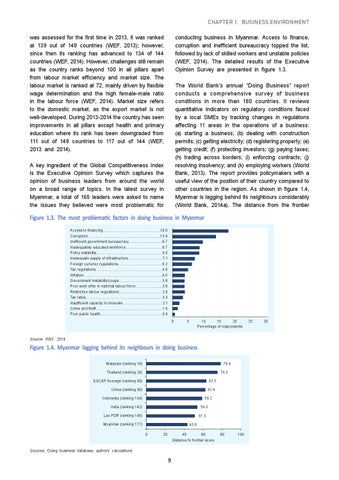
The World Economic Forum (WEF) Global Competitiveness Index has been reporting and benchmarking the factors that underpin national competitiveness in more than 100 countries for more than three decades. The index defines competitiveness as the “set of institutions, policies, and factors that determine the level of productivity of a country” (WEF, 2014; p.4). Many different factors that drive productivity and competitiveness are arranged into 12 pillars of competitiveness. These include: (a) institutions; (b) infrastructure; (c) macroeconomic environment; (d) health and primary education; (e) higher education and training; (f) goods market efficiency; (g) labour market efficiency; (h) financial market development; (i) technological readiness; (j) market size; (k) business sophistication; and (l) innovation (WEF, 2014).
The Government has acknowledged the problem and has made commitments to achieve good governance and a clean government as part of its reform agenda (OECD, 2013). A new Anti-Corruption Law was passed in 2013. A key provision in this law was the establishment of an Anti-Corruption Commission that came into force in 2014 with the stated aim of reducing corruption and bribery. Corruption cases are now being investigated more frequently, with the Government announcing that nearly 17 000 civil servants had been punished between April 2011 and December 2012 (OECD, 2013).
The index reveals that although Myanmar’s institutional quality is low, it has improved recently. When Myanmar 8
CHAPTER 1. Business environment was assessed for the first time in 2013, it was ranked at 139 out of 148 countries (WEF, 2013); however, since then its ranking has advanced to 134 of 144 countries (WEF, 2014). However, challenges still remain as the country ranks beyond 100 in all pillars apart from labour market efficiency and market size. The labour market is ranked at 72, mainly driven by flexible wage determination and the high female-male ratio in the labour force (WEF, 2014). Market size refers to the domestic market, as the export market is not well-developed. During 2013-2014 the country has seen improvements in all pillars except health and primary education where its rank has been downgraded from 111 out of 148 countries to 117 out of 144 (WEF, 2013 and 2014).
conducting business in Myanmar. Access to finance, corruption and inefficient bureaucracy topped the list, followed by lack of skilled workers and unstable policies (WEF, 2014). The detailed results of the Executive Opinion Survey are presented in figure 1.3. The World Bank’s annual “Doing Business” report conducts a comprehensive survey of business conditions in more than 180 countries. It reviews quantitative indicators on regulatory conditions faced by a local SMEs by tracking changes in regulations affecting 11 areas in the operations of a business: (a) starting a business; (b) dealing with construction permits; (c) getting electricity; (d) registering property; (e) getting credit; (f) protecting investors; (g) paying taxes; (h) trading across borders; (i) enforcing contracts; (j) resolving insolvency; and (k) employing workers (World Bank, 2013). The report provides policymakers with a useful view of the position of their country compared to other countries in the region. As shown in figure 1.4, Myanmar is lagging behind its neighbours considerably (World Bank, 2014a). The distance from the frontier
A key ingredient of the Global Competitiveness Index is the Executive Opinion Survey which captures the opinion of business leaders from around the world on a broad range of topics. In the latest survey in Myanmar, a total of 165 leaders were asked to name the issues they believed were most problematic for
Figure 1.3. The most problematic factors in doing business in Myanmar Access to financing.......................................................18.0 Corruption.....................................................................13.9 Inefficient government bureaucracy................................9.7 Inadequately educated workforce...................................8.7 Policy instability...............................................................8.6 Inadequate supply of infrastructure.................................7.1 Foreign currency regulations...........................................6.2 Tax regulations................................................................4.8 Inflation...........................................................................4.0 Government instability/coups..........................................3.8 Poor work ethic in national labour force..........................3.8 Restrictive labour regulations..........................................3.8 Tax rates..........................................................................3.3 Insufficient capacity to innovate......................................2.1 Crime and theft................................................................1.6 Poor public health............................................................0.6 0
5
10 15 20 Percentage of respondents
Source: WEF, 2014.
Figure 1.4. Myanmar lagging behind its neighbours in doing business Malaysia (ranking 18)
78.8 75.3
Thailand (ranking 26) ESCAP Average (ranking 88)
63.5
China (ranking 90)
62.6 59.2
Indonesia (ranking 144) India (ranking 142)
54.0
Lao PDR (ranking 148)
51.5
Myanmar (ranking 177)
43.6 0
20
40
60
Distance to frontier score
Sources: Doing business database; authors’ calculations.
9
80
100
25
30
MYANMAR BUSINESS SURVEY: DATA ANALYSIS AND POLICY IMPLICATIONS score in the figure indicates that Myanmar is 56.4 percentage points away from the best performance across all countries (World Bank, 2014a).
Figure 1.6. Index of Economic Freedom: Myanmar (20112015) 55 Index score
In 2014 the World Bank also conducted its first Enterprise Survey in Myanmar. This firm-level survey13 obtained information from owners and top managers on a broad range of business environment topics. In Myanmar, the sample comprised 632 registered small, medium and large sized enterprises, mostly in manufacturing and services (World Bank, 2014b). The main constraints found were access to finance, land and electricity (figure 1.5). While corruption was not frequently reported as a major obstacle, the incidence of corruption was quite high with more than 50 per cent of firms reporting that bribes were necessary for being granted an import licence (World Bank, 2014b). This discrepancy may reflect acceptance by the business community of corruption as a “fact of life”.
50 45 40 35 30 2011
2012 2013
2014 2015
Source: Heritage Foundation, 2015.
economy and opening up markets (figure 1.6). Much improvement has also been observed in the areas of corruption, labour market, business regulation and the banking sector. The Government is encouraged to continue its reform process with particular emphasis on corruption, property rights, independent judiciary and further trade and investment liberalization (Heritage Foundation, 2015).
Myanmar also remains low in The Heritage Foundation’s Index of Economic Freedom, which has been published annually in cooperation with the Wall Street Journal (Heritage Foundation, 2015). The Index is based on 10 factors under four economic categories: rule of law; fiscal policy; regulatory efficiency; and market openness. For 2015, Myanmar is ranked at 161 out of 186 countries, while it is also at 38 out of 42 countries in Asia and the Pacific. During the past five years, however, the country has showed substantial improvement among the participating countries, particularly by liberalizing
JETRO (2014) has been conducting surveys of Japanese companies operating in the Asia-Pacific region in order to better understand their business activities and the challenges they face. In the 2013 survey only 6.9 per cent of 2 500 sampled Japanese firms were engaged in trade with Myanmar compared with 61 per cent for China and more than 30 per cent for Indonesia, Malaysia and Viet Nam. A substantial
Figure 1.5. Main constraints to doing business in Myanmar 22.7
Access to finance
21.3
Access to land 16.8
Access to electricity 9.4
Access to skilled workers Labour regulations
4.9
Political instability
4.4
Tax rates
2.9
Tax administration
2.3
Transport
2.1
Business licensing and permits
1.7
Customs and trade regulations
1.6
Courts
1.4 1.0
Competition from informal sector Corruption
0.6
Crime, theft and disorder
0.4 0
5
10
15 Percentage
Source: World Bank, 2014b.
10
20
25
CHAPTER 1. Business environment portion of Japanese firms trading with Myanmar find the environment appealing in only two out of 15 issues: (a) market scale and growth potential; and (b) low labour cost and abundant workforce (JETRO, 2014). In fact, many Japanese firms remain concerned about business risks in Myanmar such as inadequate infrastructure, the weak legal system and enforcement, and political instability (JETRO, 2014).
also limited in different ways. The three JETRO surveys were conducted mainly with Japanese companies whose experience or perception is expectedly quite different from local companies or those of other nationalities. The World Bank’s Enterprise Survey was limited to the manufacturing and service sectors in five cities, mainly focusing on medium and large-sized enterprises. This survey excluded: agriculture (which remains the largest sector in the economy); industries in the countryside; and micro and small enterprises (which account for the majority of businesses in Myanmar). The Executive Opinion Survey of the WEF Global Competitiveness Index comprised a small sample of only 165 respondents and therefore was unlikely to give a comprehensive picture. The Heritage Foundation’s Index of Economic Freedom shared little information on survey methodology, and the detailed sample data are not available to researchers. For all of these reasons, ESCAP and OECD decided to conduct the comprehensive survey of businesses in Myanmar spanning more than 3 000 firms in all sizes and industries, and in all geographic regions.14
JETRO (2009 and 2012) also conducted two business surveys in 2009 and 2012 in the Greater Mekong Subregion, which comprises Cambodia, the Lao PDR, Myanmar, Thailand and Viet Nam, in 2009 and 2012. Both surveys interviewed Japanese investors and local enterprises, operating mainly in Myanmar’s manufacturing sectors, to identify corporate strategies and challenges in their cross-border operations, including the quality of infrastructure, and related policies and regulations (JETRO, 2009 and 2012). Although the two surveys adopted the semi-structured interview method some informants participated in the surveys through telephone interviews and questionnaires. The major findings from the two surveys are summarized below:
Endnotes Abe and others (2012) also proposed that entrepreneurship and business development services be considered as two of other important elements of business environment, although they are not fully covered by this survey.
1
(a) A number of surveyed firms have expanded or intend to expand their operations to Myanmar through, for example, investment in new factories and upgrading of existing facilities; (b) The motives for Japanese investment to Myanmar are to: (i) seek greater access to the market; (ii) secure key factor inputs such as labour; and (iii) reduce operational costs through the pro-business policy framework in the host country; (c) Investors tried to reap benefits from various free trade agreements, such as AFTA and ASEAN+6, by sourcing parts and components from other ASEAN members and ASEAN+6 partners; (d) A number of obstacles to the growth of business in Myanmar were also highlighted. Those obstacles can be categorized into six groups: (i) the policy and regulatory framework; (ii) infrastructure; (iii) labour market; (iv) entrepreneurship; (v) trade liberalization; and (vi) logistics services.
Myanmar developed the definitions of micro and SME manufacturers in the early 1990s with a minor modification on the definition of micro firms in 2011 (see OECD, 2013). The new SME law, which is currently under the final enforcement process, will define Myanmar SMEs in all industrial sectors, including services. The draft definition, which is available at www.smedevelopmentcenter.gov.mm/?q=en/def_sme, more or less meets international standards (cf. Abe and others, 2012).
2
By definition Myanmar enterprises are business entities wholly owned or controlled by Myanmar citizens. By regulation, however, they are those registered under Myanmar Citizens Investment Laws (1994 and 2013) (cf. OECD, 2013).
3
They are either wholly or partially owned or controlled by foreigners or branches of foreign enterprises.
4
Military enterprises were initially established to supply necessary goods and services for military operations under the control of the Ministry of Defence. Over the years they grew into major conglomerates in Myanmar, covering almost all industries, such as extraction, rubber products, fisheries, food and beverages, garment and apparel, industrial materials and manufacturing, real estate and construction, trade, tourism, transportation, banking and telecommunications (OECD, 2013).
5
All the abovementioned business surveys took a horizontal approach, using standardized questionnaires across a large number of countries to enable comparisons. While immensely useful, this approach necessarily comes at the cost of the depth and detail required for a thorough analysis of the unique characteristics of Myanmar. The individual surveys were
As shown in figure 1.1, there are several patterns of establishing joint ventures among different types of enterprises, such as joint ventures between SOEs and foreign
6
11
MYANMAR BUSINESS SURVEY: DATA ANALYSIS AND POLICY IMPLICATIONS enterprises, joint ventures between Myanmar enterprises and foreign enterprises. At the same time, the Government encouraged the establishment of joint ventures between SOEs and domestic and foreign investors in order to upgrade the capacity of SOEs through the transfer of technology and knowhow.
7
In addition to financial incentives such as tax and duty exemptions, special economic zones are directly managed by the central Government and provide the international standard facilities. Traditional industrial zones are typically developed by subnational government authorities, and equipped with substandard facilities and utility supplies.
8
The Myanmar Company Act and associated rules and regulations are expected to be revised within a couple of years, while other business-related laws, such as the new Private Industrial Enterprise Law and legislation on intellectual property and arbitration, have also been drafted in cooperation with international donor agencies (OECD, 2015).
9
Those seven themes include: institutions; human capital and research; infrastructure; market sophistication; business sophistication; knowledge and technology outputs; and creative outputs. 10
China, India, Indonesia, the Philippines, Sri Lanka, Thailand and Viet Nam.
11
Transparency International has published the Corruption Perception Index (CPI) annually for the past 18 years. The CPI allows comparisons of public sector corruption across countries. The CPI is a composite indicator based on various surveys of corruption perceptions from business people and country experts in each country. In the case of Myanmar, CPI 2014 is based on seven surveys: (a) the World Bank’s Country Performance and Institutional Assessment for Myanmar; (b) the WEF Executive Opinion Survey; (c) the International Country Risk Guide; (d) the Economist Intelligence Unit’s Country Risk Assessment; (e) the Global Insight Country Risk Rating; (f) World Justice Project-Rule of Law index; and (g) the Bertelsmann Foundation Transformation Index (Transparency International, 2014b). 12
This global business survey mainly focused on medium and large-sized enterprises, and excluded micro or smaller enterprises.
13
It should be noted, however, that both the Institute of Economic Development and JETRO have conducted a number of business surveys in Myanmar. Although they addressed limited geographical or sectoral issues, the surveys made substantive and substantial contributions to enhancing the understanding of the current situation of the Myanmar economy and its challenges (see, for example, Aung, 2011; JETRO, 2013; and Kudo, 2005). 14
12
MYANMAR BUSINESS SURVEY: DATA ANALYSIS AND POLICY IMPLICATIONS •
• •
•
Agribusiness and food industries
Enhance access to finance for purchasing machinery and equipment that will increase the productivity of workers; Foster business and technology incubators and develop tools for technology-based development; Encourage partnerships between academic institutes and the private sector. Academic institutions can access to funds while firms can access talented innovators; Partner with firms overseas in order to gain much-needed capital, technology and management practices, all of which would improve productivity of local firms.
The Government has recognized the fact that the agribusiness and food industries a key strategic sector in the equitable and inclusive development of Myanmar. The survey revealed several characteristics in the sector. They are dominant industries in rural areas while contributing to the national economy through exports of agro-products. The average age of firms in this sector is older than that of firms in other sectors, confirming its status as a traditional industry of Myanmar. Whereas the firm sizes in this sector are relatively larger than in other sectors, agribusiness and food industries appear to be less profitable. The sector relies on relatively low-cost informal lenders who are available in rural areas. Some special interventions in this sector may be appropriate for enhancing its exporting contribution as well as rural development. The following policy options are proposed: • Enhance productivity through the adoption of advanced agricultural technologies and knowhow while investing in rural infrastructure; • Encourage agribusiness and food industries to obtain international quality certificates or to meet such standards for enhancing market access; • Foster export-oriented agribusinesses through conducting trade promotion measures, such as trade fairs, exhibitions or foreign missions (for detailed measures, see Abe and others, 2012, p. 161); • Introduce formal lending schemes among rural agribusinesses to provide low-cost loans.
Corruption Although reforms such as an Anti-Corruption Law and an Anti-Corruption Commission have been attempted, the problem of corruption remains widespread (Transparency International, 2014a). This survey shows that corruption still tops the list of the most severe obstacles faced by firms in Myanmar. The survey specifically reveals that bribery is more common among larger firms as well as firms in extractive industries and firms in certain geographic locations. Although the legal and administrative enforcement is a necessary part of the anti-corruption effort, it is unlikely to be sufficient. Policies that target the root causes are more likely to be effective. A few examples are suggested below: • Reduce excessive regulation across the board as part of creating a business enabling environment. Empirical evidence from this survey suggests that red tape is being used to extract bribes from more successful firms; • Streamline the administrative procedures for business permits, licences and registration. This includes simplifying the process, codifying requirements and keeping discretionary powers of public officials to the necessary minimum; • Improve training and incentives for public officials and inspectors to make them less susceptible to bribery; • Enhance accountability of public officials by introducing modern management practices in the bureaucracy; • Create a transparent process for licences in the extractive industries sector. Inspections to ensure adherence to environmental laws should not be ignored. 68
references
Abe, M. (2014). “Growing through manufacturing: Myanmar’s industrial transformation”, ARTNeT Working Paper Series No. 145. Bangkok: United Nations Economic and Social Commission for Asia and the Pacific. Abe, M. and M. K. Dutta (2014). “A new policy framework for Myanmar’s SME development”, ARTNET Working Paper Series No. 142). Bangkok: United Nations Economic and Social Commission for Asia and the Pacific. Abe, M. and M. Molnar (2014). “Myanmar Business Survey 2014: Survey results”. Yangon: OECD and United Nations Economic and Social Commission for Asia and the Pacific. Abe, M., M. Troilo, J. S. Juneja and S. Narain (2012). Policy guidebook for SME development in Asia and the Pacific, United Nations publication. Bangkok: United Nations Economic and Social Commission for Asia and the Pacific. Abonyi, D. and M. Abe (forthcoming). What AEC 2015 will mean for Myanmar businesses. Bangkok: United Nations Economic and Social Commission for Asia and the Pacific. Acemoglu, D. and S. Johnson (2005). “Unbundling institutions”, Journal of Political Economy, vol. 113, No. 5. ADB (2012). “Myanmar in transition: Opportunities and challenges”. Mandaluyong City, the Philippines: Asian Development Bank. (2009). “Enterprises in Asia: Fostering dynamism in SMEs – Key indicators for Asia and the Pacific 2009; Special Chapter”. Mandaluyong City, the Philippines: Asian Development Bank. Aung, N. M. (2011). “Agricultural efficiency of rice farmers in Myanmar: A case study in selected areas”, IDE Discussion Paper No.306, September 2011. Chiba: Institute of Developing Economies, Japan External Trade Organization. Behling, O. and K. S. Law (2000). Translating Questionnaires and Other Research Instruments: Problems and Solutions. Thousand Oaks, California: Sage Publications, Inc. Conference Board, The (2015). Total Economy Database.TM Available at www.conference-board.org/data/economydatabase/ index.cfm?id=27762 in February 2015. Cornell University, Institut Européen d’Administration des Affaires and World Intellectual Property Organization (2014). “The Global Innovation Index 2014: The human factor in innovation”. Fontainebleau, Ithaca and Geneva. CSO (2014). “Industrial Zone Survey, 1 January 2014”. Nay Pyi Taw: Central Statistical Organisation, Ministry of National Planning and Economic Development. DCED (2008). Supporting Business Environment Reforms: Practical Guidance for Development Agencies. Cambridge, United Kingdom: Donor Committee for Enterprise Development. Dillman, D. A. (1978). Mail and Telephone Surveys: The Total Design Method. New York: John Wiley & Sons, Inc. Drucker, P. F. (2008). Management: Revised Edition. New York: Harper Collins. El-Ansary, A. I. and L. W. Stern (1972). Power Measurement in the Distribution Channel, Journal of Marketing Research, 9 (February), 47-52. ESCAP (2015). Business and Development in Myanmar: A Policy Handbook for Private Sector, Studies in Trade and Investment No. 82. Bangkok: United Nations Economic and Social Commission for Asia and the Pacific.
(2006). Entrepreneurship and e-Business Development for Women. Bangkok: United Nations.
Gans, J., S. King and G. Mankiw (2011). Principles of Microeconomics, Publisher: Cengage Learning.
71
MYANMAR BUSINESS SURVEY: DATA ANALYSIS AND POLICY IMPLICATIONS Gaviria, A. (2002). “Assessing the effects of corruption and crime on firm performance: Evidence from Latin America”, Emerging Markets Review, vol. 3; pp. 245-268. GIZ (2013). Myanmar’s Financial Sector. A Challenging Environment for Banks, February 2015 (undated version). Yangon: Deutsche Gesellschaft für Internationale Zusammenarbeit, Available online at www.giz.de/en/downloads/giz2013-en financial-sector-myanmar.pdf. Heide, J. B. (1994). “Interorganizational governance in marketing channels”, Journal of Marketing, vol. 58 (January); pp. 71-85. Heritage Foundation, The (2015). “2015 Index of Economic Freedom”. Available at www.heritage.org/index/. Herman, C. (2013). “Myanmar: Transfer pricing in Myanmar”, International Tax Review. Available at www.internationaltaxreview.com /Article/3196922/Myanmar-Transfer-pr”icing-in-Myanmar.html. Huntington, S. (1968). Political Order in Changing Societies. New Haven: Yale University Press. International Labour Organization (2008). Work, Income and Gender Equality in East Asia: Action Guide. Bangkok: Subregional Office for East Asia. Jaffe, K., S. Carciente and W. Zanoni (2007). “The economic limits of trust: the case of a Latin American informal urban commerce sector”, Journal of Developmental Entrepreneurship, vol. 12, No. 3; pp. 339-352. Japan International Cooperation Agency (2006). Effective Support Approaches for Small and Medium Enterprises by Development Stages: Final Report. Tokyo. JETRO (2014). “FY2013 Survey on the International Operations of Japanese Firms”. Tokyo: Japan External Trade Organization.
(2013). “Data collection of industrial zones in Myanmar, February”. Yangon: JETRO Yangon Office.
(2012). “Survey on Business Needs and Strategies in Mekong Sub-region, 2012”, (30 August) Bangkok: Japan External Trade Organization. (2009). “Survey on the Business Needs and Strategies in Mekong region”, (30 September). Bangkok: Japan External Trade Organization. Kaufmann, D., and S. Wei (2000). “Does ‘grease money’ speed up the wheels of commerce?” IMF Working Paper No 64. I Washington, D.C.: International Monetary Fund. Kudo, T. (2005). “The impact of United States sanctions on the Myanmar garment industry”, IDE Discussion Paper No. 42. 2005.12. Chiba: Institute of Developing Economies, Japan International Cooperation Agency. Kudo, T. and S. Kumagai (2012). “Two-polar growth strategy in Myanmar: Seeking “high” and “balanced” development”, IDE Discussion Paper No. 371. Chiba: Institute of Developing Economies, Japan International Cooperation Agency. Kyaw, A. (2008). “Financing small and medium enterprises in Myanmar”, IDE Discussion Paper No. 148. Tokyo: Institute of Developing Economies, Japan International Cooperation Agency. Linn, Z. (2014). “Is Burma’s Anti-corruption Commission helpful?” Asian Tribune. Available at www.asiantribune.com/node/72427. McKinsey Global Institute (2013). Myanmar’s Moment: Unique Opportunities, Major Challenges. Website: www.mckinsey.com/. Ministry of Economy and Finance of Cambodia (2005). “Draft outline of SME development framework: Sub-committee on Small and Medium Enterprises”. Phnom Penh. North, D. (1990). Institutions, Institutional Change and Economic Performance. Cambridge: Harvard University Press. OECD (2015). Multi-dimensional Review of Myanmar: Volume 2. In-depth Analysis and Recommendations. OECD Development Pathways. Paris: Organisation for Economic Co-operation and Development Publishing. (2013). Multi-dimensional Review of Myanmar – Volume 1: Initial Assessment. OECD Development Pathways. Paris: Organisation for Economic Co-operation and Development Publishing. (1999). Managing National Innovation Systems. Paris: Organisation for Economic Co-operation and Development Publishing.
72
references (undated). “Enterprises’ Information Survey Questionnaire: Final survey questionnaire for Viet Nam”. Paris: Organisation for Economic Co-operation and Development. Qiang, C. and C. Rossotto (2009). Economic impacts of broadband (Information and communications for development 2009: Extending reach and increasing impact). Washington, D.C.: World Bank Group. Shleifer, A. and R. Vishny (1994). “Politicians and firms”, Quarterly Journal of Economics, vol. 109; pp. 995-1025. Soans, A. and M. Abe (forthcoming). Bribery, Corruption and Bureaucratic Hassle: Evidence from Myanmar. Bangkok: United Nations Economic and Social Commission for Asia and the Pacific. Svensson, J. (2003). Who Must Pay Bribes and How Much? Evidence from a Cross Section of Firms, Quarterly Journal of Economics, vol. 118, No.1; pp. 207-230. Thompson, R. (2014). “Can Myanmar escape corruption”, The Interpreter. Available at www.lowyinterpreter.org/post/2014/04/07/ Can-Myanmar-escape-corruption.aspx?COLLCC=2123203007&. Transparency International (2014a). “The 2014 Corruption Perceptions Index: Measures the perceived levels of public sector corruption in 175 countries and territories”. Available at www.transparency.org/cpi2014. (2014b). “Corruption Perceptions Index 2014: Technical Methodology Note”. Available at www.transparency.org/cpi2014/ in_detail. WEF (2014). The Global Competitiveness Report 2014–2015: Full Data Edition. Geneva: World Economic Forum.
(2013). The Global Competitiveness Report 2013–2014: Full Data Edition. Geneva: World Economic Forum.
Williamson, O. E. (1985). The Economic Institutions of Capitalism. New York: The Free Press. World Bank (2015). “World Development Indicators”. Washington, D.C.: World Bank Group. Available at http://data.worldbank. org/data-catalog/world-development-indicators in February 2015. (2014a). Myanmar Enterprise Surveys, What Businesses Experience: Myanmar (2014). Washington, D.C.: World Bank Group. Available at www.enterprisesurveys.org/data/exploreeconomies/2014/myanmar.
(2014b). Doing Business 2015: Going Beyond Efficiency. Washington, D.C.: World Bank Group.
(2013). Doing Business 2014: Understanding Regulations for Small and Medium-Size Enterprises. Washington, D.C., World Bank Group. (2008). Monitoring and Evaluation for Business Environment Reform: A Handbook for Practitioners. Washington, D.C.: World Bank Group. Wall Street Journal (2014). “Myanmar Awards Foreign Bank Licenses“. Available at www.wsj.com/articles/myanmar-awards foreign-bank-licenses-1412141121. Wu, X. (2009). “Determinants of bribery in Asian firms: Evidence from the World Business Environment Survey”, Journal of Business Ethics, vol. 87, No. 1; pp. 75-88.
73
74
Annexes
Annexes
75
MYANMAR BUSINESS SURVEY: DATA ANALYSIS AND POLICY IMPLICATIONS
ANNEX 1. Survey Questionnaire in English Area ID:
Team ID:
Interviewer ID:
ALL INFORMATION WILL REMAIN STRICTLY CONFIDENTIAL. YOU AND YOUR FIRM'S IDENTITY WILL NOT BE RELEASED.
A
Your business environment
1. How would you rate the overall business conditions in Myanmar? Circle the most
appropriate.
Very unfavourable
1
Very favourable
2
3
4
5
6
2. To what degree does each of the following issues present an obstacle to the current operations of your firm? Circle the most appropriate. Very severe obstacle
No obstacle
a.
Access to land, factory or office space
1
2
3
4
5
6
b.
Supply of petrol
1
2
3
4
5
6
c.
Telecommunications
1
2
3
4
5
6
d.
Supply of electricity
1
2
3
4
5
6
e.
Supply of water
1
2
3
4
5
6
f.
Business registration, licensing & permits – fees
1
2
3
4
5
6
g.
Business registration, licensing and permits – administrative procedures
1
2
3
4
5
6
h.
Customs and trade regulations
1
2
3
4
5
6
i.
Transport and logistics
1
2
3
4
5
6
j.
Tax collection process
1
2
3
4
5
6
k.
Tax burden
1
2
3
4
5
6
l.
Exchange rate
1
2
3
4
5
6
m.
Availability of foreign exchange
1
2
3
4
5
6
1 76
Annexes
n.
Inflation
1
2
3
4
5
6
o.
Access to capital
1
2
3
4
5
6
p.
Interest rates
1
2
3
4
5
6
q.
Property rights
1
2
3
4
5
6
r.
Corruption
1
2
3
4
5
6
s.
Domestic competition
1
2
3
4
5
6
t.
Foreign competition
1
2
3
4
5
6
u.
Insufficient local supply of inputs
1
2
3
4
5
6
v.
Insufficient foreign supply of inputs
1
2
3
4
5
6
w.
Insufficient working capital
1
2
3
4
5
6
x.
Inadequate access to external finance
1
2
3
4
5
6
y.
Low demand for your company’s goods or services
1
2
3
4
5
6
z.
Lack of technology
1
2
3
4
5
6
aa. Insufficient domestic market information
1
2
3
4
5
6
bb. Insufficient export market information
1
2
3
4
5
6
cc.
1
2
3
4
5
6
dd. Political instability
1
2
3
4
5
6
ee. Labour regulations
1
2
3
4
5
6
ff.
1
2
3
4
5
6
gg. Shortage of unskilled labour
1
2
3
4
5
6
hh. Relationship with public authorities
1
2
3
4
5
6
International sanctions
Shortage of skilled labour
3. Are there any particular laws or regulations you find hard to comply with in your daily
operations? Yes
No
1
2
If yes, please provide examples:
77 2
MYANMAR BUSINESS SURVEY: DATA ANALYSIS AND POLICY IMPLICATIONS
4. How much would a firm like yours have to offer, in addition to official charges to the
authorities, to obtain a business registration, licence or permit? Circle the most appropriate range (1 lakh = 100,000 kyats).
None
5 lakhs or less
6-10 lakhs
11-25 lakhs
26-50 lakhs
51100 lakhs
101250 lakhs
251500 lakhs
5011,000 lakhs
More than 1,000 lakhs
1
2
3
4
5
6
7
8
9
10
5. To what extent do you agree that it is more difficult for women to run businesses in
Myanmar? Circle the most appropriate. Strongly agree
1
Strongly disagree
2
3
4
5
6
If you agree, please explain why women face such difficulties:
B
Your customers and markets
6. The major customers of your business are mostly (i.e. they make up more than 10% of
total sales). Circle all that apply. a. Government
1
g. Foreign enterprises in Myanmar
7
b. State owned enterprises
2
h. Overseas customers
8
c.
3
i.
Group/parent companies
9
d. Joint ventures/partnerships
4
j.
End users and consumers
10
e. Small and medium enterprises
5
Others, please specify:
f.
6
Large enterprises
Cooperatives
7. How many major customers do you have (i.e. they each make up over 10% of total revenue)? Circle the most appropriate range.
None
1 or 2 customers
3-4 customers
5-6 customers
7-8 customers
9-10 customers
1
2
3
4
5
6
3 78
Annexes
8. What percentage of total revenue comes from the following markets? Provide your best
estimates.
a. Your township
%
b. Rest of your district
%
c.
%
Rest of your state/province
d. Rest of Myanmar
%
e. Bordering countries (Bangladesh, China, India, Lao PDR and Thailand)
%
f.
%
Other foreign countries
Total
100%
9. What percentage of your firm’s sales of its goods or services was sold on credit in the last
year? Circle the most appropriate range None
10% or less
11- 25%
26- 50%
51-75%
76-90%
More than 90%
1
2
3
4
5
6
7
10. Which currency do you mainly use for settling domestic receipts? Kyat
US dollars
1
2
Others, please specify:
11. Which currency do you mainly use for settling foreign receipts? Do not export
Kyat
US dollars
1
2
3
Others, please specify:
12. Have you heard about the ASEAN Economic Community (AEC) 2015? Yes
No
1
2
If yes, do you foresee how the AEC 2015 will impact on your business? Very unfavourable
1
Very favourable
2
3
4
4 79
5
6
MYANMAR BUSINESS SURVEY: DATA ANALYSIS AND POLICY IMPLICATIONS
C
Your suppliers
13. The major suppliers of inputs to your business are mostly (i.e. they make up over 10% of total supply by value). Circle all that apply. a. Government
1
g.
Foreign enterprises in Myanmar
7
b. State-owned enterprises
2
h.
Overseas suppliers
8
c.
3
i.
Overseas buyers (who provide inputs and purchase final products)
9
d. Joint ventures/partnerships
4
j.
Group/parent companies
10
e. Small and medium enterprises
5
Others, please specify:
f.
6
Large enterprises
Cooperatives
14. How many major suppliers do you work with (i.e. they individually provide over 10% of total supply by value)? Circle the most appropriate range. 3-4
None
1 or 2 suppliers
suppliers
5-6 suppliers
7-8 suppliers
9-10 suppliers
1
2
3
4
5
6
15. What percentage of your firm’s supplies was purchased on credit in the last year? Circle the most appropriate range. None
10% or less
11-25%
26-50%
51-75%
76-90%
More than 90%
1
2
3
4
5
6
7
16. Which currency do you mainly use for settling your domestic purchases? Kyat
US dollars
1
2
Others, please specify:
17. Which currency do you mainly use for settling purchases of products or services from abroad?
Do not import
Kyat
US dollars
1
2
3
Others, please specify:
5 80
Annexes
D
Innovation
18. Innovation is crucial to the success of your business. Strongly agree
1
Strongly disagree
2
3
4
5
6
19. Has your firm implemented any of the following innovations? (Answer all questions): Strongly disagree
Strongly agree a.
New or significantly improved products or services
1
2
3
4
5
6
b.
New or significantly improved supply, production or distribution processes or methods
1
2
3
4
5
6
c.
New or significantly improved R&D, marketing and sales practices for your goods or services
1
2
3
4
5
6
d.
New or significantly improved management practices or systems (e.g., accounting, ICT and human resources management)
1
2
3
4
5
6
20. Has your firm obtained any international quality certification (e.g. ISO and HACCP) so far? Yes
No
1
2
If yes, please specify which ones:
21. What are the major reasons your business has developed or introduced new or significantly
improved goods, services, processes, methods or business plans? Circle all that apply.
a.
Developing a new business line
1
j. React to competitors’ movements
10
b.
Enter or establish a new market
2
k. Enhance reputation or brand values
11
c.
Enter to export markets
3
l. Increase capacity of production or service provision
12
d.
Increase or maintain market share
4
m.Improve quality of goods or services
13
e.
Increase revenue
5
n. Improve Information and Communications Technology (ICT) capabilities or better utilize ICT applications
14
6 81
MYANMAR BUSINESS SURVEY: DATA ANALYSIS AND POLICY IMPLICATIONS f.
Improve productivity (i.e. increase output per worker)
6
o. Reduce environmental impacts
15
g.
Reduce costs
7
p. Improve safety or working conditions for workers
16
h.
Reduce prices or maintain competitive prices
8
q. Enhance corporate social responsibility (CSR)
17
i.
Increase responsiveness to customer needs
9
Others reasons, please specify:
22. How much has your firm invested in Research and Development (R&D) activities in the past year? Circle your best estimates (1 lakh = 100,000 kyat).
None
50 lakhs or less
51100 lakhs
101500 lakhs
5011,000 lakhs
1,0012,500 lakhs
2,5015,000 lakhs
5,0017,500 lakhs
7,50110,000 lakhs
More than 10,000 Lakhs
1
2
3
4
5
6
7
8
9
10
23. Has your firm protected its intellectual property? Yes
No
1
2
If yes, which protective measures below have your firm applied? Circle all that apply.
a. Apply for patents
1
g. Rely on trust between staff/team members
7
b. Register trademarks
2
h. Gain lead-time over competitors
8
c.
3
Claim copyright
i.
Withhold or limit key information from staff
9
d. Register designs
4
j.
Ensure complex design
10
e. Make confidentiality agreements
5
k.
Build in special know-how into products
11
f.
6
Others, please specify:
Ensure secrecy
7
82
Annexes
E
Your human resources
24. Did your firm change the size of its workforce in the past 12 months? Decreased
No change
Increased
1
2
3
Which of the following best describes the reasons why your firm changed the size of its workforce in the past 12 months? Circle all that apply. a. Changes in domestic demands
1
b. Changes in international demands
2
c.
3
Changes in business environment
d. Changes in the supply of labour
e.
Changes in labour regulations and/or their enforcement
5
f.
Perceived future change in the economy
6
Others, please specify:
7
4
25. In the past 3 years, compared with competitors, the increases in your employees’ wages
were:
Much lower
1
Much higher
2
3
4
5
6
26. Has your firm experienced any technical or professional skills problems with the
workforce? Yes
No
1
2
If yes, the main reason why there are technical or professional skills problems is (circle all that apply):
a. Lack of adequate skills in the labour market
1
e. Skilled employees move to larger firms
5
b. Labour costs are too high to afford the skills needed
2
f.
6
c. Skilled employees move to other firms
3
Others, please specify:
d. Skilled employees move to other sectors
4
8 83
Skilled employees move to work abroad
7
MYANMAR BUSINESS SURVEY: DATA ANALYSIS AND POLICY IMPLICATIONS
27. Did you experience a shortage of skilled workers? Yes
No
1
2
If yes, what measures have you taken to overcome shortage of skilled workers? Circle all that apply. f.
Strengthened links with schools or universities to secure people with the right skills
6
g. Provided scholarships for prospective employees
7
a. Organized in-house training
1
b. Established an in-house training unit or centre
2
c. Sent employees to free (e.g. government-provided) training externally
3
d. Paid for employees to attend public training externally
4
No action taken
e. Paid for employees to attend private training externally
5
Others, please specify:
h. Outsourced tasks where skills are missing in-house
8
9
28. Which institutions has your firm cooperated with to provide training? Circle all that apply. a. Government agencies
1
g.
Private vocational training institutes
7
b. Universities
2
h.
Business or industry associations such as UMFCCI
8
c.
3
i.
International or donor agencies
9
d. Vocational/technical high schools
4
None
e. General high schools
5
Others, please specify:
f.
6
Technical colleges
Public vocational training institutes
10
29. How much on average does your firm spend for training per employee per year? Circle the most appropriate range.
None
500 kyat or less
5011,00 0kyat
1,0015,000 kyat
5,00110,000 kyat
10,00150,000 kyat
50,001100,000 kyat
100,001 500,000 kyat
1
2
3
4
5
6
7
8
9 84
500,001 More than 1,000,000 1,000,000 kyat kyat
9
10
Annexes
30. In addition to public holidays, how many leave days does your firm grant to employees annually? Circle the most appropriate range. None
3 days or less
4- 6 days
7- 10 days
11-15 days
16-20 days
More than 20 days
1
2
3
4
5
6
7
31. How many sick leave days does your firm annually grant to employees? Circle the most appropriate range. None
3 days or less
4-6 days
7-10 days
11-15 days
16-20 days
More than 20 days
1
2
3
4
5
6
7
32. Does your firm cover any medical expenses of employees? Yes
No
1
2
33. Does your firm provide any pension schemes to retirees? Yes
No
1
2
34. Does your firm have apprentices, interns or trainees working for your business? Yes
No
1
2
If yes, answer Questions 35 and 36 below. If no, move directly to Question 37:
35. Are apprentices (or interns or trainees) paid? Yes
No
1
2
If yes, how much per month per person? Circle the most appropriate range.
10,000 kyat or less
10,00125,000 kyat
25,00150,000 kyat
50,001100,000 kyat
100,001250,000 kyat
More than 250,000 kyat
1
2
3
4
5
6
10 85
MYANMAR BUSINESS SURVEY: DATA ANALYSIS AND POLICY IMPLICATIONS
Who pays the apprentices (or interns or trainees)? Circle all that apply. a. Your firm
1
d. International donor
b. Government/public agency
2
Others, please specify:
c.
3
NGO
4
36. On average, what percentage of apprentices do you hire after their apprenticeship is completed? Circle the most appropriate range. None
10% or less
11-25%
26-50%
51-75%
76-90%
More than 90%
1
2
3
4
5
6
7
37. How many employees does your firm presently employ? Total: Among them, how many are full-time, part-time or seasonal employees? Full-time: Part-time: Seasonal or casual:
38. Can you estimate what percentages of your employees have completed the following levels of education?
a. Postgraduate, master degree or higher
%
b. Undergraduate or first degree
%
c.
%
Vocational/technical colleges or diploma/certificate
d. High school
%
e. Middle school
%
f.
%
Elementary or primary school
No formal education
%
Total
100%
11 86
Annexes
39. Please describe your firm’s human resources by filling the table below. Include part-
time, seasonal or casual workers.
Number of present staff
Occupation groups
Male
Number of present vacancies
Female
Average monthly salary per person (in kyat)
a. Top management (CEO, managing director) b. Middle management (department/division heads) c.
Lower management (section/unit chiefs, team leaders, project managers)
d. Professionals e. Skilled workers f.
Unskilled workers
g. Interns, trainees and apprentices
40. Can you estimate the level of difficulty in finding qualified workers by occupation group for your firm (circle the most appropriate)? Occupation groups
Very difficult
a. Top management (CEO, managing director)
1
2
3
4
5
6
b. Middle management (department/division heads)
1
2
3
4
5
6
1
2
3
4
5
6
d. Professionals
1
2
3
4
5
6
e. Skilled workers
1
2
3
4
5
6
f.
1
2
3
4
5
6
1
2
3
4
5
6
c.
Lower management (section/unit chiefs, team leaders)
Unskilled workers
g. Interns, trainees and apprentices
Not difficult at all
12 87
MYANMAR BUSINESS SURVEY: DATA ANALYSIS AND POLICY IMPLICATIONS
41. Please specify where there is a lack of skills and competencies in the various occupation groups (circle all that apply). Managem ent and leadership
Creativit y and initiative
Analytical thinking and problem solving
a. Top management
1
2
b. Middle management
1
c. Lower management
Communicatio n interpersonal and work ethics, teamwork
Technic al skills
Finance, accounting and budgeting
Computer and ICT
Selling and custome r service
3
4
5
6
7
8
9
2
3
4
5
6
7
8
9
1
2
3
4
5
6
7
8
9
d. Professionals
1
2
3
4
5
6
7
8
9
e. Skilled workers
1
2
3
4
5
6
7
8
9
f. Unskilled workers
1
2
3
4
5
6
7
8
9
g. Interns, trainees and apprentices
1
2
3
4
5
6
7
8
9
Occupation groups
42. How much does the average salary for women differ from the average salary for men in the same position in your firm? Circle the most appropriate. 21% or less
11-20% lower
1-10% lower
No difference
1-10% higher
11-20% higher
21% or more
1
2
3
4
5
6
7
43. How would you rate the overall opportunities for employment available to women in Myanmar? Circle the most appropriate.
F
Very unfavourable
Unfavourable
Somewhat unfavourable
Somewhat favourable
Favourable
Very Favourable
1
2
3
4
5
6
Financing your business
44. Are the presently available financing sources adequate for your firm?
Yes
No
1
2
13 88
Foreign language
Annexes
45. Has your firm borrowed from external source(s) either formally or informally? Yes
No
1
2
If yes, please explain why. Circle suitable options below. a. Expansion
1
f. Investment in land and buildings
6
b. Diversification
2
g. Investment in machinery, vehicles, equipment
7
3
h. Trade finance
8
d. Working capital (e.g., payment for supply, rent)
4
i. Paying back loans to other sources
9
e. Human resources (e.g., salaries, recruitment and training)
5
Others, please specify:
c.
R&D, technology or product/service development
46. To what extent do you think each of the following statements describes the present situation to obtain loans from external source(s)?
Strongly disagree
Strongly agree
a.
Collateral/guarantee requirements are too stringent
1
2
3
4
5
6
b.
Financial disclosure requirements are too strict
1
2
3
4
5
6
c.
Credit rating is too strict
1
2
3
4
5
6
d.
The interest rate is too high
1
2
3
4
5
6
e.
The term (i.e., the length of time) of the loan is too short
1
2
3
4
5
6
f.
The size of the loan is too small relative to financing needs
1
2
3
4
5
6
g.
The procedures for the loan applications are too complicated and time consuming
1
2
3
4
5
6
h.
Banks provide poor customer services for businesses
1
2
3
4
5
6
i.
Banks do not understand your financing needs
1
2
3
4
5
6
j.
Banks cannot provide timely services
1
2
3
4
5
6
k.
Banks are too far away (physical access to banks)
1
2
3
4
5
6
14 89
MYANMAR BUSINESS SURVEY: DATA ANALYSIS AND POLICY IMPLICATIONS l.
It is difficult for you to provide accurate financial statements to banks
m. You don’t know much about banking services
1
2
3
4
5
6
1
2
3
4
5
6
n.
You are not interested in borrowing money from outside
1
2
3
4
5
6
o.
You are not sure if your loan application will be approved
1
2
3
4
5
6
p.
Your firm is less able to access loans than other companies
1
2
3
4
5
6
47. What are the major sources of financing for your company? Provide your best estimates.
a. Personal savings
%
b. Personal loans from family/relatives/friends
%
c.
%
Retained earnings (i.e., profits kept by the firm)
d. Loans from state development banks
%
e. Loans from private banks
%
f.
%
Loans from financial cooperatives
g. Micro-finance
%
h. Money lenders
%
i.
Loan from other firms (e.g. group/parent companies)
%
j.
Loan or advance money from customers
%
k.
Stock/equity
%
l.
Corporate bonds
%
m. Leasing
%
n. Accounts receivable (factoring)
%
o. Public grants, subsidies or loans
%
Others
%
Total
100%
15 90
Annexes
48. Based on your answer in question 47, please specify why your firm has chosen these particular lending sources? Circle all that apply. a. Best interest rates offered
1
f.
Quickness of loan approval
6
b. Lender that your firm trusts the most
2
g. Long relationship with your firm
7
c.
3
h. No need for a loan
8
Only available sources of credit your firm could obtain
d. Most convenient location e. Best lending conditions and services
4
i.
Did not think our loan application would be approved
5
Others, please specify:
9
49. How large are the outstanding loans from external sources? Do not include your own
funds, borrowing from family/relatives/friends and saved profits (1 lakh = 100,000 kyats). Circle the most appropriate range.
Type
None
Less than 50 lakhs
50100 lakhs
101500 lakhs
5011,000 lakhs
1,0015,000 lakhs
5,00110,000 lakhs
10,00150,000 lakhs
50,001100,000 lakhs
100,001500,000 lakhs
More than 500,000 lakhs
a. Short-term loan (1 year or less)
0
1
2
3
4
5
6
7
8
9
10
b. Mid- to long-term loan (more than 1 year)
0
1
2
3
4
5
6
7
8
9
10
50. If you borrow any formal loan, what is the average interest rate per year? In this case, the longest borrowing period is
months.
51. If you borrowed informally, what is the highest interest rate per month? In this case, the longest borrowing term is
%
months.
16 91
%
MYANMAR BUSINESS SURVEY: DATA ANALYSIS AND POLICY IMPLICATIONS
52. What kinds of collateral or guarantees are required to get formal or informal loans?
Circle all that apply.
Formal loan
Informal loan
a. Land
1
1
b. Building
2
2
c.
3
3
d. Machinery or equipment
4
4
e.
Accounts receivable or inventories
5
5
f.
Personal assets
6
6
7
7
8
8
Vehicles
g. Third-party guarantors Others, please specify None
53. To the best of your knowledge, at what percentage of the market price would your collateral be valued?
%
54. What kinds of banking services do you use other than loans? Circle all that apply. a. Current account
1
f.
b. Short term savings account
2
g. Factoring
7
c.
3
h. Trade finance (e.g. L/C)
8
d. Line of credit
4
None
9
e. Mortgages
5
Others, please specify:
Fixed term savings account
Leasing
55. Do you use an external accountant to prepare your financial statements?
Yes
No
Do not prepare financial statements
1
2
3
17 92
6
Annexes
G
Your business
56. In what year was your business started?
Year
57. In what year was your firm registered with any government office?
Year
Which government office did your firm register with? Please specify How long did it take for your firm to complete the whole process of company registration with the government office? Months
Not yet registered
a
58. In which sector does your firm primarily operate? For the primary sector, circle one only.
For the additional sectors, circle as many of them that apply.
Primary sector (one only)
Additional sector (as many as apply)
01 - Agriculture, hunting and related service activities
1
1
02 - Forestry, logging and related service activities
2
2
3
3
10 - Mining of coal and lignite; extraction of peat
4
4
11 - Extraction of crude petroleum and natural gas; service activities incidental to oil and gas extraction, excluding surveying
5
5
12 - Mining of uranium and thorium ores
6
6
13 - Mining of metal ores
7
7
14 - Other mining and quarrying
8
8
9
9
16 - Manufacture of tobacco products
10
10
17 - Manufacture of textiles
11
11
18 - Manufacture of wearing apparel; dressing and dyeing of fur
12
12
19 - Tanning and dressing of leather; manufacture of luggage, handbags, saddlery, harness and footwear
13
13
A - Agriculture, hunting and forestry
B – Fishing 05 - Fishing, aquaculture and service activities incidental to fishing
C - Mining and quarrying
D - Manufacturing 15 - Manufacture of food products and beverages
18 93
MYANMAR BUSINESS SURVEY: DATA ANALYSIS AND POLICY IMPLICATIONS 20 - Manufacture of wood and of products of wood and cork, except furniture; manufacture of articles of straw and plaiting materials
14
14
21 - Manufacture of paper and paper products
15
15
22 - Publishing, printing and reproduction of recorded media
16
16
23 - Manufacture of coke, refined petroleum products and nuclear fuel
17
17
24 - Manufacture of chemicals and chemical products
18
18
25 - Manufacture of rubber and plastics products
19
19
26 - Manufacture of other non-metallic mineral products
20
20
27 - Manufacture of basic metals
21
21
28 - Manufacture of fabricated metal products, except machinery and equipment
22
22
29 - Manufacture of machinery and equipment n.e.c.
23
23
30 - Manufacture of office, accounting and computing machinery
24
24
31 - Manufacture of electrical machinery and apparatus n.e.c.
25
25
32 - Manufacture of radio, television and communication equipment and apparatus
26
26
33 - Manufacture of medical, precision and optical instruments, watches and clocks
27
27
34 - Manufacture of motor vehicles, trailers and semi-trailers
28
28
35 - Manufacture of other transport equipment
29
29
36 - Manufacture of furniture; manufacturing n.e.c.
30
30
37 – Recycling
31
31
40 - Electricity, gas, steam and hot water supply
32
32
41 - Collection, purification and distribution of water
33
33
34
34
50 - Sale, maintenance and repair of motor vehicles and motorcycles; retail sale of automotive fuel
35
35
51 - Wholesale trade and commission trade, except of motor vehicles and motorcycles
36
36
52 - Retail trade, except of motor vehicles and motorcycles; repair of personal and household goods
37
37
38
38
39
39
E - Electricity, gas and water supply
F – Construction 45 - Construction
G - Wholesale and retail trade; repair of motor vehicles, motorcycles and personal and household goods
H - Hotels and restaurants 55 - Hotels and restaurants
I - Transport, storage and communications 60 - Land transport; transport via pipelines
19 94
Annexes 61 - Water transport
40
40
62 - Air transport
41
41
63 - Supporting and auxiliary transport activities; activities of travel agencies
42
42
64 - Post and telecommunications
43
43
65 - Financial intermediation, except insurance and pension funding
44
44
66 - Insurance and pension funding, except compulsory social security
45
45
67 - Activities auxiliary to financial intermediation
46
46
70 - Real estate activities
47
47
71 - Renting of machinery and equipment without operator and of personal and household goods
48
48
72 - Computer and related activities
49
49
73 - Research and development
50
50
74 - Other business activities
51
51
52
52
53
53
54
54
90 - Sewage and refuse disposal, sanitation and similar activities
55
55
91 - Activities of membership organizations n.e.c.
56
56
92 - Recreational, cultural and sporting activities
57
57
93 - Other service activities
58
58
95 - Activities of private households as employers of domestic staff
59
59
96 - Undifferentiated goods-producing activities of private households for own use
60
60
97 - Undifferentiated service-producing activities of private households for own use
61
61
62
62
J - Financial intermediation
K - Real estate, renting and business activities
L - Public administration and defence; compulsory social security 75 - Public administration and defence; compulsory social security
M – Education 80 – Education
N - Health and social work 85 - Health and social work
O - Other community, social and personal service activities
P - Activities of private households as employers and undifferentiated production activities of private households
Q - Extraterritorial organizations and bodies 99 - Extraterritorial organizations and bodies
20 95
MYANMAR BUSINESS SURVEY: DATA ANALYSIS AND POLICY IMPLICATIONS
59. What share of total sales is in your firm's primary sector? Circle the most appropriate range. 10 % or less
11-25 %
26-50 %
51-75 %
76-90 %
More than 90%
1
2
3
4
5
6
60. What is the legal structure of your firm? Circle the most appropriate. Sole proprietorship (i.e. non-incorporated, owned by an individual)
1
State-owned enterprise
6
Private limited liability company
2
Cooperative
7
Public limited liability company
3
Registered branch/representative office
8
Partnership
4
Others, please specify:
Joint venture
5
61. What is the ownership structure of your firm? a. State-owned
%
b. Domestic entity owned
%
c.
%
Domestic individual-owned
d. Foreign entity-owned
%
e. Foreign individual-owned
%
f.
%
Collective ownership/partnership
Total
100%
62. What is the nationality of your firm’s major ownership? Circle an appropriate nationality below:
American
1
Indonesian
11
Australian
2
Japanese
12
British
3
Korean
13
Bangladeshi
4
Malay
14
Canadian
5
Myanmar
15
Chinese
6
Singaporean
16
Hong Kong Chinese
7
Taiwanese
17
French
8
Thai
18
German
9
Vietnamese
19
Indian
10
Others, please specify:
21 96
Annexes
63. Where is the headquarters of your firm? Circle the location. Ayeyarwady Region
1
Mon State
9
Bago Region
2
Rakhine State
10
Chin State
3
Shan State
11
Kachin State
4
Sagaing Region
12
Kayah State
5
Tanintharyi Region
13
Kayin State
6
Yangon Region
14
Magway Region
7
Nay Pyi Taw Union Territory
15
Mandalay Region
8
Others, please specify:
District:
Township:
City/Town:
64. Where are your major plants or branches? Circle up to 5 locations. Ayeyarwady Region
1
City/Town(s):
Mon State
9
City/Town(s):
Bago Region
2
City/Town(s):
Rakhine State
10
City/Town(s):
Chin State
3
City/Town(s):
Shan State
11
City/Town(s):
Kachin State
4
City/Town(s):
Sagaing Region
12
City/Town(s):
Kayah State
5
City/Town(s):
Tanintharyi Region
13
City/Town(s):
Kayin State
6
City/Town(s):
Yangon Region
14
City/Town(s):
Magway Region
7
City/Town(s):
Nay Pyi Taw Union Territory
15
City/Town(s):
Mandalay Region
8
City/Town(s):
65. What was the sales revenue of your firm in the most recent fiscal year (1 lakh = 100,000
kyats)?
lakh
(or USD
) 22 97
MYANMAR BUSINESS SURVEY: DATA ANALYSIS AND POLICY IMPLICATIONS
If you are not sure about the exact amount, circle the most appropriate range in the below table. Less than 50 lakhs
50100 lakhs
101500 lakhs
5011,000 lakhs
1,0015,000 lakhs
5,00110,000 lakhs
10,00150,000 lakhs
50,001100,000 lakhs
100,001500,000 lakhs
More than 500,000 lakhs
1
2
3
4
5
6
7
8
9
10
66. What was the profit/gross income (before tax) of your firm in the most recent fiscal year
(1 lakh = 100,000 kyats)? lakh
(or USD
)
If you are not sure about the exact amount, please provide the profit/gross income (before tax) as the percentage of the sales revenue. % of sales revenue
67. In which business or industry associations is your firm a member? UMFCCI
Other please specify:
Not a member of any association
1
2
68. The top manager of your firm is (circle all that apply and the most appropriates): a. Male
1
b. Female
2
c.
1
The owner of the firm
d. A former government official
2
e. Myanmar national with overseas experience f.
Foreign national
3 4
g. Age
25 or less
1
26-35
2
36-45
3
46-55
4
56-65
5
Over 65
6
23 98
Annexes h. Years of business experience No experience
1
1 or 2
2
3-5
3
6-10
4
11-15
5
Over 15
6
69. What is the education of the top manager of this firm (circle the most appropriate)? PhD or equivalent
1
High school
5
Postgraduate or Master’s degree
2
Middle school
6
Undergraduate or first degree
3
Elementary school
7
Vocational/technical diploma/certificate
4
No formal education
8
70. What is your role within the business? Circle all that apply: a. Owner of the business
1
d. Person in charge of marketing or sales
4
b. Top Manager
2
e. Person in charge of operations
5
3
Others (please specify):
c.
Person in charge of finance or planning
71. What is your job title?
Title:
72. What is your gender? Female
Male
1
2
73. Circle the answer below that best indicates how confident you were in your ability to answer the questions in this questionnaire
Not at all confident
Not very confident
Somewhat confident
Very confident
1
2
3
4
24 99
MYANMAR BUSINESS SURVEY: DATA ANALYSIS AND POLICY IMPLICATIONS
Please use the space below for any additional comments.
THE INFORMATION YOU PROVIDED IN THIS QUESTIONNAIRE WILL REMAIN STRICTLY CONFIDENTIAL.
Time for completion:
Date:
/
minutes
/
25 100
101
Lack of experienced or skilled volunteers
Unwilling to answer some specific or sensitive questions
Unwilling to participate in the survey
Difficulties/challenges
ANNEX 2.
-‐
-‐
-‐
-‐
-‐
-‐
-‐
-‐
-‐
-‐
-‐
-‐
-‐
-‐
-‐
-‐
-‐
e.g. Q65 and Q66
e.g. section E
Provide more on-site training for volunteers. Conduct interviews by area managers.
Difficult to find and recruit experienced volunteers.
Not interested to be volunteers for a short-term project.
Large skill gap among volunteers.
26
Difficult to manage the volunteers due to short preparation time.
More challenging than volunteers expected to conduct interviews (e.g., Mandalay).
Transfer experienced and skill volunteers from one town to another where needed.
e.g. Q23
Recruit local volunteers who could easily gain trust from local businesses.
Explain the policy of confidentiality.
Mention cooperating agencies (e.g., United Nations, OECD).
Explain about future opportunities such as applying for loans from banks.
Train interviewers on technical knowledge relating to the questionnaire.
Recruit local volunteers who could easily gain trust from local businesses.
Explain the policy of confidentiality.
Mention cooperating agencies (e.g., United Nations, OECD).
Explain about future opportunities such as applying for loans from banks.
Convince businesses by highlighting the importance of the survey for upcoming political and economic changes.
Solutions
Lack of qualified people in some areas (e.g., Bago, Taunggyi).
o
Difficult to understand.
o
Irrelevant questions to those that have no modern management.
o
Leak to the tax office.
Lack of general interest in the survey.
Lack of trust in interviewers.
Unsatisfied with UMFCCI.
Leak to the tax office.
Repercussion to their business by participating in the survey.
Lack of trust in maintaining confidentiality.
Time consuming to answer the questionnaire.
Lack of confidence in the usefulness of the survey.
Reasons
Difficulties and challenges in data collection
Annex 2
Annexes
102
International organizations (e.g. United Nations) are unwelcome.
-‐
Questionnaire is too sophisticated for some businesses.
-‐
-‐
-‐
-‐
-‐
-‐
-‐
27
People in some areas (i.e. Kyaukphyu, Sittwe) lack trust with international organizations such as the United Nations. -‐
-‐
Many questions (e.g. sections D and E) are not relevant to the nature of samples’ businesses, especially for micro, small or family-owned businesses.
First experience participating in a sophisticated survey.
-‐
-‐
-‐
-‐
-‐
Due to language barrier (e.g., informants’ major/native language is Chinese), found it difficult to answer questions.
Local CCI or business associations in some areas (e.g., Bhamo, Bago and Taunggyi) are not happy with UMFCCI.
Senior managers, directors or owners of large firms are busy with their business.
The better-off businesses do not care whether there should be policy change or changes in the business environment and they do not need help from anyone.
The bigger the business the harder to arrange appointment.
-‐
Difficult in making appointment or approaching military enterprises.
-‐
-‐
-‐
Have to go through different ministries or government departments to conduct interviews or request them to cooperate.
-‐
Little cooperation from local CCIs or business associations
Difficult to reach out to better-off or large businesses
Difficulty in reaching out to SOEs and military enterprises
Send Rakhine (Arakanese) native(s) who can speak Rakhine language to gain trust from the community to conduct interviews.
Provide more time for informants to figure out estimations.
Use local/native languages to explain to those who found it difficult to understand in Burmese.
Spend more time explaining difficult questions.
Executive Director or Project Manager makes phone calls directly to the senior members of local CCIs to seek cooperation.
Approach civil society organizations such as community organizations to seek cooperation (e.g., approaching a church in Bhamo).
Leave the questionnaire at the offices and collect them back later as/if required.
Mention the increasingly competitive business environment in Myanmar, especially after the establishment of AEC.
Approach concerned or influential members of military for their introduction to the military enterprises.
Approach higher authorities such as senior government officials by survey managers in Yangon and request cooperation and permissions to interview managers of SOEs.
MYANMAR BUSINESS SURVEY: DATA ANALYSIS AND POLICY IMPLICATIONS
Annexes
ANNEX 3.
Profile of respondents Number of respondents
Characteristics Total respondents
Percentage of respondents
3 055
100.0
Agriculture
416
13.6
Extractive Industries
121
4.0
1 016
33.3
Trade
544
17.8
Hotels and restaurants
215
7.0
Other services
727
23.8
16
0.5
Micro (1-9 employees)
1 473
48.2
Small (10-49 employees)
Sector
Manufacturing
Missing Size
1 110
36.3
Medium (50-249 employees)
358
11.7
Large (250+ employees)
110
3.6
4
0.1
10
0.3
2 to 4 years
499
16.3
5 to 9 years
639
20.9
10 to 14 years
495
16.2
1 389
45.5
23
0.8
Missing Age 1 year
15+ years Missing Location of the Headquarters Ayeyarwady
90
2.9
Bago
198
6.5
Chin
62
2.0
Kachin
126
4.1
Kayah
60
2.0
Kayin
116
3.8
Magway
111
3.6
Mandalay
566
18.5
Mon
85
2.8
Nay Pyi Taw
64
2.1
Rakhine
81
2.7
Sagaing
169
5.5
Shan
319
10.4
Tanintharyi
92
3.0
Yangon
908
29.7
missing
8
0.3
2 493
81.6
209
6.8
Majority ownership Domestic individual owned Domestic entity owned
Â
Â
103
MYANMAR BUSINESS SURVEY: DATA ANALYSIS AND POLICY IMPLICATIONS Foreign individual owned
47
1.5
Foreign entity owned
26
0.9
152
5.0
Collective ownership/partnership State owned Missing
22
0.7
106
3.5
Legal structure Sole proprietorship
2 461
83.8
Private limited liability
290
9.9
Public limited liability
52
1.8
Partnership
36
1.2
Joint venture
56
1.9
State owned enterprise Cooperative Registered branch Missing
8
0.3
23
0.8
10
0.3
119
3.9
Within an industrial zone Yes
154
5.0
2 901
95.0
0
0.0
2 609
85.4
437
14.3
9
0.3
American
3
0.1
Australian
2
0.1
British
1
0.0
Canadian
9
0.3
27
0.9
Hong Kong Chinese
2
0.1
French
2
0.1
German
2
0.1
Indian
9
0.3
Indonesian
3
0.1
Japanese
12
0.4
Korean
12
0.4
No Missing Informal firms Registered Not yet registered Missing Nationality of major ownership
Chinese
Malay Burmese Singaporean
0.1 95.4
13
0.4
Taiwanese
3
0.1
Thai
7
0.2
Vietnamese
2
0.1
Others
7
0.2
Missing
23
0.8
Â
Â
2 2 914
104
Annexes
Subsector Number of firms
Sectors
Percentage of firms
Agriculture
416
13.6
Agriculture, hunting and related service activities
255
8.3
75
2.5
Forestry, logging and related service activities Fishing, aquaculture and service activities incidental to fishing
86
2.8
121
4.0
Mining of coal and lignite; extraction of peat
10
0.3
Extraction of crude petroleum and natural gas; service activities incidental to oil and gas extraction, excluding surveying
13
0.4
Mining of uranium and thorium ores
16
0.5
Mining of metal ores
22
0.7
Extractive Industries
Other mining and quarrying Manufacturing Manufacture of food products and beverages
60
2.0
1 016
33.3
409
13.4
Manufacture of tobacco products
21
0.7
Manufacture of textiles
78
2.6
Manufacture of wearing apparel; dressing and dyeing of fur
78
2.6
Tanning and dressing of leather; manufacture of luggage, handbags, saddlery, harness and footwear
23
0.8
Manufacture of wood and of products of wood and cork, except furniture; manufacture of articles of straw and plaiting materials
25
0.8
Manufacture of paper and paper products
30
1.0
Publishing, printing and reproduction of recorded media
45
1.5
3
0.1
Manufacture of coke, refined petroleum products and nuclear fuel Manufacture of chemicals and chemical products
15
0.5
Manufacture of rubber and plastics products
40
1.3
Manufacture of other non
17
0.6
Manufacture of basic metals
0
0.0
Manufacture of fabricated metal products, except machinery and equipment
11
0.4
Manufacture of machinery and equipment n.e.c.
31
1.0
6
0.2
Manufacture of electrical machinery and apparatus n.e.c.
48
1.6
Manufacture of radio, television and communication equipment and apparatus
12
0.4
Manufacture of medical, precision and optical instruments, watches and clocks
33
1.1
Manufacture of office, accounting and computing machinery
Manufacture of motor vehicles, trailers and semi
28
0.9
Manufacture of other transport equipment
18
0.6
Manufacture of furniture; manufacturing n.e.c.
38
1.2
7
0.2
544
17.8
95
3.1
Wholesale trade and commission trade, except of motor vehicles and motorcycles
190
6.2
Retail trade, except of motor vehicles and motorcycles; repair of personal and household goods
259
8.5
Recycling Trade Sale, maintenance and repair of motor vehicles and motorcycles; retail sale of automotive fuel
Hotels and restaurants
215
7.0
Hotels and restaurants
215
7.0
Â
 105
MYANMAR BUSINESS SURVEY: DATA ANALYSIS AND POLICY IMPLICATIONS Other services
727
23.8
Electricity, gas, steam and hot water supply
13
0.4
Collection, purification and distribution of water
30
1.0
141
4.6
Construction Land transport; transport via pipelines
60
2.0
Water transport
22
0.7
9
0.3
Air transport Supporting and auxiliary transport activities; activities of travel agencies
46
1.5
Post and telecommunications
6
0.2
Financial intermediation, except insurance and pension funding
6
0.2
Insurance and pension funding, except compulsory social security
0
0.0
Activities auxiliary to financial intermediation
5
0.2
18
0.6
4
0.1%
60
2.0
2
0.1
53
1.7
3
0.1
Education
69
2.3
Health and social work
56
1.8
Real estate activities Renting of machinery and equipment without operator and of personal and household goods Computer and related activities Research and development Other business activities Public administration and defence; compulsory social security
Sewage and refuse disposal, sanitation and similar activities
1
0.0
Activities of membership organizations n.e.c.
2
0.1
Recreational, cultural and sporting activities
17
0.6
Other service activities
67
2.2
1
0.0
Undifferentiated goods
10
0.3
Undifferentiated service
11
0.4
Extraterritorial organizations and bodies
15
0.5
Missing
16
0.5
3 055
100.0
Activities of private households as employers of domestic staff
Total
Sector by size of firm Sectors Agriculture Extractive Industries
Micro
Small
175
166
Medium 61
Total
14
416
78
28
12
1
119
Manufacturing
422
385
138
70
1 015
Trade
367
151
20
6
544
82
90
38
5
215
Hotels and restaurants Other services Total
340
285
87
14
726
1 464
1 105
356
110
3 035
Note: The table excludes 20 cases with missing data.
Â
Â
Large
106
Annexes
Majority ownership by size Majority ownership American Australian British Canadian Chinese Hong Kong Chinese French German Indian Indonesian Japanese Korean Malay Burmese Singaporean Taiwanese Thai Vietnamese Others Total
Micro
Small
0 1 0 4 10 0 1 2 4 1 1 1 1 1 424 5 0 2 1 0 1 458
Medium
1 0 0 4 9 0 0 0 4 1 6 1 0 1 065 4 0 4 1 4 1 104
Large
2 1 0 1 3 0 0 0 1 0 3 0 1 340 3 0 0 0 2 357
Total
0 0 1 0 5 2 1 0 0 1 2 10 0 82 1 3 1 0 1 110
3 2 1 9 27 2 2 2 9 3 12 12 2 2 911 13 3 7 2 7 3 029
Hotels and restaurants
Other services
Note: The table excludes 26 cases with missing data.
Majority ownership by sector Majority ownership American Australian British Canadian Chinese Hong Kong Chinese French German Indian Indonesian Japanese Korean Malay Burmese Singaporean Taiwanese Thai Vietnamese Others Total
Agriculture
Extractive industries
Manufacturing
Total
1 0 0 3 0
0 0 0 0 0
0 0 0 4 13
0 0 0 0 2
0 0 0 1 0
2 2 1 1 12
3 2 1 9 27
0
0
2
0
0
0
2
0 0 0 0 2 1 0 399 3 0 1 0 2 412
1 0 1 0 0 0 0 119 0 0 0 0 0 121
1 0 5 2 4 9 2 958 2 3 3 1 1 1 010
0 0 0 1 2 1 0 533 1 0 1 0 0 541
0 0 0 0 1 0 0 210 0 0 1 1 1 215
0 2 3 0 3 1 0 682 7 0 1 0 3 720
2 2 9 3 12 12 2 2 901 13 3 7 2 7 3 019
Note: The table excludes 36 cases with missing data.
Â
Â
Trade
107
MYANMAR BUSINESS SURVEY: DATA ANALYSIS AND POLICY IMPLICATIONS
Location of headquarters by size Headquarters
Ayeyarwady Bago Chin Kachin Kayah Kayin Magway Mandalay Mon Nay Pyi Taw Rakhine Sagaing Shan Tanintharyi Yangon Missing Total
Micro
Small
44 129 34 83 44 59 69 264 45 22 31 85 212 56 292 4 1 473
33 63 23 37 14 48 41 237 31 30 40 67 84 27 333 2 1 110
Medium
Note: The table excludes four cases with missing data on firm size.
13 5 4 6 2 8 1 52 8 12 9 13 22 8 194 1 358
Large
0 1 1 0 0 1 0 11 0 0 1 4 1 1 88 1 110
Total
90 198 62 126 60 116 111 564 84 64 81 169 319 92 907 8 3 051
Profiles of the top manager Number of respondents Gender Male Female Missing
2 322 723 10
76.0 23.7 0.3
Background The owner of the firm A former government official Myanmar national with overseas experience Foreign national
2 779 120 168 23
91.8 4.0 5.6 0.8
68 496 877 834 520 250 10
2.2 16.2 28.7 27.3 17.0 8.2 0.3
21 166 417 626 520 1 287 18
0.7 5.4 13.6 20.5 17.0 42.1 0.6
Age 25 or less 26-35 36-45 46-55 56- 65 Over 65 Missing Years of business experience No experience 1 or 2 3-5 6-10 11- 15 Over 15 Missing
Percentage of respondents
108
Annexes
Profiles of the survey respondents Number of respondents
Percentage of respondents
Gender Male
2 137
70.0
Female
900
29.5
Missing
18
0.6
Owner of the business
2 187
71.6
Top manager
1 322
43.3
Person in charge of finance or planning
445
14.6
Person in charge of marketing or sales
415
13.6
Person in charge of operations
614
20.1
13
0.4
Functional role
Others Note: Respondents may perform more than one role in the firm.
Â
Â
109