UNCTAD
The Economic Development in Africa Report 2015, subtitled Unlocking the
UNCTAD/ALDC/AFRICA/2015 United Nations publication Sales No. E.15.II.D.2 ISSN 1990-5114
The report makes specific and actionable policy recommendations on how to better leverage Africa’s services trade and the related development, employment a n d g ro w t h b e n e f i t s . T h e re p o r t emphasizes the need for greater policy coherence at the national, regional and international levels to address services sector and trade policy disconnects. www.unctad.org/Africa/series
ISBN 978-92-1-112888-8
UNITED NATIONS
Printed at United Nations, Geneva 1507888 (E)–April 2015–5,650
Potential of Africa´s Services Trade for Growth and Development, examines some of the major policy issues that underlie Africa’s services sector and provides policy guidance on how services could contribute to Africa’s regional integration and generate inclusive growth and employment. More broadly, the report discusses how services can contribute to sustainable growth and development continent-wide, especially given the enabling role of services and their capacity to link with other sectors. Africa needs to boost services trade and become better integrated in global value chains.
Economic Development in Africa Report Report 2015
he services sector is a critical source of income and employment in Africa. As the most dominant sector in many African economies, it has become a dynamic driver of growth in the continent in recent years. This dynamism, however, has not translated into a structural transformation of the continent. Africa’s services provision remains suboptimal and is delivered at a high cost. Various regulatory and policy shortcomings prevail, which explain these inefficiencies and impede Africa’s capacity to fully capitalize on the potential of its services sector. If the continent is to fully realize the benefits of development, services must play an enhanced role in the growth process. Regulation of and policies for infrastructure services need to better target existing market failures and address structural impediments to improve performance in the sector and unleash the potential of Africa’s services economy.
U n i t e d n at i o n s C o n f e r e n C e o n t r a d e a n d d e v e l o p m e n t
ECONOMIC DEVELOPMENT IN
A
REPORT 2015
Unlocking the Potential oF aFrica’s services trade For growth and develoPment
U N I T E D N AT I O N S C O N F E R E N C E O N T R A D E A N D D E V E L O P M E N T
ECONOMIC DEVELOPMENT IN
AFRICA
REPORTT 2015 REPOR
UNLOCKING THE POTENTIAL OF AFRICA’S SERVICES TRADE FOR GROWTH AND DEVELOPMENT
New York and Geneva, 2015
ii
Economic Development in Africa Report 2015
NOTE Symbols of United Nations documents are composed of capital letters combined with figures. Mention of such a symbol indicates a reference to a United Nations document. The designations employed and the presentation of the material do not imply the expression of any opinion on the part of the United Nations concerning the legal status of any country, territory, city or area, or of authorities or concerning the delimitation of its frontiers or boundaries. Material in this publication may be freely quoted or reprinted, but acknowledgement is requested, together with a copy of the publication containing the quotation or reprint to be sent to the UNCTAD secretariat.
UNCTAD/ALDC/AFRICA/2015 UNITED NATIONS PUBLICATION Sales No. E.15.II.D.2 ISBN 978-92-1-112888-8 eISBN 978-92-1-057284-2 ISSN 1990–5114
Copyright Š United Nations, 2015 All rights reserved.
iii
ACKNOWLEDGEMENTS The Economic Development in Africa Report 2015 was prepared by a team of UNCTAD contributors: Junior Roy Davis (team leader), Laura Páez and Bineswaree Bolaky. The work was completed under the overall supervision of Taffere Tesfachew, Director of the Division for Africa, Least Developed Countries and Special Programmes at UNCTAD. An ad hoc expert group meeting on unlocking the potential of African services trade was held in Geneva on 21–22 January 2015 to conduct a peer review of the report. The meeting brought together specialists in the fields of services trade, finance, economic development and trade policy in Africa. The participants at the meeting were David Luke, Coordinator, African Trade Policy Centre, United Nations Economic Commission for Africa; Jane Drake-Brockman, Senior Services Adviser, International Trade Centre; Stephen Gelb, Director, World Trade Institute; and Vinaye Dey Ancharaz, Senior Development Economist, International Centre for Trade and Sustainable Development. Also participating were members of the Economic Development in Africa Report team. The following UNCTAD staff members also participated in the meeting and/or made comments on the draft: Lisa Borgatti, Mussie Delelegn, Sara Emanuelsson, Masataka Fujita, Samuel Gayi, Jan Hoffmann, Martine Julsaint Kidane, Joachim Karl, Benjamin McCarthy, Ahmad Mukhtar, Patrick Nwokedi Osakwe, Claudia Roethlisberger, Amelia Santos-Paulino, Rolf Traeger, Pamela Ugaz, Guillermo Valles, David Woodward, Anida Yupari and Liping Zhang. Statistical assistance was provided by Agnès Collardeau-Angleys and Sanja Blazevic. Maria Bovey provided secretarial support. Sophie Combette designed the cover. Maritza Ascencios, Deniz Barki and Lucy Deleze-Black edited the report. Madasamyraja Rajalingam did the overall layout, graphics and desktop publishing.
CONTENTS
v
CONTENTS Explanatory notes ................................................................................................ vii Abbreviations................................................................................................. ..... viii
INTRODUCTION ................................................................................................................. 1 A. Africa’s services economy and why it matters for the continent ................... 2 B. Main focus and messages of the report....................................................... 3 C. Organization of the report ........................................................................... 5
CHAPTER 1: THE SERVICES SECTOR IN AFRICA: EMERGING TRENDS ...... 7 A. Introduction ................................................................................................. 8 B. Stylized facts on the services sector in Africa .............................................. 8
CHAPTER 2: MAKING REGULATION WORK FOR SERVICES IN AFRICA .. 37 A. Introduction ............................................................................................... 38 B. What are infrastructure services and why is their regulation important? ..... 38 C. Reforming infrastructure services provision in Africa .................................. 46
CHAPTER 3: ADDRESSING THE POLICY DISCONNECT IN AFRICA’S SERVICES TRADE ........................................................... 49 A. Introduction ............................................................................................... 50 B. Mapping African services policies at the national level ............................... 50 C. Mapping African services policies at the regional level ............................... 53 D. Mapping Africa’s services trade policies at the global level......................... 67 E. Bridging the disconnect of African services policies: Towards a coherent strategy for enhanced services trade .......................... 76
CHAPTER 4: UNLOCKING FINANCIAL SERVICES POTENTIAL IN AFRICA THROUGH CROSS-BORDER BANKING ....................... 81 A. Introduction ............................................................................................... 82 B. Financial sector development in Africa: depth and access issues .............. 82 C. internationalization of banking: cross-border banking ................................ 91 D. Financial services and cross-border banking regulation .............................. 97 E. Global regulatory commitments on financial services trade ....................... 102 F. Balancing domestic and global financial services regulation .................... 109
Economic Development in Africa Report 2015
vi
CHAPTER 5: MAIN FINDINGS AND RECOMMENDATIONS ........................ 113 A. B. C. D.
Introduction ............................................................................................ 114 Main findings .......................................................................................... 114 Main messages and recommendations ................................................... 118 Conclusion .............................................................................................. 123
NOTES ............................................................................................................................. 126 REFERENCES ................................................................................................................. 127
BOXES 1.
Conceptualizing and defining services in Africa ............................................. 34
2.
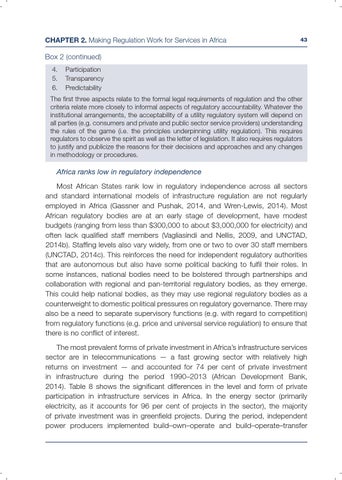
Typology of a regulatory and/or institutional framework for infrastructure services ......................................................................................................... 42
3.
Uganda: Best practice in electricity industry regulation .................................. 47
4.
The General Agreement of Trade in Services waiver for least developed countries: Progress towards its operationalization.......................................... 75
FIGURES 1.
Sectoral shares of real gross domestic product by percentage and value, 2000–2012 ..................................................................................................... 20
2.
Share of services in total employment by country, 2009–2012 ....................... 22
3.
Exports and imports of services, 2001–2012 ................................................. 25
4.
Distribution of exports and imports of services, 2013 .................................... 29
5.
Relevance of services in African National Development Plans ........................ 51
6.
Adults holding an account at a formal financial institution, by rural-urban designation, 2011................................................................... 86
7.
Use of formal account and loan services across firm-size groups, 2011 ....... 90
8.
Number and share of domestic and foreign banks, 1995–2009 ..................... 93
9.
Financial services trade restrictions index scores, 2012 ............................... 106
CONTENTS
vii
TABLES 1. 2. 3. 4. 5. 6. 7. 8. 9. 10. 11. 12. 13. 14. 15. 16. 17.
Distribution of real total value added by sector and country, 2001–2012 ........ 10 Growth in real gross domestic product and services and its components by region, 2001–2012 .................................................................................. 14 Growth in real gross domestic product, services and exports of goods and services by country, 2001–2012 ............................................................ 15 Real growth in services categories by country, 2001–2012 ............................ 18 Services exports and imports by country, averaged for 2009–2012 ............... 26 Other services exports by country, averaged for 2009–2012 ......................... 30 Other services imports by country, averaged for 2009–2012 ......................... 32 Total public-private partnership infrastructure projects by service sector and type, 1990–2013 .................................................................................... 45 Major instruments, policies and institutions dealing with services issues in regional economic communities................................................................. 56 Legal elements of horizontal services protocols in the regional economic communities.................................................................................................. 64 Overview of commitments scheduled under the General Agreement on Trade in Services by African member States .................................................. 69 Horizontal measures affecting investment and employment in services of African schedules of the General Agreement on Trade in Services ............. 73 Financial depth indicators .............................................................................. 83 Financial access indicators ............................................................................ 87 Major cross-border and international banks, 2013 ......................................... 95 Overview of financial services commitments under the General Agreement on Trade in Services schedules of African member States ........................... 107 Measures affecting investment and employment in banking and financial services of African General Agreement on Trade in Services schedules ....... 108
EXPLANATORY NOTES The $ sign refers to the United States dollar. Sub-Saharan Africa: Except where otherwise stated, this includes South Africa. North Africa: In this publication, the Sudan is classified as part of sub-Saharan Africa, not North Africa. A hyphen (-) indicates that the data are either not available or not applicable.
Economic Development in Africa Report 2015
viii
ABBREVIATIONS CEMAC
Communauté économique et monétaire de l’Afrique centrale
CFTA
continental free trade area
COMESA
Common Market for Eastern and Southern Africa
EAC
East African Community
ECOWAS
Economic Community of West African States
FDI
foreign direct investment
GATS
General Agreement on Trade in Services
GATT
General Agreement on Tariffs and Trade
GDP
gross domestic product
ICT
information and communications technology
IMF
International Monetary Fund
LDC
least developed country
M&A
mergers and acquisitions
MFN
most favoured nation
OECD
Organization for Economic Cooperation and Development
SADC
Southern African Development Community
SMEs
small and medium-sized enterprises
INTRODUCTION
2
Economic Development in Africa Report 2015
A. AFRICA’S SERVICES ECONOMY AND WHY IT MATTERS FOR THE CONTINENT Africa’s services sector holds tremendous economic promise. It contributes to almost half of the continent’s output, and a number of African countries have emerged as services-oriented economies. Indeed, growth in services has been vibrant in Africa, at more than twice the average rate for the world during 2009– 2012. The sector’s performance has undoubtedly contributed to Africa’s growth trajectory of the past decade. The services economy in Africa is a vital source of income and employment. In some countries, as much as two thirds of the workforce is engaged in services. Overall, the services sector in Africa accounted for one third of formal employment during 2009–2012. If the informal sector were included, the relevance of services would be even greater. Furthermore, as Africa’s middle class continues to grow, and given current population and urbanization trends (Africa’s population is forecast to double by 2025), this sector is expected to expand. Equally important is the sector’s contribution to Africa’s trade. African services exports and imports totalled $271 billion in 2012. Though Africa is a marginal player in global services trade, with an export share of only 2.2 per cent, the services sector represents an important source of export revenue that should be further exploited if Africa is to assume a role as a global player in services trade. Services also have a vital role to play in the context of Africa’s development strategy, whether it is based on the exploitation of its natural resource base (African Development Bank et al., 2013) or on labour-intensive light industry and manufacturing (Harrison et al., 2014; Lin and Rosenblatt, 2012). For either approach to succeed, exploiting the services potential of Africa will be critical to sustainable development. Indeed, as the most dominant sector in many African economies, services need to support the process of structural transformation, characterized by a shift from low- to high-productivity activities, and a declining share of agriculture in output and employment, as well as an increasing share of manufacturing and modern services in output. There are some dynamic emerging subsectors within the services sector with the potential to generate growth, trade and employment opportunities, which have yet to be tapped. For instance, logistics and distribution could greatly benefit Africa’s agriculture (including agribusiness and food trade) and manufacturing sectors. Therefore, African policymakers need to place greater emphasis on how to move towards the provision of more sophisticated services
INTRODUCTION
3
where there is greater value addition and which offer opportunities for technology transfer and linkage development with other sectors of the economy. Some services sectors are also considered to be the backbone of economic activity and have a bearing on social development. In particular, infrastructure services — encompassing transport, telecommunications, water, energy and financial services — are of critical importance to economic development and could contribute to addressing Africa’s physical infrastructure deficit, inclusive growth and better social welfare. Infrastructure services also provide and support basic services (i.e. electricity, gas and potable water), which will be critical to the achievement of future post-2015 sustainable development goals. Lastly, infrastructure services are essential to the development of other service sectors, including tourism, distribution (wholesale, retail), information and communications technology (ICT) services, and business process outsourcing services. For infrastructure services to contribute successfully to the economic and social development of Africa, the institutional and regulatory environment must be supportive. The continent is already tapping into some of the opportunities the services sector has to offer. For example, some African economies have been developing their services industries with relative success and are supplying services across Africa. Known examples of emerging regional services are the financial and banking services industries of Mauritius and Nigeria, the commercial and cargo air transport industry in Ethiopia and South Africa, the educational services industries of Uganda and Ghana, the telecommunication services of Egypt and the port services industries of Djibouti and Kenya. Major challenges persist, however, especially as Africa seeks to move away from consumption-based growth to more durable sources of growth. The continent will need to shift away from relying on subsistence and non-tradable services to services which generate greater value addition and growth. Therefore, a key policy question is how to translate this services-led growth into sustainable employment and inclusive development for Africa.
B. MAIN FOCUS AND MESSAGES OF THE REPORT Africa finds itself at an important crossroads in terms of defining and shaping its transformational agenda. The services sector can and must form part of this process, given the role it plays in Africa’s economy. The Economic Development in Africa Report 2015 examines some of the major policy issues that underlie the continent’s
4
Economic Development in Africa Report 2015
services sector and provides policy guidance on how services could contribute to regional integration in Africa and generate inclusive growth and employment. It analyses Africa’s services sectors’ regulatory and institutional frameworks, liberalization and growth at the regional level, and how services trade agreements and regulations (for example, the General Agreement on Trade in Services (GATS) and a continental free trade area (CFTA)) interface with the domestic regulation of services. Some of the key questions addressed in this report are as follows: • What is the contribution of the services sector to the African economy and trade? • How might the domestic regulatory and institutional framework improve the provision of services and the sector’s contribution to growth? • What national and regional policies need to be in place in order for services to make an enhanced contribution to African economies? • Is there a potential role for a pan-African approach to services development/ integration? • What services negotiations agenda should African countries pursue in regional and global services negotiations/forums? • How does the national and regional policy landscape look for services trade in Africa, and how can it be made use of? The key messages of the report are outlined in the following paragraphs. First, the services sector has the potential to become a significant driver of sustained economic growth and structural transformation in Africa. This would, however, require policies to be aligned to build complementarities between the services sector and other sectors of the economy especially manufacturing. Africa must make greater efforts to link these services and industries, that is, to prioritize those services that are relevant for a value chain that is strategically important to a certain country. Second, services provision remains suboptimal and is delivered at a high cost. Various regulatory and policy shortcomings prevail, which explain these inefficiencies and impede Africa from fully capitalizing on its services sector potential. For Africa to better harness the potential of its services economy, regulation of and policies for infrastructure services need to better target existing market failures including issues of accessibility, quality, affordability and competition.
INTRODUCTION
5
Third, although African countries have made efforts to address services trade at the national, regional and global levels, a policy disconnect prevails between these three levels, hampering Africa’s opportunities to tap into the benefits of greater services trade. Lastly, the report makes specific and actionable policy recommendations on how to better harness the potential of Africa’s services trade and the related development, employment and growth benefits.
C. ORGANIZATION OF THE REPORT The report is organized in five chapters. Chapter 1 provides empirical evidence on economic trends in the services sector and the sector’s actual contribution to African economies. Chapter 2 examines the economic development potential of the regulation of infrastructure, whether public or privately owned, to boost growth and regional integration in Africa. Chapter 3 evaluates the existing policies that pertain to the services sector at the national, regional and global levels, in an effort to define how well such policies target the sector and the sector’s contribution to development goals of African Governments, such as the CFTA. Chapter 4 focuses solely on the banking and financial services sector in Africa and examines crossborder expansion, financial inclusion, product innovation and regulation. On the basis of the previous analysis, chapter 5 provides an outline of the main policy findings on services trade. It also highlights the lessons learned from the experiences and best practices discussed in chapters 1 to 4.
1
CHAPTER
THE SERVICES SECTOR IN AFRICA: EMERGING TRENDS
8
Economic Development in Africa Report 2015
A. INTRODUCTION In many African countries, the services sector constitutes the largest segment of the economy, and during the period 2000–2012, the sector contributed an increasing share to gross domestic product (GDP), trade and employment. The development of efficient and competitive services economies and trade, especially in infrastructure services such as telecommunications, transport, energy and finance, could significantly improve the economic outlook in Africa. This chapter outlines key stylized facts about the services sector in Africa, based on both national and international sources of data. These facts capture the importance of the services sector in African national economies in terms of their contribution to GDP, trade and employment, and highlight areas for boosting the potential of services in Africa. Box 1 summarizes selected conceptual issues concerning the definition, classification and treatment of services data in economic analysis.
B. STYLIZED FACTS ON THE SERVICES SECTOR IN AFRICA From the period 2001–2004 to the period 2009–2012, the share of services in African output rose from 45.8 to 49 per cent. The share of services in real output was highest among exporters of manufactured goods. Table 1 shows the distribution of total value added in Africa (in constant 2005 dollars) by sector.1 The share of services in Africa’s real output rose from 45.8 to 49.0 per cent from the period 2001–2004 to the period 2009–2012. This mirrored the trend in developing economies, where the share of services in real output rose from 51.9 to 52.8 per cent over the same period. In Africa, the share of services in real output was highest among exporters of manufactured goods (comprising Lesotho and Tunisia), at 61.7 per cent, followed by services exporters at 57.0 per cent, and lowest among fuel exporters, at 33.9 per cent. This may indicate that services are an important determinant of competitiveness in manufacturing exports. Within the services sector in Africa, during the period 2009–2012, the shares of subsectors were as follows: wholesale trade, retail trade, restaurants and hotels accounted for 14.5 per cent of output; transport, storage and communications accounted for 9.2 per cent of output; and other activities accounted for 25.2 per
CHAPTER 1. The Services Sector in Africa: Emerging Trends
9
cent of output. The shares of these services categories in total services in Africa also mirrored the shares observed in developing economies. The wholesale trade, retail trade, restaurants and hotels subsector contributed more than 25 per cent to output in the Gambia and Sao Tome and Principe during the period 2009–2012. The transport, storage and communications subsector accounted for more than 25 per cent of output only in Djibouti, a major services exporter, reflecting the economic importance of its port services to neighbouring landlocked countries and its strategic location close to the Suez Canal. The other activities category represented more than 40 per cent of output in Lesotho, Namibia, South Africa and Seychelles. In countries where the services sector is already a major contributor to GDP and exports, an important policy question is how to use the sector as a launch pad for creating further employment and delivering on inclusive growth and sustainable development. This requires understanding the constraints of the sector in order to enhance its competitiveness, as well as identifying opportunities for optimizing backward and forward linkages between the services sector and other sectors that have a potential for growth and are critical for economic development. During the period 2009–2012, 21 African countries had a share of services in output greater than 50 per cent. As shown in table 1, during the period 2009–2012, the share of services in real output accounted for more than 50 per cent on average in 21 African countries (excluding South Sudan). Seychelles was the most services-dominant economy (80 per cent), followed by Djibouti, Mauritius and South Africa. However, of the 21 countries, only the following eight — mostly relatively small countries dependent on travel and tourism services — were dependent on the exports of services: Cabo Verde; Djibouti; the Gambia; Madagascar; Mauritius; Rwanda; Sao Tome and Principe; and Seychelles. In most African countries where the share of services in real output was above 50 per cent, the services sector was mostly domestic demand-driven rather than exports-led. Although the Comoros, Ethiopia and Liberia were classified as services exports-dependent during the period 2009–2012, the share of services in output in these countries did not exceed 50 per cent. The least services-dependent economies were Equatorial Guinea, Liberia, Angola, the Congo, Chad and Libya, all of which, with the exception of Liberia, are among the top eight oil-exporting economies in Africa. Equatorial Guinea was the only country with a share of services in output of less than 5 per cent. From the
Food and agriculture Côte d'Ivoire Guinea-Bissau Malawi Somalia Fuels Algeria Angola Chad Congo Equatorial Guinea Gabon Libya Nigeria South Sudan Sudan Manufactured goods Lesotho Tunisia Mixed exporters Benin Burkina Faso Burundi Cameroon Central African Republic Egypt Eritrea Ghana Kenya Morocco Mozambique Namibia Niger
Exports specialization
Industry
Mining, manufacturing and utilities Manufacturing Construction
Services
Wholesale trade, Transport, retail trade, storage and restaurants communiand hotels cations Other activities
41 25 42 37 62 14 8 8 29 5 3 4 2 32 .. 38 10 10 10 27 36 39 43 20 54 15 14 32 27 15 28 12 45
39 26 43 26 60 13 10 9 22 4 1 4 2 32 9 34 9 8 9 26 35 40 38 22 53 13 17 27 23 16 27 7 48
15 24 16 14 7 60 60 71 31 74 96 61 76 47 .. 20 31 32 30 24 14 17 17 35 14 37 23 20 19 27 24 28 12
18 18 14 32 7 52 50 65 41 70 89 55 63 32 27 24 30 34 26 24 14 16 15 28 15 39 23 24 20 25 22 27 12
12 21 14 10 3 57 53 67 30 71 94 59 72 46 .. 16 25 26 25 19 10 12 14 32 10 33 12 15 14 21 20 25 10
15 16 12 27 3 46 41 59 40 67 85 52 58 30 12 19 25 28 21 18 9 11 11 24 10 33 8 16 14 18 19 23 10
10 16 13 8 2 4 5 4 8 4 0 4 5 3 .. 8 19 20 18 13 9 11 12 19 6 17 10 11 12 16 15 13 6
13 12 11 25 2 5 5 5 6 5 0 6 4 3 5 8 17 17 16 11 8 6 9 17 7 17 6 9 12 14 13 14 6
3 2 2 3 4 3 7 3 1 3 1 2 4 2 .. 4 6 6 5 4 4 5 3 3 4 4 11 5 4 6 3 3 2
3 2 2 5 4 5 10 6 1 4 4 3 5 2 15 5 5 6 5 6 5 5 4 3 4 6 16 9 5 7 3 4 3
43 51 42 48 31 25 32 21 30 22 3 35 22 22 .. 43 58 58 59 49 49 44 40 46 32 48 64 48 54 58 49 60 43
46 59 44 50 32 34 41 23 30 23 3 39 30 31 76 43 62 58 65 51 51 44 47 49 32 50 60 49 58 59 51 65 40
14 12 21 13 10 10 10 11 14 6 1 15 3 11 .. 16 12 8 15 15 18 11 19 22 12 14 21 11 11 14 14 13 15
16 13 21 20 11 12 14 14 14 7 1 17 5 18 16 15 11 9 14 15 18 15 21 22 13 15 19 11 14 13 16 15 14
7 8 4 6 9 5 8 3 2 4 0 6 3 2 .. 12 8 5 11 7 8 5 3 5 4 10 13 15 11 6 11 5 7
8 9 5 6 10 7 10 4 2 5 0 6 5 6 20 13 12 9 15 9 9 5 5 8 6 13 12 16 14 8 13 7 6
23 32 17 30 12 11 14 7 14 11 2 14 15 9 .. 15 38 44 33 27 23 28 18 19 15 23 30 21 32 37 24 42 21
23 36 17 24 12 14 16 5 13 11 3 15 20 8 39 15 39 41 36 26 24 24 21 20 12 21 28 22 30 38 22 43 19
2001– 2009– 2001– 2009– 2001– 2009– 2001– 2009– 2001– 2009– 2001– 2009– 2001– 2009– 2001– 2009– 2001– 2009– 2004 2012 2004 2012 2004 2012 2004 2012 2004 2012 2004 2012 2004 2012 2004 2012 2004 2012
Agriculture, hunting, forestry and fishing
Table 1. Distribution of real total value added by sector and country, 2001–2012 (Percentage) 10
Economic Development in Africa Report 2015
Agriculture, Mining, Wholesale trade, Transport, hunting, manuManuretail trade, storage and Other Industry Construction Services forestry facturing facturing restaurants communiactivities Exports specialization and fishing and utilities and hotels cations 2001– 2009– 2001– 2009– 2001– 2009– 2001– 2009– 2001– 2009– 2001– 2009– 2001– 2009– 2001– 2009– 2001– 2009– 2004 2012 2004 2012 2004 2012 2004 2012 2004 2012 2004 2012 2004 2012 2004 2012 2004 2012 Senegal 17 16 24 23 20 18 16 14 4 5 59 61 22 20 9 14 28 27 Sierra Leone 49 52 11 15 9 13 3 2 2 2 40 34 9 8 6 7 25 18 South Africa 3 3 32 28 29 25 19 17 2 3 66 69 14 14 10 10 42 45 31 32 Swaziland 9 8 45 38 41 35 39 33 4 3 47 54 11 14 5 8 Togo 45 41 19 19 16 14 10 10 2 5 37 42 11 9 5 6 21 27 Uganda 29 19 22 25 12 11 7 7 10 14 50 54 18 19 5 8 27 27 United Rep. of Tanzania 33 27 21 24 13 14 8 9 8 10 46 49 15 16 6 8 24 25 Zimbabwe 13 10 38 46 38 46 6 7 0 0 47 46 17 13 3 4 27 30 Ores and metals 29 25 30 28 24 21 8 7 6 8 41 46 15 17 4 7 21 21 Botswana 2 2 48 33 42 25 6 8 6 8 50 66 13 21 4 6 34 39 Democratic Rep. of the Congo 55 44 19 23 16 18 5 5 3 5 28 31 16 19 3 4 9 8 Guinea 23 20 33 34 25 27 6 7 8 7 40 44 18 18 6 8 15 18 Mali 38 41 25 19 20 15 9 6 5 4 38 39 14 16 4 6 20 17 Mauritania 33 26 30 31 26 25 10 5 4 6 37 44 8 8 5 13 24 22 Zambia 24 19 25 30 17 16 11 10 8 14 52 49 22 18 4 7 25 24 Services 29 25 16 18 11 11 8 7 6 7 55 57 17 18 12 14 25 25 Cabo Verde 14 10 22 24 12 12 6 6 10 12 64 66 15 17 19 19 30 31 Comoros 49 49 12 10 6 5 4 4 6 5 39 41 18 17 5 8 17 15 Djibouti 3 4 15 19 8 9 3 3 6 10 81 77 20 22 27 27 35 28 Ethiopia 46 40 13 13 8 8 5 5 5 5 41 48 15 18 5 5 22 25 Gambia 27 26 14 14 8 10 6 6 6 4 59 60 34 27 11 14 15 19 Liberia 77 61 6 16 4 14 3 6 2 3 17 17 4 5 5 6 8 7 Madagascar 29 28 18 20 16 15 14 13 2 4 53 52 11 11 19 19 23 22 Mauritius 6 5 29 25 24 19 22 17 6 6 64 70 18 18 11 13 35 38 Rwanda 44 34 14 16 8 7 7 7 6 9 41 50 12 17 6 9 23 24 Sao Tome and Principe 20 18 18 17 10 10 7 7 8 8 63 65 25 26 14 17 25 22 Seychelles 4 2 18 18 13 10 11 7 5 8 78 80 20 20 15 16 43 44 Developing economies 10 8 38 39 33 33 14 22 6 6 52 53 14 15 8 8 30 30 16 16 39 35 35 29 12 11 4 5 46 49 13 14 8 9 25 25 Africa 6 5 34 32 28 25 17 16 6 7 60 63 16 17 8 10 36 36 America 11 8 40 42 34 35 13 26 5 6 49 50 13 14 7 8 29 29 Asia Source: UNCTAD secretariat calculations, based on data from UNCTADStat, available at http://unctadstat/EN/Index.html. Notes: Averages are calculated based on years for which data are available (for South Sudan, data are available only for 2012). Data are based on national systems of accounts and are presented according to six categories of exports specializations (food and agriculture, fuels, manufactured goods, mixed exporters, ores and metals and services). A country is classified under a given category if the share of exports in that category accounts for more than 45 per cent of total exports, based on values during the period 2009–2012. Mixed exporters are countries in which no single category accounts for more than 45 per cent of total exports. The sum of the shares of the three main economic sectors is not always 100 per cent due to discrepancies between total value added and the sum of value added across the three sectors in the original data and due to rounding.
Table 1 (continued) CHAPTER 1. The Services Sector in Africa: Emerging Trends 11
12
Economic Development in Africa Report 2015
period 2001–2004 to the period 2009–2012, the share of services in real output expanded in 45 countries. The expansion was most significant in Botswana, where the share of services in output over this period rose by 15.6 percentage points, from 50.3 to 65.9 per cent. The largest contraction was in Sierra Leone, a postconflict country where the share of services in output fell from 40.3 per cent during the period 2001–2004 to 34.1 per cent during the period 2009–2012. The second largest contraction was in Djibouti, a major services exporter, where the share of services in output fell from 81.5 per cent during the period 2001–2004 to 77.2 per cent during the period 2009–2012, mainly due to the postponement of planned foreign direct investment (FDI) and a reduction in port operations, upon which the country’s economy heavily depends. During the periods 2001–2004 and 2009–2012, of the 45 countries where the share of services in output rose, 30 experienced a contraction in manufacturing. Many African countries have undergone a process of shifting from agricultural to mainly non-tradable services, without undergoing a process of manufacturing development marked by significant productivity improvements, formal job creation, exports of sophisticated goods and the application of technology to the wider economy. Table 1 shows that during the periods 2001–2004 and 2009–2012, of the 45 countries where the share of services in output rose, 30 experienced a contraction in manufacturing. This suggests that the complementary elements between the two sectors have yet to be fully developed in some countries. The services sector in Africa has a critical role to play in the industrial and manufacturing development of African countries, as well as in boosting agricultural productivity. Africa needs to raise investment in infrastructure, encompassing a range of services subsectors, in order to achieve its development goals of structural transformation and economic diversification (UNCTAD, 2014a). Building complementarity, that is, strengthening input–output and demand linkages between services, manufacturing and agriculture remains a necessary continental goal. Africa’s services sector grew at more than twice the world average rate during the period 2009–2012. During the period 2009–2012, the services sector grew rapidly in real terms in Africa, at more than twice the world average rate (see table 2). Growth was particularly strong in Eastern and Western Africa.
CHAPTER 1. The Services Sector in Africa: Emerging Trends
13
During this period, the services sector in Africa grew at a rate of 4.6 per cent, compared to 5.4 per cent in the developing world. The wholesale trade, retail trade, restaurants and hotels category grew at 5.0 per cent, compared to 5.8 per cent for the transport, storage and communications category and 4.0 per cent for other activities. Of the 10 countries (Burundi, Chad, the Congo, Côte d’Ivoire, Equatorial Guinea, Ethiopia, Ghana, Nigeria, Rwanda and Togo) where the services sector grew fastest in real terms during this period, at an annual average rate of more than 8 per cent, only Ethiopia and Rwanda were services exports-dependent. In the services exports-dependent economies of Cabo Verde, the Comoros, Mauritius, Sao Tome and Principe and Seychelles, services growth was below the African average of 4.6 per cent, reflecting a potential slowing down of the services sector in these countries. Furthermore, in the 53 African countries considered in this analysis, there was an estimated inverse correlation between the share of services in GDP during the same period and real growth in the services sector (a negative correlation coefficient of -0.27), which suggests that growth was fastest in countries that were among the least services-oriented and that some countries made significant progress in developing their services sector potential, albeit from a low base, for example Burundi and Equatorial Guinea. Among the 10 fastest growing economies by services sector, four countries are major fuel exporters (Chad, the Congo, Equatorial Guinea and Nigeria). This may indicate a potential nexus between fuel exports revenues and services, with booming oil revenues supporting an increase in demand for services in some African economies. Averaging the real growth rate in services across categories of exports specializations shows that the real growth in services during the periods 2001–2004 and 2009–2012 was highest among fuel exporters (8.6 and 7.8 per cent, respectively) and lowest among food and agriculture exporters. Similarly, during the period 2009–2012, the manufacturing sector in all major fuel-exporting countries grew at a rate of 9.3 per cent on average, compared to 5.2 per cent for manufactured goods-exporting countries. As shown in table 3, at the country level, during the period 2009–2012, the services sector grew at a double digit rate in Burundi, Equatorial Guinea, Ethiopia and Nigeria. The sector contracted only in Madagascar, a services exportsdependent country that experienced a major retrenchment in public investment, official development assistance receipts and tourism, due to significant political turmoil during the period 2009–2011 (Ploch and Cook, 2012).
Economic Development in Africa Report 2015
14
Table 2. Growth in real gross domestic product and services and its components by region, 2001–2012 (Percentage)
Group
Gross domestic product
Services
Wholesale trade, Transport, retail trade, storage and restaurants communiand hotels cations
Other activities
2001– 2009– 2001– 2009– 2001– 2009– 2001– 2009– 2001– 2009– 2004 2012 2004 2012 2004 2012 2004 2012 2004 2012
World
2.72 1.79 2.68 1.99 2.90 1.94 3.73 1.88 2.43 2.04
Developing economies
4.94 5.25 4.97 5.40 4.59 5.83 6.62 5.59 4.75 5.15
Developed economies
1.99 0.44 2.15 1.04 2.27 0.40 2.81 0.37 2.02 1.33
Developing economies: Africa
5.08 3.41 4.76 4.60 4.30 5.02 7.32 5.75 4.26 3.95
Eastern Africa
4.01 7.02 4.26 7.94 3.19 7.48 6.33 9.38 4.28 7.69
Middle Africa
6.87 4.42 5.91 5.03 6.60 4.65 7.24 5.40 4.65 5.45
Northern Africa
4.72 1.63 4.89 3.29 3.17 2.86 7.39 3.95 4.91 3.22
Southern Africa
3.51 1.97 4.11 2.83 3.05 3.04 6.51 2.31 3.94 2.88
Western Africa
8.29 6.27 6.31 9.05 8.44 9.23 10.19 14.15 3.46 6.22
Developing economies: America
2.15 2.88 2.21 3.35 1.77 3.06 3.13 3.99 2.21 3.34
Developing economies: Asia
6.14 6.29 6.41 6.30 6.09 7.02 8.19 6.18 6.11 5.99
Source: UNCTAD secretariat calculations, based on data from UNCTADStat. Note: Figures relate to annual growth in value of GDP and services and its components at constant 2005 dollars, averaged over the given periods.
There has been vigorous growth in the telecommunications sector in Burundi, fuelled by FDI as a result of liberalization measures in the mobile telephony market introduced by the Government. Ethiopia has implemented a Promoting Basic Services Programme since 2012, to improve access to education, health, water and sanitation services by the poor and to improve its transport infrastructure to promote trade. The rebasing of Nigeria’s national accounts in 2014 highlighted the emergence of new services subsectors, notably the electricity, gas, steam and air conditioning supply sectors, as well as the sound recording, film and music production industries (Mail and Guardian, 2014). There has also been a dramatic increase in the number of cellular telephone subscribers in Nigeria, since the Government issued cellular telephone licenses in 2002, and resurgent growth in the banking sector since central bank reforms increased capital requirements for banks, which led to significant consolidation in the industry (Mail and Guardian, 2014).
CHAPTER 1. The Services Sector in Africa: Emerging Trends
15
Table 3. Growth in real gross domestic product, services and exports of goods and services by country, 2001–2012 (Percentage)
Exports specialization
Food and agriculture Côte d'Ivoire Guinea-Bissau Malawi Somalia Fuels Algeria Angola Chad Congo Equatorial Guinea Gabon Libya Nigeria South Sudan Sudan Manufactured goods Lesotho Tunisia Mixed exporters Benin Burkina Faso Burundi Cameroon Central African Republic Egypt Eritrea Ghana Kenya Morocco Mozambique Namibia Niger
Gross domestic product
Services
Exports of goods and services
2001– 2004
2009– 2012
2001– 2004
2009– 2012
2001– 2004
2009– 2012
-0.42 0.81 2.48 3.25
2.52 2.59 2.89 2.60
-1.29 -0.71 3.42 3.44
8.55 2.46 0.47 1.94
1.37 -3.14 14.61 1.32
4.20 0.06 2.09 3.14
5.02 8.04 17.00 3.19 33.81 0.70 4.17 12.43 .. 7.34
2.62 4.13 7.05 7.25 2.62 4.60 11.70 7.03 .. 4.61
4.92 7.39 9.00 7.18 21.25 1.60 6.10 11.67 .. 7.51
5.21 4.57 9.51 8.04 12.11 4.36 6.86 11.72 .. 2.45
3.40 1.98 45.89 -2.41 22.14 -2.13 7.14 4.60 .. 9.69
-3.96 -4.00 -0.25 0.47 -1.12 0.09 11.87 8.05 .. 2.39
2.94 4.49
4.80 2.17
2.84 5.57
4.95 3.61
23.84 3.41
0.03 1.49
4.42 5.81 2.45 4.06 -1.07 3.49 2.64 4.98 3.26 5.50 8.96 5.62 3.84
3.53 5.68 10.46 3.66 3.00 3.45 5.58 8.73 4.37 4.02 7.05 3.70 5.20
4.06 7.50 9.63 7.30 -5.04 3.76 4.31 5.06 3.16 4.62 7.53 5.02 2.49
3.41 7.86 10.39 4.21 3.41 4.01 7.95 8.73 5.02 4.71 7.33 5.10 4.52
1.86 3.54 5.48 1.77 -9.43 7.69 2.50 -13.09 7.65 6.42 32.24 6.95 -0.10
2.08 26.19 -1.77 -0.86 5.52 -4.64 84.22 17.96 4.86 1.68 13.82 0.40 16.01
Economic Development in Africa Report 2015
16
Table 3 (continued) GDP Exports specialization
2001– 2004
Senegal 4.45 Sierra Leone 15.13 South Africa 3.48 Swaziland 2.02 Togo 1.21 Uganda 6.95 United Republic of Tanzania 6.98 Zimbabwe -4.31 Ores and metals Botswana 3.41 Democratic Rep. of the Congo 3.45 Guinea 3.10 Mali 6.51 Mauritania 3.60 Zambia 4.67 Services Cabo Verde 5.10 Comoros 2.43 Djibouti 2.70 Ethiopia 5.31 Gambia 4.44 Liberia -5.46 Madagascar 2.10 Mauritius 3.80 Rwanda 7.38 Sao Tome and Principe 4.05 Seychelles -2.33 Developing economies 5.33 5.27 Africa 2.62 America 6.51 Asia
Services 2009– 2012
2001– 2004
2009– 2012
Exports of goods and services 2001– 2004
2009– 2012
3.13 11.76 1.89 0.73 4.52 5.20 6.61 10.38
5.22 12.57 4.12 2.93 -2.99 8.03 7.46 -3.29
3.45 5.87 2.58 2.46 9.82 6.19 7.79 7.28
4.60 30.69 1.58 6.17 5.20 15.60 13.28 -22.85
4.33 72.33 -2.24 6.95 12.87 -2.54 17.33 62.33
2.63 6.00 2.40 2.96 3.86 7.04
3.57 3.80 1.85 5.00 7.91 4.32
7.50 5.52 1.11 0.49 5.82 6.05
0.85 38.33 2.95 7.30 0.42 28.41
-0.28 5.99 10.07 5.55 5.80 12.13
2.38 1.91 4.50 10.25 3.68 8.65 0.11 3.51 7.42 4.86 3.32 5.25 3.41 2.88 6.29
5.79 1.61 2.16 4.94 0.84 -0.83 1.40 5.30 8.73 6.07 -2.01 5.41 5.04 2.77 6.78
2.94 1.91 4.97 12.31 5.30 7.95 -0.66 4.38 9.07 3.65 3.59 5.40 4.60 3.35 6.30
-0.97 0.39 4.89 17.43 -18.94 2.35 3.15 -0.18 25.66 1.25 -2.21 8.68 4.66 5.08 10.04
3.26 2.04 14.00 0.87 60.30 7.93 0.36 5.17 15.65 3.82 -1.43 4.36 -0.48 2.78 5.11
Source: UNCTAD secretariat calculations, based on data from UNCTADStat. Note: Figures relate to annual growth in value of GDP and services and exports of goods and services at constant 2005 dollars, averaged over the given periods.
CHAPTER 1. The Services Sector in Africa: Emerging Trends
17
Table 4 shows real growth in the services sector by category. Over the period 2009–2012, real growth exceeded 10 per cent in the wholesale trade, retail trade, restaurants and hotels subsector in countries such as Burkina Faso, Burundi, Chad, Ethiopia, Libya, Nigeria and Togo. Real growth exceeded 10 per cent in the transport, storage and communications subsector in 11 countries, including Burundi (26 per cent) and Nigeria (23 per cent). In the other activities category, growth exceeded 10 per cent only in Equatorial Guinea, Ethiopia and Togo. Identifying the drivers of services growth in Africa requires understanding factors accounting for both an increase in demand for services and in supply. On the demand side, the growth of services is driven by broader economic growth, rising exports revenues and a growing population. As both disposable incomes and urbanization increase, the demand for infrastructure services also rise. During the period 2009–2012, simple correlation coefficients between growth in the services sector and real GDP growth was a high 0.63 and coefficients between services growth and growth in exports was 0.19. On the supply side, the services sector tends to expand as countries undertake commitments to improve access to basic services (for example as undertaken in Ethiopia) and reforms to introduce greater competition among services suppliers, and as regional integration deepens through projects to improve transport and logistics. The services sector was the most important driver of growth in 30 out of 54 countries during the period 2009–2012. Figure 1 shows the sharp expansion of the services sector in real terms in Africa since 2000, which was maintained during the 2008–2009 global crisis. The services sector can play an important role in cushioning the effect of global economic shocks in Africa, by sustaining domestic consumption and domestic output when exports are adversely affected by international crises. Weighted real GDP growth rates were calculated for each African country and the contribution of the services sector to real growth was assessed.2 The analysis reinforced the importance of services as a cushion for national economies at times of global economic shock. During the period 2009–2012, the services sector was the most significant driver of economic growth in 30 out of 54 countries, accounting for more than 50 per cent of real economic growth. The sector accounted for more than 70 per cent of total real economic growth in 12 countries, and in seven of these countries, services accounted for more than 50 per cent of GDP. In Côte d’Ivoire, Madagascar, Mali, Seychelles and Swaziland, the services sector accounted for
Economic Development in Africa Report 2015
18
Table 4. Real growth in services categories by country, 2001–2012 (Percentage)
Exports specialization
Food and agriculture Côte d'Ivoire Guinea-Bissau Malawi Somalia Fuels Algeria Angola Chad Congo Equatorial Guinea Gabon Libya Nigeria South Sudan Sudan Manufactured goods Lesotho Tunisia Mixed exporters Benin Burkina Faso Burundi Cameroon Central African Republic Egypt Eritrea Ghana Kenya Morocco Mozambique Namibia Niger
Wholesale trade, retail trade, restaurants and hotels
Transport, storage and communications
Other activities
2001– 2004
2009– 2012
2001– 2004
2009– 2012
2001– 2004
2009– 2012
-0.73 2.61 4.61 3.55
8.55 -0.27 4.71 1.93
-1.07 4.25 8.40 3.31
8.56 4.36 2.41 1.93
-1.54 -5.45 2.12 3.46
8.54 5.84 -1.97 1.94
6.18 7.35 8.51 8.52 22.92 2.08 11.36 13.28 .. 2.76
6.13 4.19 12.05 10.13 3.20 4.17 12.40 10.94 .. 3.57
5.30 7.98 9.68 13.42 14.46 -0.96 11.67 27.21 .. 13.27
4.16 4.14 17.30 9.64 2.95 3.86 12.05 22.78 .. 2.21
3.84 7.18 9.61 4.39 21.19 2.36 4.07 6.61 .. 8.82
5.15 6.12 5.90 5.93 16.04 4.80 5.82 6.50 .. 1.62
3.33 4.53
4.23 0.65
8.59 7.19
6.50 4.18
2.10 5.52
4.84 4.65
3.62 6.84 11.47 9.16 -1.08 0.09 4.83 5.42 3.31 3.37 8.32 6.31 3.59
2.05 12.38 10.96 3.04 3.80 3.49 7.94 6.75 6.98 2.42 5.65 5.78 3.96
4.37 9.91 10.79 9.46 -1.39 5.94 4.82 5.55 8.35 9.54 6.95 12.23 4.31
5.43 5.62 26.38 5.80 4.30 5.67 7.94 10.08 5.24 9.42 11.59 4.23 6.04
4.30 7.75 7.73 4.77 -8.61 5.45 3.75 4.53 1.64 4.32 7.36 3.82 1.10
3.74 6.25 7.66 4.96 2.86 3.39 7.96 8.79 4.03 4.52 6.22 5.01 4.43
CHAPTER 1. The Services Sector in Africa: Emerging Trends
19
Table 4 (continued)
Exports specialization
Wholesale trade, retail trade, restaurants and hotels
Transport, storage and communications
Other activities
2001– 2004
2001– 2004
2009– 2012
2001– 2004
2009– 2012
2009– 2012
Senegal Sierra Leone South Africa Swaziland Togo Uganda United Republic of Tanzania Zimbabwe Ores and metals Botswana Democratic Rep. of the Congo Guinea Mali Mauritania Zambia Services Cabo Verde Comoros Djibouti Ethiopia Gambia Liberia Madagascar
3.35 16.91 3.06 -0.08 1.34 6.08 6.91 -13.19
2.79 7.17 2.66 2.18 12.84 4.47 7.49 5.66
13.30 26.67 6.54 10.49 6.42 14.85 7.66 -1.36
4.13 5.45 2.09 3.73 1.16 8.68 12.03 5.21
4.21 8.75 3.93 2.89 -6.81 8.18 7.74 3.62
3.58 5.46 2.67 2.30 11.59 6.84 6.63 8.39
1.40 2.54 1.92 6.11 6.85 5.89
8.16 6.03 -0.52 3.74 4.46 4.07
-1.29 17.04 1.68 6.72 27.50 3.95
9.35 5.80 1.84 3.03 10.55 12.25
5.03 2.20 1.85 3.97 5.29 3.05
6.92 4.32 2.74 -3.19 4.15 5.91
9.39 -1.81 4.16 4.43 -3.85 1.80 1.12
3.39 1.91 5.52 11.74 1.85 7.95 1.75
3.61 18.25 2.35 9.82 16.85 8.49 0.81
2.15 1.91 5.87 11.29 8.54 7.95 -1.01
5.63 1.49 0.96 4.24 2.56 -6.45 2.23
3.24 1.91 3.73 12.98 8.83 7.95 -1.38
Mauritius Rwanda Sao Tome and Principe Seychelles Developing economies Africa America Asia
3.59 10.41 6.75 -1.17 5.27 4.94 2.59 6.68
2.18 7.98 3.33 5.55 5.83 5.02 3.06 7.02
7.81 12.55 8.52 -5.23 6.95 7.55 3.82 8.35
6.08 10.63 3.87 2.11 5.59 5.75 3.99 6.18
5.50 7.03 4.19 -1.07 5.10 4.35 2.61 6.44
4.91 9.27 3.88 3.37 5.15 3.95 3.34 5.99
Source: UNCTAD secretariat calculations, based on data from UNCTADStat. Note: Figures relate to annual growth in value of the categories at constant 2005 dollars, averaged over the given periods.
Economic Development in Africa Report 2015
20
more than 100 per cent of real GDP growth, offsetting negative growth in the other two sectors. The international competitiveness of African manufacturers is negatively impacted by high indirect costs related to infrastructure services. Inadequate infrastructure services remain a major obstacle to achieving full economic growth potential in Africa. Addressing Africa’s infrastructure will require a substantial programme of investment, estimated at $93 billion per year (Foster and Briceño Garmendia, eds., 2010) Improved infrastructure and provision of services has the potential to contribute to growth in the manufacturing sector in Africa, a sector where the competitiveness of African firms is weak. The cost structure of firms and particularly the difference between the direct and indirect costs of production have a bearing on the weak competitiveness of African manufacturing. One study shows that the overall level of profitability of African firms, which is much lower than elsewhere, results from high indirect costs (Eifert et al., 2008). Firms in developing regions with a stronger Figure 1. Sectoral shares of real gross domestic product by percentage and value, 2000–2012 100
700,000
90
600,000 500,000
70 60
400,000
50 300,000
40 30
200,000
20 100,000
10 0
2000 2001 2002 2003 2004 2005 2006 2007 2008 2009 2010 2011 2012 Left axis:
Agriculture
Industry
Services
Right axis:
Agriculture
Industry
Services
Source: UNCTAD secretariat calculations, based on data from UNCTADStat.
Va l ue in real terms (million $)
Real GDP (percentage)
80
CHAPTER 1. The Services Sector in Africa: Emerging Trends
21
performance have indirect costs amounting to less than 15 per cent of total costs, whereas indirect costs in poor African countries account for 20 to 30 per cent of total costs, often exceeding labour costs. It may be seen that a considerable share of indirect costs in African firms comprises costs related to infrastructure and public services such as energy, transport, communications, water and security, which constitute significant barriers to the international competitiveness of African manufacturers. The services sector accounted for 32.4 per cent of total employment during the period 2009–2012. The services sector accounted for 32.4 per cent of total employment in Africa during the period 2009–2012 (International Labour Organization, 2014). As shown in figure 2, among the eight services exports-dependent economies for which employment data are available, only Cabo Verde, Liberia and Mauritius sourced more than 40 per cent of their formal employment from the services sector. Services-oriented countries do not necessarily source a large share of their formal employment from the services sector. In fact, during the period 2009–2012, the correlation coefficient between the share of services in total employment and in output was a weak 0.08. In some countries (for example Ethiopia, Mozambique, Rwanda and Zambia) where services contributed more than 40 per cent to output over the period 2009–2012, the services sector accounted for less than 20 per cent of total employment. This may be due to the nature of the services sector in these economies, the labour intensity of the services sector (for example, in tourismdependent economies such as Mauritius and Seychelles, the services sector is highly labour intensive) and the fact that in these economies, the services sector coexists with a labour-intensive and low value added agricultural sector. In order for the services sector in Africa to increase its contribution to employment and output, the issue of informality in the services sector will need to be addressed. The informal sector ranges from 50 to 80 per cent of GDP and 60 to 80 per cent of total employment and accounts for 90 per cent of new jobs (Benjamin and Mbaye, 2014). Some of the fastest growing sectors of West African economies (wholesale trade and retail trade, restaurants and transportation) are dominated by informal firms. African services are predominantly informal and small in scale. Addressing the issue of how to bring informal services firms into the formal sector is crucial for raising productivity and the contribution of the services sector to growth and employment.
Economic Development in Africa Report 2015
22
Figure 2. Share of services in total employment by country, 2009–2012 Libya South Africa Gabon Mauritius Namibia Algeria Botswana Angola Tunisia Benin Cabo Verde Egypt Senegal Nigeria Congo Equatorial Guinea Liberia Sudan Togo Morocco Swaziland Côte d'Ivoire Mauritania Kenya Developing economies: Africa Gambia Niger Sierra Leone Uganda Mali Guinea-Bissau Ghana Cameroon Zimbabwe Comoros Central African Republic Lesotho United Rep. of Tanzania Guinea Somalia Rwanda Zambia Mozambique Malawi Chad Democratic Rep. of the Congo Madagascar Eritrea Ethiopia Burkina Faso Burundi 0
10
20
30 40 Percentage
50
60
Source: International Labour Organization, 2014. Data are not available for Djibouti, Sao Tome and Principe and Seychelles.
70
CHAPTER 1. The Services Sector in Africa: Emerging Trends
23
Relative to other regions, Africa captures only a small share of global services trade in value added terms. There is significant potential for African countries to position themselves as services suppliers in national, regional and global value chains for goods production and in services value chains. Services are also enablers of many production and sales processes. There are important input–output linkages between manufacturing and services. With regard to South Africa, one study estimates that 25.3 per cent of the intermediate inputs into manufacturing come from services (of which the bulk comes from trade and finance) and 24.7 per cent of the intermediate inputs into services come from manufacturing (Tregenna, 2007). If imported intermediates are excluded, 31.4 per cent of all domestically produced intermediates into manufacturing are purchased from the services sector and 18.6 per cent of all domestically sourced intermediate inputs into services come from manufacturing. While African countries should aim to develop their manufacturing sectors, increasing the competitiveness of their domestic services sectors should also be a concurrent objective (UNCTAD and United Nations Industrial Development Organization, 2011). There is significant scope for African countries to position themselves as reliable and competitive services suppliers in manufacturing value chains, whether at national, regional or global levels. Global value chains can offer significant new opportunities for structural transformation in Africa. About 60 per cent of global trade consists of trade in intermediate goods and services that are incorporated at various stages in the production process of goods and services for final consumption (UNCTAD, 2013a). To date, Africa has captured only a small share of global trade in terms of value added, although its total level of global value chain integration is high compared to other regions. However, much of this concerns the forward integration of Africa’s commodity exports as inputs in foreign manufacturing, which creates little additional value added in Africa (African Development Bank et al., 2014). Upgrading over time within these value chains through process, product or functional upgrading must be a long-term policy goal for Africa in order to maximize potential economic gains from participation (UNCTAD and United Nations Industrial Development Organization, 2011, and UNCTAD, 2013a). The successful insertion of the African services sector into global production and services value chains will depend on the ability of African countries to: build global competitiveness in the services sector; understand the determinants of competitiveness and the constraints faced by the private sector engaged in the
24
Economic Development in Africa Report 2015
delivery of services; and hold public–private dialogues on services issues and elaborate a clear services sector policy strategy that sets long-term development objectives for the sector. Africa is a marginal player in global services exports and imports. Only 11 African countries have consistently been net services exporters since 2005. In 2012, exports of services were $4.4 trillion globally and $1.3 trillion for developing countries (measured in current prices and at current exchange rates). The distribution of services exports worldwide in 2012 was as follows: 19.9 per cent in transport, 24.7 per cent in travel; and 55.4 per cent in other services, of which the largest portion was other business services. Total imports of services in Africa amounted to an estimated $173 billion in 2012, while exports of services totalled an estimated $98 billion (UNCTADStat, February 2015). In 2012, Africa accounted for only 2.2 per cent of the world’s total exports of services compared to 3.6 per cent for developing America and 24.3 per cent for developing Asia. Africa accounted for 4.0 per cent of total world services imports, compared to 5.2 per cent for developing America and 27.9 per cent for developing Asia. Figure 3 depicts the steep rise in imports of services in Africa around 2005 and a growing divergence thereafter between services exports and imports. Services exports, in nominal terms, grew on average 9 per cent per annum between 2005 and 2009, while services imports grew at a rate of 17 per cent. In 2011 and 2012, services exports grew at around 4 per cent per annum while services imports grew at a rate of 12 per cent in 2011. Such explosive growth may reflect an ongoing liberalization process in the services sector, due to a rising demand for certain types of services associated with economic development, such as construction booms (for instance in Angola and Ethiopia) and an uncompetitive and underdeveloped formal domestic services sector. Africa’s balance of trade in services as a share of GDP was -3.63 per cent in 2012 compared to 1.08 per cent for developing economies in general. At the country level, Egypt and South Africa are Africa’s two main global exporters, accounting for 0.49 per cent and 0.34 per cent of world services exports. Angola, Nigeria and South Africa are the main African global importers, accounting for more than 0.40 per cent of total world services imports. Only the following 11 African countries have consistently been net services exporters since 2005: Cabo Verde; Djibouti; Egypt; Eritrea; Kenya; Mauritius;
CHAPTER 1. The Services Sector in Africa: Emerging Trends
25
Figure 3. Exports and imports of services, 2001–2012 180 000 160 000 140 000
Value (million $)
120 000 100 000 80 000 60 000 40 000 20 000 0
2001 2002 2003 2004 2005 2006 2007 2008 2009 2010 2011 2012 Exports
Imports
Source: UNCTAD secretariat calculations, based on data from UNCTADStat (accessed 1 February 2015).
Morocco; Namibia; Seychelles; Tunisia; and the United Republic of Tanzania. With the exception of Djibouti and Kenya, these countries are mainly dependent on exports of travel services (see table 5). Cabo Verde and Seychelles are among the world’s 10 most tourism-intensive countries, measured as the share of tourism in GDP. Based on averages for the period 2009–2012, the largest net services importers in Africa as a share of GDP were Liberia (-64.5 per cent), the Congo (-32.2 per cent), Angola (-21.7 per cent), Chad (-19.6 per cent) and Equatorial Guinea (-18.9 per cent). More than 60 per cent of the services imports of Chad — a landlocked country – originated in the transport sector. Over 70 per cent of the services imports of Angola, the Congo, Equatorial Guinea and Liberia originated in the other services category, that is, other than transportation and travel services. The other services category is divided into the following nine subsectors: financial; construction; communications; insurance; computers and information; Government; royalties; personal, cultural and recreational; and other business (see table 7). About 92.2
Economic Development in Africa Report 2015
26
Table 5. Services exports and imports by country, averaged for 2009–2012 (Percentage shares) Exports Exports specialization
Travel
Transport
Imports Other services
Travel
Transport
Other services
Food and agriculture CĂ´te d'Ivoire
23.8
19.4
56.8
12.9
56.7
30.5
Guinea-Bissau
32.3
0.9
66.8
29.4
37.6
33.0
Malawi
37.5
27.5
35.0
35.0
13.5
51.5
..
..
..
0.0
42.3
57.7
Algeria
6.4
21.0
72.6
4.3
28.1
67.5
Angola
87.1
4.1
8.8
0.7
18.4
80.9
Somalia Fuels
Chad
37.5
1.6
60.8
12.0
65.7
22.3
Congo
17.0
3.8
79.2
4.7
15.0
80.3
Equatorial Guinea
45.1
1.1
53.8
4.8
20.4
74.8
6.3
18.1
75.6
26.3
30.7
42.9
Gabon Libya Nigeria South Sudan Sudan
6.9
69.7
23.4
38.3
34.1
27.6
21.8
54.6
23.6
26.4
36.4
37.2
..
..
..
..
..
..
52.1
1.9
46.0
43.1
45.9
11.1
Manufactured goods Lesotho
60.8
1.3
37.9
57.9
14.1
27.9
Tunisia
44.6
26.9
28.5
16.7
49.1
34.3
Benin
45.3
22.1
32.6
9.9
61.2
28.9
Burkina Faso
26.3
16.0
57.7
8.1
45.9
46.0
Mixed exporters
Burundi Cameroon
2.3
1.8
96.0
18.3
58.2
23.4
19.7
35.8
44.5
20.9
38.5
40.6
Central African Republic
20.6
3.4
76.0
32.8
52.1
15.1
Egypt
48.4
37.0
14.6
16.3
44.4
39.4
Eritrea
63.0
27.7
9.3
48.1
28.1
23.8
Ghana
37.6
25.3
37.1
16.5
40.4
43.1
Kenya
21.8
41.9
36.3
9.9
49.0
41.1
Morocco
52.3
18.5
29.2
15.9
37.4
46.8
Mozambique
29.5
27.8
42.7
13.0
28.6
58.4
Namibia
55.9
15.9
28.1
23.4
37.7
38.9
Niger
73.7
5.7
20.6
6.7
71.1
22.2
Senegal
40.6
7.0
52.4
12.6
51.9
35.5
Sierra Leone
30.2
23.3
46.5
5.2
52.0
42.8
CHAPTER 1. The Services Sector in Africa: Emerging Trends
27
Table 5 (continued) Exports Exports specialization
Travel
Transport
Imports Other services
Travel
Transport
Other services
South Africa
64.6
11.5
23.8
27.0
41.4
31.6
Swaziland
14.8
13.5
71.7
9.6
14.3
76.1
Togo
21.2
38.3
40.5
11.8
62.2
26.0
Uganda
58.4
5.9
35.7
17.0
55.7
27.3
United Republic of Tanzania
60.5
21.9
17.6
42.5
40.4
17.1
Zimbabwe
44.6
38.8
16.6
4.6
79.9
15.5
Ores and metals Botswana Democratic Rep. of the Congo Guinea Mali
17.1
10.0
72.9
11.1
15.9
73.0
2.8
19.9
77.3
6.9
47.7
45.4
2.7
9.0
88.4
3.6
43.6
52.9
50.2
2.7
47.2
10.9
61.2
27.9
Mauritania
59.4
1.9
38.7
27.8
31.8
40.4
Zambia
38.2
48.4
13.4
6.9
54.0
39.1
Cabo Verde
62.1
27.8
10.1
42.1
36.4
21.5
Comoros
55.2
5.2
39.6
19.7
62.3
18.1
Services
Djibouti
5.6
34.6
59.8
9.0
60.3
30.7
Gambia
58.0
28.4
13.6
12.8
55.5
31.7 29.0
Ethiopia
22.3
55.7
22.0
5.5
65.5
Liberia
32.4
15.8
51.8
4.5
7.9
87.6
Madagascar
35.3
30.7
34.0
9.7
40.2
50.1
Mauritius
46.7
13.2
40.1
18.3
27.1
54.5
Rwanda
58.2
12.0
29.9
14.0
61.3
24.7
Sao Tome and Principe
83.7
1.3
15.0
1.0
80.2
18.8
Seychelles
64.2
28.2
7.5
15.2
50.4
34.3
45.3
25.6
29.1
16.2
36.7
47.1
Developing economies: Africa
Source: UNCTAD secretariat calculations, based on data from UNCTADStat.
per cent of other services imports in Liberia were accounted for by government services, while in Angola, the Congo and Equatorial Guinea, about 48 per cent were accounted for by other business services. Some of these countries are undergoing significant post-conflict reconstruction, and the provision of private sector services has broken down and has yet to be fully restored. With regard to services, the existence of low levels of exports and high levels of imports must be interpreted with caution and should not necessarily be associated with poor economic performance. A high level of services imports could reflect
28
Economic Development in Africa Report 2015
growing demand for services as an input in quickly growing productive sectors, while a low level of services exports may suggest that more domestic services are being used to relieve supply bottlenecks in the domestic economy. Figure 4 shows the distribution of imports and exports of services in Africa in 2013. The five major imports subsectors in 2013 were transport, travel, construction, government services and other business services. Together, these five subsectors accounted for about 72 per cent of total services imports in Africa. The five major exports subsectors were travel, transport, government services, other business services and communications, which totalled 87 per cent. This chapter highlights, through a series of stylized facts, the actual contribution of the services sector to African economies in terms of output, employment and exports. The services sector has the potential to contribute to structural transformation, economic growth and development in Africa if concerted efforts are made to tackle sectoral informality, generate more formal jobs and implement development strategies. African countries should aim to exploit the potential complementarities and linkages between the services sector and other productive sectors of the economy. Policies should also facilitate the insertion of African services suppliers into global value chains and regional value chains in both goods and services.
CHAPTER 1. The Services Sector in Africa: Emerging Trends
29
Figure 4. Distribution of exports and imports of services, 2013 (Percentage shares) A. Services exports Government, 6% Nonallocated 6%
Personal, cultural and recreational 0% Royalties and license fees, 0% Computers and information, 1% Insurance, 1% Construction, 2%
Ot
he
rb
us
ine
Transport, 29%
ss
,6
%
Communication. 5%
Financial, 3% Travel, 41%
B. Services imports
Non-allocated, 18%
t, 6%
, 6%
usiness
ct
io
n,
8%
Other b
tru
Royalties and license fees,1% Computers and Information, 1% Insurance, 4%
Transport, 38%
nmen
Co ns
Personal, cultural and recreational 0%
Gover
Travel, 14%
Communication, 2% Financial, 2%
Source: UNCTAD secretariat calculations, based on data from UNCTADStat.
Economic Development in Africa Report 2015
30
Table 6. Other services exports by country, averaged for 2009–2012 (Percentage shares) Exports specialization
Financial
CompuPersonal, Constru- Communiters and GovernOther cultural Insurance Royalties ction cation informa- ment and recre- business tion ational
Food and agriculture CĂ´te d'Ivoire
10.1
0.9
16.1
6.4
0.9
26.5
0.0
0.0
39.2
Guinea-Bissau
14.6
1.1
61.5
1.1
2.4
5.3
2.8
0.4
10.8
Malawi
14.0
2.4
34.6
4.7
1.4
18.3
0.0
2.4
22.2
..
..
..
..
..
..
..
..
..
8.5
6.3
6.4
3.0
0.7
5.2
0.1
0.2
69.7 5.3
Somalia Fuels Algeria Angola
1.5
8.2
57.2
0.5
1.2
0.0
1.4
24.6
Chad
2.6
1.0
0.9
0.9
2.1
80.4
2.4
0.3
9.3
Congo
12.6
4.6
4.4
4.3
9.9
6.6
11.5
1.5
44.5
Equatorial Guinea
2.3
0.9
0.8
0.8
1.8
82.6
2.1
0.3
8.3
Gabon
7.1
2.6
2.5
26.2
5.5
23.5
6.5
0.8
25.2
Libya
0.0
0.0
37.8
..
..
..
..
..
..
Nigeria
2.0
0.0
7.8
0.2
0.0
84.6
0.0
0.0
5.3
South Sudan Sudan
..
..
..
..
..
..
..
..
..
7.8
8.9
14.0
0.9
0.3
55.9
1.0
0.5
10.8
Manufactured goods Lesotho
2.9
0.0
20.4
6.0
2.3
27.5
0.0
0.0
41.0
Tunisia
4.4
26.9
20.0
4.1
2.7
20.6
1.7
0.6
19.0
Mixed exporters Benin
8.8
3.7
25.4
2.8
0.2
19.2
0.0
0.2
39.6
13.0
21.0
41.2
1.2
1.7
12.9
0.2
0.5
8.3
Burundi
0.5
2.6
0.3
1.9
0.6
91.4
0.2
0.0
2.6
Cameroon
2.1
0.5
10.9
7.5
0.2
12.2
0.0
7.3
59.3
Central African Republic
3.4
1.2
1.2
1.2
2.6
75.1
3.1
0.4
11.9
Egypt
5.2
18.9
27.1
3.6
5.7
7.6
2.6
3.5
25.8
Eritrea
13.5
5.0
4.7
4.6
10.6
0.0
12.4
1.6
47.7
Ghana
0.0
0.0
6.6
3.2
0.0
22.2
0.0
0.0
68.0
Burkina Faso
Kenya
7.9
0.0
28.8
2.5
0.0
57.5
2.9
0.4
0.0
Morocco
1.1
1.3
18.7
3.9
8.8
11.0
0.1
1.2
54.0
Mozambique
1.3
7.2
11.4
1.1
1.9
23.3
0.2
0.9
52.7
CHAPTER 1. The Services Sector in Africa: Emerging Trends
31
Table 6 (continued) Exports specialization
Namibia Niger
Financial
CompuPersonal, Constru- Communiters and GovernOther cultural Insurance Royalties ction cation informa- ment and recre- business tion ational
1.3
0.0
6.1
1.6
0.4
8.1
0.0
0.0
82.5
14.1
1.1
22.6
4.1
2.1
14.7
2.3
0.3
38.7
Senegal
1.0
11.2
30.6
2.3
4.7
21.7
0.3
0.1
28.2
Sierra Leone
1.6
1.7
69.3
1.3
3.6
1.1
4.1
0.5
16.5
South Africa
34.3
25.0
1.8
6.3
8.3
8.6
11.9
1.8
2.0
Swaziland
6.0
18.4
9.9
6.2
0.3
5.6
3.0
1.2
49.3
Togo
8.6
3.2
41.9
1.8
0.0
24.1
5.3
0.5
25.4
Uganda
4.1
17.1
4.7
3.3
8.5
39.1
1.4
0.4
21.3
United Republic of Tanzania
1.6
6.1
10.6
7.5
1.2
12.0
0.0
0.7
60.3
Zimbabwe
0.0
0.0
3.1
13.3
3.8
45.1
2.1
1.2
31.4
Ores and metals Botswana
0.6
2.8
7.2
9.2
1.2
19.8
0.1
0.0
59.1
13.6
1.5
19.7
1.3
0.0
40.5
0.0
1.6
21.9
Guinea
0.0
18.0
41.2
13.8
0.2
6.1
0.0
5.9
14.7
Mali
2.6
2.1
72.7
2.5
0.0
16.1
0.5
0.4
3.2
Mauritania
3.7
1.4
1.3
1.3
2.9
72.6
3.4
0.4
13.0
Zambia
0.0
0.0
54.4
16.7
0.0
0.0
0.0
19.7
9.2
Cabo Verde
4.0
0.4
47.7
11.1
0.2
32.4
0.0
0.2
4.1
Comoros
0.0
0.0
63.8
0.5
0.0
35.7
0.0
0.0
0.0
Djibouti
0.6
0.2
4.2
0.2
0.5
91.6
0.5
0.1
2.1
Gambia
0.0
21.6
58.6
18.7
1.1
0.0
0.0
0.0
0.0
Ethiopia
1.0
4.9
24.9
0.4
0.1
44.5
0.1
0.0
24.2
Liberia
0.3
0.1
0.1
0.1
0.2
97.9
0.3
0.0
1.0
Madagascar
3.8
5.5
6.9
2.6
4.0
12.1
7.7
0.3
57.1
Mauritius
8.9
2.6
7.1
3.4
3.9
3.0
0.1
2.1
69.1
Rwanda
0.6
1.4
22.2
0.8
0.0
66.7
5.2
0.0
3.2
Sao Tome and Principe
19.7
0.6
53.8
0.5
1.2
17.2
1.4
0.2
5.4
Seychelles
10.2
3.7
24.7
3.0
8.0
1.7
11.4
1.2
36.1
Democratic Rep. of the Congo
Services
Source: UNCTAD secretariat calculations, based on data from UNCTADStat. Note: Figures relate to the share of each category in other services.
Economic Development in Africa Report 2015
32
Table 7.
Other services imports by country, averaged for 2009–2012 (Percentage shares)
Exports specialization
Constru- ComuniFinancial ction cation
Insurance
ComputPersonal, ers and Governcultural Other Royalties informa- ment and recre- business tion ational
Food and agriculture CĂ´te d'Ivoire Guinea-Bissau
15.8
2.7
9.1
10.7
1.8
24.9
2.2
0.1
32.6
0.5
0.2
11.5
11.0
5.3
6.9
0.0
17.0
47.7
Malawi
3.7
2.5
6.9
18.6
1.0
30.2
0.5
10.0
26.5
Somalia
6.9
4.8
4.9
9.5
6.7
0.0
15.9
2.2
49.1
Fuels Algeria
0.7
30.4
1.1
2.5
0.8
5.7
1.1
0.3
57.5
Angola
2.5
34.2
2.7
1.6
0.3
9.0
0.0
1.0
48.7
Chad
6.4
4.4
4.5
8.9
6.2
7.1
14.7
2.1
45.6
Congo
6.9
4.8
4.9
9.5
6.7
0.2
15.8
2.2
49.0
Equatorial Guinea
6.8
4.7
4.8
9.3
6.6
2.2
15.5
2.2
48.0
Gabon
6.6
4.6
4.7
9.1
6.4
4.8
15.1
2.1
46.7
Libya
0.0
2.9
2.8
..
..
..
..
..
0.0
Nigeria
2.4
1.2
4.0
7.0
2.0
22.3
2.8
0.6
57.7
South Sudan Sudan
..
..
..
..
..
..
..
..
..
6.2
2.0
6.9
19.8
2.9
50.3
2.0
2.0
7.9
Manufactured goods Lesotho
1.2
4.2
4.8
13.3
1.5
25.7
3.2
2.0
44.1
Tunisia
5.9
30.9
5.4
19.2
2.7
16.5
1.2
0.8
17.5
Mixed exporters Benin
3.4
8.6
22.1
15.3
4.7
6.1
1.7
0.0
38.1
Burkina Faso
6.3
11.6
10.9
27.0
4.9
5.4
0.1
0.0
33.9
Burundi
3.2
3.3
3.2
6.5
4.4
41.8
4.5
0.6
32.5
Cameroon
3.7
4.9
5.1
16.5
0.5
6.1
1.3
0.4
61.4
Central African Rep.
6.8
4.7
4.8
9.3
6.6
2.2
15.5
2.2
48.0
Egypt
0.8
5.3
6.5
25.4
2.1
20.4
4.7
1.0
33.9
Eritrea
6.9
4.8
4.9
9.5
6.7
0.0
15.9
2.2
49.1
Ghana
4.1
2.9
2.9
9.4
4.0
36.3
9.5
1.3
29.5
Kenya
8.3
3.4
13.0
13.2
0.2
21.5
2.5
0.8
37.0
Morocco
1.7
0.1
2.4
5.3
1.7
46.5
1.2
0.7
40.3
Mozambique
1.6
37.8
4.2
1.5
1.7
5.2
0.5
0.3
47.1
Namibia
1.6
17.7
0.1
10.4
11.9
3.0
2.5
2.3
50.6
Niger
5.9
19.6
26.1
8.9
7.1
0.0
4.4
0.6
27.5
Senegal
3.8
10.7
17.5
27.1
4.7
9.5
1.7
0.0
25.0
Sierra Leone
0.2
5.5
9.5
11.4
1.2
9.3
0.6
2.7
59.7
CHAPTER 1. The Services Sector in Africa: Emerging Trends
33
Table 7 (continued) Exports specialization
Financial
ComputPersonal, Constru- Comuniers and Governcultural Other Insurance Royalties ction cation informa- ment and recre- business tion ational
South Africa
2.4
0.1
6.3
9.9
3.4
8.0
34.7
0.2
34.9
Swaziland
2.6
1.7
3.2
3.4
8.4
3.7
13.5
0.1
63.3
Togo
2.3
9.8
16.2
37.6
8.7
6.3
5.8
0.6
25.4
Uganda
1.3
15.7
4.0
14.2
6.8
4.5
1.1
2.2
50.4
United Rep. of Tanzania
1.1
7.1
6.9
20.3
3.2
13.4
3.4
0.1
44.4
Zimbabwe
0.0
0.0
6.4
4.5
6.7
3.0
11.6
2.7
65.1
Ores and metals Botswana
1.5
3.6
7.2
11.5
2.1
25.8
2.1
2.8
43.3
Dem. Rep. of the Congo
5.3
3.2
1.1
28.9
3.3
20.2
4.1
1.2
32.6
Guinea
6.8
6.1
4.9
13.7
0.8
17.4
0.3
1.0
48.9
Mali
1.7
20.1
25.5
13.4
4.0
4.6
0.4
0.4
29.9
Mauritania
4.3
3.0
3.1
6.0
4.2
37.4
9.9
1.4
30.7
Zambia
1.4
32.1
3.0
29.2
1.3
10.4
0.1
1.2
21.3
Services Cabo Verde
3.7
2.3
10.1
26.4
10.8
14.8
3.3
1.2
27.4
Comoros
0.0
0.0
7.9
65.0
3.0
3.7
0.0
2.5
17.9
Djibouti
2.6
1.8
1.9
27.0
2.6
38.5
6.0
0.8
18.7
Gambia
2.8
4.7
18.3
43.7
3.1
0.0
6.4
0.9
20.1 28.0
Ethiopia
0.3
44.4
9.7
13.6
0.5
2.3
0.3
0.9
Liberia
0.5
0.3
1.3
0.2
0.5
92.2
1.1
0.5
3.4
Madagascar
1.1
1.5
7.0
1.0
1.6
20.1
4.2
0.1
63.5 67.2
Mauritius
9.3
2.0
5.0
5.6
1.2
3.2
1.0
5.6
Rwanda
0.8
2.2
19.4
3.4
0.2
70.3
0.4
0.1
3.2
Sao Tome and Principe
4.0
0.5
4.7
29.7
0.7
53.8
1.6
0.2
4.9
Seychelles
7.7
8.1
1.2
10.3
7.3
6.3
1.6
2.5
55.0
Source: UNCTAD secretariat calculations, based on data from UNCTADStat. Note: Figures relate to the share of each category in other services.
34
Economic Development in Africa Report 2015
Box 1. Conceptualizing and defining services in Africa Definitional issues Services may be defined as changes in the condition of an economic agent (including a person) or in the condition of a good or asset (wealth) belonging to an economic agent, as a result of some activity of a second economic agent, carried out with the prior agreement of the first agent. The System of National Accounts of the United Nations distinguishes the following three categories of services: • Change-effecting services: Services that may lead to changes in the physical condition of an agent or good (e.g. car or home repairs, medical procedures and haircuts), or the mental condition of an agent (e.g. education and legal services). The change in condition brought about by such services may be temporary or permanent. • Margin services: Changes in condition that facilitate the exchange of other goods or assets or services between the user of such services and another party (who may or may not be the producer of the service). Such services include wholesale and retail distribution activities and changes in condition related to the physical location of an agent or its goods (transportation) or an agent’s current wealth or risks facing future wealth (financial services) or the social condition of an agent by enabling interaction (connection) with other agents (communications). • Knowledge-capturing products: Hybrid products, with characteristics of both goods and services (e.g. newspapers, electronic media and digital information). Such products have a physical existence; ownership rights can terefore be established and transferability is possible. The knowledge they store may be accessed more than once and production and consumption are not necessarily simultaneous. However, they are like services in that their content (the information and knowledge they contain) changes the mental condition of the user, either temporarily or permanently. The first characteristic of services is that they are produced and consumed (or used) simultaneously. Production is the activity bringing about the relevant change in condition and use is the change in condition itself. For many services, particularly if the change in condition is a physical change to a person or a good, a second characteristic follows as a corollary of the first: the producer and user must be in the same location. The third characteristic of services is that they are intangible and cannot be stored, that is, because they are changes in condition, they cannot be produced in advance of their use. They are only produced once demand for them exists. Finally, services are unlike goods in that they are not transferable separately from their production. Agents cannot purchase services separately from their use in order to establish ownership rights over the services and transfer them to third parties. The need for simultaneous production and consumption when services are traded internationally focuses attention on another set of characteristics of services, the mode of supply (i.e. the process through which the producer and user come into contact). Under some circumstances, cross-border trade (referred to as mode 1 in GATS) is possible, where the producer and user are located in different countries and export and import, respectively. For some services (e.g. tourism and surgical procedures), users from importing countries must move temporarily to the exporting country (consumption abroad, mode 2). A services producer may also move from an exporting country in order to provide services to users in an importing country, either by locating a permanent operation in the country via a capital investment (commercial presence, mode 3) or by temporarily migrating labour to provide the services (presence of natural persons, mode 4).
CHAPTER 1. The Services Sector in Africa: Emerging Trends
35
Box 1 (continued) Measurement issues Measurement of services output (value added) and international trade in services is subject to two major challenges, which follow from the definitional characteristics discussed above. The first challenge is measuring the real output of services activities and the volume of international trade in services. Measuring real output, adjusted for inflation, requires a price index, which assumes that what is defined as a single unit of the product does not change over time in either quantity or quality. Assuming unchanged quality is an issue for both goods and services, especially in defining whether a product with features that are new compared with earlier versions should be considered a new product or a new model of an original product. However, for services, even assuming constant quantity over time is not straightforward, due to difficulties in defining a single unit of a services product, as services are heterogeneous and difficult to standardize and the nature of the product often depends in part on the user as well as the producer (e.g. in education services). The second challenge of measurement arises from the need for many services inputs in the production of both goods and services. Input services such as financial management or factory cleaning may be provided by the producer of an output, in which case they are not measured separately as a services output. Alternatively, they may be sourced from an independent services producer, in which case they are measured separately. Output and employment in services are higher in the former scenario, even though actual economic activity may not be different. Another issue with regard to measurement, of particular relevance to Africa, relates to informal sector activities, which overlaps (but is not identical with) what is referred to as the nonobserved economy in the System of National Accounts. The informal sector in general has a greater predominance of services sector activities than manufacturing or other industrial activities, in part because the entry barriers to many services activities are low, especially in low-income market segments in developing countries. Both household and enterprise surveys are used to measure informal sector activity, often in combination, but these are imperfect instruments, especially in developing countries. Although considerable progress has been made in developing agreed definitions and approaches to measuring informal sector output, there is as yet no standardized approach, making cross-country comparison difficult (United Nations, 2009). Measuring international trade in services can pose particular challenges over and above those faced in the measurement of services value added. Mode 1 transactions require foreign currency exchanges and as a result are, in principle, recorded and included in the current accounts of the balance of payments as non-factor services. However, the growth of e-commerce has made it much more difficult to record international trade in margin services. With regard to mode 2, services production and use occur within the territory of an importing country, with no exchange of foreign currency or customs declarations attached to individual transactions. In principle this should not make a difference to the measurement of value added and employment, yet it may be difficult to identify a transaction as involving international trade. For instance, it is difficult to distinguish the purchase of a restaurant meal or visit to a local museum by a foreign tourist from the same purchases made by a domestic resident. International services trade via modes 3 and 4 is less complicated conceptually. Services trade via mode 3 (commercial presence or direct investment in a host country by a foreign services provider) is counted in principle as part of the host economy’s national accounting system. The amount supplied by foreign providers (imported, in terms of the GATS conceptual framework) is used to develop foreign affiliate statistics data, detailed in the Manual on Statistics on
36
Economic Development in Africa Report 2015
Box 1 (continued) International Trade in Services of the United Nations Department of Economic and Social Affairs, which notes that there are currently few reliable international comparisons of foreign affiliate statistics. Only some member countries of the Organization for Economic Cooperation and Development (OECD) have developed this data and such data is not available for Africa, as it is not a priority in the allocation of already-scarce resources for statistics collection and construction. Services trade via mode 4 involves the temporary migration of labour from an exporting to an importing country to produce services for users in the latter, for example an employee of a South African investment bank moving to Kenya to arrange financing for a new power station for a Kenyan electricity company. Payment for the individual’s services would be a crossborder transaction and recorded in the current accounts of the balance of payments of the importing and exporting countries under factor services. It may be noted that there is a considerable amount of international trade in services in the context of the informal sector and unrecorded economy in Africa, given the relative porosity of borders and the large numbers of temporary and permanent migrants throughout the continent. Categorizing services There are essentially two approaches to categorizing services, depending on the object of measurement. Measures of value added and other national accounts variables defined by the System of National Accounts follow the International Standard Industrial Classification of All Economic Activities, in which sectors are classified into primary, secondary and tertiary groups, based on their relationship with and distance from natural resources.* Services make up the tertiary sector, including wholesale trade and retail trade, restaurants and hotels, transportation and storage, information and communications, finance and insurance, real estate, professional, scientific and technical, government (including defence, education and health) and other services. In the International Standard Industrial Classification hierarchy, construction, followed by electricity, gas and water, are placed before wholesale trade and retail trade, and these two sets of activities may be included in either the secondary or tertiary sectors. A sectoral classification for internationally traded services is detailed in the sixth edition of the Balance of Payments and International Investment Position Manual of the International Monetary Fund (IMF), which differs from the International Standard Industrial Classification (the Harmonized System used to classify traded goods also differs from the International Standard Industrial Classification). The main categories are as follows: manufacturing services on physical inputs owned by others; maintenance and repair services; transport, travel and construction; insurance and pensions; financial services; charges for the use of intellectual property; ICT; other business services; personal, cultural and recreational services; and government goods and services (IMF, 2009). Wholesale trade and retail trade services are included in the cost of the goods distributed by services. The differences between the two frameworks therefore complicate the analysis of services trade growth linkages at sectoral and national levels. * Some countries use their own variations of the International Standard Industrial Classification, such as the Statistical Classification of Economic Activities in the European Community, the General Classification of Economic Activities in Switzerland and the North American Industry Classification System in the United States.
2
CHAPTER
MAKING REGULATION WORK FOR SERVICES IN AFRICA
38
Economic Development in Africa Report 2015
A. INTRODUCTION The services sector plays an important role in Africa’s economic and social development. However, Africa has not been able to fully capitalize on the sector, and services provision is suboptimal and entails high costs. Many of the market failures and inefficiencies afflicting the sector may be addressed through regulation. This chapter examines the economic development potential of the regulation of the infrastructure services sector (whether public or privately owned) and how regulation may contribute to bridging Africa’s infrastructure gap in order to promote economic development. In addition, this chapter discusses how domestic regulatory and institutional frameworks might improve the provision of infrastructural services, and the analysis of regulatory provision focuses specifically on the means of enhancing the contribution of regulated infrastructure services to growth and development in Africa.
B. WHAT ARE INFRASTRUCTURE SERVICES AND WHY IS THEIR REGULATION IMPORTANT? A critical constraint to realizing economic growth potential in Africa is the state of infrastructure services (transport, telecommunications, water, energy and sanitation). Infrastructure services critical to social development, health and economic growth are provided via physical networks (e.g. electricity wires, gas pipelines and sewage pipe systems) and mainly through local or national monopoly facilities. These services are highly capital intensive, are mainly comprised of sunk assets (i.e. immovable equipment with little second-hand value) and are characterized by considerable economies of scale and scope. Since the 1980s, privatized infrastructure services have grown and demand for effective utility regulation has increased largely because of the poor financial performance of many (State-owned) utilities, inappropriate pricing policies (often due to political pressures) and unsustainable subsidization of services for certain categories of customers. In addition, most African countries face stringent limitations on public sector finance for new capacity in transport, telecommunications, water and energy infrastructure, and wish to accelerate services provision to foster economic growth (World Economic Forum et al., 2009). As infrastructure services industries are typically dependent on monopolistic networks (whether public or privately owned or local and/or national), economic regulation needs to address
CHAPTER 2. Making Regulation Work for Services in Africa
39
concerns about competition (asymmetries of information and abuse of dominance) and consumer interests (universal access, affordability and quality). With the increasing integration of infrastructure systems across Africa through pan-territorial initiatives (e.g. Programme for Infrastructure Development in Africa) and common electricity markets, potentially significant benefits from economies of scale and shared resources require effective regional regulation.3 Infrastructure services regulation is also critical as a guarantor of access, affordability and quality control, which are interconnected. For example, if high technical, health, safety or environmental standards are not achieved, the poorest segments of society cannot afford formal infrastructure services and consequently rely on low quality and unsafe informal and unregulated suppliers. The type of regulation matters; simply regulating inputs or processes rather than outputs or outcomes may reduce a utility or firm’s incentive to improve quality, access and efficiency. If a country decides to open up the sector, the sequencing of privatization and development of regulatory institutions are also important, as establishing an institutional framework conducive to promoting competition and governing access, affordability and quality control before privatizing infrastructure services is correlated with improved investment and wider services provision (Zhang et al., 2004, and UNCTAD, 2012). Since the 1980s, it has become both technologically and commercially possible to separate infrastructure networks (e.g. electricity transmission lines and railways) from services provision and, as a consequence, to introduce competition in some segments of the market. This has fundamentally changed the nature of regulation, but has not lessened the need for it, particularly where infrastructure services are unbundled (or separated) from traditional monopoly utilities. In recent years, there has been growing recognition that significant welfare gains may be realized through deep forms of regional integration that entail the harmonization of legal, regulatory and institutional frameworks. Reforms that reduce cross-border transaction costs and improve the performance of infrastructure services are arguably as important for the creation of an open and unified regional economic space as trade policy reforms (Kessides et al., 2009). The preferred institutional organization of regulation is generally a body appointed or authorized by the Government, but independent of it, and thus less subject to political or electoral pressures (see box 2).4 With regard to professional services (credibility products) the market is often self-regulated by the collective action of providers, though the State may provide them legal authority to do so. Establishing
40
Economic Development in Africa Report 2015
the independent economic regulation of network utilities and infrastructure services (transport, telecommunications, water and energy, including petroleum, piped gas and electricity) has emerged as a key economic policy issue in the past 30 years, with the rise of public utility privatization. Regulation in infrastructure involves (at least) the following four elements: market access and barriers to entry; operational regulation and pricing; competition; and investment requirements for services providers. The latter element is significant in Africa, where networks are often quite limited in range and poorly maintained, but private providers may be reluctant to expand and upgrade. National Governments define policy for public services and regulate many private services markets. This applies in particular to infrastructure services (transport, telecommunications, water and energy), financial services, education, health care and professional services (medical, legal, engineering, accounting and auditing), that is, services that display some public good characteristics and/or that are credibility products whose quality may be difficult to assess even after consumption. The need for regulation of such essential economic infrastructure and utility services is critical for three reasons. First, for achieving post-2015 sustainable development goals related to social welfare, water and sanitation and health-related indicators, greater emphasis is placed on regulation that protects consumers, attracts investors and enables Governments to achieve policy objectives (Stern and Cubbin, 2005). Second, Africa’s infrastructure services, in particular road freight, are more expensive and of lower quality than in any other region of the world (African Development Bank, 2010). Inland transport costs are much higher than elsewhere. One study estimated that international transport costs faced by African countries, at 12.6 per cent of the delivered value of exports, were more than twice as high as the world average of 6.1 per cent (International Labour Organization, 2014, and UNCTAD, 2003). In addition, freight moves slowly and uncertainly and the reduction in trade resulting from poor transport performance could exceed 20 per cent (Infrastructure Consortium for Africa, 2013). Third, access to electricity is low across Africa and the amount of electricity being generated, reliably and consistently, is too low to meet rising demand (Vagliasindi and Nellis, 2009). What are the key features of a modern regulatory framework? There is growing consensus on the key design features of a modern regulatory framework and ancillary agency (see box 2). The main features of effective regulation
CHAPTER 2. Making Regulation Work for Services in Africa
41
of privatized utilities are coherence, independence, accountability, predictability, transparency and capacity, along with accessibility, affordability, ownership and quality control (Brown et al., 2006). Coherence implies that the laws underpinning regulation are consistent, with clear divisions of responsibility between municipal and national regulators. Predictability relates to overall decision-making stability in the regulatory framework, as confidence in the decision-making processes of a regulatory body is important for long-term investors in network industries. Capacity relates to the quality of human resources available to the authority and appropriate levels of staffing. Regulatory bodies should be strengthened, allowed to operate independently and adapted to fit the specific needs of each State. The structure of infrastructure services industries is of critical importance, not least in defining the role of regulation. In addition, the nature of a Government’s infrastructure services policy will determine how important liberalization and competition are in a given industry. A key consideration in establishing an effective regulatory framework for infrastructure services is industry characteristics (e.g. the size of the market), with a particular focus on the nature of demand and rate of technical progress, both of which have implications for market entry and competition. Typically, infrastructure services with a high or rising level of demand and a faster rate of technological progress, such as telecommunications, tend to be more attractive to new market entrants and may have lower barriers to entry, reducing the need for extensive regulation. However, this needs to be balanced against other areas where infrastructure networks require regulation to monitor equal market access and avoid the market dominance of an incumbent (whether public or privately owned), for example with regard to electricity transmission lines and railway rolling stock and tracks. A key element of any regulatory framework for infrastructure services is tariff setting. Regulatory bodies need to develop transparent and predictable procedures for tariff setting without reducing the incentive of infrastructure services providers and operators to increase efficiency. Most regulation regimes focus on either a form of price-cap or rate-of-return regulation. In theory, price-cap regulation should encourage greater efficiency, as operators attempt to lower operational costs to make a profit but, in fact, the difference between the two approaches in developing countries is quite small (Brown et al., 2006). Conventional cost-plus pricing used to be widespread in Europe, based on the costs of utilities, plus a return to compensate for their activity. Today, only a few countries allow distribution and transmission system operators to automatically pass along costs in their tariffs.
Economic Development in Africa Report 2015
42
Box 2. Typology of a regulatory and/or institutional framework for infrastructure services The key objectives of economic regulation involve regulation of the following: • Prices and/or rates of return on assets • Quality of services • Investment and/or development plans (regulatory investment plans in monopoly networks) A regulatory authority is typically responsible for implementing and developing the regulatory framework. In countries with regulatory best practice, there is usually a clear structure to the framework, comprising primary law, licenses and/or secondary legislation and detailed codes on services obligations, technical codes and performance standards. Each code and standard assists in regulation of a particular aspect of industry conduct. A regulatory authority also offers guidance and subjects licensed companies to checks and controls at a number of levels, for example planning, operations and customer service. In such a system, legal authority for issuing appropriate guidelines, codes and standards must be devolved to the regulatory body. For instance, a regulatory authority in the energy sector may thereby be permitted to perform the following actions: • Divide the regulatory task into manageable segments • Regulate purchase, distribution, supply and utilization of infrastructure services (e.g. electricity and gas) • Issue licenses for generation, transmission, distribution and supply of electricity and transportation and supply of gas and regulate licensed companies • Regulate tariffs • Identify problems that may appear • Monitor standards and performance A regulatory authority should be responsible for approving codes and standards applicable to the infrastructure services industry (e.g. electricity supply). In doing so, the authority would aim to ensure the following: • The scope of codes and standards is adequate to accomplish the task at hand • Standards are not unduly demanding or unduly lax but appropriate for the price of the service • Standards and codes are enforced • Consumers are kept aware of their rights (the authority should do its utmost to ensure that such rights are fulfilled) All consumers can access affordable and high-quality services The following six interrelated aspects of regulatory governance (at least) are essential to the development of an effective regulatory framework: 1. 2. 3.
Clarity of roles and objectives Autonomy Accountability
CHAPTER 2. Making Regulation Work for Services in Africa
43
Box 2 (continued) 4. 5. 6.
Participation Transparency Predictability
The first three aspects relate to the formal legal requirements of regulation and the other criteria relate more closely to informal aspects of regulatory accountability. Whatever the institutional arrangements, the acceptability of a utility regulatory system will depend on all parties (e.g. consumers and private and public sector service providers) understanding the rules of the game (i.e. the principles underpinning utility regulation). This requires regulators to observe the spirit as well as the letter of legislation. It also requires regulators to justify and publicize the reasons for their decisions and approaches and any changes in methodology or procedures.
Africa ranks low in regulatory independence Most African States rank low in regulatory independence across all sectors and standard international models of infrastructure regulation are not regularly employed in Africa (Gassner and Pushak, 2014, and Wren-Lewis, 2014). Most African regulatory bodies are at an early stage of development, have modest budgets (ranging from less than $300,000 to about $3,000,000 for electricity) and often lack qualified staff members (Vagliasindi and Nellis, 2009, and UNCTAD, 2014b). Staffing levels also vary widely, from one or two to over 30 staff members (UNCTAD, 2014c). This reinforces the need for independent regulatory authorities that are autonomous but also have some political backing to fulfil their roles. In some instances, national bodies need to be bolstered through partnerships and collaboration with regional and pan-territorial regulatory bodies, as they emerge. This could help national bodies, as they may use regional regulatory bodies as a counterweight to domestic political pressures on regulatory governance. There may also be a need to separate supervisory functions (e.g. with regard to competition) from regulatory functions (e.g. price and universal service regulation) to ensure that there is no conflict of interest. The most prevalent forms of private investment in Africa’s infrastructure services sector are in telecommunications — a fast growing sector with relatively high returns on investment — and accounted for 74 per cent of private investment in infrastructure during the period 1990–2013 (African Development Bank, 2014). Table 8 shows the significant differences in the level and form of private participation in infrastructure services in Africa. In the energy sector (primarily electricity, as it accounts for 96 per cent of projects in the sector), the majority of private investment was in greenfield projects. During the period, independent power producers implemented build–own–operate and build–operate–transfer
44
Economic Development in Africa Report 2015
contracts. In contrast, in the water and sewage sector, most private investment projects involved management and lease contracts, but accounted for only 15 per cent of the total amount invested. These differences reflect both the technological characteristics of each sector and the respective market structures. For countries seeking to introduce greater competition into infrastructure services markets, these factors are important in developing a regulatory regime appropriate to the structural characteristics of a given infrastructure services sector (Brown et al., 2006). In Africa, there has been a relatively high frequency of discontinuation of private sector involvement in the provision of infrastructure services (particularly water). According to one study, 25 per cent of water contracts and 15 per cent of electricity contracts were cancelled during the period 1990–2009, even when performance was judged to have improved (African Development Bank, 2014). In general, there is little empirical consensus on the impact of privatization in developing countries, especially in terms of the relative performance of the private and public sector in infrastructure services provision (Estache and Wodon, 2014; Vagliasindi and Nellis, 2009; and Zhang, 2006). Although most studies suggest that competition is generally more important than ownership, other factors should also be taken into account in explaining performance improvements in developing countries, such as the quality of institutions and regulation, the existence of well-developed capital markets and private property rights (Pollitt, 1997; Stern and Davis, 1998; and Hare and Davis, 2006). However, the type of infrastructure matters; telecommunications and the majority of energy supply (e.g. generation and distribution) are more amenable to privatization with the introduction of competition than a market for water services, which is usually cost inefficient in most developing countries (UNCTAD, 2014b; and UNCTAD, 2014c). Given the scale of investment in fixed assets or network assets required to supply water, competition is often infeasible (although there is a vibrant water market in a few countries, such as Nigeria) and the costs are high in developing countries. The Africa Infrastructure Country Diagnostic study collected data measuring institutional reforms in infrastructure undertaken by African countries, utilizing an institutional scorecard comprised of the following three broad areas: reform (sectoral legislation, restructuring of enterprises and private sector participation); regulation (transparent and independent regulatory bodies and tools); and governance (internal management in infrastructure enterprises, such as shareholder relations). Each indicator serves as a basis for measuring the (aggregate and disaggregate)
CHAPTER 2. Making Regulation Work for Services in Africa
45
Table 8. Total public-private partnership infrastructure projects by service sector and type, 1990–2013 Primary sector Energy
Type of public-private partnership Concession
19 9
1 717
118
18 205
Management and lease
18
5
164
22 396
Divestiture
32
23 558
Greenfield
169
85 174
4 Total
0
205
108 732
Concession
63
7 782
Divestiture
3
169
Greenfield
20
10 237
Management and lease
16
52
102
18 241
Total Water and sewage
2 469
Greenfield
Management and lease Transport
Total investment (million $)
Divestiture
Total Telecommunications
Number of projects
Concession
2
76
Greenfield
3
259
Management and lease
23
57
Total
28
392
Grand total
499
149 761
Source: African Development Bank, 2014. Note: Most infrastructure projects with private participation fit in one of the above four types, but boundaries between types are not always clear and some projects have features of more than one type. In such instances, projects are classified under the type that better reflects the risks borne by the private sector.
effects of progress in reforms and enterprise performance (Foster and BriceĂąo Garmendia, eds., 2010, and Vagliasindi and Nellis, 2009). The study shows that most African countries have not made progress in these three areas although, in general, institutional development in utilities (ICT, water and energy) is further advanced than in the transport sector (Escribano et al., 2010).
46
Economic Development in Africa Report 2015
Regional transport and power pool infrastructure have the potential for integration and growth In Africa, regional infrastructure, such as transport corridors and utility power pools, has the potential for greater integration and widening access to infrastructure services due to economies of scale. National Governments may also induce greater competition between national power producers, though this depends on whether they ease controls on access to distribution networks (Wren-Lewis, 2014). One study estimates returns to cross-border transmission investment of 120 per cent in the Southern African Power Pool and 20 to 30 per cent in other power African pools (Eberhard et al., 2011). However, many countries still need to harmonize their regulatory standards and more effectively pool their resources if this potential is to be realized. In this regard, the Programme for Infrastructure Development in Africa, which merges all continental initiatives on infrastructure, is a useful step forward in trying to pursue greater harmonization.
C. REFORMING INFRASTRUCTURE SERVICES PROVISION IN AFRICA African Union efforts to prioritize increasing investments and efficiency in the infrastructure services sector can help African countries lay the foundations for future growth. The determination of the optimal policy framework and respective roles of the private and public sectors can only be made nationally. Given the capitalintensive nature of infrastructure provision, due to constrained public finances, African Governments must consider options that encourage private investment where feasible, such as targeted finance aimed at redressing market failures, in the form of equity (e.g. under the Commonwealth Development Corporation) or as long-term loans (e.g. under the Emerging Africa Infrastructure Fund). There are significant in-country investments (e.g. savings and pension funds) not currently tapped for the financing of infrastructure, mainly due to inadequate risk–return ratios and the lack of adequate risk-mitigation mechanisms. If a country decides to open up the infrastructure services sector, then establishing an institutional framework conducive to promoting competition and governing access, affordability and quality control is an essential prerequisite to privatizing infrastructure services, and policy sequencing and institutional development are therefore important. Critically, policymakers in Africa need to continue their efforts to develop an appropriate legal and regulatory framework for infrastructure services,
CHAPTER 2. Making Regulation Work for Services in Africa
47
to encourage investment and improve efficiency in the sector. Domestic regulation should be addressed first, in order that countries do not lose their regulatory policy space in the drive for greater liberalization and attraction of FDI through free trade agreements and bilateral investment treaties. For African countries with limited experience of the economic regulation of infrastructure services there are few useful examples of how to transition from initial arrangements (e.g. on subsidies and regulatory risk guarantees) to consistency between regulatory legislation and contractual arrangements and to an effective independent regulatory body. Given the heterogeneity of institutional quality and economic development in Africa, it is difficult to directly apply particular country examples in other countries. The example from Uganda in box 3 highlights some elements of regulatory best practice. Countries also need to improve the capacity-building efforts of regulatory bodies with regard to human resources, to enhance performance, which may be supported regionally through shared training programmes, twinning arrangements and information sharing arrangements to more effectively disseminate best practices and benchmark regulatory performance. Cross-country regulation, at the regional economic community level or more broadly, is of particular importance. A key issue in such regulation is the harmonization Box 3. Uganda: Best practice in electricity industry regulation The Ministry of Energy and Mineral Development is responsible for overall management, policy formulation and monitoring of the energy sector in Uganda. The Electricity Regulatory Authority is responsible for the electricity sector. Authority members are appointed by the minister responsible for energy on approval of the cabinet for a period of five years. The Authority is financed by the Ministry of Finance, Planning and Economic Development, by fees prescribed by the Authority on licensing and by a levy not exceeding 0.3 per cent of the revenue generated from the sale of electrical energy. The Authority is independent in the performance of its functions and duties and is not subject to the direction of any person or authority. It is a competent and well-managed regulatory body operating under a well-designed legal framework. The Electricity Regulatory Authority of Uganda provides an effective framework for the support of commercialization and use of private investment in the electricity industry. In addition, the Authority successfully combines concession agreements with the economic regulation of electricity distribution, along with the Ugandan Rural Electrification Fund, to increase electrification rates. The Authority has also made use of a World Bank Partial (regulatory) Risk Guarantee facility to support the concessions and the regulator for the first seven years of the distribution contract. Source: (UNCTAD, 2014d).
48
Economic Development in Africa Report 2015
of national standards and systems, to enable linking and coordination of national infrastructure networks. This is crucial for international trade in infrastructure services at regional and global levels. Commitments made through regional trade agreements can also facilitate a process of domestic regulatory reform through the following: widening the scope of competition in services markets to include foreign operators, which could lead to higher output and employment across the sector (as in telecommunications); undertaking commitments to open up services, which may enhance the credibility of domestic policy reforms, as regional commitments can indemnify investors against the risk of possible future policy reversals; and allowing countries to tap into the regulatory expertise of their trading partners, thereby bolstering domestic regulatory capacity and harmonization. Examples of panterritorial cooperation already in place among regulators include the mechanism for central bankers in Africa, Southern African Development Community (SADC) payment systems, power pools and civil aviation authorities (Páez, 2008a). Although the State remains a major player in the provision of infrastructure services in Africa, regulatory independence is an important element of effective infrastructure services provision. The type of ownership – whether State, private, public–private partnership or joint venture – may vary, as long as it contributes to a Government’s development objectives. Private operation of a State-owned utility is a widely used method in developing countries, as the private sector often considers this less risky than full privatization. Private participation can accelerate infrastructure development and access to improved services. However, Governments must carefully analyse risks, social benefits and employment opportunities. This chapter discusses critical issues pertaining to the regulation of infrastructure services. In conclusion, given critical infrastructure needs in Africa and the status of infrastructure regulation, African countries may capitalize on opportunities for growth through international trade much more effectively if regulation addresses some of the infrastructure services constraints currently faced in Africa. This requires innovative policy reforms aimed at improving the institutional relevance and performance of regulatory bodies tasked with the mandate of balancing fiscal, national, public and private demands. For African firms to effectively exploit growing opportunities for expanded trade through global services value chains, major investments in transport, logistics and energy infrastructure are required.
NOTES AND REFERENCES
126
Economic Development in Africa Report 2015
NOTES 1
Total value added is referred to as output in this report and is used as a measure of output instead of GDP to ensure that the shares of the three main economic sectors (services, industry and agriculture, hunting, forestry and fishing) in output add up to 100 per cent. The total may not always be 100 per cent due to discrepancies in the original data and rounding (see notes to table 1). 2 Weighted real GDP growth = (share of services in GDP * real growth in services) + (share of industry in GDP * real growth in industry) + (share of agriculture, hunting, forestry and fishing in GDP * real growth in agriculture, hunting, forestry and fishing). The contribution of services to real growth = (share of services in GDP * real growth in services) / weighted real GDP growth. Figures used are averages for the period 2009–2012. All values are at constant 2005 dollars. 3 The Programme for Infrastructure Development in Africa is a joint initiative of the African Development Bank, the African Union Commission and the Planning and Coordinating Agency of the New Partnership for Africa’s Development, in collaboration with several other African stakeholders, including regional economic communities and member States, and provides a common framework to build the infrastructure necessary for more integrated transport, energy, ICT and transboundary water networks, to boost trade and stimulate growth. 4 Regulatory independence may be considered to consist of the following three elements: an arm’s-length relationship with regulated firms, consumers and other interests; an arm’s-length relationship with political authorities; and the attributes of organizational autonomy (such as dedicated funding and exemptions from restrictive civil service salary rules) necessary to foster the requisite expertise and underpin such relationships. 5 The eight regional economic communities recognized by the African Union are as follows: the Arab Maghreb Union, the Community of Sahel-Saharan States, the Common Market for Eastern and Southern Africa (COMESA), EAC, the Economic Community of Central African States, ECOWAS, the Intergovernmental Authority on Development and SADC. 6 See box 1 on four modes of service delivery. 7 See COMESA, 2014; EAC, 2009; SADC, 2012. 8 Short-term (less than three years), medium-term (three to seven years) and longterm (more than seven years) targets. 9 For a list of GATS schedules of WTO members , see: http://i-tip.wto.org/services/ Search.aspx (accessed 5 April 2015) 10 In the political economy of trade negotiations, schedules are a result of a multilateral process cross-sectoral request-offer. For example, a country may have prioritized agricultural negotiations and hence has been more willing to give away services in return for higher protection of its agricultural markets at the moment of entry into WTO. In particular, schedules of countries that joined WTO at a later stage may reflect the high entry costs of the accessions process.
Notes and References
127
11 A carve-out is an exception (exemption) to a rule or agreement. 12 Beyond the GATS schedules that reflect what each WTO member is committed to offer to the membership, demand-side interests of African members pertain to what is being offered to them (albeit non-exclusively) by the rest of the members in their schedules, as well as through the interpretation of GATS rules (e.g. at Services Council level) and trade ministerial rounds, where the General Council can take decisions that exclusively target Africa. 13 For example, a submission proposed by the Africa Group for services contributed to the adoption of two modalities to govern the treatment of autonomous liberalization and special treatment of LDCs in WTO at Services Council level (WTO, 2003a, 2003b). 14 M2 is money and quasi money comprising the sum of currency outside banks, demand deposits other than those of the central Government, and the time, savings, and foreign currency deposits of resident sectors other than the central Government (World Bank, 2014). 15 Prudential regulation, concerns regulatory monitoring of a bank’s asset quality and effectiveness of monitoring; capital adequacy; and other portfolio restrictions to avoid financial instability.
REFERENCES Acharya VV and Schnabl P (2010). Do global banks spread global imbalances? The case of asset-backed commercial paper during the financial crisis of 2007–09. NBER Working Paper No. 16079. National Bureau of Economic Research, Inc. African Development Bank (2010). African Development Report 2010: Ports, Logistics and Trade in Africa. Oxford University Press, New York. African Development Bank (2014). Africa Infrastructure Country Diagnostic. Available at http://www.infrastructureafrica.org/tools/data (accessed 13 November 2014). African Development Bank, OECD Development Centre and United Nations Development Programme (2014). African Economic Outlook 2014: Global Value Chains and Africa’s Industrialization. OECD Publishing. Paris. African Development Bank, Organization for Economic Cooperation and Development, United Nations Development Programme, Economic Commission for Africa (2013). African Economic Outlook 2013: Structural Transformation and Natural Resources. Organization for Economic Cooperation and Development. Paris. African Union (2006a). Migration policy framework for Africa. EX.CL/276(IX). Banjul. 25–29 June. African Union (2006b). Common African position on migration and development. EX.CL/277(IX). Banjul. 25–29 June. African Union (2014a). Uganda validates the African Union report on higher education services in Uganda. African Union Commission press release. No. 274/2014. 16 October.
128
Economic Development in Africa Report 2015
African Union (2014b). Burkina Faso validates the report of the African Union on cultural services. African Union Commission press release No. 103/2014. 15 May. African Union (2014c). Decision on the Report of the High-level African Trade Committee on Trade Issues, Assembly/AU/Dec.531 (XXII). Aghion P, Fally T and Scarpetta S (2007). Credit constraints as a barrier to the entry and post-entry growth of firms. Economic Policy. (22)731–779. Anderson K and Yao S (2001). How can South Asia and sub-Saharan Africa gain from the next WTO round? No. 3170. Centre for Economic Policy Research. Bank for International Settlements (2012). Core principles for effective banking supervision. September. Available at http://www.bis.org/publ/bcbs230.htm (accessed 13 April 2015). Barth JR, Caprio G Jr and Levine R (2013). Bank regulation and supervision in 180 countries from 1999 to 2011. NBER Working Paper No. 18733. National Bureau of Economic Research, Inc. Baumann U and Nier E (2003). Market discipline and financial stability: Some empirical evidence. Financial Stability Review. (14)134–141. Beck T, Fuchs MJ and Uy M (2009). Finance in Africa: Achievements and challenges. Policy Research Working Paper No. 5020. World Bank. Beck T, Singer D, Fuchs M and Witte M (2014). Making cross-border banking work for Africa. No. 89202. World Bank. Beck T, Todorov R and Wagner W (2013). Supervising cross-border banks: Theory, evidence and policy. Economic Policy. 28(73):5–44. Bellmann C (2014). The Bali Agreement: Implications for development and the WTO. International Development Policy|Revue internationale de politique de développement. Articles and debates 5.2. Benjamin N and Mbaye AA (2014). Informality, growth and development in Africa. World Institute for Development Economics Research Working Paper No. 2014/052. United Nations University. Berg G and Fuchs MJ (2013). Bank financing of SMEs in five sub-Saharan African countries: The role of competition, innovation and the government. Policy Research Working Paper No. 6563. World Bank. Bleeke J and Ernst D (1991). The way to win in cross-border alliances. Harvard Business Review. 69(6):127–35. Borchert I, Gootiiz B and Mattoo A (2012). Guide to the services trade restrictions database. Policy Research Working Paper. No. WPS6108. World Bank. Brown AC, Stern J and Tenenbaum B with Gencer D (2006). Handbook for Evaluating Infrastructure Regulatory Systems. World Bank. Washington, D.C. Buch CM, Koch CT and Koetter M (2011). Size, productivity, and international banking. Journal of International Economics. 85(2):329–334. Claessens S and Van Horen N (2014). Foreign banks: Trends and impact. Journal of Money, Credit and Banking. 46(s1):295–326.
Notes and References
129
COMESA (2001). Protocol on the Free Movement of Persons, Labour, Services, Right of Establishment and Residence. COMESA (2004). Framework for liberalizing trade in services. COMESA (2014). Report of the thirty-second meeting of the Council of Ministers. CS/ CM/XXXII/2. Kinshasa, Democratic Republic of Congo. February. Demirguc-Kunt A (2006). Finance and economic development: Policy choices for developing countries. Policy Research Working Paper. No. WPS3955. World Bank. Demirguc-Kunt A and Klapper L (2012). Measuring financial inclusion: The global Findex database. Policy Research Working Paper 6025. World Bank. Dihel N, Fernandes AM, Mattoo A and Strychacz N (2005). Reform and regional integration of professional services in East Africa. Economic Premise. No. 32. World Bank. September. EAC (2009). Protocol Establishing the EAC Common Market. Economic Commission for Africa (2013). Sustainable Tourism Master Plan for the Intergovernmental Authority on Development Region: 2013–2023. Available at http:// www.uneca.org/publications/sustainable-tourism-master-plan-inter-governmentalauthority-development-igad-region (accessed 1 April 2015). Economic Commission for Africa, African Union and African Development Bank (2010). Assessing Regional Integration in Africa IV: Enhancing Intra-African Trade. Economic Commission for Africa. Sales No. E.10.II.K.2. Addis Ababa. Eberhard A, Rosnes O, Shkaratan M and Vennemo H (2011). Africa’s Power Infrastructure: Investment, Integration, Efficiency. World Bank. Washington, D.C. Eichengreen BJ, Mussa M and Dell’Ariccia G (1998). Capital Account Liberalization: Theoretical and Practical Aspects. International Monetary Fund. Washington, D.C. Eifert B, Gelb A and Ramachandran V (2008). The cost of doing business in Africa: Evidence from enterprise survey data. World Development. 36(9):1531–1546. Escribano A, Guasch JL and Pena J (2010). Assessing the impact of infrastructure quality on firm productivity in Africa: Cross-country comparisons based on investment climate surveys from 1999 to 2005. Policy Research Working Paper No. 5191. World Bank. Estache A and Wodon Q (2014). Infrastructure and Poverty in Sub-Saharan Africa. Palgrave Macmillan. New York. Financial Times (2014a). Ecobank board ousts chief executive Thierry Tanoh. 11 March. Financial Times (2014b). African banks: Fragile dream. 12 March. Estache A and Wodon Q (2014). Infrastructure and Poverty in Sub-Saharan Africa. Palgrave Macmillan. Foster V and Briceño-Garmendia C, eds. (2010). Africa’s Infrastructure: A Time for Transformation. World Bank. Washington, D.C. Frey L and Volz U (2011). Regional financial integration in sub-Saharan Africa: An empirical examination of its effects on financial market development. Proceedings
130
Economic Development in Africa Report 2015
of the German Development Economics Conference. Berlin. No. 29. Verein für Socialpolitik. Research Committee on Development Economics. Fry MJ (1995). Money, Interest, and Banking in Economic Development. Johns Hopkins University Press. Baltimore, Maryland, United States. Gassner K and Pushak N (2014). 30 years of British utility regulation: Developing country experience and outlook. Utilities Policy. 31:44–51. Global Parnership for Financial Inclusion (2011). Global Standard-Setting Bodies and Financial Inclusion for the Poor: Toward Proportionate Standards and Guidance. White Paper. Available at http://www.gpfi.org/sites/default/files/documents/CGAP. pdf (accessed 9 April 2015). Hare PG and Davis JR (2006). Institutions and development: What we (think we) know, what we would like to know. Centre for Economic Reform and Transformation Discussion Paper No. 2006/03. Heriot-Watt University. Harrison AE, Lin JY and Xu LC (2014). Explaining Africa’s (Dis)advantage. World Development. 63(C):59–77. Herrmann K (2012). Uganda: Moving beyond price to recruit international students. Borderless Report. Issue 10. The Observatory on Borderless Higher Education. 19 April. Infrastructure Consortium for Africa (2013). Infrastructure Financing Trends in Africa – 2013: ICA Annual Report 2013. Tunis Belvedere. International Centre for Trade and Sustainable Development (2014). Africa’s largest free trade area set to launch in December. Bridges Weekly. 18(36):4–6. International Labour Organization (2014). Global employment trends database. Available at http://www.ilo.org/empelm/units/employment-trends/lang--en/index. htm (accessed 24 February 2015). International Monetary Fund (2009). Balance of Payments and International Investment Position Manual. Washington, D.C. IMF (2010). Balance of Payments and International Investment Position Manual. International Monetary Fund. Washington DC. International Monetary Fund (2015). The IMF and the fight against money laundering and the financing of terrorism. 27 March. Available at http://www.imf.org/external/ np/exr/facts/aml.htm (accessed 10 April 2015). Jack W and Suri T (2011). Mobile money: The economics of M-PESA. National Bureau of Economic Research Working Paper No. 16721. National Bureau of Economic Research, Inc. Kasekende LA (2010). Developing a sound banking system in sub-Saharan African countries. In: Quintyn M and Verdier G, eds. African Finance in the 21st Century. Palgrave Macmillan and the International Monetary Fund. Basingstoke, United Kingdom; New York. Kessides IN, Noll RG and Benjamin NC (2009). Regionalizing telecommunications reform in West Africa. Policy Research Working Paper No. 5126. World Bank. Kessie E (2000). Enforceability of the legal provisions relating to special and differential
Notes and References
131
treatment under the WTO agreements. The Journal of World Intellectual Property. 3(6):955–975. Kessie E and Apea Y (2004). Participation of African countries in the multilateral trading system. In: Yussuf AA, ed. African Yearbook of International Law. Martinus Nijhoff Publishers. Leiden. 9–66. Lin JY and Rosenblatt D (2012). Shifting patterns of economic growth and rethinking development. Policy Research Working Paper Series No. 6040. The World Bank. Mail and Guardian (2014). Oil, gas play second fiddle to Nigeria’s services sector. 7 April. Manrique Carpio C and Comas Mir J (2014). The least developed countries services waiver: Any alternative under the GATS? Goettingen Journal of International Law. 6:115–143. Mattoo A and Subramanian A (2003). What would a development-friendly WTO architecture really look like? IMF Working Paper No. 03/153. IMF. Mavroidis PC (2004). In search of (meaningful) success (the Doha Round). In: African Yearbook of International Law. Martinus Nijhoff Publishers. Leiden. 105–120. Mlachila M, Park SG, Yabara M and the International Monetary Fund. (2013). Banking in Sub-Saharan Africa: The Macroeconomic Context. International Monetary Fund. Washington, D.C. Páez L (2008a). GATS financial services liberalization: How do OECD members’ schedules impact commercial banking FDI? Journal of World Trade. 42(6):1065– 1083. Páez L (2008b). Regional trade agreements and FDI: Impact of existing RTAs on FDI and trade flows in the Andean Community and implications of a hemispheric RTA in the Americas. Aussenwirtschaft. 63(3):1–31. Páez L (2011). Liberalizing Financial Services and FDI: Developing a Framework for Commercial Banking FDI. Palgrave Macmillan. Houndmills, Basingstoke, Hampshire, United Kingdom; New York, United States. Ploch L and Cook N (2012). Madagascar’s political crisis. Report for Congress No. R40448. Congressional Research Service. Pollitt MG (1997). The impact of liberalization on the performance of the electricity supply industry: An international survey. Journal of Energy Literature. 3:3–31. Southern African Development Community (2012). Services Trade Protocol. Schloemann H (2012). The LDC services waiver: Making it work. Bridges Africa. 1(4): 13–14. Stephenson S (2012). Global value chains and services: Implications for African countries. Bridges Africa. 1(4):7–9. Stephenson S and Pfister A-K (2013). The LDC services waiver beyond Bali. Bridges Africa. 2(8):27–28. Stern J and Cubbin J (2005). Regulatory effectiveness : The impact of regulation and regulatory governance arrangements on electricity industry outcomes. Policy Research Working Paper No. 3536. World Bank.
132
Economic Development in Africa Report 2015
Stern J and Davis JR (1998). Economic reform of the electricity industries of Central and Eastern Europe. Economics of Transition. 6(2):427–460. Stern M and Ward N (2013). Identifying the offensive interests of African Least Developed Countries (LDCs) in WTO Services Negotiations. DNA Economics. 19 February. Available at http://www.ideascentre.ch/wp-content/uploads/2013/10/Offensiveinte restsofAfricanLDCsinWTOserviocesnegotiations-SternandWard1.pdf (accessed 12 April 2015). Tamirisa NT, Lehmann A and Wieczorek J (2003). International trade in services: Implications for the IMF. IMF Policy Discussion Paper No. 03/6. International Monetary Fund. Tregenna F (2007). Which sectors can be engines of growth and employment in South Africa? An analysis of manufacturing and services. Presented at the United Nations University World Institute for Development Economics Research Conference on Southern Engines of Global Growth: China, India, Brazil and South Africa. Helsinki. 7 September. Available at http://www.policyinnovations.org/ideas/policy_library/data/engines_of _growth_south_africa/_res/id=sa_File1/growth%20south%20africa.pdf. UNCTAD (2003). Challenges and Opportunities for Further Improving the Transit Systems and Economic Development of Landlocked and Transit Developing Countries. United Nations publication. New York and Geneva. UNCTAD (2006). Efficient transport and trade facilitation to improve participation by developing countries in international trade. TD/B/COM.3/80. Geneva. 11 December. UNCTAD (2009). The Least Developed Countries Report 2009: The State and Development Governance. United Nations publication. Sales No. E.09.II.D.9. New York and Geneva. UNCTAD (2011). Trade and Development Report 2011: Post-Crisis Policy Challenges in the World Economy. United Nations publication. Sales No. E.11.II.D.3. New York and Geneva. UNCTAD (2012). Services, Development and Trade: The Regulatory and Institutional Dimension of Infrastructure Services. United Nations publication. New York and Geneva. UNCTAD (2013a). World Investment Report 2013 – Global Value Chains: Investment and Trade for Development. United Nations publication. Sales No. E.13.II.D.5. New York and Geneva. UNCTAD (2013b). Economic Development in Africa Report 2013: Intra-African Trade – Unlocking Private Sector Dynamism. United Nations publication. Sales No. E.13. II.D.2. Geneva. UNCTAD (2014a). Economic Development in Africa Report 2014: Catalysing Investment for Transformative Growth in Africa. United Nations publication. Sales No. E.14. II.D.2. New York and Geneva. UNCTAD (2014b). Services: New Frontier for Sustainable Development – UNCTAD Findings on Services, Development and Trade. United Nations publication. New York and Geneva.
Notes and References
133
UNCTAD (2014c). UNCTAD Surveys of Infrastructure Regulators and Competition Authorities. United Nations publication. New York and Geneva. UNCTAD (2014d). Services Policy Review Uganda (II). United Nations publication. New York and Geneva. UNCTAD and United Nations Industrial Development Organization (2011). Economic Development in Africa Report 2011: Fostering Industrial Development in Africa in the New Global Environment. United Nations publication. Sales No. E.11.II.D.14. New York and Geneva. United Nations (2009). System of National Accounts 2008. Sales No. E.08.XVII.29. New York. United Nations Capital Development Fund (2006). Building Inclusive Financial Sectors for Development. United Nations publication. Sales No. E.06.II.A.3. New York. Vagliasindi M and Nellis J (2009). Evaluating Africa’s experiences with institutional reform for the infrastructure sectors. Africa Infrastructure Country Diagnostic Working Paper No. 23. World Bank. Visa sub-Saharan Africa (2013). Realizing potential: Connecting Africa. Available at http://www.adriansaville.com/sites/default/files/Visa%20Africa%20Integration%20 Index%20-%20Adrian%20Saville%20and%20Lyal%20White%20-%20Long%20 Pap....pdf (accessed 12 April 2015). Wakeman-Linn J and Wagh S (2008). Regional financial integration: Its potential contribution to financial sector growth and development in sub-Saharan Africa. Session IV: Beyond banking – Regional financial integration. African Finance for the 21st Century. High-level seminar organized by the IMF Institute in collaboration with the Joint Africa Institute. 4 and 5 March. Tunis. World Bank (2012). African financial sectors and the European debt crisis: Will trouble blow across the Sahara? Financial Sector Policy Note No. 70434. January. Available at https://openknowledge.worldbank.org/bitstream/handle/10986/12686/704340E SW0P11800Finance0policy0note.pdf?sequence=1 (accessed 12 April 2015). World Bank (2014a). Data. World development indicators. Available at http://data. worldbank.org/products/wdi (accessed 8 April 2015). World Bank (2014b). Global Finance Development Database. Available at http://econ. worldbank.org/WBSITE/EXTERNAL/EXTDEC/EXTGLOBALFINREPORT/0,,content MDK:23492070~pagePK:64168182~piPK:64168060~theSitePK:8816097,00.html (accessed 2 Febrary 2015). World Bank and Global Partnership for Financial Inclusion (2015). Group of 20 financial Inclusion Indicators database. Available at http://datatopics.worldbank.org/ g20fidata/ (accessed 9 April 2015). World Economic Forum, World Bank and African Development Bank (2009). The Africa Competitiveness Report 2009. World Economic Forum. Geneva. World Trade Organization (2011). Preferential treatment to services and service suppliers of least-developed countries. Decision of 17 December 2011. WT/L/847 December. Available at https://www.wto.org/english/thewto_e/minist_e/min11_e/ official_doc_e.htm.
134
Economic Development in Africa Report 2015
World Trade Organization (2013). Operationalization of the Waiver Concerning Preferential Treatment to Services and Service Suppliers of Least-Developed Countries. Ministerial Decision of 7 December 2013. World Trade Organization. Bali, Indonesia. World Trade Organization (2014). Submission by the Delegation of Uganda on behalf of the LDC group: Collective request pursuant to the Bali decision on the operationalization of the waiver concerning preferential treatment to services and services suppliers of least-developed countries. S/C/W/356. 21 July. Available at http://www.chamber.ca/advocacy/canadian-services-coalition/updates/140724_ Collective_Request_LDC_Group.pdf (accessed 12 April 2015). Wren-Lewis L (2014). Utility regulation in Africa: How relevant is the British model? Utilities Policy. 31:203–205. World Trade Organization (2001). Guidelines for the scheduling of specific commitments under the General Agreement on Trade in Services (GATS). S/K/92. 28 March. World Trade Organization (2002). Proposal by Kenya, Nigeria, Senegal, Zambia, Cuba, Pakistan and the Dominican Republic, TN/S/W/3. 10 June. World Trade Organization (2003a). Modalities for the treatment of autonomous liberalization. TN/S/6. 10 March. World Trade Organization (2003b). Modalities for the special treatment for leastdeveloped country members in the negotiations on trade in services. TN/S/13. 5 September. Zhang Y, Parker D and Kirkpatrick C (2004). Competition, regulation and privatization of electricity generation in developing countries: Does the sequencing of the reforms matter? Centre on Regulation and Competition Working Paper No. 30599. Institute for Development Policy and Management, University of Manchester. Zhang KH (2006). Foreign direct investment in China. Canadian Foreign Policy Journal. 13(2):35–50.
Economic Development in Africa - Report series
135
Economic Development in Africa - Report series: 2000
Capital Flows and Growth in Africa – TD/B/47/4 – UNCTAD/GDS/MDPB/7 Contributors: Yilmaz Akyüz, Kamran Kousari (team leader), Korkut Boratav (consultant).
2001
Performance, Prospects and Policy Issues – UNCTAD/GDS/AFRICA/1 Contributors: Yilmaz Akyüz, Kamran Kousari (team leader), Korkut Boratav (consultant).
2002
From Adjustment to Poverty Reduction: What is New? – UNCTAD/GDS/ AFRICA/2 Contributors: Yilmaz Akyüz, Kamran Kousari (team leader), Korkut Boratav (consultant).
2003
Trade Performance and Commodity Dependence – UNCTAD/GDS/ AFRICA/2003/1 Contributors: Yilmaz Akyüz, Kamran Kousari (team leader), Samuel Gayi.
2004
Debt Sustainability: Oasis or Mirage? – UNCTAD/GDS/AFRICA/2004/1 Contributors: Kamran Kousari (team leader), Samuel Gayi, Bernhard Gunter (consultant), Phillip Cobbina (research).
2005
Rethinking the Role of Foreign Direct Investment – UNCTAD/GDS/ AFRICA/2005/1 Contributors: Kamran Kousari (team leader), Samuel Gayi, Richard KozulWright, Phillip Cobbina (research).
2006
Doubling Aid: Making the “Big Push” Work – UNCTAD/GDS/AFRICA/2006/1 Contributors: Kamran Kousari (team leader), Samuel Gayi, Richard KozulWright, Jane Harrigan (consultant), Victoria Chisala (research).
2007
Reclaiming Policy Space: Domestic Resource Mobilization Developmental States – UNCTAD/ALDC/AFRICA/2007
and
Contributors: Samuel Gayi (team leader), Janvier Nkurunziza, Martin Halle, Shigehisa Kasahara. 2008
Export Performance Following Trade Liberalization: Some Patterns and Policy Perspectives - UNCTAD/ALDC/AFRICA/2008 Contributors: Samuel Gayi (team leader), Janvier Nkurunziza, Martin Halle, Shigehisa Kasahara.
136
Economic Development in Africa Report 2015
2009
Strengthening Regional Economic Integration for Africa’s Development UNCTAD/ALDC/AFRICA/2009 Contributors: Norbert Lebale (team leader), Janvier Nkurunziza, Martin Halle, Shigehisa Kasahara.
2010
South–South Cooperation: Africa and the New Forms of Development Partnership - UNCTAD/ALDC/AFRICA/2010 Contributors: Norbert Lebale (team leader), Patrick Osakwe, Janvier Nkurunziza, Martin Halle, Michael Bratt and Adriano Timossi.
2011
Fostering Industrial Development in Africa in the New Global Environment - UNCTAD/ALDC/AFRICA/2011 Contributors: Norbert Lebale (team leader), Patrick Osakwe, Bineswaree Bolaky, Milasoa Chérel-Robson and Philipp Neuerburg (UNIDO)
2012
Structural Transformation and Sustainable Development in Africa UNCTAD/ALDC/AFRICA/2012 Contributors: Charles Gore and Norbert Lebale (team leaders), Patrick Osakwe, Bineswaree Bolaky and Marko Sakai. Intra-African Trade: Unlocking Private Sector Dynamism Contributors: Patrick Osakwe (team leader), Janvier Nkurunziza and Bineswaree Bolaky. Catalysing Investment for Transformative Growth in Africa Contributors: Patrick Osakwe (team leader), Rashmi Banga and Bineswaree Bolaky.
2013
2014
Copies of the series of reports on Economic Development in Africa may be obtained from the Division for Africa, Least Developed Countries and Special Programmes, UNCTAD, Palais des Nations, CH-1211 Geneva 10, Switzerland (e-mail: africadev@ unctad.org). The reports are also accessible on the UNCTAD website at unctad.org/africa/series.