A RAPID RESPONSE ASSESSMENT
THE ENVIRONMENTAL CRIME CRISIS THREATS TO SUSTAINABLE DEVELOPMENT FROM ILLEGAL EXPLOITATION AND TRADE IN WILDLIFE AND FOREST RESOURCES
1
Nellemann, C., Henriksen, R., Raxter, P., Ash, N., Mrema, E. (Eds). 2014. The Environ mental Crime Crisis – Threats to Sustainable Development from Illegal Exploitation and Trade in Wildlife and Forest Resources. A UNEP Rapid Response Assessment. United Nations Environment Programme and GRID-Arendal, Nairobi and Arendal, www.grida.no ISBN: 978-82-7701-132-5 Printed by Birkeland Trykkeri AS, Norway Disclaimer The contents of this report do not necessarily reflect the views or policies of UNEP or contributory organizations. The designations employed and the presentations do not imply the expression of any opinion whatsoever on the part of UNEP or contributory organizations concerning the legal status of any country, territory, city, company or area or its authority, or concerning the delimitation of its frontiers or boundaries.
2
UNEP promotes environmentally sound practices globally and in its own activities. This publication is printed on fully recycled paper, FSC certified, post-consumer waste and chlorinefree. Inks are vegetable-based and coatings are waterbased. UNEP’s distribution policy aims to reduce its carbon footprint.
A RAPID RESPONSE ASSESSMENT
THE ENVIRONMENTAL CRIME CRISIS THREATS TO SUSTAINABLE DEVELOPMENT FROM ILLEGAL EXPLOITATION AND TRADE IN WILDLIFE AND FOREST RESOURCES
Editorial Team Christian Nellemann (Editor in Chief) Rune Henriksen Patricia Raxter Neville Ash Elizabeth Mrema Cartography Riccardo Pravettoni
3
Preface Given the alarming pace, level of sophistication, and globalized nature that illegal trade in wildlife has now notoriously achieved, UNEP initiated a Rapid Response Assessment to provide some of the latest data, analysis, and broadest insights into the phenomenon. Tackling illegal wildlife trade demands this examination of the relationship between the environmental resources at stake, their legal and illegal exploitation, the loopholes that exacerbate the situation, the scale and types of crimes committed, and the dynamics of the demand driving the trade. In the international community, there is now growing recognition that the issue of the illegal wildlife trade has reached significant global proportions. Illegal wildlife trade and environmental crime involve a wide range of flora and fauna across all continents, estimated to be worth USD 70–213 billion annually. This compares to a global official development assistance envelope of about 135 billion USD per annum. The illegal trade in natural resources is depriving developing economies of billions of dollars in lost revenues and lost development opportunities, while benefiting a relatively small criminal fraternity. This report focuses on the far-reaching consequences of the environmental crime phenomenon we face today. The situation has worsened to the extent that illegal trade in wildlife’s impacts are now acknowledged to go well beyond strictly environmental impacts – by seriously undermining economies and livelihoods, good governance, and the rule of law. Even the security and safety of countries and communities is affected: the report highlights how wildlife and forest crime, including charcoal, provides potentially significant threat finance to militias and terrorist groups. Already recognized as a grave issue in DRC and Somalia by the UN Security Council, the assessment reveals that the scale and role of wildlife and forest crime in threat finance calls for much wider policy attention, well beyond those regions.
The illegal trade in natural resources is depriving developing economies of billions of dollars 4
The consequences are increasingly evident: illegal wildlife trafficking constitutes a barrier to the achievement of both sustainable development and environmental sustainability. As reflected in a range of decisions of the Convention on International Trade in Endangered Species of Wild Fauna and Flora, the UN Office for Drugs and Crime, the UN Commission on Crime Prevention and Criminal Justice, INTERPOL, the UN Security Council, and others, the illegal trade in wildlife and environmental crime are now widely recognized as significant threats on a global scale, to be tackled with urgency. However the responses to date, in terms of impact on the ground, have been too modest, and inadequate to the scale and growth of the threat to wildlife and the environment. A fuller understanding of the phenomenon of illegal wildlife trade is necessary to design and further strengthen – and accelerate – an effective strategy to successfully tackle the issue at all levels and with all means possible. A global and holistic response needs to be implemented to support national, regional and international efforts by strengthening and synchronizing actions targeting coherent environmental legislation, poverty alleviation and demand reduction. Achim Steiner UN Under-Secretary General and UNEP Executive Director
Contents
4 7 9 11 13 23 61 75 87 97 98 99 102 103
Preface Executive summary Responses Recommendations Introduction Wildlife trafficking Forest crime Role of wood and illegal wildlife trade for threat finance Responses Conclusion Recommendations Acronyms Contributors Notes 5
6
Executive summary Ecosystems play a crucial role and especially for developing economies by supporting revenues, future development opportunities, livelihoods and sustainable harvest sectors relying heavily on natural resources, such as in agriculture, forestry and fisheries. Healthy ecosystems provide the platform upon which future food production and economies are ultimately based.
The opportunities ecosystems provide for future development, however, are threatened by serious and increasingly sophisticated transnational organized environmental crime, undermining development goals and good governance. Transnational organized environmental crime may include illegal logging, poaching and trafficking of a wide range of animals, illegal fisheries, illegal mining and dumping of toxic waste. It is a rapidly rising threat to the environment, to revenues from natural resources, to state security, and to sustainable development. Combined estimates from the OECD, UNODC, UNEP and INTERPOL place the monetary value of all transnational organized environmental crime between 70–213 billion USD annually. This compares to a global ODA of ca. 135 billion USD. Whilst therefore benefiting a relatively small criminal fraternity, the illegal trade in natural resources is otherwise depriving developing economies of billions of dollars in lost revenues and development opportunities. The illegal trade in wildlife is no longer an emerging issue. The scale and nature of the challenge has been recognized in decisions of the Convention on International Trade in Endangered Species of Wild Fauna and Flora (CITES), the UN Commission on Crime Prevention and Criminal Justice, the Economic and Social Council (ECOSOC), the UN Security Council, UN General Assembly, INTERPOL, the World Customs Organisation (WCO) and others, including at national levels. Highlevel political conferences have also addressed the issue, most notably recently convened in Botswana and Paris (December 2013), London (February 2014), and Dar es Salaam (May 2014). However, the responses in terms of impact on the ground are still behind the scale and development of the threat to wildlife, including forests, as well as increasingly also development goals. The illegal trade in fauna and flora excluding timber, charcoal and fisheries, has been estimated by different sources to be worth 7–23 billion dollars annually. The trade involves a wide range of species including insects, reptiles, amphibians, fish and mammals. It concerns both live and dead specimens or products thereof, used for pharmaceutical, food, pets, ornamental or traditional medicinal purposes. Illegal harvest and trade includes a range of taxa such as gorillas, chimpanzees,
elephants, tigers, rhinos, Tibetan antelopes, bears, corals, birds, pangolins, reptiles, sturgeon for black caviar, and a wide range of other commercial fisheries species from the high seas and territorial waters. All of these have a significant value not only on the black market, but even more to national economies if managed sustainably. The illegal trade in wildlife operates per definition outside government official regulation and management, and thus represents a significant economic, environmental and security threat that has received relatively little attention in the past. The possible number of elephants killed in Africa is in the range of 20–25,000 elephants per year out of a population of 420,000–650,000. For the forest elephant, population size has been estimated to decline by ca. 62% between 2002 and 2011. Poached African ivory may represent an end-user 7
street value in Asia of an estimated USD 165–188 million of raw ivory, in addition to ivory from Asian sources. For rhinos, some 94% of the poaching takes place in Zimbabwe and South Africa, which have the largest remaining populations. Here poaching has increased dramatically from possibly less than 50 in 2007 to over 1,000 in 2013 involving organized syndicates. Rhinos have disappeared entirely from several Asian and African countries in recent years. Rhino horn poached last year is valued around USD 63.8 – 192 million USD, much less at the frontline. The scale of revenue from the illegal trade in fauna is dwarfed by the income from illegal logging and forest crime. Forest crime, such as illegal logging, has previously been estimated to represent a value of 30–100 billion USD annually or 10–30% of the total global timber trade. An estimated 50–90% of the wood in some individual tropical countries is suspected to come from illegal sources or has been logged illegally. Forest crime appears to take place in four forms: 1) The illegal exploitation of highvalue endangered (CITES listed) wood species, including rosewood and mahogany; 2) Illegal logging of timber for sawn wood, building material and furniture; 3) Illegal logging and laundering of wood through plantation and agricultural front companies to supply pulp for the paper industry; and 4) Utilization of the vastly unregulated woodfuel and charcoal trade to conceal illegal logging in and outside protected areas, conduct extensive tax evasion and fraud, and supply fuel through the informal sector. For pulp and paper production, networks of shell companies and plantations are actively used to by-pass logging moratoriums under the pretext of agricultural or palm- oil investments, used to funnel illegal timber through plantations, or to ship wood and pulp via legal plantations in order to re-classify pulp or wood as legal production, undermining also legal business and production. These methods effectively bypass many current customs efforts related to the Lacey Act and the EU FLEGT programme to restrict the import of illegal tropical wood to the US and to the EU, respectively. Based on data from EUROSTAT, FAO and the International Tropical Timber Organization (ITTO), the EU and the US annually imports approximately 33.5 million tons of tropical wood in all its forms. It is estimated that 62–86% of all suspected illegal tropical wood entering the EU and US arrives in the form of paper, pulp or wood chips, not as roundwood or sawnwood or furniture products, which have received the most attention in the past. In Africa 90% of wood consumed is used for woodfuel and charcoal (regional range 49–96%), with an official charcoal production of 30.6 million tons in 2012, worth approximately USD 9.2–24.5 billion annually. The unregulated char8
coal trade alone involves an annual revenue loss of at least USD 1.9 billion to African countries. With current trends in urbanization and the projected population increase of another 1.1 billion people in Sub-Saharan Africa by 2050, the demand for charcoal is expected to at least triple in the coming three decades. This will generate severe impacts like large–scale deforestation, pollution and subsequent health problems in slum areas, especially for women. The increased charcoal demand will also strongly accelerate emissions from both forest loss and emissions of short-lived climate pollutants – black carbon. Internet listings reveal over 1,900 charcoal dealers in Africa alone. At least 300 of these are exporting minimum orders of 10–20 tons of charcoal per shipment. Their minimum daily orders exceed the official total annual exports for some countries. For East, Central and West Africa, the net profits from dealing and taxing unregulated, illicit or illegal charcoal combined is estimated at USD 2.4–9 billion, compared to the USD 2.65 billion worth of street value heroin and cocaine in the region. Wildlife and forest crime has a serious role in threat finance to organized crime, and non-state armed groups including terrorist groups. Ivory also provides a portion of income raised by militia groups in the DRC and CAR, and is likely a primary source of income to the Lord’s Resistance Army (LRA) currently operating in the border triangle of South Sudan, CAR and DRC. Ivory similarly provides a source of income to Sudanese Janjaweed and other horse gangs operating between Sudan, Chad and Niger. However, given the estimated elephant populations and the number of projected killed elephants within the striking range of these militia groups, the likely annual income from ivory to militias in the entire Sub-Saharan range is likely in the order of USD 4.0–12.2 million. Illicit taxing of charcoal, commonly up to 30% of the value, is conducted on a regular basis by organized criminals, militias and terrorist groups across Africa. Militias in DRC are estimated to make USD 14–50 million annually on road taxes. Al Shabaab’s primary income appears to be from informal taxation at roadblock checkpoints and ports. In one roadblock case they have been able to make up to USD 8–18 million per year from charcoal traffic in Somalia’s Badhadhe District. Trading in charcoal and taxing the ports have generated an estimated annual total of USD 38–56 million for Al Shabaab. The overall size of the illicit charcoal export from Somalia has been estimated at USD 360–384 million per year. For African countries with ongoing conflicts, including Mali, CAR, DRC, Sudan and Somalia, a conservative estimate is that the militia and terrorist groups in the regions may gain USD 111–289 million USD annually, dependent upon prices, from their involvement in, and taxing of, the illegal or unregulated charcoal trade. More investigation is needed to determine the role of charcoal for threat finance.
Responses Illegal trade in forest and wildlife products, as well as the illegal exploitation of natural resources is now widely recognized as a significant threat to both the environment and to sustainable development. This is reflected in a range of decisions from CITES, from the UN Commission on Crime Prevention and Criminal Justice, INTERPOL, UNEP, and the UN Security Council, including on Somalia and DRC.
prevent eradication. It was combined with the establishment of some of the largest protected areas in world. While populations are slowly recovering, they are still very vulnerable and more surveys urgently needed.
International enforcement collaboration, such as the International Consortium on Combating Wildlife Crime (ICCWC), which includes CITES, UNODC, INTERPOL, the World Bank and WCO, together with increased collaboration amongst agencies, such as with UNEP, and with countries, has created a more effective structure to provide support to countries in the fields of policing, customs, prosecution and the judiciary. These initiatives have revealed important and significant early results.
Brazil is probably one of the world’s leading countries in a wide enforcement effort to reduce illegal deforestation by tackling the full criminal chain and their networks. Deforestation in Brazil’s Amazon reached its lowest level in 2012, since monitoring of the forest began in 1988. It went down by 64–78%, depending upon estimates, primarily as a result of a coordinated enforcement approach using satellite imagery and targeted police operations and investigations. This was supported by large-scale efforts through REDD+ and other initiatives to strengthen the participatory processes of indigenous peoples, stake holders and alternative livelihoods. Many parts of the world could learn from the measures and actions undertaken by Brazil.
Poaching for Shahtoosh wool from Tibetan or Chiru antelopes caused a dramatic drop of likely 80–90% or nearly a million Chiru antelopes in China in the 1990–2000s and resulted in a significant environmental, police and military effort to
In Tanzania over 1,100 rangers have received specialized training in the past two years. The training covers tracking of poachers, tactics and wildlife crime scene management, and it has been done under the auspices of INTERPOL and
9
On customs, the UNODC-WCO Container Control Programme (CCP) has been successful in targeting sea and dry port container shipments in an increasing number of countries. Seizures include not only counterfeits and drugs, but also wildlife and timber products, such as ivory, rhino horn and rosewood. An Indonesian case has shown how money-laundering measures can lead to prosecutions for illegal logging. A UNODC training course in 2012 involved Indonesian financial investigative and anti-corruption agencies (PPATK, KPK) ranging from the federal to the local levels. Methods learnt in the course were applied to detect, investigate and prosecute illegal logging. After the course the Financial Investigative Units detected highly suspicious transactions leading to the conviction of a timber-smuggling suspect who was sentenced to eight years of imprisonment with evidence showing how USD 127 million passed through his accounts. However, the scale and coordination of the efforts must be substantially increased and a widened effort implemented. They must be combined with efforts on good governance, management and consumer awareness to ensure a long-term demand reduction. It is particularly crucial to support the countries directly, as financial resources need to be directed towards efforts with effect on the ground, whether in enforcement, governance or consumer awareness.
UNODC, and has resulted in a series of frontline arrests linking suspects to the scene of crime. The training has not only improved rangers’ ability to stop and arrest poachers, but it has also supported successful prosecutions and good enforcement ethics based on evidence, prosecution and trial in court. The work they are doing is critical and also dangerous. Over 1,000 rangers are claimed killed worldwide in service to protect wildlife in the last decades. Improved intelligence sharing among agencies has also enabled INTERPOL to support countries in larger and more effective police operations, leading to larger seizures of illegal timber and wildlife products. In 2013 Operation Lead, under INTERPOL’s project LEAF, was conducted in Costa Rica and Venezuela. It resulted in 292,000 cubic meters of wood and wood products seized – equivalent to 19,500 truckloads (worth ca. USD 40 million). Also in 2013, INTERPOL’s Operation Wildcat in East Africa involved wildlife enforcement officers, forest authorities, park rangers, police and customs officers from five countries – Mozambique, South Africa, Swaziland, Tanzania and Zimbabwe – resulting in 240 kg of elephant ivory seized and 660 arrests. 10
The pace, level of sophistication and globalized nature of wildlife and forest crime is beyond the capacity of many countries and individual organizations to address. Of particular relevance is the increasing involvement of transnational organized crime in the illegal trade of wildlife and timber, as well as the significant impact on the environment and development. Solutions will require a combination of efforts to address both supply and demand reduction, based on deterrence, transparency, legal enforcement, behavioral change and alternative livelihoods. Differentiated strategies for addressing illegal wildlife and timber trafficking must be developed across the relevant value chains (covering source, transit and destination countries) A coherent effort to fully address the multiple dimensions of environmental crime and its implications for development is needed. This will require both national and international stakeholders to be involved in the process, including environmental, enforcement and development sectors, as well as stakeholders involved in security and peacekeeping missions. Environmental crime provides a serious threat to wildlife, including plant species, ecosystems, their services, climate change and to good governance and sustainable development goals. It requires a multi-faceted response
Recommendations Acknowledge the multiple dimensions of environ足 mental crime and its serious impact on the environment and sustainable development goals, and help support and balance the appropriate coordination and sharing of information from stakeholders, such as civil society, private sector, indigenous peoples, governments and a wider UN system with the need and recognition of also the role of law enforcement in good environmental governance.
1
Implement a comprehensive coordinated UN system and national approach to environmental crime by helping coordinate efforts on environmental legislation and regulations, poverty alleviation and development support with responses from the enforcement sector to curb environmental crime, as part of a holistic approach to challenge the serious threat to both the environment and sustainable development caused by the continued environmental crime.
2
Support UNEP as the global environmental authority to address the serious and rising environmental impacts of environmental crime and to engage the relevant coordination mechanisms of the UN system to support countries and national, regional and international law enforcement agencies with relevant environmental information to facilitate their efforts to combat the illegal trade in wildlife species and their products, as well as illegal logging and illegal trade in timber.
3
Encourage the entire international and bilateral donor community to recognize and address environmental crime as a serious threat to sustainable develop足 ment and revenues, and to support national, regional and global efforts for the effective implementation of, compliance with and enforcement of targeted measures to curb illegal trade in wildlife species and their products as well as illegal logging in timber.
4
Support immediate, decisive and collective action to narrow the gap between commitments and compliance, such as the ones expressed in multilateral environmental agreements, through national implementation and enforcement, including the relevant decisions and resolutions taken by their governing bodies intended to combat the illicit trade in wildlife and forest products.
5
Identify end-user markets and systematically design, support and implement where appropriate consumer awareness campaigns focusing on high consumer end-markets. Call upon both Governments and the UN system to effectively work with and engage civil society and the private sector in efforts to identify alternatives to consumer demands for traded wildlife species and forest products.
6
Strengthen awareness through certification schemes, such as e.g. the Forest Stewardship Council (FSC), to facilitate consumer recognition of legal and illegal products. This especially applies to such wood products as paper that currently include the largest share of import-exports of tropical wood, as well as to CITES-listed species and their products. To this end, both voluntary, market and legislative approaches could enhance collaboration between governments, civil society and the private sector.
7
Strengthen institutional, legal and regulatory systems to further combat corruption to effectively address wildlife-related offences and to ensure that legal trade is monitored and managed effectively.
8
Strengthen international and development support to the entire enforcement chain, including frontline, investigator, customs, prosecutors and the judiciary, with particular reference to environmental crime to support legal revenues and sustainable development, and to reduce the impacts on the environment from environmental crime.
9
Strengthen support to INTERPOL, UNODC, WCO and CITES, such as through ICCWC as well as individual programmes, to enable them to support member states and other relevant stakeholders to further identify, develop and implement the most appropriate responses to environmental crime, reflecting and acknowledging the serious threats and effects it has on environmental governance, wildlife, ecosystems and the services it provides.
10
Invest in capacity building and technological support to national environment, wildlife and law enforcement agencies to enable them to further protect key populations of iconic endangered species threatened by poaching, such as but not limited to, rhinos, tigers and the African elephant as a necessary response to safeguard these species from poaching, alongside renewed efforts to strengthening habitat protection and management.
11
Strengthen environmental legislation, compliance and awareness and call upon enforcement agencies and countries to reduce the role of illicit trade and taxing of forest and wildlife products for threat finance to non-state armed groups and terrorism. Strengthen specifically the research on the possible role of trade in wildlife and timber products including charcoal for threat finance and identify gaps in environmental legislation that may facilitate this.
12
11
12
Introduction Ecosystems play a crucial role and especially for developing economies by supporting revenues, future development opportunities, livelihoods and sustainable harvest in agriculture, forestry and fisheries. Ecosystems support tourism, valued at 5–10% of national economies.1 Ecosystems also supply vital services, such as buffering effects of extreme weather such as floods, drought and cyclones, and through provision of safe water supply to cities. They are valued globally at up to USD 72 trillion.2 Healthy ecosystems provide the platform upon which future food production and economies are ultimately based.3 Opportunities, management and future development are also threatened by serious and increasingly sophisticated transnational organized environmental crime, which is undermining development goals and good governance. Transnational organized environmental crime may include illegal logging, poaching and trafficking of wildlife, illegal fisheries, mining and dumping of toxic waste. It is a rapidly rising threat to the environment, to revenues from natural resources, to state security, and to sustainable development. Individual estimates from the OECD, UNEP, INTERPOL and UNODC place the monetary value of different forms of transnational organized environmental crimes to between USD 70–213 billion annually.4 This compares to a 2013 global ODA of ca. USD 135 billion.5 Wildlife crime is no longer an emerging issue. The scale and nature of the challenge has been accepted in decisions of the Convention on International Trade in Endangered Species of Wild Fauna and Flora (CITES)(see decisions and resolutions following COP 16)6, the UN Commission on Crime Prevention and Criminal Justice and UNODC,7 the Economic and Social Council (ECOSOC), the UN Security Council, UN General Assembly, INTERPOL,8 the World Customs Organisation (WCO) and others, including many significant nations. Highlevel political conferences have also addressed the issue, most notably recently convened in Botswana and Paris (December 2013), London (February 2014), and Dar-es-Salaam (May 2014). However, the responses in terms of impact on the ground are still behind the scale and development of the threat to wildlife, including forests, as well as increasingly also development goals. Transnational organized environmental crime involves primarily five key areas: 1. Illegal logging and deforestation 2. Illegal fisheries 3. Illegal mining and trade in minerals including conflict diamonds 4. Illegal dumping and trade in hazardous and toxic waste 5. Illegal trade and poaching of wildlife, including plants
The illegal trade in wildlife is particularly challenging as it involves multiple dimensions, including poverty, governance and is often hidden in legal trade. It also commonly involves the mixing of legal and illegal harvesting of resources. Such harvesting is done using advanced, deliberate and carefully executed systems of laundering of illegally procured wood, charcoal, bushmeat and fish or other wildlife products. Illegal trade in wildlife can involve complex combinations of methods, including trafficking, forgery, bribes, use of 13
shell companies, violence, and even hacking of government websites to obtain or forge permits. The hacking of websites shows some actors’ level of sophistication. The more typical and easier way, however, is simply to bribe corrupt officials so that they issue the necessary and required permits and certificates and other relevant documents. In this way laundering of illegally sourced wood, fish and other wildlife products in the supply chain is commonly practiced. Corruption is a deeply embedded feature of environmental crime, facilitating crime across all levels of the supply chains. Comprehensive anti-corruption measures must be a key feature of the overall effort. Due to the complexity of the issue of illegal wildlife trade, a diverse response is required in the short and long-term, and from local to international levels. To curb the rise in illegal wildlife trade responses must involve a range of legal measures, enforcement, legislation, regulation, environmental management, consumer- and demand-reduction strategies, and promotion of alternative livelihood opportunities. Fully understanding the phenomenon of illegal wildlife trade requires a broad insight into the relationship between the environmental resources at stake, their legal and illegal exploitation, loopholes, the scale and type of crimes committed, and the dynamics of the demand driving the trade. The resulting 14
threat finance fuelling conflicts and terrorism is often also an integral element of the supply chain. Illegal trade in wildlife is depriving developing economies of billions of dollars in lost revenues and development opportunities. Due to the problem’s broad scale, a comprehensive approach is required. To curb the rise in environmental crime the response must involve legal responses, enforcement, legislation, regulation, environmental management, consumerand demand-reduction strategies, and alternative livelihood opportunities. Understanding the phenomenon requires a broad insight into the relationship between the environmental resources at stake, their legal and illegal exploitation, loopholes, as well as the scale and type of crimes committed. The threat finance fuelling conflicts and terrorism is often an integrated part of this picture, and must be taken into account. Environmental crimes are difficult to define as they involve a range of types of crime of varying gravity. A helpful starting point is the UN Convention Against Transnational Organized Crime (UNTOC), which defines a transnational organized crime as “any serious transnational offence undertaken by three or more people with the aim of material gain”. The problem with relying only on this definition is that ‘serious crime’ is defined as an offence punishable by a maximum prison sentence of
At stake:
S$ nU llio i b
Livelihoods
11 to
Species extintion Endangered forests National economies: Illegal logging between 15 and 30 % of the global legal trade
30 to
10 0
Major environmental crimes At stake:
S$ lion U bil 30
Fish stocks depletion Loss of revenues for local fishers and States Targeted species: tuna, toothfish, sharks
Climate change emissions from deforestation and forest degradation
FISH
Lack of legislation National
Mafias Lack of law Corporate crime International enforcement International National National International National
48 b
US$ on illi
Increasing demand International Domestic
Major routes from North to South (unlike other environmental crimes)
Resource depletion
12 t o
Gold, diamond, rare earth... Loss of raw material for local industry
At stake:
$
At stake:
Livelihoods (local communities)
Species extinction
12 billion US to
Conflict National Regional
At stake:
1
National Local
WILDLIFE
S$ nU lio l i 5b 13
10
Corruption
Tropical species demand for pets, food and traditional medicine
illion US 23 b $ to 1 billion US$
S IVER DR
7
TIMBER
Ecosystem depletion Human health
WASTE
MINERALS
A comparison: Official Development Assistance (ODA) GRID-Arendal and Zo誰 Environment Network, 2012.
Figure 1. Estimated scale of various forms of transnational environmental crime.15 15
Western Central Pacific
Environmental crime network
Papua New Guinea
Arafura Sea
Indonesia
Mainland Southeast Asia Bering Sea
Japan
China
Russia
North America
Western Europe
Myanmar
Golden Crescent
Mediterranean Sea Eastern Africa
Andes area Central Africa Amazonia
West Africa Central South Atlantic
SouthWest Atlantic
16
Southern Africa
New and old trafficking routes Environment-related illegal trafficking. Includes wood, wildlife, animal parts (i.e.ivory, rhinocerous horns and fur) and wastes Main illegal, unreported and unregulated fishing areas “Traditional” illegal trafficking. Includes heroin, cocaine and human beings Main destination country Main transit country Country of origin of “traditional” illegal trafficking Main country or region of origin of environmental related illegal trafficking
Sources: UNODC Annual Reports 2010 e 2013; WWF-Australia; Globaltimber.co.uk, Estimates of the percentage of “Illegal Timber” in the imports of wood-based products from selected countries, 2007; TRAFFIC; FAO; World Ocean Review Report 2013; Michigan State University, Human Trafficking Task Force; Greenpeace, The Toxic Ship, 2010; National Geographic press review.
A growing sector Annual revenue, higher estimates Billion dollars Illegal logging and trafficking
Drugs
200
Illegal fishing
100
50
30
20
Illegal trafficking of light weapons
23 12
E-crimes
Wildlife trafficking Illegal trafficking of toxic wastes
at least four years or more. A definitive definition of environmental crime, which is enforceable throughout the transnational crime chain, is therefore urgently needed to ensure a common understanding of the terminology. Legislation on environmental crimes in many countries is under-developed. Sentencing guidelines typically address petty crimes and do not reflect the very serious nature and involvement of organized crime and the impacts it has on environment, economic and social development of the countries and local communities or populations. They do not take into account the sheer scale of loss of resources, money laundering or threats to state security involved. Existing laws in most countries are already in place to address such serious crimes, but there is a considerable lack of awareness of how environmental crime often falls into other categories of far more serious violations. Often the wrong laws, such as those pertaining to pure environmental violations are applied in court, rather than those addressing the involvement of organized crime, tax fraud, violence, trafficking and even funding of non-state armed groups. The lack of information regarding the role of environmental crime in threat finance – the financing of criminal networks and non-state armed groups including militias, extremists and terrorism – thus lead to comparatively trivial sentences of only minimal fines and occasionally short-term prison sentences. Insufficient investigation of the role of networks in environmental crime, which in many cases in practice constitutes threat finance, too often leads to failure in prosecution. This gap is being heavily exploited by organized crime to exploit natural resources, expand their illicit business sectors and contribute to conflicts with little or no risk. The low risk of illegal trading in
Sources: TRAFFIC; FAO; UNODC; Global Financial Integrity
Figure 2. Number of transactions registered in wildlife and plants by CITES. 17
wildlife or forest products also provides a safe haven or venue to conceal ex pat finance to extremist groups.
the countries. The IUU fishing off Senegal constitute a loss of about USD 300 million in 2012, which is 2 per cent of GDP.13
In the past decade, CITES, INTERPOL, UNODC (UN Office for Drugs and Crime), and UNEP (UN Environment Programme) have warned against the rise of organized transnational envir onmental crime. More sophisticated ways to conduct illegal extraction of resources along with more advanced laundering methods of both illegally extracted resources and the proceeds from the illegal trade have been observed,9 Furthermore, organized crime involved in drugs, trafficking, violence, murder and corruption undermine human- and state security. Criminal actors from other criminal sectors are attracted to environmental crime because of a combination of high profits and low probability of getting caught and convicted. This applies especially with respect to transnational activities, where enforcement has been virtually non-existent until now.10
Of even greater concern is the impact of illegal logging on carbon emissions and loss of revenues. Tropical deforestation accounts for 10–15% of global emissions, and nearly 50–90% of the logging is illegal in major tropical countries14 – with direct threats to emission reductions schemes and programmes such as REDD+ and the UN-REDD Programme.
Great concern has been expressed concerning illegal fishery off the coast of West Africa and its impact on local fishermen. The illegal, unreported and unregulated (IUU) fishing off West Africa, comprising between one third and half the catch, is worth USD 1.3 billion per year.11 Illegal fisheries have been previously discussed for Somalia, with links to piracy.12 Such fisheries involve major loss of revenues to
18
The substantial rise and extent of transnational organized environmental crime also endangers human- and state security by facilitating and spreading collusive corruption. Loss of revenues for the economic development of many countries impacting upon food security, damage to the environment and the ecosystems vital for the services they provide for the local population, is highly damaging to developing countries, as the largest share of the proceeds leave the countries or go to tax havens or foreign nationals.
Scale of environmental crime
The economic impact of loss of resources and revenues from envir onmental crime is substantial – especially on illegal logging and fisheries – and probably just as large as or well exceed global ODA (Official Development Assistance) of around USD 135 billion.
Table 1: Different forms of environmental crime and their approximate estimated scale. Great uncertainties exist regarding the accuracy of the estimates.16 Environmental crime
Annual loss of resources (US$)
Source or reviews
Illegal logging and trade
30–100 billion
UNEP/INTERPOL 2012 (10–30% of the global trade); OECD 2012
Illegal fisheries
11–30 billion
OECD 2012; MRAG og UBC 2008 (12–32% of the global trade)
Illegal extraction and trade in minerals/ mining
12–48 billion
GFI 2011; GA 2012 (Estimated as only 1–4% by industry of the global trade)
Illegal trade and dumping of hazardous waste
10–12 billion
US 2000; GA 2012
Illegal trade and poaching of plants and other wildlife
7–23 billion
Wyler and Sheik 2008; GFI 2011; OECD 2012
Sum environmental crime and loss from primarily developing countries
Minus 70–minus 213 billion
Official development assistance (ODA) (2013 estimate)
Ca. 135 billion
19
20
21
22
Wildlife trafficking The illegal trade in wildlife excluding timber and fisheries has been estimated by different sources to be worth 7–23 billion dollars annually,17 involving a wide range of species including insects, reptiles, amphibians, fish and mammals. It concerns both live and dead specimens or products thereof. The specimens and products are used for pharmaceutical, ornamental or traditional medicinal purposes. The transnational pet trade in tropical fish, primates and reptiles is also a major beneficiary of illegal harvest and trades. Illegal harvest and trade further includes a range of species from iconic ones like gorillas, chimpanzees and orangutans, elephants, tigers, rhinos, Chiru antelopes and bears to corals, birds, pangolins, reptiles and sturgeon for black caviar. All of these have a significant value not only on the black market, but even more to national economies if managed sustainably. Environmental crime operates per definition outside government regulation and management, and thus represents a significant economic, environmental and not least security threat that has received little attention in the past.
Annually, the international wildlife trade is estimated by CITES to include hundreds of millions of plant and animal specimens. The trade is diverse, ranging from live animals and plants to a vast array of wildlife products derived from them, including food products, exotic leather goods, wooden musical instruments, timber, tourist curios and medicines. Levels of exploitation of some animal and plant species are high and the trade in them, together with other factors, such as habitat loss, is capable of heavily depleting their populations and even bringing some species close to extinction. Many wildlife species in trade are not endangered, but the existence of an agreement to ensure the sustainability of the trade is important in order to safeguard these resources for the future. Because the trade in wild animals and plants crosses borders between countries, the effort to regulate it requires international cooperation to safeguard certain species from over-exploitation. CITES, in collaboration with the states, helps provide varying degrees of protection to more than 35,000 species of animals and plants, whether they are traded as live specimens, fur coats or dried herbs. CITES also regulates trade in more marine and timber species following COP 16 decisions in 2013. Bushmeat hunting – the hunting of wild animals for food – is also a major threat to wildlife populations across the globe, including in protected areas.
A high number of iconic species like rhinos, tigers, great apes and elephants, to mention a few, are also victims of the illicit trade. But many other species are also being hunted intensively, such as guanacos in Argentina–Chile, and Saiga antelopes in Kazakhstan, where populations crashed following the collapse of the Soviet Union by over 95%.18 23
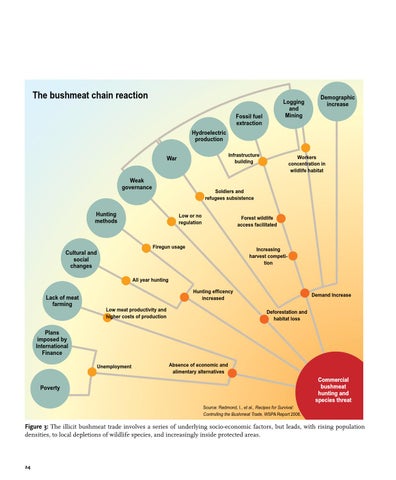
The bushmeat chain reaction
Logging and Mining
Fossil fuel extraction
Demographic increase
Hydroelectric production Infrastructure building
War Weak governance
Soldiers and refugees subsistence
Hunting methods
Low or no regulation
Forest wildlife access facilitated
Firegun usage
Cultural and social changes
Workers concentration in wildlife habitat
Increasing harvest competition
All year hunting
Lack of meat farming
Hunting efficency increased Low meat productivity and higher costs of production
Demand Increase Deforestation and habitat loss
Plans imposed by International Finance Unemployment
Absence of economic and alimentary alternatives
Commercial bushmeat hunting and species threat
Poverty Source: Redmond, I., et al., Recipes for Survival: Controlling the Bushmeat Trade, WSPA Report 2006.
Figure 3: The illicit bushmeat trade involves a series of underlying socio-economic factors, but leads, with rising population densities, to local depletions of wildlife species, and increasingly inside protected areas.
24
Saiga antelope populations RUSSIA North-West Pre-Caspian
Ural
Betpak-dala
MONGOLIA
Ustiurt
RUSSIA
KAZAKHSTAN Aral Sea
CHINA Saiga antelope population Overall direction of migrations (North in summer, South in winter)
UZBEKISTAN KYRGYZSTAN IRAN
Mongolia
Lake Balqash
Caspian Sea Caspian AZERBAIJAN Sea
TURKMENISTAN
Terrestrial protected areas Source: ACBK, 2011; WWF Mongolia, Web-based GIS database on biological diversity of Mongolia; UNEP-WCMC, Protected Planet web database; Russian Committee for the UNESCO MAB Programme.
Figure 4: Saigas have been hunted since prehistoric times and today poaching remains the primary threat to this critically endangered species. Following the collapse of the Soviet Union, Saiga populations crashed by more than 95% within a decade. While a number of Saiga populations are starting to stabilize, three continue to be in a precarious state (North-West Pre-Caspian, Ural and Ustiurt populations). 25
26
The effect of roads, expanding agriculture and livestock, along with increased poaching can also be observed in South America, such as on the wild camelids in the steppe, deserts and Andean foothills of Argentina and Chile. Guanacos (Lama guanicoe) and vicunãs (Vicugna vicugna) have lost 40–75 per cent of their ranges, and probably dropped at least 90 per cent in their numbers over the last centuries (Cajal, 1991; Franklin et al., 1997). Only a fraction, probably less than 3 per cent of the guanaco and some 34 per cent of that of vicunãs are in protected areas (Donadio and Buskirk, 2006). Also these species often avoid areas with expanding livestock and have been heavily exposed to poaching. Source: Cajal, J. L. 1991. An integrated approach to the management of wild camelidsin Argentina. In Mares, M. A. &Schmidly, D. J. (eds.), Latin American Mammology.History, Biodiversity and Conservation.University of Oklahoma Press, Norman; Donadio, E. &Buskirk, S. W. 2006. Flight behavior of guanacos and vicunas in areas of western Argentina with and without poaching.Biological Conservation 127: 139-145Franklin, W. L., Bas, F., Bonacic, C. F., Cunazza, C. & Soto N. 1997. Striving to manage Patagonia guanacos for sustained use in the grazing agroecosystems of southern Chile. Wildlife Soc. Bull.25: 65–73
27
28
Illicit trade in Great apes
The primary threat to great apes is habitat loss. However, great apes are also trafficked in various ways. In many cases wild capture is opportunistic: farmers capture infant apes after having killed the mother during a crop-raid, or bushmeat hunters shoot or trap adults for food, and then collect the babies to sell. Organized illicit dealers increasingly target great apes as part of a far more sophisticated and systematic trade. They use transnational criminal networks to supply a range of markets, including the tourist entertainment industry, disreputable zoos, and wealthy individuals who want exotic pets as status symbols. Great apes are used to attract tourists to entertainment facilities such as amusement parks and circuses. They are even used in tourist photo sessions on Mediterranean beaches and boxing matches in Asian safari parks. Even conservative estimates suggest that the illegal trade in great apes is widespread. From 2005 to 2011, a minimum of 643 chimpanzees, 48 bonobos, 98 gorillas and 1,019 orangutans are estimated to have been lost from the wild through illicit activities. These numbers are based on seizures and arrival rates of orphans at sanctuaries in 12 African countries and rehabilitation centres in Indonesia, expert reports, and great ape bushmeat and body parts seized from illegal traders. Based on extrapolations, it is likely that as many as 22,000 wild great apes were lost between 2005 and 2011 related to the illegal trade, with chimpanzees comprising 64 per cent of that number. The annual average loss of approximately 3,000 great apes could have serious consequences for the biodiversity of key regions, given the important role great apes play in maintaining healthy ecosystems. Sadly, law enforcement efforts lag far behind the rates of illegal trade. Only 27 arrests were made in Africa and Asia in connection with great ape trade between 2005 and 2011, and one quarter of the arrests were never prosecuted. Prices for great apes vary greatly. A poacher may sell a live chimpanzee for USD 50–100, whereas the middleman will resell that same chimpanzee at a mark-up of as much as 400 per cent. Orangutans can fetch USD 1,000 at resale, and gorillas illegally sold to a zoo in Malaysia in 2002 reportedly went for USD 400,000 each. Such prices are extremely rare however, and the poacher who captures a live specimen may lose it to injuries, illness or stress, or have it confiscated if the poacher is arrested. At best, the actual poachers may earn only a fraction of the ultimate sale price of a great ape.19 29
30
31
Ivory
CITES-MIKE (Monitoring the Illegal Killing of Elephants)20 and subsequent analysis suggests that 15,000 elephants were illegally killed at the 42 monitored MIKE sites in 2012. The Elephant Trade Information System (ETIS), managed by TRAFFIC21 shows that the overall weight and number of large-scale ivory seizures (more than 500 kg) in 2013 exceeded any previous year in the ETIS data, with the increase either reflecting increased law enforcement effort or increase in the trade. For the forest elephant, population size has been estimated to decline by ca. 62% between 2002 and 2011.22 Possible range of killed elephants in Africa is likely in the range of 22–25,000 elephants per year.23 Population size is estimated at 420,000–650,000 elephants.24 If we assume that 22–25,000 elephants are killed per year, with 1.8 tusks per elephant and 5.5 kg per tusk (ca. 10 kg per elephant) and a price of 750 USD/kg25 of raw ivory in Asia the poached African ivory may represent an end-user street value in Asia of an estimated 165–188 million USD, in addition to ivory from Asian sources. Some instances have involved even less.26
32
33
34
35
Conclusion The consequences of the illegal trade in wildlife span environmental, societal (including security), and economic impacts – including affecting the resource base for local communities, and resulting in the theft of natural capital at national levels. The illegal trade in wildlife is therefore a barrier to sustainable development, involving a complex combination of weak environmental governance, unregulated trade, loopholes and laundering systems used to conduct serious transnational crime, and undermining government institutions and legitimate business.
The illegal trade in wildlife involves a wide range of flora and fauna, across all continents. The pace, level of sophistication, and globalized nature of the illegal trade in wildlife is beyond the capacity of many countries and individual organizations to address. The illegal trade in wildlife constitutes not only a very significant criminal sector, involving organized crime, violent conflicts and terrorism, but it also entails poverty, development and governance challenges. Of particular relevance is the increasing involvement of transnational organized criminal networks in the illegal trade of wildlife, as well as the significant impact to the environment and sustainable development. Current trends suggest priority attention be focused on the illegal trade in charcoal and other forest products (including paper, timber and pulp, as well as endangered high-value species like rosewood, African cherry and wild mahogany), and the illegal trade derived from various charismatic mammals (especially, but not limited to, tigers, elephants and rhinos), and many other species including sharks, manta rays and sturgeon, to mention a few. Here, CITES continues to be the lead authority controlling and monitoring such trade. Responses to the illegal trade in wildlife need to reflect the differentiated and shared characteristics of various supply chains, and recognize that consumer demand remains the most important driver of the illegal trade in wildlife. The economic, social, and environmental impacts of the illegal wildlife trade can only be effectively tackled if both the demand and supply elements of the chain are targeted, encompassing elements of deterrence, transparency, legal clarity and enforcement, behavioural change, and the development of alternative livelihoods. This will require both national and international stakeholders to be engaged, including environmental, enforcement and development sectors, as well as stakeholders involved in security and peacekeeping missions. At the national and regional level, numerous strong recent commitments have been made in relation to the many aspects of illegal trade in wildlife, and immediate, decisive and collective action is now required to narrow the gap between these
existing commitments – including those made under the various multilateral environmental agreements and UN agencies – and their implementation. In particular, strengthened environmental legislation, compliance and awareness, and support to enforcement agencies is required to reduce the role of illegal wildlife trade (especially of charcoal) for threat finance to non-state armed groups and terrorism. Strengthened enforcement efforts need to be complemented by broader development and awareness raising efforts. End-user markets need to be further analysed, and consumer awareness campaigns need to be systematically designed, supported and implemented. There is a central role for civil society and the private sector in such efforts, and also to identify alternatives in some instances to consumer demands for illegally traded wildlife products. At the international level, a comprehensive and coordinated UN system-wide response to support holistic national approaches to address the illegal trade in wildlife is an important component of the global response. Such a response, with additional support from the enforcement sector, would further strengthen coordinated efforts in relation to coherent legislation, environmental law, poverty alleviation and development support, awareness raising and demand reduction. Support from the international and bilateral donor community will be essential to recognize and address the illegal trade in wildlife as a serious threat to sustainable development, and support national, regional and global efforts for the effective implementation of, compliance with, and enforcement of targeted measures to curb illegal trade in wildlife. In particular, investment in demand reduction campaigns is urgently required, and in capacity building and technological support to national law enforcement agencies to enable them to further protect key populations of species threatened by illegal trade. Such support must be accompanied by renewed efforts to strengthen broader environmental management for sustainable development. 97
Recommendations Acknowledge the multiple dimensions of environ足 mental crime and its serious impact on the environment and sustainable development goals, and help support and balance the appropriate coordination and sharing of information from stakeholders, such as civil society, private sector, indigenous peoples, governments and a wider UN system with the need and recognition of also the role of law enforcement in good environmental governance.
1
Implement a comprehensive coordinated UN system and national approach to environmental crime by helping coordinate efforts on environmental legislation and regulations, poverty alleviation and development support with responses from the enforcement sector to curb environmental crime, as part of a holistic approach to challenge the serious threat to both the environment and sustainable development caused by the continued environmental crime.
2
Support UNEP as the global environmental authority to address the serious and rising environmental impacts of environmental crime and to engage the relevant coordination mechanisms of the UN system to support countries and national, regional and international law enforcement agencies with relevant environmental information to facilitate their efforts to combat the illegal trade in wildlife species and their products, as well as illegal logging and illegal trade in timber.
3
Encourage the entire international and bilateral donor community to recognize and address environmental crime as a serious threat to sustainable develop足 ment and revenues, and to support national, regional and global efforts for the effective implementation of, compliance with and enforcement of targeted measures to curb illegal trade in wildlife species and their products as well as illegal logging in timber.
4
Support immediate, decisive and collective action to narrow the gap between commitments and compliance, such as the ones expressed in multilateral environmental agreements, through national implementation and enforcement, including the relevant decisions and resolutions taken by their governing bodies intended to combat the illicit trade in wildlife and forest products.
5
Identify end-user markets and systematically design, support and implement where appropriate consumer awareness campaigns focusing on high consumer end-markets. Call upon both Governments and the UN system to effectively work with and engage civil society and the private sector in efforts to identify alternatives to consumer demands for traded wildlife species and forest products.
6
98
Strengthen awareness through certification schemes, such as e.g. the Forest Stewardship Council (FSC), to facilitate consumer recognition of legal and illegal products. This especially applies to such wood products as paper that currently include the largest share of import-exports of tropical wood, as well as to CITES-listed species and their products. To this end, both voluntary, market and legislative approaches could enhance collaboration between governments, civil society and the private sector.
7
Strengthen institutional, legal and regulatory systems to further combat corruption to effectively address wildlife-related offences and to ensure that legal trade is monitored and managed effectively.
8
Strengthen international and development support to the entire enforcement chain, including frontline, investigator, customs, prosecutors and the judiciary, with particular reference to environmental crime to support legal revenues and sustainable development, and to reduce the impacts on the environment from environmental crime.
9
Strengthen support to INTERPOL, UNODC, WCO and CITES, such as through ICCWC as well as individual programmes, to enable them to support member states and other relevant stakeholders to further identify, develop and implement the most appropriate responses to environmental crime, reflecting and acknowledging the serious threats and effects it has on environmental governance, wildlife, ecosystems and the services it provides.
10
Invest in capacity building and technological support to national environment, wildlife and law enforcement agencies to enable them to further protect key populations of iconic endangered species threatened by poaching, such as but not limited to, rhinos, tigers and the African elephant as a necessary response to safeguard these species from poaching, alongside renewed efforts to strengthening habitat protection and management.
11
Strengthen environmental legislation, compliance and awareness and call upon enforcement agencies and countries to reduce the role of illicit trade and taxing of forest and wildlife products for threat finance to non-state armed groups and terrorism. Strengthen specifically the research on the possible role of trade in wildlife and timber products including charcoal for threat finance and identify gaps in environmental legislation that may facilitate this.
12
Acronyms CITES Convention on International Trade in Endangered Species of Wild Fauna and Flora DDR Disarmament, Demobilization and Reintegration DRC Democratic Republic of the Congo CAR Central African Republic EIA Environmental Investigation Agency ETIS Elephant Trade Information System, system for tracking illegal trade in ivory and other elephant products EU FLEGT EU programme: Ensuring Legal Timber Trade and Strengthening Forest Governance EUROSTAT EU Statistics agency FAO UN Food and Agriculture Organization FDLR Democratic Forces for the Liberation of Rwanda, Rwandan Hutu rebel group based in east of DRC known for French name Forces démocratiques de libération du Rwanda ICCWC International Consortium on Combating Wildlife Crime (CITES, Interpol, UNODC, World Bank, WCO) INTERPOL International Criminal Police Organization INTERPOL LEAF Interpol Law Enforcement Assistance for Forests ITTO International Tropical Timber Organization KPK Indonesia Corruption Eradication Commission (Komisi Pemberantasan Korupsi) LRA Lord’s Resistance Army ODA Official Development Assistance, OECD term OECD Organisation for Economic Co-operation and Development PIKE Proportion of Illegally Killed Elephants, calculated as number of illegally killed elephants found divided by the total number of elephant carcasses encountered, aggregated by year for each site PATK Indonesia Financial Transaction Reports and Analysis Center (Pusat Pelaporan dan Analisis Transaki Keuangan) UN ECOSOC United Nations Economic and Social Council UNEP United Nations Environment Programme UNODC United Nations Office on Drugs and Crime UN-REDD UN collaborative initiative on Reducing Emissions from Deforestation and forest Degradation REDD+ Beyond REDD: The role of conservation, sustainable management of forests and enhancement of forest carbon stocks in reducing emissions RWE Round Wood Equivalent, measure of volume of logs when converting between tons and cubic meters, or when detailing how much roundwood went into a wood product UNSC United Nations Security Council UNODC-WCO CCP UNODC-WCO Container Control Programme UNTOC United Nations Convention against Transnational Organized Crime WCO World Customs Organization
99
100
101
Contributors Editorial team
Christian Nellemann (Editor in Chief), GRID-Arendal Rune Henriksen, GRID-Arendal Patricia Raxter, Old Dominion University, Norfolk, VA Neville Ash, UNEP Elizabeth Mrema, UNEP
Cartography
Riccardo Pravettoni Philippe Rekacewicz (Figures 6, 7 and 8)
Layout
GRID-Arendal
Contributors
Arnold Kreilhuber, UNEP Bianca Notarbartolo di Sciara, UNEP Johannes Refisch, UNEP Ibrahim Thiaw, UNEP Douglas Cress, GRASP Julien Simery, GRASP Jorge Rios, UNODC Ketil Ottersen, UNODC Troels Vester, UNODC Volha Kuzmianok, UNODC Davyth Stewart, INTERPOL David Higgins, INTERPOL John Scanlon, CITES Ben van Rensburg, CITES Pia Jonsson, CITES Haavard Reksten, Norwegian Police University College Jon Hutton, UNEP WCMC Allison Bredbenner, GRID-Arendal Hanne Jørstad, GRID-Arendal Janet Skaalvik, GRID-Arendal Riccardo Pravettoni, GRID-Arendal Petter Sevaldsen, GRID-Arendal Rune Henriksen, GRID-Arendal Rosemary Kweka, GRID-Arendal Valentin Yemelin, GRID-Arendal
102
Photo credits
1 Reuters/Scanpix 1 STR/AP Photo/Scanpix 5 Michael Nichols/National Geographic 6 Luoman/iStockphoto 7 Martha Holmes/Nature Picture Library/Scanpix 9 Michael Nichols/ National Geographic 10 Photography Perspectives/iStockphoto 12 Ms Lightbox/iStockphoto 14 Karl Ammann/Nature Picture Library/Scanpix 18 AZWAR/EPA/Scanpix 19 Dominic Nahr/ Magnum Photos/All Over Press 20 Annie Griffiths/National Geographic 20 Michael S. Yamashita/National Geographic 21 Frans Lanting/National Geographic 21 Jim Brandenburg/ Minden Pictures/National Geographic 22 Stockbyte/Getty images 23 Bruce Dale/National Geographic 25 Botafogo Dentro/iStockphoto 26-27 JLV Photos/iStockphoto 27 Marco Maccarini Photography/iStockphoto 27 ChGR/iStockphoto 28-29 Ryan Koopmans/Polaris/Scanpix 30 Michael Nichols/ National Geographic 30 Tim Laman/National Geographic 30-31 Ian Nichols/National Geographic 32 Rick Wilking/ Reuters/Scanpix 32 Tamal Roy/AP Photo/Scanpix 33 Jo Ann Crebbin/iStockphoto 34-35 Chris Johns/National Geographic 37 Christopher Marin/iStockphoto 37 Thomas Mukoya/ Reuters/Scanpix 38-39 Suksao/Shutterstock 40-41 Michael Nichols/National Geographic 43 Pro-syanov/iStockphoto 44 Freder/iStockphoto 44 Piebinga Management bv/iStockphoto 44 Grafissimo/iStockphoto 44 Ammit/iStockphoto 44 Ammit/iStockphoto 45 Tina Rencelj/iStockphoto 45 Shaun Wilkinson/iStockphoto 45 dennisvdw/iStockphoto 45 Idream photo/iStockphoto 46 Chamila Karunarathne/Demotix/Scanpix 47 Pascal Maitre/Cosmos/INA 47 Pascal Maitre/Cosmos/INA 48 Stringer/AFP Photo/Scanpix 50 Paul Jodoin/iStockphoto 52 Randy Olson/National Geographic 53 Randy Olson/National Geographic 54 imago/Siering/All Over Press 55 STR/Reuters/ Scanpix 56 Prill Mediendesign & Fotografie/iStockphoto 58-59 Bobby Haas/National Geographic 60 Juuce/Getty images 61 Luoman/iStockphoto 66 Michael Nichols/ National Geographic 67 Michael Nichols/National Geographic 68 Ricardo Azoury/iStockphoto 69 Peeter viismimaa/iStockphoto 70-71 Farah Abdi Warsameh/AP Photo/Scanpix 72 Chris Johns/National Geographic 72 Michael Nichols/ National Geographic 72-73 Paul Nicklen/National Geographic 74 Redbugg Design/iStockphoto 76-77 Brian J. Skerry/ National Geographic 81 Christian Nellemann 84 Christian Nellemann 85 Farah Abdi Warsameh/AP Photo/Scanpix 86 Stringer/Reuters/Scanpix 87 Dai Kurokawa/EPA Photo/ Scanpix 88 Richard Humphries/Polaris/Scanpix 90 Stringer/ Reuters/Scanpix 91 Lalo de Almeida/The New York Times/ Scanpix 92-93 Tim Freccia 94-95 Bobby Haas/National Geographic 96 Karl Ammann/Nature Picture Library/Scanpix 100-101 Steve Winter/National Geographic 108 Ymgerman/ iStockphoto
Notes 1.
UNEP (2011). Towards a green economy: pathways to sustainable development and poverty eradication, United Nations Environment Programme. Available from: www.unep.org/greeneconomy 2. UNEP (2010). Dead planet, living planet: biodiversity and ecosystem restoration for sustainable development. United Nations Environment Programme and GRID-Arendal, Available from: http://grida. no/publications/rr/dead-planet/ 3. UNEP (2009). The environmental food crisis. The environment’s role in averting future food crises. United Nations Environment Programme and GRID-Arendal, Available from: http://grida.no/ publications/rr/food-crisis/ ; Charles, H. et al. (2010). Food security: The challenge of feeding 9 Billion People. Science 327(812). Available from: DOI: 10.1126/science.1185383 4. OECD. (2012). Illegal trade in environmentally sensitive goods. Executive summary. OECD. Available from: http://www.oecd.org/ trade/envtrade/illegaltradeinenvironmentallysensitivegoods.htm UNODC. (2011). Transnational organized crime in the fishing industry. United Nations Office on Drugs and Crime. Available from: http://www.unodc.org/unodc/en/human-trafficking/2011/issue-paper-transnational-organized-crime-in-the-fishing-industry.html; UNEP and INTERPOL (2012). Green carbon, black trade: Illegal logging, tax fraud and laundering in the World’s tropical forests. United Nations Environment Programme and GRID-Arendal, Available from: http://www.grida.no/publications/rr/green-carbon-black-trade/. 5. OECD (2014). International Development Statistics (IDS) online databases. [Online]. Available from: http://www.oecd.org/dac/stats/ idsonline.htm. 6. CITES (n/a). Decisions of the Conference of the Parties to CITES in effect after its 16th meeting. CITES. Available from: http://www. cites.org/eng/dec/index.php 7. UNODC (2014). Wildlife and forest crime overview. [Online]. Available from: https://www.unodc.org/unodc/en/wildlife-and-forestcrime/overview.html 8. INTERPOL (2014). Environmental crime. [Online]. Available from: http://www.interpol.int/Crime-areas/Environmental-crime/Environmental-crime 9. UNEP and INTERPOL (2012). Green carbon, black trade: Illegal logging, tax fraud and laundering in the World’s tropical forests. 10. UNODC (2011). Transnational organized crime in the fishing industry. UNEP and INTERPOL (2012). Green carbon, black trade 11. Africa Progress Panel (2014). Grain, Fish, Money. Africa Progress Report 2014, Africa Progress Panel. Available from: http://africaprogresspanel.org/wp-content/uploads/2014/05/APP_AR2014_LR.pdf 12. UNODC (2011). Transnational organized crime in the fishing industry. 13. Africa Progress Panel (2014). Grain, Fish, Money. Africa Progress Report 2014. 14. OECD (2012). Illegal trade in environmentally sensitive goods. Executive summary. UNODC. (2011). Transnational organized crime in the fishing industry. UNEP and INTERPOL (2012). Green carbon, black trade. Houghton, R.A. (2013). The Emissions of carbon from deforestation and degradation in the tropics: past trends and future potential. Carbon Management. Vol 4 (5). pp 539-546. 15. GRID Arendal-FFA, 2013. Enforcement manual.; ZOI and GRIDArendal (2013). Environmental Crime. E-book Available from: http:// issuu.com/zoienvironment/docs/environmental-crimes-ebook 16. Haken, J (2011). Transnational crime in the developing world. Global Financial Integrity. http://www.gfintegrity.org/storage/gfip/documents/reports/transcrime/gfi_transnational_crime_high-res.pdf 17. OECD (2012). Illegal trade in environmentally sensitive goods-executive summary. UNODC (2011). Transnational organized crime in
18. 19.
20. 21. 22. 23.
24.
25.
26.
27. 28.
29.
30.
31.
32.
33. 34. 35. 36.
the fishing industry. UNEP and INTERPOL (2012). Green carbon, black trade. INTERPOL (2014). Environmental crime. UNEP (2010). Dead planet, living planet: biodiversity and ecosystem restoration for sustainable development. Section adopted from UNEP (2013). Stolen Apes – The illicit trade in chimpanzees, gorillas, bonobos and orangutans. Rapid Response Assessment. United Nations Environment Programme. Available from: http://grida.no/publications/rr/apes/ CITES (n/a). Monitoring the illegal killing of elephants. CITES. [Online]. Available from: http://www.cites.org/eng/prog/mike/index.php CITES (n/a). The elephant trade information system. CITES. [Online]. Available from: http://www.cites.org/eng/prog/etis/index.php Maisels F et al. (2013). Devastating decline of forest elephants in central Africa. PLoS ONE 8(3): e59469. doi:10.1371/journal.pone.0059469 CITES (2013). New figures reveal poaching for the illegal ivory trade could wipe out a fifth of Africa’s Elephants over next decade. CITES. [Online]. Available from: http://www.cites.org/eng/news/ pr/2013/20131202_elephant-figures.php?_ga=1.7329010.151031434 0.1386245222 UNEP, CITES, IUCN and TRAFFIC (2013). Elephants in the Dust – The African Elephant Crisis. A Rapid Response Assessment. United Nations Environment Programme, GRID-Arendal. Available from: http://www.grida.no/publications/rr/elephants/. Martin, E. and L. Vigne (2011). The Ivory Dynasty: A report on the soaring demand for elephant and mammoth ivory in southern China. London: Elephant Family, The Aspinall Foundation and Columbus Zoo and Aquarium, Available from: http://www.elephantfamily.org/ uploads/copy/EF_Ivory_Report_2011_web.pdf Ca. 39 APU commanders or staff members interviewed informally from Tanzania, Zambia, Uganda, Kenya, Mozambique during training sessions 2011-2013. IUCN population estimates Naresh, M. (2013). Militant link to rhino deaths worries experts. The Times of India. [Online]. August 23. Available from: http:// timesofindia.indiatimes.com/city/guwahati/Militant-link-to-rhinodeaths-worries-experts/articleshow/21988801.cms?referral=PM Government of Nepal, Ministry of Forests and Soil Conservation and Department of National Parks and Wildlife (2006). The greater one-horned rhinoceros conservation action plan for Nepal (20062011). Kathmandu: Department of National Parks and Wildlife. Available from: http://awsassets.panda.org/downloads/rhino_ action_plan_25aug_06_low.pdf Interviews of APU commanders during the conflict in Nepal 20052008 by a Rapid response team; UNEP, FAO and UNFF (2009). Vital forest graphics. Thapa, K. et al. (2013). Past, present and future conservation of the greater one-horned rhinoceros Rhinoceros unicornis in Nepal. Oryx. Vol. 47(3). pp. 345-351. Laing, A. (2013). Last rhinos in Mozambique killed by poachers. The Telegraph. [Online]. April 30. Available from: http://www.telegraph.co.uk/ news/worldnews/africaandindianocean/mozambique/10028738/Lastrhinos-in-Mozambique-killed-by-poachers.html Thapa, K. et al. (2013). Past, present and future conservation of the greater one-horned rhinoceros Rhinoceros unicornis in Nepal. Mills J., Jackson P. (1994) Killed for a cure: a review of the worldwide trade in tiger bone. Cambridge: Traffic International. Nowell, K. and Ling, X. (2007). Taming the tiger trade. Hong Kong: TRAFFIC East Asia. Tigers in Crisis (2014). [Online]. April 30. Available from: http:// www.tigersincrisis.com/trade_tigers.htm 103
37. Gratwicke, B. et al. (2008). Attitudes Toward Consumption and Conservation of Tigers in China. PLOS ONE. Vol. 3(7). Available from: DOI: 10.1371/journal.pone.0002544. 38. Wetton, J. et al.(2002). An extremely sensitive species-specific ARMS PCR test for the presence of tiger bone DNA. Forensic Science International. Vol. 126: 137–144. 39. Nowell et al (2007) Taming the tiger trade 40. INTERPOL (2014). Executive Summary. Assessment of Enforcement Responses to Tiger Crime. INTERPOL. Available online:http:// www.interpol.int/News-and-media/News/2014/N2014-055 41. CITES (n/a). Sturgeons. CITES. [Online] http://cites.org/eng/prog/ sturgeon.php 42. See: http://www.deol.ru/nature/protect/osetr.htm 43. See: http://www.express-k.kz/show_article.php?art_id=89789 44. See: http://m.prokuror.kz/rus/o-prokurature/smi-o-prokurature/ osetrovyh-unichtozhaet-brakonerstvo-i-bezdeystvie-gosorganov 45. Food Market (2013). Russian market of sturgeon caviar. Research on the company “Agriconsult”. [Online]. Available from: http://www.foodmarket.spb.ru/eng/archive.php?year=20&article=1127§ion=6 46. See: http://www.rg.ru/2014/03/14/ikra-site.html 47. See: http://www.firstnews.ru/articles/id675739-russkiy-osyetr-spasibo-chto-zhivoy/ 48. See: http://www.genproc.gov.ru/smi/news/genproc/news-57657/ 49. Adapted from http://www.cites.org/ 50. Wenbin, H. and Xiufang, S. (2013). Tropical Hardwood Flows in China: Case Studies of Rosewood and Okoumé. Forest Trend, World Agroforestry and CIFOR. Available from: http://www.illegal-logging.info/content/tropical-hardwood-flows-china-case-studies-rosewood-and-okoumé 51. EIA (2012). Rosewood robbery: the case for Thailand to list Rosewood on CITES. Environmental Investigation Agency. Available from: http:// eia-international.org/wp-content/uploads/Rosewood-Robbery.pdf 52. Wenbin et al (2013) Tropical Hardwood Flows 53. Pham, J. P. (2013). Poaching peace and security. Atlantic Council. [Online]. October 28. Available online: http://www.atlanticcouncil. org/blogs/new-atlanticist/poaching-peace-and-security 54. International Fund for Animal Welfare. (2013). Criminal Nature: The global security implications of the illegal wildlife trade. IFAW. Available from: http://www.ifaw.org/united-states/resource-centre/ criminal-nature-global-security-implications-illegal-wildlife-tra-0 55. Peters, G. (2009). How opium profits the Taliban. Washington: United States Institute for Peace. Available from: http://www. usip.org/sites/default/files/resources/taliban_opium_1.pdf ; Stanford University (2012). Mapping Militant Organizations: Haqqani Network. Stanford University. [Online]. https://www.stanford.edu/ group/mappingmilitants/cgi-bin/groups/view/363#note18 56. Matthew, R., Brown, O. and Jensen, D. (2009). From conflict to peacebuilding: The role of natural resources and the environment. Nairobi: United Nations Environment Program. 57. Hanson T. et al. (2009). Warfare in biodiversity hotspots. Conservation Biology. Vol.23. pp. 578–587. 58. Leao, A. (2007). Different opportunities, different outcomes- Civil war and rebel groups in Angola and Mozambique. Discussion paper 24/2007. Bonn: Deutsches Institut für Entwicklungspolitik 59. UNSC (2001). Letter dated 26 October 2001 from the Chairman of the Security Council Committee established pursuant to resolution 1343 (2001) concerning Liberia addressed to the President of the Security Council. S/2001/1015. United Nations Security Council. Available from: http://www.un.org/Docs/sc/committees/Liberia2/1015e.pdf. 60. Blundell, A.G. (2010). Forests and conflict: the financial flows that fuel war. Washington, DC: Program on Forests (PROFOR) 61. Matthew et al (2009) From conflict to peacebuilding. 62. Le Billon, P. (2000). The political economy of resource wars. In : 104
Cilliers, J. and Dietrich, C. (eds). Angola’s war economy: the role of oil and diamonds. Pretoria: ISS Books. 63. UNEP, FAO and UNFF (2009). Vital forest graphics. 64. Forensic Technology Inc. (2012). The international trade in endangered species and the firearm nexus. White paper. Available from: http://www.forensictechnology.com/Portals/71705/docs/whitepaper_endangered-march6-2012.pdf 65. National Defense University (2012). Trans-Atlantic Dialogue on Combating Crime Terror Pipelines. Washington, DC: National Defense University. Available online: http://cco.dodlive.mil/ files/2012/08/Crime-Terror-Pipelines-DC-Final-Report.pdf 66. Ballentine, K. and Nitzschke, H. (2005). The political economy of civil war and conflict transformation. Berlin: Berghof Research Center for Constructive Conflict Management. Available from: http://www.berghof-handbook.net/documents/publications/ dialogue3_ballentine_nitzschke.pdf 67. UNSC (2013). Letter dated 12 July 2013 from the Chair of the Security Council Committee pursuant to resolutions 751 (1992) and 1907 (2009) concerning Somalia and Eritrea addressed to the President of the Security Council. S/2013/413. United Nations Security Council. Available fom: http://www.un.org/ga/search/view_doc. asp?symbol=S/2013/413; UNSC (2001). Report of the Panel of Experts on the Illegal Exploitation of Natural Resources and Other Forms of Wealth of the Democratic Republic of the Congo. United Nations Security Council. Available from: http://www.un.org/News/ dh/latest/ drcongo.htm ; Garret, N. and Piccinni, A. (2012). Natural Resources and Conflict A New Security Challenge for the European Union. Swedish Institute for Peace Research; see Berdal & Malone, op cit; D Keen, Economic Functions of Violence in Civil Wars, Adelphi Paper no 320, IISS, London and Oxford University Press, Oxford, 1998; J François & JC Rufin (eds), Economie des Guerres Civiles, Paris, Hachette, 1996; Cilliers, J. (2000). Resource wars. A new type of insurgency. In : Cilliers, J. and Dietrich, C. (eds). Angola’s war economy: the role of oil and diamonds. Pretoria: ISS Books. 68. Shelley, L. (2005). The unholy trinity: transnational crime, corruption, and terrorism. Brown Journal of World Affairs, Vol. XI(2). p. 101-111. 69. International Fund for Animal Welfare (2013) Criminal Nature 70. Jasparro, C. (2009). Environmental threats to security, stability, and US interests in Southern Africa: Opportunity knocks- time for a comprehensive regional defense environmental international cooperation and environmental security assistance strategy. Naval War College. 71. Jensen. D. and Halle, S. (eds) (2013). The role of natural resources in disarmament, demobilization, and reintegration: Addressing risks and seizing opportunities. Nairobi: United Nations Environment Program. Available from: http://postconflict.unep.ch/publications/ UNEP_UNDP_NRM_DDR.pdf 72. UNEP (2014). Disasters and Conflict: Conflict Prevention, Peacebuilding and Natural Resources. [Online] Available from: http:// www.unep.org/disastersandconflicts/Introduction/ECP/ConflictPrevention/tabid/105989/Default.aspx. 73. Le Billon, P. (2000). The political economy of resource wars 74. Jensen et al (2013) The role of natural resources in disarmament 75. Berdal, M. and Keen. D. (1997). Violence and economic agendas in civil wars: some policy implications. Millennium: Journal of International Studies Vol 26 (3). p. 795-818. 76. Ballentine et al (2014) The political economy of civil war 77. Le Sage, A. (2010). Non-state security threats in Africa: Challenges for US engagement. Prism, Vol. 2 (1). Available from: http://www. isn.ethz.ch/Digital-Library/Publications/Detail/?ots591=0c54e3b31e9c-be1e-2c24-a6a8c7060233&lng=en&id=133911. 78. Le Billon, P. (2000). The political economy of resource wars
79. Ballentine et al (2014) The political economy of civil war 80. Sedra, M. (2002). Challenging the Warlord Culture: Security Sector Reform in Post-Taliban Afghanistan. BICC Paper 25. Bonn: Bonn International Center for Conversion. 81. Ballentine et al (2014) The political economy of civil war 82. Karbo, T. and Nelson, C. (2010). War Economies: Issues and Options for Transformation. Africa Peace and Conflict Journal, Vol. 3(1). p. 13-24. 83. Le Sage (2010) Non-state security threats in Africa. 84. Shaw, M. and Reitano, T. (2013). The evolution of organized crime in Africa: Towards a new response. Briefing Paper 244. Institute for Security Studies. Available from: http://www.africaportal.org/ dspace/articles/evolution-organised-crime-africa-towards-new-response; Le Sage (2010) Non-state security threats in Africa 85. Karbo et al (2010) War Economies: Issues and Options 86. The Hindu (2013). Militants turn poachers in new threats to wildlife. The Hindu. [Online]. November 22. http://www.thehindu.com/ todays-paper/tp-in-school/militants-turn-poachers-in-new-threat-towildlife/article5376961.ece 87. Firstpost (2013). Kaziranga: Insurgents join poachers, use AK-47 rifles to hunt rhino. Firstpost. [Online]. February 17. Available from: http://www.firstpost.com/living/kaziranga-insurgents-join-poachers-use-ak-47-rifles-to-hunt-rhinos-628212.html. 88. Levy, A. and Scott-Clark, C. (2007). Poaching for Bin Laden. The Guardian. [Online]. May 4. Available from: http://www.guardian. co.uk/world/2007/may/05/terrorism.animalwelfare. 89. Talukdar, S. (2012). The twin threat to Kaziranga rhinos. The Hindu. [Online]. October 7. Available from: http://www.thehindu.com/ sci-tech/energy-and-environment/the-twin-threat-to-kazirangarhinos/article3972746.ece. 90. Heath, K. (2012). Indian rhino poacher caught but Chinese buyer escapes. Wildlife News. [Online]. October 24. Available from: http:// wildlifenews.co.uk/2012/indian-rhino-poacher-caught-but-chinesebuyer-escapes/. 91. IBN Live (2014). Rhino shot dead in Kaziranga by poachers, take away horn, ears. IBN Live. [Online]. November 25. Available from: http://ibnlive.in.com/news/rhino-shot-dead-in-kaziranga-by-poachers-take-away-horn-ears/436035-3-251.html. 92. Bhattacharjee, U. (2013). Inside Kazingira’s one horned dream. Yahoo News India. [Online]. October 7. Available from: http:// in.news.yahoo.com/inside-kaziranga%E2%80%99s-one-horneddream-080126062.html. 93. The Hindu (2012). Two rhino poachers arrested in Assam. The Hindu. [Online]. October 16. Available from: http://www.thehindu. com/news/national/other-states/a-gang-of-18-rhino-poachersnabbed-in-assam/article4002582.ece. 94. Bhattacharjee (2013). Inside Kazingira’s one horned dream 95. UNEP (2006). Africa Environment Outlook 2.Nairobi: United Nations Environment Program. Available from: http://www.unep. org/dewa/Africa/publications/AEO-2/content/001.htm. 96. Global Witness (2014). Conflict. [Online] http://www.globalwitness. org/campaigns/conflict. 97. Global Witness (2014) Conflict 98. Blondel, A. (2004). The logs of war. Global Policy Forum. [Online] http://www.globalpolicy.org/component/content/article/198/40325. html#author. 99. UNSC (2001). Letter dated 26 October 2001 from the Chairman of the Security Council Committee established pursuant to resolution 1343 (2001) concerning Liberia addressed to the President of the Security Council. S/2001/1015. United Nations Security Council. Available from: http://www.un.org/Docs/sc/committees/Liberia2/1015e.pdf. 100. UNSC (2001). Letter dated 26 October 2001 from the Chairman of the Security Council 101. Global Witness (2002). Logs of war. The timber trade and armed
conflict. Fafo-report 379. Fafo Institute for Applied Social Science. Available from: http://www.globalwitness.org/library/logs-war. 102. UNSC (2001). Letter dated 26 October 2001 from the Chairman of the Security Council 103. Stockholm International Peace Research Institute. 2014. UN arms embargo on Liberia. http://www.sipri.org/databases/embargoes/ un_arms_embargoes/liberia 104. UNSC (2001). Letter dated 26 October 2001 from the Chairman of the Security Council 105. UNEP (2006). Africa Environment Outlook 2 106. UNEP, CITES, IUCN and TRAFFIC (2013). Elephants in the Dust – The African Elephant Crisis. 107. UNSC (2013). Letter dated 12 July 2013 from the Chair of the Security Council Committee 108. International Fund for Animal Welfare (2013) Criminal Nature 109. UNSC (2013). Letter dated 12 July 2013 from the Chair of the Security Council Committee; Agger, K. and Hutson, J. (2013). Kony’s ivory. How elephant poaching in Congo helps support the Lord’s Resistance Army, Enough Project. Available from: http://www. enoughproject.org/files/KonysIvory.pdf. 110. ACF (2013). DRC: LRA attacks at Garamba National Park- African Parks Report. African Conservation Foundation. [Online]. May 24. Available from: http://www.africanconservation.org/in-focus/item/ drc-lra-attack-at-garamba-national-park-african-parks-report. 111. HSBA (2013). Lord’s Resistance Army. Human Security Baseline Assessment. Available from: http://www.smallarmssurveysudan. org/fileadmin/docs/facts-figures/south-sudan/armed-groups/lra/ LRA_8_March.pdf 112. Hack, S. (2012). DR Congo War Stretches into Virunga National Park. The Daily Traveler. [Online]. July 10. Available from: http://www.cntraveler.com/daily-traveler/2012/07/virunga-war-break-news-071012; Lovgren, S. (2011). Marijuana Trade Threatens African Gorilla Refuge. National Geographic. [Online]. April 27. Available from: http://news. nationalgeographic.com/news/2011/04/110426-virunga-gorillas-marijuana-africa-animals-environment/; Clough, L.D. (2009). Virunga National Park, Democratic Republic of Congo. The Earth Encyclopedia. United Nations Environment Program, World Conservation M. [Online]. July 4. Available from: http://www.eoearth.org/view/article/156857/ 113. Lovgren (2011). Marijuana Trade Threatens African Gorilla Refuge 114. Lewis, K. (2014). Virunga National Park Ranger killed in Ambush. Voice of America. [Online]. January 21. Available from: http://www. voanews.com/content/drc-virunga-park-attack-fdlr-ranger-militiaforest-killed/1834367.html. 115. Lewis (2014) Virunga National Park Ranger killed 116. UNSC (2013). Letter dated 12 July 2013 from the Chair of the Security Council Committee; UNSC (2013). Letter dated 19 July 2013 from the Chair of the Security Council Committee established pursuant to resolution 1533 (2004) concerning the Democratic Republic of the Congo addressed to the President of the Security Council. United Nations Security Council. Available from: http://www.securitycouncilreport.org/atf/cf/%7B65BFCF9B-6D27-4E9C-8CD3-CF6E4FF96FF9%7D/s_2013_433.pdf 117. UNSC (2013). Letter dated 12 July 2013 from the Chair of the Security Council Committee 118. UNEP and INTERPOL (2012). Green carbon, black trade. 119. UNEP and INTERPOL (2012). Green carbon, black trade. 120. Global Witness and Environmental Investigation Agency (US) (2009). Investigation into the illegal felling, transport and export of precious wood in SAVA Region Madagascar. Global Witness and Environmental Investigation Agency (US) Available from: http:// www.parcs-madagascar.com/doc/report_vsfinal.pdf; Global Witness and Environmental Investigation Agency (US) (2010). Investigation into the Global Trade in Malagasy Precious Woods: Rosewood,Ebony 105
and Pallisander. Global Witness and Environmental Investigation Agency (US). Available from: http://www.globalwitness.org/sites/ default/files/pdfs/mada_report_261010.pdf 121. UNEP and INTERPOL (2012). Green carbon, black trade.; UNODC (2013). Transnational Organized Crime in East Asia and the Pacific: A threat assessment. United Nations Office on Drugs and Crime. Available from: http://www.unodc.org/documents/southeastasiaandpacific/Publications/2013/TOCTA_EAP_web.pdf; EIA (2012), Appetite for Destruction: China’s Trade in Illegal Timber. Environmental Investigation Agency. Available from: http://eia-global.org/images/ uploads/Appetite_for_Destruction.pdf 122. UNEP and INTERPOL (2012). Green carbon, black trade. UNODC (2013). Transnational Organized Crime in East Asia and the Pacific 123. Boucher, B. et al. (2011). The roots of the problem. What’s driving tropical deforestation today?. Cambridge: Union of Concerned Scientists. 124. Wenbin et al (2013) Tropical Hardwood Flows 125. See UNEP and INTERPOL (2012). Green carbon, black trade. 126. FAO (2014). FAOSTAT Database. Production. The Food and Agriculture Organization of the United Nations. Available from: http:// faostat3.fao.org/faostat-gateway/go/to/download/Q/*/E 170m tons Paper+board excluding newsprint + 42m tons pulp for paper. 127. FAO (2014). FAOSTAT Database. Production: 17 million out of 59 million m3 128. RISI (2011). Lockwood-Post Directory of Pulp & Paper Mills. Global Edition 2011. 129. FAO (2014). FAOSTAT Database. Production: Total industrial roundwood imported and produced in 2012: 388 million m3 130. Boucher, B. et al. (2011). The roots of the problem. 131. RISI (2011). Lockwood-Post Directory of Pulp & Paper Mills 132. The conversion factor is based on FAO averages, 3.795 m3 for every ton of pulp, and 2.49 m3 for every ton of paper. 133. This is estimated on the actual production figures compared with capacity at three of the largest mills in one of China’s largest paper and pulp conglomerates. 134. FAO (2014). FAOSTAT Database. Forestry production and forest trade. The Food and Agriculture Organization of the United Nations. Available from: http://faostat3.fao.org/faostat-gateway/go/to/download/F/FO/E; see also http://www.cpbis.gatech.edu/files/papers/ CPBIS-FR-08-03%20Zhuang_Ding_Li%20FinalReport-China_ Pulp_and_Paper_Industry.pdf 135. UNEP and INTERPOL (2012). Green carbon, black trade. 136. UNEP and INTERPOL (2012). Green carbon, black trade. 137. UNODC (2013). Transnational Organized Crime in East Asia and the Pacific 138. Forest Law Enforcement, Governance and Trade - see U.S Fish & Wildlife Service (2014). Lacey Act. [Online]. http://www.fws.gov/ international/laws-treaties-agreements/us-conservation-laws/ lacey-act.html; European Commission (2014). Environment: FLEGT Voluntary Partnership Agreements (VPAs). [Online]. http://ec.europa.eu/environment/forests/flegt.htm; 139. FAO (2014). FAOSTAT Database. Forestry production and forest trade; ITTO (2013). Annual Review Statistics Database. International Tropical Timber Organization. Available from: http://www.itto.int/ annual_review_output/?mode=searchdata; European Commission (2014). Eurostat. European Commission. Available from: http://epp. eurostat.ec.europa.eu/portal/page/portal/eurostat/home/ 140. FAO (2014). FAOSTAT Database. Forestry production and forest trade 141. FAO (2014). FAOSTAT Database. Forestry production and forest trade. 142. FAO (2014). FAOSTAT Database. Forestry production and forest trade. 143. FAO (2014). FAOSTAT Database. Forestry production and forest trade; Amous, S. (n/a). The role of wood energy in Africa, Rome: Food and Agriculture Organization of the United Nations. Available
106
from: http://www.fao.org/docrep/x2740e/x2740e00.htm#exesu Prices are based on a range from a low USD 5 per 25 kg sack at local markets/USD 200/ton to a high USD 800 per ton on the international internet based market. 144. FAO (2014). FAOSTAT Database. Forestry production and forest trade 145. FAO (2014). FAOSTAT Database. Production; FAO (2014). FAOSTAT Database. Forestry production and forest trade; World Bank (2009). Environmental crises or sustainable development opportunity? Transforming the charcoal sector in Tanzania. Policy Note 50207. The World Bank. Available from: http://www-wds.worldbank.org/ external/default/WDSContentServer/WDSP/IB/2009/09/01/000 334955_20090901084035/Rendered/PDF/502070WP0Polic1BOx0342042B01PUBLIC1.pdf 146. I.e. sub-Saharan Africa minus South Africa, Lesotho and Swaziland 147. Kenya Energy Regulatory Commission 148. Based on FAO’s estimate of 1 million tons, and Kenya’s Energy Regulatory Commission’s 1.6m tons. See Oimeke, R.P. (n/a). Charcoal production and commercialization in Kenya, Joint UN Habitat / IRENA workshop: “Renewables for Growing Cities in Africa: A roadmap from 2012 to 2050?” . Energy Regular Commission. Available from:http:// www.irena.org/DocumentDownloads/events/NaplesSeptember2012/ Robert_Pavel_Oimeke.pdf 149. Hosier, R.H., Mwandosya, M.J. and Luhanga, M.L. (1993). Future energy development in Tanzania: the energy costs of urbanization. Energy Policy. Vol 21(5). p. 491-509. 150. INTERPOL (2014). Environmental crime. UNEP and INTERPOL (2010). Last stand of the gorilla. UNSC (2001). Report of the Panel of Experts on the Illegal Exploitation of Natural Resources 151. The low estimate is based on the lower 12% estimated private taxation of shipments of charcoal in the Malawi charcoal value chain. The higher estimate combines the higher 20% estimated private taxation of shipments of charcoal in Malawi with the 33% revenue gain at the point of sale. See: Kambewa et al (2007). Charcoal - the reality: A study of charcoal consumption, trade and production in Malawi. International Institute for Environment and Development. Available from: http://pubs.iied.org/13544IIED.html 152. UNODC (2013). Transnational Organized Crime in Eastern Africa: A Threat Assessment. United Nations Office on Drugs and Crime. Available from: http://www.unodc.org/unodc/data-and-analysis/ TOC-threat-assessments.html; UNODC (2013). Transnational Organized Crime in West Africa: A Threat Assessment United Nations Office on Drugs and Crime. Available from: http://www. unodc.org/unodc/data-and-analysis/TOC-threat-assessments.html 153. Martin et al (2011). The Ivory Dynasty 154. IUCN (2014). The African and Asian Elephant Database. [Online] http://www.elephantdatabase.org 155. UNEP, CITES, IUCN and TRAFFIC (2013). Elephants in the Dust – The African Elephant Crisis. 156. Kalron, N. (2012). Africa’s white gold of jihad: al-Shabaab and conflict ivory. Elephant League. [Online] http://elephantleague.org/ project/africas-white-gold-of-jihad-al-shabaab-and-conflict-ivory/ 157. UNSC (2013). Letter dated 12 July 2013 from the Chair of the Security Council Committee 158. UNSC (2013). Letter dated 12 July 2013 from the Chair of the Security Council Committee 159. Gratwicke et al (2008). Attitudes Toward Consumption 160. Wetton et al (2002) An extremely sensitive species 161. Nowell, K. and Ling, X. (2007). Taming the tiger trade. Hong Kong: TRAFFIC East Asia. 162. Gratwicke et al (2008). Attitudes Toward Consumption 163. UNODC (2014). Wildlife and forest crime overview. 164. INTERPOL (2014). Environmental crime.
107
www.unep.org United Nations Environment Programme P.O. Box 30552 - 00100 Nairobi, Kenya Tel.: +254 20 762 1234 Fax: +254 20 762 3927 e-mail: uneppub@unep.org www.unep.org
A Centre Collaborating with UNEP
108
GRID-Arendal Teaterplassen 3 N-4836 Arendal Norway grid@grida.no www.grida.no