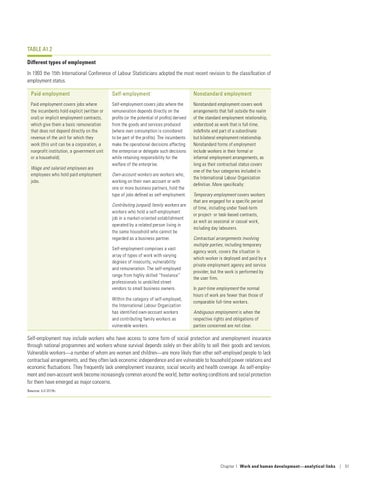
TABLE A1.2 Different types of employment In 1993 the 15th International Conference of Labour Statisticians adopted the most recent revision to the classification of employment status. Paid employment
Self-employment
Nonstandard employment
Paid employment covers jobs where the incumbents hold explicit (written or oral) or implicit employment contracts, which give them a basic remuneration that does not depend directly on the revenue of the unit for which they work (this unit can be a corporation, a nonprofit institution, a government unit or a household).
Self-employment covers jobs where the remuneration depends directly on the profits (or the potential of profits) derived from the goods and services produced (where own consumption is considered to be part of the profits). The incumbents make the operational decisions affecting the enterprise or delegate such decisions while retaining responsibility for the welfare of the enterprise.
Nonstandard employment covers work arrangements that fall outside the realm of the standard employment relationship, understood as work that is full-time, indefinite and part of a subordinate but bilateral employment relationship. Nonstandard forms of employment include workers in their formal or informal employment arrangements, as long as their contractual status covers one of the four categories included in the International Labour Organization definition. More specifically:
Wage and salaried employees are employees who hold paid employment jobs.
Own-account workers are workers who, working on their own account or with one or more business partners, hold the type of jobs defined as self-employment. Contributing (unpaid) family workers are workers who hold a self-employment job in a market-oriented establishment operated by a related person living in the same household who cannot be regarded as a business partner. Self-employment comprises a vast array of types of work with varying degrees of insecurity, vulnerability and remuneration. The self-employed range from highly skilled “freelance” professionals to unskilled street vendors to small business owners. Within the category of self-employed, the International Labour Organization has identified own-account workers and contributing family workers as vulnerable workers.
Temporary employment covers workers that are engaged for a specific period of time, including under fixed-term or project- or task-based contracts, as well as seasonal or casual work, including day labourers. Contractual arrangements involving multiple parties, including temporary agency work, covers the situation in which worker is deployed and paid by a private employment agency and service provider, but the work is performed by the user firm. In part-time employment the normal hours of work are fewer than those of comparable full-time workers. Ambiguous employment is when the respective rights and obligations of parties concerned are not clear.
Self-employment may include workers who have access to some form of social protection and unemployment insurance through national programmes and workers whose survival depends solely on their ability to sell their goods and services. Vulnerable workers—a number of whom are women and children—are more likely than other self-employed people to lack contractual arrangements, and they often lack economic independence and are vulnerable to household power relations and economic fluctuations. They frequently lack unemployment insurance, social security and health coverage. As self-employment and own-account work become increasingly common around the world, better working conditions and social protection for them have emerged as major concerns. Source: ILO 2015h.
Chapter 1 Work and human development—analytical links | 51