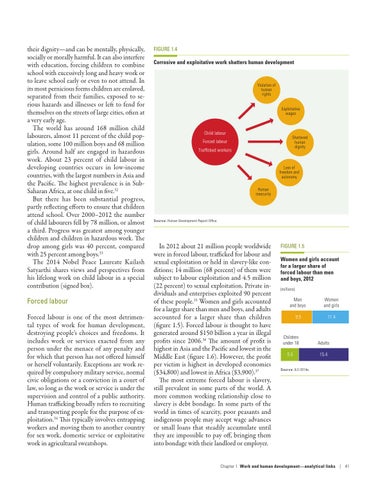
their dignity—and can be mentally, physically, socially or morally harmful. It can also interfere with education, forcing children to combine school with excessively long and heavy work or to leave school early or even to not attend. In its most pernicious forms children are enslaved, separated from their families, exposed to serious hazards and illnesses or left to fend for themselves on the streets of large cities, often at a very early age. The world has around 168 million child labourers, almost 11 percent of the child population, some 100 million boys and 68 million girls. Around half are engaged in hazardous work. About 23 percent of child labour in developing countries occurs in low-income countries, with the largest numbers in Asia and the Pacific. The highest prevalence is in Sub- Saharan Africa, at one child in five.32 But there has been substantial progress, partly reflecting efforts to ensure that children attend school. Over 2000–2012 the number of child labourers fell by 78 million, or almost a third. Progress was greatest among younger children and children in hazardous work. The drop among girls was 40 percent, compared with 25 percent among boys.33 The 2014 Nobel Peace Laureate Kailash Satyarthi shares views and perspectives from his lifelong work on child labour in a special contribution (signed box).
Forced labour Forced labour is one of the most detrimental types of work for human development, destroying people’s choices and freedoms. It includes work or services exacted from any person under the menace of any penalty and for which that person has not offered himself or herself voluntarily. Exceptions are work required by compulsory military service, normal civic obligations or a conviction in a court of law, so long as the work or service is under the supervision and control of a public authority. Human trafficking broadly refers to recruiting and transporting people for the purpose of exploitation.34 This typically involves entrapping workers and moving them to another country for sex work, domestic service or exploitative work in agricultural sweatshops.
FIGURE 1.4 Corrosive and exploitative work shatters human development
Violation of human rights Exploitative wages
Child labour
Shattered human dignity
Forced labour Trafficked workers
Loss of freedom and autonomy Human insecurity
Source: Human Development Report Office.
In 2012 about 21 million people worldwide were in forced labour, trafficked for labour and sexual exploitation or held in slavery-like conditions; 14 million (68 percent) of them were subject to labour exploitation and 4.5 million (22 percent) to sexual exploitation. Private individuals and enterprises exploited 90 percent of these people.35 Women and girls accounted for a larger share than men and boys, and adults accounted for a larger share than children (figure 1.5). Forced labour is thought to have generated around $150 billion a year in illegal profits since 2006.36 The amount of profit is highest in Asia and the Pacific and lowest in the Middle East (figure 1.6). However, the profit per victim is highest in developed economies ($34,800) and lowest in Africa ($3,900).37 The most extreme forced labour is slavery, still prevalent in some parts of the world. A more common working relationship close to slavery is debt bondage. In some parts of the world in times of scarcity, poor peasants and indigenous people may accept wage advances or small loans that steadily accumulate until they are impossible to pay off, bringing them into bondage with their landlord or employer.
FIGURE 1.5 Women and girls account for a larger share of forced labour than men and boys, 2012 (millions)
Men and boys
Women and girls
9.5
11.4
Children under 18
Adults
5.5
15.4
Source: ILO 2014e.
Chapter 1 Work and human development—analytical links | 41