Work discrimination against people with disabilities is also common
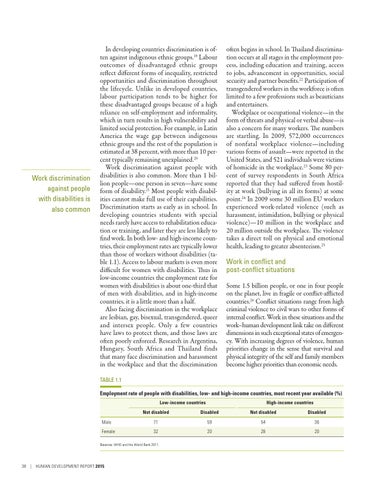
In developing countries discrimination is often against indigenous ethnic groups.19 Labour outcomes of disadvantaged ethnic groups reflect different forms of inequality, restricted opportunities and discrimination throughout the lifecycle. Unlike in developed countries, labour participation tends to be higher for these disadvantaged groups because of a high reliance on self-employment and informality, which in turn results in high vulnerability and limited social protection. For example, in Latin America the wage gap between indigenous ethnic groups and the rest of the population is estimated at 38 percent, with more than 10 percent typically remaining unexplained.20 Work discrimination against people with disabilities is also common. More than 1 billion people—one person in seven—have some form of disability.21 Most people with disabilities cannot make full use of their capabilities. Discrimination starts as early as in school. In developing countries students with special needs rarely have access to rehabilitation education or training, and later they are less likely to find work. In both low- and high-income countries, their employment rates are typically lower than those of workers without disabilities (table 1.1). Access to labour markets is even more difficult for women with disabilities. Thus in low-income countries the employment rate for women with disabilities is about one-third that of men with disabilities, and in high-income countries, it is a little more than a half. Also facing discrimination in the workplace are lesbian, gay, bisexual, transgendered, queer and intersex people. Only a few countries have laws to protect them, and those laws are often poorly enforced. Research in Argentina, Hungary, South Africa and Thailand finds that many face discrimination and harassment in the workplace and that the discrimination
often begins in school. In Thailand discrimination occurs at all stages in the employment process, including education and training, access to jobs, advancement in opportunities, social security and partner benefits.22 Participation of transgendered workers in the workforce is often limited to a few professions such as beauticians and entertainers. Workplace or occupational violence—in the form of threats and physical or verbal abuse—is also a concern for many workers. The numbers are startling. In 2009, 572,000 occurrences of nonfatal workplace violence—including various forms of assault—were reported in the United States, and 521 individuals were victims of homicide in the workplace.23 Some 80 percent of survey respondents in South Africa reported that they had suffered from hostility at work (bullying in all its forms) at some point.24 In 2009 some 30 million EU workers experienced work-related violence (such as harassment, intimidation, bullying or physical violence)—10 million in the workplace and 20 million outside the workplace. The violence takes a direct toll on physical and emotional health, leading to greater absenteeism.25
Work in conflict and post‑conflict situations Some 1.5 billion people, or one in four people on the planet, live in fragile or conflict-afflicted countries.26 Conflict situations range from high criminal violence to civil wars to other forms of internal conflict. Work in these situations and the work–human development link take on different dimensions in such exceptional states of emergency. With increasing degrees of violence, human priorities change in the sense that survival and physical integrity of the self and family members become higher priorities than economic needs.
TABLE 1.1 Employment rate of people with disabilities, low- and high-income countries, most recent year available (%) Low-income countries
High-income countries
Not disabled
Disabled
Not disabled
Disabled
Male
71
59
54
36
Female
32
20
28
20
Source: WHO and the World Bank 2011.
38 | HUMAN DEVELOPMENT REPORT 2015