The positive relationship between work and human development goes both ways
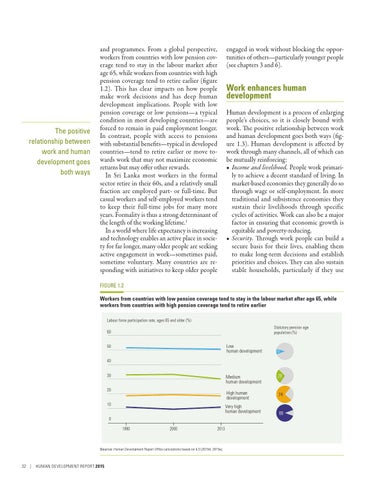
and programmes. From a global perspective, workers from countries with low pension coverage tend to stay in the labour market after age 65, while workers from countries with high pension coverage tend to retire earlier (figure 1.2). This has clear impacts on how people make work decisions and has deep human development implications. People with low pension coverage or low pensions—a typical condition in most developing countries—are forced to remain in paid employment longer. In contrast, people with access to pensions with substantial benefits—typical in developed countries—tend to retire earlier or move towards work that may not maximize economic returns but may offer other rewards. In Sri Lanka most workers in the formal sector retire in their 60s, and a relatively small fraction are employed part- or full-time. But casual workers and self-employed workers tend to keep their full-time jobs for many more years. Formality is thus a strong determinant of the length of the working lifetime.1 In a world where life expectancy is increasing and technology enables an active place in society for far longer, many older people are seeking active engagement in work—sometimes paid, sometime voluntary. Many countries are responding with initiatives to keep older people
engaged in work without blocking the opportunities of others—particularly younger people (see chapters 3 and 6).
Work enhances human development Human development is a process of enlarging people’s choices, so it is closely bound with work. The positive relationship between work and human development goes both ways (figure 1.3). Human development is affected by work through many channels, all of which can be mutually reinforcing: • Income and livelihood. People work primarily to achieve a decent standard of living. In market-based economies they generally do so through wage or self-employment. In more traditional and subsistence economies they sustain their livelihoods through specific cycles of activities. Work can also be a major factor in ensuring that economic growth is equitable and poverty-reducing. • Security. Through work people can build a secure basis for their lives, enabling them to make long-term decisions and establish priorities and choices. They can also sustain stable households, particularly if they use
FIGURE 1.2 Workers from countries with low pension coverage tend to stay in the labour market after age 65, while workers from countries with high pension coverage tend to retire earlier Labour force participation rate, ages 65 and older (%) Statutory pension age population (%)
60
Low human development
50
10
40 30 20 10
28
High human development
74
Very high human development
0 1990
2000
2013
Source: Human Development Report Office calculations based on ILO (2015d, 2015e).
32 | HUMAN DEVELOPMENT REPORT 2015
Medium human development
89