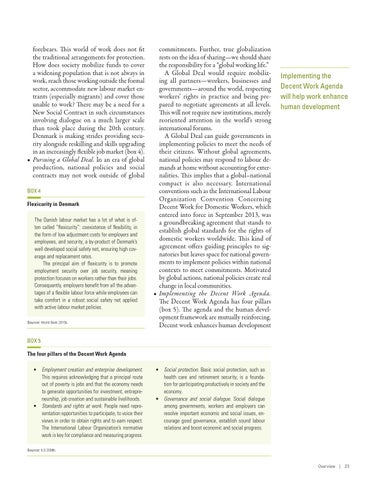
forebears. This world of work does not fit the traditional arrangements for protection. How does society mobilize funds to cover a widening population that is not always in work, reach those working outside the formal sector, accommodate new labour market entrants (especially migrants) and cover those unable to work? There may be a need for a New Social Contract in such circumstances involving dialogue on a much larger scale than took place during the 20th century. Denmark is making strides providing security alongside reskilling and skills upgrading in an increasingly flexible job market (box 4). • Pursuing a Global Deal. In an era of global production, national policies and social contracts may not work outside of global BOX 4 Flexicurity in Denmark The Danish labour market has a lot of what is often called “flexicurity”: coexistence of flexibility, in the form of low adjustment costs for employers and employees, and security, a by-product of Denmark’s well developed social safety net, ensuring high coverage and replacement rates. The principal aim of flexicurity is to promote employment security over job security, meaning protection focuses on workers rather than their jobs. Consequently, employers benefit from all the advantages of a flexible labour force while employees can take comfort in a robust social safety net applied with active labour market policies. Source: World Bank 2015b.
commitments. Further, true globalization rests on the idea of sharing—we should share the responsibility for a “global working life.” A Global Deal would require mobilizing all partners—workers, businesses and governments—around the world, respecting workers’ rights in practice and being prepared to negotiate agreements at all levels. This will not require new institutions, merely reoriented attention in the world’s strong international forums. A Global Deal can guide governments in implementing policies to meet the needs of their citizens. Without global agreements, national policies may respond to labour demands at home without accounting for externalities. This implies that a global–national compact is also necessary. International conventions such as the International Labour Organization Convention Concerning Decent Work for Domestic Workers, which entered into force in September 2013, was a groundbreaking agreement that stands to establish global standards for the rights of domestic workers worldwide. This kind of agreement offers guiding principles to signatories but leaves space for national governments to implement policies within national contexts to meet commitments. Motivated by global actions, national policies create real change in local communities. • Implementing the Decent Work Agenda. The Decent Work Agenda has four pillars (box 5). The agenda and the human development framework are mutually reinforcing. Decent work enhances human development
Implementing the Decent Work Agenda will help work enhance human development
BOX 5 The four pillars of the Decent Work Agenda • Employment creation and enterprise development. This requires acknowledging that a principal route out of poverty is jobs and that the economy needs to generate opportunities for investment, entrepreneurship, job creation and sustainable livelihoods. • Standards and rights at work. People need representation opportunities to participate, to voice their views in order to obtain rights and to earn respect. The International Labour Organization’s normative work is key for compliance and measuring progress.
• Social protection. Basic social protection, such as health care and retirement security, is a foundation for participating productively in society and the economy. • Governance and social dialogue. Social dialogue among governments, workers and employers can resolve important economic and social issues, encourage good governance, establish sound labour relations and boost economic and social progress.
Source: ILO 2008b.
Overview | 23