equally, fathers may be induced to make more use of paternal leave. • Enlarging care options, including day-care centres, after-school programmes, senior citizens’ homes and long-term care facilities. Employers can also offer child-care onsite. Another alternative is to subsidize care work through vouchers and tickets. • Encouraging flexible working arrangements, including telecommuting. There should be sufficient incentives to return to work after giving birth. These may encompass reservation of jobs for women on maternity leave for up to a year. Women could also be offered benefits and stimulus (for example, salary increases) to return to work. Telecommuting and flexible hours can also allow women and men to address imbalances in paid and unpaid work. • Valuing care work. Efforts would help raise policy awareness about the value care work brings to society and could encourage different options for rewarding such work. • Gathering better data on paid and unpaid work. National statistical systems, using more female investigators and appropriate samples and questionnaires, should gather better data on the distribution of paid and unpaid work. Targeted measures for sustainable work may focus on terminating, transforming and creating work to advance human development and environmental sustainability. Policy measures may focus on:
• Adopting different technologies and encouraging new investments. This would require departing from business as usual, pursuing technology transfer and quickly moving to more sustainable work. • Incentivizing individual action and guarding against inequality. This requires recognizing and incentivizing the positive externalities in people’s work—for example, using a social wage, which goes beyond a private wage to reward workers when their work is of value to society (for example, conservation of forests). • Managing trade-offs: For example, supporting workers who lose their jobs due to an end of activities in their sector or industry (for example, mining), implementing standards (as in the ship-breaking industry), addressing intergenerational inequality and managing and facilitating change. Additionally, a mechanism is needed to translate the desired global outcomes into country actions (box 3). Policy options mentioned earlier, particularly for education and skills building, are especially relevant to addressing youth unemployment. But given the severity of this challenge and its multidimensional (economic, social and political) impacts, it also requires targeted interventions. Exciting work opportunities for young people should be created so that they can unbridle their creativity, innovation and
Targeted measures for sustainable work may focus on terminating, transforming and creating work
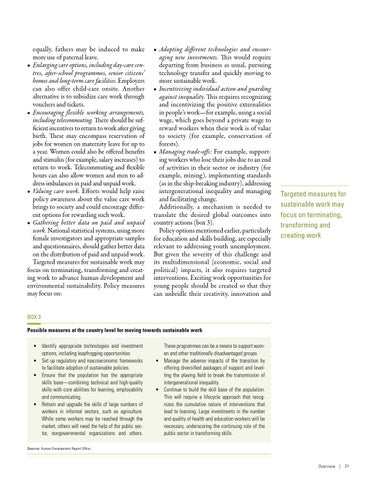
BOX 3 Possible measures at the country level for moving towards sustainable work • Identify appropriate technologies and investment options, including leapfrogging opportunities. • Set up regulatory and macroeconomic frameworks to facilitate adoption of sustainable policies. • Ensure that the population has the appropriate skills base—combining technical and high-quality skills with core abilities for learning, employability and communicating. • Retrain and upgrade the skills of large numbers of workers in informal sectors, such as agriculture. While some workers may be reached through the market, others will need the help of the public sector, nongovernmental organizations and others.
These programmes can be a means to support women and other traditionally disadvantaged groups. • Manage the adverse impacts of the transition by offering diversified packages of support and levelling the playing field to break the transmission of intergenerational inequality. • Continue to build the skill base of the population. This will require a lifecycle approach that recognizes the cumulative nature of interventions that lead to learning. Large investments in the number and quality of health and education workers will be necessary, underscoring the continuing role of the public sector in transforming skills.
Source: Human Development Report Office.
Overview | 21