encouraging the engagement of men in traditionally female-dominated professions can help shift deep-seated views.
Sustainable work is a major building block for sustainable development
Sustainable work promotes human development
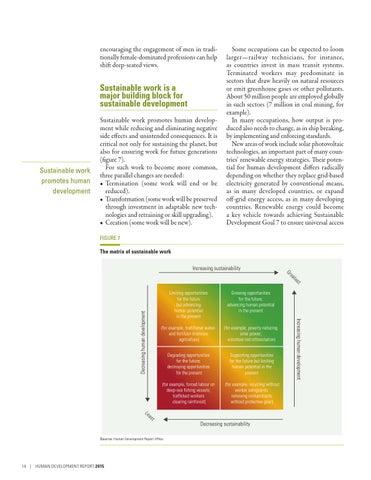
Sustainable work promotes human development while reducing and eliminating negative side effects and unintended consequences. It is critical not only for sustaining the planet, but also for ensuring work for future generations (figure 7). For such work to become more common, three parallel changes are needed: • Termination (some work will end or be reduced). • Transformation (some work will be preserved through investment in adaptable new technologies and retraining or skill upgrading). • Creation (some work will be new).
Some occupations can be expected to loom larger — r ailway technicians, for instance, as countries invest in mass transit systems. Terminated workers may predominate in sectors that draw heavily on natural resources or emit greenhouse gases or other pollutants. About 50 million people are employed globally in such sectors (7 million in coal mining, for example). In many occupations, how output is produced also needs to change, as in ship breaking, by implementing and enforcing standards. New areas of work include solar photovoltaic technologies, an important part of many countries’ renewable energy strategies. Their potential for human development differs radically depending on whether they replace grid-based electricity generated by conventional means, as in many developed countries, or expand off-grid energy access, as in many developing countries. Renewable energy could become a key vehicle towards achieving Sustainable Development Goal 7 to ensure universal access
FIGURE 7 The matrix of sustainable work Increasing sustainability
Growing opportunities for the future; advancing human potential in the present
(for example, traditional waterand fertilizer-intensive agriculture)
(for example, poverty-reducing solar power; volunteer-led reforestation)
Degrading opportunities for the future; destroying opportunities for the present
Supporting opportunities for the future but limiting human potential in the present
(for example, forced labour on deep-sea fishing vessels; trafficked workers clearing rainforest)
(for example, recycling without worker safeguards; removing contaminants without protective gear).
t
as
Le Source: Human Development Report Office.
14 | HUMAN DEVELOPMENT REPORT 2015
Decreasing sustainability
Increasing human development
Decreasing human development
st
te
ea
Gr
Limiting opportunities for the future but advancing human potential in the present