Men dominate the world of paid work, women that of unpaid work
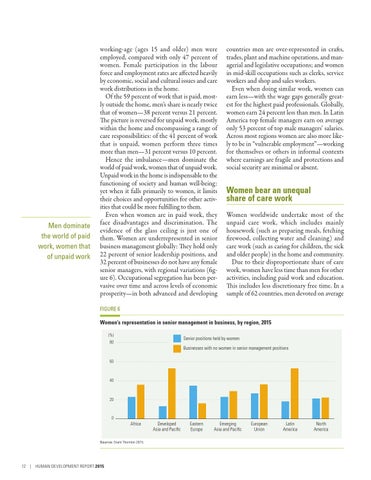
working-age (ages 15 and older) men were employed, compared with only 47 percent of women. Female participation in the labour force and employment rates are affected heavily by economic, social and cultural issues and care work distributions in the home. Of the 59 percent of work that is paid, mostly outside the home, men’s share is nearly twice that of women—38 percent versus 21 percent. The picture is reversed for unpaid work, mostly within the home and encompassing a range of care responsibilities: of the 41 percent of work that is unpaid, women perform three times more than men—31 percent versus 10 percent. Hence the imbalance—men dominate the world of paid work, women that of unpaid work. Unpaid work in the home is indispensable to the functioning of society and human well-being: yet when it falls primarily to women, it limits their choices and opportunities for other activities that could be more fulfilling to them. Even when women are in paid work, they face disadvantages and discrimination. The evidence of the glass ceiling is just one of them. Women are underrepresented in senior business management globally: They hold only 22 percent of senior leadership positions, and 32 percent of businesses do not have any female senior managers, with regional variations (figure 6). Occupational segregation has been pervasive over time and across levels of economic prosperity—in both advanced and developing
countries men are over-represented in crafts, trades, plant and machine operations, and managerial and legislative occupations; and women in mid-skill occupations such as clerks, service workers and shop and sales workers. Even when doing similar work, women can earn less—with the wage gaps generally greatest for the highest paid professionals. Globally, women earn 24 percent less than men. In Latin America top female managers earn on average only 53 percent of top male managers’ salaries. Across most regions women are also more likely to be in “vulnerable employment”—working for themselves or others in informal contexts where earnings are fragile and protections and social security are minimal or absent.
Women bear an unequal share of care work Women worldwide undertake most of the unpaid care work, which includes mainly housework (such as preparing meals, fetching firewood, collecting water and cleaning) and care work (such as caring for children, the sick and older people) in the home and community. Due to their disproportionate share of care work, women have less time than men for other activities, including paid work and education. This includes less discretionary free time. In a sample of 62 countries, men devoted on average
FIGURE 6 Women’s representation in senior management in business, by region, 2015 (%)
Senior positions held by women
80
Businesses with no women in senior management positions 60
40
20
0
Africa
Source: Grant Thornton 2015.
12 | HUMAN DEVELOPMENT REPORT 2015
Developed Asia and Pacific
Eastern Europe
Emerging Asia and Pacific
European Union
Latin America
North America