of whom are women. With appropriate protections in place, domestic work can empower people and help lift their families out of poverty. But abuse is common in paid domestic work, particularly for female migrant workers. Sometimes if the legal framework is inadequate or unenforced, employers use threats and coercion to pay low or even no wages. They can force paid domestic workers to work long hours—up to 18 hours a day without days off. Working conditions are often poor, with little food and no access to medical care. Paid domestic workers may also be subject to physical or sexual abuse. Mining is one of the most hazardous occupations in many countries. It accounts for only 1 percent of the global workforce (30 million workers) but is responsible for 8 percent of fatal accidents at work and for many injuries and disabling diseases, such as pneumoconiosis (black lung disease).
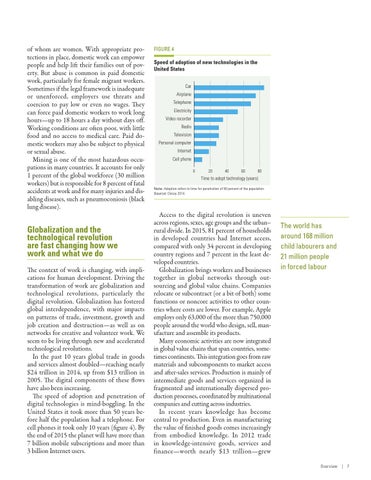
Globalization and the technological revolution are fast changing how we work and what we do The context of work is changing, with implications for human development. Driving the transformation of work are globalization and technological revolutions, particularly the digital revolution. Globalization has fostered global interdependence, with major impacts on patterns of trade, investment, growth and job creation and destruction—as well as on networks for creative and volunteer work. We seem to be living through new and accelerated technological revolutions. In the past 10 years global trade in goods and services almost doubled—reaching nearly $24 trillion in 2014, up from $13 trillion in 2005. The digital components of these flows have also been increasing. The speed of adoption and penetration of digital technologies is mind-boggling. In the United States it took more than 50 years before half the population had a telephone. For cell phones it took only 10 years (figure 4). By the end of 2015 the planet will have more than 7 billion mobile subscriptions and more than 3 billion Internet users.
FIGURE 4 Speed of adoption of new technologies in the United States Car Airplane Telephone Electricity Video recorder Radio Television Personal computer Internet Cell phone 0
20
40
60
80
Time to adopt technology (years) Note: Adoption refers to time for penetration of 50 percent of the population. Source: Donay 2014.
Access to the digital revolution is uneven across regions, sexes, age groups and the urban– rural divide. In 2015, 81 percent of households in developed countries had Internet access, compared with only 34 percent in developing country regions and 7 percent in the least developed countries. Globalization brings workers and businesses together in global networks through outsourcing and global value chains. Companies relocate or subcontract (or a bit of both) some functions or noncore activities to other countries where costs are lower. For example, Apple employs only 63,000 of the more than 750,000 people around the world who design, sell, manufacture and assemble its products. Many economic activities are now integrated in global value chains that span countries, sometimes continents. This integration goes from raw materials and subcomponents to market access and after-sales services. Production is mainly of intermediate goods and services organized in fragmented and internationally dispersed production processes, coordinated by multinational companies and cutting across industries. In recent years knowledge has become central to production. Even in manufacturing the value of finished goods comes increasingly from embodied knowledge. In 2012 trade in knowledge-intensive goods, services and finance—worth nearly $13 trillion—g rew
The world has around 168 million child labourers and 21 million people in forced labour
Overview | 7