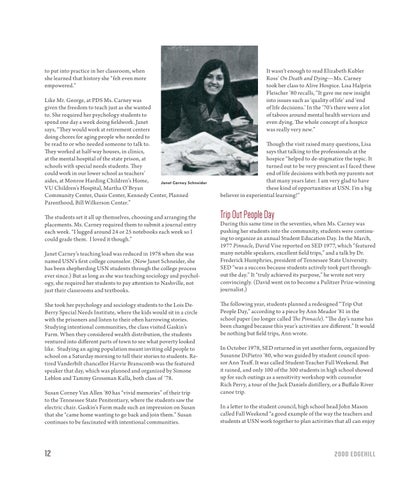
to put into practice in her classroom, when she learned that history she “felt even more empowered.” Like Mr. George, at PDS Ms. Carney was given the freedom to teach just as she wanted to. She required her psychology students to spend one day a week doing fieldwork. Janet says, “They would work at retirement centers doing chores for aging people who needed to be read to or who needed someone to talk to. They worked at half-way houses, in clinics, at the mental hospital of the state prison, at schools with special needs students. They could work in our lower school as teachers’ aides, at Monroe Harding Children’s Home, Janet Carney Schneider VU Children’s Hospital, Martha O’Bryan Community Center, Oasis Center, Kennedy Center, Planned Parenthood, Bill Wilkerson Center.” The students set it all up themselves, choosing and arranging the placements. Ms. Carney required them to submit a journal entry each week. “I lugged around 24 or 25 notebooks each week so I could grade them. I loved it though.” Janet Carney’s teaching load was reduced in 1978 when she was named USN’s first college counselor. (Now Janet Schneider, she has been shepherding USN students through the college process ever since.) But as long as she was teaching sociology and psychology, she required her students to pay attention to Nashville, not just their classrooms and textbooks. She took her psychology and sociology students to the Lois DeBerry Special Needs Institute, where the kids would sit in a circle with the prisoners and listen to their often harrowing stories. Studying intentional communities, the class visited Gaskin’s Farm. When they considered wealth distribution, the students ventured into different parts of town to see what poverty looked like. Studying an aging population meant inviting old people to school on a Saturday morning to tell their stories to students. Retired Vanderbilt chancellor Harvie Branscomb was the featured speaker that day, which was planned and organized by Simone Leblon and Tammy Grossman Kalla, both class of ’78. Susan Corney Van Allen ’80 has “vivid memories” of their trip to the Tennessee State Penitentiary, where the students saw the electric chair. Gaskin’s Farm made such an impression on Susan that she “came home wanting to go back and join them.” Susan continues to be fascinated with intentional communities.
12
It wasn’t enough to read Elizabeth Kubler Ross’ On Death and Dying—Ms. Carney took her class to Alive Hospice. Lisa Halprin Fleischer ’80 recalls, “It gave me new insight into issues such as ‘quality of life’ and ‘end of life decisions.’ In the ’70’s there were a lot of taboos around mental health services and even dying. The whole concept of a hospice was really very new.” Though the visit raised many questions, Lisa says that talking to the professionals at the hospice “helped to de-stigmatize the topic. It turned out to be very prescient as I faced these end of life decisions with both my parents not that many years later. I am very glad to have these kind of opportunities at USN. I’m a big believer in experiential learning!”
Trip Out People Day
During this same time in the seventies, when Ms. Carney was pushing her students into the community, students were continuing to organize an annual Student Education Day. In the March, 1977 Pinnacle, David Vise reported on SED 1977, which “featured many notable speakers, excellent field trips,” and a talk by Dr. Frederick Humphries, president of Tennessee State University. SED “was a success because students actively took part throughout the day.” It “truly achieved its purpose,” he wrote not very convincingly. (David went on to become a Pulitzer Prize-winning journalist.) The following year, students planned a redesigned “Trip Out People Day,” according to a piece by Ann Meador ’81 in the school paper (no longer called The Pinnacle). “The day’s name has been changed because this year’s activities are different.” It would be nothing but field trips, Ann wrote. In October 1978, SED returned in yet another form, organized by Susanne DiPietro ’80, who was guided by student council sponsor Ann Teaff. It was called Student-Teacher Fall Weekend. But it rained, and only 100 of the 300 students in high school showed up for such outings as a sensitivity workshop with counselor Rich Perry, a tour of the Jack Daniels distillery, or a Buffalo River canoe trip. In a letter to the student council, high school head John Mason called Fall Weekend “a good example of the way the teachers and students at USN work together to plan activities that all can enjoy
2000 EDGEHILL