CAPITOL LETTERS VTSGC travels to Washington, D.C.
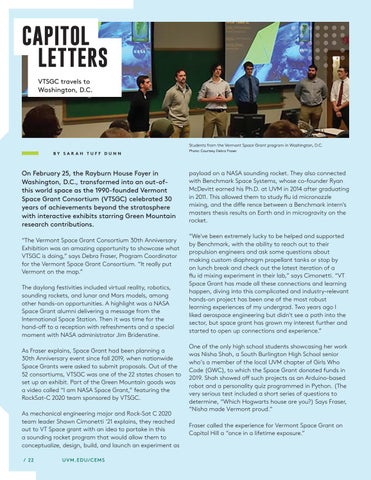
Students from the Vermont Space Grant program in Washington, D.C. BY SAR AH TUFF DUNN
On February 25, the Rayburn House Foyer in Washington, D.C., transformed into an out-ofthis world space as the 1990-founded Vermont Space Grant Consortium (VTSGC) celebrated 30 years of achievements beyond the stratosphere with interactive exhibits starring Green Mountain research contributions. “The Vermont Space Grant Consortium 30th Anniversary Exhibition was an amazing opportunity to showcase what VTSGC is doing,” says Debra Fraser, Program Coordinator for the Vermont Space Grant Consortium. “It really put Vermont on the map.” The daylong festivities included virtual reality, robotics, sounding rockets, and lunar and Mars models, among other hands-on opportunities. A highlight was a NASA Space Grant alumni delivering a message from the International Space Station. Then it was time for the hand-off to a reception with refreshments and a special moment with NASA administrator Jim Bridenstine. As Fraser explains, Space Grant had been planning a 30th Anniversary event since fall 2019, when nationwide Space Grants were asked to submit proposals. Out of the 52 consortiums, VTSGC was one of the 22 states chosen to set up an exhibit. Part of the Green Mountain goods was a video called “I am NASA Space Grant,” featuring the RockSat-C 2020 team sponsored by VTSGC. As mechanical engineering major and Rock-Sat C 2020 team leader Shawn Cimonetti ‘21 explains, they reached out to VT Space grant with an idea to partake in this a sounding rocket program that would allow them to conceptualize, design, build, and launch an experiment as / 22
U V M.E D U/C E M S
Photo: Courtesy Debra Fraser
payload on a NASA sounding rocket. They also connected with Benchmark Space Systems, whose co-founder Ryan McDevitt earned his Ph.D. at UVM in 2014 after graduating in 2011. This allowed them to study flu id micronozzle mixing, and the diffe rence between a Benchmark intern’s masters thesis results on Earth and in microgravity on the rocket. “We've been extremely lucky to be helped and supported by Benchmark, with the ability to reach out to their propulsion engineers and ask some questions about making custom diaphragm propellant tanks or stop by on lunch break and check out the latest iteration of a flu id mixing experiment in their lab,” says Cimonetti. “VT Space Grant has made all these connections and learning happen, diving into this complicated and industry-relevant hands-on project has been one of the most robust learning experiences of my undergrad. Two years ago I liked aerospace engineering but didn't see a path into the sector, but space grant has grown my interest further and started to open up connections and experience.” One of the only high school students showcasing her work was Nisha Shah, a South Burlington High School senior who’s a member of the local UVM chapter of Girls Who Code (GWC), to which the Space Grant donated funds in 2019. Shah showed off such projects as an Arduino-based robot and a personality quiz programmed in Python. (The very serious test included a short series of questions to determine, “Which Hogwarts house are you?) Says Fraser, “Nisha made Vermont proud.” Fraser called the experience for Vermont Space Grant on Capitol Hill a “once in a lifetime exposure.”