Celebrating 60 years of nursing excellence By Mikateko Mbambo
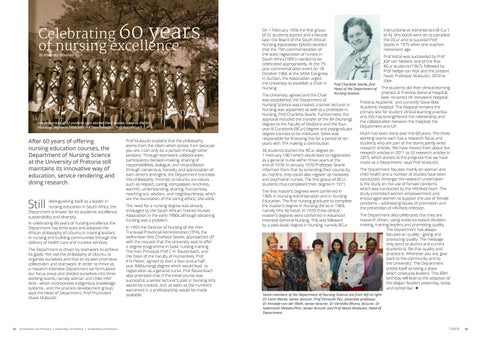
The first group of 32 students that started their studies towards the BA (Nursing) degree in 1956 with the then Principal, Prof Rautenbach.
After 60 years of offering nursing education courses, the Department of Nursing Science at the University of Pretoria still maintains its innovative way of education, service rendering and doing research.
Still
distinguishing itself as a leader in nursing education in South Africa, the Department is known for its academic excellence, sustainability and diversity. In celebrating 60 years of nursing excellence the Department has embraced and adopted the African philosophy of Ubuntu in training leaders in nursing and building communities through the delivery of health care and curative services. The Department is driven by teamwork to achieve its goals. ‘We use the philosophy of Ubuntu to organise ourselves and that on its own promotes collectivism and teamwork. In order to thrive as a research-intensive Department we formulated our focus areas and divided ourselves into three working teams, namely woman and child, HIV/ Aids - which incorporates indigenous knowledge systems - and the practice development group,’ says the Head of Department, Prof Fhumulani Mavis Mulaudzi.
22
Universiteit van Pretoria | University of Pretoria | Yunibesithi ya Pretoria
Prof Mulaudzi explains that the philosophy stems from the idiom which states: ‘I am because you are. I can only be a person through other persons.’ Through teamwork, collaboration, participatory decision-making, sharing of responsibilities, dialogue, and reconciliation through consensus, honesty and appreciation of each other’s strengths, the Department exercises this philosophy. ‘Intrinsic to Ubuntu are values such as respect, caring, compassion, kindness, warmth, understanding, sharing, humanness, reaching out, wisdom, and neighbourliness, which are the foundation of the caring ethics,’ she adds. The need for a nursing degree was already envisaged by the South African Trained Nurses Association in the early 1900s although obtaining funding was a problem. In 1955 the Director of Nursing of the then Transvaal Provincial Administration (TPA), the well-known Mrs Charlotte Searle, approached UP with the request that the University was to offer a degree programme in basic nursing training. The then Principal, Prof C H Rautenbach, and the Dean of the Faculty of Humanities, Prof A N Pelzer, agreed to start a four-and-a-halfyear BA(Nursing) degree which would lead to registration as a general nurse. Prof Rautenbach also promised that, if the initial course was successful, a senior lecturer’s post in Nursing Arts would be created, and, as soon as the numbers warranted it, a professorship would be made available.
On 1 February 1956 the first group of 32 students started and a decade later the Board of the South African Nursing Association (SANA) decided that the 75th commemoration of the state registration of nurses in South Africa (1891) needed to be celebrated appropriately. At the 75year commemoration event on 18 October 1966 at the SANA Congress in Durban, the Association urged the University to establish a Chair in Nursing.
Instructionis et Administrare (B Cur I et A). Mrs Kotzé went on to complete the DCur and to succeed Prof Searle in 1975 when she reached retirement age.
Prof Charlotte Searle, first Head of the Department of Nursing Science.
The University agreed and the Chair was established, the Department of Nursing Science was created, a senior lecturer in Nursing was appointed as well as a professor in Nursing, Prof Charlotte Searle. Furthermore, the approval included the transfer of the BA (Nursing) degree to the Faculty of Medicine and the fouryear B Curationis (BCur) degree and postgraduate degree courses to be instituted. SANA was responsible for financing this for a period of ten years with TPA making a contribution. 36 students started the BCur degree on 1 February 1967 which would lead to registration as a general nurse within three years at the end of 1970. In January 1970 Professor Searle informed them that by extending their course by six months, they could also register as midwives and psychiatric nurses. The first group of BCur students thus completed their degree in 1971. The first master’s degrees were conferred in 1969, in Nursing Administration and in Nursing Education. The first nursing graduate to complete the master’s degree in Nursing did so in 1969, namely Mrs WJ Kotzé. In 1970 three clinical master’s degrees were conferred in Advanced Intensive General Nursing. This was followed by a post-basic degree in Nursing, namely BCur
Prof Kotzé was succeeded by Prof JGP van Niekerk, one of the first BCur students (1967), followed by Prof Neltjie van Wyk and the present head, Professor Mulaudzi, 2010 to date.
The students did their clinical learning practica at Pretoria General Hospital, later renamed HF Verwoerd Hospital, Pretoria Academic and currently Steve Biko Academic Hospital. The hospital remains the primary site for student clinical learning practica and this has strengthened the relationship and the collaboration between the hospital, the Department and UP. Much has been done over the 60 years. The three working teams each has a research focus and students who are part of the teams jointly write research articles. ‘We have moved from about five research articles in 2011 to 33 research articles in 2015, which attests to the progress that we have made as a Department,’ says Prof Mulaudzi. The Department focuses mainly on woman and child health and a number of studies have been conducted. Amongst the research undertaken is the study on the use of female condoms which was conducted by the HIV/Aids team. The study promoted women empowerment and encouraged women to support the use of female condoms – addressing issues of promotion and the prevention of HIV/Aids infection. The Department also celebrates that they are research driven, using evidence-based decisionmaking, training leaders and promoting quality. The Department has always focused on quality - giving and producing quality. The message they send to alumni and current students is: ‘Be that quality and practice it. Wherever you are, give back to the community and to the University’. The Department prides itself as being a place which produces leaders. This 60th birthday will lead to the adoption of the slogan 'leaders yesterday, today and tomorrow'. ¾
Some members of the Department of Nursing Science are from left to right: Dr Carin Maree, senior lecturer, Prof Doriccah Peu, associate professor, Dr Annatjie van der Wath, senior lecturer, Dr Varshika Bhana, lecturer, Dr Salaminah Moloko-Phiri, senior lecturer and Prof Mavis Mulaudzi, Head of Department.
TUKKIE
23