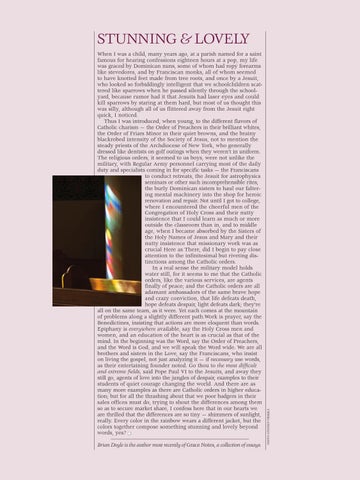
When I was a child, many years ago, at a parish named for a saint famous for hearing confessions eighteen hours at a pop, my life was graced by Dominican nuns, some of whom had ropy forearms like stevedores, and by Franciscan monks, all of whom seemed to have knotted feet made from tree roots, and once by a Jesuit, who looked so forbiddingly intelligent that we schoolchildren scattered like sparrows when he passed silently through the schoolyard, because rumor had it that Jesuits had laser eyes and could kill sparrows by staring at them hard, but most of us thought this was silly, although all of us flittered away from the Jesuit right quick, I noticed. Thus I was introduced, when young, to the different flavors of Catholic charism — the Order of Preachers in their brilliant whites, the Order of Friars Minor in their quiet browns, and the brainy blackrobed intensity of the Society of Jesus, not to mention the steady priests of the Archdiocese of New York, who generally dressed like dentists on golf outings when they weren’t in uniform. The religious orders, it seemed to us boys, were not unlike the military, with Regular Army personnel carrying most of the daily duty and specialists coming in for specific tasks — the Franciscans to conduct retreats, the Jesuit for astrophysics seminars or other such incomprehensible rites, the burly Dominican sisters to haul our faltering mental machinery into the shop for heroic renovation and repair. Not until I got to college, where I encountered the cheerful men of the Congregation of Holy Cross and their nutty insistence that I could learn as much or more outside the classroom than in, and to middle age, when I became absorbed by the Sisters of the Holy Names of Jesus and Mary and their nutty insistence that missionary work was as crucial Here as There, did I begin to pay close attention to the infinitesimal but riveting distinctions among the Catholic orders. In a real sense the military model holds water still, for it seems to me that the Catholic orders, like the various services, are agents finally of peace; and the Catholic orders are all adamant ambassadors of the same brave hope and crazy conviction, that life defeats death, hope defeats despair, light defeats dark; they’re all on the same team, as it were. Yet each comes at the mountain of problems along a slightly different path.Work is prayer, say the Benedictines, insisting that actions are more eloquent than words. Epiphany is everywhere available, say the Holy Cross men and women, and an education of the heart is as crucial as that of the mind. In the beginning was the Word, say the Order of Preachers, and the Word is God, and we will speak the Word wide. We are all brothers and sisters in the Love, say the Franciscans, who insist on living the gospel, not just analyzing it — if necessary use words, as their entertaining founder noted. Go thou to the most difficult and extreme fields, said Pope Paul VI to the Jesuits, and away they still go, agents of love into the jungles of despair, examples to their students of quiet courage changing the world. And there are as many more examples as there are Catholic orders in higher education; but for all the thrashing about that we poor badgers in their sales offices must do, trying to shout the differences among them so as to secure market share, I confess here that in our hearts we are thrilled that the differences are so tiny — shimmers of sunlight, really. Every color in the rainbow wears a different jacket, but the colors together compose something stunning and lovely beyond words, yes? n Brian Doyle is the author most recently of Grace Notes, a collection of essays.
PHOTO: STEPHEN TRIMBLE
STUNNING & LOVELY