ALUMNI | 06
ENGINEERING THE MAGIC IN MOVIES An article by alumnus Mr Yasser Hamed – recipient of the 2010 Newton-John Award. An increased demand for special effects in feature films in the past decade has commanded more attention to detail and fuelled a hunger for realism. Traditional methods of using miniatures, cloud tanks, or even “paint by frame” are now regarded as obsolete and no longer applicable to highend feature films.
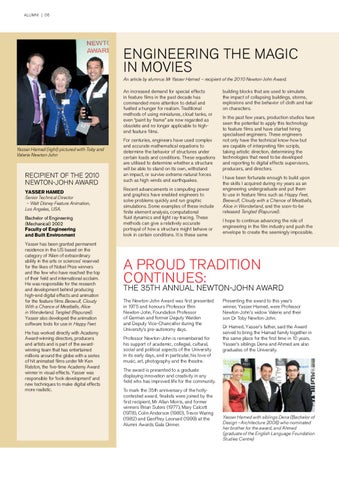
Yasser Hamed (right) pictured with Toby and Valerie Newton-John
RECIPIENT OF THE 2010 NEWTON-JOHN AWARD Yasser Hamed Senior Technical Director – Walt Disney Feature Animation, Los Angeles, USA. Bachelor of Engineering (Mechanical) 2002 Faculty of Engineering and Built Environment Yasser has been granted permanent residence in the US based on the category of ‘Alien of extraordinary ability in the arts or sciences’ reserved for the likes of Nobel Prize winners and the few who have reached the top of their field and international acclaim. He was responsible for the research and development behind producing high-end digital effects and animation for the feature films Beowulf, Cloudy With a Chance of Meatballs, Alice in Wonderland, Tangled (Rapunzel). Yasser also developed the animation software tools for use in Happy Feet. He has worked directly with Academy Award-winning directors, producers and artists and is part of the awardwinning team that has entertained millions around the globe with a series of hit animated films under Mr Ken Ralston, the five-time Academy Award winner in visual effects. Yasser was responsible for ‘look development’ and new techniques to make digital effects more realistic.
For centuries, engineers have used complex and accurate mathematical equations to determine the behavior of structures under certain loads and conditions. These equations are utilised to determine whether a structure will be able to stand on its own, withstand an impact, or survive extreme natural forces such as high winds and earthquakes. Recent advancements in computing power and graphics have enabled engineers to solve problems quickly and run graphic simulations. Some examples of these include finite element analysis, computational fluid dynamics and light ray-tracing. These methods can give a relatively accurate portrayal of how a structure might behave or look in certain conditions. It is these same
building blocks that are used to simulate the impact of collapsing buildings, storms, explosions and the behavior of cloth and hair on characters. In the past few years, production studios have seen the potential to apply this technology to feature films and have started hiring specialised engineers. These engineers not only have the technical know-how but are capable of interpreting film scripts, taking artistic direction, determining the technologies that need to be developed and reporting to digital effects supervisors, producers, and directors. I have been fortunate enough to build upon the skills I acquired during my years as an engineering undergraduate and put them to use in feature films such as Happy Feet, Beowulf, Cloudy with a Chance of Meatballs, Alice in Wonderland, and the soon-to-be released Tangled (Rapunzel). I hope to continue advancing the role of engineering in the film industry and push the envelope to create the seemingly impossible.
A PROUD TRADITION CONTINUES:
THE 35th ANNUAL NEWTON-JOHN AWARD The Newton-John Award was first presented in 1975 and honours Professor Brin Newton-John, Foundation Professor of German and former Deputy Warden and Deputy Vice-Chancellor during the University’s pre-autonomy days. Professor Newton-John is remembered for his support of academic, collegial, cultural, social and political aspects of the University in its early days, and in particular, his love of music, art, photography and the theatre.
Presenting the award to this year’s winner, Yasser Hamed, were Professor Newton-John’s widow Valerie and their son Dr Toby Newton-John. Dr Hamed, Yasser’s father, said the Award served to bring the Hamad family together in the same place for the first time in 10 years. Yasser’s siblings Dena and Ahmed are also graduates of the University.
The award is presented to a graduate displaying innovation and creativity in any field who has improved life for the community. To mark the 35th anniversary of the hotlycontested award, finalists were joined by the first recipient, Mr Allan Morris, and former winners Brian Suters (1977), Mary Calcott (1978), Colin Anderson (1980), Trevor Waring (1982) and Geoffrey Leonard (1999) at the Alumni Awards Gala Dinner.
Yasser Hamed with siblings Dena (Bachelor of Design –Architecture 2008) who nominated her brother for the award, and Ahmed (graduate of the English Language Foundation Studies Centre)