Human Sciences 111
Field Work
You will engage in field work of all varieties and in many different environments. We treat Cornwall as a living laboratory, taking learning into the field to explore the incredible landscapes in the region and beyond. In your first year, you’ll develop key field skills during a compulsory week-long residential field course in West Cornwall. In your third year, you’ll attend a residential field class, for example to the US megacities, California mountains or Kenya’s Rift Valley*, which will enable you to put your learning into practice and gain new research skills. Many modules also include days in the field, and you’ll be encouraged to explore Cornwall’s unique environment in dissertation research and independent coursework.
Assessment
Your progress is monitored through tutorial work and practical assessments. The final degree mark is based on approximately 50 per cent exam and 50 per cent coursework assessments. The latter includes a final year dissertation, which is an independent research project in which you study the topic that excites you most. The modules taken in the first year must be passed to progress to the second year but the marks obtained do not influence your final degree classification.
Study Abroad
We offer a four-year programme which allows you to spend your third year studying at a partner institution overseas. The opportunity to study abroad can greatly enhance your employability skills and build your confidence and competencies. Students on the three-year Single Honours degree programme may have the opportunity to apply to transfer to the four-year programme once studying at the University of Exeter, but places will be limited and subject to a competitive process.
Careers
Our Human Sciences degrees will allow you to take full advantage of the growing demand in research organisations, industry and business for graduates who are able to work in the multidisciplinary environments of the future. The breadth of career opportunities open to graduates is vast, such as health, conservation, education, third sector work, culture and heritage and community work. With training in both biological and social sciences (and potentially other related disciplines), your options are likely to be broader than from a more narrowly focused subject. Whatever path * Field course destinations are subject to change.
you want to follow after graduation, we’re here to help and support you with all your career and employability needs.
Programme Details BA/BSc Human Sciences
LOCATION: CORNWALL (PENRYN CAMPUS)
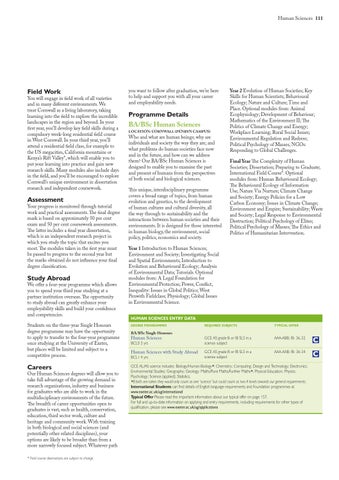
Who and what are human beings; why are individuals and society the way they are; and what problems do human societies face now and in the future, and how can we address them? Our BA/BSc Human Sciences is designed to enable you to examine the past and present of humans from the perspectives of both social and biological sciences. This unique, interdisciplinary programme covers a broad range of topics, from human evolution and genetics, to the development of human cultures and cultural diversity, all the way through to sustainability and the interactions between human societies and their environments. It is designed for those interested in human biology, the environment, social policy, politics, economics and society.
Year 2 Evolution of Human Societies; Key Skills for Human Scientists; Behavioural Ecology; Nature and Culture; Time and Place. Optional modules from: Animal Ecophysiology; Development of Behaviour; Mathematics of the Environment II; The Politics of Climate Change and Energy; Workplace Learning; Rural Social Issues; Environmental Regulation and Redress; Political Psychology of Masses; NGOs: Responding to Global Challenges. Final Year The Complexity of Human Societies; Dissertation; Preparing to Graduate; International Field Course*. Optional modules from: Human Behavioural Ecology; The Behavioural Ecology of Information Use; Nature Via Nurture; Climate Change and Society; Energy Policies for a Low Carbon Economy; Issues in Climate Change; Environment and Empire; Sustainability; Waste and Society; Legal Response to Environmental Destruction; Political Psychology of Elites; Political Psychology of Masses; The Ethics and Politics of Humanitarian Intervention.
Year 1 Introduction to Human Sciences; Environment and Society; Investigating Social and Spatial Environments; Introduction to Evolution and Behavioural Ecology; Analysis of Environmental Data; Tutorials. Optional modules from: A Legal Foundation for Environmental Protection; Power, Conflict, Inequality: Issues in Global Politics; West Penwith Fieldclass; Physiology; Global Issues in Environmental Science. HUMAN SCIENCES ENTRY DATA DEGREE PROGRAMMES
REQUIRED SUBJECTS
TYPICAL OFFER
Human Sciences
GCE AS grade B or IB SL5 in a science subject
AAA-ABB; IB: 36-32
Human Sciences with Study Abroad
GCE AS grade B or IB SL5 in a science subject
AAA-AAB; IB: 36-34
BA/BSc Single Honours BCL0 3 yrs
BCL1 4 yrs
GCE AL/AS science includes: Biology/Human Biologyp; Chemistry; Computing; Design and Technology; Electronics; Environmental Studies; Geography; Geology; Maths/Pure Maths/Further Mathsp; Physical Education; Physics; Psychology; Science (applied); Statistics. p If both are taken they would only count as one ‘science’ but could count as two A levels towards our general requirements. International Students can find details of English language requirements and Foundation programmes at www.exeter.ac.uk/ug/international Typical Offer Please read the important information about our typical offer on page 157. For full and up-to-date information on applying and entry requirements, including requirements for other types of qualification, please see www.exeter.ac.uk/ug/applications