THE UNIVERSITY OBSERVER 21 September 2010
Comment
comment@universityobserver.ie
As it ends, Matthew Judge studies the phenomenon of Big Brother
O
n the 10th of September 2010, Big Brother closed its watchful eyes and toasted a final chapter in reality television. The remaining fans mourned, realising the prospect of no longer witnessing its diary room dialogues, dramatics or downfalls. Since its initial broadcast in the Netherlands in 1999, Big Brother has had a huge impact on the world we live in and how we interact with reality and celebrity. It has facilitated our curiosity about human relationships, contributed to our obsession with celebrity life and encouraged the deterioration of privacy. On second glance, it seems that the anguish of Big Brother fans is the primary phase of withdrawal for reality television addicts. Originally a social experiment, Big Brother soon transformed into a corporate machine notorious for manufacturing celebrities overnight. From Jade Goody to Chantelle Houghton, television audiences have come to recognise average working-class citizens as national superstars. For ten years, the Big Brother franchise has showcased its contestants, enjoying their fifteen minutes of fame. In modern society, the concept of celebrity is nonsensical. Not so long ago, we adored inspirational figures who contributed to society. Today, we shiver at the thought of another informative speech delivered by Bono or Bob Geldof and instead favour the latest YouTube sensation waiting in the wings of fame. It’s important to note that even though Big Brother was a pedestal for transforming normal people into ‘celebrities’, its failure to protect contestants from excessive exposure to the media was obvious. Take Bart Spring in’t Veld, the first ever winner of the Big Brother franchise. Since being crowned the winner in 1999, Bart had suffered five breakdowns due to his private life being exposed to the media. This brings into question the validity of the rigorous psychological evaluation which contentests are routinely treated to before appearing on the show. In an intimate interview with the Guardian, Bart revealed how he was unprepared for his newfound fame and how he had gambled recklessly with his privacy. In the
13
Still Watching?
Big Brother has changed our concepts of celebrity and destroyed respect for privacy.
interview, he comments on his own participation in promoting the Big Brother franchise. “If I helped to create the mindless monster, I’m not too proud of it; Big Brother took away the need to make inspiring programmes and replaced them with mindless chatter.” Every day we are introduced to potential ‘celebrities’ promoting their latest antics on YouTube, Facebook and MySpace. Two billion videos are viewed each day by YouTube users and five hundred million Facebook users are actively roaming the site. In theory, it is marketing genius. Yet it’s frightening to see the lengths that people will go to in order to be accepted and recognised by their peers. Oftentimes, these celebrity wannabes will allow their fellow YouTube and Facebook colleagues
in-depth access to their private lives. The ideology and cult status of Big Brother has made way for revolutionary social and entertainment networks through which we can communicate with others or just reveal our own personal thoughts to the world. Essentially, it has helped spawn a society in which privacy and achievement is being increasingly devalued. We have come to rely on the efficiency and convenience of sharing information through these social networks. Lost in this necessity to communicate, social network users often forget the benefits of anonymity and get trapped into releasing details about their personal lives, friends and social activities without prior contemplation. If Big Brother was a corporate machine that
created celebrities overnight and laid the foundations for privacy-endangered social networks, then we must ask ourselves who drove this machine? The answer is we did. It is in our human nature to be curious and attracted to the drama of human relationships. Voyeurism is a part of our genetic make-up and Big Brother has facilitated this curious nature for over ten years. It’s hard to let go. Similarly, what does this say of the value we put upon geniune talent? Our celebrities are now talentless reality stars, whose private lives and problems we scan fervently. What has happened to the talented film, television and music stars of the past? We have replaced recognition of true talent with the celebration of attention for attention’s sake. However as one door closes, another one
opens. Hit shows like Jersey Shore and The Hills have also captured our attention and promoted the creation of the overnight celebrity. Even through Facebook and YouTube, we are playing out our lives on our very own online reality show to five hundred million viewers. Big Brother has been a key cultural icon for the new millennium. Some mourn its absence and some revel in its departure. It has introduced a level of voyeurism and celebrity obsession in society that has become the norm. It has been a rollercoaster of highs and lows, from a revolutionary beginning to a weary end. However, due to this cultural monster, you can be assured that there is always someone watching.
Making a Twitter of Yourself Hungover leader or overexcited media? Eoin Brady examines the reasoning behind the intense scrutiny of Taoiseach Brian Cowen’s recent interview.
L
istening back to the now-infamous Morning Ireland interview, from the moment Cathal Mac Coille greets Brian Cowen with “thank you for coming over before your breakfast”, it is obvious that Mr Cowen should not have gone on air. “Irish premier denies being drunk, hungover on air” – as reported by The Associated Press – is a story that has been covered in over 450 articles worldwide, including in influential media outlets such as the Wall Street Journal, the New York Times and the Guardian. The indirect phrasing used in that title – Mr Cowen’s denial of being under the influence, rather than his actually being under the influence – demonstrates how the story emerged and developed. This is a story not about what Mr Cowen actually said or did in his interview – the interview itself is by no means outrageous. Rather, it is about the way the events of the morning (and the preceding night) were handled by Mr Cowen, commentators and other politicians afterwards. The responses Mr Cowen gave during the Morning Ireland interview were vague,
equivocal and somewhat incoherent. He did not give straight answers to pertinent questions, including one about the suggestion that next year’s budget cuts could be €4bn, instead of the previously mooted €3bn. While this is an integral issue for the recovery of the Irish economy, and Mr Cowen’s answer will have further perturbed already jittery bond markets, he would have not given a straight answer after eight hours’ sleep, a brisk walk and a bowl of porridge. The content of his interview was conventional and unremarkable. There would have been no story here, were it not for two things: firstly, that it is known that Mr Cowen had been drinking and socialising (or becoming a socialist, if Noel Dempsey is to be believed) at 3.30am in the bar of the Ardilaun Hotel in Galway the night before. Secondly, that Fine Gael Transport Spokesperson Simon Coveney tweeted “God, what an uninspiring interview by Taoiseach this morning. He sounded halfway between drunk and hungover and totally disinterested.” Mr Coveney probably did not intend
to accuse Mr Cowen of being inebriated, but other than that, what he said was clear. Although Mr Coveney was just one of a number of people making the point on Twitter, his position on the opposition front bench lent the story an air of legitimacy. From there, the story exploded, or blossomed, depending on one’s perspective on the matter. This is not the first time that Twitter has influenced Irish politics: this event was preceded by Green Party Leader Senator Dan Boyle’s 140-character statement of no confidence in coalition partner and then Minister for Defence Willie O’Dea. The kind of unfiltered, spontaneous commentary that Twitter seems to trigger in Irish politicians should be welcomed. Without it, we could have seen Mr O’Dea’s alleged perjury and Mr Cowen’s poor preparation be subject to less analysis and discussion than they merited. This unconventional outlet gives politicians a means to act with their hearts, against the status quo. This is also not the first time that an unpopular prime minister has become embroiled in a public relations disaster that was triggered by modern technology. Gordon Brown’s labelling of Gillian Duffy – an elderly lifelong Labour voter – as a “bigot”, after the two shared an apparently pleasant discussion, would not have gone any further than the back seat of his Jaguar, were it not for a misplaced radio microphone. Arguably, Mr Brown’s gaffe was more seri-
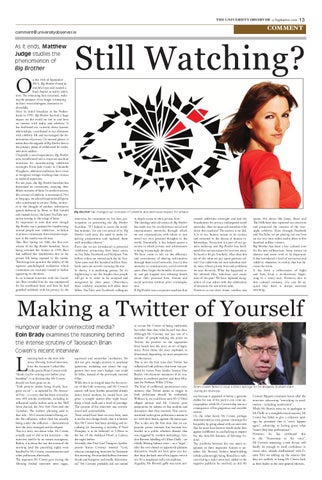
Brian Cowen failed to issue a direct apology for his allegedly drunken state during an interview.
ous because it appeared to betray a genuine dislike for one of his party’s core voter demographics, while Mr Cowen’s slip was as a consequence of his gregarious and sociable nature. On the other hand, Mr Cowen perhaps demonstrated an even greater contempt for his public by going ahead with an interview that he must have known would make him appear indifferent to, and lacking in respect for, the 464,000 listeners of Morning Ireland. The similarity between the two men’s responses to their respective furores is notable: Mr Brown’s forlorn head-holding (while unknowingly being filmed by a webcam during a radio interview) added to the negative publicity he received, as did Mr
Cowen’s flippant comment hours after the interview advocating “everything in moderation – including moderation”. While Mr Brown went on to apologise to Ms Duffy in a straightforward manner, Mr Cowen has failed to give a coherent apology: he promised that it “won’t happen again”, admitting to having given what “wasn’t [his] best performance”. However, he has attributed this to the “hoarseness in his voice”. Mr Cowen’s reasoning, a sore throat, will hardly do enough to instil confidence in voters who, already disillusioned with Fianna Fáil, are adding up the reasons that they are unlikely to bring Mr Cowen back as their leader in the next general election.