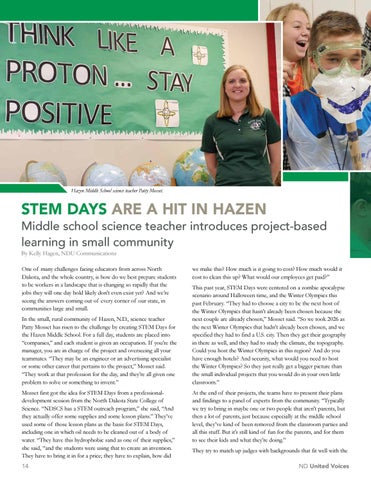
Hazen Middle School science teacher Patty Mosset.
STEM DAYS ARE A HIT IN HAZEN
Middle school science teacher introduces project-based learning in small community By Kelly Hagen, NDU Communications
One of many challenges facing educators from across North Dakota, and the whole country, is how do we best prepare students to be workers in a landscape that is changing so rapidly that the jobs they will one day hold likely don’t even exist yet? And we’re seeing the answers coming out of every corner of our state, in communities large and small. In the small, rural community of Hazen, N.D., science teacher Patty Mosset has risen to the challenge by creating STEM Days for the Hazen Middle School. For a full day, students are placed into “companies,” and each student is given an occupation. If you’re the manager, you are in charge of the project and overseeing all your teammates. “They may be an engineer or an advertising specialist or some other career that pertains to the project,” Mosset said. “They work at that profession for the day, and they’re all given one problem to solve or something to invent.” Mosset first got the idea for STEM Days from a professionaldevelopment session from the North Dakota State College of Science. “NDSCS has a STEM outreach program,” she said, “And they actually offer some supplies and some lesson plans.” They’ve used some of those lesson plans as the basis for STEM Days, including one in which oil needs to be cleaned out of a body of water. “They have this hydrophobic sand as one of their supplies,” she said, “and the students were using that to create an invention. They have to bring it in for a price; they have to explain, how did 14
we make this? How much is it going to cost? How much would it cost to clean this up? What would our employees get paid?” This past year, STEM Days were centered on a zombie apocalypse scenario around Halloween time, and the Winter Olympics this past February. “They had to choose a city to be the next host of the Winter Olympics that hasn’t already been chosen because the next couple are already chosen,” Mosset said. “So we took 2026 as the next Winter Olympics that hadn’t already been chosen, and we specified they had to find a U.S. city. Then they get their geography in there as well, and they had to study the climate, the topography. Could you host the Winter Olympics in this region? And do you have enough hotels? And security, what would you need to host the Winter Olympics? So they just really get a bigger picture than the small individual projects that you would do in your own little classroom.” At the end of their projects, the teams have to present their plans and findings to a panel of experts from the community. “Typically we try to bring in maybe one or two people that aren’t parents, but then a lot of parents, just because especially at the middle school level, they’ve kind of been removed from the classroom parties and all this stuff. But it’s still kind of fun for the parents, and for them to see their kids and what they’re doing.” They try to match up judges with backgrounds that fit well with the ND United Voices


