"ReCycle of Life" BOOKLET


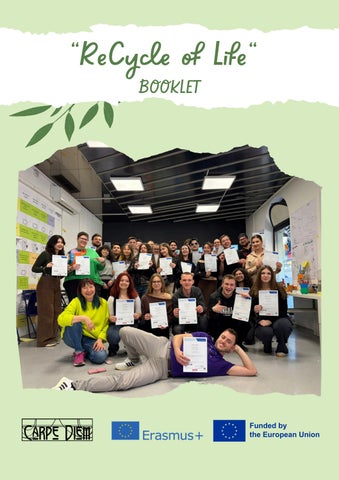
The YE took place in Karlovac, from 9th to 13th of March 2026. It gathered 6 partners from Croatia, Slovenia, North Macedonia, Greece, Moldova & Turkiye, with total number of 25 participants.
Combination of workshops, debates, and field activities, on which young participants, learned about the principles of the circular economy, designed and created functional objects or artworks using used products that are at the end of their regular life cycle. The created items were presented in an exhibition aimed at raising awareness within the local community about the importance of recycling and the circular economy.
Exhibition
Participants stand in two equal lines facing each other. They have 1–2 minutes per round to introduce themselves and answer one question (e.g., What’s your weird talent? What are you proud of?). After each round, one line shifts to create new pairs. At the end, participants share three names and facts they remember.
Objectives: Getting to know each other quickly, memory activation, communication skills.
Participants stand in a circle. One ball is thrown across the circle. The thrower says the name of the person they are passing to. The receiver repeats the name and throws to someone else. After a few rounds, add a second ball to increase energy and challenge.
Objectives: Learning names, focus, group energy.
Divide participants into two teams sitting on opposite sides. Two volunteers hold a blanket/curtain in the middle. Each team secretly selects one representative to sit close to the curtain. On the count of three, the curtain drops. The two participants must quickly say each other’s name. The faster one wins a point for their team.
Objectives: Name learning, team spirit, quick thinking.
Participants sit in a circle with one person standing in the middle. The person in the middle says: “People who…” followed by a true statement about themselves (e.g., “People who have a cat”). Everyone who identifies must change seats. The person left without a seat continues in the middle.
Objectives: Discovering similarities, movement, fun interaction.
5. Bingo – “Find Someone Who…” (20–30 min)
Each participant receives a bingo card with statements (e.g., has volunteered before, plays an instrument, speaks 3 languages). They walk around the room and find a different person for each square. The middle square is free and should represent something common to everyone.
The first 1–3 participants who complete a line shout “Bingo!”
Objectives: Deepening connections, encouraging conversation.
1. Zip Zap Boing (10–15 min)
Participants stand in a circle.
“Zip” → clap to the right
“Zap” → clap to the left
“Boing” → change direction
Anyone who makes a mistake is out (or does a funny task).
Objectives: Focus, quick reactions, energizing the group.
Participants count in order up to 5 repeatedly.
Gradually replace numbers with movements:
1 = Clap
2 = Jump
3 = Turn around
4 = Hands in the air
5 = Dance move
If someone makes a mistake, they are out or restart.
Objectives: Concentration, coordination, laughter.
3. I Love You So Much (15–20 min)
Participants sit in a circle. One person stands in the center and says to someone:
“I love you so much, why don’t you smile?”
The person must respond:
“I love you too, but I just can’t smile.”
If they laugh or smile, they switch places.
Objectives: Breaking tension, encouraging eye contact and emotional expression.
Participants stand in a circle. One volunteer goes to the center (the detective). The facilitator secretly chooses a “Frog.”
The Frog eliminates others by discreetly sticking out their tongue. Eliminated players sit down. The detective tries to guess who the Frog is before only three players remain.
Objectives: Observation skills, suspense, fun competition.
5. Princess – Castle – Storm (10–15 min)
Participants form groups of three:
Two form a Castle (holding hands in an arch)
One inside is the Princess
Commands:
“Princess!” → Princesses move to new castles
“Castle!” → Castles find new Princesses
“Storm!” → Everyone forms new groups of three
Objectives: High energy, mixing participants.
In this section we will present the workshops that were made by national groups and implemented on the youth exchange.
1.Recycling Cultures in Our Countries (United Societies of Balkans, Greece)
2.How can we contribute to reducing waste? (Mladinski center Postojna, Slovenia)
3.Circular Awareness Mission – From Problem to Action (Cosmos Youth, Türkiye)
4.Intercultural Debate Challenge (OWMSN, North Macedonia)
5. ReCycle in the City (Artico, Moldova)
6.Circular Lab – FromWaste toWorth (Artico, Moldova)
7.Creation of New Life (Carpe Diem, Croatia)
To raise participants’ awareness of recycling practices and environmental responsibility by exploring differences in recycling habits and systems across countries.The activity aimed to help participants understand how recycling works in different contexts and encourage thinking about more effective and sustainable solutions.
Participants first reflected on recycling habits in their own countries, discussing waste separation, existing infrastructure, and factors that motivate citizens to recycle.They then worked in multicultural groups where they exchanged experiences and insights about national recycling practices. Based on this discussion, each group designed an ideal recycling model, considering elements such as waste sorting systems, recycling infrastructure, and possible incentives to encourage citizens to recycle more actively.
Participants gained a broader understanding of environmental challenges and different approaches to waste management.The activity promoted critical thinking, intercultural learning, and encouraged participants to reflect on their own habits and promote more sustainable practices within their communities.
To raise participants’ awareness of how everyday habits contribute to waste and environmental pollution.The activity aimed to empower young people with practical tools to reduce waste in their daily lives and encourage personal responsibility and active citizenship in environmental protection.
The workshop explored how individual lifestyle choices influence waste production and environmental impact. It began with a short reflection activity where participants identified waste created in their daily routines. This was followed by an interactive input on different types of waste, their environmental impact, and the waste hierarchy (Reduce – Reuse – Recycle). Participants then worked in small groups to analyse common behaviours related to areas such as plastic use, food waste, fast fashion, and e-waste, and created posters featuring their topic and written alternatives to reduce waste.
Participants developed a better understanding of the connection between personal habits and environmental challenges.The activity encouraged solution-oriented thinking, personal commitment to more sustainable behaviour, and motivated participants to adopt small but consistent actions that contribute to environmental protection.
To help participants understand real-life waste problems through the perspective of circular economy and encourage them to create strong awareness messages.The activity aimed to promote critical thinking, teamwork, and active citizenship while connecting environmental issues to everyday behaviour.
The activity began with a short introduction to the difference between linear economy (take–make–throw away) and circular economy (reduce–reuse–repair–recycle). Participants reflected on current consumption habits and discussed common waste-related problems. Working in mixed-country groups, participants analysed everyday products that create waste, explored the reasons they are quickly discarded, and discussed their environmental and social impact. Based on this analysis, each group developed a clear awareness message and designed an awareness action, such as a role play, poster, speech, or campaign idea. Groups then presented their actions and received short peer feedback.
Participants gained a deeper understanding of circular economy principles and the impact of everyday consumption.The activity strengthened their ability to analyse problems, communicate awareness messages, and collaborate in multicultural teams. It also encouraged participants to think about how they can promote more sustainable behaviour within their communities.
To strengthen participants’ critical thinking, public speaking, and communication skills while promoting intercultural dialogue and cooperation.The activity aimed to develop structured argumentation, encourage respectful discussion between participants from different cultural backgrounds, and foster teamwork and active democratic participation.
Participants worked in multicultural teams to prepare and present arguments on selected debate topics.Through discussion, argument development, and responding to opposing viewpoints, they practiced expressing ideas clearly, listening to different perspectives, and supporting their arguments with examples. Participants also took roles as peer evaluators, providing constructive feedback and reflecting on the quality of arguments and communication.
Participants improved their confidence in public speaking, teamwork, and critical thinking.The activity promoted respectful dialogue, intercultural understanding, and active participation in democratic discussions.Through reflection, participants recognized the competences they developed, particularly in communication, social and civic engagement, cultural awareness, and learning to learn.
To raise participants’ awareness of waste management in urban environments by observing real-life situations in the city.The activity aimed to connect participants with everyday environmental challenges and encourage reflection on recycling practices within the community.
The workshop began with a short introduction explaining the concept of “ReCycle of Life” and the rules of the activity. Participants were divided into small teams and guided through an urban exploration task. During the activity, teams observed public spaces to identify where waste accumulates, analysed whether waste was sorted, and noted which types of waste appeared most frequently. When possible, participants also briefly interacted with local community members to ask about their recycling habits and ideas for improvement.Teams collected clean and recyclable materials such as plastic, paper, cardboard, and metal.
Participants developed a stronger connection with real environmental issues in urban spaces and reflected on local recycling practices.The activity encouraged observation, critical thinking, and discussion about community responsibility.Through a short reflection circle, participants shared surprising findings, identified challenges, and recognized positive examples of waste management in the city.
To encourage participants to see waste as a potential resource and understand the principles of circular economy through creativity and teamwork.The activity aimed to promote sustainable thinking and highlight how recycling can become part of everyday lifestyle choices.
The workshop began with sorting the materials collected during the outdoor activity and reflecting on how items considered “waste” could be reused. Participants then worked in teams to create objects, symbols, or small installations using recycled materials. Each creation was designed to communicate a message about sustainable living, responsibility, and recycling as a lifestyle.
After the creative process, participants reflected on the concept of the life cycle by adding their thoughts to a shared reflection panel prepared by the facilitators.The activity concluded with presentations of the created objects and a short closing message.
Participants gained practical experience in applying circular thinking and transforming waste into meaningful creations.The activity strengthened creativity, collaboration, and environmental awareness while connecting participants’ observations from the city with hands-on sustainable solutions. It also encouraged personal reflection on how daily choices influence waste and recycling.
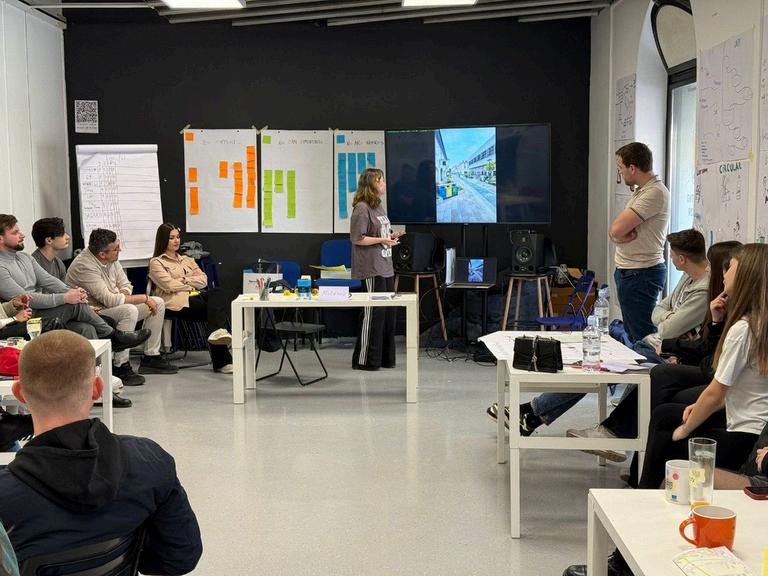
To encourage participants to see waste as a valuable resource and understand the concept of reuse through hands-on experience.The workshop aimed to promote creativity, teamwork, and sustainable thinking while highlighting how everyday materials can gain new purpose instead of being discarded.
The workshop began with an interactive warm-up where participants explored whether waste is truly waste by brainstorming new uses for common discarded items This was followed by a short discussion on the difference between recycling and reuse, supported by simple, real-life examples. Participants then reflected on what makes a good reuse product, identifying key criteria such as usefulness, simplicity, and problem-solving value.
In the main part of the workshop, participants worked in small teams to design and create a product or prototype using mostly reused materials. Each team was given a specific challenge—to create something useful, something aesthetic, or a solution to a daily problem Participants took on different roles within their teams to ensure active involvement and collaboration. After completing their creations, teams prepared short presentations explaining the transformation process, purpose, and value of their product.The workshop concluded with presentations and a reflection session focused on how reuse can be applied in everyday life.
Participants developed practical skills in reusing materials and gained a deeper understanding of sustainable resource use.The activity strengthened creativity, teamwork, and problem-solving abilities while encouraging participants to rethink waste as a potential resource. It also inspired them to apply reuse practices in their daily lives and become more conscious of their consumption habits.