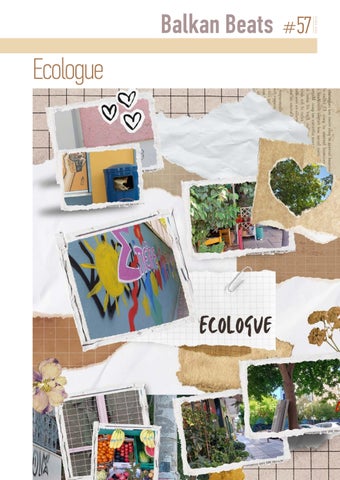
Ecologue
FREE PRESS
Balkan Beats #57
Ecologue
Dear reader, While working on this magazine, I realized a lot about how we look at ecology and our planet. Our whole editorial team took part as a volunteers in an environmental festival that takes place in Thessaloniki every September. It was very hard but we all enjoyed it a lot. The people who organize it do everything voluntarily. They want to raise awareness, support sustainable artists, and make the city and our planet a more bearable place to live. I often feel like a terrible pessimist when it comes to the environment, but working on this issue and volunteering at this festival gave me at least a bit of optimism. Read it too, maybe you will like this issue as well. The Editorial Team Tania Tarasova
Tania Tarasova
E D I T O R I A L
issue 57
02
PERSONAL NARRATIVE
From Awareness to Action
Journeys: Our Impact on Earth
04
26
06
28
08
MIX FIX
Celebrities and the Environment What I Bought on Shein for $50 Artificial Intelligence and Sustainability
An eye on Corfu Living Plastic-Free for 24 Hours
12
Snapshots of a living earth
16
30
18
35
Slow Culture Project Pan Female Sustainability
In search of a toothbrush
A photo story on Fast fashion
LOCAL LIFE Where Heritage, Environment & Daily Life Meet
20
From Concrete to Faith
23
Islahhane of Thessaloniki
Funded by the European Union. Views and opinions expressed are however those of the author(s) only and do not necessarily reflect those of the European Union or the European Education and Culture Executive Agency (EACEA). Neither the European Union nor EACEA can be held responsible for them.
03
C O N T E N T S
OPENING ACT
Opening Act From Awareness to Action
CELEBRITIES AND THE ENVIRONMENT Protection or Exploitation? by Anna Mykhalchenko
Recently, the trend of leading a healthy and environmentally conscious lifestyle has become increasingly popular. This is partly due to famous people who showcase their “right” side of caring for the environment on social media or at public events. It is a good way to build a clean reputation or to restore it if something went wrong in the past. After all, your reputation will be associated with something good. This works well as a promotional strategy. The idea of ecology is supported by people because this issue is urgent. Eco-activists organize rallies and protests on their own, they fight for their beliefs. Many celebrities support these events. For example, famous couple Joaquin Phoenix and Rooney Mara took part in a demonstration in honor of National Animal Rights Day in 2019. They marched alongside other participants wearing T-shirts with the inscription “Our planet. Theirs, too.” In their hands, they held the bodies of dead animals. Apart from this event, the couple also supports ecology in other ways. Joaquin Phoenix, winner of an Academy Award and a Golden Globe, speaks at every appearance about the need to reconsider our attitude toward
04
the normalization of violence against animals. Phoenix is a vegan, meaning he has eliminated animal products from his diet. His Oscar acceptance speech made many people reflect, as he did not just describe the problem but also showed the life of an ordinary cow, her suffering caused by human desires: “We go into the natural world and we plunder it for its resources. We feel entitled to artificially inseminate a cow, and when she gives birth, we steal her baby even though her cries of anguish are unmistakable. And then we take her milk that’s intended for her calf and we put it in our coffee and our cereal…” In 2005, Phoenix also actively participated in the making of Earthlings, a documentary film about the exploitation of animals. For this project, he was awarded the Humanitarian Award in San Diego. He is also a member of In Defense of Animals and People for the Ethical Treatment of Animals (PETA). In 2020, Phoenix, together with the legendary Jane Fonda and 146 other activists, was arrested in Washington during a protest against climate change.
From Awareness to Action Opening Act
Through the example of Joaquin Phoenix and Rooney Mara, we can see true fighters for the environment или environmental causes, those who stay committed to their beliefs in every aspect of life. Always.
(WEF) in Davos, Switzerland. At that summit, he received the Crystal Award for his leadership in eco-activism. “We have only one planet. Humanity must take large-scale responsibility for the reckless destruction of our shared home. Protecting our future on this planet depends on the conscious evolution of our species,” DiCaprio said in his speech.
Leonardo DiCaprio is another world-famous actor who advocates for ecology. In 1998, he founded the Leonardo DiCaprio Foundation, and by 2019, the nonprofit organization had allocated more than 100 million dollars for environmental purposes: events, Later that year, at the Academy Awards, he public awareness campaigns, and climate delivered another brilliant speech: change advocacy. “Climate change is real. It is happening Before the Flood (2016) is a documentary right now. It is the most urgent threat where Leonardo DiCaprio served as produc- facing our entire species, and we need to er and main protagonist. He played himself – work together to stop it.” the newly appointed UN Messenger of Peace But where does the problem lie? Carbon emison Climate Change. The film follows his joursions from private jets differ, but according to ney from the wastelands of Greenland to the some data, they are more than 37 times highforests of Sumatra as he explores the impact er than those of commercial airplanes. For this of climate change on our planet. reason, many eco-activists, and not only they, That same year, when the film was released, have labelled him a hypocrite. the actor flew 12,000 kilometres on his priAnd here arises an important question: what vate jet from Cannes to New York to receive matters more – beautiful words or honan award for eco-activism. This was not the esty? In an era when millions chase attenonly case, in the same year, DiCaprio also took tion, the audiences are becoming increasingly a private flight to the World Economic Forum aware of the difference between sincerity and hypocrisy. Kylie Jenner, for example, does not make loud statements about climate change, yet she regularly travels by private jet and is openly criticized for it. And however it may look, her stance is more honest than the grand declarations of those who do the same but hide it behind the right words. In the end, it becomes clear: the true value does not lie in the applause of the crowd, but in honesty with yourself and with others.
05
Opening Act From Awareness to Action
WHAT I BOUGHT ON SHEIN FOR $50 The Real Price of Fast Fashion by Anna Mykhalchenko
“What I bought on Shein for $50” — this this is not without reason, several factors inheadline is all over TikTok. The popularity of fluence this success. online stores offering affordable products is growing at an exponential rate every day. And Price. It’s cheap. Jeans, a sweater, or a shirt can be bought for $10, accessories start at $1. During sales, you can get a full seasonal wardrobe for only $100. It really does sound cool. This is especially valuable for people who сannot afford to shop in well-known stores (Zara, Bershka, etc.). Speed. It’s fast. You don’t even need to leave your house to put together a full outfit. During COVID-19, online shopping became the only way to buy clothes. The same goes for Shein: you don’t need to spend hours walking through stores, choosing what to buy, and standing in lines. Assortment. The site offers a huge number of models, colors, and sizes. Therefore, everyone can find something that suits them. The history of the brand began in 2008: at first, it was a small wedding dress store, but later it grew into the largest online store of everything the mind can imagine. Today Shein accounts for 28% of the fast fashion industry in the USA alone.
06
From Awareness to Action Opening Act At first glance, it’s a perfect picture. Cheap, fast, convenient. But once you look deeper into the details, everything immediately falls apart. Shein is destructive for both people and the environment. In 2023, the company released 16.7 million tons of CO₂ into the atmosphere — more than the emissions from four coal-fired power plants. Moreover, in 2022, Greenpeace published a report: laboratory tests revealed that 15% of Shein products contained hazardous chemicals in concentrations above the EU safety limits. This threatens not only buyers but also workers across Shein’s supply chain.
of clothes out of boxes and emphasizing that they spent almost nothing on them. On TikTok, under the hashtag #shein, there are currently about 8.2 million posts — that’s more than the population of Bulgaria. And in fact, Shein spent absolutely nothing on such advertising. In stores like Shein, clothes cost next to nothing for the buyer. But their real price is workers’ health, environmental destruction, and toxic traces on every piece.
But this is not the only problem. Shein claims it always practices fair labor, but numerous investigations cast doubt on this. Every day, Shein adds between 2000 and 10000 new items. From November 2022 to November 2023, Shein introduced 1.5 million new products, which exceeded Zara’s and H&M’s numbers by 37 and 65 times, respectively. It sounds unthinkable. Journalists uncovered the harsh working conditions of employees at the Chinese brand Shein, which contradict the country’s labor laws. The inews published the investigation and corresponding material. The editors of the publication, together with Channel 4, conducted an investigation in which a journalist went undercover and got a job as a seamstress at Shein. They revealed that workers are forced to work 17 hours a day, earning only 0.27 yuan (€0.032) for each item they sew. In case of mistakes, there are fines of up to two-thirds of their daily wage. It also became known that some women are forced to take showers during what should have been their lunch break. The popularity of Shein is also strongly influenced by social networks. Famous bloggers film reviews of their purchases, pulling piles
07
Opening Act From Awareness to Action
ARTIFICIAL INTELLIGENCE AND SUSTAINABILITY Digital Assistants in the Climate Fight by Helin Turan
The complex relationship between artificial intelligence, energy consumption, environmental protection, and climate action
help solve environmental problems, they also create new challenges for sustainability. This raises an important question: are AI systems helping or harming our planet?
In recent years, artificial intelligence has become part of our daily lives through smart home devices, mobile apps, and digital assistants. While these technologies promise to
The answer is not straightforward. As millions of people install smart thermostats, voice assistants, and automated lighting systems, we see both remarkable energy sav-
08
From Awareness to Action Opening Act
ings and worrying increases in the demand for digital infrastructure. This contradiction forces us to examine whether our pursuit of smarter technology is truly making the world more sustainable. Smart homes and energy efficiency Digital assistants like Alexa, Google Assistant, and Siri are changing how we manage energy in our homes. These systems can automatically adjust heating and cooling, turn off lights when rooms are empty, and optimize electricity usage during peak hours. “Smart technology can reduce household energy consumption by up to 23 percent,” according to recent studies by the International Energy Agency.
Every voice command, every automated adjustment, and every learning algorithm requires data processing that happens in distant server farms. The hidden energy costs Data centers that power AI services consume massive amounts of electricity. Google’s data centers alone used approximately 15.3 terawatt-hours of energy in 2022, which equals the annual electricity consumption of entire countries like Denmark. Training a single large AI model can produce as much carbon dioxide as five cars over their entire lifetimes. The numbers become even more striking when we consider the rapid growth of AI usage. ChatGPT processes millions of queries daily, each requiring significant computational resources. When you ask your smart speaker about tomorrow’s weather or request a recipe, that simple interaction involves multiple data centers processing your voice, understanding your request, accessing information, and sending a response back to your device.
Sarah Chen, a software engineer from California, installed smart devices throughout her apartment last year. She noticed her electricity bill dropped by nearly 30 percent within six months. “My Google Assistant learns my daily routine and adjusts everything automatically,” she explains. “I don’t even think about turning off lights anymore. It knows when I’m sleeping, Microsoft recently announced plans to build working, or away from home.” new data centers to support their AI serThe technology goes beyond simple automa- vices, but critics argue this expansion contration. Modern AI systems analyze weather fore- dicts their climate commitments. The compacasts to pre-cool or pre-heat homes, learn from ny promises to use renewable energy, yet the user behavior patterns, and even coordinate sheer scale of power needed raises concerns with electricity grids to use power when renew- about whether clean energy sources can keep able sources are most available. In Texas, some up with demand. Their new facilities will resmart home systems automatically shift ener- quire as much electricity as small cities. gy usage to times when wind power is abunMeanwhile, Amazon continues promoting dant, reducing reliance on fossil fuel plants. Alexa devices while simultaneously expandHowever, the picture is more complicated ing their cloud computing infrastructure. than it first appears. These AI systems require This creates a paradox: the same company constant internet connections and cloud com- selling energy-saving smart home technolputing power, which means they consume en- ogy is also building facilities that consume ergy even when not actively helping users. enormous amounts of power. Amazon Web
09
Opening Act From Awareness to Action
Services now operates data centers on ev- climate change scenarios. These insights help ery continent, with plans for further expan- governments and organizations make better sion to meet growing AI demands. decisions about renewable energy deployment and disaster preparedness. The environmental cost extends beyond electricity consumption. Data centers require mas- In agriculture, AI-powered systems help farmsive cooling systems to prevent overheating, ers optimize water usage, reduce pesticide often using millions of gallons of water daily. In applications, and increase crop yields. John areas experiencing drought, this water usage Martinez, a farmer in Iowa, uses drone techbecomes particularly problematic. Some facil- nology and AI analysis to monitor his corn and ities in Arizona and Nevada face criticism for soybean fields. “The system tells me exacttheir water consumption while local communi- ly where my crops need water or nutrients,” he says. “I’ve reduced my water ties implement conservation measures. usage by 40 percent while actually inGlobal applications and environmental creasing my harvest.” benefits Transportation represents another area where Despite these concerns, AI technology does AI contributes to sustainability. Smart traffic offer genuine environmental benefits in many management systems reduce fuel consumpapplications. Climate scientists use machine tion by optimizing traffic flow and reducing idle learning to analyze satellite data, predict time at intersections. Electric vehicle charging weather patterns more accurately, and model networks use AI to balance demand across
10
From Awareness to Action Opening Act
the grid and encourage charging when renew- sustainability. She warns: “We cannot igable energy is most available. nore the environmental footprint of our digital solutions. Every smart device, evPredictive maintenance powered by AI helps ery cloud service, every AI query has real industrial facilities operate more efficiently environmental consequences that we’re and reduce waste. Manufacturing companies only beginning to understand.” use sensors and machine learning to identify equipment problems before they cause fail- Her research suggests that while individual AI ures, reducing both energy consumption and applications may be efficient, the cumulative material waste. effect of billions of devices and countless daily interactions creates unprecedented demand Are we solving problems or creating for digital infrastructure. The problem resemnew ones? bles the rebound effect in energy efficiency: as technology becomes more efficient, people The environmental impact of AI technology tend to use more of it, potentially negating the extends beyond energy consumption. Maninitial gains. ufacturing smart devices requires rare earth minerals, often extracted through environ- The future of AI and sustainability depends mentally damaging mining processes. Cobalt on honest conversations about trade-offs. We mining in the Democratic Republic of Congo, need technology that genuinely reduces enlithium extraction in Chile, and rare earth min- vironmental impact rather than simply shifting in China all involve significant environmen- ing problems from one area to another. Only tal and social costs. through transparent assessment of both benefits and costs can we build a truly sustainable Additionally, these gadgets typically have digital future. short lifespans before becoming electronic waste. The average smart home device is This requires collaboration between technoloreplaced every three to five years, compared gy companies, environmental scientists, polito traditional appliances that might last de- cymakers, and consumers. We must demand cades. This cycle of constant upgrading cre- better from the companies creating these ates mounting electronic waste problems. technologies while also making responsible choices about how we use them. The climate Tech companies frequently highlight success crisis demands that we evaluate every solustories about AI helping with climate research, tion not just for its immediate benefits, but for predicting weather patterns, and optimizing its long-term environmental consequences. transportation systems. These applications genuinely contribute to environmental protection. Ultimately, artificial intelligence and digital asHowever, the total environmental cost of AI in- sistants are tools that can either accelerate frastructure might outweigh these benefits. or hinder progress toward sustainability. The choice depends on how thoughtfully we develDr. Maria Rodriguez, an environmental sciop, deploy, and use these technologies. Makentist at the University of Barcelona, studing the right choice requires understanding ies the relationship between technology and both their potential and their limitations.
11
Opening Act From Awareness to Action
SLOW CULTURE Can Art Teach Us to Live in an Eco Rhythm? by Ida Miller
Cigarette Labyrinth: The Smoke That Clouds Our Future
Eco rhythm – what does it mean to live in a rhythm of nature?
When we talk about eco rhythm, we are speaking about something simple yet increasingly rare: living in tune with the natural cycles that surround us. The rhythm of nature is slow, circular, and patient. Days fade into nights, seasons return each year, growth is followed by rest. For most of human history, life was inseparable from these patterns. Farming schedules, harvest festivals, and rituals tied to the solstices all followed the pace of the land and And yet, a quiet counter-current exists. Slow its changing seasons. culture suggests another way: slowing down, lingering, allowing ourselves to be absorbed Today, by contrast, our daily rhythm is instead of rushing past. It values depth over defined by screens, deadlines and 24/7 availability. The digital world ignores sunset quantity, presence over constant motion. and sunrise, while global logistics make strawWhat if art was not just entertainment but berries and avocados available in any season. something closer to a companion? Not by This constant pace creates an illusion that time telling us what to do, but showing us a differ- can be bent to our demands, but the cost is disent pace, through the stillness of a painting, connection, from the earth and ourselves. the echo of a melody, the patience of making something by hand. At a time when worries To live in an eco rhythm does not mean giving about the climate are part of everyday life, this up on modern life, but remembering its roots. way of engaging with art feels deeply timely. It’s about noticing the return of spring, eatCould it help us return to the natural pulse of ing with the seasons, or simply allowing space for slowness in our daily routines. Art can be a life – to what we may call an eco rhythm? bridge here: a reminder that beauty, like nature, often reveals itself to those who give it time. The world keeps spinning faster and faster. We scroll, we stream, we consume – always moving on to the next distraction before truly inhabiting the moment. Culture, too, has become fast: playlists built by algorithms changing the songs everyday, art exhibitions visited in a rush with a photo taken of every single piece, films paused and forgotten halfway through.
12
From Awareness to Action Opening Act
History of art as a record of ecological Later, in many cultures, artistic traditions rhythm grew directly out of the environment. Folk crafts used natural materials and dyes, creatArt has always been a way of noticing and ing patterns inspired by plants, animals and recording the rhythms of nature. The ear- the turning of the year. A handwoven fabric liest cave paintings, with their animals or painted pot was not just functional: it carand hunting scenes, were more than dec- ried within it the patience of seasonal labor oration; they were attempts to capture and the beauty of local landscapes. the cycles of survival and the relationship between humans and the land. Each In European art, the landscape emerged as a image echoed a dependence on seasons, genre in itself, especially during Romanticism, when artists sought to express the sublime migrations and weather.
13
Opening Act From Awareness to Action
power of nature. The impressionists, painting outdoors, captured fleeting light and weather conditions which reminded viewers of the ever-changing rhythm of the natural world. Even in music, this theme reoccurs: Vivaldi’s “Four Seasons” translated the cycle of the year into sound, while later composers and minimalist musicians explored repetition and natural tempo.
These practices share a common thread: they seek to realign cycle culture with more sustainable rhythms. In doing so they remind us that slowness is not a luxury, but a necessity – an ecological act in itself.
Land art of the 20th century, works shaped from earth, stone and plants – brought the focus back to nature as both material and subject. These works could not exist outside the elements: they eroded, decayed, or changed with time. In this way, art became not only a reflection of ecological rhythm, but a participant in it.
One of the most valuable things art can offer is the practice of slowing down. Standing in front of a painting requires patience: colors reveal themselves gradually, hidden details appear only when the viewer allows their gaze to linger. In an era of quick scrolling, this act of simply looking becomes almost radical.
Slow culture as a contemporary response to ecological crisis If the industrial era gave us speed, the digital era turned speed into overdrive. Content multiplies endlessly: new shows released every week, new trends appearing overnight, new images replacing last with a single swipe. This logic of fast culture mirrors the same mechanisms that drive overproduction in fashion or food. The result is exhaustion, not only of people’s attention, but of the planet’s resources.
How art teaches us attentiveness and rhythm
Music works in a similar way. A melody that repeats or develops slowly does not ask us to rush; it asks us to listen. Minimalist composers, for example, often build entire pieces from subtle changes that only become meaningful when experienced over time. In this way, music can teach us to notice not just the climax, but the spaces in between.
Contemporary art also explores rhythm through process rather than product. Land art – temporary works made from leaves, stones, or ice reminds us that nothing is permanent. These works shift with the weather, decay with the seaSlow culture offers an alternative. It is not sons, and disappear altogether. To engage with about rejecting technology, but about re- them is to accept impermanence, a rhythm far sisting its pressure to consume at the closer to nature than to mass production. fastest possible pace. It asks us to stay with a work of art instead of rushing through it, to Even everyday creative practices can open value depth rather than volume. In cinema, this space: sketching, writing by hand, workthis approach has given rise to “slow cinema” ing with clay, or photographing on film. Each - films that dwell on silence, long takes, and requires patience and focus, rewarding attenthe passing of time. In fashion, this movement tion rather than speed. appears as “slow fashion”: small collections, Through these experiences, art does not give handmade pieces, or second-hand clothing. us rules but rhythms. It invites us to practice Even in local festivals or community art projattentiveness, to embrace repetition, and to ects, the emphasis is placed on participation accept time as something lived rather than and presence rather than spectacle.
14
From Awareness to Action Opening Act
managed. In doing so, it quietly realigns us ucation helps cultivate the habits of slow culture, and, in turn, a deeper sensitivity to living with the eco rhythm we so often forget. in eco rhythm. Educational dimension of slow culture Challenges and criticism Education plays a key role in shaping how we relate to both art and the environment. Muse- While the idea of slow culture is appealing, it ums and cultural institutions are increasingly also faces challenges. One critique is accessiexperimenting with programs that encourage bility: taking time for art, cooking seasonally, slower engagement: guided walks through or choosing handmade objects often requires exhibitions, hands-on workshops with natu- privilege - extra money, flexible schedules, and ral materials, or community projects that em- cultural capital. Another issue is commercialphasize process over product. In schools, art ization. Terms like “slow” or “eco” are easily education can nurture the ability to observe, turned into marketing buzzwords, stripped of reflect, and connect everyday life with larger their deeper meaning. There is also the risk of ecological cycles. By treating creativity not as idealization: slowing down can inspire, but witha competition but as a form of attention, ed- out systemic change it remains symbolic. For slow culture to matter, it must move beyond lifestyle aesthetics and become a genuine shift in how we create, consume, and connect. Conclusion – art as a guide to an ecological future Art alone cannot solve the climate crisis, but it can shape how we imagine and inhabit the world. By slowing us down, it offers a space to practice attentiveness, patience, and care: qualities that echo the cycles of nature itself. Slow culture reminds us that slowness is not about nostalgia or resistance for its own sake, but about finding rhythms that sustain rather than exhaust. When we give time to a painting, a melody, or a handmade object, we rehearse a different way of living – one less focused on speed and more attuned to continuity and renewal. In this sense, art becomes not a luxury, but a compass. It can guide us back toward an eco rhythm, where human creativity and natural cycles are no longer in conflict, but in dialogue. And perhaps that dialogue is where true sustainability begins.
15
Opening Act From Awareness to Action
PROJECT PAN A Minimalist Rebellion Against Overconsumption by Irmak Turkekole
In recent years, rising global awareness of environmental issues and plastic pollution has sparked a renewed interest in Project Pan. New generations of creators and consumers embrace the movement not only for personal savings but also to reduce plastic waste and packaging left in nature. After all, the production of each cosmetic product involves significant water, energy, and raw material consumption, and every wasted product enlarges our ecological footprint. Therefore, Project Pan is far more than a consumption habit; it stands as a broader ecological responsibility and a commitment Project Pan began as a minimalist and ecologi- to sustainability. Over time, it has transcendcal movement aimed at using makeup and cos- ed cosmetics to symbolize a more mindful, metic products to the very end, pushing back eco-friendly, and minimalist lifestyle. against overconsumption and wastefulness. It first gained traction in digital communities on Plastic is the unseen mask of the beauty indusplatforms like YouTube, Instagram, and Red- try: bottles, tubes, caps, packaging, mostly dedit, especially among beauty enthusiasts. The signed for single use and destined for landfills movement encourages resisting the cycle of or oceans. Project Pan quietly rejects this mask constant buying and instead promotes finish- by refusing to succumb to the endless cycle of ing what you already own, fostering conscious disposal. Sustainability is not just about recyand sustainable consumption. Influential You- cling used products; it begins with not using Tubers such as Grav3yardgirl (Bunny), Michelle what is unnecessary in the first place. Using a Phan, and Tati Westbrook played critical roles in product down to its very last drop honors the water, energy, labor, and materials invested in spreading the movement’s message. its creation. That lipstick or eyeshadow is no When a cosmetic product is replaced before it is fully used up, it is not just a new purchase; it also adds another burden to the environment. Glossy packaging, glass or plastic bottles, inner linings, applicators — each is often single-use and lingers as waste for years. This is where the deeper meaning of Project Pan emerges: every finished product is not only a sign of personal discipline but also a testament of respect for nature. An abandoned product becomes waste, while a product used to the very last drop leaves behind a lighter environmental footprint.
16
From Awareness to Action Opening Act
longer just a cosmetic item but an ecological individual choices to the global materials statement. Every mindful consumption choice economy. Even small reductions in consumpis a silent pact with the planet. tion ripple outward, nudging supply toward sustainability. Ultimately, every empty or “finProject Pan also critiques the endless produc- ished” product leaves behind a sense of lighttion mindset. Less production, less waste, ness: on your vanity, in your mind, and in the more intention: this chain stretches from world we share.
17
Opening Act From Awareness to Action
FEMALE SUSTAINABILITY Menstruation can be sustainable too. by Xanthippi Giotopoulou
Period is a body function that most female entities are accustomed to. It comes once a month, in the form of a ‘red army’, as it is called in some languages, because it is a red mess which can leak and stain clothes and underwear. To avoid unwanted leaking and staining, women use products designed to absorb blood, such as sanitary pads and tampons, known as menstrual products. However, most of us are unaware of the materials they are made of and how they impact the environment. The Evolution—and Consequences—of Period Product Menstrual products were, from the very beginning, made from natural materials such as papyrus, lint, wool, flannel, woven fabric, animal hides, and moss, most of which were washable and reusable. However, it all changed in the 20th century, when new technologies and scientific progress emerged. In 1969, adhesive disposable menstrual products made their debut, replacing the cotton pads worn with a menstrual belt. Although tampons were first introduced in the 1930s, they gained popularity in the U.S. in the 1980s and in Europe in the 2000s. At the time, it was pioneering and an adaptation to the new, easier lifestyle of ‘throw-away’. In reality, those products are designed for single use and disposal, and as the Earth’s population grows, so does the need for menstrual products.
cycled in any way. They are primarily made of non-recyclable and non-biodegradable materials, which are known to be harmful to the environment. The culture of using single-use products, especially plastic ones, is a significant contributor to environmental impact on the planet, and menstrual products are not an exception. In Europe alone, 49 billion single-use products are used every year, while in the US, the number reaches 20 billion discarded products, resulting in 240,000 tons of solid waste. Moreover, single-use plastic products “globally contribute an estimated 245,000 tonnes of carbon dioxide annually”, according to the World Health Organisation, and regarding menstrual products, they are more likely to release toxic chemicals that can be absorbed by the users’ bodies, the plants and the animals, causing harm, health issues and deregulations. Addressing the ‘ugly’ side of single-use products is to raise awareness about the environmental impact. Should we go back to the old ways, even after being told that single-use products are more hygienic than reusable ones?
Eco-friendly menstrual products are more than just an alternative to the single-use ones, with more and more women around the globe turning again to reusable menstrual products, which are gaining popularity due to their sustainability and affordability in the long run. However, there are challenges for vulnerable Nevertheless, we should ask ourselves where populations, especially when there is a lack of all these products end up. They are treated clean water and proper sanitation. like common garbage as they cannot be re-
18
From Awareness to Action Opening Act Another environmental option is period underwear and swimwear. Like the cotton pads, The first one is a more sustainable varia- they are made from cloth and fabric that abtion of the classic cotton pad. Reusable pads sorb blood, without the plastic and chemicals made out of cloth offer the same comfort and of a regular pad. absorption as regular ones without the toxic chemicals and plastic. Cloth pads are made In conclusion, while menstruation may be a norof natural materials, without synthetics, per- mal function of the human organism, disposable fumes and plastic, making them ideal for an menstrual products are made of plastic, contribitch and irritation-free period, especially for uting to the pollution of the environment. The waste they produce is hazardous and a danger people who have allergies. to both humans and the environment. A period cup and a period disc are the eco-friendly and non-toxic alternatives to To reduce the amount of waste, there are altampons, since they do not absorb blood, ternatives made of eco-friendly and hypobut they collect it. Unlike tampons, menstrual allergenic materials, like the menstrual cup discs and cups are not linked 100% to Toxic and the cotton pads. In the long term, these Shock Syndrome. On the environmental side, products end up on the good side of both the the disc and cup are made of medical-grade planet and the human organism. silicon, rubber, or latex, meaning they are free In order for people to change their habits, of toxic chemicals that can cause pollution. awareness must be raised. But what are those products?
19
Local Life Where Heritage, Environment & Daily Life Meet
FROM CONCRETE TO FAITH Voices from Thessaloniki on trash, air, and hope for a greener city by Berke Acıcı
A few weeks ago, at the Greenwave Festival, I asked visitors and volunteers about Thessaloniki’s environmental problems. When I first arrived, I thought I would only encounter concerts, workshops, and colorful stands. But the festival actually gave me a much deeper perspective on the city. My aim was to learn more about the city’s problems and to hear what local people thought about them. Everyone had their own priorities, but the overall picture was the same. Although the answers seemed different from each other, they actually had a lot in common: the need for Thessaloniki to become a cleaner, greener, and more conscious city. Trash and More Trash (It’s Everywhere) When I asked about the biggest issue, almost everyone’s first thought was the trash in the streets and in the sea. Some said, “You see cigarette butts at every step,” while others added, “The sea smells, and that’s enough.” Trash doesn’t just create an unpleasant view; it also reveals people’s indifference toward the city. “Maybe people do not care about the place they live in.” This comment was harsh, but was it untrue? I also found it to be very real;
20
it’s impossible not to notice discarded plastics or overflowing bins while walking around. People’s lack of responsibility toward the city they live in feels like a deeper issue than the visible trash itself. Still, during the festival, we volunteers tried to collect litter, and we were not alone. This reminded me that even if it doesn’t create massive change on its own, small efforts can accumulate and become visible. What’s in the Air? There were also many complaints about Thessaloniki’s air. In particular, the pollution caused by old cars was mentioned several times. Some even claimed it was worse than Athens. For me, the most striking point was that people didn’t see this only as a technical issue, but also as an economic one. Since many cannot afford new cars, they are forced to tolerate polluted air. In reality, pollution from old vehicles could partly be solved by switching to newer models but who will pay the price? Thinking about these comments while breathing the city’s air made me reflect: isn’t wanting better air a basic right? As one person put it, “If public transport gets better, maybe people will leave their cars at home.” And
Where Heritage, Environment & Daily Life Meet Local Life
that’s true. Buying new cars may be expen- to clean the shore explained how it had turned sive, but strengthening public transport could into a never-ending cycle. help the city breathe again. I also noticed this smell while walking along Green Spaces and Beautiful Parks the coast, and it surprised me that a seaside city like Thessaloniki felt so detached from One of the most frequently repeated ideas in its sea. Sitting by the sea is supposed to be the interviews was the longing for a large, us- a pleasure… able park. Two people said directly that the international fair venue should be turned into Still, while speaking of broken hopes, the word one. Hearing this idea several times wasn’t re- hope appeared again: ally surprising to me either. Another participant stressed that abandoned buildings and empty “People can fix it if they really try. If we slowly try and clean one by one, with the contribution lots could be converted into green areas. of everyone, I think it can happen.” We were also reminded that the city isn’t just for us; special parks for dogs or small green spots After hearing this, I thought, why not? The sea near apartment buildings may be small, but may be problematic right now, but people’s they are truly necessary. Personally, as I walked faith in change is still alive. through the concrete streets of Thessaloniki, I What if you were the change itself? also wanted to see more trees and parks. I really liked how the seaside has been integrated into When I asked people what they would change people’s social life, but why not have big, central first if they had the power, their answers green parks too? Spaces that break up the city’s showed a lot about the city’s priorities. “To concrete density are badly needed. make the city more green, actually,” one perStill, I must admit: compared to many other places, Thessaloniki can still be considered relatively green. As one participant said, “The seafront of Thessaloniki, if used properly, can actually be like the lungs of the city.”. Polluted Sea, Broken Hopes The words used to describe the gulf were harsh: “awful,” “never ending,” “concerning”… People talked about the bad smell when they approached the sea. One participant who tried
son said without hesitation. Others focused on the everyday reality: “Trash,” or “Maybe the garbage that people throw on the streets.” A few brought up the sea, which, as we all know, desperately needs attention. For me, these answers highlight something deeper, the fact that small changes could already create a huge impact. Imagine a Thessaloniki with more trees, less litter on the streets, and a cleaner coastline. It might sound idealistic, but it’s also very realistic if collective action takes place. I personally believe that the first step should be tackling waste and littering,
21
Local Life Where Heritage, Environment & Daily Life Meet
because it’s a problem visible to everyone every single day. Once that is addressed, greening projects and sea protection would have a stronger foundation. So, let’s start with small problems, gradually increase our goals, and eventually become the change itself. What About the Youth? Despite the problems, one thing was very encouraging: the role of young people. These days, there seems to be a lot of criticism directed at the youth. But one of the people I interviewed told me something I strongly agreed with:
ple come together for the environment gave me optimism for the future. The most valuable thing these interviews gave me was the realization that by simply talking about problems, they become more visible, and therefore more solvable. Talking is already a beginning. Thessaloniki may be covered with concrete, but its people still hold faith in a greener and cleaner future. Maybe the next step will be turning these conversations into small actions. Maybe change begins with a simple dialogue, who knows?
What I see is this: the future of Thessaloniki does not lie in despair, but in the union “Although some people say youth is careless, I of these small, hopeful efforts think that young people know very well what’s going on in this city… They work with solidarity and it’s a big mistake to believe that young people don’t care.” Hearing this felt very real. Participants also emphasized that young people should take the lead in volunteering, recycling, cleanup campaigns, and raising awareness. At the end of a long day, one sentence stayed in my mind: “As a part of the young people, we are the change.” As a young volunteer myself, being in this atmosphere made me feel more hopeful. If young people raise their voices, small steps can turn into big changes. Final Thoughts What local people told me made me realize this: Thessaloniki’s environmental problems are not only technical, but also deeply social. Trash, air, sea, green spaces… these all matter, but the most critical issue is the sense of responsibility people feel toward their city. Yes, the problems exist but the festival itself was proof of hope. Seeing hundreds of peo-
22
Where Heritage, Environment & Daily Life Meet Local Life
ISLAHHANE OF THESSALONIKI A Witness to History by Büşra Cansel Dalkılıç
The Hamidiye-Islahane Cultural Venue
Ottoman Origins: A Reform Institution The word “Islahane” in Ottoman Turkish comes from islah, meaning “reform” or “improvement”. During the nineteenth century, the Ottoman authorities and local communities established institutions that combined care for orphans with vocational training. In Thessaloniki the Muslim community founded an Islahane orphanage and vocational school around 1874. Later, in 1903, a new complex was constructed under Sultan Ab-
The Hamidiye-Islahane Cultural Venue is a unique building in the Islahane district of Thessaloniki, Greece. Today it serves as a cultural space for art, education and community events. Yet its story began in the late Ottoman period, when it was founded as a center for social reform and education. This article presents the history of the Islahane: its origins as a reform institution, its survival through fire and urban change, and its transformation into a modern cultural center. The story of this building reflects Thessaloniki’s multicultural past and its effort to link history with the present.
23
Local Life Where Heritage, Environment & Daily Life Meet
dulhamid II, known as the Hamidiye School of Arts and Crafts. Its purpose was to provide disadvantaged children with both moral education and technical skills such as woodworking, tailoring and metalwork.
In 1917 the Great Fire devastated much of Thessaloniki and destroyed many Ottoman monuments. Remarkably, part of the Islahane complex survived. From the 1920s the premises were rented out to private individuals, hosting workshops and industrial activities such as At the time, Thessaloniki was a cosmopolitan the Axylithiotis Engineering Workshop. city where people with different religious and others lived together. The Islahane was one of Of the original complex, only one building the first institutions of its kind in the city, of- has survived to the present day. It remains fering orphans a chance to work and live in- a rare witness to the Ottoman presence in dependently. The complex originally consist- this part of the city. ed of three buildings, two inside the city walls Restoration and Cultural Rebirth and one outside. After 1912: Change and Survival
When Thessaloniki became part of Greece in 1912, many Ottoman institutions were closed or repurposed. The Islahane lost its original role and the surviving buildings were taken over by the Greek state.
24
Where Heritage, Environment & Daily Life Meet Local Life
By the late twentieth century the building was in poor condition, yet historians and cultural organizations recognized its historical value. In 1992 it was declared a protected monument by the Hellenic Ministry of Culture, including the original machinery that had remained on site. A major restoration and reuse project was later approved under the NSRF Macedonia– Thrace Programme 2007–2013 and completed in 2015. The work preserved architectural elements such as stone masonry, arched windows and wooden ceilings, while introducing modern systems for safety and comfort.
A Symbol of Shared History The Hamidiye-Islahane is more than a building. It symbolizes Thessaloniki’s multicultural identity. As historian Mark Mazower said, “Thessaloniki was once a city where cultures met, not fought.” The Islahane reminds us of that spirit of coexistence. It connects the Ottoman past with modern Greek society, offering a space where people of different backgrounds can come together. It reflects continuity, inclusiveness and cultural diversity.
From a nineteenth-century reform school to The Center Today: Culture, Art and Memory a twenty-first-century cultural venue, the Hamidiye-Islahane shows how buildings can carSince its reopening the former Islahane has ry memory and identity across generations. functioned as a cultural venue that hosts: Preserving such places is important not only for national history but also for global cultural • art exhibitions heritage. The Islahane demonstrates that history lives not only in books but also in archi• heater performances tecture, streets and shared experiences. • music concerts • workshops and educational programs • youth and community events It supports local artists and provides opportunities for learning about Thessaloniki’s past and present. In this way the building continues its original mission of supporting young peo- The center is located at El. Zografou 3 Str., ple and their development, but now through Thessaloniki 546 34, Greece (Address) art and culture instead of technical training.
25
Personal Narrative Journeys: Our Impact on Earth
AN EYE ON CORFU Beauty , history and the cost of tourism by Adeline Schillinger
During my volunteer program, I had the op- A little history… portunity to spend a few days in Corfu, a beautiful and renowned small island located For the record, Corfu was ceded to the Republic of Venice, part of what is now modern Italy, in the Ionian Sea. for about 400 years. Traces of this influence are still visible today in its many colourful, narrow streets. The name ‘Corfu’ also reflects this historical period. After being returned to Greece in 1864, the island now combines its rich past with modernity, attracting visitors from all over the world. Unfortunately, mass tourism is not conducive to ecological sustainability in Corfu. The island, nicknamed the ‘green island’ of Greece, is covered with lush vegetation, thanks in particular to its vast olive groves and abundant rainfall. Challenge in Corfu One of Corfu’s main challenges is waste management. The island has long suffered from a lack of effective waste treatment solutions, leading to illegal dumping and the waste build-up. Although recycling efforts have been put in place, waste management remains a major problem. This can be seen when visiting the islands of Paxos and Antipaxos (which I highly recommend), where you can unfortunately see plastic waste in the sea. The enormous influx of tourists during peak season puts significant pressure on the island’s infrastructure. This results in excessive water consumption, increased waste production, and water pollution. Wastewater, which
26
Journeys: Our Impact on Earth Personal Narrative is poorly treated in some areas, is sometimes many species of migratory birds, including discharged into the sea, threatening marine flamingos, and turtles. ecosystems. Not to mention the large number The island has sustainable agriculture, particularly in olive cultivation, which is moving towards organic practices. Eco-friendly farms are being developed, producing olive oil, honey and other local products using sustainable methods. Finally, public authorities, some hotels and certain tourism companies are committing to more environmentally friendly practices: reducing their water and energy consumption and sourcing from local producers. For example, I stayed in a hostel and it was a great experience, especially meeting people from different backgrounds who share the same ecological values (but be warned, there are only three on the island!). Have fun! I highly recommend this island, it is beautiful and full of charm. Just remember to travel as sustainably as possible!
of aeroplanes... Personally, I travelled by bus from Thessaloniki and then by boat, and it was a great experience! The uncontrolled development of new buildings for luxury tourism and second homes is encroaching on natural habitats. This destroys green spaces and contributes to soil erosion and biodiversity loss. A protected Area Despite this, Corfu has diverse ecosystems and protected areas. For example, Lake Korission, a coastal lagoon, is a refuge for
27
Personal Narrative Journeys: Our Impact on Earth
LIVING PLASTIC-FREE FOR 24 HOURS What I Learned by Fernaldo Xhaholli
For days, I had been thinking about putting myself to the test, something that would challenge not only my endurance but also my daily routine. I wanted something to shake me up a bit, to throw me out of the habits I took for granted. Then, one Friday night, an idea came to me: “What if I spent a whole day without using any plastic?” At first, it seemed easy, almost cute. I thought I would just avoid plastic bags and straws. How hard could it be? The truth turned out to be much more complicated.
change, I returned home ready to continue my morning routine. Only another “plastic surprise” awaited me: toothpaste. I had never thought about the fact that it comes in a plastic tube. So, I made another short trip to the pharmacy two blocks away, where I found one in metal packaging. I also bought a bar of soap to avoid liquid soap, which also comes in a plastic bottle. Within an hour, I had already learned something: plastic is not just part of our lives. It is literally everywhere. And the hardest part was not avoiding it but recognizing it. It is so ingrained in our habits and environment that we often don’t even see it.
Saturday started early. The alarm clock rang and I automatically reached out to turn it off. As soon as I touched it, I realized that the phone case was plastic. Oh well, I took it off and moved on. But at that moment, I felt like a game of chase with the plastic had begun. My I ate breakfast, simple, without packaging, and mind began to see it differently, more obser- started looking around: the kettle, the Tupperware in the fridge, the chairs, the jam spoon. vantly, almost obsessively. Plastic. It was a constant reminder of how I went to the bathroom to brush my teeth, but deeply we have become dependent on a mathe toothbrush, of course, was also plastic. I terial that was created to make our lives easilaughed at myself but decided to take it se- er, but ended up overwhelming us. riously, got dressed, and went down to the neighborhood market to buy a bamboo tooth- I didn’t wash the dishes. I don’t know if I used it brush. Excited that I had already made a small as an excuse, but I didn’t want to use detergent
28
Journeys: Our Impact on Earth Personal Narrative
that came in a plastic bottle. I hadn’t thought to buy dish soap in alternative packaging. That was a lesson learned. The paradox was that, as the day went by, I didn’t feel like I was sacrificing anything. On the contrary, I felt like I was discovering not only materials or solutions, but also the way I live. I took my dog for a walk and took my water bottle with me. Drinking coffee outside without a plastic cup or lid was very easy; all I needed was my own reusable cup. I finally realized that ecological awareness does not necessarily require sacrifice. It requires a little more organization and a little imagination.
not a fad, and it’s not about perfection. It’s an attitude. It’s the desire to find creative solutions. And most importantly? Not seeing the problem as a mountain, but as a journey. Every small decision, from buying bar soap to using a cloth bag, matters. Not only because it reduces waste, but because we learn to live more consciously.
Early in the evening, I went out with friends for coffee. I brought my own cup (glass, with a silicone lid). Some laughed, some asked questions, and that’s how a conversation started that wouldn’t have started otherwise. We talked about single-use plastics, about microplastics ending up in our water and food, about how At lunchtime, I didn’t feel like cooking, as is the little transparency there is in packaging. Some case every weekend, so I ordered in. Through people didn’t know, some didn’t care, but evthe app, I had the option to request “no plas- eryone participated. And that was enough. tic utensils,” and I did so. The food arrived in a paper box, with a wooden fork, without a bag. The day ended. Yes, I didn’t manage to avoid This alone gave me a little satisfaction because all forms of plastic. Some contact was inevI didn’t change the world, but at least I didn’t itable, some solutions unattainable. But the burden my day with something unnecessary. point wasn’t to do everything perfectly. It was to try, to question, to take even a small step. I continued to observe my home. The remote controls, the cables, the small gadgets, the What I have learned is that change does not headphones, the keyboard... all plastic. So were begin with big decisions, but with small habits. the flower pots, some of the flowers, the dog And the more we try, the easier it becomes. Not bowls, the hangers. I began to wonder: Could because the world changes from one moment there be a world with less plastic? The answer to the next, but because our view of it changes. is, of course, yes. There are already materials such as bioplastics, recycled plastics, light met- Perhaps, in the end, trying to live a day withals, wood, and ceramics that can be used in- out plastic is not so much a challenge as a stead of common plastic. It is not just a matter reminder. That we can live with less, more consciously, more responsibly. And that of technology, but also of intention. sometimes, the biggest change starts with Living zero waste is definitely not for every- just a... bamboo toothbrush. one, and I couldn’t do it every day either. It’s
29
Mix Fix Snapshots of a living earth
IN SEARCH OF A TOOTHBRUSH by Tania Tarasova
The dirt under my nails is so deep that no matter how much I try to clean it, I cannot do it without a brush. I don’t have a brush. Every time I enter a store I look for the personal care section, hoping to find at least one brush left on an abandoned shelf, one that could serve as both a nail brush and a toothbrush.
I barely remember what my face looks like. I haven’t seen people for a long time. Everyone left for communes, bunkers, country houses. I touch my face. My cheeks have sunk in, my nose seems even more noticeable. I don’t see my face, but that’s how it feels. Sometimes I catch my reflection in store windows, but looking at myself is difficult. I don’t want to. The But in the last few days I haven’t found any, feeling of dirty teeth, dirty hair, exhaustion, and my previous one was lost. What a fool I together with memories of myself, of my face, am. I refresh my breath by rinsing with water creates a dissonance I am not ready for. and chewing mint that I found in a house on the outskirts, where a woman may have once Before the end of the world I liked spending lived, a woman who loved to cook. The shelves time in nature, but more like a casual visitor. of her kitchen were overflowing with spices: Lying in a hammock, listening to birds, swimoregano, nutmeg, turmeric, cloves, and to my ming in a river, and going back home the next luck, mint. In my backpack I carry only what day. I climbed Mount Olympus, I could overis necessary, so that it’s easier to cover long come hardships, I liked feeling one with nadistances. A sleeping bag, a flashlight, half- ture. But often that feeling was artificial. I dead batteries, food collected along the way, wanted to feel one with nature and convinced a water filter I took from a hardware store in myself I did, day after day. But I did not truly the first days after the world ended. You can’t know unity with nature. And I still don’t. I hate find such a filter anymore, I’m very lucky. this damn nature I am now forced to merge with against my will. Every day I come up with a new quest for myself. The next one is to find a new toothbrush. The stone slabs lie on top of each other in Before the end of the world I was obsessed such a shaky way that they can collapse at any with brushing my teeth. They were never per- moment as I climb the mountain, so I have to fect, I wore braces, drank a lot of coffee and step carefully, God forbid I touch the wrong tea, but no matter what state I was in before rock or distribute my weight incorrectly. (Besleep or after waking up, I always brushed fore the end of the world I sometimes went my teeth. That part of my routine stayed un- climbing. All the cool people did. I wanted badchanged for years, giving me some sense of ly to be among them. The smell of chalk, the stability in my unstable life. funny little shoes.) The cracking of stones under my feet breaks into my ears with an unMy teeth are dirty. My mouth smells, and I’m pleasant screech, and my heart beats faster glad I don’t meet people, because even now, with each sound like that, but in the end everya month into my life on the road, it still mat- thing turns out fine. I keep going. ters to me how I look and smell, even though
30
Snapshots of a living earth Mix Fix I dreamed that I was in a shelter on Mount Olympus, lying on the second level of a bunk bed. The room was quiet, except for light breathing from the lower bed. The first signs of dawn came through the window, filling the room with silver light that slowly grew softer and softer. It felt good to lie on that bed.
dream was only a distorted memory, how it really happened. I was sleeping on a bunk bed, and then everything ended.
I survived, the others didn’t. From under a fallen cabinet a human hand was sticking out, moving, trying to free itself. I could have helped, but I didn’t. The air was so viscous it And then everything ended. The bed flipped felt like I couldn’t move, as if I was stuck in jelover, I covered my face with my hands, dig- ly. The hand stopped moving. That’s how the ging my fingers into my skull, trying to save end of the world began. myself. I fell and lay on the floor watching in slow motion how everything around me col- Ahead there is a gas station. It looks lootlapsed. A rush of air shattered the glass and ed, but maybe someone took pity and left a the soft light became sharp. A scream from toothbrush for me. I read the name on the sign and realize I’ve walked more than 400 kilothe lower bunk. meters in the last month, just wandering and The sleeping bag stuck to my body from cold exploring. These gas stations existed only in sweat. The air is thick and silver, just like in the north of the country. The landscape has the dream, but I was no longer asleep. That
31
Mix Fix Snapshots of a living earth
changed, so I cannot be completely sure, but anything and rarely got injured. My attention to detail was tied to a sense of unsafety. The famat least it is some kind of landmark. ily I lived in wasn’t safe. I experienced a lot of viI stand behind the corner of the station and olence, violence tied to my body. So my control listen. No human sounds. Humans, by the way, and awareness of my body became particularare actually very loud creatures. In the noise ly strong. My body was electrified. Touch it and of a city they disappear, but not here. The it shocks you with its tension. Every time I went station door is locked, but the window is bro- to a massage, the masseur told me I should go ken. Small glass shards stick out of the frame, to the sauna more and do breathing practices. showing someone already looted the place. I But nothing helped. pull myself up, throwing a leg onto the outer windowsill. It’s hard, but if I don’t drag my When I moved far, far away from my family, body inside now, I’ll fall backward, and getting thousands of kilometers away, and felt love injured now means I won’t brush my teeth for and freedom, everything changed. I started even longer. It could even mean my death, be- bumping into every possible corner, tripping, cause I don’t know how to recover from the in- always covered in bruises. Either my body was trying to warn me that I shouldn’t stay here jury in this world. because something bad was going to happen to My body has been tense all my life. Always hy- the country, or I relaxed so much, bathing in the per-attentive to my surroundings. I never broke
32
Snapshots of a living earth Mix Fix
love, care and tenderness of the people around me, that I didn’t care anymore. Even if I cracked my head open, I wouldn’t give up that softness I felt inside. The tension turned into softness, transparency, lightness, and suddenly, on the day the world ended, it gathered again. But not the same way as before. Once you know softness and transparency, it’s hard to force yourself to become thick and viscous again. But if I want to brush my teeth (and survive), I must. The floor of the gas station is wet, easy to slip on, and when I jump down, my legs slide apart slightly. My backpack hits my back. Wandering between the aisles I can see what products people took first, what they considered important. Almost no hygiene products. Food too, of course, but interestingly, sometimes I still find beans, but never toilet paper. I can’t find a toothbrush on the shelves, but here’s what I know about gas stations: people stay overnight on shifts. I had a classmate who worked such a job. I liked him. Sometimes I would stop by and he would be dozing in a chair behind the counter. Did he brush his teeth before falling asleep? The cabinet under the restroom sink for employees is slightly open. I see a toothbrush. It’s pink. I had a similar one before the end of the world. I think they used this one for cleaning tiles or the joints between the sink and the wall, but what can I do. I need to find water. Clean water, where I can wash myself too.
was the only one who didn’t speak their language, so often I was left alone with my thoughts while they joked among themselves. I wasn’t offended, but the isolation I felt was strong. Thoughts of loneliness wandered through my mind every day of my past life. Being alone felt like both a curse and a blessing. When I sat among the girls waiting for them to speak a language I understood again, I felt like there was no place for me in the world. I am an eternal nomad. And I still walk now. But alone, and the world around me still speaks a language foreign to me. I don’t understand the birds, the river, the mountains. I like them, but I don’t understand them. I am isolated, even though I am surrounded by living creatures. When you grow up, life doesn’t seem that long. It’s because you’re not yet filled with experience. You’re not yet filled with all that heaviness that pulls your heart down. Painful weights pressing the arteries, leaving bruises. All that pain inside cannot help but affect what’s outside. The first sign of that inner exhaustion were the little wrinkles under my eyes. A wrinkle under my left eye, a thin line almost invisible when my face was neutral, but it showed when I smiled, frowned, cried, laughed. Seeing it in the mirror and in photos irritated me. The line was so straight it always looked like leftover eyeshadow smudged underneath, but I could never wash the wrinkle away, because that mark would stay with me for life. Every time I passed a window or a mirror I looked at the reflection, searching for my wrinkle. It was a constant reminder of everything that had happened to me.
The area I’m in is surrounded by mountains. I know mountains often have springs, lakes, waterfalls. If you walk long enough along the old I hear water. Somewhere nearby there is water. roads, you can find tourist signs. Maybe one of I imagine how the cold water will touch my face them will lead to a damn body of water. and eyelashes, run down my chin onto my chest. I will become like liquid myself, flowing someOn the day the world ended, I wasn’t alone. I was where further, and it won’t matter anymore how talking to the girls I traveled with. Unfortunately, I
33
Mix Fix Snapshots of a living earth I smell, what my teeth look like, and that damn I see myself but I don’t look. I am scared, I look through myself, deep into the bottom. But it’s wrinkle won’t matter either. hard to avoid my own gaze. It follows me. I gather I approach the water. I soak the toothbrush in my courage and focus my gaze. Something jerks the icy water. The bottom of the small lake is inside me, like a muscle in spasm. The wrinkle is dark but shallow. I don’t look too closely and still there, just as I remembered. I want to look swish the toothbrush in the water, creating away, but the reflection won’t let me, staring too ripples. The brush is very coarse, it cuts my directly, as if testing whether I can hold up. gums, but I don’t care. The more it hurts, the cleaner it gets. I spit into the lake, my saliva is Those two pupils, empty and appraising, feel dark yellow and stays as a little lump floating like they could pierce through me. Only the slowly away. A fish swims up and quickly grabs wrinkle anchors me, reminding me that this a piece of my saliva. I spit again. I brush and is my face, not some dirty, unfamiliar strangbrush and brush, using the lake water, hop- er who looks terrifyingly like me. My heart ing it’s clean enough that I won’t poison my- pounds, my body tightens. I want to run, but self. Each time my saliva becomes cleaner and my eyes won’t leave the reflection. They folcleaner. I spit one last time, watching the fish low me, drag me, force me to face it. under the water ignoring my saliva. They swim slowly, moving their fins side to side. Watching Then I see a hand, the one that stuck out from these small living creatures, my thoughts drift under the bunk on Olympus. It appears in my far away, but my eyes stay fixed on the water. pupils, trembling there in the dark. I could have helped. It’s still with me, folded into the The fish swims away, but my gaze is stuck on lines of my face, into the wrinkle that reminds one spot. Nothing moves in the water, the tiny me this is mine, and mine alone. I look away. ripples fade, the bottom is dark.
34
Photo Gallery Mix Fix
A PHOTO STORY ON FAST FASHION by Dea Di Stefano
35
Mix Fix Snapshots of a living earth
36
Photo Gallery Mix Fix
37
Mix Fix Snapshots of a living earth
38
Photo Gallery Mix Fix
39
40
BALKAN HOTSPOT TEAM Adeline Schillinger
Fernaldo Xhaholli
France
Greece
Anna Mykhalchenko
Helin Turan
Ukraine
Republic of Türkiye
Berke Acici
Ida Miller
Republic of Türkiye
Poland
Büşra Cansel Dalkılıç
Irmak Turkekole
Republic of Türkiye
Republic of Türkiye
Dea Di Stefano
Xanthippi Giotopoulou
Italy
Greece
Tania Tarasova Estonia
41
United Societies of Balkans is a Non Governmental Organization, founded in Thessaloniki in 2008, by a team of active young people. The organization was created as a response to the pressure of constant changes in the Balkan and Eastern European region and under the need for the creation of a better social environment. Key areas of the organization’s activities concern the defense of human rights, the organization of youth exchanges and training courses, which will bring young people from Balkans and Europe together, the organization of local educational seminars and multimedia production (webradio, videos, documentaries). Main goals of the organization To promote the values of non formal le- aring,volunteering, active citizenship and democracy for the creation of a better future for European youth. To promote human rights, solidarity and respect for diversity. To build healthy cooperation bridges between countries of the Balkan area and that of Eastern Europe with the rest of Europe. To locate and multiply the special cultural attributes of our societies. The break down of prejudices and stereo- types between Balkan countries. Property of Balkan Beats The United Societies of Balkans, NGO, does not necessarily share the opinions expressed in Balkan Beats. It is illegal to reproduce any part of this publication without referring to the source.
UNITED SOCIETIES OF BALKANS, NGO | 8, Delmouzou str., Thessaloniki | Tel./Fax: +30 2310 215 629 | www.usbngo.gr
Find us: www.balkanhotspot.org | Usb_ngo.gr
42
Balkan Beats, a part of Balkan Hotspot Balkan Hotspot is the ESC (European Solidarity Corps) project of “United Societies of Balkans”, a NGO founded in Thessaloniki in 2008 by a team of active young people. The Balkans and Eastern Europe are geographical regions with many cultural features which offer a broad spectrum of actions and youth involvement initiatives. The organiza-
tion was created as a response to the pressure of constant changes in the Balkan and Eastern European region and under the need for the creation of a better social environment. Key areas of the organization’s activities concern the defense of human rights, the organization of youth exchanges and training courses, which will bring young people from Balkans and Europe together, the organization of local educational seminars and multimedia production.
The volunteers responsible for this publication are hosted in Greece in the framework of the European Solidarity Corps. This project has been funded with support from the European Commission. This publication [communication] reflects the views only of the authors, and the Commission can not be held responsible for any use which may be made of the information contained therein.
This magazine is distributed free of charge.
General Directors: Aristodimos Paraschou | Christian Cibba Editor: Tania Tarasova Graphic Designer: Anna-Maria Diamantidou
43