Current Events & Trends
WORLD NEWS & PROPHECY
Zika virus—the latest health scare
surge in babies with microcephaly—a birth defect of abnormally small heads and underdeveloped brains. There can be various causes for this problem, including other infections such as German measles (or rubella) and cytomegalovirus. A causal link to the Zika virus in the recent cases is not certain, but there is significant evidence of a direct connection (Katie Worth, “New Link Between Zika Virus and Microcephaly Is Found in Brazil,” PBS.org, Feb. 4, 2016). Many nations in South America are advising citizens to hold off on pregnancy until as late as 2018. There’s a recent case in Dallas, Texas, of the virus being transmitted sexually from someone who’d recently returned from Venezuela, but this is con-
sidered to be a very rare occurrence—with only two documented cases linking the virus to sex before this, in 2008 and 2013. What prompted the outbreak this past year is unknown. One speculation is that it may have been a traveler from Africa or Asia to the 2014 World Cup in Brazil. But it could have been anyone—wrong place, wrong time. It’s assumed that the United States might have outbreaks in the southeastern part of the country, but that the chance of it being major is low—“because most people in the US hang out indoors in the air conditioning, install window screens, use bug repellent, and keep their yards free of standing water” (Beth Skwarecki, “Your Non-Alarmist Guide to the Zika Virus,” Lifehacker.com, Feb. 2, 2016). Certainly this virus is a serious problem. But it may prove no worse than many other health issues the world is dealing with. Yet it should be remembered that Jesus warned of increasing disease epidemics before His return (Matthew 24:3-8). Any major outbreaks should serve as a wakeup call to that reality. In any case, for this and any other health crisis, we should be seeking the true Healer. In Him alone is true security and well-being. (Sources: The New York Times, Yahoo News, PBS.org, Lifehacker.com.)
be his legitimate successors. Today Iran, Iraq and Lebanon are the predominately Shiite Muslim nations—the Shiites making up 15 percent of the world’s Muslims. Fast-forward to the 20th century. Hafez al-Assad, a Syrian military officer who was Alawite (an offshoot of Shiite Islam) and an ally of the Soviet Union, participated in a series of coups that ultimately led to him becoming undisputed leader of Syria in 1970. He became a typical secular Mideast Arab dictator, instituting one-man rule. To maintain control of predominately Sunni Syria, he appointed minority Alawites into positions of control over the military, intelligence and security forces. Hafez al-Assad ruled Syria for 30 years before dying of a heart attack in 2000. He was succeeded by his similarly secular and brutal son Bashar al-Assad, who for the few preceding years had overseen the Syrian occupation of neighboring Lebanon. In early 2011, as the Islamist-fueled “Arab Spring” spread through much of the Arab world, mass protests broke out in Syria, soon becoming all-out war against Assad’s rule. In general, lining up against Assad are Sunni Syrians, which includes al-Qaeda and other Islamist groups, not least the Islamic State (IS, ISIS or ISIL), which formed in the collapsing chaos of Syria and neighboring Iraq. Their goal is to establish a fundamentalist Islamic state. The Islamists opposing Assad have drawn jihadist fighters from throughout the Muslim world, as well as from Europe, North America and Australia. Sunni
nations such as Turkey, Saudi Arabia and Qatar have helped fund those fighting for Assad’s overthrow. Supporting Bashar al-Assad, who again is Alawite, an offshoot of Shiite Islam, are the Shiite nation of Iran and predominately Shiite Lebanon, providing military and financial aid. Lebanese Hezbollah fighters and Iran’s Revolutionary Guards, Basij and Quds Force make up many of the foot soldiers propping up Assad’s government. Various other smaller militia groups are involved fighting on both sides. To complicate the list of players further, in northern Syria, as in northern Iraq, Kurdish militia groups fight against both the Assad government and Islamist groups to establish an independent homeland and hope to link up with fellow Kurds in Turkey and Iraq. Lately a potential game changer has entered the conflict—Russia, the Assad family’s longtime ally. Russia has long sought a greater role in the Middle East, and its extensive bombing campaign and introduction of highly advanced weapons shows that President Vladimir Putin doesn’t want to let this opportunity for expanded Russian influence in the region slip through his hands. This short summary shows why peace is never easy to come by in this long-suffering region, and its ongoing conflicts will continue to dominate the news until true peace comes at last with the coming reign of the Prince of Peace, Jesus Christ, to establish the Kingdom of God on earth. To learn more, download or request our free study guide The Middle East in Bible Prophecy.
A
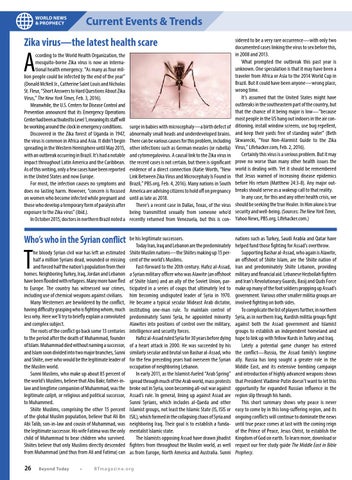
ccording to the World Health Organization, the mosquito-borne Zika virus is now an international health emergency. “As many as four million people could be infected by the end of the year” (Donald McNeil Jr., Catherine Saint Louis and Nicholas St. Fleur, “Short Answers to Hard Questions About Zika Virus,” The New York Times, Feb. 3, 2016). Meanwhile, the U.S. Centers for Disease Control and Prevention announced that its Emergency Operations Center had been activated to Level 1, meaning its staff will be working around the clock in emergency conditions. Discovered in the Zika forest of Uganda in 1947, the virus is common in Africa and Asia. It didn’t begin spreading in the Western Hemisphere until May 2015, with an outbreak occurring in Brazil. It’s had a notable impact throughout Latin America and the Caribbean. As of this writing, only a few cases have been reported in the United States and now Europe. For most, the infection causes no symptoms and does no lasting harm. However, “concern is focused on women who become infected while pregnant and those who develop a temporary form of paralysis after exposure to the Zika virus” (ibid.). In October 2015, doctors in northern Brazil noted a
Who’s who in the Syrian conflict
T
he bloody Syrian civil war has left an estimated half a million Syrians dead, wounded or missing and forced half the nation’s population from their homes. Neighboring Turkey, Iraq, Jordan and Lebanon have been flooded with refugees. Many more have fled to Europe. The country has witnessed war crimes, including use of chemical weapons against civilians. Many Westerners are bewildered by the conflict, having difficulty grasping who is fighting whom, much less why. Here we’ll try to briefly explain a convoluted and complex subject. The roots of the conflict go back some 13 centuries to the period after the death of Muhammad, founder of Islam. Muhammad died without naming a successor, and Islam soon divided into two major branches, Sunni and Shiite, over who would be the legitimate leader of the Muslim world. Sunni Muslims, who make up about 85 percent of the world’s Muslims, believe that Abu Bakr, father-inlaw and longtime companion of Muhammad, was the legitimate caliph, or religious and political successor, to Muhammed. Shiite Muslims, comprising the other 15 percent of the global Muslim population, believe that Ali ibn Abi Talib, son-in-law and cousin of Muhammad, was the legitimate successor. His wife Fatima was the only child of Muhammad to bear children who survived. Shiites believe that only Muslims directly descended from Muhammad (and thus from Ali and Fatima) can 26
Beyond Today
•
B Tm a g a z i n e . o r g