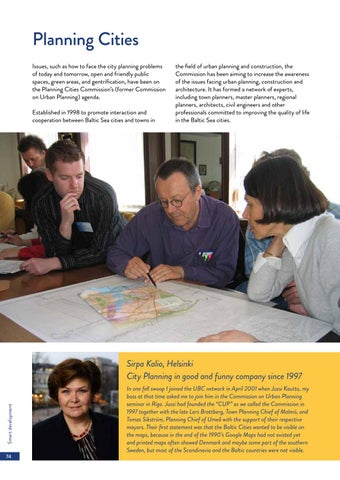
Planning Cities Issues, such as how to face the city planning problems of today and tomorrow, open and friendly public spaces, green areas, and gentrification, have been on the Planning Cities Commission’s (former Commission on Urban Planning) agenda. Established in 1998 to promote interaction and cooperation between Baltic Sea cities and towns in
the field of urban planning and construction, the Commission has been aiming to increase the awareness of the issues facing urban planning, construction and architecture. It has formed a network of experts, including town planners, master planners, regional planners, architects, civil engineers and other professionals committed to improving the quality of life in the Baltic Sea cities.
Smart development
Sirpa Kalio, Helsinki City Planning in good and funny company since 1997
74
In one fell swoop I joined the UBC network in April 2001 when Jussi Kautto, my boss at that time asked me to join him in the Commission on Urban Planning seminar in Riga. Jussi had founded the “CUP” as we called the Commission in 1997 together with the late Lars Brattberg, Town Planning Chief of Malmö, and Tomas Sikström, Planning Chief of Umeå with the support of their respective mayors. Their first statement was that the Baltic Cities wanted to be visible on the maps, because in the end of the 1990’s Google Maps had not existed yet and printed maps often showed Denmark and maybe some part of the southern Sweden, but most of the Scandinavia and the Baltic countries were not visible.