JPD 20
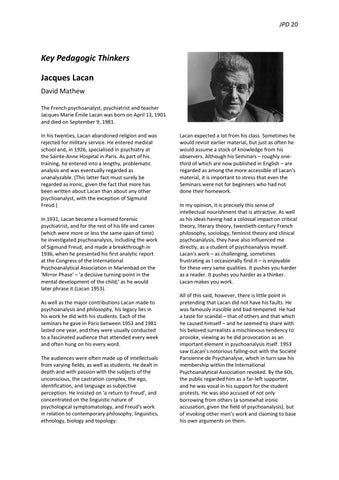
Key Pedagogic Thinkers Jacques Lacan David Mathew The French psychoanalyst, psychiatrist and teacher Jacques Marie Émile Lacan was born on April 13, 1901 and died on September 9, 1981. In his twenties, Lacan abandoned religion and was rejected for military service. He entered medical school and, in 1926, specialised in psychiatry at the Sainte-Anne Hospital in Paris. As part of his training, he entered into a lengthy, problematic analysis and was eventually regarded as unanalyzable. (This latter fact must surely be regarded as ironic, given the fact that more has been written about Lacan than about any other psychoanalyst, with the exception of Sigmund Freud.) In 1931, Lacan became a licensed forensic psychiatrist, and for the rest of his life and career (which were more or less the same span of time) he investigated psychoanalysis, including the work of Sigmund Freud, and made a breakthrough in 1936, when he presented his first analytic report at the Congress of the International Psychoanalytical Association in Marienbad on the 'Mirror Phase' – 'a decisive turning-point in the mental development of the child,' as he would later phrase it (Lacan 1953). As well as the major contributions Lacan made to psychoanalysis and philosophy, his legacy lies in his work he did with his students. Each of the seminars he gave in Paris between 1953 and 1981 lasted one year, and they were usually conducted to a fascinated audience that attended every week and often hung on his every word. The audiences were often made up of intellectuals from varying fields, as well as students. He dealt in depth and with passion with the subjects of the unconscious, the castration complex, the ego, identification, and language as subjective perception. He insisted on 'a return to Freud', and concentrated on the linguistic nature of psychological symptomatology, and Freud's work in relation to contemporary philosophy, linguistics, ethnology, biology and topology.
Lacan expected a lot from his class. Sometimes he would revisit earlier material, but just as often he would assume a stock of knowledge from his observers. Although his Seminars – roughly onethird of which are now published in English – are regarded as among the more accessible of Lacan's material, it is important to stress that even the Seminars were not for beginners who had not done their homework. In my opinion, it is precisely this sense of intellectual nourishment that is attractive. As well as his ideas having had a colossal impact on critical theory, literary theory, twentieth-century French philosophy, sociology, feminist theory and clinical psychoanalysis, they have also influenced me directly, as a student of psychoanalysis myself. Lacan's work – as challenging, sometimes frustrating as I occasionally find it – is enjoyable for these very same qualities. It pushes you harder as a reader. It pushes you harder as a thinker. Lacan makes you work. All of this said, however, there is little point in pretending that Lacan did not have his faults. He was famously irascible and bad-tempered. He had a taste for scandal – that of others and that which he caused himself – and he seemed to share with his beloved surrealists a mischievous tendency to provoke, viewing as he did provocation as an important element in psychoanalysis itself. 1953 saw tLacan’s notorious falling-out with the Société Parisienne de Psychanalyse, which in turn saw his membership within the International Psychoanalytical Association revoked. By the 60s, the public regarded him as a far-left supporter, and he was vocal in his support for the student protests. He was also accused of not only borrowing from others (a somewhat ironic accusation, given the field of psychoanalysis), but of invoking other men's work and claiming to base his own arguments on them.