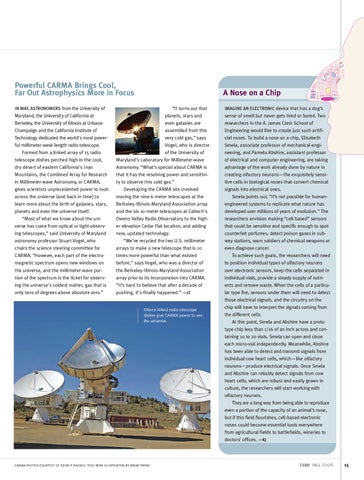
Powerful CARMA Brings Cool, Far Out Astrophysics More in Focus IN MAY, ASTRONOMERS from the University of Maryland, the University of California at Berkeley, the University of Illinois at UrbanaChampaign and the California Institute of Technology dedicated the world's most powerful millimeter-wave-length radio telescope. Formed from a linked array of 15 radio telescope dishes perched high in the cool, dry desert of eastern California's Inyo Mountains, the Combined Array for Research in Millimeter-wave Astronomy, or CARMA, gives scientists unprecedented power to look across the universe (and back in time) to learn more about the birth of galaxies, stars, planets and even the universe itself. “Most of what we know about the universe has come from optical or light-observing telescopes,” said University of Maryland astronomy professor Stuart Vogel, who chairs the science steering committee for CARMA. “However, each part of the electromagnetic spectrum opens new windows on the universe, and the millimeter-wave portion of the spectrum is the ticket for observing the universe's coldest matter, gas that is only tens of degrees above absolute zero.”
A Nose on a Chip
“It turns out that planets, stars and even galaxies are assembled from this very cold gas,” says Vogel, who is director of the University of Maryland's Laboratory for Millimeter-wave Astronomy. “What’s special about CARMA is that it has the resolving power and sensitivity to observe this cold gas.” Developing the CARMA site involved moving the nine 6-meter telescopes at the Berkeley-Illinois-Maryland Association array and the six 10-meter telescopes at Caltech's Owens Valley Radio Observatory to the higher elevation Cedar Flat location, and adding new, updated technology. “We’ve recycled the two U.S. millimeter arrays to make a new telescope that is 10 times more powerful than what existed before,” says Vogel, who was a director of the Berkeley-Illinois-Maryland Association array prior to its incorporation into CARMA. “It’s hard to believe that after a decade of pushing, it's finally happened.” —LT
Fifteen linked radio telescope dishes give CARMA power to see the universe.
CARMA PHOTOS COURTESY OF KEVIN P. RAUSCH; TECH NOSE ILLUSTRATION BY BRIAN PAYNE
IMAGINE AN ELECTRONIC device that has a dog’s
sense of smell but never gets tired or bored. Two researchers in the A. James Clark School of Engineering would like to create just such artificial noses. To build a nose on a chip, Elisabeth Smela, associate professor of mechanical engineering, and Pamela Abshire, assistant professor of electrical and computer engineering, are taking advantage of the work already done by nature in creating olfactory neurons—the exquisitely sensitive cells in biological noses that convert chemical signals into electrical ones. Smela points out, “It’s not possible for humanengineered systems to replicate what nature has developed over millions of years of evolution.” The researchers envision making “cell-based” sensors that could be sensitive and specific enough to spot counterfeit perfumes, detect poison gases in subway stations, warn soldiers of chemical weapons or even diagnose cancer. To achieve such goals, the researchers will need to position individual types of olfactory neurons over electronic sensors, keep the cells separated in individual vials, provide a steady supply of nutrients and remove waste. When the cells of a particular type fire, sensors under them will need to detect those electrical signals, and the circuitry on the chip will have to interpret the signals coming from the different cells. At this point, Smela and Abshire have a prototype chip less than 1/16 of an inch across and containing 10 to 20 vials. Smela can open and close each micro-vial independently. Meanwhile, Abshire has been able to detect and transmit signals from individual cow heart cells, which—like olfactory neurons—produce electrical signals. Once Smela and Abshire can reliably detect signals from cow heart cells, which are robust and easily grown in culture, the researchers will start working with olfactory neurons. They are a long way from being able to reproduce even a portion of the capacity of an animal’s nose, but if this field flourishes, cell-based electronic noses could become essential tools everywhere from agricultural fields to battlefields, wineries to doctors’ offices. —KJ
TERP FALL
2006
15