SPOTLIGHT ON RESEARCH
explore the dimensions of the potential dangers to youths and their responses to it, with the aim to encourage a more creative approach to research dissemination that will help research reach a wider, more general public. “We see the workshop as the beginning step to creating a truly interdisciplinary approach to understanding young people,” Alexander says. Through the playful exploration of new strategies for conducting research, and daring to think differently about how work is conducted within one’s own field, Alexander and Newberry hope participants will develop a whole new mindset to think about risk and resilience, fully embracing the advantages of a multidisciplinary perspective, and so pave the way for a truly interdisciplinary approach to the study of child and youth. U of L students are also helping to advance the institute’s objectives to better understand the lives of young people from a variety of perspectives. The institute holds “friendly feedback” sessions where students from different academic areas gain diverse input on their child- and youth-related research projects from the I-CYS directors. As well, the institute is recruiting a post-doctoral fellow for a one-year term starting this September. Over the longer term, I-CYS will introduce a minor option in child and youth studies at the University and, eventually, undergraduate and graduate degrees in the subject.
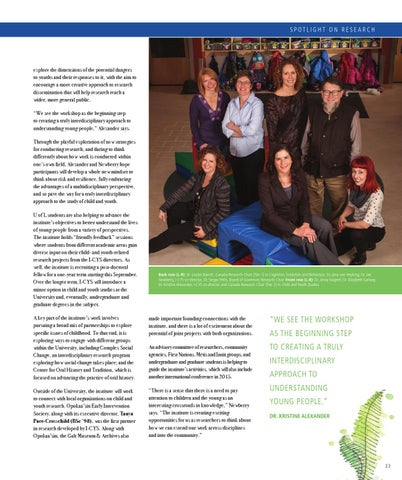
Back row (L-R): Dr. Louise Barrett, Canada Research Chair (Tier 1) in Cognition, Evolution and Behaviour; Dr. Amy von Heyking; Dr. Jan Newberry, I-CYS co-director; Dr. Sergio Pellis, Board of Governors Research Chair Front row (L-R): Dr. Janay Nugent; Dr. Elizabeth Galway; Dr. Kristine Alexander, I-CYS co-director and Canada Research Chair (Tier 2) in Child and Youth Studies
A key part of the institute’s work involves pursuing a broad mix of partnerships to explore specific issues of childhood. To that end, it is exploring ways to engage with different groups within the University, including Complex Social Change, an interdisciplinary research program exploring how social change takes place; and the Centre for Oral History and Tradition, which is focused on advancing the practice of oral history.
made important founding connections with the institute, and there is a lot of excitement about the potential of joint projects with both organizations.
“WE SEE THE WORKSHOP
An advisory committee of researchers, community agencies, First Nations, Métis and Inuit groups, and undergraduate and graduate students is helping to guide the institute’s activities, which will also include another international conference in 2015.
TO CREATING A TRULY
Outside of the University, the institute will work to connect with local organizations on child and youth research. Opokaa’sin Early Intervention Society, along with its executive director, Tanya Pace-Crosschild (BSc ’98), was the first partner in research developed by I-CYS. Along with Opokaa’sin, the Galt Museum & Archives also
“There is a sense that there is a need to pay attention to children and the young as an interesting crossroads in knowledge,” Newberry says. “The institute is creating exciting opportunities for us as researchers to think about how we can extend our work across disciplines and into the community.”
UNDERSTANDING
AS THE BEGINNING STEP INTERDISCIPLINARY APPROACH TO YOUNG PEOPLE.” DR. KRISTINE ALEXANDER
33