Anxiety Now Not the end of the world as Snobelen knows it By Kate Howell
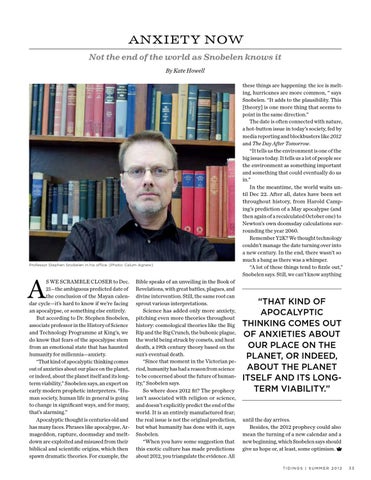
Professor Stephen Snobelen in his office. (Photo: Calum Agnew)
A
s we scramble closer to Dec. 21—the ambiguous predicted date of the conclusion of the Mayan calendar cycle—it’s hard to know if we’re facing an apocalypse, or something else entirely. But according to Dr. Stephen Snobelen, associate professor in the History of Science and Technology Programme at King’s, we do know that fears of the apocalypse stem from an emotional state that has haunted humanity for millennia—anxiety. “That kind of apocalyptic thinking comes out of anxieties about our place on the planet, or indeed, about the planet itself and its longterm viability,” Snobelen says, an expert on early modern prophetic interpreters. “Human society, human life in general is going to change in significant ways, and for many, that’s alarming.” Apocalyptic thought is centuries old and has many faces. Phrases like apocalypse, Armageddon, rapture, doomsday and meltdown are exploited and misused from their biblical and scientific origins, which then spawn dramatic theories. For example, the
Bible speaks of an unveiling in the Book of Revelations, with great battles, plagues, and divine intervention. Still, the same root can sprout various interpretations. Science has added only more anxiety, pitching even more theories throughout history: cosmological theories like the Big Rip and the Big Crunch, the bubonic plague, the world being struck by comets, and heat death, a 19th century theory based on the sun’s eventual death. “Since that moment in the Victorian period, humanity has had a reason from science to be concerned about the future of humanity,” Snobelen says. So where does 2012 fit? The prophecy isn’t associated with religion or science, and doesn’t explicitly predict the end of the world. It is an entirely manufactured fear; the real issue is not the original prediction, but what humanity has done with it, says Snobelen. “When you have some suggestion that this exotic culture has made predictions about 2012, you triangulate the evidence. All
these things are happening: the ice is melting, hurricanes are more common, “ says Snobelen. “It adds to the plausibility. This [theory] is one more thing that seems to point in the same direction.” The date is often connected with nature, a hot-button issue in today’s society, fed by media reporting and blockbusters like 2012 and The Day After Tomorrow. “It tells us the environment is one of the big issues today. It tells us a lot of people see the environment as something important and something that could eventually do us in.” In the meantime, the world waits until Dec 22. After all, dates have been set throughout history, from Harold Camping’s prediction of a May apocalypse (and then again of a recalculated October one) to Newton’s own doomsday calculations surrounding the year 2060. Remember Y2K? We thought technology couldn’t manage the date turning over into a new century. In the end, there wasn’t so much a bang as there was a whimper. “A lot of these things tend to fizzle out,” Snobelen says. Still, we can’t know anything
“That kind of apocalyptic thinking comes out of anxieties about our place on the planet, or indeed, about the planet itself and its longterm viability.”
until the day arrives. Besides, the 2012 prophecy could also mean the turning of a new calendar and a new beginning, which Snobelen says should give us hope or, at least, some optimism. µ
Tidings | summer 2012
33