Knowledge of the North Medieval Scandinavian learning within European traditions. Media and milieus: Acquisition – organization – circulation of knowledge.
Jens Eike Schnall Jonas Wellendorf
University of Bergen & UC Berkeley eike.schnall@uib.no
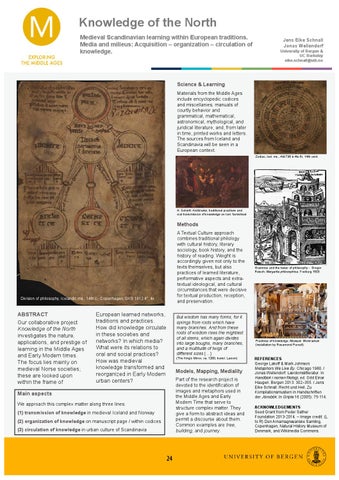
Science & Learning Materials from the Middle Ages include encyclopedic codices and miscellanies; manuals of courtly behavior and grammatical, mathematical, astronomical, mythological, and juridical literature, and, from later in time, printed works and letters. The sources from Iceland and Scandinavia will be seen in a European context. Zodiac, Icel. ms., AM 736 b 4to 6r, 14th cent.
A. Schiøtt: Kvöldvaka, traditional practices and oral transmission of knowledge on Icel. farmstead
Methods A Textual Culture approach combines traditional philology with cultural history, literary sociology, book history, and the history of reading. Weight is accordingly given not only to the texts themselves, but also practices of learned literature, performative aspects and extratextual ideological, and cultural circumstances that were decisive for textual production, reception, and preservation.
Division of philosophy, Icelandic ms., 14th c., Copenhagen, GKS 1812 4°, 4v
ABSTRACT Our collaborative project Knowledge of the North investigates the nature, applications, and prestige of learning in the Middle Ages and Early Modern times. The focus lies mainly on medieval Norse societies; these are looked upon within the frame of
European learned networks, traditions and practices. How did knowledge circulate in these societies and networks? In which media? What were its relations to oral and social practices? How was medieval knowledge transformed and reorganized in Early Modern urban centers?
But wisdom has many forms, for it springs from roots which have many branches. And from these roots of wisdom rises the mightiest of all stems, which again divides into large boughs, many branches, and a multitude of twigs of different sizes […]. (The King’s Mirror, ca. 1260, transl. Larson)
Models, Mapping, Mediality Part of the research project is devoted to the identification of images and metaphors used in the Middle Ages and Early Modern Time that serve to structure complex matter. They give a form to abstract ideas and permit a discourse about them. Common examples are tree, building, and journey.
Main aspects We approach this complex matter along three lines: (1) transmission of knowledge in medieval Iceland and Norway (2) organization of knowledge on manuscript page / within codices (3) circulation of knowledge in urban culture of Scandinavia
24
Grammar and the tower of philosophy - Gregor Reisch: Margarita philosophica. Freiburg 1503
Practices of knowledge: Museum Wormianum (installation by Rosamond Purcell)
REFERENCES George Lakoff & Mark Johnson: Metaphors We Live By. Chicago 1980. / Jonas Wellendorf: Lærdomslitteratur. In Handbok i norrøn filologi, ed. Odd Einar Haugen. Bergen 2013: 302–355. / Jens Eike Schnall: Recht und Heil. Zu Kompilationsmustern in Handschriften der Jónsbók. In Gripla 16 (2005): 75-114. ACKNOWLEDGEMENTS Seed Grant from Peder Sather Foundation 2013-2014. – Image credit: (L to R) Den Arnamagnæanske Samling, Copenhagen, Natural History Museum of Denmark, and Wikimedia Commons.