GEORGIA The University of
December 2014 • Vol. 94, No. 1
Magazine
Bullish about
Bulldogs Wall Street warms up to UGA students thanks to David Battle and the Corsair Society DECEMBER 2014 • GEORGIA MAGAZINE
1
Everything you need, everything you want and a few extra surprises—ALL RIGHT HERE.
AMENITIES AT YOUR FINGERTIPS PRIVATE PARKING GARAGE MULTI-TIERED COURTYARD WITH 3 LEVELS POOL WITH SUNDECK OUTDOOR FIRE PIT WITH LIVING AREA CLUBROOM WITH POOL TABLE FREE TANNING STUDY ROOM INDOOR AND OUTDOOR LOUNGES MODERN FITNESS STUDIO
THE BEST APARTMENT FEATURES PRIVATE WASHER AND DRYER CONTEMPORARY FURNITURE PACKAGE TEMPUR-PEDIC ® MATTRESSES STAINLESS STEEL APPLIANCES GRANITE COUNTERTOPS ECO-FRIENDLY FAUX WOOD FLOORING WATER, SEWER, TRASH, CABLE AND INTERNET INCLUDED IN RENT
APPLY ONLINE TODAY! GeorgiaHeights.com Our temporary leasing office is now open: 162 West Clayton | Athens, GA 30601 | 706.510.2486
Congratulations to the
2015
Bulldog 100 Businesses
February 7, 2015 PARTNER
SPONSORS MARQUIS
Join the UGA Alumni Association to celebrate this year’s fastest growing businesses owned or operated by Georgia Bulldogs. The evening will be highlighted by the countdown of the 2015 Bulldog 100 and a keynote address by Hala Moddelmog (MA ’81), president and CEO of the Metro Atlanta Chamber. For more information, visit www.alumni.uga.edu/B100
PLATINUM
AFFINITY
The UGA Alumni Association proudly supports the academic excellence, best interests and traditions of Georgia’s flagship university and its alumni worldwide.
AROUNDTHE
ARCH
GEORGIA MAGAZINE Allyson Mann, MA ’92, Interim Editor Lindsay Robinson, ABJ ’06, MPA ’11, Art Director Pamela Leed, Advertising Director Fran Burke, Office Manager Paul Efland, BFA ’75, MEd ’80; Peter Frey, BFA ’94; Robert Newcomb, BFA ’81; Rick O’Quinn, ABJ ’87; Andrew Davis Tucker; and Dorothy Kozlowski, BLA ’06, ABJ ’10; UGA Photographers Daniel Funke, Editorial Assistant PUBLIC AFFAIRS Tom Jackson, AB ’73, MPA ’04, PhD ’08, Vice President Alison Huff, Director of Publications ADMINISTRATION Jere W. Morehead, JD ’80, President Pamela Whitten, Senior Vice President for Academic Affairs and Provost Ryan Nesbit, MBA ’91, Vice President for Finance and Administration Kelly Kerner, Vice President for Development and Alumni Relations Laura D. Jolly, Vice President for Instruction David C. Lee, Vice President for Research Jennifer Frum, PhD ’11, Vice President for Public Service and Outreach Victor Wilson, BSW ’82, MEd ’87, Vice President for Student Affairs J. Griffin Doyle, AB ’76, JD ’79, Vice President for Government Relations Timothy M. Chester, Vice President for Information Technology Change your mailing address by emailing information to records@uga.edu or call 888-268-5442. Advertise in Georgia Magazine by contacting Pamela Leed at pjleed@uga.edu or 706-542-8124. Find Georgia Magazine online at www.ugamagazine.uga.edu. Submit class notes or story ideas to gmeditor@uga.edu. FINE PRINT Georgia Magazine (ISSN 1085-1042) is published quarterly for alumni and friends of UGA. POSTMASTER: Send address changes to: University of Georgia, 286 Oconee Street, Suite 200 North, Athens, GA 30602 In compliance with federal law, including the provisions of Title IX of the Education Amendments of 1972, Title VI of the Civil Rights Act of 1964, Sections 503 and 504 of the Rehabilitation Act of 1973, and the Americans with Disabilities Act of 1990, the University of Georgia does not discriminate on the basis of race, sex, religion, color, national or ethnic origin, age, disability, or military service in its administration of educational policies, programs, or activities; its admissions policies; scholarship and loan programs; athletic or other University-administered programs; or employment. In addition, the University does not discriminate on the basis of sexual orientation consistent with the University non-discrimination policy. Inquiries or complaints should be directed to the director of the Equal Opportunity Office, 119 Holmes-Hunter Academic Building, University of Georgia, Athens, GA 30602. Telephone 706-542-7912 (V/TDD). Fax 706-542-2822.
Three-year-old loggerhead sea turtle Ossabaw was released Sept. 8 by Lisa Olenderski (left) and Devin Dumont on Wassaw Island National Wildlife Refuge near Savannah. Dumont is curator and Olenderski is assistant curator for the UGA Aquarium, operated by the Marine Extension Service. Ossabaw hatched on Ossabaw Island in August 2011; he was discovered still in the nest and likely would not have survived if the Georgia Sea Turtle Cooperative hadn’t intervened. The hatchling was given to the UGA Aquarium and has thrived, growing from palm sized to 40 pounds with a 22-inch shell. To see a video of Ossabaw’s release, visit http://vimeo.com/105684302. Photo by Andrew Davis Tucker 2
GEORGIA MAGAZINE • www.ugamagazine.uga.edu
The University of
GEORGIA Magazine
December 2014 • Vol. 94, No. 1
5 6
Take 5 with the President
Campus news and events
An interview with President Jere W. Morehead
Around the Arch
Closeup 14 Bolton dining commons
Open seven days a week, it’s the first to offer dinner on Sunday
18 Mason’s mark
Gift from alumnus helps UGA students become public leaders
Features 20 Bullish about Bulldogs
Wall Street warms up to UGA students thanks to David Battle and the Corsair Society
26 A grand complexity
Christopher Lawton’s interactive project brings new voices to Georgia history
30 Downtown renaissance
Georgia cities get a makeover with help from UGA’s Institute of Government
Class Notes 36 Alumni profiles and notes ON THE COVER David Battle (BBA ’00) is co-founder of the Corsair Society, an organization that helps UGA students land Wall Street internships—which often lead to full-time employment. More than 100 recent graduates have earned jobs at top-tier investment banks and management consulting firms through participation in Corsair. Photo by Jeremy Bales (AB, ABJ ’01)
DECEMBER 2014 • GEORGIA MAGAZINE
3
5
TAKE
— An interview with President Jere W. Morehead
Q: The entering class of first-year students once again set a record for academic quality. What does enrolling another exceptional freshman class reveal about the University of Georgia? A: It verifies the rising academic stature of the University of Georgia. The brightest students in our state and across the country want to receive their undergraduate education from UGA. They are attracted to the premier learning experience offered by our world-class faculty. I hope and expect demand for admission only to increase as we reach new heights of excellence in the future. Certainly being ranked again among the top 20 public institutions by U.S. News & World Report confirms this expectation. I am very appreciative of the great work done by the Office of Admissions and our faculty, staff and alumni in recruiting this outstanding freshman class.
A: We have designed this facility in close consultation with our faculty who best understand teaching in science disciplines. Promoting interactive learning is an important goal, and some of the new instructional classrooms will facilitate group work, making student-to-student and student-toteacher interaction much easier. This facility will allow faculty to move beyond the traditional lecture toward innovative teaching methods that facilitate learning among students at the highest level. Q: The university completed the best fundraising year in its history in 2014. How important is the support of alumni and friends? A: First, let me thank the loyal alumni and friends whose generous contributions made this historic achievement possible. The future success of UGA depends on their continued private support. Donations allow the university to provide need-
and merit-based scholarships to students, attract and retain worldclass faculty, and build the academic programs essential for excellence in teaching, research and service in the 21st century. Q: This year David Williams celebrated his 10th year as director of the Honors Program. What is the state of Honors at UGA today? A: Our Honors Program is now one of the most comprehensive in the nation, with distinguished programs in study abroad and undergraduate research and dynamic internship opportunities. The academic quality of our Honors students today is astonishing. We recently enrolled 525 first-year students with an average GPA of 4.09, an average SAT score of 1465 and an average ACT score of 33. I am very proud of what Dr. Williams and his staff have accomplished, and I am excited about the bright future of our Honors Program under his leadership.
Q: Before the start of classes this year, UGA’s New Faculty Tour led faculty members across the state to learn about Georgia. How does this tour benefit our new faculty? A: As the state’s land-grant institution, UGA has a responsibility to use its resources to help Georgia’s communities grow and prosper. On this tour, new faculty were able to see firsthand some of the amazing ways the university carries out this responsibility on a daily basis around our state. This exposure helps our new faculty identify opportunities to connect their own teaching, research and service to the needs of Georgians. Q: Construction on the new Science Learning Center is underway. How will this learning facility transform science education on campus?
New faculty members take a walking tour of historic Savannah during UGA’s 2013 New Faculty Tour.
PETER FREY
DECEMBER 2014 • GEORGIA MAGAZINE
5
ARCH AROUNDTHE
JONATHAN LEE
Head Football Coach Mark Richt takes selfies with members of the Class of 2018 at Freshman Welcome Aug. 17. The annual event, held at Sanford Stadium, is a day of firsts for new students—first time between the hedges, first time calling the ’Dawgs and first time learning the Battle Hymn of the Bulldog Nation. Incoming freshmen pose for a class photo—in the shape of a G on the football field—and receive a copy of the G Book, a book of UGA traditions. The event is a joint partnership between the Student Alumni Association and the Student Government Association.
UGA STUDENTS AWARDED FULBRIGHT GRANTS Twelve UGA students were awarded international travel-study grants from the Fulbright U.S. Student Program for 2014-15. This is UGA’s second highest total of Fulbright recipients. Eight of the students accepted the scholarships. Recipients of the U.S. Student Full Grants, which cover research, study and creative opportunities, are Christian Conroy (AB ’13), Winn Davis (AB ’11) and Brett Heimlich (BS ’09). Two students who earned master’s degrees at UGA also received Full Grants: Sara Hobe (MA ’13) and Lauren Satterfield (MS ’14). English Teaching Assistantship Grants, which place recipients in K-12 schools and universities to serve as language-learning assistants, were given to Tiffany Brown (AB ’14), DeAnne Cantrell (AB ’14) and Christine Pardue (AB ’14). The Fulbright U.S. Student Program awards approximately 1,900 grants annually to U.S. undergraduate and graduate students. Sponsored by the U.S. Department of State, the Fulbright Program is the largest U.S. international exchange program.
6
GEORGIA MAGAZINE • www.ugamagazine.uga.edu
UGA ranks top 20 among publics UGA continues to rank among the nation’s elite public research universities, according to U.S. News & World Report, which placed the institution at No. 20 on the list contained in its Best Colleges 2015 edition, released in September. The Terry College of Business increased its standing, moving six places to No. 21 for best undergraduate business schools. Terry continues to rank top in the nation for its insurance and risk management program, placing first again this year among the best business specialties. Its real estate program was fourth. UGA has landed among the top 20 public universities six out of the last 10 years. This year, it was one of two SEC schools to make that list— along with the University of Florida. The 2015 college rankings are available online at www.usnews.com/colleges.
UGA RECEIVES DIVERSITY AWARD UGA has been named a 2014 recipient of the INSIGHT Into Diversity Higher Education Excellence in Diversity Award, a national recognition for its efforts to foster an inclusive, diverse campus. The university was one of 83 institutions honored this year with the HEED Award, the only designation of its kind awarded to institutions that exhibit outstanding efforts and success in the area of diversity and inclusion throughout their campuses. “At the University of Georgia, we value inclusion as a fundamental element in a vibrant and connected academic community,” UGA President Jere W. Morehead says. “I am pleased that UGA’s success in creating a welcoming campus that promotes educational growth and understanding is being recognized through this national award.” UGA’s efforts include initiatives to recruit diverse students, faculty and staff and to improve graduation rates of underrepresented groups. In addition, the university offers numerous diversityrelated events, curricular offerings and training and certificate programs for faculty and staff.
SPECIAL
New facilities in Athens and Griffin UGA broke ground this fall on two new buildings, the Science Learning Center in Athens (illustration above) and the Food Technology Center in Griffin. The $44.7 million, 122,500-square-foot Science Learning Center will be located on South Campus, adjacent to Pharmacy South and across from the Miller Plant Sciences Building. The building’s 33 instructional labs will be designed specifically for interactive learning in core undergraduate science courses. The center also will contain two 280-seat lecture halls and two 72-seat SCALE-UP classrooms. SCALE-UP stands for Student-Centered Active Learning Environment for Undergraduate Programs, a learning model focused on creating spaces that facilitate active, collaborative learning in a studio-like setting. The building is scheduled to open in fall 2016. The UGA Griffin Food Technology Center will be located near the southeast corner of the Melton Building. The facility will house UGA’s Food Product Innovation and Commercialization (FoodPIC) Center, including pilot plants and laboratory spaces for hot and cold temperature work; wet and dry processing; quality control laboratories; refrigerated, frozen and dry storage; a demonstration kitchen; and administrative offices. Researchers from the College of Agricultural and Environmental Sciences and industry experts will provide guidance in the areas of food product development, concept generation and evaluation, packaging, safe processing, business development, pilot plant preparation and consumer acceptance.
Student wins ‘Dance Your Ph.D.’ contest UGA doctoral student Uma Nagendra flipped and twisted her way to the top prize in the seventh annual Dance Your Ph.D. contest for her video explaining biology research through an aerial dance performance. The contest, sponsored by Science magazine, the Association of the Advancement of Science and HighWire Press, challenged scientists around the world to explain their Ph.D. research through the art form of dance. Nagendra’s video was chosen from 12 finalists as the overall winner and also won first place in the biology category. A student in the Franklin College of Arts and Sciences department of plant biology, Nagendra studies how forests regenerate after severe disturbances like tornadoes. She began her doctorate at UGA in 2011. An avid aerial dance enthusiast, she takes classes regularly at Athens-based Canopy Studio. When she decided to enter the contest, she enlisted the help of her classmates and graduate students. For winning the biology category and the overall prize, Nagendra will receive $1,000 and a free trip to Stanford University, where her video will be screened at the annual scholarly publishing meeting organized by HighWire Press. View Nagendra’s winning video at http://vimeo.com/107412178.
Uma Nagendra
TOBIN RUSSELL PHOTOGRAPHY
DECEMBER 2014 • GEORGIA MAGAZINE
7
AROUNDTHE
ARCH BEST IN SHOW A
BARK OUT TO
… Mark Jackwood, professor and molecular virologist at the Poultry Diagnostic and Research Center, who won the 2014 Charles Beard Research Excellence Award from the U.S. Poultry and Egg Association. … Ed Pavlic, professor of English and creative writing, who was awarded a 2014 National Poetry Series prize for Let’s Let That Are Not Yet: Inferno. … the Georgia Museum of Art, which earned honorable mentions for exhibition catalogs from Foreword Reviews’ 2013 IndieFab Book Awards and the American Alliance of Museums’ 2014 Publications Design Competition. … Wendy Glenn, senior parking services monitor in the South Campus parking deck, who won the Staff Member of the Year Award at the annual International Parking Institute Conference and Expo. Ed Pavlic
… UGA’s Career Center, which won the Technology Excellence Award from the National Association of Colleges and Employers for its Angry Dawgs game for iPhone and iPad. … Gary Grossman, professor of animal ecology, who received the 2014 Carl R. Sullivan Fisher Conservation “Sully” Award from the American Fisheries Society. … Christine Franklin, Lothar Tresp Honoratus Honors Professor in statistics, who won the Founders Award from the American Statistical Association. … UGA’s programs in secondary education and public administration, which were named on graduateprograms.com’s annual list of the best graduate programs in the country.
Gary Grossman
… James Wood, UGA doctoral student, who was awarded $2,000 by the Environmental Protection Agency’s National Aquatic Resource Surveys Campus Challenge, for his proposal to assess major trends in river plants and measure the bioaccumulation of heavy metals in highly urbanized watersheds. … Samuel Aggrey, professor of poultry genetics, who won the National Chicken Council Broiler Research Award from the Poultry Science Association.
Kim Coder
… Kim Coder, professor of community forestry, who was honored with the Award of Merit, the highest honor given to members by the International Society of Arboriculture.
… UGA’s Richard B. Russell Library for Political Research and Studies, which received the state of Georgia’s Governor’s Award for the Arts and Humanities.
8
GEORGIA MAGAZINE • www.ugamagazine.uga.edu
COLLEGE OF PUBLIC HEALTH REACCREDITED UGA’s College of Public Health has received a sevenyear reaccreditation, the maximum term awarded, from the Council on Education for Public Health. CEPH is the only independent agency recognized by the U.S. Department of Education to accredit schools and programs of public health. Accreditation by CEPH provides assurance that the school has been evaluated and has met accepted standards established by the public health profession. Schools seeking accreditation are evaluated on criteria such as curriculum, student learning outcomes, resources, research opportunities and student and faculty interactions. For reaccreditation, schools are required to conduct a self-study and to host a site visit. During the site visit, the team interviewed school administrators, university officials, faculty, students, alumni and community leaders. The team also inspected the school’s facilities, examined documentation corroborating the self-study and prepared a report of its findings. The CEPH Board of Councilors approved the college’s reaccreditation at its September meeting, extending it to Dec. 30, 2021. This was the college’s second review for accreditation as a school of public health. With its initial review in 2009, the college became the first CEPHaccredited school of public health in the University System of Georgia.
Georgia leads in blueberry production With the tally from the 2014 growing season complete, it’s official. Georgia now leads the nation in blueberry production. UGA blueberry breeder Scott NeSmith was surprised to hear Georgia’s production topped the nation this year. The state has been No. 1 in blueberry acreage for the last few years, but it was uncertain when all this new acreage would impact the state’s annual blueberry production. “We’ve been gaining a lot of potential over the last five years, and I think we just reached that potential a little earlier than we thought,” says NeSmith, who helped launch UGA’s blueberry breeding program in the late 1980s. The North American Blueberry Council released its report on the 2014 growing season last week, noting that Georgia produced 96 million pounds of blueberries this year. Michigan, traditionally regarded as the blueberry capital of the country, produced 91.5 million pounds. When NeSmith started producing blueberry varieties that could thrive in Georgia, farmers were only growing about 3,500 acres of blueberries. Today, they are cultivating about 20,000 acres and have grown production tenfold. Between 2011 and 2014, Georgia farmers increased blueberry production from 59 million pounds to 96 million pounds. For more, see http://blog.caes.uga. edu/blueberry/.
BULLDOG BOOKWORM
PETER FREY
Bulldog wide receiver Malcolm Mitchell and (left to right) Lynn Burt, Danna Whaley and Gail Johnson react to a comment at an October book club meeting, where the group discussed The Girl You Left Behind, written by Jojo Moyes. Mitchell joined the club after a chance encounter with member Kathy Rackley at a local bookstore. Though the members are all 40-, 50- and 60-year-old women, Mitchell shares their love of reading. After Georgiadogs. com posted a video about Mitchell joining the group, the story was picked up by a variety of news outlets. Mitchell told CBS News that he was proud of reading the Hunger Games trilogy in about two days. Where does football fit in? “That came natural,” Mitchell told CBS News. “That’s a gift. I had to work to read.” To see the video, visit http://www.georgiadogs.com/ sports/m-footbl/spec-rel/080714aaa.html.
TERRY GETS NEW DEAN, OFFERS NEW ONLINE DEGREE Benjamin C. Ayers, director of the J.M. Tull School of Accounting, became dean of UGA’s Terry College of Business July 1. Ayers succeeded Charles B. Knapp, UGA president emeritus, who served as interim dean starting in July 2013 when Robert Sumichrast stepped down as dean to accept a position at Virginia Tech. Ayers was named director of the Tull School in 2005 after serving on the faculty since 1996. He also holds the Earl Davis Chair in Taxation. Under his leadership, the School of Accounting’s programs consistently have ranked in the top 10 among public universities. Ayers has received 11 teaching awards, including the Richard B. Russell Award for Excellence in Undergraduate Teaching. The Terry College has launched an online bachelor of business administration program aimed at full-time employees, military personnel and others looking to upgrade their business skills. The online BBA is a degree completion program that specifically targets adult learners. The program operates on a cohort model, admitting about 40 students each fall, spring and summer semester. A typical student will complete two courses each semester and graduate in three years. The online curriculum supports a general business major, which provides a broad background of practical business knowledge for careers as managers or entrepreneurs. For more information, visit online.uga.edu.
DECEMBER 2014 • GEORGIA MAGAZINE
9
AROUNDTHE
ARCH SEC Fellows Faculty members Melissa Harshman, L. Stephen Miller and Judith Wasserman will gain a deeper perspective on modern academic leadership as 2014-15 SEC Academic Leadership Development Program Fellows. The program at UGA is part of the broader Academic Leadership Development Program of the Southeastern Conference and seeks to identify, prepare and advance academic leaders for roles within SEC institutions and beyond. Based on their areas of interest, the Fellows will work with select senior administrators and interact with their counterparts from other SEC institutions at two three-day workshops. Harshman, associate professor in the Lamar Dodd School of Art in the Franklin College of Arts and Sciences, directs UGA’s First-Year Odyssey Seminar program. Miller, a professor of psychology in the Franklin College and director of the UGA Bioimaging Research Center, conducts research encompassing a variety of behavioral processes as they relate to both brain function and dysfunction. Wasserman, associate professor in the College of Environment and Design, serves as director of the college’s Advanced Visualization Initiative and as the college’s diversity representative.
Melissa Harshman
L. Stephen Miller
THE (NEW) REDCOATS ARE COMING
Judith Wasserman
ANDROID APP UGA has launched its first official mobile app for Android to make it more convenient for students, faculty, staff and campus visitors to track buses, find a printer or parking deck, or see what the dining commons are serving for lunch. The UGA mobile app, which was also updated for iOS, is the official one-stop spot for some of the most popular services at the university. The app includes a map of campus with the ability to select points of interest, such as computer labs, parking decks, bike repair stations and print kiosks. It features daily menus at UGA dining commons, recreational sports schedules, athletic scores, access to the university’s learning management system and more. The same app features will be available to mobile users on both Apple and Android phones. The app is available to download from Google Play for Android devices and the App Store for iOS devices. For more information, see http://mobileapps.uga.edu.
10 GEORGIA MAGAZINE • www.ugamagazine.uga.edu
PETER FREY
The Redcoat Marching Band debuted a new uniform design Aug. 30 at the Clemson game (UGA won 45-21). The band—which celebrated its 100th anniversary a decade ago—includes about 450 members and performs for nearly one million people in person each year and countless millions by way of Georgia football broadcasts. The Redcoats perform at all home games, selected road games and bowl games each season as well as numerous high school band exhibitions, the university Homecoming Parade and other community events.
Clearing the air UGA banned all tobacco products, effective Oct. 1, in accordance with a policy adopted in March by the board of regents of the University System of Georgia. The policy reinforces the USG’s commitment to provide a safe and amicable workplace for all employees as outlined in the Georgia Smoke Free Air Act of 2005 and to preserve and improve the health, comfort and environment of students, employees and visitors on all system campuses. New signage around campus and messaging on the UGA website and via social media promote the tobacco- and smokefree campus policy, which applies to persons in indoor or outdoor areas, including all buildings, recreational areas, lawns, university sidewalks, university vehicles and parking lots. Banned products include cigarettes, cigars, pipes, all forms of smokeless tobacco, clove cigarettes and any smoking device that uses tobacco such as hookahs or simulate the use of tobacco such as electronic cigarettes. For more information, visit uga.edu/tobacco-free.
SREL HELPS WOOD STORK AVOID EXTINCTION The once imperiled American wood stork has been down-listed from endangered to threatened, and UGA’s Savannah River Ecology Laboratory had a hand in bringing the bird back from the brink of extinction. SREL’s efforts began in 1983 with an extensive study—the first of its kind—of the wood stork’s biology on the Savannah River Site and their nesting colony in Jenkins County. A few years later SREL and the U.S. Department of Energy expanded efforts to protect the stork’s habitat. In 1986, 25 acres of managed ponds—feeding grounds—were constructed at Kathwood Lake using DOE funding. Four man-made habitats in Jackson, S.C., were supplied with fish and their water levels were managed to mimic stork habitats. In 1995, the National Audubon Society assumed overall responsibility for the maintenance and operation of wood stork feeding ponds. More than 90 storks were seen on one pond, in one day, during that first year. And in September 2013, two hundred wood storks were observed on one of the ponds.
SPECIAL
UGA PARTNERSHIP BRINGS ROBOTICS TO BARROW Researchers at UGA’s College of Education will work with local teachers to develop robotics-based lesson plans for all grade levels at a new technologyfocused high school in Barrow County. The new Sims Academy of Innovation and Technology, located in Winder, hosted a ribbon-cutting ceremony in September. Above, children watch as a radio-controlled robot, made from a kit provided by South Korean company RoboRobo, moves around a table. The outreach program builds on a partnership formed earlier this year between the company and Ikseon Choi, associate professor in the college’s learning, design and technology program.
National champs
SPECIAL
The UGA majorettes and feature twirlers’ competition team won the collegiate division at the 2014 America’s Youth on Parade USA and World Twirling Championships in July. In addition to the team events, one of UGA’s three feature twirlers, Nicole Jensen, was crowned College Miss Majorette of America, the highest title for individual collegiate competitors. The team competed in two events—a halftime routine, which is judged based on artistry, and a dance-twirl routine, which emphasizes difficulty and intricacy of tricks. The UGA twirlers also placed second and third runner-up in large and small divisions of the senior dance twirl competition. Jensen, UGA’s senior feature twirler, competed against 52 other contestants for the College Miss Majorette of America title. Several of the UGA twirlers also competed in individual events and finished in the top 10. Jameson Kenerly, one of UGA’s sophomore feature twirlers, also won the individual “WOW” award for the most entertaining collegiate downfield twirler.
DECEMBER 2014 • GEORGIA MAGAZINE
11
AROUNDTHE
ARCH CAPTAIN PLANET
DOT PAUL
Altizer named Athletic Association Professor
Sonia Altizer, professor and associate dean for academic affairs in the Odum School of Ecology, has been named the UGA Athletic Association Professor in Ecology. Altizer studies the ecology and evolution of infectious diseases. Working with diverse systems ranging from monarch butterflies to vampire bats, Altizer explores questions about host-parasite interactions, the relationship of animal behavior and disease and the impact of human-caused environmental changes on infectious disease dynamics. One project, sponsored by the National Science Foundation, explores how human activity affects the spread of rabies in vampire bats in Peru. As cattle ranches expand into previously undeveloped forest areas, they provide vampire bats with a new source of food in the form of livestock—and bring them into greater contact with people. Work in Altizer’s lab showed that contrary to conventional wisdom, efforts to prevent the spread of rabies by culling vampire bat colonies could actually be making the problem worse. The NSF recognized Altizer with a Faculty Early Career Development Program Award, and the U.S. government honored her with a Presidential Early Career Award for Science and Engineering.
UGA’s J. Marshall Shepherd is a Captain Planet Protector of the Earth, according to the Captain Planet Foundation, which added him to a list of outstanding real-life environmental superheroes. Shepherd, the UGA Athletic Association Professor in the Social Sciences, receives the award this month at the annual Captain Planet Foundation Benefit Gala in Atlanta. Other honorees include renowned primatologist Jane Goodall and Carter and Olivia Ries of the nonprofit One More Generation. Past recipients include Erin Brockovich and former EPA Administrator Lisa P. Jackson. “It is wonderful to be honored for something that I would do without fanfare at all,” Shepherd says. “I am passionate about ensuring that the state of Georgia, our nation and the planet are in good shape for my two kids. It is truly humbling to be mentioned in the same breath with many of the previous honorees.” Director of UGA’s atmospheric sciences program in the Franklin College of Arts and Sciences department of geography, Shepherd served as president of the American Meteorological Society in 2013. He was a research meteorologist at NASA’s Goddard Space Flight Center for 12 years prior to joining UGA. Shepherd serves as host on the new Weather Channel Sunday talk show, “Weather Geeks.”
SCHOOL OF LAW WINS NATIONAL TRIAL ADVOCACY TOURNAMENT UGA’s School of Law won the first National Trial Advocacy Tournament, hosted by the University of Florida Levin College of Law in October. The team was composed of third-year law students Garrett S. Burrell, Joshua H. “Josh” Dorminy, Whitney T. Judson and Ashley R. Wright. They were coached by Advocacy Director Kellie Casey. Dorminy was named as the best advocate of the final round, and Judson was selected for delivering the best closing argument in the preliminary rounds. Georgia Law faced competition from Mississippi College, Fordham University, the University of Akron and Faulkner University and went undefeated in all four rounds to eventually overcome Florida Coastal School of Law for the national title. Marshall Shepherd
12 GEORGIA MAGAZINE • www.ugamagazine.uga.edu
PETER FREY
Gift to create chair in real estate UGA has received a $2.5 million gift from the estate of Roy Adams Dorsey to establish the Roy Adams Dorsey Distinguished Chair in Real Estate in the Terry College of Business, pending approval by the board of regents of the University System of Georgia. UGA Foundation Emeritus Trustee Bob Edge (AB ’60), an attorney with Alston & Bird in Atlanta, served as the attorney for the estate. “The University of Georgia is pleased to receive such a generous gift,” President Jere W. Morehead says. “It will no doubt transform real estate education for UGA students. Roy Dorsey’s legacy will continue through the countless future real estate professionals who will benefit from this chaired professorship, and we are deeply grateful.” Dorsey, who died in 2012, was the founder and president of Dorsey-Alston Realtors, a company that specializes in luxury real estate in the Atlanta metropolitan area, where he worked for his entire business career. The company, founded in 1947, is part of Who’s Who in Luxury Real Estate. Dorsey (M ’44) and his two brothers attended UGA. His father, Cam D. Dorsey, a 1903 graduate, helped establish the UGA Foundation in 1937.
SCIENTISTS GROW ORGAN FROM TRANSPLANTED CELLS A team including UGA researchers has grown a fully functional organ in a living animal for the first time. The researchers created a thymus, a butterfly-shaped gland and vital component of the human immune system. Located in the upper chest, the thymus produces Tlymphocytes, which help lead the body’s fighting forces against bacteria, viruses and even cancerous cells. “The general idea … is that to make cells change their fate, you need to reprogram first to a stem-cell like state and then coax them to change,” says Nancy Manley, professor of genetics and co-author of the team’s paper in Nature Cell Biology. “But we jump-started the process just by expressing a single gene.” Researchers took cells from a mouse embryo and reprogrammed them into a completely unrelated type of cell by increasing levels of a protein that guides development of the thymus. When mixed with other thymus cell types and grafted onto the kidneys of genetically identical mice, these cells formed a gland with the same structure, complexity and function as a healthy thymus. The team, led by scientists from the University of Edinburgh, hopes that further refinement could lead to thymus transplants for people with weakened immune systems.
Junior Corey Klaw (left) watches as sophomore Gaby Pierre feeds a Chew Crew goat named Junior.
MICKEY MONTEVIDEO
Grazing grant The College of Environment and Design, in partnership with the College of Engineering and the Office of Sustainability, will use a $25,000 grant from the Ford Motor Company Fund to continue a two-year effort to remove invasive vegetation using prescribed grazing with the help of goats. UGA’s “Grazing Our Way Back to Community Sustainability” project was one of 10 selected for implementation. This studentled community-building project corresponds with the mission of the Ford College Community Challenge of “Building Sustainable Communities.” The grant will support three sustainable community projects. First, it will allow the continuation of prescribed grazing research using goats to reclaim an overgrown and highly impaired stream on campus called Tanyard Creek. Second, a new prescribed grazing effort will be launched in Driftmier Woods—adjacent to the Driftmier Engineering Center—to begin restoring the old-growth forest. Finally, the grant will allow the creation of a junior herders program at Barrow Elementary School to teach students the importance of reclaiming the community’s landscapes. As junior herders, the students will interact with UGA students and professors while learning about ecology, hydrology and the biology and care of domesticated animals.
NEW PARTNERSHIP TO ADDRESS CONSERVATION OF REPTILES, AMPHIBIANS UGA has partnered with the Orianne Society, an international nonprofit organization dedicated to the conservation of imperiled reptiles and amphibians. The Orianne Society is working with researchers from the Warnell School of Forestry and Natural Resources on projects that focus on the conservation of reptiles and amphibians and their habitats. Often overlooked in conservation policies, reptiles and amphibians are vital to biodiversity and play an important role in pest control, but many populations are declining due to habitat loss and degradation, disease and deliberate persecution. Researchers from Warnell and the Orianne Society have collaborated on several projects, and a UGA undergraduate student is currently conducting one of the first ecological studies of canebrake rattlesnakes in the Piedmont region, a species declining rapidly throughout its range. DECEMBER 2014 • GEORGIA MAGAZINE
13
CLOSE UP
Bolton Dining Commons Open seven days a week, it’s the first to offer dinner on Sunday
PAUL EFLAND
PETER FREY
(Top) Kristin Ingmundson serves food to students on Aug. 18, opening day for Bolton Dining Commons and the first day of fall semester. (Bottom) Freshmen Katherine Ryan (left) and Veronica Block greet a friend while eating breakfast at Bolton Dining Commons. Ryan is an international business major, and Block is an English and psychology major.
14 GEORGIA MAGAZINE • www.ugamagazine.uga.edu
PAUL EFLAND
The university’s newest dining facility set a UGA serving record on Aug. 18, feeding 9,500 people on the first day of fall semester classes. Bolton Dining Commons is located on the corner of Baxter and Lumpkin streets, across from the Tate Student Center and the Miller Learning Center. The twostory, 56,000-square-foot building is the largest meal plan facility on campus, seating up to 1,000. The facility showcases interactive dining platforms throughout the building, including an all-day breakfast café with counter-style seating, cooked-to-order international cuisine such as wok stir-fry and sautéed pastas, hand-spun milkshakes, smoked meats, deli sandwiches and recipes full of vegetables, grains and whole foods. Bolton Dining Commons is named after longtime UGA treasurer and comptroller John Dixon Bolton. The facility replaces the original Bolton Dining Commons, which was completed in 1963 as part of a 1,000-student housing complex and was called Creswell Cafeteria. It was renamed soon after Bolton’s death in 1965 in honor of his 32 years of service to the university. For more information, see http://foodservice.uga.edu/ locations/bolton.
Located on the corner of Baxter and Lumpkin Streets, Bolton Dining Commons is named for longtime UGA treasurer and comptroller John Dixon Bolton.
DECEMBER 2014 • GEORGIA MAGAZINE
15
CLOSE UP
The two-story, 56,000-square-foot building is the largest meal plan facility on campus, seating up to 1,000. DOROTHY KOZLOWSKI
PAUL EFLAND
(Top) A section of the building is dedicated to menu items that are free of gluten and the eight most common food allergens— fish, shellfish, tree nuts, peanuts, eggs, milk, wheat and soy.
(Middle) Much of the interior and exterior of the building was made from granite sourced in nearby Elberton. All of the facility’s food waste is being pulped and sent to an on-campus bioconversion center to be composted and reused. (Bottom) Food service workers prepare pastries and muffins for breakfast on the first day of fall semester classes. (Right) Bolton Dining Commons is used primarily by UGA students but is open to the public. Breakfast costs $9, lunch is $11.25 and dinner is $15.50. ANDREW DAVIS TUCKER
16 GEORGIA MAGAZINE • www.ugamagazine.uga.edu
PAUL EFLAND
DECEMBER 2014 • GEORGIA MAGAZINE
17
CLOSE UP
Mason’s mark Gift from alumnus helps UGA students become public leaders by Emily Williams
Keith Mason (BBA ’82, JD ’85) always has harbored a passion for politics, watching Georgia’s public leaders—many of whom attended UGA—with admiration from his childhood home in Snellville. So when Mason was ready to attend college, he already had his eye on the University of Georgia. “Being on campus—the same campus that produced so many great leaders—was awe inspiring to me,” Mason says. And when he wanted to give back, Mason chose to support the institution that he credits for much of his success. His gift of $500,000, which supports programs in law, business and political science, aims to recreate some of the experiences he had as a student. A finance major, Mason excelled in his business classes and filled his spare time with leadership roles in various social and professional student organizations where he developed lifelong relationships with other students and alumni. He was inducted into multiple student organizations such as Blue Key, Omicron Delta Kappa, Phi Gamma Delta, Gridiron and Sphinx. After graduation, Mason enrolled at UGA’s law school. During the summer before law school, he landed an internship with the Coca-Cola Company under the tutelage of Earl Leonard (ABJ ’58, LLB ’61), an executive who became a mentor and close friend.
ANDREW DAVIS TUCKER
18 GEORGIA MAGAZINE • www.ugamagazine.uga.edu
UGA alumnus Keith Mason made a gift to UGA that created scholarship programs in law and political science, as well as a lecture series in business.
Over the years, he also developed close relationships with other UGA alumni in the business and public sectors. Mason was inspired by the dedication and service demonstrated by friends including retired chairman and CEO of Synovus Jim Blanchard (BBA ’63, LLB ’65) and Aflac CEO Dan Amos (BBA ’73). “My business and legal education, along with campus leadership experiences, have been invaluable to my career,” he says. Mason served as chief of staff for former Governor Zell Miller (AB ’57, MA ’58) and was the political architect of the lottery, which established the HOPE Scholarship. He later joined former President Bill Clinton as deputy assistant for intergovernmental affairs. He served as chairman of the board of the Georgia Ports Authority. Now an attorney at McKenna Long & Aldridge in Atlanta, Mason specializes in business strategy and public policy issues, striving to maintain a balance between work and a myriad of service commitments. “Keith is [an] exemplar of an active, engaged alumnus,” says UGA President Emeritus Chuck Knapp, who has watched Mason’s career over the last 25 years. “He gives his time, he gives his treasure and his emotional energy. He has been a solid adviser with the best interest of the university at heart.” Mason has held many volunteer and advisory roles at UGA, including as a trustee on the UGA Foundation board, the board of visitors for the School of Public and International Affairs (SPIA) and the Russell Foundation Board. He donated his personal papers and campaign memorabilia to UGA’s Richard B. Russell Library for Political Research and Studies. But he also wanted to give back financially. At the Terry College of Business, Mason endowed the Mason Public Leadership Lecture series, which brings to campus leaders who are successful in both business and public service. Speakers have included U.S. Senator Saxby Chambliss (BBA ’66), former Virginia Governor Mark Warner and former U.S. Treasury Secretary Robert Rubin. He also endowed the Keith Mason Law Scholarship at the School of Law and the Zell Miller Scholarship for Public Leadership—named in honor of his mentor and friend—at SPIA. The Miller Scholarship, given to graduate teaching assistants, is a personal acknowledgment of Mason’s gratitude to Miller, symbolizing Miller’s record as a graduate student in political science who also taught UGA classes. Both scholarships were inspired by the Leonard Leadership Scholars Program, a two-year leadership development curriculum for Terry College undergraduates that was created with a gift from Earl and Bebe (ABJ ’63) Leonard. “I hope that the lectures provide some exposure and inspiration to students to think beyond just their business career,” Mason says, “and that the scholarships will help contribute to the development of strong UGA-educated,
business sector public leaders like Earl, Jim and Dan in our state.” Fisher Law (BBA ’13), a second-year law student from Cartersville and recipient of the Keith Mason Law Scholarship, was a Leonard Scholar during his undergraduate years. The program gave him perspective on how a law degree can enhance a career in public service, and the Mason Scholarship made it financially realistic for him to attend law school, he says. Jordan Tobias Long (MPA ’14), from Philippi, W.Va., is a student in SPIA’s Ph.D. program in public administration and policy and the first recipient of the Miller Scholarship for Public Leadership. “This scholarship [allows us to] develop leaders, change agents and scholars for the next generation,” Long says. “It has allowed me to be here, to study with the best.” Like those who came before him and made an impression on his life, Mason is paying it forward through a gift that’s helping to shape the next generation of public leaders in Georgia. “That is just a part of my core,” he says, “to be able to have some positive influence on other people.” —Emily Williams is director of communications for UGA’s Office of Development.
Want to give? Visit giving.uga.edu or contact Greg Daniels at 706-542-8182 or gdaniels@uga.edu.
PETER FREY
Christopher “Chip” George (left) and Fisher Law are recipients of the Keith Mason Law Scholarship at UGA’s School of Law.
DECEMBER 2014 • GEORGIA MAGAZINE
19
20 GEORGIA MAGAZINE • www.ugamagazine.uga.edu
BY LORI JOHNSTON (ABJ ‘95)
Bullish about
Bulldogs Wall Street warms up to UGA students thanks to and the
David Battle
Corsair Society
T
JEREMY BALES (AB, ABJ ’01)
David Battle, principal at Metalmark Capital and co-founder of the Corsair Society, poses in New York City’s Financial District. The Corsair Society helps UGA students prepare to compete for internships—that may lead to jobs—in investment banking.
he Statue of Liberty looms in the distance through the floorto-ceiling windows on the 27th floor of Citi’s Greenwich Street offices in the Tribeca neighborhood of Lower Manhattan. Bethany McCain (AB, AB ’13), surrounded by fellow University of Georgia alumni, takes a final few moments to savor the view of the Hudson River before she and the others head off to their jobs at Citi, J.P. Morgan, Goldman Sachs and other investment bank and private equity firms. The 30-plus professionals gathering for this mini reunion in early September are among more than 100 recent UGA graduates who have earned jobs at top-tier investment banks and management consulting firms through their participation in the Corsair Society. The Corsair Society is a student- and alumni-led organization sponsored and supported by the UGA Honors Program, which collaborates with the Terry College of Business and other parts of the university. Founded as a small, informal group in 2006, the organization’s participants have been earning positions and excelling on Wall Street and in some of the most competitive jobs in the business world. DECEMBER 2014 • GEORGIA MAGAZINE
21
THE 2014 AND 2015 CORSAIR SOCIETY MEMBERS HAVE EARNED INTERNSHIPS AND FULL-TIME
David Williams, associate provost and director of the Honors Program, speaks at a September reunion of Corsair participants in New York.
“It still kind of takes my breath away that we have these kinds of opportunities,” says McCain, a UGA Foundation Fellow who works for J.P. Morgan, part of JPMorgan Chase & Co. “I’m very, very grateful to Corsair Society for the opportunity to be up here.” The 16 Corsair members with 2014 internships all earned job offers as their senior year began. “The fact that every single person in our class received an offer is significant, and I’m really proud of them for that,” says David Battle (BBA ’00), Corsair’s co-founder. “Participants have been more successful than anyone involved could have imagined.” Opening the doors on Wall Street is contributing to overall success at Terry, where the placement rate for the class of 2014 grew to 84 percent (up from 50 percent five years ago). The ripple effect is that more opportunities are available for UGA students.
22 GEORGIA MAGAZINE • www.ugamagazine.uga.edu
JEREMY BALES
“The most challenging, difficult jobs you get, our students are getting them, and they’re getting them in scores, and they’re getting them in either London or New York or San Francisco or wherever,” says Les Franks (BBA ’89), a managing director at UBS Investment Bank. Corsair’s impact on Wall Street and other financial districts has driven Citi, Goldman Sachs, J.P. Morgan and McKinsey & Co. to begin traveling to UGA on recruiting trips. Wes Walraven (BBA ’83), global head of industrials at Citi, says when UGA students came to New York on their own dime they were ready to impress. Corsair is why Citi is recruiting at UGA this academic year (Duke is the only other Southern school), in addition to visiting Ivy League institutions. “They articulated very well they wanted to be an investment banker, which is an important question,” Walraven says. “They had a personality. They had poise in the interviews.”
JOBS AT SOME OF THE WORLD’S MOST PRESTIGIOUS INVESTMENT BANKING AND PRIVATE
Cutting a path Corsair originated after Jeff Bogan (BBA ’02) asked his professor, now UGA President Jere W. Morehead, to recommend an alumnus working in investment banking. Morehead (JD ’80) suggested Battle, who was with Wachovia in Charlotte, N.C., at the time. “I remember when David Battle and I first discussed this concept,” Morehead says. “I agreed it was needed and would benefit our university and, more importantly, our best and brightest undergraduates. I have been very impressed with the speed, breadth and scope of the group’s success.” Wall Street was a long shot at the time, but Charlotte was within reach. Bogan placed the call. “I would not have gotten my job in investment banking if it weren’t for David,” says Bogan, now head of the institutional group at Lending Club in San Francisco. “All he did was have three one-hour phone calls with me and it made the difference between me getting a job and not getting a job.” Battle, now at Metalmark Capital in New York, and Bogan began working with interested students, eventually partnering with David Williams, associate provost and director of the Honors Program. “We saw the opportunity to provide a support network for the best students to help them find and compete for junior-year internships,” Williams says. The students have secured internships and excelled at them, receiving offers for full-time employment at a rate Battle and Williams (AB ’79, MA ’82) describe as remarkable.
Corsair’s success, Battle says, stems from preparation and introspection. Participants start thinking about their careers and work diligently to develop technical skills (including research and financial modeling) through peer and alumni mentoring that complements coursework. “The goal is to make sure they are more prepared than their competition,” says an early Corsair supporter, Charles A. Watson (MBA ’94), managing director in the Financial Sponsors Group at William Blair & Company in Charlotte. Each fall, seniors fresh off their internships choose the student applicants who they think will be the best candidates in investment banking, sales and trading, and management consulting that UGA can offer employers. Corsair Society 2014 President Sam Kinsman, a finance major, says his biggest obstacle was learning to talk about himself in a way that shows companies how he thinks and makes decisions.
Andrew Ward (BBA ’07), a member of the founding class that named the Society after J.P. Morgan’s yacht, remembers Battle and Bogan coaching him on the phone about interview attire and what questions he should expect. “It’s amazing to see how far the organization has come and how much further it can continue to grow,” says Ward, senior associate at a private equity firm in New York. “It doesn’t take a genius to do what we do, but it’s all about how prepared you are for the interview and how you set yourself apart.” Until Corsair, UGA students lacked the “secret sauce”—starting with the code and lingo—to access interviews and jobs on Wall Street, says Mike Ostergard (BBA ’89), managing partner of Accenture’s health care strategy practice. As he approached graduation from Terry, opportunities in investment banking weren’t available to him. “UGA kids, as smart as they are, never had a chance,” Ostergard says.
Vienn Kim (BBA ’11) speaks during the reunion’s breakfast meeting, hosted by CitiGroup at the firm’s Greenwich Street offices in Tribeca. JEREMY BALES
DECEMBER 2014 • GEORGIA MAGAZINE
23
EQUITY FIRMS, INCLUDING: GOLDMAN SACHS, CITI, UBS, J.P. MORGAN, CREDIT SUISSE,
In-depth preparation Starting in the fall, the Corsair senior leaders meet weekly for hours with the juniors, as well as some MBA students, providing instruction and mentoring. They review research on companies, knowledge of financial models, résumé preparation and interview attire. They conduct mock interviews that help the students develop concise, yet detailed, answers. About halfway through the semester, Corsair students receive the coveted list of alumni in investment banking and private equity who are willing to give honest—and sometimes blunt—advice and feedback. Alumni take a distanced approach, Bogan says, because they want students to demonstrate a strong work ethic, which employers demand. After all, students will be working more than 40 hours a week and on little sleep. “They have to go out of their way and show initiative. We want it to be a challenge,” he says. “If we held their hand the entire time, interviewers would see right through it. Hard work is the only way.” Corsair students already are gifted, but the group serves as a targeted training program that provides the tools to succeed in the interview and the internship, says David Kirby (BBA, MAcc ’08), an associate at Goldman Sachs. “We have been able to [attract] the most talented students at Georgia that are interested in finance to [coach] them specifically on how to get a job up here.” Mike Heider (BBA ’13) describes UGA alumni like Battle and Kirby as his “LeBron James.” “I wanted to emulate characteristics and traits that they had,” says Heider, who works in the industrials group at Goldman Sachs. Instead of mumbling through phone calls or writing casual emails, the students learn to employ networking
ANDREW DAVIS TUCKER
Mollie Kinsman (BBA ’08), client services coordinator at Bridgewater Associates, visited campus in September to speak to the newest Corsair class.
and communication skills used by professionals. It’s not enough to get the internship and a job offer, but students must make sure they are the best they possibly can be, says Shan Siddiqui (BBA ’14), who interned and works full time for Citi. The early Corsair members paid their way to interviews in New York, since no Wall Street firms with investment banking internships were recruiting at UGA until recently. Now, the Honors Program sponsors Corsair, including covering the cost for the students (both Honors and non-Honors) to travel to interviews and hosting firms that recruit on campus. As former chair of the Terry Dean’s Advisory Council, Darren DeVore (BBA ’86) helped Corsair transition from being run by a passionate group of alumni to a more formal part of UGA, in order to increase the number of students in Corsair and UGA’s overall reputation. “I’ve always wanted to help students and young people that want to do what it takes to succeed,” says DeVore, managing partner at Broad
24 GEORGIA MAGAZINE • www.ugamagazine.uga.edu
Pine Investments in Atlanta. “We all have a little bit of a chip on our shoulder, relative to some schools viewed as more prominent, and the chip on our shoulder is, we went to the University of Georgia. We know we are well trained, and we are proud of it. We’re out to prove something.” In mid-September, moments before explaining the hours involved in Corsair to more than 100 students in a standingroom-only Corsair information session in Sanford Hall, Kinsman beams with the news that Goldman Sachs has made him a job offer. “Not only can our students compete with the best in the country… but we’re all being asked to come back as fulltime employees,” he says. “We’re just as competitive.” McCain remembers walking into her interviews, armed with encouragement from her Corsair peers, alumni and faculty, such as Terry professor Chris Cornwell, head of the department of economics. “I felt so comfortable and confident.” She thought, “Why shouldn’t I be here?”
BARCLAYS, DEUTSCHE BANK, MCKINSEY & CO. AND BOSTON CONSULTING GROUP.
Long-term payoff Williams and Battle believe the organization serves as a model of alumni engagement that could translate to other schools and programs, and to jobs around the world. Links exist between business and media, engineering and other areas, Battle says. With the number of alumni working in investment banking and private equity firms—and spreading to San Francisco, London, Dubai and Asia—Battle believes the group could expand to 40 students a year, if they are willing to put in the effort. For the 2014-15 academic year, Corsair has its largest class ever, with 24 students. Prominent alumni from the fields of investment banking, strategy consulting and industry visit campus to speak at Terry and to sophomores in the Introduction to Markets and Enterprises course, which will be offered for the third time this spring (the Honors course also accepts non-Honors students). The course, overseen by Williams, complements the existing curriculum at Terry, broadens the students’ perspective of potential careers to areas such as investment
banking and strategy consulting, grounds them in ethics and gives them real-world knowledge and confidence to make decisions. “As we progress, we’re able to create a sustainable bridge that connects Athens, Ga., to not just New York City, but investment banking and strategy consulting,” Ostergard says. When Patrick Dever (BBA ’10) receives a stack of 150 résumés applying for positions at Citi, the quality in terms of high GPAs and relevant experience from UGA students stands out, and not because it’s his alma mater. “Almost universally, when I talk to people at Citi, people say, ‘The Georgia kids come in, they interview better than everybody else, they have better résumés than everybody else, they know what to say.’”
—Lori Johnston is a writer living in Watkinsville.
Get more at honors.uga.edu and terry.uga.edu.
Kevin Sun (center) speaks with Alex Edquist before the Corsair Society meeting. Sun is a junior majoring in economics and math, and Edquist is a junior majoring in economics. ANDREW DAVIS TUCKER
DECEMBER 2014 • GEORGIA MAGAZINE
25
Christopher Lawton (PhD ’11), executive director of the Georgia Virtual History Project, poses at the Shields-Ethridge Heritage Farm in Jackson County. GVHP is a “curated experience of stories” that uses technology to bridge the gap between the past and today. Accessible online and via mobile app, the project offers a larger, more varied picture of historical events told by many voices.
26 GEORGIA MAGAZINE • www.ugamagazine.uga.edu
A
GR A N D
COMPLEXITY Christopher Lawton’s interactive project brings new voices to Georgia history by Mary Jessica Hammes (ABJ ’99)
T
echnology can sometimes erase a sense of place and community—think of young faces glued to phone and tablet screens, relegating the outside world to a mere distraction. With so many diversions available on demand, it can be tough to engage people in their immediate surroundings, much less an exploration of the past. But with the Georgia Virtual History Project, Christopher Lawton (PhD ’11) wants to use the tools of today to bridge the gap between then and now. “My hope is that technology can reinstate that [sense of place],” he says.
The Georgia Virtual History Project (GVHP) takes history beyond the classroom and into the community by using new and interactive technologies to record the history of the state. GVHP collects information including archival documents and oral histories and creates minidocumentaries and other presentations, piecing together a larger, more varied picture of historical events told by many voices and accessible via website and mobile app. It’s a “curated experience of stories,” says Lawton, that when linked together, “is a fundamental remapping of the story of Georgia.”
DOROTHY KOZLOWSKI
This photo, taken at the Shields-Ethridge Heritage Farm, is part of a mini documentary created for GVHP. The image was taken in 1946 when the descendants of Joseph Shields and the slaves he owned gathered together for a Christmas celebration. The toddler at center right is Shields’ sixth great-granddaughter, and the documentary includes a similar photo taken at a reunion of the same group in 2013.
FROM THE PRIVATE COLLECTION OF SUSAN CHAISSON AND THE SHIELDS-ETHRIDGE HERITAGE FARM
DECEMBER 2014 • GEORGIA MAGAZINE
27
This revised story of Georgia relies on researchers traveling across the state, creating relationships, enthusiasm and trust with different communities and gaining access to their stories, often passed down through generations but not included in history books. It takes a team effort to find and sift through this raw data, vet it and craft it into a presentation. Lawton, executive director of GVHP and a Digital Humanities Fellow at UGA’s Willson Center for Humanities and Arts (where the project is housed), also teaches as an instructor in the Franklin College’s Department of History. He co-founded the project in 2012 with Mark Evans (EdS ’09), director of the Emerging Technology Program at Athens Technical College. T.J. Kopcha, assistant professor in UGA’s College of Education, has advised Lawton on working with educators and students from the start. And so has Lawton’s mentor, John Inscoe, who is Albert B. Saye Professor of History and University Professor at UGA as well as editor of the New Georgia Encyclopedia. As an independent nonprofit research project,
GVHP also receives support from the Georgia Humanities Council. Students in multiple academic areas—UGA’s department of history, department of learning, design and technology, the Honors Program and the Center for Undergraduate Research Opportunities—have generated original research for the project. For the past three years, high school students at Athens Academy have worked on the project as part of a dedicated class taught by Randy Reid, a member of GVHP’s board of directors. The project’s goal is to spread this collaborative model throughout Georgia, so that eventually students and faculty elsewhere will be trained to contribute their own stories independently. So far, the GVHP has been developing historical narratives for Athens, metro Atlanta and Jackson County. Lawton and graduate students are currently working with various communities and educators in McIntosh County, and in Putnam County, they are guiding community members, students, teachers and administrators as part of a yearlong project with the Putnam County Charter School System.
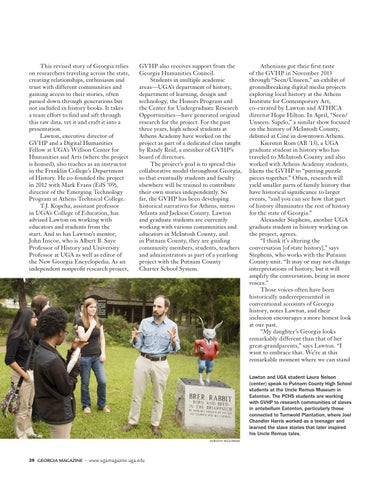
Athenians got their first taste of the GVHP in November 2013 through “Seen/Unseen,” an exhibit of groundbreaking digital media projects exploring local history at the Athens Institute for Contemporary Art, co-curated by Lawton and ATHICA director Hope Hilton. In April, “Seen/ Unseen: Sapelo,” a similar show focused on the history of McIntosh County, debuted at Ciné in downtown Athens. Kiersten Rom (AB ’13), a UGA graduate student in history who has traveled to McIntosh County and also worked with Athens Academy students, likens the GVHP to “putting puzzle pieces together.” Often, research will yield smaller parts of family history that have historical significance to larger events, “and you can see how that part of history illuminates the rest of history for the state of Georgia.” Alexander Stephens, another UGA graduate student in history working on the project, agrees. “I think it’s altering the conversation [of state history],” says Stephens, who works with the Putnam County unit. “It may or may not change interpretations of history, but it will amplify the conversation, bring in more voices.” Those voices often have been historically underrepresented in conventional accounts of Georgia history, notes Lawton, and their inclusion encourages a more honest look at our past. “My daughter’s Georgia looks remarkably different than that of her great-grandparents,” says Lawton. “I want to embrace that. We’re at this remarkable moment where we can stand Lawton and UGA student Laura Nelson (center) speak to Putnam County High School students at the Uncle Remus Museum in Eatonton. The PCHS students are working with GVHP to research communities of slaves in antebellum Eatonton, particularly those connected to Turnwold Plantation, where Joel Chandler Harris worked as a teenager and learned the slave stories that later inspired his Uncle Remus tales.
DOROTHY KOZLOWSKI
28 GEORGIA MAGAZINE • www.ugamagazine.uga.edu
Chocolate Plantation on Sapelo Island is central to the stories Lawton is building for McIntosh County. The ruins of the slave cabins and other structures are made of tabby—a cement formed with lime, sand or gravel and oyster shells—and gradually are succumbing to the elements. “The remains of Chocolate Plantation are miles out into the woods, and they truly deserve to rest in peace,” Lawton says. “It seems to me much better to use technology to let people explore Chocolate and its history off-site.” WAYNE BELLAMY
up and say there are really beautiful parts of our collective past and brutally hard parts of it, and we’re not afraid to tell it all. To be a modern Georgian is to be part of that grand complexity, to know that both the achievements and the struggles of the past are essential to who we are today.” The GVHP not only improves our understanding of history, but it also gives college and high school students the opportunity to gain an impressive host of skills, like finding primary sources, evaluating research and writing. When Athens Academy and Putnam County students go out into the field, for example, “it’s great to have them do hands-on stuff—conducting interviews, doing archival research, things I didn’t do until college,” says Rom. It also helps residents and tourists alike feel a deeper connection to geographical locations. When they stand in front of a landmark and want to know more about it, they can instantly swipe their way through an array of links, all connected in a way so that they can dive as deeply or shallowly as they choose down the rabbit hole of information. Users “can follow their own curiosity,” says Rom. The GVHP is “Georgians telling the history of Georgia,” says Lawton. His ultimate hope is that years from now, it will have created “broad ownership of a story, a moment where we came together and said, ‘here’s who we are.’” Lawton is “an innovator and an educator,” says Nicholas Allen, director of the Willson Center and Franklin Professor of English. “He is passionate about involving students, their families and communities in the creation of knowledge. He has the rare ability to make complex historical realities understandable in contemporary terms. Christopher does this
by evolving digital applications that diversify the paths along which we approach a past that is still very challenging for the present to recognize.” Not only that, but Lawton is tapping into a larger, global moment of enthusiasm for public history—a kind of historygathering that is told by voices outside of academia. “I think there is a movement toward public history worldwide,” says Allen. “You can see it in Europe presently with the centenary of World War I, where people have been encouraged to bring forward documents and objects connected to relatives who served in that conflict. The result has been a much-expanded social history of the war with new focus on its impact on domestic and social life, as much as suffering at the front. Christopher’s work does something similar.” At its heart, the GVHP is about the stories that make us who we are, Allen says. “There are stories buried in the ground,” says Lawton. “They’re in the soil beneath our feet. I can feel them resonate. It’s why I love this place, and I suppose, why I’ve always wanted to be an historian. That’s what we’re after: a way to share that feeling, that history, that sense of humility, responsibility, and absolute awe.” —Mary Jessica Hammes is a freelance writer in Athens. Get More at www.virtualgeorgia.org www.willson.uga.edu/
DECEMBER 2014 • GEORGIA MAGAZINE
29
Downtown renaissance Georgia cities get a makeover with help from UGA’s Institute of Government by Denise H. Horton (ABJ ’83, MPA ’11) photos by Peter Frey (BFA ’94)
O
n a hot Friday afternoon in August, the old Fleet Gas Station north of Cedartown is a reminder of days gone by as 70 to 80 classic cars and hot rods pull into the parking lot. At 5 p.m., the drivers begin a procession that circles through downtown to Pryor Street, where they park outside the Polk County Courthouse #2. For the next two hours, fans stop by to admire vehicles driven by members of the Throttle Jockeys Car Club. By 7 p.m., the downtown crowd has grown as Cedartown residents gather to hear a performance by the band “Little Known Letter.”
30 GEORGIA MAGAZINE • www.ugamagazine.uga.edu
The Fourth Friday Cruise-In and Concert— which drew an estimated 300 people in August—may be the most visible aspect of Cedartown’s effort to revive its downtown, but it’s just the tip of a deep iceberg of plans that townspeople have developed through a statewide partnership that includes the Georgia Municipal Association (GMA), the Georgia Cities Foundation, UGA’s Carl Vinson Institute of Government, and undergraduate and graduate students enrolled in the UGA College of Environment and Design.
Cedartown residents enjoy the city’s Fourth Friday Cruise-In and Concert June 27. The event is part of a revitalization program developed through the Georgia Downtown Renaissance Partnership (GDRP), a collaboration that includes UGA’s Carl Vinson Institute of Government. PHOTO BY AIMEE H. MADDEN
DECEMBER 2014 • GEORGIA MAGAZINE
31
Danny Bivins, public service associate at the Institute of Government, leads UGA’s participation in GDRP’s threepronged approach to bolstering Georgia downtowns. Bivins is principal investigator for the Renaissance Strategic Visioning and Planning program, helps teach the Downtown Practicum and supervises the Downtown Renaissance Fellows program.
“
I’ve been doing planning for 12 years, and I get goosebumps when I think about what has been accomplished in just a year.”
— Danny Bivins
The impetus for the project dates back to a 2011 study of downtowns initiated by a GMA task force. Based on the study, a three-pronged approach was launched in 2013 as the Georgia Downtown Renaissance Partnership, a program that already has helped close to two dozen cities. Cedartown is one of four cities chosen by GMA to participate in the Renaissance Strategic Visioning and Planning (RSVP) program, which focuses on long-term involvement by the public in improving a downtown area. “I’ve been doing planning for 12 years, and I get goosebumps when I think about what has been accomplished in just a year,” says Danny Bivins, principal investigator for RSVP and a public service associate at the Institute of Government. “This program is making a long-term impact.” “Downtowns are important economic development drivers, and we are committed to providing technical assistance and training to help Georgia cities like Cedartown thrive,” says Laura Meadows, director of the Institute of Government. For Cedartown, RSVP came along
32 GEORGIA MAGAZINE • www.ugamagazine.uga.edu
at a perfect time. According to City Commission Chair Dale Tuck, the city already had installed new streetscaping and gathered representatives of various groups, but weren’t sure where to go next. After being selected by GMA to participate in RSVP, citizens were asked via a survey to identify Cedartown’s strengths and needs. More than 1,200 responses were returned, a number that’s almost unheard of in a town of 10,000. Based on the survey, an electronic town hall meeting, meetings with focus groups and one-on-one consultations, Bivins and others with the UGA team identified a number of strengths in Cedartown’s downtown, as well as what was lacking or needed updating. Once the issues had been identified, Tuck, City Manager Bill Fann and other members of the RSVP steering committee established four key groups— organization, design, promotion and economic development—that explored both short- and long-term goals for revitalizing the downtown area. Shortterm goals included the Fourth Friday Cruise-In and Concert series, turning empty storefronts into a “gallery walk” of artwork and seasonal displays, establishing farmers markets in empty parking lots, and arranging for signage directing bicyclists on the nearby Silver Comet Trail to the downtown area. Longer-term goals include redeveloping Big Spring Park, which dates back to the days when tribes of Cherokee lived in the area, and finding ways of recruiting more businesses. On both of these goals, Cedartown has found success in a huge way. “In the case of Big Spring Park, people didn’t see it as green space,” Bivins recalls.
After the park was added to the RSVP plan, the manager of Cedartown’s Home Depot pledged to donate all of the plants that are needed. Likewise, the need for “growing their own” entrepreneurs has led to a unique combination of contributors. “When we talked about this idea, I would have been happy if six or eight people signed up,” Fann says. “We had 14!” “Biz Builders of Cedartown” is providing participants six months of twice-monthly sessions led by business and marketing instructors from Georgia Northwestern Technical College. In addition, the aspiring entrepreneurs meet at least monthly with successful business owners. The highlight for the classes will be a final competition that Fann hopes will lead to several months of free rent for the successful entrepreneur. The successes Cedartown has enjoyed in just 12 months are echoed in the other RSVP cities of Cairo, Bainbridge, Dawsonville and Perry. In fact, the city of Bainbridge won the Georgia Downtown Association Award for Excellence for its branding and marketing campaign. In each instance, Bivins emphasizes that the success of the RSVP program is what happens after the communities receive the 50- to 60-page planning documents at the end of the 14- to 15-week planning time. “What’s missing from most master planning documents is, ‘Who does what, when?’” he says. “Many programs get input from the general public in the beginning, but these programs continue that involvement by putting the names of people into the plans. It’s not the elected officials or the paid staff who are responsible for these action items, it’s the citizens of the city.” The RSVP program is the most intensive, and expensive,
Bivins and the Institute of Government worked with the city of Porterdale several years ago to create a comprehensive plan. The illustration of a kayak and canoe rental venue (left) was one proposal for reusing an already-existing building. That depot later became home to the Porterdale Yak Club (right), which offers kayak rentals.
“
Downtowns are important
economic development
drivers, and we are committed to providing technical assistance and training to help Georgia cities like Cedartown thrive.”
— Laura Meadows
of the three prongs of the Georgia Downtown Renaissance Partnership. Participating cities and GMA contribute several thousand dollars to cover the costs involved in developing the plans. Two additional programs, however, are providing Georgia downtowns the technical support they need to reimagine their communities on a lower-cost scale with the help of UGA College of Environment and Design (CED) students. The Downtown Practicum is a 14-week course during which undergraduate and graduate students concentrate their
DECEMBER 2014 • GEORGIA MAGAZINE
33
Downtown Renaissance Fellows T. Clark Stancil (left) and Erik Lauritsen look at a street scape design in a landscape architecture studio in the College of Environment and Design’s Jackson Street Building. The Fellows program gives students the opportunity to spend a summer working full time on projects for a city. Stancil worked with Fitzgerald this summer, and Lauritsen worked with Newnan.
efforts on particular aspects of a city— designing a mile-long park in the city of Griffin or developing a zoning ordinance for the Olde Town section of Conyers, for example. Working under the supervision of CED Assistant Professor Doug Pardue, Bivins, and Chris Higdon, GMA community development manager, the students present their final designs to city leaders at the end of the practicum. During spring, the first semester it was
taught, 10 students worked with the cities of Griffin, Conyers, College Park, Forsyth, Milton and Washington. The Downtown Renaissance Fellows program, meanwhile, provides two or three CED students the opportunity to spend the summer working full time. Half of the pay for the fellows is contributed by the participating cities while the remainder comes from GMA through its Georgia Cities Foundation.
34 GEORGIA MAGAZINE • www.ugamagazine.uga.edu
During summer 2013, fellows worked with the cities of Gainesville, Milledgeville and Porterdale, while this summer’s fellows worked with the cities of Newnan, Fitzgerald and Hapeville. While each city has its own issues, there are also a number of common themes, including drab city gateways, a lack of parking and city amenities that lack connectivity. The issue of parking nearly led Porterdale city officials to turn a park along the Yellow River into a 600-space parking lot. In 2013, Renaissance Fellow Kristi Korngold began searching for alternatives and also explored the expected cost of building the lot. “Kristi showed where parking spots could be found that would put people all over town who would then walk to the river to go kayaking,” Bivins recalls. “She also documented that it would cost around $3.5 million to build a lot. She stuck to her guns and the city opted to improve the Yellow River Park.” “This is America; there’s plenty of parking,” 2014 Renaissance Fellow Clark Stancil says dryly of the frequent complaint. “There’s too much truth to the song, ‘They paved paradise and put up a parking lot.’” What’s lacking is signage guiding visitors to underused parking spaces, as well as other downtown amenities. Erik Lauritsen, also a 2014 fellow, showed city of Newnan leaders how “guerilla marketing” techniques—such as putting magnetized parking signs on the back of already existing signs—could point drivers toward nearby lots. In other plans, Lauritsen drew several ideas for using an old jail, including turning it into a restaurant and using an adjacent outdoor area for weddings or community concerts. He also showed how gateways into the city could be enhanced with updated lighting, new plantings, pressurewashing a bridge, and painting curbs and utility fencing so they are less visible. “We’re already moving forward, informally, on a phase-in schedule for the bridge improvements,” says Hasco Craver, Newnan’s business development
“
My focus is
honoring the history of these buildings while also proposing solutions that are fiscally responsible.”
— Clark Stancil
Stancil designed a star motif to tie together a strip of buildings that will house Fitzgerald’s utility offices. The idea is drawn from his search of historic maps that showed the Alcyone Hotel was once located on the site. Alcyone is a star found in the Taurus constellation.
director. “We also really liked his conceptual renderings for the old jail.” Having Lauritsen on staff for the summer provided Craver and other Newnan officials the technical and artistic designs they needed to move projects forward. “Being a student, Erik has fresh and different ideas that we’re not aware of,” Craver says. “The resulting packages that he developed give us the opportunity to show these projects to community stakeholders and gain their support.” For history buff Stancil, the city of Fitzgerald offered a particularly exciting opportunity. The city was colonized in 1895 by former Union soldiers who moved from Indianapolis following a severe drought. While much of the city has maintained its beauty, including brick streets, it also has suffered the pangs of some ill-conceived choices, such as the 1960s destruction of a historic hotel to make way for a grocery store. While Stancil’s love for Fitzgerald’s 100-plus-year-old roots is clear, he recognizes the importance of protecting examples of midcentury architecture, as well. For example, for a strip of buildings that will house the city’s utility offices, Stancil showed how a star motif could tie together buildings that date from 1908-1950s. The star idea is drawn from Stancil’s search of historic maps that showed the Alcyone Hotel was once located on the site. Alcyone is a star found in the Taurus constellation. “My focus is honoring the history of these buildings while also proposing solutions that are fiscally responsible,” Stancil says.
Cedartown’s Bill Fann has worked in city management in Florida, Alabama and Georgia since 1978. “Over 30 years I’ve seen a lot of things,” he says. “Someone would get a wild hair, start with a bang and then it would fizzle.” The Downtown Renaissance Partnership, however, has been a very different experience. “It’s important that we’ve had some quick projects, so people can see immediate progress,” he says. “Then there are the long-term projects. We’ve been on a schedule that as one thing nears completion, something else starts.” Mike Starr, who chairs GMA’s Georgia Cities Foundation and co-chaired the 2011 task force, says the program has exceeded his expectations. “The cities have reacted so positively to the students and the Institute of Government staff,” he says. “I expected the students’ work to be good, but they have provided very highquality consultative work, in addition to taking such a very personal interest in the cities. We have received a lot of good feedback about these programs and are hearing from many cities who want to participate.” —Denise H. Horton is a freelance writer in Athens. Get More Carl Vinson Institute of Government: cviog.uga.edu Georgia Municipal Association: gmanet.com College of Environment and Design: ced.uga.edu
DECEMBER 2014 • GEORGIA MAGAZINE
35
NOTES CLASS
SPECIAL
Elizabeth Cauvel (ABJ ’04) made it to the finals of “MasterChef” season five, finishing as runner up. A longtime fan of the show, she auditioned with homemade lasagna, a recipe she’s been working three years to perfect. After making the top 30, she faced challenges including working in teams to feed 500 servicemen and servicewomen on a U.S. Army base and taking command of a legendary Hollywood restaurant. In the season finale, she prepared a grapefruit semolina cake with poached plums and pistachios as her final course. Cauvel is associate creative director at MRY, a digital and social advertising agency in New York City. She also caters private dinners and events. For more information, visit www.elizabethcauvelcooks.com.
CLASS NOTES
Compiled by Daniel Funke
1950-1954 Charles “Chuck” Martin (ABJ ’52) of Belton, S.C., won a first place prize from the South Carolina Press Association for a newspaper article he wrote about his father’s involvement in World War II.
1965-1969 Craig Barrow III (AB ’65) of Savannah was named the Library of American Landscape History’s 2014 Preservation Hero for his environmental stewardship and historic preservation of his ancestral property, Wormsloe. Butch Mosely (BSEd ’65, MEd ’72) of Climax was appointed to the Albany Technical College board of directors. He is
superintendent of the Dougherty County School System. Carol Liberman (BSEd ’67) of Houston, Texas, was named a finalist to represent the Astros baseball team as Teacher of the Year at the 2014 Major League Baseball All-Star Game. She retired this year after teaching at Robert M. Beren Academy for 21 years. Charlie Timmerman (BSA ’68, DVM ’70) of Aiken joined the advisory board for equine products at BioAdaptives Inc., where he will continue testing products that increase stem cells in humans and animals. Stephen Watson (BBA ’68) of Lakeland, Fla., was included in the 2015 edition of Best Lawyers, a law publication that recognizes leaders in the industry.
1970-1974 John David Jones Bloodworth (BSEd ’72, MA ’75) of Gulf Breeze, Fla., teaches business communication
36 GEORGIA MAGAZINE • www.ugamagazine.uga.edu
at the University of West Florida and has spent the past two years raising an English bulldog. Tom Landrum (AB ’72, MA ’87) of Watkinsville was named a senior consultant for Lighthouse Counsel, a firm that provides consulting services to nonprofit organizations. Lamar Paris (BBA ’72) of Blairsville was appointed to the Public Defenders Standards Council by Georgia Gov. Nathan Deal. David Garfinkel (AB ’73, MPA ’75) of Jacksonville, Fla., was included in the 2015 edition of Best Lawyers, a law publication that recognizes leaders in the industry. Bob Giles (ABJ ’73) of Marietta accepted a position as senior writer-editor in Institute Communications at Georgia Tech in July. Mid Ramsey (BBA ’73) of Watkinsville retired from Athens First Bank & Trust after 41 years and began a practice in executive coaching and leadership development.
ALUMNI PROFILE
A road less traveled Alumnus overcomes humble beginnings to pursue his passion by Daniel Funke As a son of South Georgia sharecroppers, nothing has ever come easy for Robert Jones (MS ’75). But that didn’t stop him from making his way from the cotton and peanut fields of the Peach State to becoming the president of a major research university. Jones grew up in Dawson and knew from an early age that he wanted to be a scientist. He was able to find an outlet for his innate curiosity by studying agronomy at Fort Valley State University, but his background proved to be a formidable obstacle to receiving an education. “It was not an easy transition because my father was a sharecropper and my mother was a domestic and clearly they didn’t have the resources to send me even to an undergraduate school,” he says. “So I had to work a fulltime job during my junior and senior year [of high school] in order to save enough money to pay for my education at Fort Valley my freshman year.” After getting his first taste of higher education, Jones was hooked. He earned a master’s degree at UGA and a doctorate at the University of Missouri—both in crop physiology—and landed his dream job as a professor of agronomy and plant genetics at the University of Minnesota. But Jones felt alienated from the community. In order to better connect with other African Americans, he began singing with the Grammy Award-winning choral ensemble Sounds of Blackness. “I joined essentially out of a sense of isolation, because there were very few African Americans in the Twin Cities that I was acquainted with,” he says. “And I joined primarily as a way [of] connecting back to the AfricanAmerican community through music.” Jones says his experience with Sounds of Blackness gave him perspective on his role in higher education, and today he strives to promote policies that encourage research expansion and greater involvement in the sciences by underrepresented communities. “I’d like to see people from more underserved backgrounds, particularly women and students of color, pursue these disciplines because I think the future of science and technology depends on that,” he says. After nearly 35 years at the University of Minnesota— serving in key administrative leadership positions during the last 15—Jones left to become the president of the
Robert Jones
MARK MCCARTY, UNIVERSITY AT ALBANY
University at Albany, State University of New York. “In a lot of ways the job is similar,” he says. “Developing a compelling vision of where the university is going in the future and how … we move to the next level of excellence. That’s what I find most gratifying and most exciting about my role here as president.” He’s a long way from South Georgia, and Jones hasn’t forgotten the journey that brought him to where he is today. “It’s a road less traveled, it was difficult, but nothing has ever been easy for me in this life,” he says. “I’ve always been able to make the best of it.”
DECEMBER 2014 • GEORGIA MAGAZINE
37
CLASSNOTES
® As fall comes to a close around the Arch and between the hedges here in the Classic City, let me take this opportunity to wish you and your family a happy new year. If you have not visited campus this year, I encourage you to do so in the near future. There are many exciting changes taking place on campus. UGA broke ground on a new $44.7 million, state-of-the-art Tim Keadle Science Learning Center on South Campus. The Terry College of Business is progressing nicely on Correll Hall, between Lumpkin and Hull streets. Foley Field enjoyed major renovations and should be ready for the 2015 season. On a tasty note, the new Bolton Dining Commons opened for fall semester at the corner of Baxter and Lumpkin streets. You really should see all of these changes in person—it is inspiring! Also inspiring is the ongoing support of our more than 121 alumni chapters around the world. I want to thank the Lake Oconee Area Chapter of the UGA Alumni Association for making a $2,500 donation to the Georgia Fund in September in support of student scholarships on campus. What an outstanding effort by our Bulldog alumni and friends just south of Athens. On Feb. 7, the UGA Alumni Association will once again host the Bulldog 100 Celebration in Atlanta. I am looking forward to hearing from keynote speaker Hala Moddelmog (MA ’81), the first female president and CEO of the Metro Atlanta Chamber, and a former president of Arby’s Restaurant Group. This year’s No. 1 Bulldog 100 business will also be unveiled that evening. Which Bulldog-owned or -operated company will come out on top this year? Join in the festivities to find out! Please also mark your calendar for May 1-3, when the second Return to the Arch Alumni Seminar will be held in Athens. This three-day educational experience will welcome UGA alumni and friends of all ages back to campus to enjoy the wisdom (and entertainment) of UGA’s outstanding professors and leaders. Visit www.alumni.uga.edu/alumniseminar for more information. To those of you who have made a financial contribution to the university this year, I sincerely thank you. If you have not yet contributed, please make UGA a part of your philanthropy plan for 2015. The UGA Alumni Association staff and its board of directors are here to protect and promote the traditions and best interests of the University of Georgia. Call on us at any time to help you engage with the University of Georgia. Always a Dawg, Tim Keadle (BBA ’78), president UGA Alumni Association
UNIVERSITY OF GEORGIA ALUMNI ASSOCIATION Meredith Gurley Johnson (BSFCS ’00), Interim Executive Director ALUMNI ASSOCIATION OFFICERS Tim Keadle (BBA ’78) President, Statham Ruth Bartlett (BBA ’76) Vice President, Hilton Head Island Jennifer Chapman (BBA ’97, MAcc ’98, JD ’02) Treasurer, Athens Bonney Shuman (BBA ’80) Assistant Treasurer, St. Simons Island Julie Reynolds (BSHE ’81) Secretary, Lawrenceville Steve Jones (BBA ’78, JD ’87) Immediate Past President, Atlanta
38 GEORGIA MAGAZINE • www.ugamagazine.uga.edu
ALUMNI ASSOCIATION WEBSITE www.alumni.uga.edu 800/606-8786 or 706/542-2251 ADDRESS CHANGES www.alumni.uga.edu/myinfo
1975-1979 Michael Haggerty (BBA ’75) of Dallas, Texas, was included in the 2015 edition of Best Lawyers, a law publication that recognizes leaders in the industry. Mark Hollinger (BSA ’76) of Los Altos, Calif., was nominated for a position on the American Society of Landscape Architects Council of Fellows for his work in melding landscape elements and golf course design concepts. Terry Parker (BBA ’77, MAcc ’78) of Macon was elected to serve as the 2014-15 chair of the Georgia Society of Certified Public Accountants. Bruce Lucia (BBA ’79) of Stone Mountain is president of Kroger’s Southeast Region division and opened the largest Kroger store in Georgia in north Athens in August.
1980-1984 David A. Landis (BSEd ’80) of Dacula received the Lifetime Service to Wrestling Award from the National Wrestling Hall of Fame and Museum in Stillwater, Okla. He coached wrestling for more than 30 years at high schools in the Atlanta area. Mark Ethier (BS ’81) of Indian Rocks Beach, Fla., was appointed president and chief operating officer of Infusion Brands Inc. Kim Boyd (BBA ’82) of Atlanta was named in the top 5 percent in the individual category for the Atlanta Board of REALTORS 2013 Million Dollar Club. Boyd has been recognized in that category four times during her career. Remer Brinson III (BBA ’82) of Augusta was named the 125th chairman of the Georgia Bankers Association. He is currently the president and CEO of First Bank of Georgia. Dan Forsman (BBA ’82) of Lawrenceville was recognized by the Atlanta Business Chronicle as the Most Admired CEO for Residential Real Estate in August. He is president and CEO of Berkshire Hathaway HomeServices Georgia Properties. Greg Barfield (AB ’83, EdD ’94) of Marietta was named lead program specialist at the Georgia Workforce Initiative, where he will work with Georgia-based businesses and schools to create innovative educational programs. Steve Daniel (BBA ’83) of Thomaston
ALUMNI calendar Tuesday, Jan. 27 UGA Founders Day Lecture, UGA Chapel The UGA Alumni Association and the UGA Emeriti Scholars will host the 2015 Founders Day Lecture to celebrate the university’s 230th birthday. The 2015 Founders Day Lecture will be presented by Paul M. Kurtz, UGA School of Law associate dean for academic and student affairs and J. Alton Hosch Professor of Law Emeritus.
Saturday, Feb. 7 Bulldog 100 Celebration Atlanta Marriott Marquis Reception: 6 p.m.; Dinner: 7 p.m. Join the UGA Alumni Association as it reveals the Bulldog 100 rankings of the fastest-growing businesses owned or operated by UGA graduates. Visit www.alumni.uga.edu/b100 for more information.
DELL WEST (MBA ’04)
This summer, the Raleigh Chapter of the UGA Alumni Association hosted incoming students from the Class of 2018 for a Freshman Send-Off at a local ice cream shop. Alumni were on hand to share advice with the students and their parents.
Saturday, March 21 Dawg Trot 5K Run/Walk Join hundreds of UGA alumni and friends for a scenic walk, jog or run across the university’s beautiful campus. Registration will open in early 2015 at www.alumni.uga.edu/dawgtrot.
Tuesday, March 31 Senior Signature Deadline Graduating students are invited to make a gift to the university through the Senior Signature campaign. Names of students who donate by this date will be included on the Class of 2015 plaque in Tate Plaza. Visit www.alumni.uga.edu/seniorsignature for more information.
Friday, May 1, to Sunday, May 3 Return to the Arch Alumni Seminar UGA alumni and friends are invited to return to campus for a three-day educational weekend on campus filled with presentations and interactive seminars by UGA’s leading faculty and staff. Registration will open in January at www.alumni.uga.edu/alumniseminar. To learn about these and other events, please visit www.alumni.uga.edu/calendar.
SPECIAL
The Lake Oconee Area Chapter of the UGA Alumni Association generously donated $2,500 to the Georgia Fund to support student scholarships at UGA. Presenting the check is (left to right) David Owens (BS ’72, BSEH ’77); Mark Higgins (BBA ’73); Meredith Gurley Johnson (BSFCS ’00), interim executive director of the UGA Alumni Association; David Key (BBA ’84), president of the Lake Oconee Area Chapter; Howard McMichael (BSA ’92); and Robert Copeland (BBA ’70).
For more information: alumni@uga.edu (800) 606-8786 www.alumni.uga.edu
DECEMBER 2014 • GEORGIA MAGAZINE
39
CLASSNOTES
I
WHY give
became president of West Georgia Technical College this fall. Brian Lane (BBA ’84) of Marietta was appointed chief financial officer of Endeavor, a company that provides networking and information technology support as well as other services.
1985-1989
Robert H. Ayers (right) and his late wife, Mary Frances
SPECIAL
Garden gift Emeritus professor honors his late wife by Emily Williams Robert H. Ayers and his late wife, Mary Frances, often walked together in the State Botanical Garden of Georgia. “She had a great love for all of nature and animals and plants and so on,” Ayers says. To honor Mary Frances, Ayers made a gift to the garden that will be used to build the Theatre-in-the-Woods. The theater will be an open-air, outdoor space for plays, music, dance, movie screenings and demonstrations in a naturally sloped, rustic setting shaded by 60-foot trees. Ayers, an emeritus professor of religion, came to UGA in 1945 as university chaplain and assistant professor of religion in the department of philosophy and religion. Over the years he was promoted to full professor and at one time served as head of the department. In 1984 Ayers retired, but continued to teach full time for five additional years—without taking a salary— so that the university could establish a department of religion. His effort was recognized with a proclamation from then Georgia Gov. Joe Frank Harris. “My friend George Howard was head of [the department]. I haven’t seen George in a while—that rascal,” Ayers says. “And Will Power, who is still teaching by the way, he’s 70 years old and still going strong.” The Theatre-in-the-Woods is part of what will become a larger Children’s Garden. Construction is expected to be completed in spring 2015. The garden has raised $2.5 million of the $5 million project to date. “We wanted to do anything we possibly could financially and otherwise so that the Children’s Garden will be completed,” Ayers says. “Mary Frances and I loved the garden,” he says. “It is a fitting memorial for her.”
40 GEORGIA MAGAZINE • www.ugamagazine.uga.edu
Kim Collins (BS ’85) of Wadmalaw Island, S.C., received an Excellence in Teaching Award from the College of American Pathologists at its annual pathology conference. James Wallace (AB ’85) of Atlanta was recognized on Barron’s Top 400 Financial Advisers list for his work in asset and revenue advising. Nancy Elder (ABJ ’88) of New York City, N.Y., was appointed vice president for communications at JetBlue Airways, where she oversees media relations and crisis communications. Jodie Braner (ABJ ’89) of Marietta was named president of the Georgia Association of Health Underwriters. Laura Lunde Clark (BFA ’89, MPA ’98, PhD ’08) of Athens became direcctor of undergraduate programs for the Terry College of Business in August. She has worked at UGA since 1993 and with the Terry College since 2010. Steven Colquitt (ABJ ’89) of Bogart was chosen as the 2013-14 Employee of the Year for the UGA Athletic Association, where he is an associate sports communications director. Kevin Jones (BSEd ’89) of Newnan became principal of Winston Dowdell Academy in September after serving as assistant principal at East Coweta High School for two years. Ted Wynn (BSA ’89) of Social Circle was recognized at a town luncheon June 7 for his nine years of work as a Newton County extension agent.
1990-1994 Joel Bulger (ABJ ’90) of Alpharetta is the new chief marketing officer of the Johnny Rockets restaurant franchise. In the past he served as vice president of marketing at Church’s Chicken and vice president of brand marketing at Moe’s Southwest Grill in Atlanta.
Gerald Cushenberry (AB ’91) of Joint Base Andrews, Md., retired from the U.S. Air Force after 23 years of service. Mark Spain (BBA ’93) of Cumming and his Keller Williams realty team ranked No. 2 in the country on a list of the top 250 American real estate teams by The Wall Street Journal and REAL Trends. Sean Taylor (BBA ’93) of Atlanta is a partner at Smith & Howard accounting firm, which was named the No. 1 CPA firm in the nation for 2014 by INSIDE Public Accounting. Kelley Carruthers Buttrick (ABJ ’94) of Bishop voices national advertisements and provides corporate narration for firms including IBM and Tiffany & Co. from her Athens-based studio. She has also provided an on-set voiceover for a character on a Tyler Perry television series. Jay Ferguson Jr. (AB ’94) of Atlanta received the General Counsel of the Year Award in the large employer category at the 2014 Corporate Counsel Awards from the Atlanta Business Chronicle and the Association of Corporate Counsel. Ferguson is currently the chief legal officer of Ranstad North America in Atlanta. Scott Gary Grant (ABJ ’94) and Lisa Wilbanks Grant (BSEd ’02) of Gainesville welcomed their third child, Samuel Gary Grant, Aug. 4. Charlie Sutlive (ABJ ’94) of Atlanta was appointed vice chancellor for communications for the University System of Georgia in September.
1995-1999 Mark Abrams (BBA ’95) of Powder Springs is a partner at Smith & Howard accounting firm, which was named the No. 1 CPA firm in the nation for 2014 by INSIDE Public Accounting. Chad Smith (AB ’95) of Baldwin was named chief of the Cornelia Police Department, where he has worked for nearly 20 years. Linsey Bozzelli (AB ’96) of Philadelphia, Pa., received a Most Powerful and Influential Women Award from the Pennsylvania Diversity Council for her work in business and corporate law. Brian Johnson (ABJ ’96) of Kennesaw was named director of planning and environmental
Ultimate Bridal Show Athens’ only boutique bridal show
Sunday, January 25, 2015 12:30pm - 4:30pm at the Graduate Athens Tickets are $10 and available onsite.
Presenting Partners:
Visit our site for more info:
www.AthensWeddingProfessionals.com
management at the Georgia Department of Community Affairs. Paul Atkinson (BBA ’97) of Suwanee is a partner at Smith & Howard accounting firm, which was named the No. 1 CPA firm in the nation for 2014 by INSIDE Public Accounting. Jennifer Wrinkle Hasnani (BSFCS ’97) of Whitwell, Tenn., and her husband, Kaz Hasnani (BS ’97), welcomed daughter Mallory Grace June 6. James McNaughton (BBA ’97) of Tuscaloosa, Ala., received tenure and promotion to associate professor of English at the University of Alabama. Mary Paige Adams (ABJ ’98, JD ’02) of Atlanta was appointed to the State Ethics Commission of Georgia. Lorraine Riffe Hawley (ABJ ’98) of Arlington, Va., was reappointed to the Investment and Trade Advisory Committee on Trade Facilitation and Customs Matters by U.S. Secretary of Commerce Penny Pritzker and U.S. Trade Representative Michael Froman. Hawley is director of international
government relations at the company Archer Daniels Midland. Sarah Visser (AB ’98, MPA ’90) of Grayson is the 2014-16 president for the Keep America Beautiful State Leaders Council. She joined the Georgia Beautiful Foundation in May 2011 as its first executive director and was named on the Atlanta Business Chronicle’s 50 People in Sustainability list. Kasey Libby (AB ’98) of Atlanta joined the law firm Caldwell & Watson LLP as a litigator specializing in estate and trust disputes. Jeff Fortner (BBA ’99) of Smyrna joined SK Commercial Realty as senior vice president within the company’s Healthcare Real Estate division. Robert McCorkle (BBA ’99, JD ’02) of Savannah was sworn in as the fourth president of the Metropolitan Savannah Rotary Club in July. Chris Mixon (AB ’99) of Marietta was promoted from regional community executive to executive vice president of the Bank of North Georgia. David Platt (ABJ ’99, AB ’00) of Loxahatchee, Fla.,
DECEMBER 2014 • GEORGIA MAGAZINE
41
CLASSNOTES
ALUMNI PROFILE
Silver screen dream A former Hairy Dawg fights to make it in the film world by Lori Johnston (ABJ ’95) In true director form, Matthew Perkins selects the ideal location to tell the story of “The Little Tin Man,” which started as a UGA class project 10 years ago. The place: Bryant Park in New York City. The scene: Professionals and picnickers are enjoying a sunny September afternoon. Then a five-person camera crew—unrelated to Perkins (AB ‘06) and his filmmaking— suddenly sets up in metal chairs nearby. As they start rolling, Perkins, wearing a black Georgia hat, shares his ups and downs in the industry and discusses the Kickstarter campaign that funded his independent film. In “The Little Tin Man,” co-written and co-produced by Perkins and Dugan Bridges (ABJ ‘06), Aaron Beelner (MA ‘05) plays Herman, a dwarf actor who is tired of being overlooked and sets out to be cast as the Tin Man in a remake of “The Wizard of Oz.” This fall, independent film distributor Gravitas Ventures released “The Little Tin Man” on Vutopia (a Time Warner streaming service) and digital platforms such as iTunes, Amazon and Google Play. In quirky timing, 2014 marked the 75th anniversary of “The Wizard of Oz.” Perkins, a former Hairy Dawg mascot who describes himself as a “dreamer,” says the idea began in 2004 at UGA after he and Bridges saw Beelner being offered roles that seemed to exploit his size. A couple of years after writing the script, an investor offered $2 million to make the movie, under one condition: Beelner couldn’t play the lead because he seemed too old. “We wound up walking away from that deal,” Perkins says. “There was so much of his life story woven into what we wanted to do. Something seemed wrong about having him be cut out of the process.” Perkins held on to his dream, remembering his conversations with now-retired UGA professor Jim Herbert about the indie film industry and the persistence and dedication required. “I think he has a calling,” Herbert says. “That’s sustained him for 10 years, to know that he wants to have this film come to life.” Perkins credits UGA for developing his entrepreneurial spirit. Under the Franklin College’s interdisciplinary studies program, Perkins created his major in film production. When he moved to New York City, a chance meeting at a bank led to a job on the 2007 film “American Gangster” and then he
42 GEORGIA MAGAZINE • www.ugamagazine.uga.edu
(left to right) Perkins, Beelner and Bridges
CONTRIBUTED
interned with actor Fisher Stevens’ company, GreeneStreet Films. In 2012 Perkins decided to try Kickstarter to fund the movie. The campaign raised $100,000 for the 18-day shoot in New York City, where he lives. “The Little Tin Man,” which was shown at 11 film festivals, is expected to have a limited theatrical release. “It really brings me a lot of joy when we show it in a group of people, and there’s consistent laughs. I lead with the comedy, and sort of endear you with the characters, but then you actually care about what they’re going through,” he says. “It’s Aaron’s story, but it’s also a lot of my story. It’s about feeling like an underdog and wanting to be recognized.”
—Lori Johnston is a writer living in Watkinsville.
Your source for
was elected president of the Southern Baptist International Mission Board in August by the organization’s trustees. Amy Funk Wolkin (BSEH ’99) of Atlanta received her doctorate from the University of North Carolina’s School of Public Health. She works for the National Center for Environmental Health at the Centers for Disease Control and Prevention in Atlanta.
everything UgA
2000-2004 Amanda Parker Baggett (ABJ ’00) of Jacksonville, Fla., received a Women of Influence award from the Jacksonville Business Journal for her work at Rogers Towers commercial law firm. Scott Hunter (BBA ’00) of Albany was named a member of the Wells Fargo Premier Advisors Program. Matt Pollard (BBA ’00) of Boulder, Colo., was named vice president of the IT services company IntelliSource. Natalie Virginia Price (BBA ’00) of Mableton was promoted to director of benefits and total rewards at the industrial product distributer HD Supply. Matthew Shropshire (BBA ’00) and Christy Shenefield Shropshire (BBA ’01) of Athens welcomed their second son, Aaron Jordan (A.J.), in April. Christy received tenure and was promoted to associate professor of management in the Terry College of Business in July. Ben Taylor (AB ’00) of Ashburn was named Bryan County administrator in July. Previously he was the Ashburn city manager. Carolina Watts (AB ’00) of Los Angeles, Calif., was elected to serve as chair of the board of directors of the Council of Parent Attorneys and Advocates, a national nonprofit organization that protects the civil rights of students with disabilities and their families. Sara Greeson Mitchell (BMus ’01) of New York City was named director of arts at the Bronx Charter School for the Arts. W. Ramsey Allen Jr. (BSEd ’02) and Kimberly McLean Allen (BSFCS ’99) of Cornelia welcomed their second daughter, Quinn Harper Allen, Nov. 8, 2013. Beth Thompson (BFA ’02) of Athens debuted her photography exhibit titled “Possible Perceptions: Exquisite Shards of Nature” in September. The exhibit featured
Next to Tate Center • 706-542-3171
TexTbooks
supplies
www.ugabookstore.com
Gear
Distingu isheD Li v ing Wsb tv
ChuCk DoWDLe’s home
5.8 aCre e state
th e g eorgi a C Lu b a g at e D g oL f C om mu n it y
ta ngL e brook n ort h o Con e e s ChooL s
Preview Georgia Club Real Estate Listings, both New and Resale Homes. Get Current Information about Homes in The Georgia Club and other Athens Area Real Estate Listings. Search more than 2,000 homes at www.AthensGeorgiaHomes.com.
D istinguisheD r e a Ltors ® Judy McDonald REALTOR®
404-863-9881
Carol Bitner
REALTOR® CRS, GRI
706-202-9358
DECEMBER 2014 • GEORGIA MAGAZINE
43
Reading list
Books by UGA Alumni
Elite Minds BookLogix (2013) By Dr. Stan Beecham (AB ’83) A gold medal winner in the 2014 IBPA Benjamin Franklin Awards, this book explores the relationship of the mind to physical performance to help readers reach their full potential. Confessions of a Public Transit Commuter Lulu.com (2014) By Gary B. Hulsey (BS ’64) The author’s observations on his surroundings, written during a year of commuting by public transit. Athens Arcadia Publishing (2014) By Patrick Garbin (BBA ’98) Featuring more than 160 images, this book explores the history of Athens from the 1960s to the present.
44 GEORGIA MAGAZINE • www.ugamagazine.uga.edu
Inventing Baseball Heroes Louisiana State University Press (2014) By Amber Roessner (BSEd ’03, MA ’06, PhD ’10)
The Rich Young Ruler: A Biblical Novella and Other Short Stories Westbow Press (2011) By George Grove (AB ’60, MA ’61)
A former sportswriter examines “herocrafting” in sports journalism by analyzing coverage of Detroit Tigers outfielder Ty Cobb and New York Giants pitcher Christy Mathewson.
“Might have been” stories, faithful to Scripture, that bring to life biblical characters.
Forever Christmas Thomas Nelson (2014) By Robert Tate Miller (ABJ ’84) A literary agent questions his obsession with success after a snowstorm accident, and a Christmas miracle gives him a second chance at love, life and gratitude. Endeavor: One Polish Family’s Journey from Siberia to Freedom CreateSpace Independent Publishing Platform (2014) By Hilary Shew (ABJ ’85) The true story of the Raczynski family, who were sent to Siberian work camps in 1939 after Russia invaded Poland and who later made a 20,000-mile journey to the United States.
Corporate Rules MedEcon Analytics LLC (2014) By Dennis Carr (AB ’80, MA ’81) Corporate CEO Cal Hunter is recruited to launch a blockbuster drug but discovers irregularities in clinical trials, leading to a game of cat and mouse. Little Stockey and the Miracle of Christmas CreateSpace Independent Publishing Platform (2011) By Gale Nemec (BSEd ’73, MEd ’74) The smallest Christmas stocking meets an angel and learns the true meaning of Christmas.
Submit new books written by UGA alumni to gmeditor@uga.edu. Please include a brief description of the book and a hi-res cover.
Deserving Desire: Women’s Stories of Sexual Evolution Rutgers University Press (2014) By Beth Montemurro (MA ’98, PhD ’01) Based on a study with 95 women, this book explores the development of sexuality through women’s lives and the events that change the way women feel about themselves, their bodies and their relationships. A Golden Weed Yale University Press (2014) By Drew A. Swanson (PhD ’10) A history that explores the transition and consequences of American tobacco, from colonial staple to the core of a national cigarette industry. Justice and Responsibility— Sensitive Egalitarianism Palgrave Pivot (2014) By Robert C. Robinson (PhD ’12) This text outlines an approach for identifying inequalities, helping to determine those for which it is fair to hold one responsible, and those for which it is not.
Mama Harris’ Fried Pie Army JHM Children’s Books (2013) By Richard Mandell (BLA ’90)
Iranian Tapestry: A Thriller Amazon Digital Services (2014) By Henry Eason (MA ’74)
Strange and Ever After HarperTeen (2014) By Susan Dennard (BSFR ’07)
In this children’s story, an army of fried pies baked by a nonagenarian, a stray squirrel and a souped-up Mustang convertible send the fictional town of Josh, Ga., into a tailspin.
A novel based loosely on Eason’s experiences covering the Iranian Revolution as a Washington correspondent in 1980.
In this conclusion to Dennard’s trilogy, Eleanor Fitt must control her growing power, face her feelings for a certain inventor and confront an evil necromancer.
Leading Executive Conversations Sally Williamson and Associates (2014) By Sally Williamson (ABJ ’83) This book provides a framework for organizing an executive-level conversation that will lead to a clear decision. What We Talk About When We’re Over 60 Deeds Publishing (2014) By Linda Hughes (EdD ’03), Sherri Daley and others Thirty women from a variety of backgrounds share stories about the events that changed their lives.
The Dragon Dreamer Lind Press (2014) By Jenny S. Burke (MEd ’96) This illustrated young adult science fiction novel follows the adventures of Arak, a dragon with special talents. Winterville, Georgia Self Published (2014) By Emma Foley (BBA ’08) and Mary Quinn In this book, the people and places of historic Winterville, Ga., are explored through images and stories. Financial Peace of Mind from the Word BISCA Publishing (2014) By Stan Hutchinson (BSAE ’71) Daily insights examine what the Bible has to say about money.
Auditory Electrophysiology: A Clinical Guide Thieme Medical Publishing (2012) By Samuel R. Atcherson (BSEd ’97, MEd ’00) and Tina M. Stoody Written by audiologists, this guide provides a fresh perspective on current advances and practices and includes research and clinical information. Bugs @ Play Black Kettle Books (2014) By Ann Blum (MEd ’72) This collection of puppet plays uses insect characters to teach students about topics including insect identification, life cycle and defense strategies.
DECEMBER 2014 • GEORGIA MAGAZINE
45
CLASSNOTES
ALUMNI PROFILE
Taking her best shot A top UGA debater now leads high schoolers to victory by Lori Johnston (ABJ ’95) Shuntá Jordan called the shots daily while playing pool as a student in the old game room at the Tate Student Center. As the J.B. Fuqua Chair of Speech & Debate at Pace Academy in Atlanta, she’s drawn on her competitive nature and experience CONTRIBUTED Shuntá Jordan on UGA’s Georgia Debate Union to help students win seven state debate championships and one national championship. Jordan (BSFCS ’98, MEd ’03) began debating at Atlanta’s Therrell High School, which was part of the country’s first urban debate league, and received debate and science scholarships to attend UGA. In 1994, Jordan, a UGA sophomore, made history as the first black woman to qualify for and compete in the national debate tournament. “Debate allowed me to know that I had a voice and that [my] voice mattered,” she says. “It was just an activity that took off my competitive edge and was also something that I really, really enjoyed.” She left the debate team after competing in the national championship and spent hours playing pool at Tate, where she ended up working, and in local pool leagues. “My uncle had a convenience store where we lived and there was like a small bar table and he couldn’t be beaten, so when I went to college and saw real tables I was sort of driven to improve my game so I could beat him,” Jordan says. “So when I came back home and finally beat him, I stopped playing him and then started playing much better players.” Jordan bested other students in regional competitions and advanced to a national college tournament. After graduation, she played in tournaments around the country and decided to earn her master’s in education. In 2003, it was time for her to give up pool and cue her love of debate. Fall 2014 marked her 10th year as director of debate at Pace (she’s also the assistant varsity girls basketball coach). “I always wanted to be a teacher, but I didn’t necessarily think that I would be coaching debate,” she says. “Basketball and debate won out eventually.” In 2013, a two-person Pace Academy team coached by Jordan won the National Debate Coaches Association’s National Championship. “It was my first national championship win, and the kids were quite excited about it,” she says. Jordan has the ability to engage in team building, whether it’s with debate, pool or basketball, and her humility and self-deprecating sense of humor have helped her relate to classmates, competitors and students, says Ed Panetta, director of the Georgia Debate Union, who coached Jordan. “She doesn’t mind who gets credit,” he adds. Sometimes, a student will exhibit the same competitive drive that Jordan displays in debate, pool, basketball and even iPhone games. When that happens, she finds it “joyful to watch them grow and mature.”
— Lori Johnston is a writer living in Watkinsville.
46 GEORGIA MAGAZINE • www.ugamagazine.uga.edu
photographs of the world from different or unique perspectives. Raymond Patton (AB ’03) of Springfield, Mo., received the Faculty Award for Liberal Learning from Drury University. Reagan Wolfe (BBA ’03) of Atlanta was named a 2014 Top Advisor Under 40 by the Atlanta chapter of the National Association of Insurance and Financial Advisors. He and his wife, Julia Wolfe (ABJ ’03), welcomed daughter Leighton Marie Wolfe June 19. Angelia Chappelear (BSA ’04) of Winterville and her dog Fantasy participated in the American Kennel Club’s Boxer Nationals competition in May, where Fantasy was honored in the Parade of Champions due to her 23 performance titles in obedience, rally, agility, lure coursing and therapy work. Logan K. Fields (BS ’04) of Morgantown, W.Va., joined the Athens Bone and Joint Orthopedic Clinic as an orthopedic surgeon. Thomas Hartridge (AB ’04) of Savannah was hired as a business insurance adviser by BB&T Insurance Holdings. Dave Haywood (BBA ’04) and Charles Kelley (BBA ’04) of Nashville, Tenn., and their band Lady Antebellum were inducted into the Georgia Music Hall of Fame with the Performer Award.
2005-2009 Sarah Swingle Guest (BSEd ’05) of Decatur was named Teacher of the Year at Camp Creek Elementary School, where she teaches fifth grade. Brooke Henze (BSA ’05) of Atlanta launched gift company Swell Forever in December 2013 and released a line of blankets and dresses for babies and toddlers. Bret Joiner (BSEd ’05) of Athens opened a new location of his physical therapy practice TherapySouth in Athens, marking the 18th clinic opening since the company’s creation in 2006. Nancy Palmer (AB ’05) of Athens was named the first executive director of the Georgia Craft Brewers’ Guild, a nonprofit group that represents the state’s craft breweries. Robyn K. Adams (AB ’06, JD ’14) of Gainesville joined the law firm Smith, Gilliam, Williams & Miles in 2014, where she practices family law. Eddie Garrett (BSA ’06, MBA ’08) of Winnetka, Ill., was named executive vice president and
head of strategy at the public relations firm Weber Shandwick. Jonathan W. Riffle (BS ’06) of Martinez received a doctor of osteopathic medicine degree from the Philadelphia College of Osteopathic Medicine – Georgia Campus. He began a neurosurgery residency at Tulane University in July. Candace Thompson (AB ’06) of Mableton took a position as lead nurse in treatment and research for Georgia Detox and Recovery Centers, which is affiliated with the Medical College of Georgia at Georgia Regents University. Jacob Matthew Cason (BBA ’07) of Marietta and his wife, Kayla Cason, welcomed daughter Nancy Kate July 30. Cason is vice president for the wealth management firm Diversified Trust. Will Childers (BBA ’07, MPH ’09) of Athens and Katie Rogers (BBA ’07) of Atlanta were married May 31 at Cloverleaf Farm in Arnoldsville. Matthew Farmer (BS ’07) of Augusta joined Athens Internal Medicine Associates as an internal medicine specialist, where he will provide primary and preventive care. S. Michael Gaddis (AB ’07, BBA ’07) of Ann Arbor, Mich., will become assistant professor of sociology at Pennsylvania State University in fall 2015. Edward Patrick Stapleton (ABJ ’07) of Brooklyn, N.Y., accepted a position as a promotions producer for WABC-TV in New York City. In June, he married Shana Till in Columbia, S.C. Jessie Barnett (BBA ’08, MPH ’10, PhD ’13) of Athens started a full-time public health staff position at the University of Minnesota at Rochester. Josh Irvin (BS ’08) and Dawn Bryan Irvin (BS ’08) of Ashburn welcomed their first child, Aubrey Lynne Irvin, June 23. Alexander Maggioni (AB ’08) of Fayetteville joined the Detling Law Group in Marietta as an associate attorney. Katie McCarver Miranda (BMus ’08) joined the fine arts faculty of Kell High School in Cobb County as chorus director. Barry Porter (AB ’08) of Tyrone was elected to the Mecklenburg County Bar Diversity and Inclusion Committee. Courtney Rogers (BSFCS ’08) of Atlanta was awarded both the 2014 30 Under 30 Award by the National Kitchen & Bath Association and the 40 Under 40 Class of 2014 Award from
DEAR OLD UGA Your Stories. Your Memories. Available at:
Amazon, Barnes&Noble and the University of Georgia Bookstore
1893 - 2014 THE UNIVERSITY OF GEORGIA®
Veterinary Teaching Hospital
New Hospital / New Location • Moving in Spring 2015! The site includes a state-of-the art hospital for large and small animals, a covered equine performance arena and an education center. Providing 24-hour emergency services and advanced animal healthcare 706.542.3221 • www.vet.uga.edu/hospital
DECEMBER 2014 • GEORGIA MAGAZINE
47
CLASSNOTES
ALUMNI PROFILE
Virtual virtuoso Alumnus blends technical prowess and artistic touch as visual effects supervisor for movies by John W. English Chris Wells is a Hollywood pioneer in the field of computer-generated visual effects for live-action motion pictures, racking up 44 film credits over the past two decades. “I’ve always liked making things,” Wells says over brunch in Los Angeles, where he lives and works. “When I was at UGA, I had free rein to experiment in early computer animation in the art department. I also learned a lot about kinetics from [the late drama] Professor [August] Staub.” In 1993, before Wells had even finished his degree, he landed his first job as a 3D digital artist for an Atlanta firm creating commercials and interactive PATRICK FLANNERY media. In addition to working on major Chris Wells (AB ’10) measures the dimensions of a high-tech prison cell on the set of “Escape Plan.” The crew built one set of cells and campaigns for Coca-Cola and McDonald’s, then digitally created the rest of the prison shown in the movie. he received a 1998 Emmy Award for his contributions to the documentary “Super Structures of the World.” a strong understanding of several of those packages. Cleanup In 1999 Wells moved to L.A. to help Click3X re-engineer is about 40 percent of our job. We also do stuff that makes its 3D department and shifted his focus to movies. In stunts safer as well as create scenes that would be impossible addition to working as an artist he moved into supervisory to stage.” roles, including managing shows as a creative director, In 2013—three years after receiving his UGA degree— scheduling artists’ tasks and time and meeting with both Wells decided to become a freelance supervisor, consultant clients and studios. and artist. As a solo contractor, he chooses projects that keep Over the last decade, he has supervised visual effects him near his home and two sons, 11 and 5. for such films as “The Curious Case of Benjamin Button,” “I get offers to do projects elsewhere, but I don’t want to “300,” “X-Men: The Last Stand,” “Take Shelter” (his favorite be away from my kids for long periods,” he says. project), “Looper,” “2012” and “Escape Plan.” Wells’ role as Appreciative of his UGA education, Wells gives back by a supervisor requires adept social skills as well as artistic returning to campus to guest lecture in Associate Professor sensibilities and technical prowess. Mike Hussey’s animation classes. “I try to get artists and the director on the same “I’ve been impressed with students in that program and wavelength, talking the same language,” he says. “The have hired seven UGA grads to work out here,” he says. hardest parts are keeping the artists focused and team And despite the Emmy, his favorite accolade came from building. Since I’m an artist first, I’m a sympathetic friend to UGA. my crew, but I’m also the arbiter of artistic decisions. “One of my biggest honors was receiving an [inaugural] “Visual effects artists often work on top of Outstanding Alumni Award in 2012, one of [six] that first year.” cinematography. We use both 2D- and 3D-focused software to enhance images or take out things you don’t want — John W. English, UGA professor emeritus of journalism, is audiences to see. There are several software packages used a frequent contributor to GM. today to create a wide range of effects. The best artists have
48 GEORGIA MAGAZINE • www.ugamagazine.uga.edu
Professional Remodeler magazine. Ben Gooding (BBA ’09) of Columbia, S.C., became an associate at the Sowell Gray Stepp & Laffitte law firm, where he practices commercial litigation and business dispute resolution. Lori Walker Maggioni (BSFCS ’09) of Fayetteville was selected to serve as recruiter for the Army Medical Specialist Corps’ 2nd Medical Recruiting Battalion in Atlanta. Ryan Shingler (BSA ’09) of Blakely was named a resident of the Floyd Family Medicine Residency program. Anthony David Tilton (AB ’09) of Colbert earned safety certifications and training from the Occupational Safety and Health Administration for use in the construction industry.
2010-2014 Heather Martin Emerick (BS ’10) of Dacula earned her master of science degree in regulatory affairs from Northeastern University and accepted a position as a senior international regulatory affairs specialist at CryoLife Inc. She married Logan Emerick in May. Ricky Leroux (ABJ ’10) of Woodstock moved from the copy desk to the news staff at the Marietta Daily Journal in August. Chris McCarver (BMus ’10) is band director at Russell Middle School in Barrow County. Casey Sharp (AB ’10, MA ’12) of Powder Springs is one of the founders of the Society for Humanitarian Archaeological Research and Exploration, a nonprofit organization that uses archaeology to promote discourse between young adults from Israel and Palestine. Virginia Dent (AB ’11) of Washington, D.C., was named on the 50 Most Beautiful: 50 Fresh Faces for 2014 list of the most attractive new employees working on Capitol Hill by The Hill news organization. Pauline “Polly” Stramm (BSFCS ’11) of Savannah received a bachelor of science degree in nursing from Armstrong Atlantic State University in May. Stramm is now a registered nurse at Memorial Health University Medical Center in Savannah. Leigh Taylor (ABJ ’11) of Atlanta was hired as assistant account executive at Rountree Group Integrated Communications, where she will
A BOUT IQU E HOT EL W IT H HO ME F I EL D ADVAN TAG E .
Just a short walk from the scenic and historic UGA campus. A music venue that honors the site’s roots and preserves a piece of Athens’ fine past. Rooms ready for a night like you’ve never had before. This is Graduate — get ready to be inspired. 295 E. DOUGHERTY ST.
grad u ateathens.co m
ATHENS
30601
GA
Lamar Dodd School of Art Support the education of emerging artists and scholars at The University of Georgia’s Lamar Dodd School of Art. Take A Seat / Your gift Makes a Difference With a gift of $500, your name or dedication will be inscribed on one of the 300 seats in the building’s auditoriums. Proceeds will help benefit critical opportunities for our students and faculty. Visit art.uga.edu/giving or call 706.542.4658
DECEMBER 2014 • GEORGIA MAGAZINE
49
CLASSNOTES
2014 40 UNDER 40 AWARDS LUNCHEON The University of Georgia Alumni Association recognized the UGA 40 Under 40 Class of 2014 Sept. 18 at the Georgia Aquarium in Atlanta. Kim Bearden (BSEd ’87) served as keynote speaker during the luncheon, sharing her experiences and advice as co-founder and executive director of The Ron Clark Academy in Atlanta. This year’s honorees were selected from a nominee pool of nearly 400 graduates. Selections were based on the graduates’ promote client initiatives through media relations. Teresa Davis (AB, ABJ ’13) of Washington, D.C., was named the 2014 Miss District of Columbia in June and works in a congressional office on Capitol Hill. Cody Schmelter (ABJ ’13) of Savannah joined the Cherokee Tribune in March as a photographer. Johnathan Taylor (BSFCS ’13) of Acworth was appointed to the Georgia Vocational Rehabilitation Services Board by Georgia Gov. Nathan Deal in September. James Price Barnett (BSFR ’14) of Atlanta started a full-time position with the landowning company Plum Creek in Charleston, S.C. Hilary Butschek (AB, ABJ ’14) of Cumming joined the staff of the Marietta Daily Journal in May,
commitment to a lifelong relationship with UGA and their impact in professional and philanthropic endeavors. Honorees represented 12 of the university’s 17 schools and colleges and are employed in a variety of industries, including veterinary medicine, communications and entertainment. To view the complete list of honorees, visit www.alumni. uga.edu/40u40. Nominations for the 40 Under 40 Class of 2015 will open in February.
where she primarily covers Marietta city government.
GRAD NOTES Agricultural & Environmental Sciences Dan Moser (MS ’94, PhD ’97) of Westmoreland, Kan., was named president of Angus Genetics Inc. in August. He oversees genetic research and development efforts.
Arts and Sciences Robert “Bob” Behr (MFA ’75) of Chincoteague Island, Va., was appointed
50 GEORGIA MAGAZINE • www.ugamagazine.uga.edu
to the Virginia Commission for the Arts in July by Gov. Terry McAuliffe. Joseph Fehrenbach (MA ’77) of Hampton Cove, Ala., was appointed president and CEO of Intergraph Government Solutions, which aids government clients in developing technological infrastructure. Fred Salancy (MFA ’81) of Monticello, Fla., was named vice president for advancement at Spring Hill College in Mobile, Ala. Salancy previously was assistant dean of fine arts for the Florida State University Foundation. Laura Musselwhite (MA ’91) of Rome was named the chief academic officer and dean of instruction at the University of New Mexico at Valencia, a position she began in September. Leroy Bynum
(DMA ’92) of Albany left his position associate provost and vice president for as dean of the Albany State University student affairs at Auburn University. College of Arts and Humanities for Robert J. Gilliard Jr. (PhD ’14) of the same job at the College of Saint Hartsville, S.C., was awarded a United Rose in Albany, N.Y., in August. Tonic Negro College Fund/Merck Foundation Maruatona (PhD ’01) of Gaborne, Postdoctoral Science Research Botswana, was promoted to professor in Fellowship, which provides a $92,000 the Department of Adult Education at the stipend for research and travel. University of Botswana. Sarah I. Coole (ABJ ’01) of Atlanta received the 2014 Business Employee of the Year Award from the State Bar of Georgia, where she works as Tim Mescon (PhD ’79) of Columbus communications director. Carlos Garciawill retire from his position as president Quijano (PhD ’06) of Providence, R.I., of Columbus State University Dec. 31. was promoted to associate professor with He plans to work for the Association to tenure at the University of Rhode Island. Advance Collegiate Schools of Business Karen Molek (PhD ’07) of Navarre, International in Amsterdam, The Fla., received a grant from the National Netherlands, as senior vice president and Institutes of Health for approximately chief officer for Europe, the Middle East $930,000, which will be used to and Africa. John Thompson (MBA ’82, provide support for underrepresented JD ’82) of Atlanta was selected by his undergraduate students pursuing peers for inclusion in the 2015 edition postgraduate degrees in biomedical and of Best Lawyers, a law publication that behavioral sciences. Bobby Woodard recognizes leaders in the industry. Nick UGA Law MSL- Ga Mag 7x4.375_UGA Law 9/4/14 3:31 PM Page 1 (PhD ’09) of Greenville, N.C., was named Donkar (MBA ’05) of Encino, Calif., was
named on M&A Advisor’s fifth annual 40 Under 40 list. Tim Prosser (MBA ’09) of Lawrenceville was appointed global vice president of education and training at Elekta, a company that works to find clinical solutions to treat cancer and brain disorders. Jonathan Bundy (PhD ’14) of Athens now works as an assistant professor of management and organization in Pennsylvania State University’s Smeal College of Business.
Ecology Jon Ambrose (PhD ’86) of Watkinsville was promoted to chief of the Georgia Wildlife Resources Division’s Nongame Conservation Section.
Education William G. Sloan Jr. (MEd ’73, EdS ’76) of Gainesville was reappointed to the board of trustees of the Teachers Retirement System of Georgia. Carol
Master in the Study of Law The Master in the Study of Law (M.S.L.) is a one-year graduate level degree for professionals and recent graduates seeking to increase their knowledge of law in order to bolster their professional potential.
Apply today to enroll in classes beginning in August 2015.
www.law.uga.edu/MSL
DECEMBER 2014 • GEORGIA MAGAZINE
51
CLASSNOTES
ALUMNI PROFILE
Sea Life Swimming with sharks is part of the job by Allyson Mann (MA ’92) “Excuse me, what kind of fish is that?” Tim MacKay’s light blue shirt has identified him as a staff member, and a little girl awaits his answer. “That’s a lion fish,” he replies. MacKay (BSFR ’10) is an aquarist at Sea Life, an aquarium that opened in February in Concord, N.C., right outside of Charlotte. His duties include taking care of the quarantine area plus eight exhibits that feature a variety of eels; cownose, Southern and yellow rays; an epaulette shark; potbellied seahorses; and fish including black drum, red drum, a dog face and a porcupine puffer. “I was always interested in animals,” MacKay says. “Ever since I was a child, I wanted to work at Zoo Atlanta.” Growing up in Lawrenceville gave him the opportunity to take a close look when the Georgia Aquarium opened in Atlanta in 2005. So when he got to UGA—the longtime fan’s first choice—he majored in wildlife at the Warnell School of Forestry and Natural Resources. “Warnell was fantastic,” MacKay says. “It was like a smaller school inside a bigger school, and it was nice to be part of that family.” After graduation he became scuba certified and volunteered at the Georgia Aquarium, where he began in guest programs. Eventually he worked his way up to aquarist and was part of a team working with the facility’s whale sharks. MacKay joined Sea Life in December 2013, two months before the aquarium opened. As one of the
SPECIAL
Tim MacKay feeds cownose rays (above) in Sea Life’s Ocean Tank, where he also scuba dives (left) to clean and perform maintenance.
original nine staff members—the total is now more than 50—he learned how to do every job, widening his skill set. On this Friday afternoon in September, MacKay dons waders and steps into the Ocean Tank, which features more than 1,000 animals from 50 species in more than 116,000 gallons of water. A black nose shark glides by while cownose rays stop, wings churning the water, to take food from his hand. Occasionally MacKay waves at guests who are watching from below in the Underwater Ocean Tunnel. Later he’ll do another feeding in the
52 GEORGIA MAGAZINE • www.ugamagazine.uga.edu
Bay of Rays, leaning over the edge of what looks like a giant fish bowl as guests stand beside him and watch. The feedings are fun, but MacKay’s favorite part of the job is diving, which he does about once a week to clean and maintain the tanks. “I love the interaction you get with guests when you dive,” he says. “The children love it.” With numerous exhibits to take care of, MacKay stays busy but feels lucky that he’s doing a job he loves. “It’s nice being in a different world. Underwater is just a whole different place,” he says. “If you’re having a bad day or you’re frustrated you get to blow off some steam scrubbing… Plus seeing the animals from a different perspective—being in the water with them is really cool.” “Not many people can say that [they] wear a wetsuit to work.”
Dragon Dawgs Reeves (MMEd ’92) of Watkinsville was named full-time artistic director of the Georgia Children’s Chorus. Glen Cannon (EdD ’03) of Smiths Station, Ala., became president of Gwinnett Technical College in September. Paul Schlag (MEd ’05, PhD ’07) of Macomb, Ill., was named associate director of the Western Illinois University Centennial Honors College. Previously he served as assistant chair of the Department of Recreation, Park and Tourism Administration.
Environment & Design Thomas Rainer (MLA ’02) of Arlington, Va., was named an associate principal at the landscape architecture and planning practice Rhodeside & Hartwell. Ashley Regan (MHP ’07) of Atlanta married Eric Baumann Sept. 6.
Journalism and Mass Communication Thomas R. Hagley Jr. (MMC ’92) of Vancouver, Wash., received the 2014 Community Champion Award from the Greater Vancouver Chamber of Commerce for his leadership in establishing Family-Community Resource Centers, in 12 schools, that serve high concentrations of students who are affected by poverty. He is chief of staff for Vancouver Public Schools.
Law Ronnie Joe Lane (JD ’76) of Madison was appointed director of the Georgia Judicial Qualifications Commission, which investigates complaints of ethical misconduct. J. David Smith (JD ’81) of Clayton was appointed to the Georgia Professional Standards Commission by Georgia Gov. Nathan Deal. Robert “Robbie” Kamerschen (JD ’94) of Atlanta was profiled by The Daily Report for his work as executive vice president, general counsel and corporate secretary at Aaron’s Inc. Keith Siskin (JD ’97) of Murfreesboro, Tenn., was elected presiding judge of the 16th Judicial District of Tennessee. Kimberly Bourroughs (JD ’07) of Snellville was
DOT PAUL
(Left to right) Patty Reeber (AB ’99), Amy Miller (AB ’93), Murray Weed (JD ’90) and Alyssa Jackson (AB ’02) posed together at the 28th annual Dragon Con, a multigenre convention held in Atlanta. During Labor Day weekend an estimated 63,000 attendees enjoyed thousands of hours of programming on science fiction, fantasy, comic books and other elements of fan culture, as well as a costumed parade through downtown. On the first night of the convention, these Bulldogs gathered for a photo op at one of the five host hotels. Reeber is dressed as Sparks Nevada, marshal on Mars, from “The Thrilling Adventure Hour” podcast; Miller creates her own take on “Dr. Who,” dressing as a Victorian female sixth Doctor; Weed portrays President Coriolanus Snow from The Hunger Games trilogy; and Jackson is dressed as a 1940s female Captain Marvel (aka Shazam).
named a 40 Under 40 Rising Star by The Daily Report.
Public & International Affairs Jennie Welch (PhD ’14) of Athens joined the Georgia Leadership Institute for School Improvement as a marketing analyst in August.
Veterinary Medicine Gene Maddox (DVM ’59) of Cairo received the 2014 Georgia Farm Bureau Commodity Award during the Georgia Farm Bureau Commodity Conference Aug. 14. Esco Hall Jr. (DVM ’73) of Baxley received a Distinguished Alumni Award from the UGA College of Veterinary Medicine at its 51st Annual Veterinary Conference and Alumni Weekend in March. He owns his own
mixed-animal veterinary practice in Baxley. Susan M. LaRue (DVM ’77) of Fort Collins, Colo., received a Distinguished Alumni Award from the UGA College of Veterinary Medicine at its 51st Annual Veterinary Conference and Alumni Weekend in March. She is a professor of radiation oncology at the Colorado State University College of Veterinary Medicine and Biomedical Sciences. Richard Wilkes (DVM ’77) of Chesterfield, Va., was selected as the 2014 Distinguished Veterinarian of the Year by the Virginia Veterinary Medical Association. David Pinson (DVM ’78) of Dunlap, Ill., received a teaching excellence award in general pathology from the medical class of 2015 at the University of Illinois’ College of Medicine at Peoria. Joe Kornegay (MS ’80, PhD ’82) of Carrboro, N.C., gave the 2014 Recognition Lecture at the American Association of Veterinary
DECEMBER 2014 • GEORGIA MAGAZINE
53
CLASSNOTES
ALUMNI PROFILE
Onward Reserve After online success, alumnus builds his own retail brand by Stephanie Schupska (MA ’11) T.J. Callaway has a permanent tailgating spot in Athens for game days— his storefront on Clayton Street known as Onward Reserve. Two years ago, Onward Reserve opened its Athens location just in time for Callaway (BBA ’07) to watch the Bulldogs’ home opener. This year, he barely had time to glance up at the flat-screen TV in the back of his store. From Friday to Sunday, more than 1,000 people streamed in and out of the business that caters to men looking for what Callaway calls lifestyle brands— clothing and gifts that are well made and “will last forever,” he says. “That’s the kind T.J. Callaway of product we want to provide.” Callaway is selling more than just Barbour jackets, Smathers & Branson belts, Dubarry boots, Yeti coolers and Onward Reserve’s own line of buttondowns, polos, shoes, T-shirts, ties and koozies. The former investment banker who grew up in Thomasville is also creating an atmosphere in each of his stores—including locations in Atlanta, Charlotte and Chattanooga—that values a slower-paced view of life focused on quality, community identity and doing things right. “We love for everything in our stores to have a story and meaning and purpose,” he says. “I want our stores to be really authentic.” He designs each location around that goal, including unique touches—a well-loved Coca-Cola sign in Charlotte, a full-body lion mount in Athens and brick taken from a historic Neil Reid building in Atlanta. He and wife Catherine Humann (BSFCS ’07) live about five miles from the Atlanta store. Callaway earned his bachelor’s degree in finance from the Terry College of Business and points to Terry’s Leonard Leadership Scholars Program as one of the most impactful parts of his college career. “The program took a real world view of things, through speakers, skills assessments and mentoring,” he says. “That was huge.” After graduation, Callaway was working for SunTrust Robinson Humphrey in Atlanta when he and a few friends founded the flash-sale site Five Mile Club in 2010. The site,
54 GEORGIA MAGAZINE • www.ugamagazine.uga.edu
CONTRIBUTED
still in operation, provides members-only online access to salepriced quality brands available for 72 hours—shorter if they sell out. Onward Reserve is the retail outgrowing of www.fivemile. com. Callaway, co-founder and CEO, brought a background in marketing and business—as well as definite tastes in what he likes in clothing. He’s learning “more and more about the fashion side.” “Our goal is to learn who the customer is and figure out what they want and give it to them,” he says. “If you really want to build a special brand and experience, you need a place where people can touch and feel and see and experience and have all five senses working at the same time.” The Atlanta Business Chronicle named Onward Reserve a 2014 Pacesetter Award winner, honoring it as one of the 100 fastest-growing private companies in Atlanta. “I’m really proud of what we’re doing with the Onward Reserve label,” Callaway says. “It’s flattering to see such a demand. We’re doing a good job with everything that goes into being a brand.” —Stephanie Schupska is public relations coordinator for UGA’s News Service. Get more at onwardreserve.com
Second star to the right, and straight on till morning
Serving
GEORGIA
nourishment with culinary spirit
KILLER CUPCAKE EVENT PHOTOGRAPHY
UGA alum Shawn deLoache (second from right) is co-creator and writer of “The New Adventures of Peter and Wendy,” a Web series that reimagines J.M. Barrie’s classic story of Peter Pan. Season one premiered in May and starred (back row, left to right) Kyle Walters (Peter Pan and co-creator), Graham Kurtz (John Darling), Brennan Murray (Michael Darling) and (front row) Paula Rhodes (Wendy Darling). DeLoache (AB, BS ’05) says he and Walters were drawn to the core story of Peter Pan—not wanting to grow up. “As two comic book-reading, cartoon-watching, action figure-buying man-children also trying to pay our bills and have careers, this concept rang very true.” The series was an official selection for the 2014 Raindance Web Fest, held in London in September. Season two starts filming this month—thanks to a successful crowd funding campaign via Indiegogo—and is expected to premiere in spring. DeLoache also wrote (with Dan Jolley) a graphic novel, LARP!, that will be published by Dark Horse Comics in spring. “It’s a lot like ‘GLEE,’” he says, “except instead of singing they dress in costumes and have epic battles!”
Medical Colleges Annual Conference in March. Jan Sosnowski Nichol (DVM ’80) of Camden, Del., received a Distinguished Alumni Award from the UGA College of Veterinary Medicine at its 51st Annual Veterinary Conference and Alumni Weekend in March. She founded the Delmarva Equine Clinic in 1986, which has since grown from a solo practice to a five-veterinarian practice. Juan Lubroth (MS ’82, DVM ’85) of Casaprota, Italy, was the keynote speaker for the 2014 American Association of Veterinary Medical Colleges Annual
University of Georgia Food Services foodservice.uga.edu (706) 542-1256
Conference in March. Gary Brown (DVM ’84) of Princeton, W.Va., received a Distinguished Alumni Award from the UGA College of Veterinary Medicine at its 51st Annual Veterinary Conference and Alumni Weekend in March. He serves as the District V representative to the American Veterinary Medical Association executive board. K. Paige Carmichael (PhD ’94) of Athens received the Distinguished Alumna Award from the Tuskegee University School of Veterinary Medicine. Gwynne Kinley (DVM ’95) of Colorado Springs, Colo.,
DECEMBER 2014 • GEORGIA MAGAZINE
55
Hall of Famers
Want to reach the Bulldog Nation? Advertise in Georgia Magazine. Published quarterly and mailed to the household, your advertising message reaches your audience directly, giving you one of the strongest demographic buys in the region. For information on advertising in the award-winning Georgia Magazine, contact Pamela Leed at 706/542-8124 or pjleed@uga.edu.
Bennett (left) and Copeland
CAES OFFICE OF EXTERNAL RELATIONS
The late Herb Bennett (BSA ’31) and Ben Copeland (BLA ’67), two pioneers in Georgia agriculture, were inducted into the Georgia Agricultural Hall of Fame in September. Bennett, a UGA Extension agent and poultry scientist, has been called “the father of the commercial egg industry in Georgia.” He began his ag career on a dairy farm but later switched to poultry, developing husbandry techniques that were adopted in other states and used to train poultry farmers in Puerto Rico, the Caribbean and parts of Central and South America. Bennett passed away in 1986. Copeland is president of Patten Seed Company; he and the company have been instrumental in making Georgia turfgrass one of the largest agricultural commodities in the state. At the age of 14, Copeland worked in the tobacco fields for Patten Seed Company. As a college student, he spent summers planting UGA-bred Tif bermudagrass on golf courses across the Southeast. He began his career designing parks for the Tennessee Department of Conservation, but returned to Georgia in 1970 to work with Patten, becoming president in 1995. The hall of fame is a program of UGA’s College of Agricultural and Environmental Sciences.
was promoted to lieutenant colonel in the U.S. Army Veterinary Corps. She is also a diplomate in the American College of Veterinary Preventive Medicine and deputy commander of the 438th Medical Detachment, 10th Combat Support Hospital in Fort Carson, Colo. Wesley Roach (DVM ’05) of Nashville, Tenn., received the Young Achiever Award for 2014 from the UGA College of Veterinary Medicine at its 51st Annual Veterinary Conference and Alumni Weekend in March. He is a veterinary surgeon at
Nashville Veterinary Specialists and practices orthopedic, oncology, soft tissue and neurological surgeries. Justin Brown (PhD ’07) of Boalsburg, Pa., is a wildlife veterinarian for the Pennsylvania Game Commission. Jamie Phillips (MS ’09, PhD ’11) of Davis, Calif., joined the School of Veterinary Medicine at the University of California at Davis as a research scientist in the Department of Pathology, Microbiology and Immunology.
SEND US YOUR NOTES! Help UGA and your classmates keep up with what’s happening in your life— both personally and professionally—by sending Class Notes items to one of the addresses listed below. And please include your hometown to help us keep our alumni database up to date. If you send a photo, please make sure it is a resolution of 300 dpi. Due to the volume of submissions we are not able to confirm that we have received your note. Please be patient. It can sometimes take a few months for a note to appear in the magazine after it has been submitted. Quickest way to send us Class Notes Email: GMeditor@uga.edu Fax: 706/583-0368 Website: www.ugamagazine.uga.edu UGA Alumni Association Send email to: alumni@uga.edu Website: www.alumni.uga.edu Or send a letter to: Georgia Magazine 286 Oconee Street, Suite 200 North University of Georgia Athens, GA 30602-1999
BACK PAGE
Magical Max “Magical Max” is one of nearly 350 photos entered in the Veterinary Teaching Hospital’s 2014 Picture Your Pet Photo Contest. The photo was taken in December 2013, a month before owners Athena (BSEd ’74, MEd ’75) and Jim Fogle brought the 3-year-old Yorkshire terrier to UGA for treatment of peripheral vestibular disease, a condition where irritation to the nerves in the inner ear causes loss of balance. In Max’s case, the problem stemmed from a severe ear infection that had extended into his brain. He was treated with long-term, systemic antibiotic therapy and was discharged in August. “He is thriving again and playing all the time,” Athena and Jim Fogle wrote in their contest entry. “We cannot express in words the gratitude we feel for the whole neurology department and the entire staff at the UGA Veterinary Teaching Hospital for the care and love that they showed Max.”
A slideshow of the contest’s winners can be found at www.vet.uga.edu/hospital. The images will be displayed in UGA’s new teaching hospital when it opens in March. Located nearly three miles east of the current location at the intersection of College Station and Barnett Shoals roads, the site will feature five buildings encompassing nearly 300,000 square feet. The Picture Your Pet Photo Contest was open to current and former clients of the hospital, field services or community practice clinic. More than 125 clients participated, submitting images of animals including cats, dogs, horses, cows, birds and turtles. The entries were judged on overall photo quality, creativity and sense of emotion and/ or personality exhibited. Photo by RLPhillips Photography
Non-Profit Org. US Postage PAID University of Georgia
286 Oconee Street, Suite 200 North University of Georgia, Athens, GA 30602 Change Service Requested
THERE’S MORE TO LEARN AT TERRY RETURN TO UGA TO ADVANCE YOUR CAREER
Join one of Terry College’s Full-Time Graduate Programs in Athens Gain cutting-edge knowledge and hands-on experience • Master of Accountancy (MAcc) • Master of Business Administration (MBA) • Master of Marketing Research (MMR) Gain the research and teaching skills to become a leading scholar • PhD in Economics • PhD in Business Administration Areas of Study: Accounting Marketing Finance Real Estate Management Risk Management Management and Insurance Information Systems
Advance your Career without Interrupting it with our Online and Blended Learning Programs • Professional MBA in Buckhead or Gwinnett • Executive MBA in Buckhead • Master of Internet Technology (MIT) fully online
terry.uga.edu/graduate