Questions: Answers:
How are the inhabitants reacting to their resettlement from ground floor housing to upper stories?
Since they receive high quality housing and since their status thereby is being legalized, people are not complaining. Additionally there is not enough space available in Sao Paulo to provide further ground floor housing.
How was the programme financed?
Through World Bank loans originally, but currently, its subsidies are mainly from the federal government.
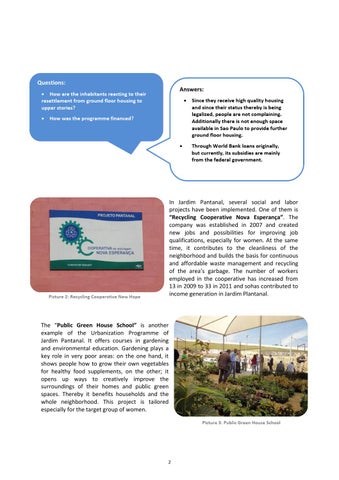
In Jardim Pantanal, several social and labor projects have been implemented. One of them is “Recycling Cooperative Nova Esperança”. The company was established in 2007 and created new jobs and possibilities for improving job qualifications, especially for women. At the same time, it contributes to the cleanliness of the neighborhood and builds the basis for continuous and affordable waste management and recycling of the area’s garbage. The number of workers employed in the cooperative has increased from 13 in 2009 to 33 in 2011 and sohas contributed to income generation in Jardim Plantanal.
Picture 2: Recycling Cooperative New Hope
The “Public Green House School” is another example of the Urbanization Programme of Jardim Pantanal. It offers courses in gardening and environmental education. Gardening plays a key role in very poor areas: on the one hand, it shows people how to grow their own vegetables for healthy food supplements, on the other; it opens up ways to creatively improve the surroundings of their homes and public green spaces. Thereby it benefits households and the whole neighborhood. This project is tailored especially for the target group of women. Picture 3: Public Green House School
2