Learning for change
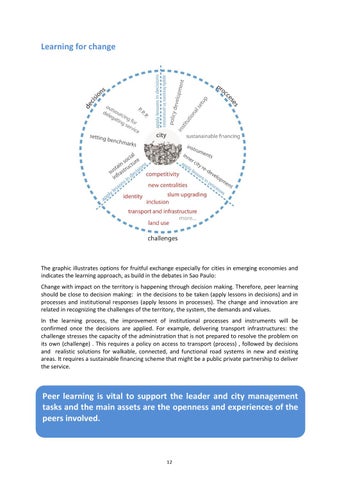
The graphic illustrates options for fruitful exchange especially for cities in emerging economies and indicates the learning approach, as build in the debates in Sao Paulo: Change with impact on the territory is happening through decision making. Therefore, peer learning should be close to decision making: in the decisions to be taken (apply lessons in decisions) and in processes and institutional responses (apply lessons in processes). The change and innovation are related in recognizing the challenges of the territory, the system, the demands and values. In the learning process, the improvement of institutional processes and instruments will be confirmed once the decisions are applied. For example, delivering transport infrastructures: the challenge stresses the capacity of the administration that is not prepared to resolve the problem on its own (challenge) . This requires a policy on access to transport (process) , followed by decisions and realistic solutions for walkable, connected, and functional road systems in new and existing areas. It requires a sustainable financing scheme that might be a public private partnership to deliver the service.
Peer learning is vital to support the leader and city management tasks and the main assets are the openness and experiences of the peers involved. Evaluations and feedback
12