local and regional governments
The change in the dominant habitat of the world population makes the process of urbanization to be among the most significant global trends of the twentyfirst century. Cities and urban places in general now occupy the centre stage in global development. They no longer function as mere spaces for settlement, production and services. They now profoundly shape and influence social and political relations at every level; determining advances
and setbacks in modes of production; and providing new content to norms, culture and aesthetics. Cities have become a major locus of power and politics consequently influencing vision achievement and dictating policy outcomes. They are also a major factor in environmental trends and sustainability processes. Urbanization is thus providing the setting, the underlying base, and also the momentum for global change.
UN-HABITAT INPUTS TO THE UNITED NATIONS POST 2015 TASK TEAM
2
LOCAL AND REGIONAL GOVERNMENTS, PARTNERS FOR THE GLOBAL AGENDA | www.uclg.org
Table of contents
About UCLG The international sub-national movement: the need for a next phase
02 Why cities matter
page 4
page 20
01
03
The global network of local and regional governments
UCLG in action
A TARGETED WORK PROGRAMME THE KEY ACHIEVEMENTS OF LOCAL AND REGIONAL GOVERNMENTS A DEMOCRATIC STRUCTURE TIMELINE 2004-2010 RECENT WORK BUILDING ON OUR HISTORY 2011-12 page 8
page 24
04 UCLG Committees and Working Groups page 40
This document provides an overview of the work done by the world organization, and some facts and figures that support the argument for allocating a special place to the political voice of local and sub-national leaders (mayors, councillors and presidents of regional authorities) in the UN Forums.
3
About UCLG
United Cities and Local Governments (UCLG) represents the interests of local and regional governments on the world stage, regardless of the size of the communities they serve. Headquartered in Barcelona, the organisation’s stated mission is: To be the united voice and world advocate of democratic local self-government, promoting its values, objectives and interests, through cooperation between local governments, and within the wider international community.
4
United Cities and Local Governments (UCLG) is a membership based international association seated in Barcelona, Spain and the inheritor of an international movement of local and regional governments and their national associations dating back to 1913. UCLG organised the first World Assembly of Local Authorities and Cities in 1996 at the occasion of the UN Conference Habitat II in Istanbul. As international association UCLG´s operations are financed by membership-fees based on the population represented by members. Following Habitat II in 2004 the three generalist global associations of cities and regional authorities (IULA, UTO and Metropolis) came together to give shape to one principal international counterpart for local and regional authorities. UCLG was formally created in May of that year in Paris with the presence of 3000 mayors, presidents of regions, councilors and representatives or most of the existing national associations around the planet. 1
UCLG currently gathers 153 national and regional associations in over 140 UN member states which represent 3 quarters of the world population. This makes it the leading worldwide organization representing local and regional associations internationally. It can be safely stated that almost every single existing national association of local authorities in the planet is member of UCLG. The above guarantees close links of its membership with their respective national governments. Additionally the direct membership of thousands of cities and regional authorities provide UCLG first hand contact with leaders and urban issues. Currently UCLG has also started the process of structural colaboration of the single generalist organization of regional1 (sub-national) authorities, Organization United Regions (ORU-FOGAR) fulfilling its original aspiration to provide a single voice to all subnational spheres of government at international level.
Under “regional governments/authorities” we understand the first territorial level below the state. This definition therefore encompasses territories of different sizes with different names and different forms of government depending on the national constitutions. This concept is understood in the United Nations texts as sub-national governments.
LOCAL AND REGIONAL GOVERNMENTS, PARTNERS FOR THE GLOBAL AGENDA | www.uclg.org
The international sub-national movement: The need for a next phase UCLG’s Agenda The Sub-national international movement, dating back to 1913, was initiated on the basis that there is a unique perspective that local and regional government can provide to global challenges, and that responsibilities cannot be faced individually by one city, nation or stakeholder. The past decades have seen important changes in our planet. We have seen the transition from a rural to an urban world. The needs and demands of citizens are changing and phenomena such as Climate Change have put local and regional governments at the forefront in facing many global challenges: population swifts, multicultural dialogue, tackling disasters and risk, providing access to basic services and contributing to increasing participatory governance. The United Nations Goals are closely intertwined with the goals of well-functioning local and regional governments in service of their communities. This has been, recognized over the past 100 years, most recently in the Rio+20 Outcome document in which both the role played up to now and the future roles of local and regional authorities have been included in the international sustainability policy. Addressing the barriers that stand in the way of development and environmental sustainability is largely a local and regional responsibility.
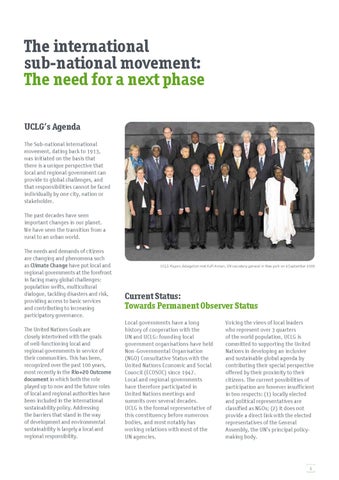
UCLG Mayors delegation met Kofi Annan, UN secretary general in New york on 9 September 2005
Current Status: Towards Permanent Observer Status Local governments have a long history of cooperation with the UN and UCLG: founding local government organisations have held Non-Governmental Organisation (NGO) Consultative Status with the United Nations Economic and Social Council (ECOSOC) since 1947. Local and regional governments have therefore participated in United Nations meetings and summits over several decades. UCLG is the formal representative of this constituency before numerous bodies, and most notably has working relations with most of the UN agencies.
Voicing the views of local leaders who represent over 3 quarters of the world population, UCLG is committed to supporting the United Nations in developing an inclusive and sustainable global agenda by contributing their special perspective offered by their proximity to their citizens. The current possibilities of participation are however insufficient in two respects: (1) locally elected and political representatives are classified as NGOs; (2) it does not provide a direct link with the elected representatives of the General Assembly, the UN’s principal policymaking body.
5
UCLG could become a catalyst for the collaboration and representation of local and regional authorities. It would enable multiple existing voices to be expressed in international policy making and contribute to shaping political and technical positions of local governments.
The Local and Regional Governments Global Taskforce Local and Regional Governments organizations -gathered in a Global Taskforce for Post 2015- are fully committed to end extreme poverty in all its forms, in the context of sustainability for all. As the government bodies charged with much of the responsibility for meeting many of the MDGs and proposed post-2015 goals commit to addressing local and regional governments address these responsibilities and demonstrating how poverty reduction, prosperity and sustainable development can be combined. Building on the Rio+20 outcome document that recognizes local and sub-national authorities as key partners, as contribution to the High Level Panel discussions and engaging on the ongoing intergovernmental process on financing, they express their commitment to support the definition of a new development agenda. They highlight the need to ensure that the new development agenda is people centered; focusing on the actors and institutions that are needed to build sustainability and prosperity.
6
Need for structural collaboration between UN and Cities and Regions There are numerous networks of cities and their associations working on specific issues. However, in view of the Post 2015 Agenda and, in particular, the Habitat III conference, the need for an overall representative that can facilitate the mobilization and articulation of the different views and inputs becomes imperative. UCLG has started consultations with the key thematic networks of local governments to facilitate this representation.
The new development agenda should be ONE (integrating all processes) and universal while also recognizing differentiated responsibilities. It should acknowledge local and regional governments as a specific sphere of government and as key actors in development building on their proven contribution to developing innovative solutions to address global and local challenges. Local and regional authorities stress the need to pay special attention to the following cross-cutting issues which are core values in any development agenda: Local democratic governance, inclusive, transparent and participatory Peaceful societies and dialogue Human Rights, promotion of gender equality, cultural diversity and opposing any discrimination Sustainable development that will be planet and people-sensitive
LOCAL AND REGIONAL GOVERNMENTS, PARTNERS FOR THE GLOBAL AGENDA | www.uclg.org
Local and Regional Governments, as levels of government closest to the people, should commit to mobilizing populations and fostering solidarity and understanding on the global agenda by local communities. Local and Regional Government networks gathered in the Global Taskforce for Post 2015 and their development partners commit to working together and contributing jointly to the international policy making process as well as supporting the global, people-centered and planet-sensitive agenda to address the universal challenges of the 21st century.
Global taskforce of local and regional governments for post-2015 and towards
Habitat iii
The Key areas to be included in the Local and Regional Governments Development Agenda that aims at contributing and becoming an integral part of the Global Agenda.
01
Democratic self-governing and participative, efficient, accountable and resourced Local & Regional Government. All within the framework of better intergovernmental coordination, harmonization processes and effective decentralization.
02
Food Security and Nutrition as basis for poverty eradication.
03
Quality Universal Basic Service Provision geared towards reducing inequalities and improving the lives of slum dwellers, including a gender sensitive approach. These services should foster inclusive societies that are mindful of providing opportunities for youth.
04
Local Economic Development, with a focus on pro-poor policies and decent job creation in a green urban economy which promotes sustaınable consumption and production.
05
Sustainable Urbanization as source of development: well-planned designed and governed cities can generate economıc growth and means of livelihood. It will include a territorial approach and cohesion, with special attention to climate change mitigation and adaptation, risk prevention and safe cities.
06
Culture as driver and enabler of development and people-centered societies.
07
Protection and sustainable management of environmental biodiversity and natural resources.
08
Local Government Development Cooperation (Decentralized Cooperation) as instrument to promote solidarity and peer learning. Istanbul Communiqué, March 2013 7
01 UCLG: THE GLOBAL NETWORK OF LOCAL AND REGIONAL GOVERNMENTS 8
LOCAL AND REGIONAL GOVERNMENTS, PARTNERS FOR THE GLOBAL AGENDA | www.uclg.org
A targeted work programme
Increasing the role and influence of local government and its representative organisations in global governance;
In this era of networks, UCLG, as the global network of local and regional governments, needs to expand its contacts and allow for exchanges beyond its membership.
Becoming the main source of support for democratic, effective, innovative local government close to the citizen;
It needs to build on local and global knowledge and intelligence to ensure access to diverse views and innovative solutions.
UCLG’s work programme focuses on
Ensuring an effective and democratic global organisation.
In this regard, UCLG has a unique convening role as network of networks and as formal chair of the United Nations Committee of Local Authorities. UCLG members are also members of other thematic networks.
UCLG Sections UCLG has a decentralized structure with 7 Regional Sections in Africa, Asia-Pacific, Euro-Asia, Europe, Latin America, Middle East and West Asia, North America and a Metropolitan section. These Regional and Metropolitan Sections are independant legal entites which conduct their own regional activites.
NORTH AMERICA
EURASIA
Asia-Pacific
UCLG -NORAM
UCLG-EURASIA
UCLG-ASPAC
Latin America
Middle East and West Asia
Metropolitan Section
FLACMA
UCLG-MEWA
Metropolis
Europe
Africa
Forum of Regions
CEMR
UCLG-Africa
Negociations in process to become a formal UCLG Sections
9
The key achievements of local authorities Local governments have achieved special status in international policies:
01 02
Local authorities are identified as one of nine ‘major groups’ in Agenda 21.
03
Local government representatives have a special relationship with UN-Habitat and through Rule 64 have distinct rights to participate as observers in the UN-Habitat Governing Council.
04
In 2000, the United Nations Advisory Committee of Local Authorities (UNACLA) was established as a body of local elected representatives that advise the UN-Habitat Executive Director.
05
UCLG has been asked to advise on the high-level UN Panel on the Alliance of Civilisations to ensure that the views of the world’s mayors and councillors are taken into account in the report to the UN General Assembly.
06 07 08
UN-DESA invited UCLG to the Advisor Board of the Development Cooperation Forum.
09
The President of UCLG and Mayor of Istanbul was appointed in July 2012 to the United Nations Panel of Eminent persons for the Post 2015 Process.
Local governments have recently achieved recognition at major UN and international meetings such as Beijing +10, the Millennium +5 Summit of Heads of State and the World Water Forum.
Presidency of UCLG The Presidency, comprising the President and up to 5 Co-Presidents is elected by the World Council from among local government members for a renewable term between two ordinary sessions of the General Assembly.
UCLG represented local and regional authorities in the OECD Working Party on Aid Effectiveness. In 2010, UNFCCC COP 16 acknowledged local authorities as a governmental stakeholder in issues related to the Climate Change agreements.
UCLG has cooperation agreements and working relations with most of the UN Agencies, including UN- Habitat, UNESCO, the United Nations Development Program, UNITAR, UN-Women, ILO, the Alliance of Civilizations and the World Bank.
10
LOCAL AND REGIONAL GOVERNMENTS, PARTNERS FOR THE GLOBAL AGENDA | www.uclg.org
UCLG: a democratic structure Continental Africa / Asia-Pacific / Eurasia / Europe / Middle East-West Asia / Latin America / North America Metropolitan Section
National National Associations of Local Authorities
World United Cities, Local and Regional Governments
Continental level
CITIZENS Local and Regional Towns / Cities / Large metropolises / Provinces / Regions
National level Local and Regional level Bringing together mayors, local councillors and presidents of regions across the world, UCLG is a truly global organisation with a democratic structure. It provides a means for citizens to express themselves though their democratically elected representatives on the world stage. Over 3 quarters of the world population are represented by UCLG members.
These councillors, mayors and presidents of regions come together at national level in Local and Regional Government Associations, which represent the towns, cities, metropolises and other subnational levels of a single country. These associations organise dialogues with national governments on all topics related to sub-national matters. Individual councillors and mayors are elected by their counterparts across the country to represent them internationally. UCLG membership is institutional and is decided by the governing body of the local or regional authority.
It is at continental level that mayors and councillors are elected to represent one of the seven world regions in the world organisation; Africa, Asia Pacific, Euro-Asia, Europe, Middle East and West Asia, Latin America and North America. Through this structure, UCLG is able to truly represent all local governments, big and small. It also holds a Metropolitan Section to cater for the special interests of cities of over 1 million inhabitants. These cities also elect mayors and councillors to represent Metropolises in the world organisation.
World level The members of UCLG come together in a General Assembly and, based on the elections that have taken place at regional and metropolitan level, elect the World Council. The World Council brings together mayors and councillors from all regions of the world, representing local governments of all types.
11
2004-2007
The promising early stage
May 2004 The Founding Congress in Paris saw the biggest ever gathering of mayors, councilors and elected representatives of cities and local and regional governments to officially create the world organization “United Cities and Local Governments”, with the mission of representing and defending the interests of local governments on the world stage. A Co-Presidency was elected, composed of Marta Suplicy, Mayor of Sao Paulo; Bertrand Delanoë, Mayor or Paris; Smangaliso Mkhatshwa, Mayor of TshwanePretoria; Clarence Anthony, Mayor of South Bay as Elected Treasurer. An unprecedented framework agreement was signed between UCLG and the World Bank in order to collaborate in fighting poverty and improving the living standards of people in the developing world. Being the first document in the world to link culture with local governance, the Agenda 21 for Culture was agreed in May 2004 by 198 cities, local governments and associations of local governments from all over the world to enshrine their commitment to human rights, cultural diversity and participatory democracy.
12
June 2004 The Cardoso Report on United Nations-Civil Society Relations recommended that “the United Nations should regard UCLG as an advisory body on governance matters”. Although never officially implemented, this recommendation gave new strength to the voice of local authorities before the UN Agencies.
September 2004
March 2005 The United Nations recognised at the Beijing +10 review that increased participation of women in local decision making is a strategic factor for the achievement of gender equality. UCLG further advocated for the percentage of seats held by women in local government bodies to be recognised as a Millennium Development Goal indicator.
June 2005 The first Committees and Working groups of UCLG were established and opened to cities, local governments and their associations. Today, over 18 different topics are covered by the Committees and Working Groups.
The longstanding relation between UN-Habitat and the local government movement was further strengthened through the signing of a cooperation agreement to promote the adoption of international policies on decentralisation.
LOCAL AND REGIONAL GOVERNMENTS, PARTNERS FOR THE GLOBAL AGENDA | www.uclg.org
Local Governments have a recognized advisory role within the UN. UCLG holds the majority of seats in the United Nations Advisory Committee of Local Authorities (UNACLA).
November 2005
August 2005 At the Millennium+5 Summit in New York, the United Nations Secretary General, Kofi Annan, and the President of the United Nations General Assembly, Jan Eliasson, met a UCLG Mayors’ delegation. The final declaration recognises local authorities as actors in the achievement of the Millennium Development Goals. Cities, regions and associations mobilise to contribute to tackling global challenges with a clear local impact with over one thousand cities and local government associations joining the high-profile UCLG Millennium Towns and Cities Campaign: White banners were displayed on local government buildings across the world. Hundreds of cities joined ‘STOP AIDS. Make the Promise to coordinate their events on international AIDS day.
The digital divide was addressed by local governments before the international community at the World Summit of Local and Regional Authorities. The Bilbao Declaration, which was our contribution to the Tunis World Summit on Information Society in 2005, included 10 principles focusing on universal access to information and the fight against all forms of discrimination in the use of information technologies.
February 2006 At the UCLG Executive Bureau meeting in Washington, World Bank President Paul Wolfowitz expressed the interest of the World Bank to strengthen relations with UCLG and committed to develop new instruments to support city development. Since then, the World Bank has developed a solid/ fixed/firm and extensive Urban Strategy which is expected to have great impact in Africa and relies on UCLG’s members support for its implementation and definition.
March 2006 Governments of the world acknowledged that local authorities play a major role in delivering sustainable access to water and sanitation services, as well as in supporting integrated water resource management. The Declaration of the Local Governments of UCLG was included in the final declaration of the World Forum on Water in March 2006.
March 2007 Local governments raised awareness on the impact of climate change on cities and their inhabitants. Over 250 mayors and local government leaders showed how the world’s cities, regardless of their geographic location, are obliged to manage the consequences of this challenge. The Paris Declaration therefore encouraged cities to set up plans and studies to assess the impact of climate change in their urban areas.
April 2007 The International Guidelines on Decentralisation constituted an important step forward towards the adoption of an international legal framework on decentralisation. For the first time ever, the decentralisation process was at the forefront of the international policy agenda.
13
2008-2009
The growing momentum
October 2007
At the Second World Congress of UCLG organized in Jeju (South
Korea), around 2,000 mayors and local governors gathered to discuss the consequences of urban expansion, cooperation with regions and the challenges for the City of tomorrow. The Declaration of Jeju points to key challenges the world will have to face in the coming years: environmental protection, local democracy, achieving the Millennium Development Goals, and the role of territorial authorities in peace building. Bertrand Delanoë, Mayor of Paris, was reelected President of the organization along with four coPresidents: Mr. Moncayo, Mayor of Quito, Ecuador; Mr. Guangning, Mayor of Canton, Popular Republic of China; Mr. Topbas, Mayor of Istanbul, Turkey and Mr. Masondo, Mayor of Johannesburg, South Africa. Clarence Anthony, Mayor of South Bay, USA, was reelected Treasurer.
June 2008 UCLG stood at the forefront on slum upgrading. The World Organization became for the following three years, the Chair of the Executive Committee of Cities Alliance, a unique partnership coordinated by UN Habitat and the World Bank that gathers the main international donors. This position became permanent in 2011.
September 2008 2008 also saw the strengthening of ties with other networks, especially those working in the field of Climate change, such as ICLEI and the C40. Together with their contributions, UCLG prepared and launched the ‘World Mayors and Local Governments Climate Protection Agreement’, to enable its members to express their commitment and developed a roadmap for local authorities for Bali-Poznan Copenhagen. Local governments expressed their will for a stronger commitment on conflict prevention, post-conflict reconstruction and peace building. The Hague Agenda for City Diplomacy developed a concrete work programme for local and regional authorities on the international scene.
UCLG undertook the first evercomprehensive study on the state of decentralization by setting up the Global Observatory on Local Democracy and Decentralisation (GOLD). The report put an emphasis on the contemporary situation of local governments in all regions of the world and demonstrated the progress made through local autonomy throughout the world during the two previous decades.
14
LOCAL AND REGIONAL GOVERNMENTS, PARTNERS FOR THE GLOBAL AGENDA | www.uclg.org
UCLG became a stakeholder in the international negotiation on aid effectiveness. Notably, UCLG became member of the advisory group of the UN First Forum for Development Cooperation in New York, and participated in the Third OECD High Level Forum on Aid Effectiveness in Accra. We made the case to the international community for the greater involvement of cities and regions in the development, implementation and monitoring of aid policies.
November 2008 Platforma, under the aegis of CEMR, the European section of UCLG, was created to facilitate dialogue between the European institutions and local and regional authorities. The Policy Paper on Social Inclusion, adopted by the World Council of UCLG in November, set out the first global political guidelines on local public policies for social inclusion.
2009-2010
The achievment years
April 2009 The adoption of the International Guidelines of Access to Basics Services was a major step towards the recognition of Local Authorities’ contribution to the achievement of the Millennium Development Goals. Local and Regional Authorities stressed the role they have in supporting peace and dialogue at the Second Forum of the UN Alliance of Civilizations.
June 2009 Local governments spoke with one united voice during the COP 15 on Climate Change thanks to the Local Government Climate Change Leadership Summit brought together by UCLG and partners in June.
November 2009
The World Council of UCLG unanismously adopted in November 2009, the UCLG Position Paper on Aid Effectiveness and Local Government, which recalls the contribution of Local and Regional Authorities in the field of aid and development through decentralized cooperation and peer to peer partnerships. It is also a call by Local Authorities to the international community not to use aid effectiveness as a pretext to further centralize aid resources and policies.
May-October 2010 On the occasion of the Shanghai World Expo, entitled, “Better City Better Life”, UCLG represented for the first time a global organization of cities, towns and regions in this universal exhibition.
June 2010 The challenges of development cannot be solved without the knowledge, expertise and endowment of local and regional governments who are legitimate actors on the ground. This was the message delivered by UCLG during the Forum on Cooperation and Development: strong accountable local governance is an effective accelerator of development.
November 2010 From 16th to 20th November, the Third
Congress of UCLG – the First World
Summit of Local and Regional Leaders – took place in Mexico City. The aim of the Summit was to discuss the critical issues facing our world, and each continent, and to agree on a set of initiatives, priorities and actions. The Summit looked at three main themes, all of which are inter-connected: Global Crises–Local Impacts; The City of 2030; Local and Regional Governments; Partners in the New Global Governance. On this occasion, a Policy Paper on Urban Strategic Planning was approved and important decisions on Culture and on Human Rights in the City were made. GOLD II, the Second World Report of UCLG on Local Democracy and Decentralisation focussing on Local Finances, was also presented. These triennial Congresses were also the setting for the renewal of the Leadership of the Organization through open elections. UCLG enters in a new period, with the election of Kadir Topbaş, Mayor of Istanbul, as the new President of the World Organisation. Accompanying the Mayor of Istanbul, Antonio Costa, Mayor of Lisbon, Portugal; Johnny Araya Mayor of San Jose de Costa Rica; Wan Qingliang Mayor of Guangzhou, China; Muchadeyi Masunda, Mayor of Harare, Zimbabwe; and Ilsur Metsin, Mayor of Kazan, Russian Federation, were elected as Co-Presidents. Ted Ellis, Mayor of Bluffton, Indiana, USA, was ratified as Treasurer.
15
2011-2012
Recent work building on our history
February 2011 MEETING WITH UN SECRETARY GENERAL
Meeting personally with Secretary General Ban Ki-Moon, the UCLG President advocated for a special status for UCLG before the General Assembly of the United Nations. The President also invited the Secretary General to consider organizing a High-Level meeting with UCLG on the Role of Cities in Development.
April 2011 THE PRESIDENT OF UCLG CHAIRS UNACLA AND LEADS THIS COMMITTEE TO A NEW PHASE
UCLG PRESIDENT ADDRESSED UN GENERAL ASSEMBLY SESSION ON DISASTER RISK REDUCTION
The regular annual meeting of the United Nations Advisory Committee of Local Authorities (UNACLA) took place on 10th April. Joan Clos, the new Executive Director of UNHabitat, proposed guaranteeing a close link between UNACLA and UCLG, ensuring that the Chair of UNACLA will always be held by the President of UCLG. The Committee members defined a thematic annual work calendar with focus on mobility and dedicated to job promotion in 2012.
The UCLG President argued that living spaces like cities should be planned properly, adding that natural disasters such as floods, earthquakes and hurricanes, as well as the effects of climate change gave rise to major problems in cities that failed to correctly make use of nature. UCLG cities have expressed their conviction that preventive action would drastically reduce the human and financial costs and that capacity building and training programmes should be developed at the local level integrating urban risk into local strategies. He called for special attention to be given to safe land and infrastructure for the poor.
April 2011 VOICE OF CITIES IN UN-HABITAT COUNCIL
Mayor Masunda, Co-President of UCLG, addressed the Opening Day of the 23rd UN-Habitat Governing Council, reaffirming the core principles and recommendations of the Manifesto for the City of 2030, adopted during the UCLG Congress in November 2010. He offered the “full partnership of UCLG and its network to address global problems through local solutions”. UCLG has expressed its conviction that under the new leadership, the Habitat Agenda will be, more than ever, the Agenda of the Habitat partners.
16
May 2011
LOCAL AND REGIONAL GOVERNMENTS, PARTNERS FOR THE GLOBAL AGENDA | www.uclg.org
UCLG played a role in the organization of the Local Government Platform that took place on 8-13 May and brought together risk reduction experts and local and regional leaders. The Platform was composed of more than 50 representatives of local and regional authorities.
March 2012
April 2012 The UN Secretary General, Ban KiMoon, welcomed Local and Regional Authorities, including UCLG, at the UN Headquarters. The groups presented their key messages for Rio+20.
WORLD WATER FORUM 2012
UCLG co-organized the Local Authorities Day on 14 and 15 March. Over 300 local and regional authorities participated and expressed renewed support for the Istanbul Water Consensus. Co-President Masunda, who opened the works and co-chaired the Local and Regional Authorities Assembly, represented the UCLG Presidency. Sessions were prepared in partnership with corporate partner SUEZ and ORU-FOGAR.
UCLG, as co-organising partner, was in charge of coordinating the inputs and participation of local and regional authorities for the Summit, which took place on 20-22 June. UCLG contributed to the formal negotiations in consultation with members.
The Urban Summit organised by UCLG and hosted by the City of Rio de Janeiro in Copacabana, gathered around 300 participants and aimed at amalgamating the different representations: cities, local and regional.
Furthermore, UCLG has been acting as convener and umbrella organization by organising a High-Level Session on 23 April in New York. This session, organised jointly with UN-Habitat, included the presence of Dr. Joan Clos, Director of UN-Habitat, and Mr. Ban Ki Moon, UN Secretary General. The UCLG Presidency and all Local and Regional Governments networks established a dialogue with key member States gathered in the Group of Friends of Sustainable Cities. At the initiative of UCLG and with the support of ORUFOGAR, joint messages agreed by all networks were presented, including eight concrete recommendations.
Despite criticisms of the outcomes of Rio+20 in terms of international agreements, the results for local and regional authorities are unprecedented with fully-fledged recognition of their role, not only in thematic areas but also in relation to the need to strengthen local governance for sustainability. The Rio+20 process has also resulted in strengthened partnerships of UCLG with international institutions, country forums and other partners, such as the Group of Friends of Sustainable Cities, Ford Foundation and C40.
ŠUN Photo/Paulo Filgueiras
17
2011-2012 Towards recognition
June 2012:
September 2012
At the Earth Summit (Rio+20), the Outcome Document acknowledged for the first time the role that local and regional governments play in the sustainable development agenda.
At the first meeting of the post-MDGs High-Level Panel of Eminent Persons, UCLG President, Kadir Topbas offered to facilitate a meeting of the Panel members with local and regional authorities.
July 2012 On the road towards the Summit on Aid Effectiveness, UCLG and its partners co-organised a session in Barcelona in March, hosted by UNDP. The session aimed at taking stock of developments in the aftermath of the summit and defining a joint strategy towards the future Global Partnership resulting from the Busan discussion. Under the political leadership of the Committee on Development Cooperation and its Working Group CIB, UCLG is closely following the post 2015 Development Agenda. UCLG as focal point for Local and Regional Authorities has requested to be included in the Steering Committee of the Global Partnership for Effective Development Cooperation which will support the Ministerial Platform. UCLG has requested the local dimension to be included in the indicators on aid efficiency that will be developed in this new phase.
United Nations Secretary-General Ban Ki-moon announced on 31st of July 2012 the members of a HighLevel Panel to advise on the global development agenda beyond 2015, the target date for achieving the Millennium Development Goals (MDGs). Among the 20 members of this High-Level Panel, Mr. Kadir Topbas, Mayor of Istanbul and President of UCLG, was nominated. This nomination comes as recognition of the work accomplished by our Organization and its members towards the achievement of the Millennium Development Goals.
The result of years of active advocacy can be seen in the focus of the UN Development Cooperation Forum on Decentralised Cooperation. For the first time the Annual Meeting of the Forum dedicated two sessions to Decentralised Cooperation and will develop work in this area. The UCLG policy paper developed by the UCLG Committee on this topic served as basis for a global discussion in New York in July.
Ban Ki-moon asked the High-Level Panel to prepare a bold yet practical development vision. The Panel hosted its first meeting in September, in the framework of the United Nations General Assembly. It is expected to submit its findings to the SecretaryGeneral in the first half of 2013.
18
According to a recent study, the goals set on the reduction of poverty, slums and access to water will be achieved; it is worth highlighting that these are fields in which the actions of local and regional authorities are of particular relevance.
LOCAL AND REGIONAL GOVERNMENTS, PARTNERS FOR THE GLOBAL AGENDA | www.uclg.org
WORLD URBAN FORUM: LOCAL AUTHORITIES LEADING HABITAT III PREPARATIONS
Over 200 Mayors and local practitioners, brought together at the World Urban Forum, called for the Third Conference of Sustainable Human Settlements (Habitat III) to revise the international governance architecture for urban and development issues. The President of UCLG presented the commitment of the UN Advisory Committee for Local Authorities (UNACLA) to significantly contribute to shaping the new Habitat Agenda. As inheritor of the Habitat II process, which set the basis for the creation of the World Organization of Cities and Local Governments, UCLG called all local government partners to unite and define the priorities of local and regional authorities internationally.
December 2012: The New Development Agenda was at the heart of the UCLG World Council meetings held in Dakar (Senegal). A Task-Force was set up to face the revision of the Millenium Development Goals.
2013-2016
Focusing the UCLG Agenda
Rabat 2013: the 4th UCLG World Congress
The Post-2015 Development Agenda
2016: HABITAT III
The future local and regional governments want!
19
02 WHY CITIES MATTER
20
LOCAL AND REGIONAL GOVERNMENTS, PARTNERS FOR THE GLOBAL AGENDA | www.uclg.org
Facts and figures
01
Currently, city-based activities account for more than 75% of world energy consumption and 80% of global carbon dioxide.
02
2007: for the first time, the world’s urban population equals the world’s rural population. By 2030, 60% of the world’s population will live in urban areas.
03
In 2010, the world’s population reached 6.85 billion, and is increasing by 75 million people each year.
04
In developed countries, cities generate over 80% of national economic output.
80% 75%
carbon dioxide emission energy consumption
50% 50% 60% 2007
2030
75m
population increase every year
80%
of national economic output
21
05
Latin America is the most urbanised region in the developing world, with 77% of its population – 433 million people – living in cities. By 2015, it is predicted that 81% of its population will reside in urban areas.
77%
of latin america population live in cities
06
2030
07
1.25$
08
by 2015
Africa is the least urbanised continent but by 2030 its urban population will exceed the total population of Europe.
More than 1.2 billion people - one in every five on Earth - survive on less than 1.25$ per day. In Africa, in urban areas, 40% of households live below the poverty line. In Latin America 25% of urban households live below the poverty line.
In 1950, there was only one city with a population of over 10 million inhabitants: New York. By 2015, 23 cities will reach over 10 million, 19 of them in developing countries.
22
LOCAL AND REGIONAL GOVERNMENTS, PARTNERS FOR THE GLOBAL AGENDA | www.uclg.org
>
23
cities will reach over 10m inhabitants
per day
09
Local governments in Africa are working to improve sanitation and health in a continent where less than 20% of households are connected to piped water and where water costs more on average than in any other region of the world.
in africa, less than
20%
are connected to piped water
10
6,000
Over 6000 local governments have implemented Local Agenda 21 strategies to develop projects in order to improve the quality of life with and for local citizens.
local governments have implemented local agenda 21
11
Although mayors deal with the most pressing development issues on a daily basis, UCLG estimates that less than 1% of global development funding is channelled through local governments.
12
70% of the world’s cities and their associations participate in city-to-city international cooperation programmes.
1%
of funding is made through local governments
70%
participate in city-to-city cooperation programmes
23
03 UCLG: IN ACTION
24
LOCAL AND REGIONAL GOVERNMENTS, PARTNERS FOR THE GLOBAL AGENDA | www.uclg.org
Table of contents
In focus #1
In focus #5
UCLG STRATEGY 2010-2016
LOCAL AUTHORITIES AS GENDER EQUALITY ENABLERS
page 26
page 34
In focus #2
In focus #6
MONITORING LOCAL DEMOCRACY: CREATING AN OBSERVATORY
Local and regional governments in development
page 28
page 36
In focus #3
In focus #7
COMMITMENT TO ACHIEVING THE MILLENNIUM DEVELOPMENT GOALS
CULTURE AS FOURTH PILLAR OF SUSTAINABLE DEVELOPMENT
page 30
page 38
In focus #4 THE FUTURE LOCAL AND REGIONAL GOVERNMENTS WANT: RIO+20 page 32
25
In focus #1 UCLG Strategy 2010-2016
Bringing the added value of local and regional authorities to the global discussions Strategic Priorities
2010-2016
Unity The ideals that united us all were based on the conviction that a “world advocate of democratic local selfgovernment, promoting the values, objectives and interests of local and regional governments of all shapes and sizes, through joint action” was possible and highly necessary. UCLG’s work programme during the first six years of existence has emphasized the need to create a respected organization before the international community; it has focused on enabling the contacts among members and has tried to put in place a flexible structure at the service of its heterogeneous membership.
26
The creation of United Cities and Local Governments in 2004 was the fruition of many years of exchanges among the local and regional leaders of the world. They were working internationally through different organizations, but for a common cause.
A special perspective: Our shared values The Habitat II conference in Istanbul in 1996 was the moment that triggered the notion of going from joint values to joint action. The shared conviction that their proximity to citizens offers local and regional authorities a unique perspective in discussions and solutions on golobal issues is of greater relevance now than ever before. The past decades have seen important changes in the international institutional framework; we have also witnessed the transformation from a rural to an urban world. Local governments are more than ever
LOCAL AND REGIONAL GOVERNMENTS, PARTNERS FOR THE GLOBAL AGENDA | www.uclg.org
at the forefront of facing global challenges. In this context, it is not surprising that our organization has been granted access to new spaces in international decision-making processes. We have also experienced important disappointments with insufficient tangible commitments on the role of local and regional authorities in international agreements; worrying trends towards recentralization of powers and resources in some parts of the world; and serious suffering among our citizens due to the world financial and economic crisis.
New Challenges We are additionally experiencing innovation and hope: We see the youth in our cities wanting to promote change. We enjoy the capacity to rethink our identity and discovering new ways forward. Our ability to acknowledge change and opportunities will be pivotal for a sustainable future. This will only happen if we work together in our united organization, UCLG.
On our way to the United Nations Conference on Habitat III Our Mexico Manifesto on the City of 2030 already provides a clear picture of the work before us. The organization has done collective thinking on what local and regional authorities around the world need to achieve for their citizens. It is now time for self evaluation and for daring proposals on our way towards the Third United Nations’ Conference on Housing and Sustainable Urban Development (Habitat III). UCLG gathers the governments of proximity, the governments most closely responsible for the daily life of citizens. In the work of local and regional governments all issues are intertwined and priorities should be defined taking into account their impact on the local territories and their populations. Experience around the world shows that any change impacting people at local level challenges local and regional governments in their capacity to coordinate actions beyond a sector approach: It calls upon them to mobilize stakeholders, to address inclusive growth and development, and to interface with the other
spheres of public governance for more efficiency. Local governments are called upon to achieve a broader global understanding of the important perspectives that their proximity brings to solutions of global issues. This is why UCLG strives to promote and consolidate decentralization as a way to democratize and modernize public governance at all levels. It is also the reason behind UCLG´s advocacy for local self-government as a requisite for true participation of people in the management of their own affairs. The perspective put forward by UCLG is that development and improvement of people’s living conditions should take place primarily at the local level. UCLG should become more proactive in setting agendas. It should become a broadly respected stakeholder on the international arena, so that the local and regional government perspective inspires and nurtures the definition and implementation of global international agendas.
In this era of global networks, UCLG, as the global network of local and regional governments, needs to expand its contacts and allow for exchanges beyond its membership. It needs to build on local and global knowledge and intelligence to ensure access to diverse views and innovative solutions.
27
In focus #2 Monitoring local democracy: creating an Observatory
One of UCLG’s objectives, agreed at the Founding Congress, is:
Becoming the source of key information on the situation and the evolution of local government all over the world, through the establishment of an observatory on local democracy With this objective in mind, UCLG decided to launch the GOLD project: the Global Observatory on Decentralisation and Local Democracy. In June 2005, UCLG’s Executive Bureau agreed to establish the Observatory through two principal activities: a portal within the UCLG website with access to relevant information and data on local democracy a UCLG Global Report on Decentralisation and Local Democracy which would be published every three years
28
LOCAL AND REGIONAL GOVERNMENTS, PARTNERS FOR THE GLOBAL AGENDA | www.uclg.org
The first UCLG Global Report on Decentralisation and Local Democracy was published in 2007. The report – the first of its kind - aims to periodically assess the progress and obstacles to the spread of local democracy and decentralisation around the world. It will analyse trends, seeking to understand them and anticipate the way they may develop in the future. The 1st report in 2007 was on the State of Decentralization 2nd report published in 2010 was on Local Finance and was published by the World Bank 3rd report to be released in 2013 will cover the Governance of Local Public Services C
2008
reference on the world. The ralization and ial structures; nal chapter is s, in particular ferent realities mocracy do, or ards innovative is increasingly
The Global Report on Decentralisation and Local Democracy
M
Y
CM
MY
CY CMY
A global information portal on local government The report has become the only reference document on decentralization that covers the whole world based on the work of renowned researchers at the same time that it includes policy recommendations from local and regional authorities that have been consulted while the research is on going. It currently counts on the support of international institutions such as Cities Alliance, the World Bank Facility for Public-Private Partnership, but also regional governments such as that of Catalonia and national authorities such as the French Development Agency.
K
The GOLD portal (www.uclggold.org) is an information and communication tool for UCLG members. The first phase of the portal was launched in December 2005 and was developed in partnership with UCLG’s Regional and Metropolitan Sections. The GOLD portal currently provides access to information on over 1200 existing sites of relevance to local government, as well as ‘our selection’ of 120 site of special interest to local government. The websites accessible through GOLD include regional and metropolitan sections of UCLG, local government associations, city networks, international and public organisations working on local issues, universities and research centres specialising in local government, databases and other local observatories.
Decentralization and local democracy in the world
It also provides country profiles on the situation of local governments and the state of local selfgovernment around the world, advice on decentralised co-operation and international co-operation between cities and local government associations, and a document library.
Decentralization and local democracy in the world First Global Report by United Cities and Local Governments
2008 GOLD I Report
GOLD II Report
29
In focus #3 Commitment to achieving the Millennium Development Goals
UCLG Millennium Towns and Cities Campaign In June 2005, the World Organization of United Cities and Local Governments agreed to launch the UCLG Millennium Towns and Cities Campaign with the slogan ‘2015: No excuse! The world must be a better place.’ Thousands of local governments have joined the campaign and this list was presented on 8 September 2005 to the UN Secretary General.
As the legitimate partner of the United Nations owing to its representativeness and democratic structure, UCLG shares the same objectives and contributes to achieving them on a daily basis. At a meeting in September 2000, the leaders of the world’s governments identified the Millennium Development Goals (MDGs): eight measurable objectives with deadlines for fighting against poverty, hunger, disease, illiteracy, degradation of the environment and discrimination against women. The Millennium Declaration includes commitments in the areas of human rights, good governance and democracy which are closely linked with the daily work of local
30
authorities in the service of their citizens. Indeed, the realities of urbanisation are all in a day’s work for locally elected representatives: improving unhealthy environments, managing water resources, finding pragmatic solutions environmental problems, raising education levels, promoting the participation of women in local political life, fighting major diseases and enhancing sanitation. The urgency of these problems necessitates practical solutions. The proximity of local governments to their citizens allows for a dialogue which encourages innovative methods. Consequently, local governments offer both know-how and the expertise which should be at the service of everybody.
LOCAL AND REGIONAL GOVERNMENTS, PARTNERS FOR THE GLOBAL AGENDA | www.uclg.org
The members of UCLG share their expertise with one another; they also share their expertise with the international community and are committed to furthering this information exchange. For this reason, UCLG works closely with UNHabitat, the UN agency for human settlements and organiser of the 2004 World Urban Forum. During the Forum in September 2004, a Cooperation Agreement was signed by the two organisations. Some experts believe that the conditions are now in place to ensure that everyone in the world can have access to sufficient food, clothing and accommodation by 2050. UCLG members are committed to contribute to addressing the barriers that stand in the way of global development and have expressed and acted on this commitment since 2005.
UCLG Mayors Delegation On the eve of the world leaders summit on 14-16 September 2005, a mayors’ delegation from all world regions met with Kofi Annan, UN Secretary General, and Jan Eliasson, President of the UN General Assembly, for a constructive dialogue on the role of local governments in international development. During the meetings Mr Annan reaffirmed the “critical role” of local authorities in key MDG domains including education, the fight against poverty, health, water, sanitation and gender equality, and Mr Eliasson declared himself an ally of local government and assured the delegation that, although it would not be an easy task, he would “bring this [the delegation’s] message to the negotiation table.”
Outcome of the Millennium + 5 Summit Governments meeting at the Summit of Heads of State in New York on 14-16 September 2005 explicitly recognised the important role of local authorities in contributing to the achievement of the Millennium Development Goals. The Summit outcome document contains important advances for local government. Local authorities are mentioned first as major actors with the United Nations (title of the subchapter 172175) and are explicitly mentioned as a partner of the UN. A specific paragraph is dedicated to local government’s contribution to the achievement of the Millennium Development Goals (Paragraph 173) and the document opens up new possibilities for direct dialogue between the General Assembly and the world organisation of local governments (Paragraph 175).
UCLG Co-President Paco Moncayo, Mayor of Quito, led the delegation which held meetings with Mr Annan and Mr Eliasson. In addition to highlighting the information gap between strategic planning at the global level and policy implementation at the local level which is hindering progress on the MDGs, the delegation also presented Mr Annan with the Local Government Millennium Declaration. As part of the UCLG Millennium Towns and Cities Campaign, some
1,000 cities, local governments and national local government associations from across the world signed the declaration. In the declaration, local governments commit their full support for the United Nations Millennium Development Goals whilst simultaneously requesting a formal advisory role at the UN. Such a role would enable them to contribute their invaluable insight in global decision-making which will be crucial to achieving the MDGs.
Beyond 2015 UCLG is developing a strategy to position local authorities in the global debates that are crucial for the definition of the future UN development agenda, namely: the Agenda Post-2015 and the New Urban Agenda. It is mobilising its membership and strengthening partnerships with civil society, academics and the private sector. UCLG is calling its members to participate in the national and regional consultations. At global level, the organization has identified priorities among the 9 issues that are being discussed. The President of UCLG will be able to transmit these perspectives through the work of the High Level Panel post-2015.
31
In focus #4 The future local and regional governments want: Rio+20
The first Earth Summit in 1992 achieved wide consensus and was considered a major step forward in the understanding of environmental issues and their broader impact. It also re-affirmed the growing awareness of non-state actors, through the formal recognition of stakeholders through Major Groups among which local authorities are mentioned in chapter 28.
Over twenty years, the challenges faced by the world have changed and local and regional governments are more than ever recognized as key stakeholders in sustainable development policies.
In this context, UCLG and UNHabitat, with the support of Cities Alliance and UNACLA, gathered local and regional government leaders and networks in New York on 23rd April where 8 joint recommendations were presented to the United Nations Secretary-General, Ban Ki-moon, to other UN officials and to the 29 states members of the Group of Friends of Sustainable Cities. The meeting allowed the networks to unify messages before the negotiating parties for Rio+20 and increased the profile of local and regional authorities in the final days of the negotiation. High-level Session of Cities, metropolises, regions and their associations United Nations Headquarters - New York 23 April 2012
32
LOCAL AND REGIONAL GOVERNMENTS, PARTNERS FOR THE GLOBAL AGENDA | www.uclg.org
Outcomes of the RIO+20 Summit Despite the, according to many, discouraging results of the Rio+20 Summit due to lack of concrete multi-lateral agreements and commitments, there is a bright side to the Outcome Document relative to the acknowledgement of the role that local and regional governments play and need to play in the sustainable development agenda. The document addressed most of the issues that UCLG and its members had identified as a priority throughout the process. The level of recognition for the value and role of the sub-national spheres of government was unprecedented for an international policy document. The outcome document focused a specific subheading on sustainable cities and human settlements. Furthermore it payed tribute to progress achieved at sub-national and local levels; the role played by local governments in the implementation of policies and the engagement of stakeholders. It also recognises the critical role of governance at local and sub-national level and explicitly mentions local and sub-national governments are in the thematic areas and cross-sectoral issues. The outcome document also called for the strengthening of financial
mechanisms accessible to subnational and local authorities and for the adoption of regulatory frameworks to stimulate publicprivate partnerships. The recognition of the relevance of the Habitat Agenda is an important achievement which will positively influence the development agenda in the near future. Its shortcomings include the lack of references to culture as a crucial pillar for development and the lack of clear inclusive governance mechanisms for future policy development.
The outcomes of Rio are an important milestone in the UN agenda of UCLG. The World Secretariat and UCLG members continue working on ensuring political representation in the follow up process process and towards Habitat III.
Key messages on a renewed global governance system for sustainable development With the negotiations heading towards an environmentally driven agenda in 2011, UCLG and its members started campaigning for a more humancentered discussion where governance, cohesion among territories, inclusion, service provision and the fourth cultural pillar would be put on the agenda that would recognize the new urban reality. The UCLG position and the 8 recommendations of the Joint Local and Regional Governments Messages were all geared in this direction.
33
In focus #5 Local authorities as gender equality enablers
Equality of Women and Men: key to governance and development Local and regional governments are in a unique position to contribute to the global struggle for gender equality. They can have a great impact on the status of women around the world in their capacity as the level of governance closest to citizens, as service providers and as employers. Equality is a human right and it benefits the quality of our social systems. UCLG members around the world are convinced that the systematic integration of women increases democratic legitimacy and the efficiency and the quality of the activities of local and regional government.
5.1%
34
CAPITAL CITY WOMEN MAYORS
6.1%
WOMEN MAYORS OF CITIES OVER 1 MILLION INHABITANTS
LOCAL AND REGIONAL GOVERNMENTS, PARTNERS FOR THE GLOBAL AGENDA | www.uclg.org
If local government is to meet the needs of both women and men, it must build on the experiences of both women and men, through equal representation at all levels and in all fields of decision-making, covering the wide range of responsibilities of local governments. In order to meet the challenges of sustainable human development, it is crucial that women be empowered and involved in local government as decision-makers, planners and managers. The gender perspective must be mainstreamed into all areas of policy making and management in local government.
20%
WOMEN COUNCILLORS WORLDWIDE
Action plan The UCLG Standing Committee on Gender Equality has agreed on the following focus areas:
PARTNERSHIPS Develop a collaboration agreement with UN Women: Mission to New York, February. Develop a work plan with grassroots international women’s associations.
©Mairie de Paris/JB Gurliat
Political advocacy PARTICIPATION OF WOMEN IN DECISION MAKING Building on the European Observatory for Equality, gathering data on local elected women through the Global Observatory for Equality of Women and Men in Local Life.
Thematic action through programme development in two key areas: WOMEN’S ACCESS TO SERVICES
UCLG’s involvement in gender equality is built on longstanding work developed by our founding organizations on the advancement of the participation of women in decision making. UCLG is the inheritor of the Worldwide Declaration of Women in Local Decision Making which states the need to increase political participation of women in all levels of decision making. In 2004 and 2005, the World Organization implemented a programme for the creation of elected women’s networks in the different continents and within UCLG Sections. This work has resolted in the
SAFER CITIES FOR WOMEN
existence and renewal of networks in African and Latin America. UCLG has also gathered information on the participation of women at local level throughout the world and has supported the development of the Charter for Gender Equality of its European Section CEMR. UCLG has promoted the collaboration between grassroots women’s associations and elected women’s groups.
UCLG has an agreement with UN-Women and is part of the Gender Advisory Panel of UN-Habitat.
Throughout the process of the Millennium Development Goals Summit, UCLG and its members highlighted the importance of women in decision making for the eradication of poverty and the achievement of the Millennium Development Goals.
35
In focus #6 Local and regional governments in development
United Nations Development Cooperation Forum This UN multi-stakeholder mechanism follows development trends and promotes international discussions to facilitate decision making in this arena. Chaired by Under Secretary General Sha Sukan it has become an important space for local and regional authorities. For the first time the DCF 2012 counted on a Special Policy Session on Decentralised Cooperation, recognizing this important trend as efficient mechanism for development. The UCLG Committee dedicated to this issue was represented and voiced the concerns and aims of local authorities concerning the Forum:
The local and regional government constituency welcomes the work that the UN-DCF has been able to develop as a safe- port where impartial analysis and multiple stakeholders interact. UCLG would hope that discussions on decentralized cooperation and implementation and improvement of this type of cooperation can be a structural part of the DCF.
The DCF should ensure debates that can enrich the work of the Post 2015 Taskforce on the Future we want for all and its agenda should be closely linked with the Post 2015 preparations. Efforts need to be made to ensure that processes are integrated and not run independently from each other.
With the Rio+20 outcomes document clearly acknowledging the urban era and local and sub-national contributions and challenges, the DCF should strengthen the debates around urban and metropolitan needs as bases to construct overall development.
Post-Busan Aid Agenda On the road towards the Summit on Aid Effectiveness, UCLG and its partners co-organised a session in Barcelona in March, hosted by UNDP to take stock at the aftermath of the summit and to define a joint strategy towards the future Global Partnership resulting from the Busan discussion. Under the political leadership of the Committee on Development Cooperation and its
36
Working Group CIB, UCLG is closely following the post 2015 Development Agenda. UCLG as focal point for Local and Regional Authorities has requested to be included in the Steering Committee of the Global Partnership for Effective Development Cooperation which will support the Ministerial Platform. UCLG has requested that the local dimension is included in the indicators on aid efficiency that are developed in this new phase.
LOCAL AND REGIONAL GOVERNMENTS, PARTNERS FOR THE GLOBAL AGENDA | www.uclg.org
The result of years of active advocacy can be seen in the focus of the UN Development Cooperation Forum in Decentralised Cooperation. For the first time the Annual Meeting of the Forum dedicated two sessions to Decentralised Cooperation and will develop work in this area. The UCLG policy paper developed by the UCLG Committee on this topic served as basis for a global discussion in New York in July.
City Development Strategies through city-to-city exchange: City Future 12 UCLG members are involved in the mentoring process. The City of Durban (South Africa), through their municipal learning initiative, hosted the Learning Event of the Committee on Urban Strategic Planning on 13th and 14th June 2011 and expects to set up new mentorships between Latin America and Africa. A first mentorship has been established in Kenya between the City of Bergen (Norway) and Mombasa (Kenya). In Malawi, the UCLG Mentoring project is growing and now covers 3 of the 5 cities with an increased concentration on decentralization needs. Following the request of the Mozambique Local Governments Association ANAMM, UCLG established a task force for mentoring in Mozambique, including 2 Brazilian cities (Porto Alegre and Belo Horizonte) and the City of Maputo (Mozambique). The cities will be working on innovations for decision-making processes and asset management, especially and for urban growth. The core element of the programme will focus on performance management and participatory instruments for settlements in smaller municipalities and in more efficient land management for the city of Maputo.
The Cities Alliance partnership Cities Alliance is a partnership, seeking to improve the quality and coherence of support being provided to city and national governments in the developing world, and the quality of the 114 members’ own urban programmes. To this end, the Cities Alliance works through its members, as well as other development partners, to promote the vision of ‘Sustainable Cities without Slums’. To achieve this vision, the Cities Alliance promotes partnerships between local and national governments, slum dwellers, private foundations, the private sector, NGOs and other development partners. UCLG’s programme City Future and the work of the Local Finance
Committee are supported by Cities Alliance. A joint work programme UCLG-CA is currently being developed. UCLG is the Permanent Chair of the Executive Committee of the Alliance and together with Metropolis represents local governments. The new business model that has been adopted in 2011 focuses activities around:
Citywide and nationwide slum upgrading programmes; City development strategies; National policies on urban development and local government.
Development Cooperation: UCLG Policy In the current context of economic hardship we are observing trends aiming at reducing international development cooperation and financial support to local governments.
“development effectiveness”. The Consultation of the European Union on the Communication on “Local Governments and Development” is particularly relevant in this regard.
This is also a time when the citizens are demanding more support and more services from their representatives and when the role of local government becomes increasingly important if the world is to succeed in meeting the numerous challenges before us.
Given all of these changes and developments, UCLG’s Development Cooperation and City Diplomacy Committee (DCCD) and Capacity and Institution-Building Working Group (CIB) decided to draw up a Policy Paper and Advocacy Strategy on Development Cooperation and Local Government, to advance UCLG’s work and objectives. UCLG members have been consulted on all the key issues.
At the same time we are also able to see how the international community increasingly sees the merits of “South-South” cooperation and city-to-city cooperation. We have also seen the Busan Partnership for Effective Development Cooperation, following the Paris Declaration, shifting from “aid effectiveness” to
The paper aims at explaining the role of local governments in development cooperation and it reaches key recommendations for both our membership and our international partners.
37
In focus #7 Culture: Fourth pillar of sustainable development
The longstanding commitment of local and regional authorities to the promotion of culture as a vital part of development and as a prerequisite for a diverse and peaceful society has lead the World Organization to mainstream culture in its current work and to promote the adoption of the Agenda 21 for Culture by cities and regional authorities. Building on UNESCO’s Universal Declaration on Cultural Diversity (2001) and Convention on the Diversity of Cultural Expressions (2005), the Executive Bureau of United Cities and Local Governments agreed at its meeting in Chicago (April 2010) to mandate the Committee on Culture to develop a Policy Statement on Culture as the Fourth Pillar of Sustainable Development. The content of this policy
38
statement will translate into concrete actions to be developed closely with the regional sections and thematic committees. Among these actions, it is envisaged to develop: Lobbying and advocacy before the international community. Exchange of practices, experiences and mutual learning. Capacity building projects.
LOCAL AND REGIONAL GOVERNMENTS, PARTNERS FOR THE GLOBAL AGENDA | www.uclg.org
UCLG policy statement
Mayors, Presidents, municipal leaders and practitioners, representing local and regional authorities as well as their associations worldwide, gathered in Mexico City on the occasion of the 3rd World Congress of United Cities and Local Governments: RECALLING UNESCO’s Universal Declaration on Cultural Diversity, UNESCO’s
Convention on the Diversity of Cultural Expressions, and Agenda 21 for Culture;
RECALLING that the lack of consideration of the cultural dimension of
development is hindering the possibility of achieving sustainable development, peace and wellbeing;
RECOGNIZING that the trio of economic growth, social inclusion and environmental balance no longer reflect all the dimensions of our global societies; RECOGNIZING that the fundamental purpose of governance is to work towards a healthy, safe, tolerant and creative society, and that this requires the promotion by local governments of a model of development that ‘meets the needs of the present without compromising the ability of future generations to meet their own needs’, as well as ensuring the universal enjoyment of culture and its components, and protecting and enhancing the rights of citizens to freedom of expression and access to information and resources; AFFIRMING that culture in all its diversity is needed to respond to the current challenges of humankind; BELIEVING that governance at all levels (local, national and international) should include a strong cultural dimension; THE MEMBERS OF UNITED CITIES AND LOCAL GOVERNMENTS share the vision that culture is the fourth pillar of sustainable development. UNITED CITIES AND LOCAL GOVERNMENTS CALLS ON CITIES AND LOCAL AND REGIONAL GOVERNMENTS AROUND THE WORLD TO:
Integrate the dimension of culture into their development policies; Develop a solid cultural policy; Include a cultural dimension in all public policies; Promote the idea of culture as the fourth pillar internationally, in particular in international policy making. UNITED CITIES AND LOCAL GOVERNMENTS CALLS ON NATIONAL GOVERNMENTS TO:
Bring a cultural perspective to national development plans as a whole; Establish concrete objectives and actions concerning culture in areas such as education, the economy, science, communication, environment, social cohesion and international cooperation; Promote the idea of culture as the fourth pillar internationally, in particular in international policy making. UNITED CITIES AND LOCAL GOVERNMENTS CALLS ON THE UNITED NATIONS, DEVELOPMENT AGENCIES AND THE INTERNATIONAL COMMUNITY TO:
Explicitly integrate culture into programmes on sustainable development; Promote the international debate on the implications of the inclusion of culture as fourth pillar of development; Foster the inclusion of culture in international policy making.
39
04 UCLG COMMITTEES AND WORKING GROUPS
40
LOCAL AND REGIONAL GOVERNMENTS, PARTNERS FOR THE GLOBAL AGENDA | www.uclg.org
The UCLG Committees and Working Groups are mandated by the World Council within the framework of the UCLG Activity Programme to facilitate networking, foster policy debate and to support sharing of expertise between UCLG members on specific themes identified as priorities of the global agenda of the World Organization.
Gender equality The UCLG Standing Committee on Gender Equality was established at the meeting of the UCLG Executive Bureau in Rabat in June 2011. Following the request by women political representatives, it was decided to transform the existing UCLG Committee on Gender Equality into a Standing Committee that would not only ensure follow up of issues of relevance for the international gender agenda but that would also ensure the mainstreaming of gender in the organization of UCLG. http://women.uclg.org
Committee Objectives The Committees participate in the preparation and implementation within the sphere defined by the Executive Bureau and the framework of the Activities Programme for the period in progress. The results of their work shall be presented before the UCLG Executive Bureau and/or World Council. Each Committee can establish one or various working groups.
Working Group Objectives The Committees participate in the preparation and implementation within the sphere defined by the Executive Bureau and the framework of the Activities Programme for the period in progress. The results of their work shall be presented before the UCLG Executive Bureau and/or World Council. Each Committee can establish one or various working groups
Local Finance and Development There is no decentralisation process without local government financial autonomy. At the same time, local governments can not contribute effectively to the achievement of the Millennium goals without accessing or developing additional financial resources. Within this context, the UCLG Local Finance Committee aims at advising the UCLG members on matters related to municipal finance and resource mobilization.
Culture Decentralisation and Local Self-Government The Committee on Decentralisation and Local Self-Government, chaired by the Government of the Province of Barcelona, has as its main objective to strengthen decentralisation and localself government processes with the aim of improving local governance in every region of the world. The work of the Committee contributes to the strategy of the World organisation of United Cities and Local Governments on this field. www.cities-localgovernments.org/ committees/DAL/
The Committee on culture of UCLG is a unique platform. There is not another structure at a global level that gathers together cities, organisations and networks that foster the relation between local cultural policies and sustainable development. The main objective of the UCLG Committee on Culture is to promote the role of culture as a central dimension of local policies through the dissemination and implementation of the Agenda 21 for culture. www.agenda21culture.net
Development Cooperation & City Diplomacy The Committee on Development Cooperation and City Diplomacy is a political Committee which proposes and develops policies and gives advice to the World Organization on issues related to local government international development cooperation and city diplomacy. The main objective of the Committee is to inform and support UCLG’s reflection on the importance and added value of local government development cooperation within the debate on the new aid architecture and to achieve the Millennium Development Goals. The Committee on Development Cooperation and City Diplomacy is formally liaised with the Working Groups below:
UCLG working groups Capacity and Institution Building (CIB-ACB platform) One of the main objectives of the CIB Working Group is to exchange experiences, best practices and know how, to professionalize and enhance the work amongst Local Government Associations (LGAs) and individual local governments. To this effect, an information sharing and tool exchange
41
platform has been developed to up the work of LGAs and individual local governments active in the field of Association Capacity Building (ACB) and Municipal International Cooperation (MIC). www.cib-uclg.org/
Migration and Co-development The main objective of the Working Group on Migrations and Co-Development (MC-D) is to develop a draft paper on the value and the role of municipal associations and local governments in migrations and co-development to be used by the Decentralized Cooperation Committee and by other members in UCLG. Other more specific objectives of the MC-D for the development of the working plan are: Promotion of the debate and reflection scenarios on links between migration and development. www.cities-localgovernments.org/ committees/fccd/
Responsible Tourism and Sustainable Development The Working Group on Responsible Tourism and Sustainable Development was created with the aim of promoting within United Cities and Local Governments (UCLG), a tourism that besides offering the traveler cultural, natural, relaxation and recreational attractions constitutes a responsible mechanism that promotes the local communities economic and social development projecting their culture at an international level and preserving their natural resources. www.turismosolidario.yucatan.gob. mx/
Local governments and Cooperation in Middle-East The UCLG Local Governments and Cooperation in the Middle East Working Group is foreseen as a place for discussion and dialogue, with the aims to favor cooperation, exchange as well as strategy and opportunity sharing among members and to strengthen and expand the involvement of UCLG member local governments and communities by debating on ideas and informing on the situation in the field, on current proposals and concrete projects.
42
Social Inclusion, Participative Democracy and Human Rights (CISDP) The CSIPD aims to contribute to constructing UCLG´s united voice on social inclusion, participatory democracy and human rights, and to advise local governments on the design of these policies. To that end, it has promoted political positions with the documents for a world of inclusive cities and the Global Charter-Agenda for Human Rights in the City. The Committee on Social Inclusion, Participative Democracy and Human Rights is formally liaised with the Working Group on Economic Development. www.uclg-cisdp.org/
UCLG WORKING GROUP on Economic Development The UCLG Working Group on Economic Development aims to contribute to the objectives laid down by the CISDP and to the general objectives of the UCLG, reinforcing cooperation between local governments in the different regions of the world and participating actively in achieving full recognition of the role of local governments in the worldwide debate on new development models and the role of local economic development.
Mediterranean Interregional Committee The Mediterranean Committee is an inter-regional commission which, within UCLG, is at the crossroads of three regional sub-sections: Europe, Africa and the Middle East/West Asia. The Mediterranean Commission established an institutional consensus-seeking platform, common to all of the local authorities in Mediterranean countries, to promote decentralized cooperation and engage in dialogue with national, European and international institutions. The Mediterranean Commission, intent not to leave the States or the European solely responsibility for giving impetus to Mediterranean relations, will be the place of choice for identifying and promoting concrete initiatives in favour of peace and development across the region. www.commed-cglu.org
LOCAL AND REGIONAL GOVERNMENTS, PARTNERS FOR THE GLOBAL AGENDA | www.uclg.org
Urban Health Considering the success of the activities accomplished under the Millennium +5 Summit and the well-recognized performance of City Councils, it seems a very effective strategy for the UCLG World Organization to start a new initiative specifically dedicated to health. This policy should be seen as an indispensable pillar for the main task of the organization, which is defined as “global combined voice and advocate of democratic local governance.” www.uclg-urbanhealth.com/eng/
Peripheral Cities The cities in the periphery are complex, varied and changing realities. Although situations across the world vary, these peripheral cities share common characteristics. They are at the core of basic questions such as relations between the centre and the periphery for the governance of metropolitan areas, infrastructure, living environment, the spatial dimension of activities, regional planning, social and territorial segregation, social integration, the relationships between urgent immediate needs and long-term projections of space, democracy and the role of the citizen. The UCLG Committee on Peripheral Cities aims to facilitate the exchange of experience and practices, and develop a common approach by peripheral cities.
Urban Mobility The importance of cities as living space for people is growing. Cities are the engine of economic and social development. They are also the places where the ecological and social challenges of the 21st century are particularly pronounced. Parts of these challenges are the growing traffic and the accessibility of our cities. The Committee on Urban Mobility want to search for common ways towards sustainable mobility - meaning a mobility which is accessible to all, environmentally-friendly and economy-focused. In this endeavour, we would like to cooperate closely with all UCLG members as well as experts from the economy, universities, research institutions and the civil society. www.cities-for-mobility.net
Digital and Knowledge-Based Cities The Committee of Digital and Knowledgebased Cities (CDC) of UCLG aims to create an efficient network of cooperation integrated by Local Authorities to take advantage of the opportunities that the new information and communication technologies (ICT), innovation and knowledge bring, and to share, assimilate and adapt them to local needs, and create new opportunites for all the cities and municipalities. www.cities-localgovernments.org/ committees/cdc/
Urban Strategic Planning Urban Development is the key responsibility of local governments and has to respond to trends and dynamics of high complexity. The fight against poverty, improving the quality of life, the management of urban growth and administrative reforms are constant challenges for urban development. Within this context, the UCLG Committee on Strategic Urban Planning aims at promoting worldwide experiences related to strategic planning and urban development.
Š UCLG April 2013 Published by UCLG
43
Carrer Aviny贸, 15 08002 Barcelona - Spain Telf: +34 933 428 750 Fax +34 933 428 760 info@uclg.org
www.uclg.org
Africa
Asia-Pacific
Euro-Asia
Europe
Latin America
Middle East-West Asia
North America
Metropolitan Section