3. Smart Indicators 3.3 Smart Governance On‐line public services Electronic signature
An electronic signature is legally equivalent to a handwritten signature, and operates using a digital certificate embedded in a chip. The electronic or digital certificate includes data that is used to identify the certificate holder, to exchange information with other persons and entities, in a secure manner, and to sign the data being sent electronically to verify its integrity and provenance.
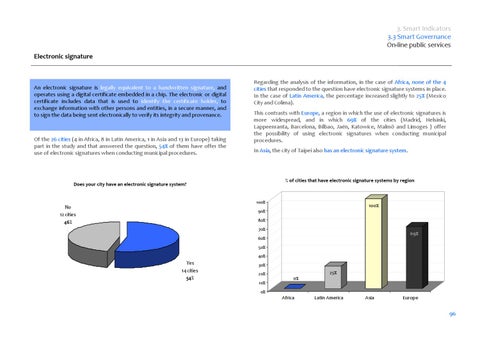
Of the 26 cities (4 in Africa, 8 in Latin America, 1 in Asia and 13 in Europe) taking part in the study and that answered the question, 54% of them have offer the use of electronic signatures when conducting municipal procedures.
Regarding the analysis of the information, in the case of Africa, none of the 4 cities that responded to the question have electronic signature systems in place. In the case of Latin America, the percentage increased slightly to 25% (Mexico City and Colima). This contrasts with Europe, a region in which the use of electronic signatures is more widespread, and in which 69% of the cities (Madrid, Helsinki, Lappeenranta, Barcelona, Bilbao, Jaén, Katowice, Malmö and Limoges ) offer the possibility of using electronic signatures when conducting municipal procedures. In Asia, the city of Taipei also has an electronic signature system.
% of cities that have electronic signature systems by region
Does your city have an electronic signature system?
100%
No 12 cities 46%
100%
90% 80% 70%
69%
60% 50% 40%
Yes 14 cities 54%
30% 20% 10%
25% 0%
0%
Africa
Latin America
Asia
Europe
96