1. Cities in the digital, innovation and knowledge age 1.2 Evolution from digital cities to innovative cities
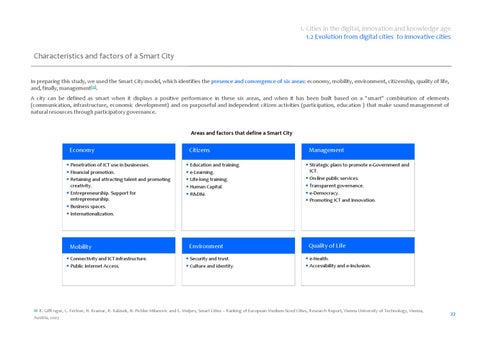
Characteristics and factors of a Smart City In preparing this study, we used the Smart City model, which identifies the presence and convergence of six areas: economy, mobility, environment, citizenship, quality of life, and, finally, management[3]. A city can be defined as smart when it displays a positive performance in these six areas, and when it has been built based on a "smart" combination of elements (communication, infrastructure, economic development) and on purposeful and independent citizen activities (participation, education ) that make sound management of natural resources through participatory governance.
Areas and factors that define a Smart City
Economy Penetration of ICT use in businesses. Financial promotion. Retaining and attracting talent and promoting creativity. Entrepreneurship. Support for entrepreneurship. Business spaces. Internationalization.
Mobility Connectivity and ICT infrastructure. Public Internet Access.
[3]
Citizens
Education and training. e‐Learning. Life‐long training. Human Capital. R&D&i.
Environment Security and trust. Culture and identity.
Management Strategic plans to promote e‐Government and ICT. On‐line public services. Transparent governance. e‐Democracy. Promoting ICT and Innovation.
Quality of Life e‐Health. Accessibility and e‐Inclusion.
R. Giffi nger, C. Fertner, H. Kramar, R. Kalasek, N. Pichler‐Milanovic and E. Meijers, Smart Cities – Ranking of European Medium‐Sized Cities, Research Report, Vienna University of Technology, Vienna,
Austria, 2007
22