3. Smart Indicators 3.6 Smart Living Accessibility and e‐Inclusion
Accessibility and e‐Inclusion
ICT can enhance the capabilities of people with special needs, providing them with autonomy, independence and access to services that had not always been available to them. This is why the use of ICT should focus mainly on two objectives: solving deficiencies and enhancing capabilities. ICTs are valuable tools to solve problems considered as basic group problems, and also as instruments to ensure inclusion in cultural, artistic, sporting and leisure environments. e‐Inclusion is a social movement whose goal is to eliminate the digital divide; i.e. the separation between people using Information and Communication Technologies (ICT) as a routine part of their daily lives and those who have no access to them and who, even if they did have access, would not know how to use them.
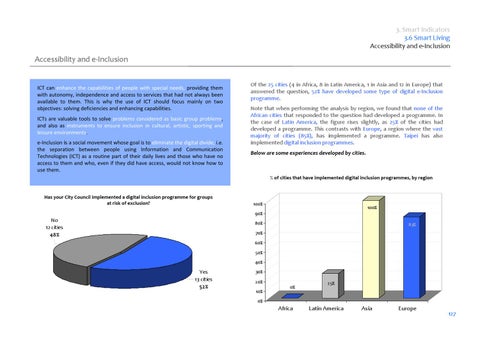
Of the 25 cities (4 in Africa, 8 in Latin America, 1 in Asia and 12 in Europe) that answered the question, 52% have developed some type of digital e‐Inclusion programme. Note that when performing the analysis by region, we found that none of the African cities that responded to the question had developed a programme. In the case of Latin America, the figure rises slightly, as 25% of the cities had developed a programme. This contrasts with Europe, a region where the vast majority of cities (85%), has implemented a programme. Taipei has also implemented digital inclusion programmes. Below are some experiences developed by cities.
% of cities that have implemented digital inclusion programmes, by region
Has your City Council implemented a digital inclusion programme for groups at risk of exclusion?
100%
100%
90%
No 12 cities 48%
80%
83%
70% 60% 50% 40%
Yes 13 cities 52%
30% 20% 10%
0%
25%
0%
Africa
Latin America
Asia
Europe
127