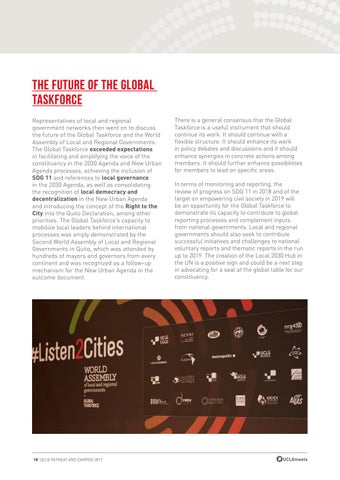
The future of the Global Taskforce Representatives of local and regional government networks then went on to discuss the future of the Global Taskforce and the World Assembly of Local and Regional Governments. The Global Taskforce exceeded expectations in facilitating and amplifying the voice of the constituency in the 2030 Agenda and New Urban Agenda processes, achieving the inclusion of SDG 11 and references to local governance in the 2030 Agenda, as well as consolidating the recognition of local democracy and decentralization in the New Urban Agenda and introducing the concept of the Right to the City into the Quito Declaration, among other priorities. The Global Taskforce’s capacity to mobilize local leaders behind international processes was amply demonstrated by the Second World Assembly of Local and Regional Governments in Quito, which was attended by hundreds of mayors and governors from every continent and was recognized as a follow-up mechanism for the New Urban Agenda in the outcome document.
18 UCLG RETREAT AND CAMPUS 2017
There is a general consensus that the Global Taskforce is a useful instrument that should continue its work. It should continue with a flexible structure. It should enhance its work in policy debates and discussions and it should enhance synergies in concrete actions among members. It should further enhance possibilities for members to lead on specific areas. In terms of monitoring and reporting, the review of progress on SDG 11 in 2018 and of the target on empowering civil society in 2019 will be an opportunity for the Global Taskforce to demonstrate its capacity to contribute to global reporting processes and complement inputs from national governments. Local and regional governments should also seek to contribute successful initiatives and challenges to national voluntary reports and thematic reports in the run up to 2019. The creation of the Local 2030 Hub in the UN is a positive sign and could be a next step in advocating for a seat at the global table for our constituency.