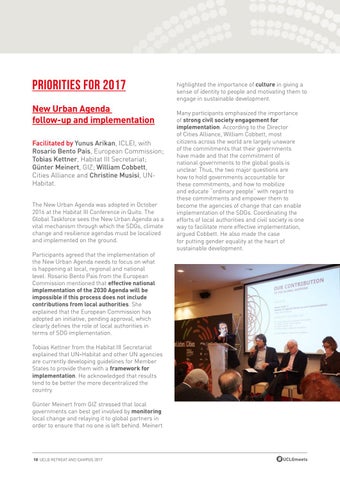
PRIORITIES FOR 2017 New Urban Agenda follow-up and implementation Facilitated by Yunus Arikan, ICLEI, with Rosario Bento Pais, European Commission; Tobias Kettner, Habitat III Secretariat; Günter Meinert, GIZ; William Cobbett, Cities Alliance and Christine Musisi, UNHabitat. The New Urban Agenda was adopted in October 2016 at the Habitat III Conference in Quito. The Global Taskforce sees the New Urban Agenda as a vital mechanism through which the SDGs, climate change and resilience agendas must be localized and implemented on the ground. Participants agreed that the implementation of the New Urban Agenda needs to focus on what is happening at local, regional and national level. Rosario Bento Pais from the European Commission mentioned that effective national implementation of the 2030 Agenda will be impossible if this process does not include contributions from local authorities. She explained that the European Commission has adopted an initiative, pending approval, which clearly defines the role of local authorities in terms of SDG implementation. Tobias Kettner from the Habitat III Secretariat explained that UN-Habitat and other UN agencies are currently developing guidelines for Member States to provide them with a framework for implementation. He acknowledged that results tend to be better the more decentralized the country. Günter Meinert from GIZ stressed that local governments can best get involved by monitoring local change and relaying it to global partners in order to ensure that no one is left behind. Meinert
10 UCLG RETREAT AND CAMPUS 2017
highlighted the importance of culture in giving a sense of identity to people and motivating them to engage in sustainable development. Many participants emphasized the importance of strong civil society engagement for implementation. According to the Director of Cities Alliance, William Cobbett, most citizens across the world are largely unaware of the commitments that their governments have made and that the commitment of national governments to the global goals is unclear. Thus, the two major questions are how to hold governments accountable for these commitments, and how to mobilize and educate “ordinary people” with regard to these commitments and empower them to become the agencies of change that can enable implementation of the SDGs. Coordinating the efforts of local authorities and civil society is one way to facilitate more effective implementation, argued Cobbett. He also made the case for putting gender equality at the heart of sustainable development.