EXECUTIVE SUMMARY
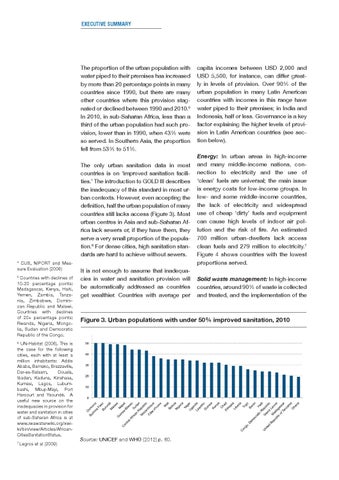
The proportion of the urban population with water piped to their premises has increased by more than 20 percentage points in many countries since 1990, but there are many other countries where this provision stagnated or declined between 1990 and 2010.5 In 2010, in sub-Saharan Africa, less than a third of the urban population had such provision, lower than in 1990, when 43% were so served. In Southern Asia, the proportion fell from 53% to 51%. The only urban sanitation data in most countries is on ‘improved sanitation facilities.’ The introduction to GOLD III describes the inadequacy of this standard in most urban contexts. However, even accepting the definition, half the urban population of many countries still lacks access (Figure 3). Most urban centres in Asia and sub-Saharan Africa lack sewers or, if they have them, they serve a very small proportion of the population.6 For dense cities, high sanitation standards are hard to achieve without sewers. CUS, NIPORT and Measure Evaluation (2006) 4
Countries with declines of 10-20 percentage points: Madagascar, Kenya, Haiti, Yemen, Zambia, Tanzania, Zimbabwe, Dominican Republic and Malawi. Countries with declines of 20+ percentage points: Rwanda, Nigeria, Mongolia, Sudan and Democratic Republic of the Congo. 5
UN-Habitat (2006). This is the case for the following cities, each with at least a million inhabitants: Addis Ababa, Bamako, Brazzaville, Dar-es-Salaam, Douala, Ibadan, Kaduna, Kinshasa, Kumasi, Lagos, Lubumbashi, Mbuji-Mayi, Port Harcourt and Yaoundé. A useful new source on the inadequacies in provision for water and sanitation in cities of sub-Saharan Africa is at www.iwawaterwiki.org/xwiki/bin/view/Articles/AfricanCitiesSanitationStatus.
It is not enough to assume that inadequacies in water and sanitation provision will be automatically addressed as countries get wealthier. Countries with average per
Legros et al (2009)
Energy: In urban areas in high-income and many middle-income nations, connection to electricity and the use of ‘clean’ fuels are universal; the main issue is energy costs for low-income groups. In low- and some middle-income countries, the lack of electricity and widespread use of cheap ‘dirty’ fuels and equipment can cause high levels of indoor air pollution and the risk of fire. An estimated 700 million urban-dwellers lack access clean fuels and 279 million to electricity.7 Figure 4 shows countries with the lowest proportions served. Solid waste management: In high-income countries, around 90% of waste is collected and treated, and the implementation of the
Figure 3. Urban populations with under 50% improved sanitation, 2010
6
7
capita incomes between USD 2,000 and USD 5,500, for instance, can differ greatly in levels of provision. Over 90% of the urban population in many Latin American countries with incomes in this range have water piped to their premises; in India and Indonesia, half or less. Governance is a key factor explaining the higher levels of provision in Latin American countries (see section below).
Source: UNICEF and WHO (2012) p. 60.