81
have been setbacks in the Caucasus and Central Asia. The MDG targets on access to ‘improved sanitation facilities’ will not be achieved, despite the remarkable progress in South-Eastern Asia. In 2010, 2.5 billion people were still living without improved sanitation; Southern Asia and Sub-Saharan Africa are especially off-track.2 Even where targets will be met at national level, there are often disparities between and within regions and cities. The MDG monitoring system doesn’t include data on the extent of water and sanitation provision by city or district. The only disaggregated data globally is on the national proportion of the urban and rural population with provision. Despite improving urban access globally, there has also been evidence over the last ten years of growing inadequacies in urban areas, especially in the informal settlements that are now home to nearly one billion peo-
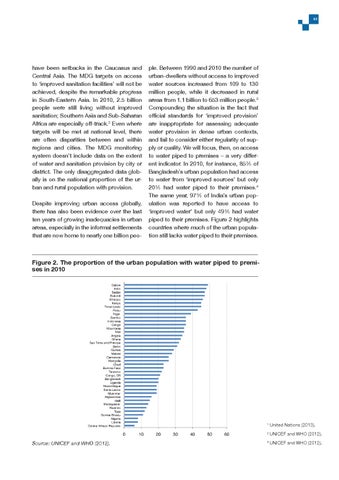
ple. Between 1990 and 2010 the number of urban-dwellers without access to improved water sources increased from 109 to 130 million people, while it decreased in rural areas from 1.1 billion to 653 million people.3 Compounding the situation is the fact that official standards for ‘improved provision’ are inappropriate for assessing adequate water provision in dense urban contexts, and fail to consider either regularity of supply or quality. We will focus, then, on access to water piped to premises – a very different indicator. In 2010, for instance, 85% of Bangladesh’s urban population had access to water from ‘improved sources’ but only 20% had water piped to their premises.4 The same year, 97% of India’s urban population was reported to have access to ‘improved water’ but only 49% had water piped to their premises. Figure 2 highlights countries where much of the urban population still lacks water piped to their premises.
Figure 2. The proportion of the urban population with water piped to premises in 2010
Source: UNICEF and WHO (2012).
1
United Nations (2013).
2
UNICEF and WHO (2012).
3
UNICEF and WHO (2012).