EXECUTIVE SUMMARY
cal services that affect the daily life of their populations. Expenditures on the maintenance of existing infrastructure are usually deferred until absolutely necessary. In spite of the steady rise in the value of developed land, real estate taxes provide little public revenue in MEWA countries relative to global norms. Key constraints on the municipalities’ ability to generate revenue
The resulting neglect of infrastructure and inadequate service levels in informal settlements and lower-income neighborhoods are contributing factors to the current unrest in the region. Public-Private Partnerships: Governments in the non-oil producing countries are looking at a greater involvement of the private sector in the financing of infrastructure pro-
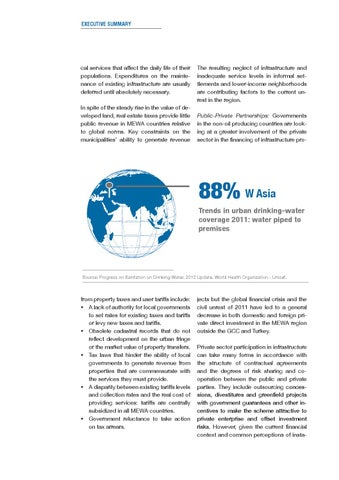
88% W Asia Trends in urban drinking-water coverage 2011: water piped to premises
Source: Progress on Sanitation on Drinking-Water. 2013 Update. World Health Organization - Unicef.
from property taxes and user tariffs include: A lack of authority for local governments to set rates for existing taxes and tariffs or levy new taxes and tariffs. Obsolete cadastral records that do not reflect development on the urban fringe or the market value of property transfers. Tax laws that hinder the ability of local governments to generate revenue from properties that are commensurate with the services they must provide. A disparity between existing tariffs levels and collection rates and the real cost of providing services: tariffs are centrally subsidized in all MEWA countries. Government reluctance to take action on tax arrears.
jects but the global financial crisis and the civil unrest of 2011 have led to a general decrease in both domestic and foreign private direct investment in the MEWA region outside the GCC and Turkey. Private sector participation in infrastructure can take many forms in accordance with the structure of contractual agreements and the degrees of risk sharing and cooperation between the public and private parties. They include outsourcing concessions, divestitures and greenfield projects with government guarantees and other incentives to make the scheme attractive to private enterprise and offset investment risks. However, given the current financial context and common perceptions of insta-