EXECUTIVE SUMMARY
resulted in a backlog in construction of needed infrastructure and public facilities, leading to continued densification and expansion of under-serviced informal settlements. In some countries (Iraq, Yemen, and Lebanon, for instance), over half of the urban population lives in slums. The dynamics of the land and real estate markets has also led to wasteful sprawl around larger cities.
ture and inadequate service levels in informal settlements and lower-income neighborhoods have contributed to the current unrest in the region. The degree to which MEWA countries will continue to pursue decentralization is unclear at this time. Most governments are implementing modest reforms in response to restive young populations; some are retaining greater central control while introducing minor changes in their legal frameworks.
Institutional framework In most of the MEWA region, three levels of sub-national administration provide services to urban areas: governorates, districts, and municipalities. Major infrastructure investment decisions are made at the central ministerial level, while local authorities are responsible for the enforcement of development regulations and the delivery of services. With the exception of Turkey, where major institutional reforms have recently been made to devolve decisions powers to
Central / local responsibilities in 足providing services All countries in the region, with the exception of Iran and Turkey, have been depleting their water resources. The need to manage a scarce resource and the cost of trunk infrastructures has led central governments to assume the primary responsibility for the regulation, planning and management of water and sanitation systems. Municipal-足 level water utilities typically have limited involvement in planning and financing, and
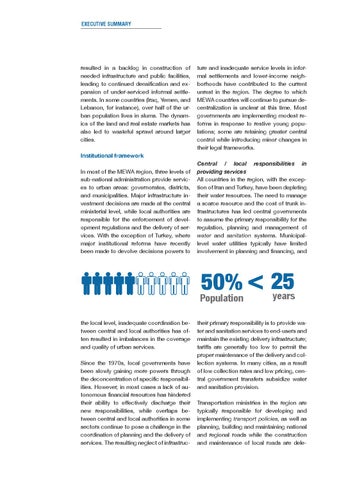
50% < 25 years
Population the local level, inadequate coordination between central and local authorities has often resulted in imbalances in the coverage and quality of urban services. Since the 1970s, local governments have been slowly gaining more powers through the deconcentration of specific responsibilities. However, in most cases a lack of autonomous financial resources has hindered their ability to effectively discharge their new responsibilities, while overlaps between central and local authorities in some sectors continue to pose a challenge in the coordination of planning and the delivery of services. The resulting neglect of infrastruc-
their primary responsibility is to provide water and sanitation services to end-users and maintain the existing delivery infrastructure; tariffs are generally too low to permit the proper maintenance of the delivery and collection systems. In many cities, as a result of low collection rates and low pricing, central government transfers subsidize water and sanitation provision. Transportation ministries in the region are typically responsible for developing and implementing transport policies, as well as planning, building and maintaining national and regional roads while the construction and maintenance of local roads are dele-