EXECUTIVE SUMMARY
the voluntary sector. There is also an informal sector that works in specific niches (e.g. waste-pickers in waste-sorting and recycling). Financing In recent decades, there have been great efforts to invest in basic local services in Latin America. Policies have focused on access to drinking water, rural electrification, sanitation and transport. These efforts, alongside initiatives by international financing bodies (IDB, WB, CAF) have contributed to improving access to basic services. There has also been progress in the financing of basic services by means of direct user tariffs, although these have often been subsidized. Local governments have also contributed by improving the mobilization and management of their own resources.
inadequate to keep up with the region’s growth. It is estimated that, over the next few decades, an average annual investment of USD 12.5 billion will be required to close the infrastructure gaps for drinking water and sanitation in Latin America. In the waste management sector, the most worrying issue is insufficient cost recovery. It is estimated that current average cost recovery is around 51.6%, with a slight improvement seen over previous years, insufficient to guarantee the financial sustainability of services. Public transport in Latin American cities is less heavily subsidized than in their European counterparts. Most subsidies are for railways and metros (60%), but there are also subsidized bus systems (e.g.: Buenos
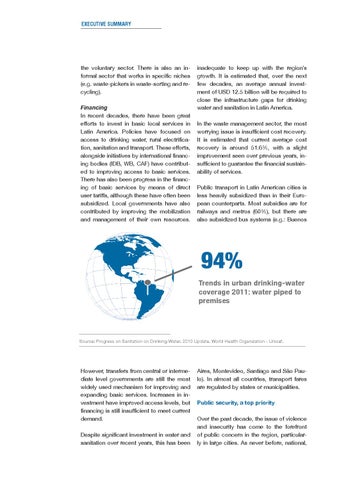
94% Trends in urban drinking-water coverage 2011: water piped to premises
Source: Progress on Sanitation on Drinking-Water. 2013 Update. World Health Organization - Unicef.
However, transfers from central or intermediate level governments are still the most widely used mechanism for improving and expanding basic services. Increases in investment have improved access levels, but financing is still insufficient to meet current demand. Despite significant investment in water and sanitation over recent years, this has been
Aires, Montevideo, Santiago and SĂŁo Paulo). In almost all countries, transport fares are regulated by states or municipalities. Public security, a top priority Over the past decade, the issue of violence and insecurity has come to the forefront of public concern in the region, particularly in large cities. As never before, national,