EXECUTIVE SUMMARY
In almost every country in the region water supply and sanitation facilities are owned by municipalities or higher-tier governments. In Kyrgyzstan, Tajikistan, Ukraine, Belarus and Russia, most water is provided by state- or municipally-run public utilities. In Armenia and Georgia, water supply and sanitation systems are managed by pri vate operators. In Russia, about 25% of the population is provided with water and sanitation by private operators under PPP contracts.
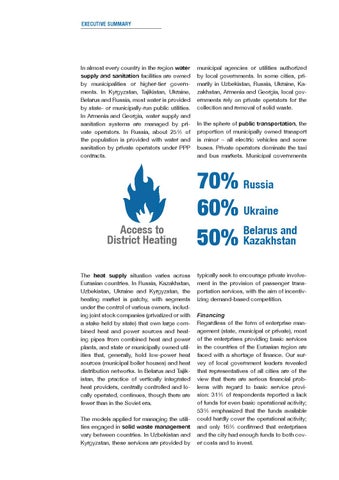
Access to District Heating The heat supply situation varies across Eurasian countries. In Russia, Kazakhstan, Uzbekistan, Ukraine and Kyrgyzstan, the heating market is patchy, with segments under the control of various owners, includ ing joint stock companies (privatized or with a stake held by state) that own large combined heat and power sources and heating pipes from combined heat and power plants, and state or municipally owned utilities that, generally, hold low-power heat sources (municipal boiler houses) and heat distribution networks. In Belarus and Tajikistan, the practice of vertically integrated heat providers, centrally controlled and locally operated, continues, though there are fewer than in the Soviet era. The models applied for managing the utilities engaged in solid waste management vary between countries. In Uzbekistan and Kyrgyzstan, these services are provided by
municipal agencies or utilities authorized by local governments. In some cities, primarily in Uzbekistan, Russia, Ukraine, Kazakhstan, Armenia and Georgia, local governments rely on private operators for the collection and removal of solid waste. In the sphere of public transportation, the proportion of municipally owned transport is minor – all electric vehicles and some buses. Private operators dominate the taxi and bus markets. Municipal governments
70% Russia 60% Ukraine Belarus and 50% Kazakhstan typically seek to encourage private involvement in the provision of passenger transportation services, with the aim of incentivizing demand-based competition. Financing Regardless of the form of enterprise man agement (state, municipal or private), most of the enterprises providing basic services in the countries of the Eurasian region are faced with a shortage of finance. Our survey of local government leaders revealed that representatives of all cities are of the view that there are serious financial problems with regard to basic service provision: 31% of respondents reported a lack of funds for even basic operational activity; 53% emphasized that the funds available could hardly cover the operational activity; and only 16% confirmed that enterprises and the city had enough funds to both cover costs and to invest.