EXECUTIVE SUMMARY
eralizations can be difficult. Nevertheless, some broad patterns can be observed.
councils and territorial authorities in New Zealand).
In the countries which face the greatest challenges in providing basic s ervices, local governments tend to d eliver services though in-house departments. Most face financing and technical challenges, weak management capacities, and a lack of transparency, which result in inefficient or inadequate service delivery. In higher-income countries, SPAs, or public utilities, have been used to great success. Their high degree of autonomy and financial management capacities have allowed them to manage projects demanding large investments, wide geographic coverage, and complex management approaches.
City Cluster Development (CCD), a form of collaborative agreement recently introduced in Sri Lanka and India by the Asian Development Bank (ADB), allows auton omous local governments to link basic infrastructure like roads, water and sanitation in an urban cluster. Recent ADB initiatives have shown that CCDs benefit from economies of scale by clustering investment in productive nodes, reducing transaction costs, and attracting skilled labour and managerial talent. While few basic services in the region are provided independently by large private
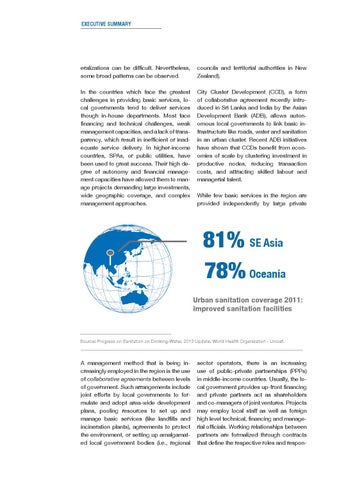
81% SE Asia 78% Oceania Urban sanitation coverage 2011: improved sanitation facilities
Source: Progress on Sanitation on Drinking-Water. 2013 Update. World Health Organization - Unicef.
A management method that is being increasingly employed in the region is the use of collaborative agreements between levels of government. Such arrangements include joint efforts by local governments to formulate and adopt area-wide development plans, pooling resources to set up and manage basic services (like landfills and incineration plants), agreements to protect the environment, or setting up amalgamated local government bodies (i.e., regional
sector operators, there is an increasing use of public-private partnerships (PPPs) in middle-income countries. Usually, the local government provides up-front financing and private partners act as shareholders and co-managers of joint ventures. Projects may employ local staff as well as foreign high level technical, financing and managerial officials. Working relationships between partners are formalized through contracts that define the respective roles and respon-