BASIC SERVICES FOR ALL IN AN URBANIZING WORLD
Third Global Report of United Cities and Local Governments on Local Democracy and Decentralization GOLD III
Executive Summary
This Executive Summary is made up of the Introduction, Conclusion, and shortened versions of the Regional Chapters of the publication 'Basic Services for all in an Urbanizing World: Third Global Report on Local Democracy and Decentralization'.
DISCLAIMER “The terms used concerning the legal status of any country, territory, city or area, or of its authorities, or concerning delimitation of its frontiers or boundaries, or regarding its economic system or degree of development do not necessarily reflect the opinion of United Cities and Local Governments. The analysis, conclusions and recommendations of this report do not necessary reflect the views of the all members of United Cities and Local Governments.”
Copyright© 2013 United Cities and Local Governments Cités et Gouvernements Locaux Unis Ciudades y Gobiernos Locales Unidos Avinyó 15 08002 Barcelona, Spain www.uclg.org Design and Layout: ITD Bòria 17 pral 08003 Barcelona, Spain Editorial Consultant: Sheridan Bartlett Cover Photos: United Nations, National League of Cities, End User, Christian Senger, Geoffrey Whiteway Interior Photos: Eric Fischer (p.4), Halfrain (p.12), Wippetywu (p.25), Eddy (p. 32), Gregor Fischer (p. 39), Luis Hernández (p. 45), Lett (p.53), Guillen Pérez (p. 59), Spiterman (p. 65), Gisela Giardino (p. 70), Jason Rogers (p.78), Nicolas Raymond (p. 112) All rights reserved
This document has been produced with the financial assistance of the European Union. The contents of this document are the sole responsibility of UCLG and can under no circumstances be regarded as reflecting the position of the European Union.
3
CONTENTS
Foreword 5 Editorial board 7 Credits 11 Introduction 13 Africa 25 Asia Pacific 32 Eurasia 39 Europe 45 Latin America 53 Middle East and West Asia 59 North America 65 Metropolis 70 Conclusions 78 Recommendations 118
EXECUTIVE SUMMARY
5
FOREWORD As President of UCLG, I warmly welcome the publication of the Third Global Report on Local Democracy and Decentralization (GOLD III). This report on basic local service provision fulfils UCLG’s commitment to present a review of the state of local democracy and decentralization across the world every three years. As a member of the SecretaryGeneral’s High-Level Panel of Eminent Persons on the Post-2015 Development Agenda, I am certain that GOLD III will make a unique contribution to international debates on the Millennium Development Goals, the Post-2015 Development Agenda, and the Habitat III Global Urban Agenda. Basic services are essential, not only for the preservation of human life and dignity, but also in driving economic growth and ensuring social equality. ‘Putting people first’ therefore implies putting basic services first. In this light, GOLD III should be taken as a call to action. The report makes clear that, while there has been progress in service access and quality, huge gaps in provision remain and access rates are even falling in some cities in Sub-Saharan Africa and South Asia. In addition to existing access deficits, rapid urbanization and demographic and environmental changes are posing radical new challenges that make significant increases in investment in basic service infrastructure necessary. The global urban population will grow by around 1.4 billion people over the next 20-30 years. These new urban residents will need access to drinking water, sanitation, housing, waste collection, transport, and electricity. There are already nearly a billion slum-dwellers who have limited or no access to many basic services. A failure to address the urban access issue will have serious repercussions for human wellbeing, environmental sustainability, and economic development. GOLD III serves as a warning, but, at the same time, it offers a way forward. Local governments, as the level of government closest to the people, are particularly wellplaced to guarantee universal access to quality basic services. This report demonstrates that improvements to basic services are positively correlated with local government involvement in their provision. Local governments are willing and able to rise to the challenge of providing basic services, but they need the human, technical and, above all, the financial resources to do so. GOLD III highlights the common challenges that local governments across the world face in balancing the financial sustainability of services with affordability for their residents, particularly the urban poor. Strengthening the capacity of local governments is essential to reducing access deficits. GOLD III showcases examples of where decentralized management, improved efficiency, along with a better mobilization of local resources and a more targeted use of subsidies, have contributed to expanding access in a sustainable way.
EXECUTIVE SUMMARY
A central recommendation of GOLD III is that national governments and international institutions should prioritize the financing of basic services, especially in low and lowermiddle income countries where the gaps between required investment and current resources are widest. The long-term horizons of infrastructure investments require concessional loans of a nature that can only be provided with the direct financial involvement of national governments and multilateral organizations. Another significant proposal of GOLD III is that international organizations facilitate local government’s direct access to global financing mechanisms. The report also draws attention to the fact that the effective management of basic services requires closer cooperation between local authorities and other levels of government; improved vertical and horizontal coordination between local, regional, national, and international institutions is necessary. Effective multi-level governance requires institutional and legal frameworks that clearly define the roles and responsibilities of all levels of government, guided by the principle of subsidiarity. GOLD III recognizes the ways in which various stakeholders, including the private sector and civil society organizations, act in partnership with local governments to provide basic services. The report acknowledges the diversity of opinions about Public Private Partnerships (PPPs), and explores the conditions necessary for their success. Above all, it emphasizes the need for local governments to be empowered with decision-making, management and oversight capacities so that they can collaborate effectively and hold their external partners to account. Finally, as Mayor of Istanbul, one of the oldest metropolises in the world, I wholeheartedly support GOLD III’s call for a more holistic vision of urban development. Basic service infrastructure should accompany and guide the spatial planning of cities and regions, and urban planning must engage all stakeholders, including those living in informal settlements, to monitor and improve access. I call on international institutions, national governments, and civil society organizations to take on board the messages of GOLD III and to engage in dialogue with local governments on the best ways to respond to the immense challenges we face in guaranteeing universal access to quality basic services over the coming decades. Together we can build “the future we want”: an environmentally sustainable future in which human dignity, economic development and social justice are enjoyed by all.
Dr. Kadir Topbas Mayor of Istanbul President of UCLG ‘
7
EDITORIAL BOARD Coordination Gold team • Director: Josep Roig, Secretary General, UCLG • Coordinator: Edgardo Bilsky • Coordination Assistants: Claire Frost, Mathieu Guérin, Kate Shea Baird • Support: Irene Fuertes Cabrera, Mariola Szek
UCLG World Secretariat team Pere Ballester, Alessa Bennaton, Mohamed Boussraoui, Jean-Baptiste Buffet, Sara Hoeflich, Craig Laird, Ricardo Martínez, Mónica Mora, Carole Morillon, Jorge Pellicer, Natalène Poisson, Marie-Laure Roa, Emilia Saiz, Elisabeth Silva.
Steering Committee UCLG Regional and Metropolitan Sections • Brock Carlton, Secretary General, UCLG North America • Mehmet Duman, Secretary General, UCLG Middle East & Western Asia • Jean-Pierre Elong Mbassi, Secretary General, UCLG Africa • Rudolf Hauter, Former Secretary General, UCLG Asia Pacific (in Memoriam) • Tim Kehoe, Deputy Secretary General, UCLG-North America • Alain Lesaux, Secretary General, Metropolis • Angelika Poth-Mögele, Director of Policy, CEMR, Europe • Rassikh Sagitov, Secretary General, UCLG Euro-Asia • Guillermo Tapia, Secretary General of FLACMA, UCLG Latin America • Bernadia Irawati Tjandradewi, Secretary General, UCLG Asia-Pacific • Frédéric Vallier, Secretary General, Council of European Municipalities and Regions (CEMR), UCLG Europe • Peter Woods, Special Ambassador, UCLG Asia Pacific Coordinator of Chapter Authors • David Satterthwaite, Global Coordinator, Senior Fellow, Human Settlements Group, International Institute for Environment and Development (IIED), United Kingdom Principal Partners • Cities Alliance: William Cobbett, Manager • Cities Development Initiative for Asia (CDIA): Hajo Junge, Senior Officer and Rhoda Lynn Gregorio, GIZ • Diputación of Barcelona and UCLG Committee on Decentralization and Local SelfGovernment (Spain): Jordi Castells i Masanés, Director of International Relations, Arnau Gutierrez Camps and Ana Tapia
EXECUTIVE SUMMARY
• French Development Agency – Agence Française de Développement (AFD): François Tirot and Marie Bjornson-Langen, Local Governments and Urban Development, • French Institut for Public Private Parnership - Institut de Gestion Délégué (IGD): Jean Marie Tétart, National Congressman, Mayor of Houdan (France), Special Adviser for the President. • French Ministry of Foreign Affairs (MAE): Marc Trouyet, Head of the Division, and Emilie Maehara, Democratic Governance Division • Generalitat of Catalonia (Spain): Carles Llorens, Director General for Development Cooperation, Elisabet Guillemat Marrugat and Guadalupe Moreno Iturriaga, Secretariat of Foreign Affairs • Multilateral Investment Fund (MIF-FOMIN) – Interamerican Development Bank: Celia Bedoya del Olmo • Public-Private Infrastructure Advisory Facility (PPIAF) – World Bank: James Close, Program Manager, and Lauren Wilson, Portfolio Coordinator • Suez Environment: Thomas Perianu, Director for Sustainable Development UCLG Committees Secretariats • Eva García Chueca, Secretary of the Committee on Social Inclusion, Participatory Democracy and Human Rights • Laia Vilademunt, Secretary of the International Observatory on Participatory Democracy
9
CREDITS Chapter Authors Introduction • David Satterthwaite, Senior Fellow, International Institute for Environment and Development (IIED), United Kingdom Africa • Susan Bannister, Acting Head of the Strategic Project Unit, Ethekwini Municipality, South Africa • Michael Sutcliffe, Former CEO of the City of Durban, City Insight (Pty) Ltd, South Africa With the collaboration of: • Mounir Zouggari, Expert on Water in Sanitation, Infrasol Sarl, Morroco • Jean Yango, Director of studies, town planning and sustainable development, Cameroon Asia Pacific • Aprodicio A. Laquian, Centre for Human Settlements, School of Community and Regional Planning University of British Columbia, Canada With the collaboration of: Bharat Dahiya, formerly of UN Habitat, India Country and sectorial paper writers: Sascha Moege (Australia); Sohana Samrin Chowdhury (Bangladesh); Oueng Kimunn (Cambodia); Aprodicio Laquian (China); Ibnu Syabri (Indonesia); Om Prakash Mathur (India); Masao Kikuchi (Japan); Rajesh Pradhan (Korea); Selvarajoo Manikan, Wan Norashikin Mohd Thair and Syaibul Hafiz (Malaysia); Hem Raj Lamichhane (Nepal); Mike Reid (New Zealand); Anwar Hussain (Pakistan); Remigio Ocenar (Philippines); Sujata N. Gamage (Sri Lanka); Wijitbusaba Marone (Thailand); Vu Thi Vinh (Vietnam) Eurasia • Sergey Sivaev, Institute for Urban Economics, Russia With the collaboration of: Alexei Rodionov, Timur Shakirov, and Anna Dzembak, Institute for Urban Economics, Russia Europe • Pierre Bauby, Institute of Political Sciences and University of Paris 8, Reconstruire l’Action Publique (RAP), France • Mihaela M. Similie, CERI - Institute of Political Sciences & Reconstruire l’Action Publique (RAP), France
EXECUTIVE SUMMARY
Latin America • Sergio Galilea Ocón, Institute for Public Affairs, University of Chile, Chile With the collaboration of: Ricardo Casanova, Geraldine Espinoza, Mario Ossandón Cañas, Giselle Pedreros, Fernando Ossandón Correa, Mario Rosales Ortega. And special contribution of: Catherine Paquette Vassali, IRD - Mexico Middle East & West Asia • Mona Serageldin, Institute for International Urban Development, Cambridge MA, USA With the collaboration of: Sheelah Goba, Warren Hagist, Carolina Morgan, François Vigier from the Institute for International Urban Development, Cambridge MA, USA Ozdemir Somnez, Istanbul Metropolitan Planning and Urban Design Centre, Turkey North America • Christian Hoene, Former Director of Research, National League of Cities, USA • Andrew Sancton, Professor of Political Science, University of Western Ontario, Canada • Darrene L. Hackler, George Mason University, Department of Public and International Affairs, USA Coordination by: Jim Brooks at the National League of Cities. Contributions to the chapter were also made by staff and representatives of the National League of Cities and Federation of Canadian Municipalities Metropolis • Carlos de Freitas, Global Fund of Cities (FMDV), France Conclusions • David Satterthwaite, Senior Fellow, International Institute for Environment and Development (IIED), United Kingdom
11
Special acknowledgments to: Cities Development Initiative for Asia (CDIA) Cities Alliance Diputació de Barcelona (Province of Barcelona) Generalitat de Catalunya (Government of Catalonia) European Commission French Agency for Development - Agence Française de Développement (AFD) French Ministry of Foreign Affairs (MAE) Multilateral Investment Fund (MIF-FOMIN) – Interamerican Development Bank Public-Private Infrastructure Advisory Facility (PPIAF) – World Bank Suez Environment UN Habitat
for their financial and advisory support.
EXECUTIVE SUMMARY
13
INTRODUCTION David Satterthwaite
Progress in local democracy must be measured in terms of improvements to quality of life. After all, local governments are ultimately judged on their ability to meet the needs of their citizens. Basic services are fundamental to improving living standards and, in general, local governments have the responsibility for their provision. Even when local government institutions are not officially assigned responsibility for basic service provision, they often deal with the health, economic, social and environmental consequences of unmet basic needs. Improving the delivery of basic services has been a key component of the Millennium Development Goals (MDGs), which aim to eradicate extreme poverty worldwide. The issue of basic services will also be central to the Post-2015 Development Agenda. With this in mind, United Cities and Local Governments (UCLG) has dedicated this Third Global Report on Local Democracy and Decentralization (GOLD III) to reviewing the current state of basic local service provision across the world. The report examines the provision and governance of local basic services across seven regions of the world. It describes gaps and deficiencies in access, and seeks to draw conclusions and propose solutions about how to address them. It places a particular focus on the actual and potential role of local government in guaranteeing universal access to quality basic services. What are basic local services? As GOLD I demonstrated, local governments throughout the world tend to have responsibility for a number of basic services
(see Box 1). The UN Habitat Agenda provides the following definition of local basic services: “Basic infrastructure and services at the community level include the delivery of safe water, sanitation, waste management, social welfare, transport and communication facilities, energy, health and emergency services, schools, public safety, and the management of open spaces.”1 The services included within this definition can be organized into the following three categories: Basic infrastructure services: water and sanitation, waste collection and management, transport, energy. Social services: education, health, housing, and elderly and child care. Quality of life services: public safety, urban planning, culture and entertainment, sport, public spaces. While the second category also includes services that are fundamental to human development, the services in the first group form the foundation on which human settlements are built and function. Everyone needs water, a toilet, energy, and a way to dispose of household waste and to get from place to place. Thus, this report focuses on the following local services: Potable water delivery;2 Sanitation, including the collection, treatment and disposal of waste water and runoff; Solid waste management, including collection, disposal and recycling3 Urban transportation;4 Energy5 (usually electricity)
UN Habitat Agenda Goals and Principles, Commitments and the Global Plan of Action Article 84, New York, 1996. 1
The report focuses on the management and distribution of potable water for domestic purposes. It does not address the management and protection of resources or supply of water for agricultural or industrial purposes. 2
See international reference texts on the definition of locally managed domestic waste. Domestic waste is distinguished from industrial waste and hazardous hospital waste, where management is often a national responsibility. Also see reference on methods of waste treatment (landfill, incineration, recycling and composting, etc.). 3
The report focuses on system management and the regulation of public transport and related urban infrastructure (train stations and terminals). In some countries or regions, the management of urban roads is also included. 4
Energy is not often a local responsibility, but local management of energy distribution is an important debate in some countries and regions. Furthermore, the issue of energy conservation has implications for transport, waste and water services. 5
EXECUTIVE SUMMARY
Box 1. Main local government responsibilities across the world
Services: water distribution, waste water and solid waste collection, public transport, street lights, cleaning of streets, markets and public places, public toilets, pollution control, public/environmental health, some aspects of child care and schooling, libraries and cultural activities, some forms of social welfare provision (usually shared with higher authorities), fire services and disaster response (usually shared with higher authorities), registration of births and deaths, monitoring for infectious diseases, cemeteries, and, in many countries, health, education, housing and policing. Infrastructure: water piped distribution, sanitation, storm and surface drainage, local roads, paths and bridges, solid waste disposal facilities, waste water treatment, bus terminals, parks/squares/sports facilities/public spaces. Buildings: building regulation, maintenance of public buildings, regulations for rental accommodation. Urban planning: land-use management and the application of land-use regulations, plans for the expansion of infrastructure. Other: local economic development, tourism. Because citizens’ needs are diverse and evolving, flexibility has been allowed for this core group of services to be modified according to the unique context of each region. The Asia Pacific chapter makes reference to slum upgrading and risk prevention; the Eurasia chapter covers heating; the North America chapter covers broadband services, as does the chapter on Europe, which also explores child and elder care services. The Latin America chapter includes a discussion of urban security and the increasing role of local governments in building safer cities. Furthermore, while the report is based in an analysis of these basic service sectors, its aim is to contribute to a holistic vision of basic local service provision. After all, local governments are often confronted by political, social, economic and environmental challenges
that cannot be adequately tackled by isolated, single sector interventions. There are significant differences in the extent to which the responsibilities for providing basic services are allocated between levels of government, as well as in the actual roles that local governments play on the ground, whether as service funders, managers, providers or supervisors, whatever their official responsibilities. In some countries, local governments are still considered organs of the central state, meaning they work under the direction of central governments, in some cases without any legally recognized independent authority. In most instances, however, local authorities play at least some role in these services, whether in urban infrastructure planning, land use management, revenue raising, service pro-
15
vision or oversight. There is, in short, a wide range of ways that well-functioning local governments can contribute to improving basic services and, consequently, the quality of life of their residents. The scope of GOLD III: basic local services in context The seven regional chapters of this report explore a set of common issues that shape the provision of local basic services. Each regional report describes the roles of each level of government and, in particular, the conditions necessary for local governments to be able to fulfil the responsibilities as-
local governments and the extent of political and fiscal decentralization in the field of local basic services. Basic services are anchored in particular geographic locations and have to respond to a range of local realities. There is therefore a strong case for the decentralization of authority over many basic services, in line with the principle of subsidiarity: decisions are made by the lowest level of government that is able to make them effectively. In decentralized systems, local governments are vested with powers to organize the provision of basic services. They are
Box 2. The concept of decentralization6 In this report, decentralization is understood as the existence of: Local authorities, distinct from the state’s administrative authorities, who have a degree of self-government, elaborated in the framework of the law, with their own powers, resources and capacities to meet responsibilities and with legitimacy underpinned by representative, elected local democratic structures that determine how power is exercised and that make local authorities accountable to citizens in their jurisdiction)
signed to them. The chapters examine the relationship of local governments with national and regional levels of government, the private sector and civil society. There is a special focus on the question of how to guarantee a minimum level of service to all, while, at the same time, ensuring the financial and environmental sustainability of services. Each report ends with policy recommendations that aim to achieve these goals in the context of the existing and emerging challenges in the region. Institutional and legal frameworks: Particular attention is given to the role of
considered as the ‘organizing authority’ of such services. An organizing authority is a public or publicly-owned body with legal and political responsibility to plan or regulate services in a specified area.7 It determines the ownership model, level of competition, and sets accessibility, affordability, technical and environmental standards. Access: The latest data on the coverage and quality of basic local services are reviewed, as well as the disparities between countries and within them. In some cases, this task is complicated by a lack of reliable or comparable data, or controversies
Extracted from UCLG, Decentralization and Local Democracy in the World, 1st GOLD Report, Washington, World Bank, 2008. 6
Definition from ISO 24510 standard for water and waste water: “the responsible authority is the entity that has the overall responsibility for providing the service to the population in a given geographic area.” See also: http://www.uitp. org/public-transport/organising-authorities/ 7
EXECUTIVE SUMMARY
UNICEF and WHO, Progress on Drinking Water and Sanitation; 2012 Update, Joint Monitoring Programme for Water Supply and Sa nitation, 2012. 8
9
UNICEF and WHO, 2012.
10
UNICEF and WHO, 2012.
11
UNICEF and WHO, 2012.
around how to define ‘adequate’ service standards. For example, in high-income (and many middle-income) countries, adequate provision for water is defined as drinking quality water piped into each home 24 hours a day. However, the only global dataset on water provision8 only indicates the proportion of residents with water piped to their premises and the proportion with ‘improved provision.’ This includes public taps or standpipes, tube wells or boreholes, protected springs, protected dug wells or rainwater collection. Those with access to just a public tap or standpipe are still classified as having ‘improved provision’ even when fetching water involves long queues, sporadic availability, punishing loads and often undrinkable water. There are comparable problems for sanitation. In high-income (and many middle-income) countries, adequate sanitation is understood as a water-sealed toilet (WC or pour-flush) in each home with provision for the safe collection and treatment of waste water. The only indicator available globally defines ‘improved provision,’ which includes, without disaggregation, pour-flush to a piped sewerage system, septic tank or pit latrine, ventilated improved pit latrines, pit latrines with a slab and composting toilets.9 Another data issue is the reliance of national governments and international agencies on sample surveys that reveal the proportion of the urban or rural population with services but do not break down the data any further. Information on local inequalities in provision is thus very limited. Census data is rarely available to local governments in a form that makes it possible to locate where provision is deficient. Such surveys are aimed at national governments and international agencies, rather than at the local governments responsible for provision. Despite data limitations, the scale of the differences in the quality and extent of provision of basic services across the world is evident. In high- and some middle-income
countries, all, or nearly all, of the population is well-served. In most middle-income countries, the proportion of the population with access to basic services increased significantly between 1990 and 2010. However, in low- and some middle-income nations, half or more of the population still lacks provision. In 2010, in sub-Saharan Africa, only 16% of the population had water piped to their premises – a 1% increase from 1990. In Southern Asia, the figure was 25% in 2010, up from 20% in 1990.10 Even with the low standards set for ‘improved provision’ of sanitation, only 30% in sub-Saharan Africa and 41% in South Asia had access to such services in 2010. 41% and 25% still relied on open defecation in South Asia and sub-Saharan Africa, respectively.11 Management and finance: The design and implementation of management and financing models are analysed. Management models include direct public provision, privatized provision and public-private partnerships, public-NGO and public-community partnerships. Where provision is not provided directly by the public sector, a focus is given to the capacity of local governments to provide oversight of external operators, and to ensure appropriate tendering, monitoring, enforcement and sanctioning of contracts. In terms of financing, chapters examine the extent to which local responsibilities are accompanied by fiscal decentralization (particularly local powers over taxes and service tariffs). They also review financing from the ‘3Ts’, a framework of the sources of funds for services initially developed by the OECD to ensure sustainable funding in the water sector, but applicable to any public service. The 3Ts categorize the main sources of funds for basic services as: Tariffs paid by service users, Taxes (local or national) paid by
17
citizens and distributed through governmental subsidies, and Transfers from foreign donor agencies. In addition to the 3Ts, bank loans, bonds or investments by private operators are also examined as important financing instruments that help to bridge gaps in cash flows. However, given the fact that they must be repaid, these are not funding ‘sources’ in the same way as the 3Ts. The role of service tariffs and subsidies in guaranteeing access to the poor is also considered. Existing and emerging challenges: Each chapter draws out the main factors that are currently constraining optimal service provision, as well as the economic, demographic, and environmental challenges (such as climate change and disaster prevention) that are likely to have an impact on basic services in the near future. Case studies: In each of the regional chapters, for every challenge in the field of basic services, examples are given of innovative solutions from local governments and their partners. Cases of both success and failure can be valuable learning tools for local governments across the world.
Basic service provision in an urbanizing world GOLD III places a particular emphasis on urban areas and the challenges presented to basic service provision by the rapid pace of global urbanization. Over the last few decades, some metropolitan governments have had to respond to a more than twenty-fold growth in population; in some cities, there has been more than a hundred-fold increase. In high- and uppermiddle income countries, most of the population (and economy) is already based in urban areas. However, an urban focus is also relevant to low- and middle-income countries, which are currently undergoing rapid urbanization. UN projections suggest that almost all the growth in the world’s population over the next few decades will be in urban areas, almost all of it in today’s low- and middle-income countries.12 A defining influence on the global future will be the extent to which the vast backlog in basic service provision in urban areas is addressed, and whether national and sub- national governments are able to provide basic services to the world’s 1.4 billion new urban-dwellers.
United Nations, World Urbanization Prospects: The 2011 Revision, Department of Economic and Social Affairs, Population Division, New York, 2012: http://esa. un.org/unpd/wup/index. htm. 12
EXECUTIVE SUMMARY
Figure 1: Projected increase in urban populations 2010 to 2030 (millions of inhabitants)
Source: United Nations (2012).13
United Nations, 2012. Note that during this period, projections suggest that rural populations will not grow. 13
David Satterthwaite, “Urban myths and the mis-use of data that underpin them”, p.83-99, Jo Beall, Basudeb Guha-Khasnobis and Ravi Kanbur (editors), Urbanization and Development; Multidisciplinary Perspectives, Oxford University Press, Oxford, 2010 14
This report considers as ‘urban’ all settlements defined by their national governments as such. In some countries, this includes centres with a few hundred inhabitants, while in others, only settlements with thousands of inhabitants are considered as urban. Unfortunately, these definitional differences make international comparisons difficult, for instance, India would be considered predominantly urban (rather than 30% urbanized) if it used Sweden’s or Peru’s urban definition.14 Rates of urban vs. rural service access in this report should, therefore, be interpreted with care. The ability of governments to cope with urbanization has profound implications for basic service provision and for whether or not international goals and targets for access and quality are met. This does not mean that basic service provision is less important in rural areas. Even in an urban izing world, more than two-thirds of the
population in most low-income countries is rural, and some of the greatest deficiencies in basic service provision are found in rural areas. However, there are significant differences in the forms of service provision and institutional arrangements that are appropriate for urban contexts and those that are suited to rural areas. Furthermore, urban populations have distinct characteristics and needs. Large, densely populated urban settlements require different kinds of services for water, sanitation, solid waste collection and management and public transport. For instance, protected wells and pit latrines can provide good quality water and sanitation provision in many rural contexts but are totally inadequate in most large cities. The UN system’s failure to recognize such differences in, for example, its definition of ‘improved sanitation’, means that official statistics can seriously over-state the quality of provision in urban areas.
19
There are also differences in the populations served by urban and rural governments. Cities often include dense concentrations of poor residents living in informal settlements. The lack of infrastructure provision to these settlements can be a challenge but, in many places, the urban poor have also organized and worked with local governments to provide solutions. Many of the social reforms that transformed the living conditions and health of low-income populations in cities in today’s high-income countries were responses to the demands of organized urban poor groups in the 19th century. Today, organizations and federations of slum-dwellers15 and other low-income groups (such as self-employed women and waste pickers) are taking on a similar role in low- and middle-income countries.16
The idea of good governance was first used by aid agencies and development banks with reference to national governments, with little attention to how it applied to local governments. However, good local governance played a central role in improving basic services in what are today’s high-income countries; in much of Europe, more effective municipal government was able to widen the quality and coverage of basic services dates from the late 19th or early 20th century.18 More recently, improvements in basic service provision resulting from democratization, decentralization and greater accountability and transparency in many countries, as will be seen in this report, have been a reminder of the importance of good governance at local level.
Governance As well as examining the role of government in service provision, GOLD III seeks to explore the nature of the relationships between levels of government, and between governments, the private sector, and civil society, i.e. the ‘governance’ of local basic services. The concept of governance includes the mechanisms, processes and institutions through which citizens, civil society and the private sector articulate their interests, exercise their legal rights and meet their obligations.17
There is great diversity in the stakeholders involved in the governance of local basic services. The private sector alone ranges from individual entrepreneurs selling water in informal settlements to large multinational corporations working across the water, sanitation, solid waste management and public transport sectors. Civil society is equally diverse, including trade unions, NGOs, grassroots organizations, from small savings groups to national federations of slum- dwellers, and residents, professional and business associations. Civil society groups represent a range of (often competing) interests and priorities and they, too, can apply ‘good governance’ principles to their own operations.
Discussions of development for low- and middle-income countries since the 1980s have often made reference to the concept of ‘good governance’. A focus on good governance widens the scope of enquiry from institutional and legal considerations to include accountability and transparency, checks on corruption, and scope for citizen participation in decision making and service provision.
Multi-level governance As noted previously, the essentially ‘local’ nature of basic services, together with the principle of subsidiarity, suggests a primary role for local governments in the governance of basic services. Nevertheless, these services are governed within complex systems in which authority is held at multiple levels. The principles of decentralization and subsidiarity, therefore, will only func-
Governance and multi-level governance
This report uses the term ‘slum’ alongside ‘informal settlements’. While the word ‘slum’ has historically been pejorative, it has recently been reclaimed by the residents of informal settlements themselves, who have organized in self-proclaimed ‘slum-dweller’ federations. The term ‘slum’ is also used for global estimates of housing deficits collected by the United Nations. For a discussion of more precise ways to classify the range of housing sub-markets through which those with limited incomes buy, rent or build accommodation, see Environment and Urbanization 1 (2) October (1989), available at http://eau.sagepub.com/ content/1/2.toc. 15
See http://www.sdinet. org/; also David Satterthwaite and Diana Mitlin, Reducing Urban Poverty in the Global South, Routledge, London, 2014. 16
UNDP, Governance for sustainable human development, United Nations Development Programme, New York, 1997 17
Peter Clark, European Cities and Towns 400-2000, Oxford University Press, Oxford, 2009. 18
EXECUTIVE SUMMARY
tion within an effective ‘multi-level governance’19 system. According to Marks and Hooghe, multi-level governance “emerges when experts from several tiers of govern ment share the task of making regulations and forming policy, usually in conjunction with relevant interest groups.”20
There is no universally accepted definition of multi-level governance. The OECD defines multi-level governance as the explicit or implicit sharing of policy-making authority, responsibility, development and implementation at different administrative and territorial levels. OECD, Water Governance in OECD Countries; A Multi-Level Approach, OECD Studies on Water, OECD Publishing, Paris, 2011. In the context of the European Union, “the Committee of the Regions sees the principle of Multilevel Governance as based on coordinated action by the EU, the Member States and regional and local authorities according to the principles of subsidiarity and proportionality and in partnership, taking the form of operational and institutionalized cooperation in the drawing-up and implementation of the European Union’s policies” (CdR 273-2011 fin) 19
Rod Hague and Martin Harrop, Comparative government and politics: an introduction, p. 282, Palgrave Macmillan, Basingstoke, 2007.
Even in systems in which local governments are the organizing authorities for basic services, other government actors and external stakeholders are usually involved in some aspect of their regulation, financing, management or delivery. For example, urban transport infrastructure may be financed and managed by metropolitan governments rather than individual municipalities. In the European Union, shared governance between the European Commission, Member States and local governments has become important in standard-setting, financing and procurement regulation. As well as vertical coordination, the concept of multi-level governance includes various forms of horizontal collaboration; local governments may decide, for example, to partner with neighbouring municipalities to provide services. This may be motivated by the identification of shared goals and interests, or used as a way to more efficiently manage limited resources by creating economies of scale, as is often the case for landfills or water treatment plants. The implication of multi-level governance, then, is that, even in a report focused on local government, a full exploration of basic local services requires a consideration of the effectiveness of the relationships between public, private and civil society stakeholders at local, national, and international level.
20
http://ppp.worldbank.org/ public-private-partnership/ agreements/full-divestiture-privatization 21
The role of the private sector in basic service delivery As shown throughout the report, private sector participation in basic service governance can take a range of forms, with asset ownership, capital investment, commercial
risk, administration and contract duration varying widely (see Table 1. on private sector participation in water and sanitation services). This section provides a brief outline of some of the most important models of private sector participation. At its most extreme, privatization or divestiture involves the transfer of ownership of the service or its infrastructure from the public to the private sector. However, most private sector involvement takes the form of a ‘public private partnership’ (PPP) in which roles and responsibilities are shared between the public and the private sector. Even in the case of divestiture, public bodies may maintain supervisory authority over prices and quality. A private company may buy equity in a government-owned enterprise and take over service management with some degree of control over investment, but the government generally retains some indirect control and regulation by means of granting licenses to deliver services.21 Other models of private sector participation do not involve asset transfer. At its simplest, a private operator may be given a contract by the organizing authority for specific public works – for instance, building a public toilet or set of standpipes. This may involve a competitive bidding process. Build-Operate-Transfer (BOT) is one of the most common forms of PPP. Under these agreements, generally the local government delegates the building, operation and maintenance of infrastructure (e.g. piped water or sewers) to a private enterprise for a specified period, during which it raises the funding and retains the revenues. The private partner manages the infrastructure, with the government purchasing the supply. At the end of the contract, the assets are generally transferred back to the government. BOT schemes are common for Greenfield projects such as a water treat-
21
ment or waste water treatment plants, often built on government-provided land. A variation on BOT is BOOT, Build-Own-Operate-Transfer – where the private enterprise owns the infrastructure until the concession period ends. There is also BOO – Build-Own-Operate, where the private enterprise retains ownership of the assets. Under concession contracts, the private contractor takes over management of the utility and invests in maintenance and
contracts are similar, but the private operator takes responsibility for operation and maintenance, including billing, revenue collection and user services. In both cases, the operator collects the revenue but, under an affermage, the contractor is paid an agreed-upon fee (e.g. for each unit of water produced and distributed). Under a lease, the operator pays a lease fee to the public sector and retains the remainder. Service contracts are usually short-term agreements whereby a private contractor takes
Table 1: Models of private sector participation in water and sanitation provision Increasing private participation
---------------------------------------------------------- >
Service contract
Management contract
Affermage
Lease
Concession
BOT-type
Divestiture
Asset ownership
Public
Public
Public
Public
Public
Private / public
Private
Capital investment
Public
Public
Public
Public
Private
Private
Private
Commercial risk
Public
Public
Shared
Shared
Private
Private
Private
Operations/ maintenance
Private / public
Private
Private
Private
Private
Private
Private
Contract duration
1–2 years
3–5 years
8–15 years
8–15 years
25–30 years
20–30 years
Indefinite
SOURCE: Budds, Jessica and Gordon McGranahan (2003) 22
xpansion at its own commercial risk. e Concessions have longer terms than most forms of contract to allow the operator to recoup its investment. At the end of the contract, assets are either transferred back to the state or a further concession is granted. The role of the government is predominantly regulatory. Under a management contract, the government transfers certain operation and maintenance responsibilities to a private company but retains responsibility for investment and expansion. Payment is either fixed or performance-related. Lease and affermage
responsibility for a specific task, such as installing meters or collecting bills for a fixed or per unit fee. There are also joint ventures where a utility company, formed by the private company and the public sector, with participation of private investors, takes a contract for utility management. While PPPs usually take the form of contracts between a government body and a private company, the term ‘partnership’ more generally refers to mutually shared objectives and working arrangements that go beyond the fulfilment of any contractual agreement.
22 Jessica Budds and Gordon McGranahan, “Are the debates on water privatization missing the point? Experiences from Africa, Asia and Latin America”, Environment and Urbanization, 2003 , Vol. 15, No. 2, pages 87-114.
EXECUTIVE SUMMARY
Private sector provision depends on adequate returns (or expected returns) on investment. This is easier to achieve where demand is strong and tariffs are easily collected, or where public budgets pay for private provision. However, there is great diversity on both the demand side (many service users have limited capacity to pay) and the supply side (there are sometimes large deficits in infrastructure and very limited city budgets).
survey focused on the adequacy of the local infrastructure to meet a municipality’s current population needs and received responses from 232 municipalities. Draft chapters were presented at regional workshops in early 2013 to gather and integrate the experiences of more than three hundred practitioners, academics, and representatives of local and regional authorities and their national associations from 80 countries.
The methodology of GOLD III
This report offers a synthesis of the evolution of the governance of basic services across the world over the last decade. In some regions, authors were faced with shortages or inadequacies in data and information which have not always been possible to overcome, particularly in relation to the financing of basic services. In regions where information and analysis are more plentiful, the challenge has been to sacrifice detail and diversity and to draw out the main, cross-cutting commonalities and trends. All chapters present conclusions on the main challenges to service provision in the region, as well as recommendations for the improvement of basic services now and in the future.
GOLD III is unique in its global scope, having drawn on the expertise of both regional and local practitioners, politicians and academics over the three years of its preparation. The report is organized into seven regional chapters in line with the regional structure of United Cities and Local Governments. Each of the regional chapters was prepared by one or more authors, all of whom have worked extensively on basic service issues. Each chapter draws on questionnaires sent to national associations of local authorities and on interviews with elected local government representatives. In Latin America, there were 238 questionnaire responses from 19 countries, including 29 from metropolitan governments. In Eurasia, questionnaires went to cities in all countries; 41 completed questionnaires were returned, 25 of them by mayors. For Asia and the Pacific, a survey covered 98 city and municipal mayors and 39 heads of basic public service departments in 15 countries. In Europe, local government associations and cities from 28 countries answered the questionnaire or contributed to the country sheets. In North America, the Federation of Canadian Municipalities (FCM) used a former survey of its municipal members to determine the state of their roads and water and wastewater systems. Of 346 municipalities surveyed, 123 responded, and these represented approximately half of the Canadian population. For the USA, a National League of Cities (NLC)
On the basis of the conclusions and recommendations of the regional chapters, the global conclusions chapter summarizes the trends and challenges that emerge across the world regions, and attempts to draw out lessons on governance, management, financing and partnership models. The conclusion then reaffirms the importance of basic services and the active participation of local governments to the achievement of the MDGs and the formulation of the post 2015 global development agenda. Finally, a set of policy recommendations are addressed to relevant stakeholders (local, national, and international governments and institutions, the private sector, and civil society) with the aim of improving access to quality basic services for all.
23
“
Basic services are essential for the preservation of human life and dignity.
“
Dr. Kadir Topbas Mayor of Istanbul President of UCLG ‘
EXECUTIVE SUMMARY
25
AFRICA
Africa’s urban growth rate is unprecedented in its history, and its future, like that of the rest of the world, is urban. Between now and 2050, its urban population will increase threefold, from around 400 million people to around 1.2 billion. This demographic shift means, among other things, a huge challenge for local governments in the area of basic service provision. While efforts are being made to respond to the rapid growth of the urban population, changes have been neither sufficient, nor fast enough. For the vast number of residents in informal settlements (where most of this urban growth is taking place) in particular, improving health, welfare, education and empowerment for women are all dependent on improving access to water, sanitation, waste collection, energy and transport services. Basic services are local by nature – serving local people, responding to local conditions, dependent on local infrastructure. They should, from a practical perspective, be entirely, or at least partially, the concern of local authorities. The extent to which local governments are responsible for the governance of network basic services in Africa is the main focus of this chapter.
Institutional framework Definition of roles and responsibilities in basic service provision African states are still young in institutional terms, and efforts to adapt colonial structures and institutions to the social, economic and cultural realities of the continent are a relatively recent phenomenon. The adoption of democratic political systems and political decentralization are giving birth to new arrangements, with authority vested in both central and local governments, and permitting the emergence of new stakeholders such as civil society organizations, the private sector and community groups. Local governments play a particular role as the authority closest to the people. However, there is enormous variability across Africa in the capacity of local governments, and the partial commitment to decentralization by most national governments has impeded the improvement of service delivery. Role of central governments In all countries, the central government takes charge of the upstream production and generation of services and the linking of production to consumption areas. It also develops the overarching legislation and
EXECUTIVE SUMMARY
policy that governs the delivery of basic services throughout the country. It is often influenced in its standard-setting role by international donor organizations, sometimes with no reference to the local context. In response to the capital intensive nature of basic service support infrastructure, central governments usually establish public sector bodies, or utilities, to benefit from economies of scale in the production and delivery of services. In many cases, these utilities take charge of all aspects of service, except in countries where there is a deliberate will to have local governments involved in downstream delivery, as in South Africa or Namibia. In these countries, bulk water and electricity are delivered to municipalities or regional entities which, in turn, distribute them to end users. In many cases, economies of scale require a more collaborative approach between central governments, the utilities and local governments, and affordability becomes a major challenge. Role of subnational or provincial governments National governments tend to rely on subnational governments for integrated water resource management, in particular, the protection of water catchments and the management of aquifers and river basins. Subnational governments are also empowered to plan and manage landfill sites but most are ill equipped to fulfil these missions efficiently, hence the need for a multi-level governance approach, coordinating the interventions of different tiers of governments to improve efficacy and to avoid duplication and fragmentation of efforts. Role of local governments The trend towards decentralization means local governments have taken on greater roles in basic service delivery to end users. In East and Southern Africa, most cities buy
bulk water from official public (or private) utilities and charge city-dwellers water tariffs for delivery. In North Africa, more cities are delegating service delivery to private companies, but they still control the definition of delivery performance and water tariffs. In Central and West Africa (with the exception of Nigeria), public (or private) utilities are chosen by the central government and carry out service delivery and establish tariffs, bypassing city governments. The access to, and management of, sanitation lag far behind the water sector. Many major cities lack sewer systems and good storm water drainage systems. Without this infrastructure, sanitation provision becomes more difficult and, in most cities, sanitation remains a major problem. Local governments tend to be responsible for the collection and disposal of solid waste, but often have limited funding and weak management capacity. Local taxes are mostly insufficient to cover costs, making national government support necessary. Throughout Africa, the provision and transmission of electricity is a national responsibility, and, in many cases, public utilities run this service. In Northern and Southern Africa, however, many municipalities deal with distribution, using it as a revenue source to cross-subsidize other local services. Often, service accounts are consolidated, meaning that the electricity supply can be cut off if bills for other services are not paid. Many local governments have been authorized to manage transport, and to build and maintain roads within their jurisdictions. However, most only set regulations and control of private transport providers. Public transportation is too challenging to be mastered by local governments alone and a collaborative approach between central and local governments and, increasingly, the private sector is most ideal.
27
In practice, there is considerable duplication in the work of central and local governments, with ministries, rather than local governments, holding operators accountable for basic service delivery. The involvement of international institutions and partners contributes to this confusion – the promotion of Sector-Wide Approaches (in water, but also in some transport projects, e.g. Bus Rapid Transit) managed by ministries tends to ignore the subsidiarity principle and encourages a narrow focus that loses sight of the city as a whole. Access to basic services Many experts argue that a major reason for Africa’s failure to reach MDG goals and targets is related to its lack of basic service provision and to the lack of empowerment and involvement of local governments in basic service delivery (particularly water, sanitation, electricity and solid waste). Water and sanitation Across the continent, almost two-thirds of the population is estimated to have access to “improved” water sources, and just over 40% to “improved” sanitation facilities. In the context of rapid urbanization, there is a growing urban gap between supply and demand, and the share of those with piped water is actually declining. While some cit-
23% 28%
ies have strategies to ensure that people in informal settlements have access to at least standpipes, this is not the norm. Most African city-dwellers still rely on pit latrines, often poorly maintained, or relieve themselves outdoors. Flush toilets are the exception in most cities. Solid waste While many cities have formal solid waste removal systems, in others most waste is disposed of by households through dumping, burying or burning. Most cities lack systems to move waste to transfer stations (where they even exist) and to landfill sites (which, when available, are seldom well-engineered). Most engineered landfills are in Northern Africa, South Africa, Botswana and Zimbabwe. The rest of Africa relies on open dumping, or on landfills that function as open dumps because municipalities lack the financial capacity to maintain them. The need to comply with environmental regulations is now pushing many central governments to invest in landfill sites, using, in a very few cases, the Clean Development Mechanism under the Kyoto Protocol for their financing. Energy In many major cities, less than 60% of households have access to electricity, and those that do contend with frequent
Northern Africa Sub-Saharan Africa
Proportion of the 2011 population that gained access to drinking-water sources since 1995 (%) Source: Progress on Sanitation on Drinking-Water. 2013 Update. World Health Organization - Unicef.
EXECUTIVE SUMMARY
 utages. Around 70% of Africa’s population o still uses solid fuels for cooking and heating, with a huge effect on the environment and health. Public transport The uncontrolled sprawl of most African cities has created a fragmented public transport system. To reach what transport there is, most people walk long distances on unsafe roads. The private sector dominates in urban transport, with stiff competition between informal minibus operators and buses. Given massive congestion in large cities, integrated transport and rapid transport initiatives like Bus Rapid Transport (BRT) have recently been implemented in some cities. In South Africa and parts of North Africa, tramways and railway transportation are being developed. However, in general, urban transport systems are inadequate. Management and financing models Management models of basic services Historically, basic services in Africa have been largely the preserve of central governments, with local governments only regulating, monitoring and, in some cases, maintaining these services (with some exceptions). During the 1980s, in the context of structural adjustment, there was a push for privatization. In water and sanitation, for instance, some international companies developed a presence in various countries in Africa in the 1990s, but their involvement decreased in the 2000s. Full-scale privatization has not become the norm. Where private sector organizations are involved (mostly in francophone countries), they have involved management contracts to revamp and integrate existing services. Overall, the delivery of basic services is still primarily managed through the public sector, although with variations. There is no single management model in the water
and sanitation sectors: around one-third of African countries (mostly francophone) have a national water utility; the rest have decentralized water services to local level. Models involving the participation of civil society and the private sector have also been adopted; and the role of small service operators is increasingly important in areas which currently lack service provision. Of all the basic services under review, the management of solid waste is probably the most decentralized and fragmented. In almost all cities, the private sector (including the informal sector) and civil society are also involved. In the vast majority of African countries, the central government continues to manage all aspects of the delivery of electricity. South Africa is different: over 170 municipalities are involved in the distribution of electricity. However, in twelve countries there has been some degree of privatization, with a range of models. Recently, many African cities have been looking at solar initiatives as a way of dealing with power shortages, high costs or unreliability of electricity supplied through the grid. Local government financing of basic services To be able to take on the challenges that rapid urbanization poses to Africa, an annual investment of close to 5% of the continent’s GDP is required over the next 20 years. Current spending is half of that at 2.5% of GDP, two-thirds of which are domestically sourced (USD3 billion a year). The public sector is the dominant contributor to these investments and its resources come from taxation or loans. The low level of fiscal decentralization makes it difficult for local governments in Africa to play a significant financing role. Private sector participation in basic service investment funding remains very modest and the PPP model promoted by the international com-
29
munity has only been implemented in cities in middle-income countries, such as Johannesburg (South Africa) and Casablanca (Morocco). Existing and emerging challenges The unavoidable role of small and medium size service providers A major problem for basic service governance in Africa lies in the dual nature of urban conglomorations, with informal neighbourhoods alongside areas with formal access to basic services. In these informal areas, basic service provision will continue to depend, for the foreseeable future, on small independent operators from the informal sector who provide services to the poorest in society, often at a higher cost than the official operator providing these services in the richest neighbourhoods. Africa’s local authorities must acknowledge this fact and develop policies that manifest a commitment to equality and inclusion and promoting dialogue between all stakeholders. The partnership challenge African countries and local governments need to find ways of partnering with the private sector. Local governments face two important questions: how can they be sure of the long-term economic viability of the partnership? And, how can they equip themselves to genuinely manage this partnership given that the private partner often has more experience and training? At present, almost no local government in Africa is capable of facing this double challenge. However, the example of Morocco, where there is a state directorate to support local authorities in negotiating Public-Private Partnerships is an example of how this can be achieved. The planning challenge The lack of regional planning and of spatial and temporal coherence between var-
ious national, sectoral strategies for basic network services is a critical problem for basic service provision. Strategic basic network service planning must go hand in hand with land use planning at all levels of governance. Given the impact of basic infrastructure in the increase in land value of the area it serves, planning should also be a tool for resource mobilization through the capture of added land value deriving from city development. A momentum for alternative solutions The immense backlogs in basic service infrastructure development compel African cities and local governments to look for alternative solutions to centralized grids and networks. It is unrealistic to imagine that whole cities will be served by such grids in the near future. This is why semi-centralized or decentralized solutions in water and sanitation service provision, as well in energy, have emerged. On-site solutions, increasingly viable, present alternatives to basic service provision by public authorities. The affordability challenge Addressing the costs of providing services to city dwellers is a primary issue for local governments. The cost of universal household connections to water and sanitation networks is estimated at 1% of GDP, compared with the estimated 6.5% GDP cost of the lack of adequate access to these services. In other words, given their sustained GDP growth rate (beyond 4%-5%), most African countries can build solutions without waiting for outside resources. The second issue is access for the poor. African cities are among the most unequal in the world. There is a huge divide in access, with the poor paying more than the rich for lesser quality services. This is why local governments should implement pro-poor policies using cross-subsidies.
EXECUTIVE SUMMARY
Adapting to climate change Climate change has serious current and potential consequences for African cities, as is evident in recurrent episodes of flooding, coastal erosion, storm surges and drought. Both central and local governments are inadequately prepared. There is an urgent need for bold steps to improve the resilience of cities, in great part through the provision of adequate protective infrastructure such as storm drains and all weather roads. This is another compelling reason for the proper provision of basic services to the urban poor, who live disproportionately in the areas most vulnerable to extreme weather events.
Conclusions and recommendations Ten conclusions and recommendations on the governance of basic services in African cities follow: Access to basic services is key to improving the living conditions of city-dwellers, the effectiveness of local businesses, the attractiveness of cities and, in the end, the competitiveness of national economies. Progress in access to basic services is positively linked to the greater involve-
ment of local government in their provision and delivery. Progress is also much better when there is a multi-level, collaborative approach in the provision and governance of basic services. The infrastructure needed for providing basic services is capital intensive and requires the intervention of the state for its funding. In African cities, it is common for the maintenance and management of basic service infrastructure to be neglected because of the poorly defined allocation of responsibility among different levels of government, with consequences for access and efficiency in service delivery. One of the main problems facing basic service provision in Africa is the lack of planning for support infrastructures associated with land use planning. Long term strategic city planning should become routine in all cities so that infrastructure development occurs in a coordinated, coherent and timely manner. Local governments throughout Africa struggle with huge urban growth, which creates moving targets in service delivery and a constant shortage in the funding necessary to keep up with demand.
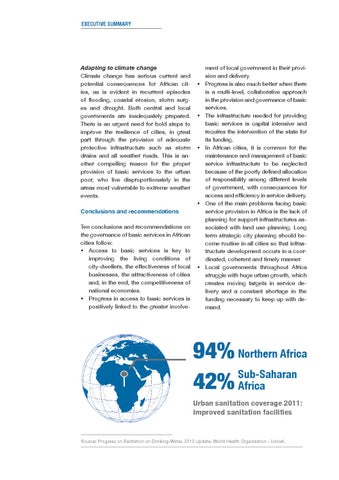
94% Northern Africa Sub-Saharan 42% Africa Urban sanitation coverage 2011: improved sanitation facilities
Source: Progress on Sanitation on Drinking-Water. 2013 Update. World Health Organization - Unicef.
31
The affordability of basic services for the majority of city-dwellers is a daunting problem for local authorities, complicated by the tension between rights-based and market-based solutions for delivery. The recourse to taxation, tariffs and transfers (the 3Ts) to finance the provision of basic services relies more on grants from central governments and transfers from donor community in order to cope. Given the financial limitations of most of central and local governments there has been a move towards Public-Private-Partnerships (PPPs), though these have experienced a downturn after the financial and banking crisis of 2008. Furthermore, upfront development expenses before PPP implemen-
tation are huge. Hence, the need for a strong capacity building program for African cities to acquire the skills needed to negotiate and manage PPP contracts and to improve public regulation. For the time being, most African cities continue have a dual system of service delivery, formal and informal. This must be recognized with local policies that accommodate and interface the two systems in a single whole city delivery policy. All service delivery should be people-centred, guided by the principle of reality, the diversity of solutions, and the choices of citizens following a democratic debate. In that sense, the basic services debate is at the heart of democracy.
EXECUTIVE SUMMARY
ASIA-PACIFIC
The 63 countries and territories of the Asia-Pacific region are home to 4.2 billion people, more than half the world’s population. This report is based on information from 17 countries that reflect the diversity of the region and, with it, the challenge of making generalizations that apply to every local government. The region includes countries as affluent as Australia and Japan, rapidly developing middle income countries like India, Indonesia and Thailand, and several low income countries like Bangladesh and Nepal. Some of these low and middle income countries still pose a tremendous challenge to the ability of governments to deliver local basic services. 45% of the region’s people live in urban areas, and this urban population is increasing at a rate of 1.8% a year, greatly accelerating the demand for services. Almost a third of city-dwellers live in slums, an indication of the depth of the inequalities in the context of rapid economic growth. In lower income countries, it is not uncommon for more than half of urban residents to live in slums and informal settlements, most of them without access to basic services. Despite considerable investment, many large cities in the region suffer from air and water pollution, traffic gridlock, intermit tent water supplies, power brown-outs and uncollected waste. In many countries,
service provision in towns and small and medium-sized cities is even worse. The situation is exacerbated by climate change and the increasing frequency of destructive weather events in the region. Institutional framework Local basic services in the Asia-Pacific region are provided by more than a million local governments, which typically share responsibility for providing water, sanitation, transport, energy, solid waste man agement, slum improvement and disaster preparedness with central governments. The allocation of the authority and power to organize these basic services takes the form of deconcentration (as in China, Pakistan, Sri Lanka and Vietnam), delegation (Bangladesh, Cambodia, Fiji, Malaysia and Nepal) and decentralization/devolution (Australia, India, Indonesia, Japan, Korea, New Zealand and the Philippines). In deconcentrated systems, the central government assigns tasks to hierarchical units led by appointed officials who act as agents of the centre. In delegated systems, authority and power can be exercised by elected officials but their autonomy is limited. In devolved systems, the central government transfers wide-ranging powers to local Governments for the management of local affairs. China and Vietnam are special
33
cases where governance is centralized but local authorities benefit from a significant degree of autonomy that enables them to provide basic services.
provincial governments. In some countries, electricity is provided by public utilities but, increasingly, it is provided by private companies supplying energy to national grids.
Provision of water and sanitation usually involves collaborative efforts between var ious government agencies. Typically, central government agencies are charged with the management and protection of water resources, ensuring water quality, con structing infrastructure, and enforcing performance standards. Special Public Author ities (SPAs, also called government owned or controlled corporations, public utilities or parastatals) granted with autonomous powers to manage and deliver services in many provinces and large cities. In towns and small cities, many small providers deliver water, while public-private partnership (PPP) schemes are used in some metro politan areas.
In most Asia-Pacific countries, policies on solid waste management are promulgated by central or state/provincial governments, while the collection of solid waste is usually carried out at the city or municipal govern ment level, either by sanitation departments or private partners. There are some metropolitan governments where solid waste disposal is managed collaboratively between neighbouring cities and municipal ities. Local government services are often supplemented by community-based efforts in solid waste collection, sorting, recovery, recycling and composting.
In all Asia Pacific countries, sanitation standards are set by central government agencies. In big cities, sanitation is often combined with water provision and managed by autonomous Special Purpose Authorities (SPAs). In smaller cities where many people use pour/flush latrines, local governments usually rely on private companies to provide sanitation services. Roads in most Asia-Pacific countries are classified as national or local, and managed by the corresponding level of government. Transport systems range from privately owned vehicles (like cars and motorbikes) to light or heavy rail-based systems. Typically, central government agencies set transport policies and safety standards. A few metropolitan governments run bus net works and rail-based transit systems, but most bus companies are privately owned. The main form of energy used in Asia-Pacific is electricity. Policies for electricity provision are set by central governments or state/
Most Asia-Pacific countries have adopted slum improvement policies and programs. Many cities and municipalities have housing programmes but, in general, their efforts are hampered by a lack of funds, inappropriate or irrelevant planning and housing standards, a lack of serviced land, and legal and institutional constraints on the use of private property. Often, slum improvement is carried out by slum-dwellers themselves with the help of local or international agencies. With the increasing frequency and severity of disasters in many Asia-Pacific countries, most central governments have set up disaster preparedness programs. Local governments supplement these efforts with a special focus on community-based groups, especially those occupying dangerous areas. Often, civil society and community-based groups participate actively in disaster preparedness programs. Management and financing Management models Management models for basic services vary considerably across the region and gen
EXECUTIVE SUMMARY
eralizations can be difficult. Nevertheless, some broad patterns can be observed.
councils and territorial authorities in New Zealand).
In the countries which face the greatest challenges in providing basic s ervices, local governments tend to d eliver services though in-house departments. Most face financing and technical challenges, weak management capacities, and a lack of transparency, which result in inefficient or inadequate service delivery. In higher-income countries, SPAs, or public utilities, have been used to great success. Their high degree of autonomy and financial management capacities have allowed them to manage projects demanding large investments, wide geographic coverage, and complex management approaches.
City Cluster Development (CCD), a form of collaborative agreement recently introduced in Sri Lanka and India by the Asian Development Bank (ADB), allows auton omous local governments to link basic infrastructure like roads, water and sanitation in an urban cluster. Recent ADB initiatives have shown that CCDs benefit from economies of scale by clustering investment in productive nodes, reducing transaction costs, and attracting skilled labour and managerial talent. While few basic services in the region are provided independently by large private
81% SE Asia 78% Oceania Urban sanitation coverage 2011: improved sanitation facilities
Source: Progress on Sanitation on Drinking-Water. 2013 Update. World Health Organization - Unicef.
A management method that is being increasingly employed in the region is the use of collaborative agreements between levels of government. Such arrangements include joint efforts by local governments to formulate and adopt area-wide development plans, pooling resources to set up and manage basic services (like landfills and incineration plants), agreements to protect the environment, or setting up amalgamated local government bodies (i.e., regional
sector operators, there is an increasing use of public-private partnerships (PPPs) in middle-income countries. Usually, the local government provides up-front financing and private partners act as shareholders and co-managers of joint ventures. Projects may employ local staff as well as foreign high level technical, financing and managerial officials. Working relationships between partners are formalized through contracts that define the respective roles and respon-
35
sibilities of the partners. Outcomes have been good on the whole, although there are exceptions. Many local governments in the Asia-Pacific region have also entered into public-NGO partnerships for the delivery of basic services. Some NGOs started out as militant activist groups, critical of government pol icies, but many now cooperate with govern ments. Their activities supplement public programs in solid waste management, affordable housing, environmental conservation and sanitation. Where the private sector provides services independently, this usually involves small operators, often within the informal sector, catering to the needs of low-income residents for transportation, solid waste management, sanitation, energy, and slum improvement service. Rickshaws and three wheeled vehicles, for instance, may be available for hire where there are no public transport options, and waste pickers, earning money by recycling usable items, are a common alternative to municipal solid waste systems. Private companies also empty septic tanks where there is no trunk sewerage. However, unregulated private enterprise can also create problems. Transport providers contribute to road congestion, air pollution and high accident rates; waste collectors may only collect useful
45%
Population live in urban areas
items and scatter other types of waste; water vendors in slum areas often charge higher rates than public utilities and sometimes sell contaminated water; and septic tank service providers have been known to dump effluent in rivers and streams. Financing basic services The financing of infrastructure in Asia- Pacific is dominated by central and state/ provincial governments. Local governments have little capacity to raise funds for day-to-day operations and infrastructure investment. The private sector, through PPP schemes, is starting to venture into infrastructure finance, but faces complex government regulations. In recent years, domestic banks and other financial institutions have started to finance projects, but many local officials are reluctant to borrow for infrastructure financing because they lack knowledge of, and competence in, credit financing. Credit financing procedures are often very complicated. Borrowing is often limited (e.g. it must not exceed 30% of project costs in China, or 5% of current budget ba lance sheets in Malaysia). In India and the Philippines, local governments must obtain acceptable credit ratings from public and private entities. In all countries, internation al loans involving foreign currencies require a sovereign guarantee.
1.8%
Urban population a year
EXECUTIVE SUMMARY
Most local governments are not authorized to collect income, payroll or general sales taxes. Only a few local governments are empowered to collect property taxes. Income from local enterprises such as public markets, barely meet operation and maintenance costs. In China and Vietnam, local governments have financed infrastructure by “monetizing” land values, but other Asia Pacific countries have difficulty doing this because most land is privately owned. Some local governments seek to make basic services sustainable by collecting user tariffs. Most get good returns from the electricity, water, and transport sectors where consumption is easier to measure. How ever, user tariffs are often difficult to collect for sanitation and solid waste services, especially from people living in slum areas. PPP financing has been used in Asia-Pacific for water and sanitation, electricity, transport, and solid waste management. In most PPP projects, investments are made by the private sector, while governments make contributions in the form of public land or provide capital subsidies, tax breaks or guaranteed annual revenues. The notable success of some PPP schemes in Asia-Pacific does not mean they have been trouble free. Problems include the following: some PPP projects are over-designed and over-built because private partners tend to use the latest technological approaches, which can be expensive; some projects are built in one stage instead of in several stages, which often increases costs; local governments often find it hard to manage projects after the private partners move on because staff development programs are not included in the schemes; the benefits from PPP projects tend to be inequitably distributed among a city’s pop ulation since the poor often cannot afford tariff charges); and PPP projects using for eign currency loans become expensive
when foreign exchange rates fluctuate and local currencies are devalued. Access to basic services Based on a survey of a sample of ASCAP cities, there appears to be a positive correlation between the degree of decentralization and the level of basic services. How ever, the main factor influencing access to most services in Asia Pacific is the level of economic development, as measured by per capita GDP. In high income countries like Australia, Japan and Korea, for instance, 100% of the population has water piped to their premises and access to adequate sanitation facil ities. By contrast, in Bangladesh only 6% have piped water; and in Cambodia only 28% have access to adequate sanitation. While the water and sanitation information provided by the 2012 WHO-UNICEF Joint Monitoring Program (JMP) points to increasing coverage in the region, with a number of countries “on track” to meet full coverage for adequate provision, this information also appears overly optimistic in many cases, reporting rates exceeding those reported by Demographic and Health Surveys. The standards used to define adequacy can also be misleading in many urban settlements, where density often affects the suitability of theoretically adequate solutions. Provision in many urban slums remains dire. In India, for instance, almost 20% of urban residents still rely on open defecation, and less than half have access to toilets connected to drains; in Karachi, Pakistan, water is supplied for an average of four hours a day. Electricity consumption in Asia Pacific is similarly related to levels of economic development, with high income countries hav ing 100% electrification rates but less developed countries having only intermittent power supplies. In a number of countries,
37
less than half the population has access electricity. At the same time, residents in some Asia-Pacific cities with high numbers of people in poverty (like Manila) pay the highest electricity tariffs in the region.
increase in the urban population, with its associated demands for improved provision, will continue to overwhelm urban gov ernments. In countries facing aging populations, there will be increased demand by dependent people for particular services.
The private car remains the main transport mode in high income countries. Some cit ies have introduced rail-based rapid transit and bus rapid transit systems, but tariffs are usually too high for low income people. An alarming trend in many Asia-Pacific cities is the rapid increase in the use of motorcycles and three wheelers, which are associated with high accident rates and road congestion.
Many of the economies of Asia-Pacific countries, especially those that are export oriented, are vulnerable to global econom ic crises. Countries fearful of local gov ernments’ independent spending are likely to re-centralize authority and power in the context of economic crises. This, in turn, will weaken the ability of local governments to provide services.
Solid waste management continues to be a problem in the region, despite the fact that, on average, each person generates only 1.05 kg of waste per day, compared to 4.0 kg per day in North America. Only about 63% of local governments in Asia-Pacific have solid waste management programs.
Delivery of basic services in Asia- Pacific will be seriously challenged by environmental problems, particularly rising sea levels and destructive weather events. Many Asia-Pacific countries are located in the “Ring of Fire,” where earthquakes and other disasters are
2% 23%
Japan Bangladesh
Proportion of the 2011 population that gained access to drinking-water sources since 1995 (%) Source: Progress on Sanitation on Drinking-Water. 2013 Update. World Health Organization - Unicef.
Many cities rely on open dumps rather than sanitary landfills. The problem is particularly acute in slum areas, which are seldom served by municipal systems.
frequent. Some Pacific Island countries are losing land to rising sea levels. Port cities in the Asia-Pacific are also vulnerable to rising sea levels and weather-r elated disasters.
Existing and emerging challenges While population growth has been declin ing in the Asia Pacific region, the persistent
Economic and social inequality among social groups, and between growing and lagging areas, is widening in the Asia-Pacific. The
EXECUTIVE SUMMARY
550 million or so people who live in slums are glaring proof of this inequality. In many cities, the rich enjoy modern services in gated communities, while most slum dwellers lack basic necessities. The increasing inequality may cause social unrest. Conclusions and recommendations Central governments dominate the delivery of basic services, but it is local governments that are closest to the people and local officials who are best placed to develop practical solutions. In order to support the principle of subsidiarity, however, local governments need adequate financial, managerial and technical-professional resources to deliver basic services. Governance reforms are needed, including legislation to change institutional and legal frameworks to grant more authority and power to local governments. Comprehensive regional development planning should be used to integrate the delivery of basic services in metropolitan areas to avoid fragmentation and achieve coordination and cooperation. With their autonomous status, SPAs avoid many of the problems associated with traditional city or municipal operations, such as overly bureaucratic procedures, administrative fragmentation, and over-staffing. When established as special purpose vehicles in PPP schemes, they have been shown to function as effective mechanisms for managing basic services. In many Asia-Pacific countries, the main challenge facing local governments is how to provide local basic services through traditional government departments or units. Local governments should monitor and evaluate local needs and provision options, and adopt service delivery systems
appropriate to the local context. In the more technologically advanced countries in the region, many local governments are shifting from the role of “service provider” to that of “service buyer,” while some city governments, after long experiences using private service providers, are considering the “re-municipalization” of basic services. Local governments need to adopt collaborative arrangements to increase local revenues and strengthen their abilities to finance infrastructure projects. They should coordinate tax rules and regulations on common methods of property assessment, common tax rates, common incentive schemes to attract investors and common tax collection schemes. They should pool assets to improve their credit ratings, enabling them to borrow to invest in large infrastructure projects. Local basic services need to be delivered in an equitable way, with special attention given to meeting the needs of the poor and marginalized groups. Services provided to these groups by NGOs and CBOs should be integrated into government delivery mechanisms. The active participation of all segments of society is an important factor in service provision. In many Asia-Pacific countries, consultation with citizens has proven useful, both in eliciting inputs during program formulation and in gathering feedback from the public about actual performance. The setting up of “one stop” service centres by local governments to gather information from service users and respond to complaints and suggestions should be encouraged. Experience in the Asia-Pacific region also shows that the efforts of NGOs and community organizations need to be integrated into municipal service delivery systems to reach difficult to serve communities of the urban poor.
39
EURASIA
After the breakup of the Soviet Union, the Eurasian countries under review (Armenia, Georgia, Belarus, Kazakhstan, Kyrgyzstan, Moldova, Russia, Tajikistan, Ukraine and Uzbekistan) were left with sufficiently developed water supply and sanitation, district heating and urban public transport. In terms of the share of population with access to these basic services, levels were almost comparable to those in developed countries. Though infrastructure created during the Soviet period was characterized by high capital intensity and energy consumption, service delivery was reliable. At that time, the major shortcoming stemmed from the fact that infrastructure facilities were designed with unreasonably high levels of consumption of water and heating in mind. This resulted in a situation in which public utilities in Eurasian countries had to bear significant overheads and other costs related to the maintenance of a redundant infrastructure that were not covered by user tariffs. In contrast to other basic services, little attention was paid during Soviet rule to the management of solid waste. Solid waste infrastructure facilities were financed from state budget transfers, while operating costs were mostly covered from high tar-
iffs set for industrial users on the basis of cross-subsidies. The break-up of the USSR triggered numerous structural changes in the public sector in the countries of the Eurasia region. The absence of any renewal of fixed assets caused a deterioration of the quality of public services as well as a rise in the accident rate in utility facilities and networks. In many cities, water supply services became unsustainable. Facilities for waste water treatment and solid waste disposal stopped working. District heat services were discontinued in many cities of the Caucasus and Central Asia, including in capital cities. Over the past decade, the degradation of the utility infrastructure in most countries has been halted and, to some extent, reversed. Governments in region have adopted a range of legislative, institutional and economic measures aiming to reform urban basic services, provide incentives for enhanced efficiency of service provision and encourage an enabling environment for public participation. Despite these efforts, public service provision often fails to reach the levels of the Soviet period. For example, the capital cities of Armenia (Yerevan) and Georgia (Tbilisi) are currently experiencing enormous difficulties in providing heating services.
EXECUTIVE SUMMARY
Institutional framework: responsibilities of local government in basic service 足provision In most countries of the Eurasia region, local governments are allocated responsibility for the provision of water and sanitation (with the exception of Armenia and Georgia), district heat supply (with the exception of Moldova and Tajikistan), solid waste
issues relating to tariff policy for public services. Despite the implementation of decentralization reforms in most countries of the region, and the development of local self-governance, decentralization processes are frequently inspired by the wish to get rid of the excessive centralization inherited from Soviet times, rather than by
84%
Caucasus and Central Asia
Trends in urban drinking-water coverage 2011: water piped to premises
Source: Progress on Sanitation on Drinking-Water. 2013 Update. World Health Organization - Unicef.
management, and intra-urban passenger transportation services. A survey of representatives of cities in Russia, Armenia, Georgia, Ukraine, Moldova, Kyrgyzstan, Kazakhstan, Tajikistan and Uzbekistan revealed that responsibility for the provision of basic services falls to municipal governments in 88% of cases. Central and regional governments play a minor role.
an understanding of the advantages of a proper distribution of authority between various levels of power. As a result of decentralization reforms, many local authorities had to assume the responsibility for the provision of basic services without the relevant authority or resources required to do so successfully. Access to basic services
At the same time, in most countries, almost all regulation of basic services is the domain of central government (with the exception of the haulage and disposal of solid waste and passenger transportation services, in some countries). State or regional public authorities, or specially created national regulatory bodies, tackle the
In the 1990s, the countries of the Eurasia region witnessed a general decline in the access of the population to public services and a downward trend in service quality. In the past decade the situation, as noted, has stabilized and shows some signs of improvement.
41
Water supply and sanitation Access to water and sanitation services varies greatly across the region. More than 75% of the urban population in Russia, Belarus, Armenia, Kazakhstan, Uzbekistan, and Ukraine has access to water and sanitation services. The highest proportion of the urban and rural population with access to a centralized water supply and sanitation is found in Russia, at 100% in cities and 96% in small towns with less 10,000 residents, but even here only 31% of rural settlements have access to a piped water supply. Access rates for piped sanitation services in Russia are 100% in cities, 82% in small towns and 6% in rural settlements. More than half of the population in Kyrgyzstan and Uzbekistan lack access to reliable sources of drinking water, and a major part of the urban and rural population gets water according to a fixed schedule (whether delivered or supplied via pipelines). In Georgia, most settlements also suffer from interrupted water supplies. Inadequate access to drinking water is a significant problem in Moldova and Tajikistan, especially for poor and rural populations. Access to improved sanitation (piped sewers, slab-covered pit latrines or toilets connected to septic tanks) is insufficient in Central Asia. Heat supply District heat supply systems, drawing on piped steam or hot water from centralized plants, are widely used in Russia, Ukraine, Belarus, Kazakhstan, Uzbekistan and Kyrgyzstan. Over 70% of housing stock relies on these systems in Russia, over 60% in Ukraine, and above 50% in Belarus and Kazakhstan. According to national policies, the countries plan to gradually increase the proportion of the urban population with access to district heating by constructing thermal power plants and
introducing innovative high performance technologies. Public transport services In all countries of the region, except for Kazakhstan, there has been a decline in the quality and use of public transportation as a result of such factors as fare increases, deteriorating service and growing levels of car ownership. Over the past two decades, the only type of transport to have experienced a slight increase in investment and construction is underground railways. Solid waste management Waste management in Eurasia, as a rule, is limited to collection and transportation of waste to be dumped in landfills. Waste is not “managed” in the modern sense of this term. Delays in collection, non-sanctioned landfills and illegal dumping are common problems for most countries in the region. The legal regulation of waste management in the Eurasian region is targeted mainly at environmental pollution, rather than the reuse and recycling of solid waste. Most countries lack a system of separate collection for different kinds of waste. However, a number of cities of Russia, Ukraine, Kazakhstan, Belarus and Uzbekistan have begun to implement selective collection, sort ing, and recycling. Management and financing Management models In Eurasia, there are positive trends in the evolution of management models, and most local authorities select the models they find most appropriate for managing the enterprises that provide basic services. At the same time, local authorities generally lack the power to set tariffs for services, which makes it difficult for them to fulfil their responsibilities for provision.
EXECUTIVE SUMMARY
In almost every country in the region water supply and sanitation facilities are owned by municipalities or higher-tier governments. In Kyrgyzstan, Tajikistan, Ukraine, Belarus and Russia, most water is provided by state- or municipally-run public utilities. In Armenia and Georgia, water supply and sanitation systems are managed by pri vate operators. In Russia, about 25% of the population is provided with water and sanitation by private operators under PPP contracts.
Access to District Heating The heat supply situation varies across Eurasian countries. In Russia, Kazakhstan, Uzbekistan, Ukraine and Kyrgyzstan, the heating market is patchy, with segments under the control of various owners, includ ing joint stock companies (privatized or with a stake held by state) that own large combined heat and power sources and heating pipes from combined heat and power plants, and state or municipally owned utilities that, generally, hold low-power heat sources (municipal boiler houses) and heat distribution networks. In Belarus and Tajikistan, the practice of vertically integrated heat providers, centrally controlled and locally operated, continues, though there are fewer than in the Soviet era. The models applied for managing the utilities engaged in solid waste management vary between countries. In Uzbekistan and Kyrgyzstan, these services are provided by
municipal agencies or utilities authorized by local governments. In some cities, primarily in Uzbekistan, Russia, Ukraine, Kazakhstan, Armenia and Georgia, local governments rely on private operators for the collection and removal of solid waste. In the sphere of public transportation, the proportion of municipally owned transport is minor – all electric vehicles and some buses. Private operators dominate the taxi and bus markets. Municipal governments
70% Russia 60% Ukraine Belarus and 50% Kazakhstan typically seek to encourage private involvement in the provision of passenger transportation services, with the aim of incentivizing demand-based competition. Financing Regardless of the form of enterprise man agement (state, municipal or private), most of the enterprises providing basic services in the countries of the Eurasian region are faced with a shortage of finance. Our survey of local government leaders revealed that representatives of all cities are of the view that there are serious financial problems with regard to basic service provision: 31% of respondents reported a lack of funds for even basic operational activity; 53% emphasized that the funds available could hardly cover the operational activity; and only 16% confirmed that enterprises and the city had enough funds to both cover costs and to invest.
43
Role of the private sector Private operators are being attracted to the utility sector in the Eurasian region, and various models of public-private partnership (PPP) are in operation. This approach is practiced primarily in Russia, Ukraine and Armenia. Over recent years, both the legal and institutional conditions necessary for the implementation of PPP projects have been established. The legislation of Kazakhstan is also geared to the development of PPP mechanisms, and the country plans to implement pilot PPP projects in the urban heat supply sector in 2013.
sion is either non-existent or very modest. However, there is a sound basis for private involvement due to the decentralization of utility management. Belarus: This country has a centralized national system that manages the utility sector. All responsibilities in the sector rest with the state authority. Privately owned companies are not welcome in the utility sector and, moreover, it would be impossible to attract them without radical institutional changes. Existing and emerging challenges
The most widely used forms of private sector participation in the utility sector in the region are lease contracts. In this model, a lessee assumes responsibility, not only for management, but also for the collection of payments for services. Authorities remain responsible for investments, which can be made, partially or fully, using lease payments. There are also cases where the private operator is also responsible for investments under lease contracts. In terms of PPP development, Eurasian countries can be divided into four groups: Armenia and Russia: The involvement of privately owned enterprises in the water and sanitation sector is common in these countries. Despite different forms of coop足eration between businesses and authorities, public private partnerships have generally been successful in these countries. Georgia, Kazakhstan and Ukraine: Recently, these countries have been doing a lot to try to attract privately owned enterprises to the utility sector. However, the involvement of private companies in this sector is still rare, with only a few examples. Kyrgyzstan, Moldova, Tajikistan and Uzbekistan: In these countries, the participation of private sector in basic services provi-
Despite significant efforts in the region to reform the frameworks for basic services and improve efficiency, there is a long way to go to solve the problem of universal access to quality basic services. Constraints include rising energy prices, inadequate financing, and substantial deterioration of infrastructure due to a lack of support by higher-tier governments. Increasing energy costs in the utilities sector mean that user tariffs are dedicat足 ed to covering these price rises, rather than to investment in repairs of worn-out utility infrastructure. The chronic shortage of financing of basic services is one of the crucial causes of their low efficiency. Tariffs and collection rates in some countries (especially in Central Asia) are too low, meaning that investments to improve efficiency cannot be made. Most of the revenue of basic service providers comes from user tariffs, with the remainder provided with the help of state transfers. Repayment financing from private sources is still very insignificant. In most cases, the condition of basic service infrastructure is worn out and 足fails to meet the requirements for sustainable, high quality basic service provision. This has
EXECUTIVE SUMMARY
also led to growing accident rates, disruptions to service provision, over-spending of material and technical resources, and an inefficient use of energy and water. Deterioration in the quality of services observed over recent years in the region is, as a rule, the first sign that their fixed assets have not been adequately maintained. The importance of ensuring a reliable water supply and the reduction of pollution will only increase in the context of global climate change. Some countries in the region are already experiencing an acute shortage of water (Kazakhstan, Turkmenistan and Uzbekistan). This shortage is even a problem for some regions in countries “rich in water resources” (for example, southern parts of the Russian Federation and Ukraine). Conclusions and recommendations Decentralization: at present, in most countries of the region, centralization processes are underway. Government statements concerning the legal decentralization of basic services contradict the centralization of decision-making witnessed on the ground. Legal decentralization of authority over basic services should be accompanied by both administrative and financial authority and capacities. Decentralization also requires the co-financing of basic services at the local level and tariff policies designed with due regard for people’s ability to pay. The small scale of basic service provision at the local level and the poor competencies of local managerial staff should be addressed, not through the transfer of authority to “higher echelons of power”, but rather by developing horizontal links in the form of inter-municipal cooperation and private sector partnerships.
Increase in the financing of basic services and an improvement in the investment climate: the task of attracting investment in basic services is essential to enhancing the level and quality of services. The major challenge in the region is to improve tariff regulation, increase cost recovery through user tariffs, and target state assistance to low-income households. Moreover, to improve the investment climate, it is necessary to create a system of incentives for service providers to cut expenses, modernize their operations and enhance the level and quality of services. Verification of the financial sustainability of basic services should be a central consideration when setting tariffs and schemes to support access for low-income households should be established or strengthened. Attention to maintenance: it is most important to prevent the further deterioration of fixed assets by conducting repairs and renovation, since these costs will only grow if investment is delayed. Improved multi-level governance: many challenges in basic service provision are of both local and national concern. The accessibility and quality of basic services in Eurasian countries is crucial for the political survival of both local and national elites. It is important that this should not result in centralization and the concentration of power at the state level. It must instead contribute to the development of well-bal anced policies based on the decentralization of responsibilities and resources, with a parallel creation of national mechanisms to encourage the development and modernization of services through legislative frameworks and state programmes to support local reforms.
45
EUROPE
Unity and diversity Compared to other world regions, Europe, with its small area and average population, has a relatively high density of inhabitants. European countries have a long history of free local government administration on the one hand and, on the other, of public serv ices. This report presents an overview of the provision of basic services in the European Union and in three other non-EU countries. Across Europe, local public authorities have responsibilities for basic public serv ice provision and management. Local basic services are the expression of an essential dimension of local autonomy. In Europe, the basic services under analysis are described as “public services” or “serv ices of general interest” (SGI). The specific history, traditions, culture and institutions in each country continue to mark the nature and evolution of these services across the continent. The definition of basic public services, as well as their level of geographical provision, the authorities responsible for them and the economic and management models (public, mixed, private or associa tive), vary across Europe. Amidst national diversity, there is a profound unity in Europe as regards basic public services. In each European state, these
services are subject, not only to common competition law and market rules, but to specific laws regarding their organization and regulation. These common rules have the following aims: guaranteeing the right of each inhabitant to reach essential goods or services; building European solidarity; ensuring economic, social and territorial cohesion; taking into account long-term considerations; and creating the conditions for economic, social, environmental and sustainable development. These objec tives of general interest are at the heart of the system of values which characterizes all European countries. There are three major trends at work in shaping basic public services in Europe: National histories, traditions and institutions, which continue to mark modes of organization and regulation. Sectoral logic, i.e. telecommunications, electricity, water, and transport cannot be organized in the same way or be subject to the same rules. The process of “Europeanization” of basic public services over the past 25 years. This does not mean that all serv ices are regulated or organized centrally (due to the principle of subsidiarity). Europeanization works in parallel to national traditions and the specificities of each sector.
EXECUTIVE SUMMARY
Today, there is a European Acquis (body of shared law) in the field of public services that defines the framework for the organ ization of basic services and gives clear guarantees to local governments (see Box 1. in the Europe Chapter of the full report). Institutional framework: the responsibilities of local authorities In Europe, basic services are at the heart of multiple and complex tensions between: Balancing the realization of an idealized common internal market with the fact that basic public services are anchored in specific local areas that have their own needs and objectives; Fulfilling public service obligations, in general and for each precise sector, to carry out “particular tasks” defined by public authorities to meet general interest objectives; Implementing the subsidiarity principle in the context of shared authority between European, national, regional and local levels in order to offer optimal public services; Working towards the objective of econom ic, social and territorial cohesion of the EU. Basic public services in Europe continue to be defined, organized, commissioned, financed, controlled and regulated in diverse political, administrative, economic, geograph ical, demographic and cultural contexts. In almost all European countries, the responsibility for water and sanitation management falls under the jurisdiction of municipalities or other local institutions. Municipalities are also generally responsible for municipal solid waste collection and transfer, though the recycling, treatment and disposal of solid waste sometimes falls under the jurisdiction of other authorities. Responsibilities also vary according to waste type (hazardous or non-hazardous, municipal, industrial, agricultural, commer-
cial, or construction). The (re)organization of waste services has been influenced, in some cases, by the increasingly rigorous environmental standards imposed by EU law. Urban transport is generally the responsibility of cities, a particularly important service, given the fact that about 70% of the European population lives in urban areas. The responsibilities of local authorities for electricity are limited in most countries, despite some moves towards the decentralization of energy policy. In each sector, the Europeanization of basic public services has led to common rules that frame the “free administration” powers of national, regional and local authorities. How ever, transversal rules for basic public services have also been adopted, in particular regarding funding and public procurement. Member States and sub-national governments are free to choose the management model used to deliver basic public services. The EU is neutral on the issue of the ownership of basic service providers. Overall, there is a general trend towards the sharing of powers and responsibilities between different levels of government, and between different institutions in each country and region, though differences exist in the intensity and scale of these interactions. This sharing of authority may be vertical or horizontal, inter-sectoral, or some combination of all three dimensions. Thus, in Europe, basic public services are increasingly subject to multi-level governance. Multi-level governance implies the de velopment of cooperative relationships and partnerships between stakeholders, the definition of appropriate geographical area of each service and, on that basis, the establishment of ‘organizing authorities’ for basic public services. Organizing authorities do not have exclusive responsibility for service provision; rather, they are tasked
47
with coordinating the links between all relevant stakeholders. Converging public action from micro-local to European level in a non-hierarchical way to combine self-government, subsidiarity and solidarity is a challenge in which nation al governments continue to play a crucial role. Management and financing Management models Diverse management models for basic public services are used in Europe. Each is shaped by history, national and regional evolution, sectoral characteristics, the impact of European policies, Europeanization and globalization, and new public management approaches. Historically, in most European countries, basic public services were defined, organized, provided and financed by local public authorities, even if some countries delegated the management of these services to autonomous or private actors at a very early stage (e.g.: water and transport in France). In Northern Europe, local authorities have significant jurisdiction and responsibilities in the fields of social and basic services. A particular public service management model used in Germany is the multi-service enterprise (Stadtwerke), which allows horizontal cross-subsidization between different local services (e.g. profits from electricity or water used to finance transport services). Central and Eastern Euro pean countries have been influenced by their transition to democracy and a market economy since 1990. Local governments are improving their institutional capacity to collaborate in the provision of local basic services with both the private and not-for-profit sectors. However, if ‘national models’ ever existed, it is clear that reforms in the field of basic public services over the past 25 years have
destabilized them and further complicated the situation. Hybridization is underway, meaning that paradigmatic models no longer exist and management models vary greatly among countries and sectors. Local public provision of services whether directly, in partnership with other public authorities, or through public undertakings, remains dominant. The development of public-public partnerships according to new public management approaches has been a particular growth area. In the field of water and sanitation, serv ices are managed by public authorities in almost all EU Member States. On average, private operators provide water and sanitation to just 26% and 23% of the European population, respectively. Only in two countries is more than half of the population is served by private enterprises: in France through delegated management, a legacy of the 19th century, and in England and Wales, where infrastructure and management were privatized in the 1980s. The European water market is thus highly fragmented, comprising tens of thousands of different operators. Traditionally, local public water enterprises were organized at the level of each local authority and were therefore small size providers, in contrast to other network services, such as electricity and telecommunications. Although regroupings have occurred, the public enterprises of this sector are not transnational companies. In some cases, such as in Paris and Bergkamen, local public authorities have decided to initiate re-municipal isation of some local services. In the field of solid waste management, service delivery models include direct public management and delegated man agement to mixed or private operators for some or all waste services. In France, Germany and the UK, public and private operators have a roughly equal role in municipal waste collection and processing.
EXECUTIVE SUMMARY
Some municipal companies also operate across European borders. European organizing authorities can choose, in accordance with the law, after having defined the aims and purpose of services, to directly manage services inhouse, or to delegate their management by means of external partnerships. No proven and universally superior single management model: the research dem
agement model is a public system of regulation, based on the democratic participation of all stakeholders. This marks a move from regulation by ‘experts’ to regulation by ‘actors’. There is an increasing acknowledgement of the necessity to involve all stakeholders, not just public authorities and service operators, but also consumers (domestic and industrial users, both large and small), citizens, local authorities, elected officials, staff, and trade unions.
91-100% Proportion of the population using improved sources of drinking-water in 2011
Source: Progress on Sanitation on Drinking-Water. 2013 Update. World Health Organization - Unicef.
onstrates no universally superior single management model. The optimal choice between externalisation and re-municipal isation can only be made on the basis of case-by-case assessments of the advantages and disadvantages of each model by public authorities. The performance of service operators under both delegation and direct management depends on the capacity of public authorities to control quality, price, and access, whether the operator is private or public. The relationship between the organizing authority, provider and users is central, regardless of the management model used. Democratic participation of all stakeholders: crucial to the success of any man-
Guaranteeing free choice, allowing experimentation and reversibility: no single system has demonstrated its universal superiority in the field of service management and regulation. The most important criterion for successful service provision seems to be the ability of a public authority to mobilize knowledge and expertise. Public authorities should be guaranteed a free choice of management models for basic services and be able to experiment with different man agement models and reverse their decisions if they prove unsuccessful. Financing basic public services European countries boast again a rich variety of financing models for basic public services, including:
49
Free service provision to all or some users a funded by general taxation. Financing the entire cost of services by user tariffs, according to the principle of “full cost recovery”. A system of subsidies or participation by other actors (as in the case of urban transport in many French municipalities). Co-financing by national, regional and
70%
central government but, since 1990, decentralization has been accompanied by a reduction in this source of financing. Investments in the water sector are mainly financed by public subsidies and loans. In this respect, EU structural funds can play a very important role in some local contexts. In the solid waste sector, sub-national
Population lives in urban areas
local public authorities, as well as European or international funds. Cross-subsidies, which can be geogra phical (e.g. a single, universal price for a postage stamp), social (between generations or to smooth returns on investment over the mid- to long-term) or between sectors (profits from one activity being used to finance deficits in others).
grants are sometimes provided to meet environmental targets. In the field of water, EU policy goals are evolving to increase emphasis on cost recovery from water users. However, very few countries have managed to recover all economic and environmental water costs through tariffs (Denmark is a notable exception). Rates of tariff collection also vary widely among countries.
Often, a combination of these models of financing is used, which sometimes makes it hard to make transparent the ‘true costs’ of service provision.
Access: meeting the needs of the p opu lation: solidarity, social dialogue and citizen participation
The funding of urban public transport, for example, only partly relies on the fares paid by passengers. Most costs are financed by public subsidies and provider revenues, and financial participation from other economic operators. In France, cross-subsidies between different municipal services are used to finance transport, while in Germany revenues resulting from associated commercial transport activities are used. In Central and East European countries, urban transport services were traditionally financed by the
Basic public services exist to meet the basic needs of citizens and communities. Services therefore evolve over time according to evolving needs and technological change. Overall, in Europe, access to basic services is much more developed than in other parts of the world. At the same time, available statistics show that access is not yet universal. For instance, there is still an East–West divide in access to safe drinking-water in Europe. In many Western countries, access
EXECUTIVE SUMMARY
to piped water is close to 100%, while in the Eastern part of the continent, access is improving but remains lower, particularly in rural areas. In Northern Europe, more than 85% of the population has access to im proved sanitation, while in southern European countries the proportion falls to 4060%, with access levels even lower in the East. There is also a significant rural-urban divide in this sector. Access to solid waste services also varies. Not all households are provided with solid waste collection services; this is particularly the case in Central, Eastern and Baltic countries, as well as in Cyprus, Greece, Ireland, Italy, and Spain. Broadband is still only considered a basic public service in a few countries, but increasing numbers of municipalities are setting up free Internet access in public places. Similarly, the provision of child and elderly care services varies considerably between countries. Organizing the expression of needs: the effective governance of basic public services requires the organization of the changing needs of citizens. By combining different levels of organization and facilitating a democratic debate with citizens and users, solutions can be found to ensure that needs are met. Methods of participation vary by country, and may take the form of open meetings of local councils, referendums, online debate and feedback, public meetings, and public consultations. Participation includes public debates on different alternatives (technical, economic, sectoral, inter-modal solutions) between stakeholders (users, service operators and their s taff, and elected officials). A strategic social dialogue: effective governance requires the development of a strategic social dialogue to converge users’ expectations with those of workers and trade unions. The 2008 European Commis-
sion report on industrial relations included a typology of national industrial relations arrangements, which groups the EU Member States into five regimes, according to union and employer organization, the power relations between them, levels and styles of bargaining, the space for social partner intervention in public policy and for state intervention in union-employer relations: North (the “organized corporatism”, Centre- West (the “social partnership”), South (the “state centred” approach), West (the “liberal” pluralism), Centre-East (a “mixed” approach - polarised or state-centred regime). The essential role of citizens and elected officials: public authorities and elected officials play an essential role in organizing the evaluation and control of services to ensure their adaptability to changing needs. Taking into account the needs and expectations of users gives them a better knowledge of the challenges they face and the choices on offer. At the same time, public authorities must assume the ultimate responsibility for defining the objectives of each public service, implementing the best ways to achieve them, and organizing and evaluating results and adapting the decisions they take accordingly. Developing evaluation and control and implementing changeability: improved evaluation of the performance of basic public services is needed in Europe. The use of specific indicators to evaluate the performance of basic services and municipalities is being developed at national and local level. Some indicators are made public and/or involve the direct or indirect participation of service users. European rules do not require Member States to create regulatory agencies for the basic public services covered in this report, with the exception of electricity. Such agencies are uncommon at national and local level.
51
Existing and emerging challenges The financial, economic and social crisis that began in 2008 has brought new chal lenges to the field of basic public services. There is a ‘scissor effect’ developing: on the one hand, an increasing proportion of the population is vulnerable or living in poverty, and meeting their needs is the raison d’être of public services; on the other hand, public services have fewer resources from which to draw from due to adjustment and austerity policies.
26% Water
mean that exemplary and innovative management is essential in order for basic public services to be delivered effectively. Governance innovation in local government touches on central policy debates in Europe: the growing quest for efficiency and effectiveness, the definition and implementation of new services, the development of forms of partnership between public authorities, the participation of community and non-profit partners as well as private operators, and the definition of solidarity-based funding models (e.g. free access or subsidies).
23% Sanitation
Provided by private operators
Meeting the challenges of the crisis and its effects: basic public services have acted as a ‘shock absorber’ of the effects of the crisis by providing essential services to the population. From this perspective, the current situation requires both access and quality to be strengthened. Profound changes: local communities in Europe face a diversity of challenges and have different resources with which to deal with them. At the same time, there are several common issues currently affecting basic services and their sustainable development across the region: demographic and climate change, energy efficiency and the development of renewable energy, and ICT. More efficiency and quality: cuts to public sector spending and human resources
Conclusions and recommendations The definition, organization, financing, regulation and governance of basic public services in Europe are not uniform; they are inextricably defined by unity and diversity, convergence and singularity. These characteristics are bound up in the idea of multi-level governance; a concept that is neither linear nor hierarchical, but rather reciprocal and based on partnership. Combine unity and diversity: for each local public service, governance involves taking into account the specificities of each area and organizing the expression of the evolving needs of citizens and users. It is only on a case-by-case basis that the most appropriate geographical area and organizing authority for each service can
EXECUTIVE SUMMARY
be defined. However, this cannot be the exclusive responsibility of local governments. In all sectors, in each local area, institutional levels should cooperate to build horizontal relationships, share knowledge, draw on synergies, and develop a holistic approach. Clarify the distribution of competences and responsibilities: there is a need to clarify powers and responsibilities by taking into account sectoral specificities, as well as national histories, traditions and institutions. Current transformations and governance innovations should be used to develop a mapping of competences, which cannot be absolute but must evolve according to technological change and users’ preferences. Establish simple, operational, but not standardizing common rules: the existence of some common European rules reflecting the general principles and common values is appropriate. However, these rules should be guided by the subsidiarity principle, under which decisions are taken at European level only if it is more effective than taking them at lower levels of government. Support diversity: for all services that remain under the “wide discretion of national, regional and local authorities” (Protocol 26 of the Lisbon Treaty), European institutions should not only respect sectoral diversity and the diversity of local realities, but also encourage innovation and experimentation, and develop exchanges of good practices and benchmarking. Articulate economic, social, territorial and environmental dimensions: basic public serv ices play an essential role in guaranteeing the fundamental rights of each person and
in promoting social, territorial and economic cohesion. They should fully take account of the challenges of climate change and sustainable development. In Europe, the largest part of carbon dioxide emissions is generated in cities, particularly by transport and public services. Therefore, public services have an essential role to play in sustainable development. Improve evaluation: evaluation could increase the efficiency of basic public services and allow them to better meet citizens’ needs. Evaluation may focus on the predefined objectives of the service or on its performance. This does not imply the creation of new topdown constraints for local public authorities, or comparisons between countries, operators and public authorities. Instead, it should foster exchanges of innovative experiences with an open flow of information about innovation, successes and failures. Evaluation should be a tool for the adaptation, evolution and modernization of local public services. Implement all the provisions of the EU treaties, in particular Protocol 26: the Lisbon Treaty reinforces the powers and responsibilities of local governments. The new provisions of the EU treaties should be implemented, in particular those on services of general interest, and most especially Protocol 26, which states that non-economic services of general interest are not bound by European competition law or the internal market. According to Protocol 26, services of general economic interest should take into account the diversity that may result from different geographical, social or cultural situations, as well as the values of service quality, safety and affordability, equal treatment and the promotion of universal access and user rights.
53
LATIN AMERICA
In recent decades, there have been significant improvements in both the coverage and quality of basic services in Latin America. The region already meets, or is predicted to meet, the Millennium Development Goals for water and sanitation. However, there are still hurdles to be overcome to ensure access to quality basic services for all. This report presents an overview of the role of local government in providing basic services in seventeen countries in Latin America. Economic growth in Latin America over the last decade, along with redistributive policies in several countries, has led to a relative decline in poverty in the region. However, major economic and social inequalities still exist: a third of the region’s population still lives in poverty and 13% in extreme poverty. Although Latin America is one of the most urbanized continents (80% of the population lives in cities), Latin American cities, especially its metropolises, are still experiencing intense urban expansion that is very difficult to manage. It is estimated that urban areas will gain a further 90 million inhabitants between now and 2020. Cities reflect the social heterogeneity that characterizes the region. About 30% of the urban Âpopulation (138 million people) lives
in slums. Marginalized neighborhoods and informal settlements exist alongside exclusive residential areas and gated communities. This feature of the region has significant implications for the governance of basic services. Stark contrasts in service access and quality are observed across the region. As described in the previous GOLD Reports (2008 and 2010), the democratization that began in Latin America in the 1980s was accompanied by significant decentralization. Despite the strong centralism that characterizes Latin American states, decentralization processes have transformed the institutional relationship between central and sub-national governments. Although there are still serious disparities between countries, local governments have gradually acquired greater responsibility for the provision of services, as well as the financial and professional capabilities necessary to meet these responsibilities. Institutional framework The legislation in most countries allocates the responsibility for the basic services to local governments. Latin American municipalities often share the running of these public services with intermediate and national levels of government, with each level
EXECUTIVE SUMMARY
of government managing particular parts of the services. However, in many countries there is a need to improve coordination between levels of governments. For example, in the water sector, a recent OECD study points to significant coordination problems in policymaking, the management of finance, and technical, information and control capabilities. In recent decades, new laws or regulations for water and sanitation have been implemented in most countries of the region, as well as laws concerning solid waste in at least seven countries. Regulatory bodies have also been created to oversee basic services (water and sanitation in particular). The survey of local authorities carried out for this report confirms the need to improve the legal framework in which local governments operate, particularly with regard to clarifying the distribution of responsibilities and setting the terms for partnerships with external stakeholders (e.g. private sector operators). Access to basic services In water and sanitation, there has been a steady increase in coverage over recent years. However, of the 90% “improved water” coverage reported by the JMC, no less than 25% consists of irregular or illegal sources. Of the more than 80% “improved sanitation” coverage, 37% have only precarious access to sanitation. There are also significant disparities between services. Service quality is patchy in many countries. This deficit is particularly notable in the interior and in disadvantaged urban areas and communities. The current coverage of wastewater treatment systems, although improving, is still low, and is estimated to reach only 26.3% of the total population of the region. The collection of solid waste has also been extended noticeably over the last decade,
with coverage expanding at a faster rate than population growth. As of 2010, solid waste collection reached 93.4% of the population, though quality and technologies vary widely. Of waste collected, only 54.4% is processed in sanitary landfills, while the remaining 45.3% is disposed of in open dumps. There has been limited yet significant progress in waste sorting and recycling, but informal recycling is widespread. From the late 1980s, public transport was deregulated in almost all Latin American countries. The supply of small- and medium-capacity vehicles increased, as did very small private operators, leading to a significant deterioration of public services to the detriment of users and cities (causing traffic congestion and air pollution). However, during the last decade, there has been renewed interest from local governments in public transport. In addition to the construction or extension of metro systems (Buenos Aires, Mexico, Panama, and Sao Paulo) and the modernization of suburban trains (in Brazilian cities, Buenos Aires, Santiago) and trams (Buenos Aires), the most important initiatives have been preferential bus lanes (Bus Rapid Transit). The reference point for this new generation of transport is the Transmilenio in Bogota, opened in 2000, which became the model for other metropolises in the region. Today, many large cities in the region have one or several lines of this type. Management and financing of basic services Management During the 80s and 90s, many Latin American countries implemented policies deregulating and privatizing the markets for basic services. The involvement of the private sector aimed to bring significant innovations and investment in basic services, and to improve efficiency and effectiveness in
55
service delivery. As demonstrated by the surveys carried out for this report, local authorities agree that privatization has led to neither a massive influx of resources nor to lower costs, but this is often blamed on a lack of monitoring and transparency in the implementation of externalization. In 2000, several externalization processes were further damaged by the economic crisis (Argentina) and public protests (Bolivia). In Latin America, water is generally provided by the public sector. Around a third of the countries surveyed have direct municipal systems for water supply and sanitation, in the form of local utilities that provide services in urban areas. Rural provision is dominated by water boards (under different models, including community associations and cooperatives). Regional governments play an important role in providing water services in Argentina, Chile, Brazil, Mexico, and Venezuela, while national utilities dominate in Costa Rica, El Salvador, Honduras, Nicaragua, Panama, Paraguay and Uruguay. The municipal management of solid waste (by municipal workers or autonomous municipal utilities) makes up 50.6% of waste collection services in the region and 52.8% of final disposal. Chile is an exception; it has granted concessions for most solid waste collection services, and directly provides services to just 18% of the population. In terms of final disposal, El Salvador, Colombia and Chile are the countries which have externalized services to the greatest degree (over 80%) while, at the opposite extreme, 70% of services are provided directly by municipalities in Bolivia, Ecuador, Guatemala, Honduras, Dominican Republic and Uruguay. A major change in the organization of the sector is the increased inter-municipal cooperation through inter-足 municipal associations in order to achieve better economies of scale and enforcement of regulatory standards. These partnerships
are especially important for both large metropolitan areas, where most urbanized municipalities or districts lack the land for treatment. Service provision by micro-足 enterprises, cooperatives and NGOs is also growing, particularly in slums and informal settlements. Provision by micro-enterprises and non-profits currently stands at 3.3% overall, rising to 7.8% in large cities. In general, urban transport services in Latin America are divided into several sectors: the formal sector is managed by a few large operators (either public or private), while the informal sector, which provides most urban transport, is made up of numerous small private operators. The Bus Rapid Transit projects (BRT) reflect a significant evolution in service governance: the BRT are managed by local governments via concessions granted to the private sector. Everywhere where they have been introduced in the region, BRT have helped change the vision and practices of cities, and made possible the re-appropriation of public spaces. They are, in this sense, the beginning of a real change in Latin American cities. Nevertheless, the institutional systems for integrated transport management are still weak. Many cities lack appropriate planning instruments, or are unable to implement them. Along with the public management of serv足 ices by different local, regional or national bodies, private sector involvement in basic service provision continues to grow. Private sector involvement usually takes the form of public concessions made by local, state, or central governments. In most countries of the region, there are laws, regulations and standards governing Public Private Partnerships (PPPs), many of which have been established in the last decade. The characteristics of private sector partners vary, ranging from large multinational companies to local or national providers, including non-profit organizations, cooperatives, and small-scale providers closely linked to
EXECUTIVE SUMMARY
the voluntary sector. There is also an informal sector that works in specific niches (e.g. waste-pickers in waste-sorting and recycling). Financing In recent decades, there have been great efforts to invest in basic local services in Latin America. Policies have focused on access to drinking water, rural electrification, sanitation and transport. These efforts, alongside initiatives by international financing bodies (IDB, WB, CAF) have contributed to improving access to basic services. There has also been progress in the financing of basic services by means of direct user tariffs, although these have often been subsidized. Local governments have also contributed by improving the mobilization and management of their own resources.
inadequate to keep up with the region’s growth. It is estimated that, over the next few decades, an average annual investment of USD 12.5 billion will be required to close the infrastructure gaps for drinking water and sanitation in Latin America. In the waste management sector, the most worrying issue is insufficient cost recovery. It is estimated that current average cost recovery is around 51.6%, with a slight improvement seen over previous years, insufficient to guarantee the financial sustainability of services. Public transport in Latin American cities is less heavily subsidized than in their European counterparts. Most subsidies are for railways and metros (60%), but there are also subsidized bus systems (e.g.: Buenos
94% Trends in urban drinking-water coverage 2011: water piped to premises
Source: Progress on Sanitation on Drinking-Water. 2013 Update. World Health Organization - Unicef.
However, transfers from central or intermediate level governments are still the most widely used mechanism for improving and expanding basic services. Increases in investment have improved access levels, but financing is still insufficient to meet current demand. Despite significant investment in water and sanitation over recent years, this has been
Aires, Montevideo, Santiago and SĂŁo Paulo). In almost all countries, transport fares are regulated by states or municipalities. Public security, a top priority Over the past decade, the issue of violence and insecurity has come to the forefront of public concern in the region, particularly in large cities. As never before, national,
57
subnational and local governments have been confronted with public order situations of such complexity that they have even affected their ability to govern. Local governments can play a central role in providing safe neighborhoods, schools and in regenerating public spaces, as long as they can rely on the systematic support of other levels of government to build effective hor足 izontal relationships between citizens and the police. Community organizations themselves have become active participants in warning, reporting and information provision to prevent insecurity and delinquency. Conclusions and recommendations A review of the responsibilities of local governments and sub-national entities in providing basic local services in Latin America shows great diversity across the region. Some powerful municipalities in large and intermediary cities play a leading role in basic services. Their growing technical capacity and resources have enabled them to improve services through municipal utilities or collaboration with the private sector and the community. However, most municipalities in the region are not equipped with the financial resources and management skills of large metropolises. Services in these municipalities generally have lower quality and access indicators. Rural municipalities face even greater challenges in meeting the needs of smaller, dispersed populations. The decentralization of the provision of services requires strong incentives, driven by central governments. Despite these difficulties and challenges, local governments in the region have been important, if not decisive, players in improving the coverage of basic services, either directly or in partnership with other levels of government, the private sector or communities. However, at present,
the percentage of local governments that implement strategic planning for all basic serv足 ice sectors is still limited. Comprehensive sectoral management plans are necessary to improve access and quality. These plans must be coordinated with urban strategic development and/or territorial development plans, to encourage coordination between the different institutions and stakeholders and, above all, to set more ambitious long term goals. The deficiency in planning contributes to the persistence, despite some improvements, of unequal access to basic services. Social and spatial fragmentation in the cities of the region has a direct impact on the governance of the services. Due to levels of poverty, universal access to services can only be achieved through appropriate social policies that include the granting of large subsidies, the architecture of which needs to be revised to improve its equitability in many countries. Moreover, local authorities are faced with increasing urban sprawl (urban peripheries will grow by 90 million people over the next decade), the backlog in infrastructure provision to slums and the deterioration of historic urban centers. The growing impact of climate change is also posing new challenges to the sector. Cities that are supplied by mountain sources of drinking water (La Paz, Arequipa, Quito and Bogota) have recorded significant drops in their glacial water supplies, requiring them to look for new water sources and to establish alternative seasonal storage systems and divert river flows. There is also a need to reduce the vulnerability of infrastructure to increasingly extreme weather phenomena (floods and droughts resulting from El Ni単o or La Ni単a) and the impact of natural disasters (particularly Mexico, Central America, the Caribbean and the Andes). These
EXECUTIVE SUMMARY
t足hreaten both basic service infrastructure and human life, particularly for the poor. These developments present both local and national governments with a complex financing challenge. In many sectors, current investments must be multiplied must be tripled or quadrupled over the coming years. To reduce these gaps, further national investment in these sectors will be required, as well as public, private and international financing. Once again, the role of local government is vital at all levels: to drive social policies and target subsidies so that they reach the most vulnerable; to improve the efficiency of departments or municipal utilities to reduce costs (e.g. loss reduction, improved productivity, new management methods and technologies); to mobilize more resources by improving payment collection and local taxation; to promote closer cooperation, not only with the private sector, but with small service providers and the informal sector. Policies to strengthen local management of ser-
80%
vices, combined with appropriate regulatory frameworks and better collaboration between different stakeholders and levels of government, can help to reduce the financing gap. This report suggests that, where decentralization processes allow local governments to gradually take on greater responsibilities, local governments can greatly improve basic service access and quality. More efficient governance requires national policies that promote social inclusion and enhancing the role of local governments in the development of their communities. It also requires active, efficient local leadership and a private sector engaged with the needs of the community. In short, improving access and quality of basic local services in Latin America depends on the strengthening of decentralization and the role of local governments, increased public investment and stronger cooperation between stakeholders, including the private sector and civil society.
Population lives in urban areas
30%
Population lives in slums
59
MIDDLE EAST AND WEST ASIA
Countries in the Middle East and West Asia region share a socio-cultural context, a tradition of centralized and multi-tiered administration and some significant challenges. More than half of the region’s population is under the age of 25, and the annual urban population growth rate of 2.6% is well above the world average of 1.97%. There is a high concentration of youth in urban areas and youth unemployment rates of over 30%. Widening disparities aggravate perceptions of injustice and social exclusion. Recurrent periods of war and civil unrest in the past half century have complicated the situation in many countries. Despite these commonalities, countries in the region also vary dramatically. Per capita incomes, for example, range from some of the world’s lowest (Afghanistan) to some of the highest (Qatar). The MEWA region may be divided into three economically and geographically related sub-regions: the Eastern Mediterranean Region (Lebanon, Palestine, Syria, Turkey); the Middle East extending into West Asia (Iran, Iraq, Jordan, Afghanistan); and the Gulf Cooperation Council (GCC) area (Bahrain, Kuwait, Oman, Qatar, Saudi Arabia, UAE, Yemen). The GCC is the most affluent and urbanized of these sub-regions, with over 80% of the population living in cities.
Countries in the region are both the source and the recipients of large flows of migrants. In Kuwait and Qatar, for instance, refugees and migrants make up over 70% of the population. However, in the non-oil producing countries, high unemployment rates and the rising cost of living have led to the massive out-migration of young people seeking employment, with Europe and the GCC their primary destinations. Not all migration in the region is economic or voluntary; wars and internal conflicts over the past 50 years have caused political instability, damage to infrastructure, and stunted economic growth. The civil unrest that started in the spring of 2011 will continue to hamper urban economic growth, especially in Syria and its neighbours until the political situation stabilizes. A major task facing the region’s authorities is the need to address issues of inclusion in the provision of urban basic services. However, centralized governance structures have posed clear challenges to recent efforts to improve the management of cities and the delivery of public services. Despite progress in the affordable housing sector, the rate of urbanization, together with the limited resources outside the GCC, has stressed the ability of urban governments to deliver on their responsibilities. The serious underfunding in the urban sector has
EXECUTIVE SUMMARY
resulted in a backlog in construction of needed infrastructure and public facilities, leading to continued densification and expansion of under-serviced informal settlements. In some countries (Iraq, Yemen, and Lebanon, for instance), over half of the urban population lives in slums. The dynamics of the land and real estate markets has also led to wasteful sprawl around larger cities.
ture and inadequate service levels in informal settlements and lower-income neighborhoods have contributed to the current unrest in the region. The degree to which MEWA countries will continue to pursue decentralization is unclear at this time. Most governments are implementing modest reforms in response to restive young populations; some are retaining greater central control while introducing minor changes in their legal frameworks.
Institutional framework In most of the MEWA region, three levels of sub-national administration provide services to urban areas: governorates, districts, and municipalities. Major infrastructure investment decisions are made at the central ministerial level, while local authorities are responsible for the enforcement of development regulations and the delivery of services. With the exception of Turkey, where major institutional reforms have recently been made to devolve decisions powers to
Central / local responsibilities in 足providing services All countries in the region, with the exception of Iran and Turkey, have been depleting their water resources. The need to manage a scarce resource and the cost of trunk infrastructures has led central governments to assume the primary responsibility for the regulation, planning and management of water and sanitation systems. Municipal-足 level water utilities typically have limited involvement in planning and financing, and
50% < 25 years
Population the local level, inadequate coordination between central and local authorities has often resulted in imbalances in the coverage and quality of urban services. Since the 1970s, local governments have been slowly gaining more powers through the deconcentration of specific responsibilities. However, in most cases a lack of autonomous financial resources has hindered their ability to effectively discharge their new responsibilities, while overlaps between central and local authorities in some sectors continue to pose a challenge in the coordination of planning and the delivery of services. The resulting neglect of infrastruc-
their primary responsibility is to provide water and sanitation services to end-users and maintain the existing delivery infrastructure; tariffs are generally too low to permit the proper maintenance of the delivery and collection systems. In many cities, as a result of low collection rates and low pricing, central government transfers subsidize water and sanitation provision. Transportation ministries in the region are typically responsible for developing and implementing transport policies, as well as planning, building and maintaining national and regional roads while the construction and maintenance of local roads are dele-
61
gated to the municipalities. The centralization of transport policy has resulted in a lack of coordination between transportation investments and urban spatial growth strategies, which are the responsibility of municipal and regional governments. Investments in urban public transport have been limited and have resulted in a growing reliance on private vehicles. Solid waste management, by contrast, is decentralized throughout the region. Waste collection and disposal are typically the responsibility of municipalities or provincial administrations. Ministries of Health and the Environment establish performance standards, regulate municipal and private sector performance, and initiate and implement infrastructure projects, including landfills. Access to and quality of basic services In the past decade, access rates to improved drinking water sources and sanitation have risen to over 90% in most countries and to over 95% in most cities. However, household connection rates to publicly supplied water, as well as connections to sewers and wastewater treatment facilities, vary widely throughout the region, with access higher in cities than in rural areas. Water shortages have led to intermittent supply in many cities while leaks in the collection network or failures in treatment plants have resulted in the discharge of effluent that is not fully treated. Private water suppliers or natural sources cover the gaps in public supply. Desalinated seawater has become a major source of drinking water in the GCC countries, while treated wastewater for irrigation and, in a few cases, drinking water, are becoming more frequent, in spite of high capital costs. The rates of solid waste collection are highest in cities. However, open dumping remains a challenge, particularly in infor-
mal settlements, and many sanitary landfills are not maintained to intended standards. Urban sprawl and increasing car ownership in all MEWA countries has caused significant and unsustainable traffic congestion in city centers and on major arterials. In spite of a growing demand for urban public transportation, this tends to consist mainly of privately operated minibuses and taxis. Publicly operated light-rail and buses are limited to a few large metropolitan areas. The inadequate regulation of private transport operators has led to increased accident rates and urban air pollution. The network, especially on the urban fringe, has lagged behind urban growth and city roads are insufficiently maintained and deteriorating. Some large metropolitan areas, however, are developing major integrated transportation plans to increase their economic competitiveness and relieve congestion. Management and financing Local financial resources are limited and, with the exception of Turkey where half of municipal revenues are based on the property tax, municipal budgets depend on transfers from central governments and, to a lesser extent, on the collection of tariffs. The financing and construction of major infrastructure remains the responsibility of central governments while the role of local governments is limited to the operation of basic services. Outside the GCC, international donors have been major contributors to the construction of transportation, water and solid waste infrastructure projects, though external financing covers only capital costs. Local recurrent expenditures for basic services: Given the lack of financial and human resources to effectively carry out the responsibilities devolved to them, local authorities give greatest priority to the criti-
EXECUTIVE SUMMARY
cal services that affect the daily life of their populations. Expenditures on the maintenance of existing infrastructure are usually deferred until absolutely necessary. In spite of the steady rise in the value of developed land, real estate taxes provide little public revenue in MEWA countries relative to global norms. Key constraints on the municipalities’ ability to generate revenue
The resulting neglect of infrastructure and inadequate service levels in informal settlements and lower-income neighborhoods are contributing factors to the current unrest in the region. Public-Private Partnerships: Governments in the non-oil producing countries are looking at a greater involvement of the private sector in the financing of infrastructure pro-
88% W Asia Trends in urban drinking-water coverage 2011: water piped to premises
Source: Progress on Sanitation on Drinking-Water. 2013 Update. World Health Organization - Unicef.
from property taxes and user tariffs include: A lack of authority for local governments to set rates for existing taxes and tariffs or levy new taxes and tariffs. Obsolete cadastral records that do not reflect development on the urban fringe or the market value of property transfers. Tax laws that hinder the ability of local governments to generate revenue from properties that are commensurate with the services they must provide. A disparity between existing tariffs levels and collection rates and the real cost of providing services: tariffs are centrally subsidized in all MEWA countries. Government reluctance to take action on tax arrears.
jects but the global financial crisis and the civil unrest of 2011 have led to a general decrease in both domestic and foreign private direct investment in the MEWA region outside the GCC and Turkey. Private sector participation in infrastructure can take many forms in accordance with the structure of contractual agreements and the degrees of risk sharing and cooperation between the public and private parties. They include outsourcing concessions, divestitures and greenfield projects with government guarantees and other incentives to make the scheme attractive to private enterprise and offset investment risks. However, given the current financial context and common perceptions of insta-
63
bility in the region, governments have found it difficult to develop financing models attractive to the private sector. Special funds for financing municipal development: MEWA countries do not have as many privately-managed funds or innovative funding mechanisms that target local development as other developing regions. They also lack microfinance institutions that offer products to finance housing and assist lower income households to upgrade basic services and improve the living environment in slums and informal settlements. As long term financing is difficult to obtain in the MEWA countries, municipal financial institutions have been created to specifically provide local governments with investment capital. These institutions receive funds primarily from central governments with support from international development organizations. Most funds are allocated to finance infrastructure projects, although there is a recent trend towards targeted funding of poverty-reduction and environmental projects. Land-based financing: Local authorities have turned to peripheral urban land and strategically located infill sites as a pivotal asset in the financing of urban projects and social projects, particularly in developing countries. Land obtained by local authorities is typically used for rights of way for public utilities or for public facilities in underserved neighborhoods. Local authorities have recently utilized instruments that allow them to recover the market price of land through clearance of dilapidated blocks, infrastructure upgrading and the replatting and resale of part of the land. The significant difference between the value of land and the value of the improvements built on it allows them to capture a share in the value added by public investments in infrastructure and services.
Existing and emerging challenges MEWA cities face several common longterm challenges. Foremost among these is the combination of rapid urbanization and demographic trends that are driving the demand for jobs, housing and urban services. The youth bulge is a particularly prominent factor: with 50% of MEWA’s population under the age of 25, young people migrate to cities in search of employment and educational opportunities. Meeting the resulting demand for such basic urban services as clean water, sewerage, solid waste management, and transportation will be high priorities as a high rate of urbanization continues for the foreseeable future. Political unrest and violence has disrupted the response to development pressures over the past decade, especially the wars in Afghanistan and Iraq, the civil war in Syria, and the “Arab Spring� protests. Damaged infrastructure will have to be rebuilt, adding to the costs already incurred by the disruption of the economy and loss of foreign investors. In addition to natural and youth-driven growth, cities have become magnets for refugees. The greatest environmental challenge to the region is the dwindling water supply. As most areas are arid and receive little rainfall, the supply of freshwater has always been a challenge. Rising demand from growing populations is only increasing the strain on rivers and aquifers, many of which are depleting faster than their natural recharge capacity. Already, many cities in the region ration water consumption, leading to an irregular, intermittent supply that is not reflected in the formal figures that indicate high potable water access rates in the region. Climate change will exacerbate this trend, with drier areas becoming drier and precipitation events more intense. Natural
EXECUTIVE SUMMARY
disasters such as flooding and earthquakes affect the dense populations of cities most severely, and will continue to be a source of concern as urban areas expand. Cities also suffer the environmental and health impacts of inadequately treated wastewater, inefficient solid waste management and vehicle-related air pollution. Conclusions and recommendations MEWA municipalities have gradually been gaining more authority over the provision of basic services and local finances. However, many local governments remain incapable of levying the funds necessary to provide the services devolved to them. Additionally, overlapping responsibilities between national, regional and local governments in service provision have led to uncoordinated activities in several sectors. There is a particular need to adopt coherent spatial plans and land management policies that reduce sprawl and improve services in informal settlements, the fastest growing areas of MEWA cities, and use land-based fiscal instruments to promote the construction of affordable housing. Major investments are needed in the water delivery infrastructure and sewage treatment networks and facilities. Significant investments are also needed in urban transportation as traffic congestion has
reached levels that threaten the MEWA cities’ competitiveness. These investments exceed the capabilities and resources of local authorities and are usually undertaken by national ministries, directly or through PPPs. Tariff reforms may help reduce consumption but will not suffice to finance infrastructure improvements. Cities must leverage the high value of urban land and capture a share of rising values in areas serviced by public investments in infrastructure and services. A key issue will be the ability of cities to leverage urban improvements to promote the creation of local jobs through a combination of outsourcing construction and maintenance contracts to local firms and partnerships with NGOs to improve the quality of services. Turmoil and civil war have set back the financial decentralization process. Cash strapped governments facing civil strife have opted to keep local finances under strong central control even when such moves deviate from governance laws. This state of affairs may last for an undefined interim period until political stability is restored. Except in Turkey, there is little agreement at this time as to the degree of autonomy that should be granted to local authorities or the financial resources that should be made available to them.
2.6% Urban population annually
65
NORTH AMERICA
Introduction Basic local services, referred to as public infrastructure services in North America, are often described as the ‘backbone’ of the economy and quality of life in Canada and the United States (U.S.). While access to basic public services is not a key challenge in the region, after decades of underinvestment both countries are confronted by significant ‘infrastructure deficits’ – backlogs of delayed repairs and construction needed to sustain and improve current infrastructure and strategic investments needed in additional infrastructure to support future growth. These infrastructure deficits are visible to the general public in the form of crumbling roads and crowded buses, subways, and roads, but are also often less visible in the form of decaying drinking water systems, sewer systems, and structural deterioration of bridges. Without significant reinvestment in public infrastructure, local leaders in the region warn that it will become increasingly difficult to sustain economic growth and quality of life. The challenge goes beyond traditional mechanisms for delivering basic local services and financing public infrastructure services. On their own, local governments in the U.S. and Canada lack the revenue tools to rebuild infrastructure. Local gov-
ernments in both countries own and operate the largest shares of the respective nations’ infrastructure, but collect much smaller shares of the total tax dollars paid. Reinvestment must happen in concert with provincial and state governments, national governments, and the private sector. Amid constrained resources at all levels, particularly in the context of the recent recession, reinvestment will also have to better integrate infrastructure systems (transportation, water, sanitation, solid waste, and energy). This reinvestment will need to be sustainable – integrating the goals of economic growth, stewardship of resources, and equity in access to and costs of infrastructure systems. This report is drawn from several sources, including: existing research on local responsibilities and authority, governance models for service delivery, financing mechanisms, and existing and emerging challenges; national-level data sources including Statistics Canada and the U.S. Census of governments; surveys of local officials addressing the provision of local infrastructure services; and examples of promising practices that have been implemented by local governments in both countries. A defining feature of North America is that the provision, governance, financing, and
EXECUTIVE SUMMARY
challenges confronting basic local services are nested within complex federal systems that devolve authority in varying degrees across basic local service sectors. Management and financing models in both countries are heavily influenced by institutional frameworks and governance models, and for this reason these issues are dealt with together in this report. Governance, management and financing Urban transportation North American local and state/provincial governments have lead responsibility for
surface transportation—roads, highways, and bridges are shared between levels of government. Local, state, and federal governments play a variety of roles from the raising of revenues, to spending on constructing and operating transportation systems. Most local roads fall under the jurisdiction of local governments. However, while local governments have most of the authority over local roads, the funding comes primarily from other sources, like state and metropolitan/regional planning authorities/organizations. This creates a hybrid system where local authority is deeply entwined with the U.S. federal system.
2009: public transit in the U.S. was provided by nearly 8,000 different organizations ranging from large multi-modal systems to single-vehicle service providers. most transportation and transit infrastructure, but the federal governments in both nations have important regulatory and fiscal influence roles. In the U.S., the federal government often plays a significant role in multi-jurisdictional projects and planning. This role has evolved over the past century, and currently includes investing in new infrastructure, maintaining existing transportation infrastructure, and regional and multi-jurisdictional coordination. In Canada, these functions are generally performed by provincial governments. No single level of government has the fiscal capacity to cover the full range of transportation needs. However, while governance and finance cross levels of government, neither country has a cohesive national transportation plan.
Highways are provincial responsibilities with no Canadian equivalent of the U.S. Interstate Highway System or regular federal presence in the creation and maintenance of urban expressways. Most of Canada’s roads and bridges are owned and operated by local governments. Many new municipal roads, however, are built through public-private partnerships. In both Canada and the U.S., most new suburban areas (subdivisions) are built by developers as a result of an agreement with the relevant municipality. The agreements usually require the developer to build the public infrastructure (roads, water-supply pipes, and sewers) and, as the project nears completion, give ownership to the municipality.
Roads and highways The U.S. has an extensive federal Interstate Highway System and responsibilities for
Transit As with roads, the Canadian federal government has no programme that Âspecifically
67
relates to urban transit, although it has been funding particular transit investments from its recent infrastructure programmes. All provinces provide some form of capital funding for transit infrastructure, which include the purchase of new buses, but the formulas vary dramatically from province to province. Many U.S. transit systems are operated by separate regional and special authorities, but city governments are prevalent as well. As of 2009, public transit in the U.S. was provided by nearly 8,000 different organizations ranging from large multi-Â modal systems to single-vehicle service providers. As in Canada, the U.S. federal government provides some capital funding for transit infrastructure. Water and sanitation Provision of water and sanitation (referred to as sewer and wastewater systems) in the U.S. and Canada is primarily done through local governments. In the U.S., most provision is local, with federal and state governments playing a significant role in terms of regulation and, in part, funding. In Canada, authority for water systems is mostly province-based, but the delivery of most water services is done by local governments. The governance of water and sanitation systems in the U.S. and Canada often occurs through multi- and sub-jurisdictional special authorities and districts. Financing mechanisms include a mix of fare- and ratebased systems, local taxes, debt-financing (particularly for capital investments) and funding provided through province/state governments and the federal governments of the respective countries. Access to basic water and sanitation is not an issue for the overwhelming majority of people in the region.
other waste services happens at the local level, with some subsidies and regulations from the federal governments. Multi-jurisdictional collaboration and partnerships and the use of private sector providers are common in both countries. The full-scale contracting out of solid waste management services is particularly common among U.S. local governments. Several local governments in the region are increasingly experimenting with new waste-to-energy technologies and cradle-to-cradle approaches to solid waste management. Energy and broadband Although pivotal to local residents, energy (including electricity and natural gas) and broadband/telecommunications technologies, operate mostly outside the purview of local governments in North America. This is largely due to issues of scale, with the delivery of electricity and natural gas spanning continents or, in the case of broadband, much of the populated world. Issues of geographical scale, in fact, likely explain why the delivery of water-supply and sanitation systems is almost always a state/provincial-local responsibility in North America while electricity, natural gas, and broadband are typically addressed at the national level. In contrast to the other infrastructure categories, U.S. electricity, natural gas and broadband services are often provided by the private sector. Few local governments provide these services through publicly owned and operated enterprises. However, regardless of the provider, federal and state governments have significant regulatory authority in these sectors. Existing and emerging challenges
Solid waste management Solid waste management in North America is almost entirely the responsibility of local governments. In Canada and the U.S., the management of solid waste, recycling, and
North America’s complex federal systems are not the only challenges to the provision of basic local services. In both countries, scale and geography complicate all stages
EXECUTIVE SUMMARY
of planning investment and delivery. Both countries are geographically large and the U.S. and Canadian governments provide services to 300+ million and 33 million people, respectively. The costs of building and maintaining some infrastructure services across these large geographies and populations often results in natural monopolies, operated by a mix of public and private enterprises and, increasingly, public-private partnerships. Regional, multi-jurisdictional special authorities and districts are common in transport, water and sanitation, and solid waste management services. Other long-term challenges confronting the provision of basic infrastructure services for local governments in North America include: (1) Aging infrastructure and deferred maintenance issues that present policymakers with difficult choices between maintaining current infrastructure and more costly replacement at a later date; (2) Demand for new infrastructure fueled by the continued population growth and expansion of urbanized areas; (3) Identifying and implementing financing and pricing mechanisms that are sustainable over time, politically viable, and that more effectively price the full costs—construction, operation, and maintenance, of infrastructure; and, (4) Equity and access issues, while relatively lesser in scope in comparison to other regions, nevertheless present challenges in terms of variation in service quality across jurisdictions and, in some notable exceptions, access to basic services for specific, small populations. Among these, financing to address infrastructure deficits remains the key challenge for the region. In 2012 the Federation of Canadian Municipalities (FCM) and National League of Cities (NLC) surveyed each of its municipal members to determine the state of their roads and water and wastewater systems.
Canada’s “Infrastructure Report Card” was a joint project of FCM, the Canadian Construction Association, the Canadian Public Works Association, and the Canadian Society of Civil Engineers. Of 346 municipalities surveyed, 123 responded, representing approximately half of the Canadian population. The respondents rated about 30% of the infrastructure as being in either “poor” or “very poor” condition. The replacement costs for these assets alone totals 171.8 billion CAD. The NLC survey garnered similar results. With 232 municipalities responding, most reported that infrastructure systems— drinking water, sanitation, solid waste, recycling, and electricity and gas—were poorly maintained and lack enough capacity to meet growing needs. Only roads and bridges, transit, and broadband received adequate quality ratings. Conclusions and recommendations A broad consensus exists among policymakers and other stakeholders in the region about the challenge of ongoing and increasing infrastructure deficits and the implications of not addressing those deficits for future economic growth, competitiveness, and quality of life in the U.S. and Canada. Beyond the need for reinvestment, there is near universal acknowledgement that future investments require better planning and integration between levels of government and across sectors. While a broad consensus exists among policy makers and stakeholders on the most pressing issues for infrastructure systems in the region, proposed solutions to these challenges are more controversial. The complexity of the public infrastructure systems described in this chapter, and the myriad challenges confronting these serv ices, require that reinvestment in, planning for, and ensuring the sustainability of the
69
region’s infrastructure systems should be top priorities for policymakers and stakeholders. Failure to address the challenges that confront basic services in Canada and the U.S. threatens the future quality of life in communities and the economic competitiveness of the region. Policymakers in both nations are increasingly moving in positive directions, particularly as local, regional and national economies emerge from the recent economic downturn. How-
ever, significantly more action is needed in order to maintain and strengthen the region’s “backbone” of economic growth and prosperity. The overarching recommendation that emerges from the analysis of the region is that each country should move to develop and implement a national infrastructure plan that defines the roles, responsibilities, and financing mechanisms for the various levels of government and other key stakeholders.
91-100% Proportion of the population using improved sources of drinking-water in 2011
Source: Progress on Sanitation on Drinking-Water. 2013 Update. World Health Organization - Unicef.
EXECUTIVE SUMMARY
METROPOLIS
Introduction “Metropolises -not states- rule the world now.” This claim is constantly reiterated to multinational corporations and policymakers by financial analysts, and it raises a number of questions. How should it be interpreted? What institutional transformations and new opportunities and responsibilities will this paradigm shift mean with regard to basic service provision? What new relationships, professions, balances and rivalries will be involved? What models and rules of governance will it entail? Already producing over half of global GDP, metropolises (here defined as cities of over one million people) are the most visible and studied, and attractive urban geographical unit, yet they are neither homogenous nor easily deciphered. The regional chapters of this report demonstrate disparities in the implementation of decentralization, as well as a wide diversity of realities, opportunities, limits, and challenges to basic service delivery today. This same diversity is true of metropolises, where, depending on the socio-economic, political and cultural contexts, a wide variety of delivery models, knowledge and capacities, funding and management models are found, with unequal results.
This chapter attempts to read the current trends in the metropolitan management of basic services. It considers the many constraints to universal provision, including: the exponential urbanization of the planet and the geopolitical re-balancing this entails; the conditions for effective wealth sharing; the ecological and social transitions of societies; climate change and the preservation of natural resources; demographic, cultural, technical and technological transformations, and their consequences for our practices, relationships and institutions. The chapter also reflects on initiatives with the potential to address these challenges. Basic services: metropolitan specificities As agents of the state, and as providers or overseers of basic services, districts, metropolitan regions, and urban agglomerations have responsibilities and powers that are defined by frameworks of decentralization that are not always coherent or evenly applied. These ‘megacities’ are significantly distinguished from other units of local government by organisational realities, roles and powers defined by the institutional and national policy context. Engaged in the (inter)national dynamics of ‘attractiveness’ and ‘competitiveness,’ these national shop windows maintain strong relation-
71
ships with their central governments, which encourage them to meet service needs to contribute to local development, as well as to the state’s reputation for effectiveness. Metropolises can be political and cultural capitals, economic hubs, financial centres, geo-strategic gateways, centres of excellence, specialised or centripetal cities or ‘ordinary’ agglomerations. Each of these characteristics, sometimes in combination, defines the profile of a specific metropolis, with its comparative advantages, disadvantages and consequences. Johannesburg is
provoke tensions, instabilities, bottlenecks, insecurities that primarily penalize the most vulnerable segments of the population. Several other variables affect the quality and accessibility of basic services in metropolitan areas: national and global contexts, socio-economic, political and environmental, including such challenges as conflict, insecurity, corruption, climate change, pollution and contamination); administrative and institutional planning, decentralization and managerial capabilities; choices of op-
‘Megacities’ are significantly distinguished from other units of local government by decentralization realities, roles and powers defined by the institutional and national policy context. not Cairo, Shanghai is not New York, Buenos Aires is not Moscow, and Lagos is not London. These metropolises may be different in their form and status as cities, governorates, or metropolitan regions, but all are confronted by the same need to offer their inhabitants high quality basic services. There are a number of limits on metropolitan action in basic service provision: shortcomings in governance (and revenues), administrative borders often made inadequate by demographic spill over; institutional fragmentation that results in confusion around responsibilities; complex multi-level governance, influenced by a plethora of economic, political and social actors (internationally, nationally, or regionally); strategic investment choices uninformed by citizen participation; the strength of elite and rentier economies; massive flows of people and consequent spatial sprawl; socio-economic disparities and segregation which
erating model (public/private/mixed); tools for monitoring and reporting; capacity for adaptation and innovation; the quality of political leadership; demographic indices (aging populations/booming youth); the growth of middle-class demands; socio- economic tensions from unmet demand; level of budgetary and fiscal autonomy; pay scales for civil servants and contractors; obsolescence or saturation of infrastructure; and the relative maturity of economic models and the technical and technological solutions for each service. Concrete examples of these challenges have been documented in Mexico City, Bamako and Casablanca, each the subject of a full report by IRD researchers, available in addition to the GOLD III chapter. Metropolises that have been studied in other contexts include: Sao Paulo, Santiago de Chile, Moscow, Mumbai, Shanghai, Manila, Dakar, Harare, Lagos, Cairo, Johannesburg, and Detroit.
EXECUTIVE SUMMARY
As hotbeds for technical and technological innovation, benefiting from instantaneous exposure, metropolises are in the best position to bring together partners and funding, and promote hybrid models of pooling resources for investments in services. In the absence of clear, agreed rules for equalization at the national or local level, this can mean reductions in the financial resources available to smaller cities or those not judged to be strategic or of high priority by policymakers. In response, and to ensure access to services, local authorities, but also other stakeholders in the area, are constantly employing strategies to access financing that may be in changing, coordinated, compartmentalised or even contradictory. Among the challenges faced by metropolitan governments, insufficient or poorly conceived land management constitutes a significant handicap as it renders essential, long-term strategic planning difficult, or even impossible. This is notably the case for several African cities, two important examples of which (Dakar and Antananarivo) are explored in the report. Based on these trends, and through numerous examples, this chapter tries to prioritize the identification of strategies, instruments, and management models, as well as the financial models that facilitate universal basic service provision in metropolitan areas. It also raises some questions about the benefits and risks associated with these practices. How do we guarantee and implement universal access? What conditions and resources need to be brought together, following what social and political agreement and organization? Containing examples of the most radical segregation (gated communities, favelas/slums) as well as the most dazzling urban science (Bus Rapid Transit, Metrocable, etc.), metropolises, in all their diversity, may not offer universal solutions, but they do provide examples to
explore and emulate. (See, among others: Medellin, Bogota, Sao Paulo, Portland, Tokyo, Shanghai, Vancouver, and Melbourne). Management models Given the combined effects of neo-liberalism and structural adjustment on the organization of public services, the levels of investment and demand required today, the growing complexity of standards and the imperatives of sustainability, metropolises find themselves obligated to renew their approaches to basic services, especially through the implementation of new forms of partnership and provision. Administrative organization and operation reconsidered To fulfil their responsibilities, maintain their attractiveness, and correct the disjuncture between identified needs, available revenues, and limits to institutional manoeuvring, certain metropolises have begun to engage in reforms to reposition the role of the city as the organizing authority over basic services. Such reforms include changes to accounting and computerization procedures; improved standards of service to users and client relations; stronger internal competencies and better managed human resources (e.g. in some Chinese cities like Shanghai, but also in Sao Paulo and Cape Town). These changes in practice create favourable and empowering conditions for exploring new partnerships that are more diverse, equal, and effective: delegations and 足public-private partnerships (PPPs); public-public; public-small private operator; public-community based organization (CBO) or non-governmental organization (NGO). The legal frameworks for these partnerships today are already in place, most of the time. They are favoured by central governments as a means to withdraw from
73
direct service management and provision, but are often accompanied by a transfer of human and financial means incommensurate with identified local needs. There is no evidence of the superiority of any specific model of basic service management, either at the global or regional level. However, the politico-institutional and socio-economic environment of the metropolis allows for the development of common composite criteria for success. To be effective, the metropolis must have all of the key competencies to co-develop, monitor, and follow partnerships in the long term. In light of extremely complex procedures and a variety shared management models (mainly for PPPs), numerous gaps in roles and responsibilities can result from unbalanced information and mismatched jurisdictions between the delegating authority and the delegated provider. When the public organizing authority is not able to play a full monitoring and oversight role, contracts are often ineffectively implemented, with negative effects for service provision and sustainability. These shifts provoke social tensions and harmful and time-consuming litigious attitudes. Only cities with the power to negotiate, plan, and organize internally are able to create, with private partners, real conditions for provision that fit the initial, negotiated framework. Clearly, the delegating authority’s guiding principle of acting in public interest can be challenged by the market logic of the private sector. Mechanisms, and especially practices, of dialogue and safeguards to align the interests of stakeholders are essential. In the metropolitan experience, these governance and transparency mechanisms are unevenly understood and applied, and demand the invention of more tailored approaches. There are several examples of metropolises creating autonomous public enterprises, governed by private law and functioning as satellite agencies of the municipality (e.g.
Medellin or Shanghai). These managing and regulatory authorities aggregate several levels of government, or bring together resources at the horizontal, territorial level to respond to a demand for basic services on a scale too vast for a single metropolis or its partner cities. In this way, public authorities’ borrowing capacity and power to act, and more affordable financial, technical and technological innovation, are facilitated. Some metropolitan areas, after conceding the management of services to external partners, find that direct operation is more efficient. Other large metropolises have never ceased to provide services directly. Tokyo, for example, manages its water supply network (26,000 km of pipes, 3.6% leakage) for 13 million service subscribers and recovers 99.9% of bills. In this case, it would make little sense to transfer service management to the private sector. Instruments for allying with small private operators, CBOs and NGOs constitute, if not an innovation, at least a model to monitor. These mechanisms can be a valuable source of methodological, technical, and pricing innovation. Responding as closely as possible to unmet needs, these alternative and complementary forms of production, delivery, and maintenance of services are paths towards the invention of new models. They reach informal settlements at substantially lower costs than those required by traditional infrastructure networks. Strongly linked to cheap labour, these instruments render the city more ‘liveable’ for underserved segments of the population through a redistribution of revenue, however small. Yet, in doing so, they join the economically dominated mechanisms of urban poverty reproduction with the expensive formulas they offer to users. Service standards and quality may be issues, as well as resistance to reforms and change. Because they take a great variety of forms, their replication and scaling-up for
EXECUTIVE SUMMARY
economic integration is potentially difficult. They require reinforcements in their planning, management, and investment capacities (human, capital, and material) for their sustainability or transformation (see Maputo or Casablanca, Dhaka, Cape Town, Rio de Janeiro, Bamako, and Ho Chi Minh City). The decentralized production of services by individuals or small businesses (‘off grid’ or ‘post-network’) is becoming increasingly possible and affordable (through solar panels, miniature wind turbines, small sewerage treatment plants, etc.). Disrupting the model of universal networked infrastructure, this trend transforms the provider/user relationship, as the user becomes a co-producer or a supplier to the network. This change in user status challenges man-
and smart grids) are underway to explore the possibilities of low carbon systems and the coupling of basic services with high technology. These innovations integrate computer controls, develop mobile applications, promote efficient consumption (adjusted user cost, choice of provider), and adjust network losses. In addition to generating gains in productivity and resource savings, the data produced in the course of the consumption of basic services becomes a resource for new urban contractors and multinational corporations (including Cisco, IBM, Siemens, General Electric, Veolia and Suez) seeking to adapt their products and strategies to user needs. These advances can result in services that are more responsive, focused, better monitored, and high performing for metropolitan
The data produced in the course of the consumption of basic services becomes a resource for new urban contractors seeking to adapt their products and strategies to user needs. agement and production models, and the economic, financial, technical, and institutional foundations of basic services. As with alliances with small private operators, CBOs, and NGOs, this trend calls into question the governability of local access management by multiplying the number of partners and blurring the boundaries between their roles and status (e.g. in London and Stockholm).
areas. However, here again, there must be increased vigilance to avoid a privatization of the government and to ensure solidarity with isolated populations.
The practice of local marketing is increasingly common. Communication campaigns dealing with the challenges of urbanizationand basic services encourage citizens to engage in key urban issues and to appropriate and preserve resources and common Technical and technological progress goods – see metropolises like Vancouver or Medellin. The remarkable communication Numerous initiatives (such as waste-to- campaign for the new Metro Bus system energy, circular economy, smart meters in the City of Curitiba, which has inspired
75
numerous other metropolises, is a good example of effective place-based marketing to strengthen local action. Access to services and sustainable financing The generation of sufficient revenues for universal access to basic services organized by the metropolis is underpinned by spatial planning investment planning, the definition of global funding strategy, the hybridisation of resources and the strengthening of local economies. The challenge is to anticipate the needs over long periods and to commit often considerable investments. Projects such as the Île de France Region’s commissioning of five or six new metro lines in 2030 (200km; 72 stations; 27 billion euros) or Riyadh’s 175 km of new metro line at 17 billion euros cannot be improvised. The conditions for such strategies are rarely met and never in an exemplary manner. Metropolitan regions are living and moving organisms. They need to take into account institutional, environmental, social, and economic contexts that are complex to control. No metropolis possesses the magic formula for profitable financing of all basic services in its territory; and the rules for performance and efficiency in the most organized metropolitan administrations resist transposition into environments that may be experiencing exponential growth in demand for services, investment obligations, fees and costs of maintenance, with limited user ability to pay, over-indebtedness or widespread corruption (see the “exemplary” case study of Antananarivo). In the shift toward the financialisation of economies, to the detriment of real, local economies and the environment, two dynamics have been triggered more sharply than ever before. First, resource hybridisation (local, national, in banking and financial markets, from international donors, specialised financial institutions, etc.) now tends
to be better exploited by metropolises. Equally, an endogenous approach, directed to the local area, where the local economy is the primary contributor to local development, complements traditional schemes of tax recovery, state grants, PPPs, and other funds from capital markets. Even if we are only beginning to take back and re-localize our economies, these steps introduce a revolution in economic thought in which competition does not take precedence over the network of inter-communal, inter-generational and inter-territorial solidarities. Innovative financial vehicles and practices diversify resources by mobilising local and international resources that are rarely, if ever, used. Supported by diverse international donors or members of the banking and financial sector, city networks, private sector and NGOs, metropolises can raise their creditworthiness and credit ratings following criteria adapted to the socio-eco- political principles guiding public policy. Among these vehicles are: impact investment/output-based aid (OBA); infrastructure, retrofit, and endowment funds; local investment funds and carbon funds (clean development mechanism, local carbon exchange markets); migrant remittances; sub-sovereign loans from bilateral agencies (with or without the guarantee of the state); and access (progressive or accompanied) to bond issuance upon empowerment of the administration and elected officials (we will discuss examples from New York, Casablanca, Melbourne, Tokyo, Sao Paulo, Bogota, Medellin, Ahmedabad, and Lima). Land and property taxes are discussed and promoted these days as a panacea for metropolises that are legally able to implement them and define their ratios, including taxes on residence, property, land-value gains, but also on land holdings, anticipated land purchases, commercial and real-estate valorisation of nodal spaces (transport stations), and small business increment fi-
EXECUTIVE SUMMARY
nancing (SBIF). However, these procedures imply secure access to property (land tenure), a complete land registry, real property taxation, land management tools and project management with a social housing dimension in order to mitigate the risk of the poorest populations becoming victims of the valuation of the district. These conditions are prerequisites for the success of operations of this kind (examples will include Tokyo, Chicago, Istanbul, Shanghai, Bogota and Brasilia). Other strategies and complementary budgetary, economic, or monitoring tools are also being employed. They are able to: transform the organization of local authorities or associated institutions; promote equal access to basic services; and engage a new cycle of dynamic relationships with inhabitants. Examples include: participatory budgeting (Porto Alegre and Yaound辿), social and local currencies (Rio de Janeiro, Bristol, Paris, Toulouse, and Amsterdam), new indicators of wealth (Bogota and Sao Paulo), reduction of working hours (El Paso-USA), etc. Frameworks for parallel political, socio-economic and technical management action are equally necessary including (among other actions): city-to-city/decentralized cooperation and peer-to-peer/ inter-territorial cooperation; taxes on the total payroll of businesses, transportation subsidies paid by entrepreneurs for their employees and urban congestion charges; in-depth work on economies of scale, costs avoided and valorisation of positive externalities of urban interventions in basic services; the equalization of revenues from basic services; differentiated tariffs including exemptions, population targeting and cross-subsidising; cooperation with networks for social and solidarity economy and finance (cooperatives for citizen energy production, for example); negotiated engagement with the private sector through
Corporate Social Responsibility (CSR) programmes; local crowd-funding; and local microcredit for households and entities working on the development or delivery of basic services. These elements will be illustrated with the case of Antananarivo, Berlin, Sao Paulo, Durban, London, Singapore, Semarang, Casablanca, Johannesburg, and Rio de Janeiro. This diversification of resources (and partners) needs to be conducted with full awareness of the potential negative consequences of the financialisation of territories. With the withdrawal of the state, the recourse to practices of the banking sector and the financial system (including forms of PPPs like Build-Operate-Transfer) and, relatedly, the use of their technical logic in urban fabric (mortgage, debt, securitization, derivatives) will have a de facto, direct impact on budget trade-offs and therefore, prioritization. The logic of these financial actors, often outside the scope of the local, is, in fact, highly heterogeneous. It refers to time scales that are completely inconsistent with those of the locality. The short term logic of financiers exists in opposition to long term urban processes and bases itself on risk-足return without integrating the 足social/足solidarity criteria that elected officials and administrative staff are responsible for placing at the heart of their policies and actions (e.g. in Bangalore and Chicago). Challenges, conclusions and recommendations The quest for basic service delivery for all presents some of the most fundamental and significant challenges for local officials in metropolitan areas, as they struggle to meet existing needs and to anticipate future needs. The future is part of the present for local authorities, as it is for central governments;
77
there is no excuse to ignore it. The challenge lies in the urban form of cities, and their urgent need for densification. It is no longer tolerable, in terms of service management, to have to plan water, sanitation, or transportation networks over hundreds of kilometres, rather than tens of kilometres. If density is the aim and the ideal city on this model is Manhattan, then the safest, fastest, and most economic model for public transport is neither the bus nor the metro, but the elevator – paid for by the public or private sector, and used for free! There are solutions, though many of them are yet to be invented. These solutions can be trusted to the dynamic of local powers and administrations to innovate, with their private partners, but also with the support of the population. Local geography is a ‘total social fact’. It applies to all members of society and is
created by all its members in constant interaction, taken either together or separately. However unique they may be, with their complex metabolism, all metropolises are intrinsically dependent on basic services whose production, provision, management, access, and quality they organize - whether or not they have the mandate, responsibility, or means. Deeply rooted in the realities of their localities, metropolises stand at the forefront of such pressing issues as climate change, where states, prisoners of their national interests, fail to agree on mechanisms and joint actions. While these cities themselves, for all the reasons mentioned, do not manage to fully organize subsidiarity and coordination of their actions within their boundaries, they remain indispensable to the potential capacity of human societies to bring to life a utopia for the common good. In this respect, the battle for dignity and equity will be won -or lost- in metropolises.
EXECUTIVE SUMMARY
79
CONCLUSION:
Global trends in basic service provision David Satterthwaite INTRODUCTION By 2030, the world population is projected to exceed 8 billion, rising to 9 billion by 2050. Most of this growth will be in cities and towns, which are expected to grow by 1.4 billion over the next 15-20 years. This trend offers considerable opportunity. Economies, in general, tend to grow as countries become more urban. Concentrations of people and investment, economies of scale and proximity, high levels of exchange, can all foster vitality, innovation and development, ideally with benefits for all. However, urbanization also brings challenges. The future inhabitants of these cities, towns and their surrounding regions will need water, food, shelter, energy, sanitation, and transport, as well as jobs, education, and health care. There are already considerable difficulties in meeting current demands; these are just a prelude to the enormous challenges ahead. GOLD III focuses on how local governments can help guarantee the universal provision of basic services. It shows progress made by local government in service provision, and by many national governments and international organizations in recognizing the importance of local government in this area, as well as in ensuring more accountable and transparent governance. However, there are also exceptions to the decentralization trend. Some countries have kept decision-making and funding centralized or even recentralized powers, and many international agencies still ignore local gov-
ernments. The importance of basic service provision to economic development is often overlooked, leading to lack of support for local governments in managing urbanization and the demands it generates. This conclusion considers the global trends in service provision, both the progress and the unmet needs in each region, as well as the levels of investment needed in the near future. It reviews issues of governance, management and funding and considers local government engagement with community organizations and the private sector (international, national, local and informal). The chapter ends by discussing emerging challenges and the role of decentralization and basic services in the MDG and Post2015 Development Agenda.
REGIONAL OVERVIEW Local governments across the world are facing, to varying degrees, the effects of the economic and financial crisis, environmental constraints, demographic changes, and rapid urbanization. The financing of basic services is a particularly significant challenge. Beyond these common challenges, the regional chapters in this report present a diverse picture. They show improvements in service delivery in many middle-income countries, serious backlogs in most lowand lower-middle income countries, and new constraints in high-income countries, including changing institutional frameworks, deteriorating infrastructure, and
Acknowledgment: To the World Secretariat of UCLG for its support in the development of this conclusion, to Pierre Bauby for his contribution to the section on governance, to Claude de Miras for his contribution to the section on financing, to Jacques Labre for his insights, and to Sheridan Bartlett for her editing work.
EXECUTIVE SUMMARY
aging populations. They also show great variety in how basic services are provided, funded and governed, and in the allocation of responsibility between different levels of government, public utilities, private enterprises (from local to multinational) and civil society. This diversity is found not just between regions, but between and within countries. In Africa, the greatest challenge is still the provision of basic services to both the rural and urban poor, particularly the region’s 225 million slum dwellers (almost 40% of the urban population). In Asia Pacific, service access and quality varies widely both between high, middle and low-income countries, and between large, well-resourced cities and their smaller counterparts. Access to basic services for the more than 550 million slum dwellers is also a critical problem. In Eurasia, almost every country has halted the deterioration in services after the breakup of the Soviet Union, but renovating infrastructure remains a challenge. In Europe, access and quality is good but service budgets are under pressure after the global financial and economic crisis. Latin America has seen progress in both decentralization and basic service provision over the last two decades, with an innovative role often played by local governments in partnership with civil society. In the Middle East and West Asia, service provision is generally centralized at national government level, except in Turkey. Water stress is a particular challenge across the region. In North America, the greatest issue is the backlog of underinvestment in infrastructure, a problem, both for improving services and maintaining current levels of provision. In both Africa and the Middle East, many countries face additional challenges of conflict and insecurity that affect basic service infrastructure and provision. While central governments tend to play an important role in service provision in small
countries, state or regional authorities are often more important in countries with large populations, especially those with federal structures. Countries also differ in how many levels of government they have, depending on their size, population and political factors. Much of the regional variation in basic service provision, however, relates to the structure of local governments. There are 1.1 million of them in Asia and the Pacific alone, around 2 million globally, and they are very diverse; their jurisdictions range from a few square kilometres to tens of thousands, with populations from a few thousand (or less), to over 20 million. Regional, provincial and state governments can serve over 200 million inhabitants, and the largest metropolitan authorities have populations larger than most countries. It is difficult to generalize about local governments within countries, and even more so at international level. Geographical, social and institutional diversity all influence the capacity of local governments to deliver services. The disparities are even starker in many low- and middle-incomes countries where rural municipalities face even greater challenges in meeting the needs of smaller, dispersed populations, especially in peripheral regions.
ACCESS TO BASIC SERVICES: THE SCALE OF UNMET NEEDS Water and sanitation: GOLD III points to impressive improvements in both the coverage and quality of water and sanitation services in many regions over recent decades. Many countries in Asia, Latin America, and North and South Africa are approaching almost universal coverage of water from ‘improved sources,’ meeting MDG targets.1 However, coverage is declining in Sub-Saharan Africa and there
81
have been setbacks in the Caucasus and Central Asia. The MDG targets on access to ‘improved sanitation facilities’ will not be achieved, despite the remarkable progress in South-Eastern Asia. In 2010, 2.5 billion people were still living without improved sanitation; Southern Asia and Sub-Saharan Africa are especially off-track.2 Even where targets will be met at national level, there are often disparities between and within regions and cities. The MDG monitoring system doesn’t include data on the extent of water and sanitation provision by city or district. The only disaggregated data globally is on the national proportion of the urban and rural population with provision. Despite improving urban access globally, there has also been evidence over the last ten years of growing inadequacies in urban areas, especially in the informal settlements that are now home to nearly one billion peo-
ple. Between 1990 and 2010 the number of urban-dwellers without access to improved water sources increased from 109 to 130 million people, while it decreased in rural areas from 1.1 billion to 653 million people.3 Compounding the situation is the fact that official standards for ‘improved provision’ are inappropriate for assessing adequate water provision in dense urban contexts, and fail to consider either regularity of supply or quality. We will focus, then, on access to water piped to premises – a very different indicator. In 2010, for instance, 85% of Bangladesh’s urban population had access to water from ‘improved sources’ but only 20% had water piped to their premises.4 The same year, 97% of India’s urban population was reported to have access to ‘improved water’ but only 49% had water piped to their premises. Figure 2 highlights countries where much of the urban population still lacks water piped to their premises.
Figure 2. The proportion of the urban population with water piped to premises in 2010
Source: UNICEF and WHO (2012).
1
United Nations (2013).
2
UNICEF and WHO (2012).
3
UNICEF and WHO (2012).
EXECUTIVE SUMMARY
The proportion of the urban population with water piped to their premises has increased by more than 20 percentage points in many countries since 1990, but there are many other countries where this provision stagnated or declined between 1990 and 2010.5 In 2010, in sub-Saharan Africa, less than a third of the urban population had such provision, lower than in 1990, when 43% were so served. In Southern Asia, the proportion fell from 53% to 51%. The only urban sanitation data in most countries is on ‘improved sanitation facilities.’ The introduction to GOLD III describes the inadequacy of this standard in most urban contexts. However, even accepting the definition, half the urban population of many countries still lacks access (Figure 3). Most urban centres in Asia and sub-Saharan Africa lack sewers or, if they have them, they serve a very small proportion of the population.6 For dense cities, high sanitation standards are hard to achieve without sewers. CUS, NIPORT and Measure Evaluation (2006) 4
Countries with declines of 10-20 percentage points: Madagascar, Kenya, Haiti, Yemen, Zambia, Tanzania, Zimbabwe, Dominican Republic and Malawi. Countries with declines of 20+ percentage points: Rwanda, Nigeria, Mongolia, Sudan and Democratic Republic of the Congo. 5
UN-Habitat (2006). This is the case for the following cities, each with at least a million inhabitants: Addis Ababa, Bamako, Brazzaville, Dar-es-Salaam, Douala, Ibadan, Kaduna, Kinshasa, Kumasi, Lagos, Lubumbashi, Mbuji-Mayi, Port Harcourt and Yaoundé. A useful new source on the inadequacies in provision for water and sanitation in cities of sub-Saharan Africa is at www.iwawaterwiki.org/xwiki/bin/view/Articles/AfricanCitiesSanitationStatus.
It is not enough to assume that inadequacies in water and sanitation provision will be automatically addressed as countries get wealthier. Countries with average per
Legros et al (2009)
Energy: In urban areas in high-income and many middle-income nations, connection to electricity and the use of ‘clean’ fuels are universal; the main issue is energy costs for low-income groups. In low- and some middle-income countries, the lack of electricity and widespread use of cheap ‘dirty’ fuels and equipment can cause high levels of indoor air pollution and the risk of fire. An estimated 700 million urban-dwellers lack access clean fuels and 279 million to electricity.7 Figure 4 shows countries with the lowest proportions served. Solid waste management: In high-income countries, around 90% of waste is collected and treated, and the implementation of the
Figure 3. Urban populations with under 50% improved sanitation, 2010
6
7
capita incomes between USD 2,000 and USD 5,500, for instance, can differ greatly in levels of provision. Over 90% of the urban population in many Latin American countries with incomes in this range have water piped to their premises; in India and Indonesia, half or less. Governance is a key factor explaining the higher levels of provision in Latin American countries (see section below).
Source: UNICEF and WHO (2012) p. 60.
83
Figure 4. The countries with a low proportion of their urban population with electricity
Source: Legros et al (2009)
‘3 (or 4) Rs’ (reduce, reuse, recycle and recover) is improving. Just 40% of waste in OECD countries is sent to landfills. In middle-income countries, the average collection rate is 75%, but nearly two thirds is sent to landfills and the remainder to open dumps. There have been improvements, with increased mechanization, better treatment processes and recycling.8 In Latin America, use of controlled landfills increased from 22.6% to 54.4% in the 2000s.9 However, improvements in middle-income countries in other regions have not kept up with increased waste generation. Although low-income countries generate relatively little household waste, they also have low collection rates, averaging around 41%. Africa’s collected waste is almost exclusively dumped or sent to poorly engineered landfills. There is also enormous variation in service across and within cities, especially between slum and non-slum areas.
Public transport: Many cities in high- and some middle-income countries have extensive public transport systems, with provision for walking and, increasingly, cycling, which helps keep down the proportion of private automobile trips and helps reduce air pollution and traffic congestion. However, there is widespread under-investment in public transport. Most cities struggle with traffic congestion, particularly in low- and lower-middle income countries where roads are often unsurfaced and public transport is poor. Despite efforts to provide innovative transport solutions in recent years, new systems have been insufficient and often poorly integrated with existing transport systems. In most large cities in low- and middle-income countries, the lack of public transport and/or its high cost makes daily mobility a challenge. Low-income communities located in city outskirts face particularly poor transport provision.
Hoornweg and Bhada- Tata (2012). 8
Latin American Chapter – GOLD III 9
EXECUTIVE SUMMARY
Box 3. Estimating the costs of basic services, including addressing backlogs A number of estimates of the costs of addressing backlogs in basic service provision suggest capital sums far beyond current investments. The OECD estimated the need for infrastructure investment at USD 75 trillion by 2030, nearly half of it for water and sanitation. Other sources estimate the infrastructure financing needs for low- and middle-income countries at USD 57 trillion up to 2030. Sub-Saharan Africa needs around USD 93 billion per annum in infrastructure spending, 15% of regional GDP, with two-thirds needed for capital works and one-third for operations and maintenance. For water and sanitation specifically, 21.9 billion is needed, double the current investment. In Asia, infrastructure investment of USD 4.7 trillion is needed over the next 10 years. For East and South Asian countries, total necessary investments represent between 6.5% and 7% of GDP. Significant investments are also required in high-income countries to replace aging infrastructure and adapt to new constraints (e.g. climate change and aging populations). In 2012, replacements of basic infrastructure in Canada was estimated at USD 165.6 billion; in the USA, at USD 1.5 trillion in 2009 (more than double planned spending). It is clear that for most countries and sectors, current investments are inadequate, both in terms of absolute amounts and as proportions of the levels required. The gap between needs and investment is still wider if resilience to climate change is factored in. Source: OECD (2006); Bilal (2013); Foster and Briceño-Garmendia (2010) p. 8; ADB (2012); North American GOLD III chapter.
GOVERNANCE AND MANAGEMENT OF BASIC SERVICES On decentralization and multilevel governance
On the concept of multilevel governance used here, see the introduction. Also, Claire Charbit (2011); OECD (July 2013). 10
Local governments play a critical role in basic service provision. As a result of decentralization, they are responsible for the provision of basic services in most countries, responding to local demands, ensuring accountability and transparency and often deciding on management and funding.
Basic service provision increasingly takes place within complex multi-level, multi-stakeholder governance systems, with increased interaction between levels of government, and an important role for external partners, from large international holdings to small-scale local enterprises and community organizations. The term ‘multi-level governance’ is used to describe and analyse the effectiveness of the relationships between different levels of governments (vertical coordination) and between local governments (horizontal coordination).10
85
The UN International Guidelines on Decentralization and Access to Basic Services calls for the clarification of roles and responsibilities in the organization and delivery of basic services and for partnerships between stakeholders, within a framework of decentralization.11 Three factors influence the extent to which decentralized governance can fulfil its potential of improving the efficiency and accountability of service provision: 1) decisions about which powers are decentralized and to what level; 2) technical and financial differences between services; and 3) the influence of political factors and existing governance on decentralization and on cohesion between levels of government and across regions. On the first issue, constitutional or legal reforms have generally transferred responsibilities for basic services (except energy) to local governments. The principle of subsidiarity (that the organizing authority be as close as possible to the people, while still being efficient) is critical. Local proximity, knowledge and accountability are important, but so are economies of scale. Some services are better provided locally; others work better on a larger scale, integrating a number of municipalities (e.g. metropolitan transport) or at regional level (watershed management). In terms of the second issue –technical and financial differences between services- the distribution of responsibilities should be adapted to the logic of each sector. Each stage of service provision can be managed in different ways. Local authorities have traditionally been responsible for water, sanitation, waste and local transport and, in a few cases, for the distribution of electricity. However, the landscape of service provision is evolving due to technological and economic changes. Shared responsibility between supra-municipal entities, intermediate governments, and even with
central governments, is increasingly common. In some cases, central governments has created public operators to manage the whole process, including servicing local populations (often the case for water in West and Central Africa and the Middle East, as well as in some small countries in Asia and Latin America). Regulation and planning is a national responsibility (carried out by sectoral ministries or specialized agencies). Financing is increasingly a shared responsibility, though local governments are still usually heavily dependent on central governments. This brings us to the third factor: the effective transfer of responsibilities, not only officially, but in practice, is vital. This includes the autonomy of local governments over local policies, management and funding, upward accountability (degree of discretion in decision-making and resource mobilization, etc.) and the coordination between different levels of government. Downward accountability is also critical: if basic service provision is the responsibility of local governments but higher levels of government continue to carry out the tasks transferred to local governments, or fail to support their autonomy, to what extent can local governments be genuinely accountable to citizens? The regional reports show how different degrees and forms of decentralization across the world affect service delivery. In countries with widespread provision of good quality services, local governments generally have greater autonomy and accountability, legally recognized authority, qualified human resources, the capacity to raise revenues, and expenditures that are significant share of government spending (averaging 24% in Europe).12 This situation is encountered mainly in high- and upper-middle income countries. While this doesn’t mean that multi-level governance issues have been resolved in high-income countries, it does
See www.unhabitat.org/ pmss/listItemDetails.aspx ?publicationID=2613 11
12
See Europe chapter
EXECUTIVE SUMMARY
mean that local governments can act effectively in a multilevel governance framework. By contrast, in low- and middle-income countries where basic service provision is still lacking, local governments typically have limited powers and resources. They lack professional staff and revenue raising capacity. Their budgets are small in both absolute and relative terms, (for instance, less than 8% of central government expenditure in Sub-Saharan Africa).13 In many of these countries, central governments give a low priority to basic service provision and necessary institutional and legal reforms, particularly local government empowerment. The concept of multi-level governance may be difficult to apply in contexts where effective governance has still not been consolidated. However, it can still serve to highlight problematic relationships between levels of government, and between government and other stakeholders, as well as to flag up the negative consequences of its absence on service provision.
13
UCLG (2011).
This issue was highlighted in the OECD multi-level diagnosis approach to the water sector in high- income countries and Latin America. OECD (2011). See also: Akhmouch (2012). 14
Also see: Institut de Gestion Délégué (IGD), Contractual Governance of Basic Network Services, Working Group chaired by Jean-Pierre Elong Mbassi, 2012 15
One of the main challenges to effective multi-level governance is the unclear distribution of responsibilities and frequent overlapping of roles due to weak institutional frameworks and poorly-implemented decentralization processes. Ineffective multi-level governance can result in weak planning processes, backlogs in budget executions, higher transaction costs, economic inefficiencies and the recentralization of decision-making.14 Numerous and constantly changing rules and regulations contribute to the confusion. The promotion of sector-wide approaches by international donors and central governments that often fail to include local levels undermines multilevel governance. This failure diminishes local autonomy and accountability to residents. All these dimensions have serious consequences for both the quality of multi-level governance and for service provision. Given
the growing complexity in the distribution of powers and the incorporation of new stakeholders into the field of basic services, there is a need to clarify and regularly review the relationships between institutions. Local governments are also responsible for cooperating at local level to improve horizontal governance. Inter-municipal cooperation reduces institutional fragmentation, enhances the potential of agglomeration economies and fosters coherence and coordination locally as well as with other levels of government. Inter-municipal cooperation is well entrenched in much of Europe and increasingly in other regions, as noted in the chapters on Asia and Latin America. In order to be effective, multilevel governance should be rooted in the principle of subsidiarity, respect for local autonomy and genuine partnership. GOLD III features examples of successful national policies implemented with strong involvement from local governments, as well as examples of failures where local governments have been excluded from policy-making and implementation.
On governance and management15 At least four clear definitions are necessary to clarify roles in the governance of basic services: a) the identification of the ‘organizing authority’, b) its institutional powers and human and financial resources, c) the management model and how it is chosen, d) the combination of financing sources. This section analyses three of these four issues (financing is explored in the next section), and explains the governance constraints on local authorities in different regions. A clear role for the ‘organizing authority’ in ensuring the delivery of basic local services The ‘organizing authority’ is the public authority legally and politically responsible for
87
ensuring provision of basic services in a specific geographical area.16 Its role should be clearly defined in legislation, vesting it with powers to plan and regulate provision, determine the management regime (in-house, external public utility, PPP, etc.), impose standards of quality and access, and ensure affordability, and technical, environmental and financial sustainability. The organizing authority should respond to user needs, identified through consultation and participation. However, while responsibility is often assigned to local governments (at least officially), their role as organizing authorities often remains unclear or problematic. The extent of this problem varies widely between services and according to the decentralization frameworks in each country. The role of local governments is most clearly defined in high- and some middle-income countries. Europe has a long-rooted tradition of local autonomy in service provision, although increasing EU regulations could challenge local governments’ ‘room for manoeuvre’. In the U.S.A. and Canada, and in Australia, New Zealand, Japan and South Korea, both intermediate and local governments also play a dominant role in service delivery. By contrast, there are countries where the role of local government in service delivery is weak or unrecognized. This is the case where there is no decentralization and central or provincial administrations are the organizing authority, or where local authorities act only as agents of higher level authorities (as in many countries in the Middle East and West Asia, Asia and Africa). The same is true of some countries in Eurasia, where local administration and governance are still constrained by the centralization inherited from Soviet times. Between these extremes are many countries where responsibilities transferred in
law are not decentralized in practice. In West and Central Africa, for instance, despite decentralization, central governments continue to carry out most of the official responsibilities of local governments, through national agencies and utilities (sometimes in partnership with the private sector), or ad-hoc special units for development and infrastructure projects, often with support from international donor institutions. Institutional powers and human and financial resources to meet the needs of the population In addition to a lack of clarity on their role, in many regions local governments lack the resources – human and financial – to meet their responsibilities.17 GOLD III highlights wide differences between countries and categories of local governments: those in major urban areas are generally better- resourced than those in peripheral and intermediate cities, towns and rural areas, although large metropolitan areas in South Asia and cities in Sub-Saharan countries also have great backlogs in access. Even in high- and upper-middle-income countries, local governments struggle regularly with inadequate resources and unfunded tasks and responsibilities. For example, current public sector and economic reforms in Europe could weaken local government capacity to respond to increasing demands for basic services in some countries. In other regions, four categories of basic service governance can be identified. In the first, mostly in middle-income countries, progress in decentralization and service provision are positively correlated. Most of Latin America is this group. In the last few decades, national policies have given increased powers and resources to local governments (their share of national expenditure rose from 13% on average in the 1980s to 19-20% at the end of the 2000s).18 However, this process has been far from ho-
The organizing authority and service operator are different roles. The operator (public or private) runs the service on a daily basis. In some cases, the organizing authority may also play the role of operator (e.g. through a local government department). The organizing authority may be a municipality, but the dominant operator can be a public utility owned by the state/ province, as for water in Brazil. 16
See WHO (2012). Over 90% of 74 developing countries assessed have decentralized responsibility for water and sanitation, but only 40% have fiscal decentralization and 60% reported insufficient human resources to operate and maintain urban drinking-water systems, weakening the capacity of local governments to plan and deliver services. 17
18
GOLD II, p 99.
EXECUTIVE SUMMARY
mogeneous; in the low- and lower-middleincome countries of the region, most local governments still have difficulties managing basic services. In many countries, national public utilities continue to provide some key services. In large countries, like Brazil, there are wide differences in provision and intermediate governments play a significant role.
reforms are underway but local governments have neither the powers nor the resources to assume their responsibilities. South Africa is an exception; it has made significant progress thanks to constitutionally-entrenched powers for local government and increased collaboration between the central government and empowered local governments, particularly in major cities.
In the second group, there has been little or no progress in decentralization or service provision. This includes much of Eurasia, where local governments are responsible for the provision of basic services but lack sufficient authority or resources to cover operational activities or deal with the consequences of a decade of infrastructure deterioration. Powers and responsibilities are unstable and higher levels of government continue to exert significant control. Particular problems include national tariff policies that do not reflect the increasing cost of basic services and the weak authority of local governments over taxation and tariffs.
The fourth category includes much of North Africa, where central governments still exercise strong control over basic services, despite the presence of local elected authorities. In Morocco, local governments are more active. Data show improvements in access to basic services in North Africa, but investment is concentrated in coastal areas, leaving intermediate interior cities and other areas under-equipped (arguably a factor in recent popular uprisings in the region). In the Middle East, elected local governments (where they exist) also act under tight central government control, although there have been efforts to promote local management of solid waste and regulation of urban transport. An exception is Turkey, where decentralization has increased local government responsibilities and resources for service provision.
Cutting across these two groups are middle-income countries in Asia, where decentralization reforms have been implemented over the last two decades. Progress in service delivery in wealthier urban areas is accompanied by backlogs in intermediate cities and towns. In India, where decentralization is generally stuck at state level, variations are even wider. In China, local governments in large cities have been granted authority to develop and modernize basic infrastructure over the last twenty years; but the situation with regard to basic services is less positive in smaller urban centres and rural areas. Across the region, particularly in India, poor access for slum-dwellers (one third of the population, 396 million people) is the critical issue. In the third group are most countries in Sub-Saharan Africa. Here, decentralization
While this simplified typology does not account for all cases, it suggests a significant link between governance, decentralization and improvements in the provision of basic services. A strategic choice management models
between
Organizing authorities have a range of possible management choices for basic services: direct management; contracting a public provider or outsourcing to a private enterprise; and partnership with NGOs or community organizations. Total privatization (divestiture) is rare. The complexities of
89
service provision do not make the choice an easy one, and require consultation with stakeholders, analysis of the local context and strategic decisions on the models of provision, financing, and governance for each service. Public management (either in-house, shared or via public utilities) remains the most widely used model. In principle, this allows the organizing authority to monitor the service, including its objectives and operation, and minimizes transaction costs, overlapping responsibilities and loss of information, as well as facilitating greater coherence and responsiveness. A public operator can also reduce costs, since it does need to make a profit.19 However, public management is also criticized for being uncompetitive and inefficient. Many public operators have opaque management structures with little accountability and with decision-making powers concentrated among a select few (see, in particular, the regional chapters on Asia and Latin America). Their cumbersome administrative procedures do not always facilitate a good quality service at a lower cost. Outsourcing service provision to the private sector is sometimes then proposed as a way of improving efficiency and responsiveness to customers’ needs. Competition in a sector, in theory, impedes the emergence of ‘natural’ monopolies, creates incentives for operators to innovate, improves access and quality, and lowers costs, which is ultimately beneficial for local governments, for service users and for taxpayers. However, as stressed in the European chapter, there is no empirical evidence that one management system is intrinsically more efficient than any other.20 The optimal choice between outsourcing and direct management can only be made based on caseby-case assessments of each situation by
public authorities. This is why the organizing authority’s freedom of choice of management models is essential. This facilitates experimentation and innovation and promotes flexibility and adaptation to local contexts. In practice, national traditions, sectoral logic and the evolution of the institutional framework, influence how services are managed. In Europe, there are different models: German local multi-service enterprises (Stadtwerke) owned by local authorities; the longstanding French experience of using public utilities, private companies, or joint ventures; and the United Kingdom’s privatization of most basic services in the 80s. Most of these national traditions have become hybridized to some degree over the last twenty years. Currently, three quarters of Europe’s population is provided with water and sanitation by public operators. In Latin America, 90% of water and sanitation is provided by public operators - utilities in urban areas and, usually, water boards in rural areas. Regional governments play an important role in federal countries, while national utilities dominate in smaller countries. In Africa, many francophone countries retain a single national water utility, while anglophone countries tend to have more decentralized management.21 In both cases, but particularly in francophone countries, private operators partner with national utilities or manage part of the service. In Asia, many countries have moved from direct management to national and local public utilities and outsourcing, including joint ventures with private partners. In China, development over recent decades has been supported by both strengthening the capacity of local governments, and through PPPs and joint ventures with foreign partners In most of Eurasia, the majority of water and sanitation providers are owned by municipal and higher-tier governments
Cf. For the advantage of public management http:// www.psiru.org/. See also: http://www.fnccr.asso.fr/ documents/APE-GestionPubliqueDeLEau_2.pdf (in French). 19
Bel, Fageda and Warner (2008) and Mühlenkamp (2013). 20
21
Banerjee et al (2008) p.7.
EXECUTIVE SUMMARY
or by a national utility (as in Tajikistan). In recent years, more private operators have been attracted to the utility sector in some countries. In Russia, a quarter of the population is provided with water and sanitation by private operators under PPP contracts, though recent laws have limited the privatization of these assets. Waste management is the most ‘decentralized’ service in every region, often provided directly by local governments. However, contracts with private operators are common in many countries. In Europe, 80% of waste workers are employed by the private sector.22 In Latin America, municipalities manage about half of services, the private sector 45%, and cooperatives 3%.23 In most of Eurasia, local governments contract waste management out to private operators. Urban transport systems are often run by special public authorities or agencies in high-income countries, though there are also private operators and privately owned systems (i.e. bus and tram networks). In less populated areas, local governments run transport systems that would not be profitable for private operators. In Eurasia and Eastern Europe, after the fall of the Soviet Union, responsibility for urban transport was transferred to municipalities without sufficient funding for operation and maintenance; private operators sprang up as service quality declined. In less affluent countries, local governments have authority over transport routes, maintain roads, regulate traffic, and sometimes own services (e.g. Porto Alegre, Brazil), but the private sector dominates the sector, with small providers playing an important role. Wollman and Marcou (2010); Hall and Nguyen (2012). 22
See chapter 23
Latin
American
Electricity is not usually a local government responsibility but, in some cases, distribution is shared between central and local
authorities. The regional reports note cases where local governments have promoted renewable energies; or helped isolated areas with locally owned electric utilities or cooperatives (in the USA and Latin America). In China, metropolitan authorities own public electricity utilities. Whatever the form of management– inhouse or not – the organizing authority is responsible for ensuring accountability, control over public goods and equity of access. Therefore, when contracting out services, local governments should ensure systematic monitoring and control of external operators (public or private) and the evaluation of their performance. In many countries, local governments are ill-equipped to negotiate with private partners, who often have greater expertise and resources to deal with complex contracting processes. Asymmetric relationships can lead to misunderstandings, increasing uncertainty and risk and, in the long term, costs. There is no universal formula for success, but organizing authorities should try to maximise their strengths. The regional chapters present many successful local strategies for allowing competition between operators, while maintaining in-house control and expertise. This report highlights several local government initiatives that assess municipal and utility performance in service delivery. Voluntary and compulsory benchmarking initiatives include the World Bank’s IBNET, the European Benchmarking Initiative for water, ADERASA, and the network of regulation agencies in Latin America. Local governments should be supported to strengthen their monitoring capacity to promote efficiency in basic services.
91
FINANCING BASIC SERVICES24 The financing role of local governments takes different forms, depending on the extent of decentralization, their resources, and whether they are the organizing authority for services. This section explores the financing of basic services, tariffs and affordability, and investment mechanisms, as well as how these affect the governance of basic services.
Basic services and public funding Since the 2000s, there has been a move away from the idea of ‘full cost recovery’ through user tariffs to the concept of Sustainable Cost Recovery (SCR), which relies on a combination of tariffs, taxes and transfers (the 3Ts).25 SCR also implies the use of the 3Ts to attract loans, bonds or equity for investment in extending or maintaining services. While the 3Ts are the main sources of financing, repayable sources can play a crucial role in upfront investment by extending repayments over the financing period. Three main characteristics of sustainable cost recovery have been identified:26 a mix of the 3Ts to finance recurrent and
capital costs and leverage other financing; predictability of public subsidies to facil-
itate investment (planning); tariffs that are affordable to all while en-
suring financial sustainability. Sustainable financing requires that sectors are not treated in silos. Cross-subsidization is vital to bridge geographical inequalities and implement inter-sectoral equalization (where the profits from one service are used to finance deficits in others).
Central governments remain a major source of financing for basic services, but local governments are providing an increasing proportion in high- and middle-income countries. SCR implies that public spending will complement revenues from tariffs, particularly (but not only) in lower-middleand low-income countries, where affordability is a significant constraint. For example, while tariffs make up 90% of revenue to the water sector in France, they account for just 40% in Korea, and 10% in Egypt.27 Donor contributions can be an important source of investment capital in low-income countries (equivalent to 1% of GDP in seven countries).28 The European chapter discusses a range of ways of financing services: full cost recovery through tariffs (i.e. water in Denmark); financing solely through taxation (i.e. water and sanitation in Ireland); a mix of subsidies for various service providers (i.e. transport in France and Germany); geographical, social or sectoral cross-subsidies; co-financing by national, regional and local public authorities; and European or international funds. Combinations of these models can make it difficult to uncover the “true costs” of service provision. Few countries recover all water service costs through tariffs, and investment is mainly financed by public subsidies (local, national or international). Public transport is also heavily subsidized (by municipal and intermediary government budgets, national grants, and commercial sources). While progress has been made in tariff collection and financing in Latin America, subsidies from local, intermediate and central governments continue to be vital. In most cases, profits from water utilities are insufficient for effective operation, particularly for infrastructure investment. Most countries use tax subsidies and national grants
For more on financing, see Appendix to this report by Claude de Miras, Institut de Recherche pour le Développement (France). 24
‘Tariffs’ are fees paid by service users, ‘taxes’ refer to funds channelled to basic services by central, regional and local governments, and ‘transfers’ refer to funds from international donors and charitable foundations. Transfers include grants and concessional loans, such as those given by the World Bank, which include a grant element in the form of a subsidized interest rate or a grace period. OECD (2009). 25
26
Winpenny (2002)
OECD (2009). See also Annex I. However, even in France, public funds represent around 88% of public investment in water sector. Pezon (2009).cited in D. Hall and E. Lobina (March 2012), Financing water and sanitation: public realities, PSI-PSIRU, www.psiru.org 27
28
OECD (2009).
EXECUTIVE SUMMARY
to finance water provision.29 In the Russia, private water, sanitation and heat suppliers are entitled to central government compensation when tariffs regulations reduce their revenues. In India, 90% of water and sanitation has been publicly financed in recent years.30 In the Middle East, almost all basic services receive substantial public financing. In Africa, taxes and tariffs make up two thirds of water service financing, with the remainder coming from external sources.31 Only 30% of utilities internationally generate sufficient revenue to cover operation, maintenance and partial capital costs.32
See Latin American chapter, CAF (2012) and ADERASA http://www. aderasa.org/index.php/es/ grupos-de-trabajo/benchmarking. The analysis is based on a representative sample of 10 countries, 30.7% of existing businesses in water sector and 19.5% of the population in these countries. 29
30
Hall and Lobina (2009).
Foster and Briceño-Garmendia (2010) p. 299, table 16.6. 31
32
Komives et al (2005).
Hoornweg and Bhada-Tata (2012). See Latin American chapter. 33
CAF (2011), quoted in the chapter on Latin America. 34
35
OECD (2009) p. 17.
See chapter on Europe, 3.5 Financing basic public services. 36
37
CAF (2012) p. 25.
See Latin American chapter, particularly Martinez et al (2011). 38
Foster and Briceño-Garmendia (2010) p. 10. See regional reports for different modalities of billing. 39
Taxes and subsidies are even more critical for sanitation and solid waste management, as users are less willing to pay for these than for water, electricity, and transport. In high-income countries, waste collection and management represent around 10% of local budgets (with a larger part financed from tariffs), in middle-income countries, around 40%, and in low-income countries, 80-90%. In Latin America in 2010, the average cost recovery from tariffs was around 52%, though some cities do manage to recover costs successfully.33 In Eurasia, tariffs mostly cover operational costs of waste collection (except in Tajikistan and Kyrgyzstan). Urban transport is heavily subsidised in almost all regions. In the USA, the main source of funding for transportation, after fares, is a tax on gasoline. However, the gas tax has not been increased since the early 1980s and more fuel efficient vehicles and inflation mean that its contribution has fallen, resulting in a growing backlog in necessary infrastructure investment. In Eurasia, almost 30% of transport financing comes from non-core activities and subsidies. In Africa, urban transport systems receive regular subsidies from central governments. This is less common in Latin America.34 Funding for transport in Indonesia comes from direct grants from central
ministries and the budgets of provinces, cities and regencies (kabupaten).
Tariff-setting, affordability and collection As well as contributing to the financial sustainability of services, the payment of tariffs by users also provides an incentive for their efficient use. In recent years, there have been considerable increases in revenues from tariffs.35 Pricing models and the capacity of service operators and municipalities to collect tariffs and taxes, strongly influence the sustainability and affordability of services. In Europe, pricing is generally defined locally in contracts between organizing authorities and operators, although European regulations increasingly influence financing and price-setting.36 In the water sector in Latin America, prices are set by regulatory agencies or national public utilities. In federal countries like Mexico, tariffs must be approved each year by each state. Service providers usually need approval from government to change tariffs.37 In the waste sector, pricing is even more diverse, with most municipalities undertaking collection in-house.38 In Africa and the Middle East, national (or regional) authorities set tariffs. In Eurasia, “socially acceptable” tariffs are generally fixed at national or state levels; with resulting gaps between costs and revenues covered by public subsidies. Collecting tariffs and taxes is a huge challenge in low- and middle-income countries. Household surveys in Africa show about 40% of users not paying for utilities in the water sector – up to 65% in some countries.39 In many cities, there is no system to identify the address that should be billed. For example, only 15% of the properties in Maputo, Mozambique, are billed. A system to identify streets is often the first step in
93
improving collection, but this is particularly difficult in settlements where formal tenure is not even recognized. Nevertheless, there are examples in GOLD III of the successful implementation of adapted payment collection systems by local governments or service providers with the support of community organizations (e.g. in Manila, Philippines). Striking a balance between affordability and financial sustainability is a central challenge of tariff-setting, but these goals are not mutually exclusive. According to UNDP, to guarantee the right to water, tariffs should not exceed 3% of household income. In Europe in 2011, tariffs made up a small share of average household incomes (1.7% for water and 4.4% for electricity), but these averages hide substantial variation. If affordability is a concern even in high-income countries, it is even more of a problem in low- and middle-income countries. The affordability debate can be approached from two perspectives: a) a market perspective, assessing household incomes and setting tariffs which poor groups can afford; b) a human rights approach, in particular for water, guaranteeing free access to a minimum level of consumption.40 The rights-based approach has been boosted by the UN General Assembly’s recognition of the right to drinkable water and sanitation in 2010.41 In South Africa, the poor are guaranteed minimum levels of free access to water, electricity and solid waste collection.42 This strategy has dramatically increased access over the past 15 years, though it has not provided universal access to drinking water. It is more common to differentiate prices, generally through cross-subsidization, to support low-income households.43 An alternative is direct subsidies through targeted income support or cash transfers, as practised in Chile and Colombia. There are examples of subsidies for service connections rather than consumption in Asia, effective in targeting the poor where network
access is low. Subsidies should be predictable, transparent, targeted and, ideally, phased out over time. This report also gives examples of differential tariffs: social tariffs based on volume or block tariffs in Latin America and Europe; tariffs that vary by geographical area or service standards (e.g. public standpipes with cheap or free water in Africa and Asia); support for community-action that lowers costs and prices (like the construction of public toilets in partnership with NGOs and community associations, in Mumbai); and the use of safety nets.44 Policies that keep tariffs low for all users are generally problematic, failing both to target poor and to ensure financial sustainability. For example, in Africa, about 90% of people who enjoy subsidies for piped water or electricity services belong to the richest 60% of the population.45 Affordability for unserved households that rely on informal vendors is also critical. They often pay more than users of network services, with dramatic impacts on household incomes. Local governments should monitor this situation.
Local budgets: a problematic source service financing46
key but of basic
In most countries, there is greater decentralization of responsibility than of revenues. In OECD countries, sub-national governments account for 22% of general government revenues, but 31% of public expenditure. In Latin America, local governments represent 12% of general government revenues but 19% of expenditure;48 in Sub-Saharan Africa, around 3% of revenues and 8% of expenditure.49 There is a striking contrast between high-income countries and most middle and low-income countries in terms of local government’s share of total public expenditure. In the EU27 it averages 24.3%, 1.3 times that of Latin America and Asia,
A Directive of the European Commission also prohibits disconnection of electricity to ‘vulnerable customers’ in critical times. Same protections exist for water. See European chapter. 40
UN General Assembly, Resolution 64/292, The human right to water and sanitation, 28 July 2010 41
See Africa chapter: every poor household receives the first 200 litres of water per day and around 50-100 kWh per month for free. In 2012, the program reached 86% of all households. 42
Some international institutions are critical of subsidies arguing they ‘undermine efficient management’. See Komives et al (2005). 43
See OECD (2009) pp. 2122 for a more detailed analysis of the pros and cons of different social tariffs. 44
Foster and Briceño- Garmendia (2010) p. 11. This policy is also criticized in Eurasia and in some countries in Latin America. 45
Information for this section is extracted primarily from GOLD II Report and refers to the late- 2000s. 46
OECD, Claire Charbit (2011); in 27 European Union countries subnational governments represent 5.8% and 33.6%, respectively, of public sector the revenues and expenditures in 2011, for Europe see CEMR-Dexia, Subnational public Finance in the European Union, Summer 2012, 11th edition. The GFS-IMF, give the following average values: In 2008, local governments globally were responsible for 17.8% of public expenditure; for 12.2% of public revenues. In developed countries these percentages are: 22.6 % and 16.3% respectively and in developing countries: 14.5 % and 9.4% (Om Prakash Mathur, 2012).). 47
48
Source GOLD II.
Source GOLD II. Thierry Paulais (2012), calculated the ratio of local expenditures /public expenditures at 11.7% in 2010. 49
EXECUTIVE SUMMARY
and three times more than in Sub-Saharan Africa. In the late 2000s, local governments spent around USD 3000 – 4000 per person annually in the USA and in Europe,50 but just USD 36 in Africa.51 But ranges from EUR 15,872 in Denmark to EUR 97 in Malta (see Europe chapter). 50
See GOLD II. In Eurasia the average annual budget expenditure/person of local governments is around USD 232; in Latin America USD 133; in low- and middle-income countries in Asia USD 92. 51
On average developing countries raise 0.5% of GDP from property tax compared to 2% in developed countries. Property tax is almost absent in many countries (in Asia and Middle East but also in Africa, Eurasia and Latin America). It is difficult and expensive to administer, all the more so in countries without well-defined property registers, with sizable informal areas, and with weaker local capacity for value assessments, enforcement, and collection. See GOLD II. 52
Mathur (2012). This trend of transfers is also stressed by the OECD [Claire Charbit (2011)]. In Europe, local taxes and fees increased at a similar rate as grants in the last decade (except during 2009-2010), and represent around 54.7% of local budgets Grants and subsidies fell in Europe from 2010 to 2012 (-5.5%), while own revenues increased (see CEMR-Dexia, summer 2012). In Latin America, local governments raised about 40% from own taxes and fees (average for 15 countries), with wide variation. In Africa an average of 40% of local budgets come from local taxes and fees and 60% from transfers (sample of 15 countries), with wide variations between countries. 53
Zhang (2011); cited in Mathur (2012) p. 32. 54
The increasing gap between expenditures and revenues is largely due to the limited powers and capacity of local governments to mobilise local resources, one of the main elements of decentralization. Traditionally, local government has been financed from three main sources: 1) local taxes and tariffs for services (‘own revenues’), 2) transfers from higher levels of government, and 3) borrowing. Many local governments, however, have a limited capacity to mobilise their ‘own’ local resources and little control over transfers. Generally speaking, local governments lack the buoyant tax sources that would produce revenue growth in line with their increasing responsibilities. The potential of property tax, the most commonly recommended and globally used local government tax, remains unrealized.52 Political barriers include both limitations imposed by higher levels of government and reluctance on the part of local government to raise taxes. The other main source of ‘own revenues’ is tariffs for services. In Canada and the USA, local governments generate a quarter of their own revenues through fees, in the EU27, 10.6% in 2011. The situation is very different in many middle and low income-countries where tariffs make a limited contribution to local budgets, partly due to affordability problems and partly to weak local collection capacities. Transfers from central government are second source of revenues. According to a UN Habitat study, they account for 47% of local government revenues in developing countries and around 36% in developed countries, a percentage that rose in the 2000s, (as the share of local taxes in local budgets de-
creased).53 Far from being an ‘easy’ solution to better service provision, the use of transfers poses a number of challenges, including unpredictability and lack of transparency (as in West and Central Africa); or vulnerability to cuts with poor consultation (e.g. in Eurasia). An excessive reliance on conditional grants can also overly constrain local government autonomy and shift their focus from local to national priorities. Most importantly, substantial revenue-sharing can create perverse incentives for local revenue generation, undermining local resource mobilization and local government accountability. Resources can also be distributed very unevenly, concentrated in main cities and central regions. Large cities, with their larger fiscal bases and greater capacity to mobilize resources, tend to have less difficulty in financing services, but it is in intermediary cities where the most significant growth is expected and the greatest investment is needed. Many countries lack effective equalization grants, critical to improving access to basic services in the least wellserved regions and towns. In Africa, just a few countries (including Morocco and South Africa) have introduced such mechanisms, and in the Middle East and West Asia there are none. The situation is a little better in Latin America. Some Asian countries use equalization transfers (e.g. Australia, Indonesia, and Japan), but others virtually ignore fiscal disparities. The financial gap between responsibility and the devolution of adequate revenues has resulted in increasing pressures on local government. Global trends towards decentralization have, in fact, often been accompanied by the centralization of revenues.54 After two decades of gradual decentralization, local governments across the world face increasing problems in generating the revenues to meet the recurring costs of service provision. Problems are being handed to local governments, but not the means
95
to find solutions. Local revenue generation and autonomy are critical to enable local governments to meet their responsibilities for expenditure on basic services in an accountable and efficient way. However, sustainable financing of basic services is not out of reach, even in the regions with the greatest backlogs in investment. As mentioned in the African chapter, the cost of full household connections in water and sanitation networks is estimated at 1% of GDP, compared with an estimated 6.5% GDP cost of the lack of adequate access to these services. Given their sustained GDP growth rate (beyond 4%-5%), most African countries can build solutions without waiting for outside resources. Other regions are confronted with the same challenge. National and local governments need to join forces to set appropriate taxes and tariffs levels, improve efficiency of budget management and experiment with innovative financing models. In many countries, structural reforms are still required to bridge the gap in basic service access and allow decentralization to fulfil its promise.
Borrowing and other alternatives for basic service financing Public financing through borrowing, local taxes and tariffs has been the backbone of most infrastructure investment in Western cities over the past two centuries. Municipalities have led the process, supported by central governments.55 In emerging countries today, many cities are borrowing to expand provision, and their traditional options are loans and, in some countries, debt obligations on the markets (bonds). Other financing models include land value capture (see Box 4) and PPPs, which have not completely fulfilled the high expectations many had for them (see below ‘partnership with private sector’).
In OECD countries, the financing system is conducive to sub-national borrowing, but elsewhere it is a mixed picture. In many middle-income countries, local government borrowing is legally constrained. In Asia, local governments in middle-income countries are permitted to access loans, but this is difficult in practice. Weak creditworthiness and administrative constraints curb access outside metropolitan areas and large cities.56 The main exception is China, where infrastructure financing involves local borrowing from domestic and international markets and the use of land as collateral. In some municipalities, land has financed up to 70% of local infrastructure investment through leases or by serving as collateral for loans. The China Development Bank provides about 50% of infrastructure funding, and the Urban Development Investment Corporation, created by municipalities, places assets as collateral for local loans under a single umbrella.57 In Eurasia, loan mobilization from commercial banks is often constrained by law or the low credit-worthiness of local governments and utilities.58 In Latin America, local governments in most countries can borrow through loans or bonds, subject to annual debt limits, and large cities are increasingly issuing bonds. Municipal banks or national funds dominate local government borrowing, but commercial banks are also active. Foreign borrowing is not allowed without authorization from higher levels.59 Longterm financing for local basic services is also difficult to obtain in non-oil producing countries of the Middle East and West Asia. What funds are available are allocated to infrastructure projects in major cities. Some municipal financial institutions have been created in the region to provide local governments with investment capital.60 Access to borrowing also remains very limited in Sub-Saharan Africa, with a few exceptions (South Africa). Municipal development funds continue to dominate local
Juuti and Katko (2005); BarraquĂŠ (2007), cited in D. Hall and E. Lobina (March 2012) 55
56
See Asia Pacific Chapter.
Peterson and Muzzini (2005) pp. 224-225. 57
58
See Eurasian Chapter.
Latin American Chapter and GOLD II Report 59
60
See MEWA Chapter.
EXECUTIVE SUMMARY
investments through grants and borrowing as commercial banks see insolvent or weak local governments as too risky. It is very rare for local governments to issue bonds.61 The role of intermediate financing institutions
61
Paulais (2012).
For Africa, Paulais (2012, pp.162-164) makes the following distinction: SFIs’ main focus is lending in middle-income countries; MDFs’ purpose is to channel resources from central governments and donors to local governments in low-income countries. The lending activities of this last group are more restricted and require a trusteeship agreement from central government. 62
GOLD II; Paulais (2012) p. 164. 63
Paulais argues that in Africa, a paradigm shift is needed. This could also be applied to other regions. 64
Latin American Chapter and GOLD II Report. USD 2 billion between 20062012. 65
Camdessus et al (2012). Despite the global financial crisis, the total amount of development aid for water and sanitation has risen at an average annual rate of 5% in real terms from 2001 to 2009 (though it did fall in 2010). 66
Global Environment Facility (GEF), Carbon Partnership Facility (CPF), Climate change fund (ACF-ADB), Carbon Market Initiative, Clean Energy Financing Partnership Facility (CEFPF), Global Climate Partnership Fund. 67
Municipal Development Funds (MDFs) or Specialized Financing Institutions (SFIs) have been set up in more than 60 low- and middle-income countries to support lending to local governments and services providers.62 They are generally state owned, though some have a para-public or private status (e.g. the INCA in South Africa). Inspired by the specialized public banks or funds in high-income countries that provide financing to cities at reasonable costs, these institutions have had disappointing results, associated with the politicization of lending decisions, problematic loan designs, market narrowness or professional weakness.63 However, there have been success stories (Findeter in Colombia and FEC in Morocco; local development banks such as BNDES and CEF in Brazil). Despite their shortcomings, SFIs play an important role in the credit enhancement of sub-national governments and utilities. The capacity of local governments and utilities to access lending in order to improve basic services remains an issue. It is clear is that ‘business as usual’ cannot continue. Investment in urban development requires empowered local governments, an enabling environment to mobilize endogenous financing, and the bolstering of local investment tools to access domestic loans and capital markets.64 Other international sources International and regional development banks already play an important role in financing urban basic service infrastruc-
ture. In Asia and Latin America, they have increased the number of loans in recent years.65 However, these banks lend to national governments and the private sector, hardly ever granting credits directly to local governments. In order to overcome institutional barriers other options should be explored (e.g. innovative guarantees for sub-national loans to reduce foreign exchange risks). Donors continue to play a significant role in financing infrastructure investments in some low-income countries. In 2009-10, annual average aid commitments for water and sanitation amounted to USD 8.3 billion, 7% of total aid.66 There are concerns about the distribution of this aid for water however (around 45% goes to just 10, mostly middle-income, countries). South-South cooperation has a growing role – investments by China and India in Africa rose from almost nothing in the early 2000s, to about USD 2.6 billion annually between 2001 and 2006. In most cases, they provide funds to central governments or to ad hoc financial intermediaries; only a very limited part is then reassigned to local governments. There are very few examples of donors making sub-sovereign loans. In the framework of the Kyoto Protocol, some innovative sustainable development mechanisms are also contributing to financing specific projects. The Clean Development Mechanism (for reduction of greenhouse gas emissions and clean technology investments) has supported several waste management and transportation projects, but its current resources are limited (USD 70 million in 2012) and approved projects have been concentrated in a small group of sectors and countries (China, India and Brazil). Other mechanisms to finance climate change adaptation exist, but access for local governments is restricted.67
97
Capturing land value for investment Capturing land value for public investment is a method unique to local governments. It works on the principle that public works raise surrounding land values, so their costs should therefore be shared by local property owners. Land-based financing has a long history in city development and infrastructure financing in Europe and the United States, and has also been implemented in Asia, Latin America, North Africa, and Turkey, especially where cities are growing rapidly. The enormous urban growth in China over the past two decades has been partially financed by these land value capture mechanisms. The Asian chapter explains how rules were adapted to allow China’s cities to use land as collateral for loans, and gives examples of success stories. Landbased financing mechanisms are closely related to land management and planning, which are also crucial to the provision of ba-
sic services. Most importantly, land-based financing requires the development of land ownership records which, in the long run, make for easier ‘own revenue’ mechanisms to be developed (see Box 4). Closing the financing gap will require countries to mobilise financing from a variety of sources, which may include reducing costs (via efficiency gains or cheaper service options), increasing basic sources of finance (i.e. tariffs and taxes) and mobilizing repayable finance. Marshalling local savings for local capital investments will benefit national economies, prevent savings from being invested abroad, and reduce foreign- currency borrowing requirements. Given rising pressures on public finances in donor countries, transfers are unlikely to grow significantly in the coming years, meaning that these resources will need to be spent strategically to maximise their leveraging capacity and effectiveness.
Box 4. Land-based financing of urban improvements Some land-financing techniques generate revenue before infrastructure investment is undertaken, while others involve borrowing during the construction period, with debt repaid from subsequent increases in land value. In low- and middle-income countries where it is difficult to obtain long-term credit to finance urban infrastructure, the up-front nature of the revenue generated by land financing adds flexibility to financing decisions. However, land-financing instruments are not long-term generators of recurring revenue for operating costs. They are capital financing opportunities, whose revenues should be dedicated to capital costs and used to finance significant leaps forward in infrastructure capacity. Principal tools and related examples: Land asset management: public entities undertake a strategic examination of their balance sheets and decide to exchange underused or vacant land for infrastructure. A critical element of this approach is to lease or divest non-core land assets so that local government can concentrate its financial resources and management on core infrastructure. Sale of development rights: Sao Paulo (Brazil) sold additional construction rights (to construct at greater densities in an urban areas or convert rural land
EXECUTIVE SUMMARY
to urban use) to help finance public investment in designated growth areas in the city. Betterment levies: the state taxes a portion of land-value increases resulting from infrastructure projects. Colombia has used such a betterment levy, the contribución por mejoras, to finance public works. Bogotá has simplified the approach and converted the betterment levy into a general infrastructure tax, packaged into a citywide bundle of public works. Developer exactions and impact fees: developers install on-site and neighbourhood-scale infrastructures at their own expense or pay for infrastructure provided by public authorities. Impact fees cover the external infrastructure cost of the new development (e.g. in the USA). Developer land sales: developers install public infrastructure in exchange for land. It is used to develop new towns and urban areas in partnership with private investors, usually consisting of a mix of affordable housing, largescale public housing and industrial zones (e.g., in Copenhagen and North Africa). Developers are required to build roads and to help pay for major trunk lines that deliver water, wastewater removal and treatment systems, and street lighting. Sale or lease of publicly held land: public land assets are sold and the proceeds used to finance infrastructure investments (e.g. in China). For a major urban highway project, a municipality can transfer the land surrounding the highway to a public-private development corporation, which borrows using the land as collateral to finance highway construction, and then repays the debt and makes a profit by selling or leasing land whose value had increased with its access to the new highway.
Source: Peterson (2009).
PUBLIC MANAGEMENT AND PARTNERSHIPS Basic services are provided by a large variety of operators: local governments; local and national public utilities; small local businesses; international private companies; and joint public-private ventures. In many low- and middle-income countries, small-scale local operators and the informal sector play a complementary role in poor and peripheral urban areas.
Local public management of basic services and infrastructure Public management of basic services is the most common model of basic service delivery in most countries in the world. Decentralization has therefore meant an increasing role for sub-national governments. Public management is evolving fast; in Europe, the strong push for ‘Europeanization’ led to the emergence of hybrid management models across the region, though national traditions still exert an influence. In the USA, dominant
99
management models are special purpose authorities or special district authorities for specific services (water and sewerage, public transportation, and solid waste) as well as direct provision by local governments. These special authorities operate as quasi-public, quasi-private enterprises, and are self-governing, with their own board of directors, including local government officials. Most transport systems are operated by special purpose authorities, the largest of which is the Metropolitan Transit Agency of New York. Such bodies are responsible for 39% of US urban transport services; local governments provide 32%. High-performing local public utilities have emerged in other OECD countries, such as Japan and Korea. The Arisu Office of Waterworks distributes water to 10.4 million people in the Seoul metropolitan area.68 Many such public utilities are at the forefront of innovation in their sectors (using smart technologies to reduce water consumption, waste-to-energy technologies, zero waste strategies, etc.). Local public utilities or Special Purpose Authorities have also been developed in middle-income countries. As a result of the strong push from international organizations in the last two decades, many local and national public services have been transformed into corporatized entities, with independent boards and management.69 Public utilities allow different levels of government to pool their resources to finance major projects and attract professional staff. Consolidating management under one structure improves credit ratings to enable borrowing from domestic and foreign sources. In Latin America, one of the outstanding examples is the Empresas Públicas de Medellín (EPM) owned by the municipality of Medellin, Colombia. It, and other local or state public utilities in Latin America (such as Sedapal in Lima and Sabesp in Brazil), are regarded as among the best-performing enterprises regionally and internationally.
Indeed, some SPAs behave like private companies, developing joint ventures with the private sector, as has been the case in China. Shanghai moved from a traditional direct, in-house management system in the early 90s, to the use of numerous, publicly traded, public utilities. Some were joint ventures with international companies for the provision of basic services. Shared management between public institutions, particularly inter-municipal cooperation, has developed in many countries in Europe, Asia and Latin America. As mentioned in the introduction, these inter-municipal partnerships are particularly valuable for achieving economies of scale across municipal boundaries (for instance, in the management of solid waste, waste-water treatment, and public transport). In Asia, the Asian Development Bank has promoted ‘city cluster development’ to bring together groups of local governments to adopt regional plans and join up basic infrastructure. Metropolitan authorities constitute a unique form of inter-jurisdictional cooperation between local authorities. Unified metropolitan bodies can reduce fragmentation, achieve better coordination of basic service delivery, develop efficient management arrangements and pool their financial resources. A potential disadvantage of such unified governments is that they can be less accountable to local residents. Seoul Metropolitan Government, Mission of Seoul Waterworks, Presentation at the UCLG-ASPAC Workshop on the GOLD III chapter, held in Gwangju, Korea, May 16, 2013. 68
While large public utilities and SPAs are usually found in major cities, smaller cities and towns tend to use direct, in-house management. GOLD III provides examples of many small- or medium-scale in-house models providing local basic services. The management of solid waste, for example, is usually carried out at the city or municipal level through sanitation departments or through cooperation between neighbouring municipalities, especially for final
The main characteristic of public utilities or SPAs is their legal status. While independent, the enterprises are still ultimately responsible to local, regional or national governments (sometimes all of them). See Asia Pacific and Latin America Chapters. 69
EXECUTIVE SUMMARY
disposal. However, such in-house waste management costs can represent a high percentage of local budgets (up to 80-90% in low-income countries).70 Despite progress, many public utilities and municipal service providers still lack the institutional strength, human resources, technical expertise and equipment, or the financial or managerial capacity to effectively provide universal quality basic services. In most of the 70 countries surveyed in the 2012 GLASS Report, infrastructure in the water sector was in a poor state of repair and maintenance.71 The Latin American, African, Asian and Middle East chapters report problems of inefficiency (leakage, weak maintenance, weak capacity to collect fees, overstaffing, etc.), but these problems are not unique to publicly managed services.72 Such issues can be improved by the use of decentralized cooperation between public bodies, known as public-public partnerships (PUPs).73 Over the last 20 years, 130 PUPs have been used across 70 countries in all regions of the world. Since 2006, the United Nations has actively supported such partnerships through the Global Water Operators’ Partnership Alliance (GWOPA) coordinated by UN-Habitat.
See also OECD (2009).
Local authorities should remain attentive to their capacity to oversee public utilities and SPAs and ensure their accountability to users and citizens. They should combine efficiency in service provision with access to quality services for all inhabitants, and contribute to the sustainable development of cities. Reducing inefficiencies and promoting cooperation between municipalities will increase the resources that can be mobilized to extend access and the quality of basic services.
Hall et al (2009) and Hall et al (2011).
Partnerships with the private sector
Hoornweg and Bhada-Tata (2012). 70
WHO-UN WATER (2012); See also, OECD (2009). 71
72 73
For water, see: Marin (2009). 74
OECD (2009); Marin (2009); Hall et al (2011). 75
For most of the 20th century, it was assumed that public authorities were the
most suitable providers of basic services. However, limited progress in many countries and urban areas led to the promotion of reforms that sought to contract provision with public utilities or delegate to private operators. The last two decades have seen an increasing participation of the private sector in basic service provision, particularly in middle-income countries.74 However, as Figure 5 shows, the bulk of private investment has followed the global financial cycle and currently is declining. It has been concentrated in emerging countries in a few regions (Latin America, East Asia and Eastern Europe, particularly in emerging economies) and sectors (telecoms, energy, transport and, to a lesser extent, in water). The hopes in the 1990s that private sector participation and concession schemes would bring new investment and extend access, particularly in low-income countries, have not always been fulfilled. Some early uses of concessions underestimated the cost of renovating and extending infrastructure and over-estimated the potential for cost-recovery through user charges. The failure of some PPS schemes in Latin America in the early 2000s was attributed to poor risk management and capacity problems, as well as the investment environment. There was a shift from the private concession model to other forms of PPPs, combining private operation with public investment, including leases (affermages), mixed-ownership companies, and management contracts (sometimes called 2nd generation PPPs).75 The performance of PPPs over the last 20 years has been mixed. Their biggest contributions have been to efďŹ ciency and service quality. Leases focused on service quality (e.g. reducing water rationing) and operational efficiency (e.g. bill collection, productivity, and reduced water losses) performed
101
Figure 5. Total investment commitments in PPP by sector and region 1990-2012
Source: WB-PPIAF, Private Participation in Infrastructure (PPI) Project Database (extracted data, July 2013)
better, while concessions had greater difficulty meeting their contractual targets of increased investment and improved coverage.76 The regional chapters give various examples of public-private partnerships, for example, public transit managed by local/state/provincial governments in North America, where public and private capital and equity were combined, allowing private sector operators to charge user fees to finance and maintain systems (e.g. the Reno Transportation Rail Access Corridor and the Skyway Bridge concession in Chicago). In the waste sector, new solid waste disposal technologies and a changing regulatory
environment encouraged the private sector to develop the expertise and investment capital to respond to recycling, and take advantage of opportunities to recover energy from waste.77 There are also examples of PPPs that work with several local governments in low- and middle-income countries,78 as well as other models of private participation, such as DBO or BOT. In urban transport, the picture is more mixed; many large cities in low- and middle-income countries externalize services through concessions or licences, with small private operators predominating.
Marin (2009): Out of 65 developing countries that embarked on water PPPs during the past two decades, at least 41 still had private water operators, and 84% of all awarded contracts were still active at the end of 2007; 24 countries had reverted to public management, and several contracts had been terminated early following conicts between the parties. 76
Extracted from the North American Chapter. 77
A study published by PPIAF-World Bank argues that the difficulties experienced with
See also, Banerjee et al (2008). 78
EXECUTIVE SUMMARY
79
Marin (2009) p. 8.
40 French municipalities decided to re-municipalised part of water services, as well as Budapest, Napoli and some cities in Germany (see example of Bergkamen in European chapter). In France, a study from 1998-2008 covering most of the French water market (where private water management covers more than 60 % of the population), found 107 local authorities that switched from private to public while 104 switched from public to private. On the principles that guide part of the debate on ‘re-municipalization’, see http://www.fnccr.asso.fr/ documents/APE-GestionPubliqueDeLEau_2.pdf or Wollman (2013). 80
See European Chapter. Pigeon et al (2012). 81
See European chapter and also Hall et al (2011). 82
Hall et al (2005) and Cheng (2013). Some examples mentioned are: Malaysia, Manila (Philippines), Argentina and Bolivia. Hamilton (Canada) In Africa, contracts were terminated in Gambia, Mali, Chad, Nkonkobe (South Africa) and Dar-es-Salaam (Tanzania, 2005). Most recently in Morocco, increasing popular dissatisfaction with private operators in the water sector due to increasing tariffs. 83
84
Brugmann (2012).
Hasan (2006); Ostrom (1996); OECD (2009). 85
PPIAF, Gridlines, Note nº9, June 2006. 86
87
Etienne et al (2010).
88
Cited by Paulais (2012).
concessions in the water sector suggest that this option is generally more appropriate for upper-middle-income countries (where medium and long term private borrowing in the local currency is available). For low- and middle-income countries, they suggest that PPPs will probably need to be funded by public money and that the main contribution of private operators will be in the improvement of the operational efficiency of services.79 The role of the private sector in basic service provision is subject to debate in several countries. There has been a trend toward the re-municipalisation of basic services in some European cities;80 the municipality of Paris, France, chose to take water services back under municipal control in 2010.81 In 2011, Italian citizens, through a referendum, repealed laws allowing local public services to be entrusted to the private sector.82 In North America, Latin America, Asia and sub-Saharan Africa, some significant PPPs ran into difficulties associated with a breakdown in the relationship between the state and the private company or increasing public opposition.83 As the regional chapters stress, an effective, well-enforced regulatory framework is essential for getting the best out of private enterprises. Many countries have implemented reforms to facilitate the participation of private sector in service provision in recent years; however, in some regions (e.g. Latin America) local governments consider legal frameworks in relation to tendering, contracts and the oversight to be insufficient or unimplemented. The insufficient clarity of regulatory frameworks also discourages domestic and foreign business investment. PPP projects have proved to be complex undertakings, but successful cities have to encourage and retain private investment. In almost all contexts, the scale of necessary
investments in infrastructure and service provision in cities will require the contribution of all stakeholders.84 Experience has demonstrated the contexts in which PPPs work best. In order for partners to contribute to reinforcing public policies and local institutions, local governments need the capacity to be active and demanding partners.
The “other private sector” Small private enterprises in both the formal and informal sectors play an important role where the quality and extent of provision by official service providers is lacking, and provide a high proportion of the urban population with basic services.85 They range from individual operators to small enterprises serving hundreds of households. Some operate under contracts with utilities, others have specific licences, and many are unregistered. There are also cooperatives and community-groups organizing, managing and financing the installation of street sewers, public toilets and washing facilities with the support of local governments. Much of this happens in informal settlements, where small-scale service providers may serve communities of up to 50,000 people.86 Beyond responding to needs, small-scale operations and the informal sector are an important source of employment and innovation (the recycling industry has a turnover of over USD 1 billion in Latin America). Mozambique was a pioneer in delegating water service delivery to small-scale operators in 365 small municipalities.87 Similar initiatives have spread to in other African countries, resulting in a hybrid model of provision, especially in peripheral urban areas where small autonomous systems (with wells pumps, storage and piping systems) ensure distribution to a group of houses or a neighbourhood.88 The share of the population with water provided by such operators in major urban centres in Africa ranged from
103
21% in Dakar to 80% in Khartoum. Levels of informal provision of electricity in the region are similar.89 Municipal authorities have also partnered with small private entrepreneurs to provide toilets or sanitation (in Suzhou, China, and in partnership with a federation of women slum-dwellers in Mumbai, India). Such initiatives have produced better quality, cheaper, and better managed solutions.90 In most cities in Africa, Asia and Latin America, small, informal modes of public transport (by minibus, scooter, tricycles and shared taxis) are central to transport services. In Latin America, up to 30% of journeys are made in informal transport, with a much higher proportion for low-income groups. The lack of formal solid waste services also often leads to the emergence of cooperatives, micro enterprises, NGOs and informal workers catering to households and businesses. In Latin America, these providers represent an estimated 3.3% of activity in the sector, rising to 7.8% in large cities, particularly in slums and informal settlements. The number of informal recyclers is estimated at over 400,000 people across the region.91 In many cities in Asia and in Africa, tens of thousands of people make a living through waste collection,92 sometimes competing with formal systems and challenging weak municipalities. For example, in Addis-Ababa, Ethiopia, users refuse to pay the municipal tax for waste collection, preferring to pay informal waste pickers directly. This reduces municipal revenues for financing the less visible aspects of waste transfer and management.93 There are also good examples of partnerships between waste pickers and local governments, which have been strengthened where waste pickers have organized to bid for local government contracts.94 This approach can be less than half the cost of formal provision.95 However, if efforts are not made to improve working conditions and integrate the informal sector, such savings can come at the price of safe working con-
ditions of the waste-pickers operating in the informal sector. Small-scale providers have an especially important role to play in the medium-term where urbanization has outpaced the ability of local government to provide services. Small providers can be a second-best solution, as is the case with the use of public standpipes or dry sanitation in South African cities, or street lighting and solar lanterns in Kenya. Such initiatives provide households with services at a cost slightly higher than the traditional alternatives, but still much cheaper than the most up-todate services. In some cases, they may not represent a viable long term solution. The role of local governments in regulating and overseeing these small providers is crucial because of potential consequences for human safety and the environment. For example, as reminder in the Asian chapter, competition between transport providers causes traffic congestion and air pollution from poorly-maintained vehicles, as well as higher accident rates due to a lack of safety standards. Private sludge removers sometimes just dump waste from septic tanks into rivers and streams. Private waste collectors may be more interested in waste that can be recovered or recycled, neglecting unprofitable wet and malodorous waste. Private water suppliers in slum areas charge much higher rates than municipal utilities and often provide contaminated water, and the uncontrolled exploitation of groundwater can have serious consequences. Local governments should not only regulate small providers, but also support them to build a more integrated system of urban services.
Local government and Âcommunity provision In many low- and middle-income countries, where poor neighbourhoods and informal
PPIAF, Gridlines, Note nÂş 9, June 2006. McGranahan et al (2006). 89
90
Burra et al (2003).
91
Fergutz et al (2011).
92
Keita (2001).
AFD (2007); cited by Paulais (2012). 93
Terrazza and Sturzenegger, 2010 quoted in Latin American Chapter. In Brazil, legislation supports the cooperation between the public and informal sectors in waste collection and recycling. 94
95
Kadalie (2012).
EXECUTIVE SUMMARY
settlements are part of urban landscape, there is a long tradition of local communities playing a role in basic service provision, often with support from NGOs and community organizations. Infrastructure for basic services takes a long time to reach these areas, and many inhabitants will continue to depend on community provision for the foreseeable future. In India, Civic Exnora started in 1989 as a community-based movement to manage solid waste. It has grown into an organization of around 5,000 groups whose activities include clean and green programmes, often in collaboration with local governments and municipal services. The Latin America and Africa chapters provide numerous examples of government support for community initiatives to maintain roads, collect waste and improve water infrastructure.
Satterthwaite and Mitlin (2014). 96
The acceptance by local governments of the necessity for upgrading programmes in informal settlements is a significant step to improved basic service provision and increased coverage for urban populations. Even where upgrading is community-led, partnerships with local governments are necessary to regularize tenures and provide essential trunk infrastructure. The chapter on Asia Pacific includes examples of community-led upgrading programmes that have provided basic services to hundreds of thousands of low-income people in Thailand and India, with strong support from local governments in connecting upgraded settlements to infrastructure networks. Hundreds of local governments in Africa and Asia have established formal partnerships with local federations of slum-dwellers and many cities have set up local funds (with contributions from local governments and slum-dweller associations) to improve housing and services. 96 UCLG Africa has such a partnership with the African branch of Slum Dwellers International. In many cities, however, these initiatives are still not the norm.
They are other more problematic examples of local communities, supported by international organizations and NGOs, creating parallel mechanisms to support the delivery of local services, and bypassing local decision-making processes and institutions. While such efforts can improve service delivery, they ultimately undermine the legitimacy and effectiveness of local government if their systems are not integrated into local governance frameworks. Local government policy for basic service provision must address the realities of poor residents and informal settlements. This means supporting communities and NGOs and encouraging their essential role in the oversight of health and environmental issues. For example, the “Know Your City Campaign”, a joint initiative launched by UCLG-Africa and Slum Dwellers International, with the financial support of Cities Alliance, mobilizes local communities to collect data in Epworth, near Harare, in Zimbabwe, and in Lusaka, Zambia. Informal settlements are then organized and involved in innovative mapping and city planning projects.
CURRENT AND EMERGING CHALLENGES IN MEETING DEMANDS FOR BASIC SERVICES Reaching the unserved Despite progress in the last decade, over 780 million people still lack access to improved drinking water, 2.5 billion lack improved sanitation and almost 1 billion people still live in slums with limited access to basic services. The percentage with population with access to quality basic services is declining rather than improving in many urban areas in Sub-Saharan Africa and South Asia.
105
Massive investments are needed to expand access to basic services (see Box 3). This necessitates strong political will and financial investment at all levels of government, as well as from international institutions. For many low-income countries, the investments required exceed domestic funding capacity and will require better targeting of international aid. GOLD III has demonstrated that localized investment and implementation strategies and the increased involvement of local governments and stakeholders are critical. The chronic shortage of financing for basic services is a crucial factor in their low efficiency. Resources are inadequate to extend access and improve quality; existing infrastructure and facilities are worn-out in many regions; inefficiencies are widespread in all basic services. In Africa, the World Bank estimates that reducing inefficiencies in the water sector and a better-targetting of subsidies at the poor could contribute USD 2.9 billion annually to the current funding gap of USD 14.3 billion.97 The same is true in Latin America, where the gap is USD 8.1 billion.98 The improved management of services, essential to reduce inefficiencies, requires the strengthening of local governments and their utilities, as well as improvements to multi-level and multi-stakeholder governance. These challenges require the revision of local and national policies and priorities, improved partnerships with other local governments and other stakeholders (particularly the private sector and local communities). The ideal is regular supplies of piped water and a toilet in each home, access to electricity, regular collection of solid waste for each household, and safe, affordable public transport. Where funds and capacities are lacking and backlogs are immense, local governments should explore and support, in collaboration with experts, intermediate solutions that can bring immediate benefits
to low-income groups, including alternative systems. Better quality provision can then be introduced when funding and capacity are available.
Participation and accountability This report demonstrates clear but uneven progress in citizen participation and accountability in the field of basic services. Frequently, public participation is understood as the right of citizens to have access to information about tariffs and budgets, to make complaints, or sometimes to co-足 produce services (where access is limited or non-existent). Paradoxically, public participation in decision-making is deemed to be of minor importance. In several regions, citizen participation takes the form of open meetings of local councils to debate services provision policies, online debates, public meetings, referendums and public consultations. Service users can participate in the establishment of water tariffs and quality standards in England, in Consultative Committees for Local Public Services in France, or appeal municipal decisions and to propose users initiatives in Finland. Consultation and control mechanisms in management and decision-making are also used in Latin America (Colombia, Chile and Peru). In some cases, despite positive legislation, service users stress the difficulties of genuine participation due to asymmetries of knowledge and resources between service users, private providers and public authorities. Mechanisms to gather and respond to user complaints include client panels, electronic feedback systems, service inquiries, and feedback boxes. In some countries, there are national and local public consumer protection bodies. The idea of local ombudsmen has gained ground in Europe and Latin America. There have also been efforts
Foster and Brice単o-Garmendia (2010) p. 299, table 16.6. 97
Foster and Brice単o-Garmendia (2010) p. 8; CAF (2012) pp. 44-45. 98
EXECUTIVE SUMMARY
at national and local level to include users in the evaluation and control of public services and municipalities through consultation, open (online) monitoring systems, or surveys, mostly in Europe. In Latin America, the ‘Bogotá Como Vamos’ project is another example. However, in many countries, it is not easy for users to access the information to participate effectively. Local governments are best placed to collect and publish this data, both for services that they provide directly and those provided by external stakeholders. This information is essential in the local and national policymaking, particularly for control and monitoring and to curb corruption. An important dimension of accountability is dialogue between local governments and workers and trade unions. This is a tradition in most of Europe. In Africa, Asia and Latin America, there is a tradition of neighbourhood organization and mobilization to demand and defend local services. One of the most innovative examples of citizen participation is the participatory budgeting process launched in Porto Alegre in the early 90s, now active in over 1,000 cities.99 An outstanding example is the city of Chengdu, China, where over 50,000 projects were implemented in 2,300 communities in recent years, resulting in great improvements in day-to-day life for millions of people. Participatory budgeting also introduced local democratic changes through resident participation in deliberations. (For more examples, see Box 5).
Strategic planning
Cabannes (2013); Cabannes and Ming (2013). 99
United Nations (2012); IFRC (2010). 100
101
IPCC (2012).
The governance of basic services is inextricably linked to spatial and long-term strategic planning. Many cities need to plan their future to reverse the deterioration in living standards, reduce the number of slums and accommodate the 1.4 billion new urban
residents projected over the next twenty years. This planning includes infrastructure for basic services, which cannot be improvised; repayment takes years, even decades. Planning plays a key role in enabling cities to benefit from economies of agglomeration. Therefore, infrastructure plans and priorities for basic services should be informed by a clear understanding of the spatial distribution of current and future economic and social activity. A spatial perspective sheds light on the need to coordinate across sectors, with due regard to social, environmental and economic contexts. The urbanization process also requires that each city and its rural hinterland be treated as an integrated economic and social unit. Prosperity and density go together. Concentration triggers prosperity in both urban and rural areas. The rural versus urban debate should be replaced by an understanding of their interdependence. The economic and social integration of rural and urban areas is the only route to growth and inclusive development.
Climate change prevention
and
disaster
A high proportion of cities globally have experienced extreme weather events (including storms, floods and heat waves) that have caused disasters,100 with cities in Asia, Latin America, the Caribbean and North America most at risk. The cost of these disasters has been growing rapidly, and climate change is likely to increase their frequency and intensity.101 The impact of these extreme weather events varies, and is influenced by the quality of housing, infrastructure and services, as well as by whether local governments have managed expansion in ways that avoid the occupation of high-risk sites. In cities where a substantial proportion of the population lives in informal settlements lacking basic infrastructure
107
Box 5. Participatory budgeting and basic service provision A study for GOLD II focused on participatory budgeting in 20 urban centres to see how it influenced basic service provision. The urban centres ranged from small centres to large cities, in Europe, one North America, Asia and (mostly) Latin America. Within these urban centres, 20,000 projects were funded through 74 participatory budgets (PB) processes with a total value of around USD 20 billion. The proportion of the municipal budget allocated through participatory budgeting was generally between USD 8 and 30 per inhabitant – although it reached over USD 200 in Ilo (Peru) and USD 180 in Port Alegre. Over a third of all projects were related to one or more basic services. The priorities in basic service projects supported by PB in 18 cities were as follows: 1: Roads, paths, opening up alleys and paving of streets (in 17 cities and often the first or second priority). 2: Water and sanitation (in 13 cities and ranked first or second in six cities) 3: Energy and public lighting (in 13 cities, ranked first or second in five cities) 4: Water drainage (11 cities) 5: Transport and increased mobility (10 cities) 6: Potable water supply (9 out of the 18 cities. Many of the cities already had close to 100% water coverage, but this was the first or second priority in 3 cities) Solid waste collection and management related projects were carried out in only 5 of the 18 cities but were the first or second priority in 3 cities. Source Cabannes (2013).
and services, risks are particularly high.102 This is especially true for informal settlements that have developed in flood plains or on steep slopes because no other (safer) sites were available.103 In some countries and regions, freshwater resources are being depleted and water stress is likely to be further exacerbated by climate change. Many major cities will face serious constraints in freshwater availability. All coastal cities and towns will be affected by sea-level rise104 and resulting risks from storm surges in the short term; hundreds of millions of urban-dwellers live
in low-elevation coastal zones that are, or will soon be, at risk. Most cities that already experience high temperatures will face more intense or long-lasting heat waves. All of these risks require local government responses, especially in reducing vulnerability for the poorest. Both disaster risk reduction and climate change adaptation depend on local governments, as so many necessary risk-Â reduction measures fall within their responsibilities and jurisdictions. While it can be hard for local governments to pay attention to climate change in the face of so many
102
Bicknell et al (2009).
103
Douglas et al (2007).
McGranahan (2007). 104
et
al
EXECUTIVE SUMMARY
other pressing issues, local governments that invest in improving infrastructure and services or supporting upgrading of informal settlements can integrate disaster risk reduction and resilience to the impacts of climate change into their plans. Many local governments in Latin America have demonstrated a remarkable capacity to reduce disaster risks – often supported by national agencies and new legislation.105 Some local governments have also demonstrated a capacity to integrate disaster risk reduction and climate change adaptation into city planning and governance.106 Though cities in Europe are less affected by the most severe consequences of extreme weather, they also need to build their resilience. There is also the urgent need for global reductions in greenhouse gas emissions. Many local governments in North America and Europe, as well as some in other regions, have made commitments to reduce greenhouse gas emissions within their boundaries and are implementing initiatives to do so, but the scale and the scope of these commitments needs to expand greatly.
of improving the lives of slum-dwellers can also only be achieved by extending access to basic services to informal settlements. Only two basic services covered in this report - solid waste management and transport - were not mentioned in the MDGs. The MDGs have been helpful in drawing attention to basic needs and rights, but weaker in addressing the issue of responsibility for implementation. While national governments made the MDG commitments (with little or no consultation with sub-national governments), local governments are responsible for achieving many of the goals in practice. A major question in achieving the MDGs by 2015 – and for the Post-2015 Agenda – is whether global processes that are still largely dominated by national governments and international agencies can adapt to give sufficient attention to sub-national governments and their three critical roles: as implementers, financers and manag-
ers of the basic services that are essential to meeting many development goals; as the focal point for democratic en-
gagement with citizens and civil society on understanding and jointly addressing needs and ensuring accountability; and
THE MILLENNIUM DEVELOPMENT GOALS, BASIC SERVICES AND LOCAL GOVERNMENTS 105
IFRC (2010).
Roberts (2008); Roberts (2010). 106
“We learned from the MDGs that global targets are only effectively executed when they are locally-owned – embedded in national plans as national targets.” United Nations High-Level Panel (2013) p. 21. 107
While the only MDG target that directly deals with basic services is target 7.C on access to “safe drinking water” and “basic sanitation”, the achievement of many other goals - the reduction of poverty, hunger and disease, the promotion of gender equality and improved maternal and child health, ensuring sustainable development - implies improvements to basic services. The target
in monitoring and reporting on progress
at local level so that local discrepancies in meeting targets are revealed. Discussions about ‘localizing’ the MDGs refer to the national level, not local contexts.107 When ‘good governance’ is mentioned, it refers to national government activities, rather than the vital relationships between citizens and their local administrations. When progress is measured, national data sets are used, relying on aggregate data, and failing to reveal who is left out and where they live. The report of the UN System Task Team on the Post-2015 Development Agenda pointed out that the MDGs
109
suffered from “rigid national policy agendas, following international benchmarks, rather than local conditions.”108 The understandable desire for simple, easily communicated universal goals obscures the complexity of the development process and the diversity of contexts. A sharper focus is needed on the vital roles and responsibilities of sub-national governments and the support they need to fulfil them. A ‘localized’ perspective is all the more important given the different challenges of rural and urban areas. The world has already achieved the MDG goal of halving the proportion of people without ‘sustainable access to safe drinking water.’ But, as shown in this report, the indicator for ‘improved’ provision does not guarantee adequate provision in urban areas. However, despite the limitations of the MDGs, there is now growing international recognition of the importance of sub-national governments in ensuring the universal provision of basic services, and in providing more accountable and transparent governance for citizens and civil society.
Sub-national governments and the Post-2015 Agenda109 At the September 2010 MDG Summit, UN Member States began to consider the Post-2015 Development Agenda. This process includes: deliberations of the High Level Panel set up to advise the UN Secretary General; discussions emerging from the UN Rio + 20 Summit; climate change negotiations; dialogues on financing for development (following the Monterrey Consensus); the Beijing Agenda; and the Habitat III Agenda. The issue of local basic services continues to cut across the debates on poverty reduction; “measures to improve the access of poor and excluded people to quality ba-
sic services, have produced gains in many countries”, states the report of the Secretary-General.” The High Level Panel report recognizes lack of access as a manifestation of poverty, and has kept water and sanitation front and centre with a stand-alone goal of universal access to both services. It affirms that “everyone should have access to modern infrastructure – drinking water, sanitation, roads, transport and information and communications technologies (ICT).” It also recognizes, as does the UN task team, that the management of solid waste is a serious challenge in cities. The Post2015 report of the UN Regional Commission also highlights the importance of basic services to development. All of the themes under consideration in the UN Open Working Group, which works on the follow-up to Rio+20, are directly or indirectly related to basic services: water and sanitation; health and population dynamics; infrastructure development and industrialization; energy; sustainable cities, human settlements, transport, consumption and production; social equity, gender equality and women’s empowerment. As GOLD III demonstrates, basic services are best where empowered local governments have the authority, resources, and capacity to fulfil their responsibilities in delivery. Many local governments have been pioneers in inclusive development. Where substantive progress is being made on the MDGs, it often thanks to local governments. Accountability and transparency mechanisms, allowing residents to hold local governments to account, are critical, especially for residents for whom global development goals are not yet a reality. It makes sense, therefore, for the setting, implementation and measurement of global goals and targets to be decentralized. Local governments which have much of the responsibility for meeting international goals should have an influence in setting priorities, greater resources and capacities
United Nations Task Team (2012) p. 47. 108
This section draws from a number of reports and documents: UN Task Team (2012); Report of the Secretary-General (26 July 2013); United Nations Regional Commission (2013); HLP (2013). 109
EXECUTIVE SUMMARY
to meet them, and a role in monitoring their achievement at local level. The United Nations Task Team report urges flexibility in implementing goals in local contexts, stressing that there are “no blueprints” and that space is needed “for experimentation and adaptation to local settings”. The United Nations Regional Commission report notes non-income related disparities in the achievement of goals at local level and argues that experience has shown the added value of approaches involving local governments. The High Level Panel report, in particular, explicitly recognizes local governments as vital and positive stakeholders in development, pointing to their “critical role in setting priorities, executing plans, monitoring results and engaging with local firms and communities.” This report argues that “local authorities form a vital bridge between national governments, communities and citizens and will have a critical role in a new global partnership.” Urban poverty beyond 2015 The reports of both the Secretary-General and the HLP acknowledge the transformative power of urbanization, and the challenges it brings. The HLP report affirms that “cities are where the battle for sustainable development will be won or lost”, and implies that the ability of local governments to tackle urban poverty is crucial. The HLP report recognizes the scope and scale, and growing importance of city government responsibilities, arguing that “good local governance, management and planning are the keys to making sure that migration to cities does not replace one form of poverty by another.” Commendably, the HLP report also points out that “the most pressing issue is not urban versus rural, but how to foster a local, geographic approach to the Post2015 Agenda. The Panel believes this can be done by disaggregating data by place, and giving local authorities a bigger role in
setting priorities, executing plans, monitoring results and engaging with local firms and communities.” It suggests that one way to support local governments “is by recognizing that targets might be set differently at the sub-national level—so that urban poverty is not treated the same as rural poverty, for example.” Local development… but how? While the HLP Report notes the essential roles of local governments, it does not mention decentralization or specify how local governments can contribute. Here, as in many other sets of global recommendations, there is no recognition that local governments should be included in defining and making commitments. Scant attention is paid to the unique challenges that both rural and urban governments face in making poverty-reduction a reality. Goals can be universal but targets and indicators need to recognise both the differences and the interdependence between rural and urban contexts and the need for social and territorial cohesion. Even more worryingly, while the Panel recommends an international conference to take up the issue of finance for sustainable development, it makes no mention of improving the financing of sub-national governments. Local governments will not be able to fulfil their potential to contribute to the development agenda, if they lack adequate resources. Good governance: a newcomer in the Post-2015 Agenda Good governance, not included in the MDGs, has become a central issue in the Post-2015 debates. Over the last decade there has been increasing interest on the part of international agencies in good governance and ‘social accountability’ for service provision. The
111
High Level Panel report calls for “a fundamental shift—to recognise peace and good governance as core elements of well-being, not an optional extra.” The UN Regional Commission report recognizes too that democratic, accountable governance at all levels is critical to sustainable development. Residents should be able to hold service providers to account, and civil society organizations are often the most effective means to increase the influence of the marginalized and to improve access to basic services. Even more positively, the concept of good governance is finally coming to include local governance, including more integrated territories and enhanced partnerships. The UN Solutions for Sustainable Development Network report recognizes that local government is an integral partner and stakeholder in good global governance, 110 and emphasizes the ‘enormous’ challenge of urban governance. The UN Task Team report recognizes that the “tailoring of development targets to national and local circumstances is most effectively and legitimately done through participatory processes.” As GOLD III demonstrates, local governments are often at the forefront of collaborating with other levels of government, civil society, and the pri-
vate sector to provide innovative solutions to pressing citizen needs. Inequalities and basic services Although the High Level Panel report did not recommend goals relating to inequalities, this issue is seen as critical by many stakeholders. Many of the most dramatic inequalities are related to housing, living conditions and access to basic services, which have knock-on effect on other inequalities, particularly gender inequalities. This connection led the Global Task Force of Local and Regional Governments for Post-2015111 to include basic services as one of the main elements of its agenda. The GOLD III Report has drawn attention to the basic services that are critical to both the achievement of MDGs and the Post2015 Agenda. Without drinkable water, sanitation and waste management and a healthy environment, there will be no future. Without the basic infrastructure that is the foundation of prosperity, there will be no development. Putting people first means making basic services a priority, and local governments are key partners in facing this global challenge. This firm belief and commitment forms the basis of the recommendations that follow.
United Nations Solutions for Sustainable Development Network (2013) p. 3. 110
Local and regional government organizations launched the Global Task Force of Local and Regional Governments at the UCLG World Council in Dakar in December 2012. It aims to build a joint strategy to contribute the perspective, knowledge, and interests of local and regional governments to international policy-making debates within the framework of Rio+20, the Post2015 Agenda, and towards Habitat III. 111
EXECUTIVE SUMMARY
113
RECOMMENDATIONS For the achievement of the MDGs and to support the Rio+20 Agenda and the Post2015 Agenda, a stronger partnership between national, regional and local governments, international organizations and civil society is needed to guarantee universal access to basic services as a cornerstone of global development. ‘Putting people first’ means putting basic local services first. This implies: The recognition of the vital role of basic
local services in guaranteeing human rights and dignity, driving economic development, and addressing social and economic inequalities, including gender inequalities; A political commitment to increase in-
vestment in basic services in order to address existing deficits in provision, increasing demand in urban areas, and the sustainability and resilience challenges posed by climate change and other threats; The development of new forms of pro-
duction and consumption for the provision of sustainable basic services in a world whose population will grow to 9 billion within the next 30 years.
plans for basic service infrastructure development: Infrastructure plans should be devel-
oped alongside land use plans and support city development strategies; Planning should include long-term in-
vestment strategies that take account of the full economic and social cost of service provision; Priorities should include to building and
maintaining capacities to reduce disaster risk and improving the resilience of basic services to natural disasters and climate change. Develop sustainable financial strategies that ensure access to quality basic services for all: Define business models that guaran-
tee the long-term financial viability of each service. Tariffs and public spending should aim to cover operating costs and, where possible, contribute to investment and service expansion. Particularly in lower-income countries, increases to current levels of public financing remain essential; Use mechanisms such as social tariffs,
cross-subsidies and safety nets should be used to make basic services affordable to all members of society;
Local and regional governments and their associations, with the support of other levels of government, should:
Put in place accountable and transparent
Take responsibility for ensuring universal access to basic services and, in pursuit of this goal, develop long-term strategic
information systems on local budgets and the use and allocation of all funds for basic services should be put in place to ensure
EXECUTIVE SUMMARY
that citizens can hold local governments and service providers to account; Take steps must be taken to improve
local and regional governments’ creditworthiness, and that of public operators, to increase their borrowing capacity on the financing market. Promote innovative multi-stakeholder and multi-level partnerships: Initiate policy dialogue with key stake-
holders (central governments, service operators, trade-unions, civil society) to draw up local charters defining levels and standards of services, roles and responsibilities, financing and management; Local governments should acknowledge
the role played by small scale and informal operators in basic service provision, particularly in informal settlements, and assume responsibility for monitoring quality, harmonizing prices, and coordinating service deliver with official providers to avoid gaps in provision; The following principles should inform
partnerships with other stakeholders in the delivery of services: (1) local governments remain ultimately responsible for services; (2) clear legal and regulatory frameworks; (3) and the aim is to harness the financing and expertise of partners to improve service access and quality; (4) accountability and transparency must be ensured. Build in-house policy-making, management and oversight capacities: Improve the efficiency and effective-
ness of local and regional government departments and public providers by investing in human and technical resources and implementing modern management systems and technologies;
ments should develop and maintain the internal capacity to monitor and provide oversight to ensure that access, quality and tariffs meet the needs of citizens; Improve local data on basic service ac-
cess and quality with the aim of identifying local needs and priorities and of monitoring service delivery. Local data should be made public so users can hold providers to account; Make preventing and tackling corruption
in basic services a priority and establish appropriate criminal penalties and whistle-blower protections. Urban and metropolitan governments should: Adopt measures to ensure jurisdictional coordination:
inter -
Coordinate between metropolitan and
neighbouring local governments to ensure that basic service infrastructure accompanies and guides urban growth; In the water sector, carry out coordina-
tion at the level of the river basin, facilitating local partnerships to act in the event of emergencies or disasters. Harness land management and land added value to develop service provision: Consider using land management and
taxes on land added value to leverage funds to finance urban development and basic services; Use GIS (Geographic Information Sys-
tems) and other satellite based tools in land market analysis to monitor land value of areas served by basic service infrastructure. Encourage planning:
participatory
strategic
When basic service provision is entrust-
Engage all stakeholders in planning, in-
ed to external partners, local govern-
cluding those living in slums and infor-
115
mal settlements. The needs of women should be taken into account at all stages of the planning process; Design facilities and transport systems
to guarantee the mobility and security of people with disabilities and other special needs. National governments and international institutions should: Harness the enormous potential of local governments to provide basic services by applying the principle of subsidiarity: Recognize the diverse ways that local
governments globally have expanded and improved basic service provision, with examples of both success and failure; Provide clear legal frameworks for de-
centralization, defining the responsibilities of local governments in service provision and facilitating their relationships with other stakeholders; Accompany decentralization with ca-
pacity building policies to improve the ability of local governments to manage services and negotiate and work with external partners. Define and implement an effective multi-governance framework for basic service provision: Improve vertical and horizontal coordi-
Provide frameworks for procurement
and contracting, and the technical, professional supports to implement them, so local governments can hold partners to account; Give local governments a seat at the
table in international negotiations that affect basic service provision or impose constraints (e.g. trade agreements, employment laws, development goals, service standards, procurement rules). Equip local governments with the financial resources to improve basic service provision: Local governments need financial pow-
ers and autonomy to generate local revenues, set service tariffs, target subsidies at the poor, and experiment with innovative financing models; Guarantee that transfers to complement
local government budgets are regular and predictable, set based on objective cost assessments and aim to equalize service disparities between regions; Establish or reinforce mechanisms like
municipal development funds and municipal banks to leverage access to credit or capital markets and adapt them to the long-term horizons of infrastructure investments; Donors and multilateral financial insti-
tutions should target technical support and aid to sub-sovereign levels of government; international institutions should support consistent, long-term investment in basic services in order to provide concessional loan rates to local governments and explore ways to develop guarantees and reduce risks;
nation between and within local, regional and central governments to: address the challenges of basic service delivery that cross municipal or regional borders; promote collaboration, knowledge- sharing and resource efficiency; and to improve the implementation of national sectorial policies; Give local governments direct access to global financing mechanisms such as Recognize local governments’ freedom to the Clean Development Mechanism and choose, in consultation with communities, emissions trading schemes, and facilithe models of service management and tate their use of such mechanisms. partnership that fit local needs and priorities;
EXECUTIVE SUMMARY
National and local governments and international institutions should: Promote decentralized cooperation be-
Submit to regular transparent auditing
and develop mechanisms to ensure accountability and tackle corruption in public service delivery;
tween local governments and public- public partnerships between utility oper- Comply with local, national and international standards on working conditions, ators; including ILO Conventions on fundamen Support international and regional traintal rights and decent working conditions; ing centres and programmes to strengthen capacities of local governments and service providers and improve provision. Both national and local governments should: Create an enabling environment for civil
society participation; Institutional frameworks should specify
the rights and responsibilities of civil society organizations and trade-unions in relation to basic services; Promote the informed involvement of civ-
il society in basic service provision, and in the definition, monitoring and evaluation of public policies; Set up ombudsmen to trouble-shoot and
mediate between citizens, service operators and local governments to resolve conflicts; Involve community organizations and
civil society in the co-management of systems for monitoring public opinion about the quality and price of services. Public and private providers should:
sector
service
Carry out their contracts in accordance with International Guidelines on Decentralization and Access to Basic Services for All, national and international legislation and instructions from public authorities: Combine efficiency in service provision
(to keep costs and environmental impacts as low as possible) with attention to the social impact of basic services;
Private providers should step up efforts
to hire local workers, build their capacities and promote them to management positions. Recognize their corporate social responsibility to the communities where they operate: Invest in health, educational or social
services to support local development; Participate in local planning, consulta-
tion, monitoring and capacity-building. Civil society, trade unions and c ommunity organizations should: Claim the right to participate in policy-
making and the allocation of resources for basic services. Encourage underrepresented groups, particularly women, in this regard; Hold local governments and service
providers to account for inadequacies in quality, coverage or cost of basic services by developing their capacity to monitor services, express their views, make claims and register complaints; Share knowledge about service delivery
with other stakeholders and coordinate their initiatives with local governments to avoid overlaps or gaps in provision; Where informal organizations of workers
work in partnership with local governments to provide services, efforts should be made to improve their working conditions and the quality of services.
117
BIBLIOGRAPHY
Cheng, Deborah. “(In)Visible Urban Water Networks: The Politics Of Nonpayment In Manila’s Low-Income Communities.” Environment and Urbanization 25, no. 1 (2013).
ADB. Infrastructure for Supporting Inclusive Growth and Poverty Reduction in Asia. Philippines: ADB, 2012.
CUS, NIPORT and Measure Evaluation. Slums in Urban Bangladesh: Mapping and Census 2005. Dhaka and Chapel Hill: CUS, NIPORT and Measure Evaluation, 2006.
Akhmouch, Aziza. Water Governance in Latin America and the Caribbean: A Multi-level Approach. Vol. 04, in OECD Regional Development Working Papers. 2012. Annez, Patricia Clarke. Urban Infrastructure Finance From Private Operators: What Have We Learned From Recent Experience? World Bank Policy Research Working Paper, World Bank, 2006. Banerjee, Sedshna, Heather Skilling, Vivien Foster, Cecilia Briceño-Garmendia, Elvira Morella, and Tarik Chfadi. Ebbing Water, Surging Deficits: Urban Water Supply in Sub-Saharan Africa. AICD Background Paper, Washington: World Bank, 2008, 7. Barraqué, Bernard. “Small Communes, Centralisation, and Delegation to Private Companies: The French Experience.” Journal of Comparative Social Welfare 23, no. 2 (2007): 121-130. Bel, Germà, Xavier Fageda, and Mildred Warner. Is Private Production of Public Services Cheaper than Public Production? A Meta-Regression Analysis of Solid Waste and Water Services. Vol. 04, in Research Institute of Applied Economics 2008 Working Papers. 2008. Bicknell, Jane, David Dodman, and David Satterthwaite. Adapting Cities to Climate Change: Understanding and Addressing the Development Challenges. London: Earthscan, 2009. Bilal, San. “Editorial: Financing Infrastructure.” Great Insights 2, no. 4 (2013): 1. Brugmann, Jeb. “Financing the Resilient City.” Environment and Urbanization 24, no. 1 (2012): 215-232. Burra, Sundar, Sheela Patel, and Thomas Kerr. “Community Designed, Built and Managed Toilet Blocks.” Environment and Urbanization 15, no. 2 (2003): 11-32. Cabannes, Yves. “Contribution of Participatory Budgeting to the Provision and Management of Basic Services at Municipal Level Municipal Practices and Evidence from the Field.” Background paper for UCLG Gold III, first draft, 2013. Cabannes, Yves, and Zhuang Ming. “Innovations in Participatory Budgeting in China: Chengdu On-Going Experiment At Massive Scale.” Environment and Urbanization forthcoming (2013). CAF. Agua Potable Y Saneamiento En América Latina Y El Caribe: Metas Realistas Y Soluciones Sostenibles. CAF, 2012. Camdessus, Michel, Gérard Payen, and Pierre-Frédéric Ténière Buchot. “Building Awareness Of Water’s Vital Role.” In Development Co-operation Report 2012: Lessons in Linking Sustainability and Development. OECD, 2012. CEMR-Dexia, Subnational public Finance in the European Union, Summer 2012, 11th edition Charbit, Claire. “Governance of Public Policies in Decentralised Contexts, The Multi-level Approach.” OECD Regional Development Working Papers 04 (2011).
Douglas, Ian, Kurshid Alam, MaryAnne Maghenda, Yasmin McDonnell, Louise McLean, and Jack Campbell. “Climate Change, Flooding and the Urban Poor in Africa.” Environment and Urbanization 19, no. 2 (2007). Etienne, Jacques, Jacques Monvois, Clément Répussard, Fréderic Naulet, and Céline Gilquin. Financer Les Services d’Eau Potable Dans les Petites Aglomérations Via Des Opérateurs Privés Locaux. GRET-AFD, 2010. Fergutz, Oscar, Sonia Dias, and Diana Mitlin. “Developing Urban Waste Management in Brazil with Waste Picker Organizations.” Environment and Urbanization 23, no. 2 (2011): 597-608. Foster, Vivien, and Cicelia Briceno-Garmendia. “Africa’s Infrastructure: A Time for Transformation.” Washington, DC: Agence Francaise de Developpement, 2010. 8. Hall, David, and Emanuele Lobina. Paying for Water and Sanitation: The Essential Role of Public Finances. PSIRU and University of Greenwich, 2009. Hall, David, and Tue Anh Nguyen. Waste Management in Europe: Companies, Structure and Employment. EPSU FESP EGOD, 2012. Hall, David, Emanuele Lobina, and Robin de la Motte. “Public Resistance to Privatisation in Water And Energy.” Development in Practice 15, no. 3 & 4 (2005): 286-301. Hall, David, Emanuele Lobina, and Violeta Corral. Trends in Water Privatization. Public Services International Research Unit, 2011. Hasan, Arif. “Crossing the Great Divide: Coproduction, Synergy and Development.” World Development 24, no. 6 (1996): 1073-1087. Hoornweg, Daniel, and Perinaz Bhada-Tata. What a Waste: A Global Review of Solid Waste Management. Washington, DC: World Bank, 2012. IFRC. World Disasters Report 2010: Focus on Urban Risk. Geneva: International Federation of Red Cross and Red Crescent Societies, 2010. IPCC. Managing the Risks of Extreme Events and Disasters to Advance Climate Change Adaptation. A Special Report of Working Groups I and II of the Intergovernmental Panel on Climate Change. Edited by C.B. Field, et al. Cambridge and New York: Cambridge University Press, 2012. Juuti, Petri, and Tapio Katko. “Water, Time and European Cities: History Matters for the Future.” 2005. http://www.watertime.net/Docs/WP3/WTEC.pdf Kadalie, Rhoda. “Cleaning Up Delivery.” Citizen, June 8, 2012. Komives, Kristin, Vivien Foster, Jonathan Halpern, and Quentin Wodon. Water, Electricity and the Poor: Who Benefits from Utility Subsidies? Washington: World Bank, 2005.
EXECUTIVE SUMMARY
Legros, Gwénaelle, Ines Havet, Nigel Bruce, and Sophie Bonjour. The Energy Access Situation in Developing Countries; A Review Focusing on the Least Developed Countries and Sub-Saharan Africa. New York: World Health Organization and United Nations Development Programme, 2009. Mühlenkamp, Holger. “The Efficiency of Public (and Private) Enterprises.” International Brainstorming Workshop on Public Enterprises in the 21th century: Recent advances on public missions and performance: Theory contributions and literature review. Berlin, 2013. Marin, Philippe. Public-Private Partnerships for Urban Water Utilities: A Review of Experiences in Developing Countries. Washington D.C., 2009. Mathur, Om Prakash. Intergovernmental Transfers in Local Government Finances. UN-Habitat, 2012. McGranahan, Gordon, Cyrus Njiru, Mike Albu, Mike Smith, and Diana Mitlin. How Small Water Enterprises can contribute to the Millennium Development Goals: Evidence from Dar es Salaam, Nairobi, Khartoum and Accra. Water, Engineering and Development Centre, Loughborough University. Leicestershire, 2006. McGranahan, Gordon, Deborah Balk, and Bridget Anderson. “The Rising Tide: Assessing the Risks of Climate Change and Human Settlements in Low-Elevation Coastal Zones.” Environment and Urbanization 19, no. 1 (2007): 17-37. Mitlin, Diana and David Satterthwaite. Urban Poverty in the Global South: Scale and Nature. London: Routledge, 2013. Modibo, Keita. Building Partnerships for Urban Waste Management in Bamako. London: IIED, 2001. OECD. Infrastructure to 2030: Telecom, Land, Transport, Water and Electricity,. Paris: OECD, 2006. OECD. Meeting the Challenge of Financing Water and Sanitation. Paris: OECD, 2011. OECD. OECD Recommendation on Principles for Effective Public Investment: A shared responsibility across levels of government (Draft). OECD, 2013. OECD. Private Sector Participation in Water Infrastructure: OECD Checklist for Public Action. Paris: OECD, 2009. OECD. Water Governance in OECD Countries: A Multi-Level Approach. OECD, 2011. Ostrom, Elinor. “Crossing the great divide: coproduction, synergy and development”, World Development 24 no. 6 (1996): 1073-1087. Paulais, Thierry, Financer les villes d’Afrique, AFD-World Bank, 2012. Peterson, George E., and Elisa Muzzini. “Decentralizing Basic Infrastructure Services.” In East Asia Decentralizes: Making Local Government Work, 224-225. Washington: World Bank, 2005. Peterson, George. Unlocking Land Values to Finance Urban Infrastructure. PPIAF - World Bank, 2009. Pezon, Christelle. “Decentralization and Delegation of Water and Sanitation Services in France.” In Water and Sanitation Services: Public Policy and Management, edited by José Esteban Castro and Léo Heller. Earthscan, 2009. Pigeon, Martin, David A. McDonald, Olivier Hoedeman, and Satoko Kishimoto. Remunicipalization: Put-
ting Water Back into Public Hands. Amsterdam: MSPCEO-TNI, 2012. Roberts, Debra. “Prioritising Climate Change Adaptation and Local Level Resiliency in Durban, South Africa.” Environment and Urbanization 22, no. 2 (2010): 397-413. Roberts, Debra. “Thinking Globally, Acting Locally: Institutionalizing Climate Change at the Local Government Level in Durban, South Africa.” Environment and Urbanization 20, no. 2 (2008): 521-538. UCLG. Local Government Finance: The Challenges of the 21st Century : Second Global Report on Decentralization and Local Democracy. Gold II, Edward Elgar Publishing, 2010. UNICEF and WHO. Progress on Drinking Water and Sanitation: 2012 Update. Joint Monitoring Programme for Water Supply and Sanitation, New York and Geneva: UNICEF and WHO, 2012. United Nations. “A New Global Partnership: Eradicate Poverty and Transform Economies through Sustainable Development.” High-level Panel of Eminent Persons on the Post-2015 Development Agenda. New York: United Nations, 2013. United Nations. The Millennium Development Goals Report 2013. New York: United Nations, 2013. United Nations. “Realizing the Future We Want for All.” United Nations Task Team on Post-2015 UN Development Agenda. New York: United Nations, 2012. United Nations. World Urbanization Prospects: The 2011 Revision. New York: United Nations Department of Economic and Social Affairs, Population Division, 2012. United Nations Regional Commission. A Regional Perspective on the Post-2015 United Nations Development Agenda. New York: United Nations, 2013. United Nations Secretary-General. A Life Of Dignity For All: Accelerating Progress Towards The Millennium Development Goals And Advancing The United Nations Development Agenda Beyond 2015. UNGA 68th Session. Report of the Secretary-General, 26 July 2013. A/68/202. United Nations Solutions for Sustainable Development Network (SDSN). An Action Agenda for Sustainable Development. New York: United Nations, 2013. WHO. GLASS Report 2012: UN-Water Global Analysis and Assessment of Sanitation and Drinking Water. Switzerland: WHO, 2012. Winpenny, James. Report of the World Panel on Financing Water Infrastructure Chaired by Michel Camdessus. Financing Water for All, World Water Council, Global Water Partnership, 2002. Wollman, Hellmut. “Public Services in European Countries: From Public/Municipal to Private Sector -- And Back to Municipal?” ICCP Conference. Grenoble: Humboldt Universitat zu Berlin, 2013. Wollman, Helmmut, and Gérard Marcou. The Provision of Public Services in Europe: Between State, Local Government and Market. Edward Elgar Publishing Ltd, 2010. Zhang, Yongsheng. How Will China’s Central-Local Governmental Relationships Evolve? An Analytical Framework and its Implications. Canberra: Australian National University, 2011.